
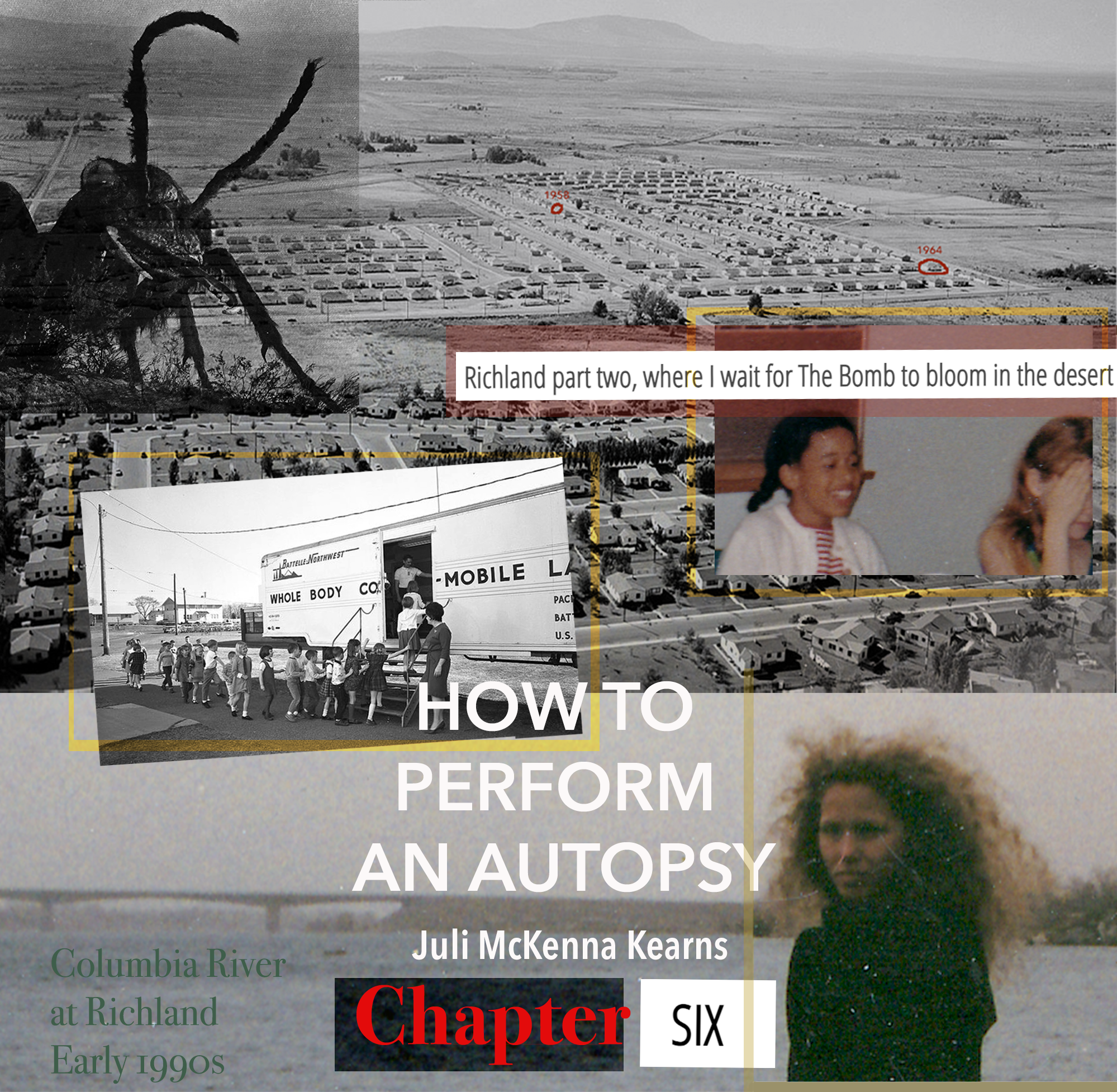
SIX
Richland part two, where I wait for The Bomb to bloom in the desert
1
Paul Bunyan. The giant who isn’t a giant, not the fairy tale grim fee-fi-fo-fum I smell the blood of an Englishman be he alive or be he dead I’ll grind his bones to make my bread type, Paul is a giant because everything was Big on the North American continent, everywhere big, big trees, big mountains, big prairies, big chasms, the Grand Canyon (which is massive and the sky above it ever changing, no photo will ever do it justice), the Great American Desert, landscapes that went on for days wooden wagon wheels rolling into weeks, so much big the ordinary individual was overwhelmed with the vastness of it all, awed by the millions of fierce curly-hair bison that poured over the earth quaking it with the pounding of their hooves, the sun blotted out with the wings of millions of passenger pigeons assailing the sky, where the tallgrass waved tall it was taller than tall. Paul was a natural in this landscape of the seeming eternal in every direction, because the big that was the American continent grew him to naturally fit its expanse. When he wanted water, the Great Lakes were his cup. His hunger may not have been satiated by milk and meat from giant cows and giant eggs from giant chickens, but the availability of human-sized food, crumbs for Paul, was such that he never went hungry because there was an infinite supply of wheat for pancakes and hogs for bacon aplenty and his camp table stretched past the horizon. Tales of Paul Bunyan have been said to have a murky beginning as anecdotes in first Canadian then American lumber camps, but a book by Michael Edmonds, Out of the Northwoods: The Many Lives of Paul Bunyan, asserts the first reliable Bunyan stories are from Tomahawk, Wisconsin, told in the winter of 1885-1886, which was where were located, on land formerly Ojibwe, construction camps for a dam and the railroad, the leading developer being Tomahawk Land and Boom Company, headed by William Bradley who owned fifty-one percent of the Chicago, Milwaukee and Saint Paul railroad, and fifty-nine percent of the Land, Log and Lumber Company. These camps were the origin of the town of Tomahawk, platted in 1887, which had a neighborhood called Frenchtown, as many of the settlers were French speakers from Canada. These tales went on to other lumber camps, were eventually made into stories by Michigan lumberjack turned news editor James MacGillivray, were popularized by William B. Laughed’s PR pamphlets for the Red River Lumber Company of Minnesota and California beginning about 1914, the year of America’s entry into World War I, then were further storied by others. What's peculiar about these tales of Paul Bunyan is that, at root, Paul is not so interesting for his prowess at logging but the connection he grants to the grandeur of the old growth forests—which he cuts down. Which is the irony of Paul Bunyan. In this way he's like the Babylonian heroes Gilgamesh and Enkidu who marveled at the great, ancient cedar forest of Lebanon, the primal forest of the gods, but were determined to fell it
Six - 2
so Gilgamesh could build a great and famous city that would serve as a memorial to him. Gilgamesh represents civilization, a heroically big man, even physically a giant, part divine through his mother yet well within the realm of the human, while Enkidu is the wild man who understands the language of the animals and must be tamed, similar to the Greek Orion, another hairy giant who is also a great hunter and master of beasts as he understands them for he is close to them. Just as Orion is in some myths given as earthborn, Enkidu is a being who materialized out of the very landscape and is in a transitional state from the primal to civilized human. Lured from the wild, like the biblical strongman Sampson he loses his fullest strength by womanly wiles that were not only sexual but represented the peak of civilization’s attractive comforts, not just the sensual but ultimately familial, a woman serving as his initiator to the human community and its obligations of relationship. Enkidu lies with Shamhat, the temple prostitute, for a week, and at the end of this he is considered weakened, no longer pure, the animals run from him, but he has gained reason and understanding, not dissimilar from Eve bringing knowledge to Adam, which is the cause of their being tossed out of the primeval paradise in which Adam was said to have named all creatures. Shamhat clothes Enkidu and teaches him to eat as humans eat and to drink ale. Enkidu never having previously had any companionship with humans, she must also, in that short space of a week, have taught him human language, which highlights how Enkidu’s introduction to civilization takes place during a magical compression of time in respect of his transition from animal wild to human society. Enkidu is being specifically prepared for meeting Gilgamesh, but that first meeting occurs at his own initiative when he learns how Gilgamesh is the first to sleep with all brides, preceding their husbands. Angered by this, by Gilgamesh’s cruelty as a ruler, Enkidu goes to stand in Gilgamesh’s way and proves himself nearly Gilgamesh’s equal in a wrestling match. A close companionship follows, and perhaps this represents the tempering of Gilgamesh’s cruelty as a ruler, perhaps it represents Enkidu’s further assimilation into civilization, but Enkidu becomes a protector of Gilgamesh. Now that the two are teamed, Gilgamesh looks to conquering the forest of the gods. After killing Humbaba, the guardian of the cedars, the pair then slay the great Bull of Heaven, and it's because of this second outrage that one of them must die. The doomed one is, of course, Enkidu, the taming of the wild and the victory of civilization having robbed him of his life force. Paul Bunyan is like these giants, but the North American version strips him of his wild origins, except for his home being the forests, which he tames, chopping them down to make way for civilization. The tales of Paul Bunyan dispense with the death of Enkidu and the great grief that Gilgamesh experiences due this, his demand that all should mourn the death of Enkidu, the ensuing gigantic despair that overwhelms Gilgamesh, that deprives Gilgamesh of any joy in his deeds and drives him to seek out the secret of eternal life, which he gains but promptly loses. Gilgamesh and Enkidu are the first great depressives who discover the futility of doing and conquering as they are unable to defeat death. In Paul Bunyan, we are left only with a giant whose prodigious appetite represents the totality of settlers clearing the land from the Atlantic to the Pacific, and the oxen that helped them represented by Bunyan’s giant of a blue ox helper named Babe. Dispensed with is the need for redemption that comes with Gilgamesh's recognition of the part he played in Enkidu's death. The North American version is a tale half told, for it only appraises with satisfaction the glorious working of Paul Bunyan's axe, and
Six - 3
then rather than Paul dying, cursed by his slaughter of the trees, with his great ox he fades away as modern technology takes his place in a "settled" United States of America. As Paul isn’t permitted to die, but now distanced from humanity by his virtual immortality, he is out there, somewhere, and we used to know he still lived as he was periodically spied by an acquaintance of an acquaintance of a friend of an acquaintance of a complete stranger.
The tale of Paul Bunyan grew over time and forms two Pauls who at first glance are in conflict with one another. The primary Paul is one we see in his nineteenth-century lumberjack garb, heavy boots, trousers, shirt (likely flannel), maybe suspenders, and on his head typically a knitted beanie or a cap of some sort. He belongs to a world subsequent the earliest white colonization of North America, coming after the stories of the Puritans, Pilgrim’s Rock, the Revolutionary War. He doesn’t appear to go below the Mason-Dixon line to clear land that would be worked by slaves, as if the South didn’t have trees, and I don’t believe it’s just that it wasn’t the land of the big trees as to why we don’t find him down there, because the South had tall trees, it was loaded with pines. Even if the tales originally told about him don’t predate the 1880s, the stories do loosely, atmospherically associate him with northern-oriented settlers as they leave the original colonies and begin to confront an interior landscape of America unimaginable on the east coast, which is where the second Paul Bunyan comes in, whose footsteps form the beds for the 10,000 lakes of Minnesota, and who builds the Rocky Mountains. This second Paul Bunyan is in conflict with the first as he is the property of primeval times, and instead of being born big so to tackle the continent with superhuman strength, one can instead think of him as manifesting the continent as white settlers traverse and take occupation of it, which becomes taking ownership of what is reimagined as built for them, for the white Paul Bunyan, having sculpted America’s geographic features, has swept away the Indigenous population and pre-colonialist history. To my knowledge there is no indigenous Paul Bunyan, unless one counts the historical Antoine Barada, whose father was French-American, a fur trapper and interpreter, and whose mother was Omaha Indian. Through her, due his allotment on the Great Nemaha “Half-Breed” Reservation, Barada would settle in Richardson County, Nebraska, where he founded the town of Barada. One of the first stories of his strength I find is published in an 1885 Omaha Evening Bee biography, the year of Antoine Barada’s death, which states that while living in St. Louis as a boy to young adult, he was “employed in various industrial pursuits. During this time he had developed extraordinary muscular powers. Being employed by the firm of Whitnell & Coats as their superintendent for their quarries he had frequent opportunities to prove his wonderful strength. One of his feats was to lift clear eighteen hundred pounds weight. In the year 1832 Antoine returned to his tribe…” Peculiarly, this initial story of his strength, being in 1885, is the same year that Edmonds places the “first reliable Bunyan stories” in Tomahawk, Wisconsin. In other tellings it’s a 1700-pound stone, or a barrel or 1800-pound sack of flour, The Omaha Evening Bee that gives the most detail, placing this occurring while he worked at a quarry, but when I look for the quarry named I find nothing on it, its first appearance may be in this 1885 bio. Tales of his strength reached legendary Paul Bunyan status, such as with the story of his pitching a railroad drop hammer across the Missouri River, the land buckled where it landed, and thus was Barada responsible for creating the Missouri River
Six - 4
Breaks, which wasn’t expected to be taken seriously, but in the manner of Paul Bunyan he was associated with a mythic reorganizing of the land during the time of white settlement. Whereas Paul Bunyan cut timber, the foundation of Antoine’s exploits seems to be his aiding settlers, such as he would help midwestern pioneers construct their barns as he was able to hold the beams in place by himself while they were fastened down. Barada was also a settler, and belonged to Paul Bunyan’s white colonialism world with the distinction of being also Indigenous and assimilated.
A Black counterpart of Paul Bunyan is John Henry, four feet wide and twelve feet tall, whose tale associates him with the building of the railroad and, with his superhuman strength, proving that a man could compete against a machine and win. Unlike Paul Bunyan, after winning against the machine, John Henry died, having given his all to prove himself and the value of his fellow workers. While there may or may not have been a historical individual who preceded the legend, there are a number of ways to interpret the death of the larger-than-life John Henry.
In mid-twentieth century America, Paul left reminders of himself lying about in the form of fiberglass statues, twenty feet tall. In the early 1990s we came across one in St. George, Utah, that had Paul holding a rifle instead of an axe. I took a photo and did a painting of it in 2005, because Paul’s axe replaced with a rifle was mesmerizing, also because a Sinclair gas station sporting a dinosaur was in the background and the juxtaposition of the two seemed fitting, the North American West also populated with fiberglass statues of these near unfathomable yet very real beasts that roamed the earth sixty-five million years ago, now perfect tourist attractions due their big wow factor (and while their fossils aren’t given as discovered by science until 1819, by William Buckland, I wonder if long ago their fossilized bones and footprints contributed to the myths of dragons). Though the tales of Paul Bunyan in school were part of our folklore education, intended to connect us with our American past, they were only related in part to the bigness of America, Paul Bunyan was instead about the bigness of Christian-European determination to occupy that bigness, though no one called it occupation, instead it was all land improvements, a giant real estate venture that strapped itself to mystical visions of divine right, Paul’s clearing of the land a sacred stealth authorization making treaties with Indigenous nations null and void. For schoolchildren it was an ad campaign to clear the consciences of the sons and daughters of Manifest Destiny, not that I felt any guilt when in elementary school, as far as I was aware I was a native-born American as I had entered into this world in a hospital in Lawrence, Kansas. The various countries from which my ancestors originated wouldn’t want me turning up on their doorstep, I didn’t belong to them. I was American. The ad campaign was to help reinforce for us, as we grew into adults, how America rightfully belonged to those for whom the mythical Paul Bunyan cleared the land, because at least in some areas of the country a fine degree of tension and anxiety lingered as to what was rightfully the possession of White America, and the Civil Rights Movement was making people nervous with what might be expected of White America, not just what might be owed African-Americans, but American Indians. The Wounded Knee Occupation didn’t happen until the winter of 1973 but I’m in the living room of my father’s parents in Missouri, it’s night, the light is dim in the dining room and the manner in which unrest is being talked about flicks on my
Six - 5
understanding that white America is confident nothing will come of it, but I also know this adamant assurance, the tension reposed in it, means an inherent nervousness that the system in place may look secure but we’re actually not that far removed from the fragility of a colonial frontier mentality. I’m listening to a conversation that couldn’t have occurred later than the summer of 1972, for though I was in Missouri visiting my father’s parents in the summer of 1973 the rest of my family wasn’t, I couldn’t have been listening to my father and grandparents conversing in the summer of 1972 on events that occurred in 1973, so it seems the Wounded Knee Occupation, in the layer cake of years, was compressed with an earlier conversation, this memory would be a blend of a conversation that I had with my grandparents in the summer of 1973 with one between my father and grandparents in 1972, perhaps a simple awareness of American Indian unrest, the occupation of Alcatraz having ended a year earlier in 1971. I distinctly remember talking about the Wounded Knee Occupation with my grandparents. The point is that in White fragility is fear of a wheel turning and those who are at top being displaced, and at the time I thought of it in terms of colonialism, capitalism and money. What always mattered was who had the money and the will to retain wealth.
Paul Bunyan’s razing of timber would have been called “improvements” in the nineteenth century. Construction and the transformation of raw materials into something else, what use of natural resources settlers made on their land was qualified as an “improvement”, which is a wide open window on the mindset by which they came by their land and by which some, not all, kept it. With the establishment, in 1872, of Yellowstone as the first national park, America began to be taught by some conservationists that maybe not everything needed to be improved upon, there were places that needed to be left just fine as they were. The concept of the national park is said to have been pioneered by George Catlin, during a trip into the Dakotas in 1832, an artist-author-traveler-lawyer who made hundreds of paintings of the American West and its Indigenous populations, portraits that are startling in their capture of personality in contrast to the flat Europeanized representations of North America’s Indigenous that were previously typical. Catlin took these portraits and his collection of American Indian artifacts on an exhibition tour in America and Europe. He toured Europe as well with Ojibwe Indians, then fourteen individuals from the Ioway tribe in 1844 and 1845, the time of the first telegraphed message, made by Samuel Morse from Washington, D.C., to Baltimore. The journey of the Ioway through the royal courts and cities of Europe is a subject that would make a great movie but not of the Hollywood type that makes a supposed improvement on the raw material by converting it into historical romance designed for contemporary satisfaction, with make-up and clothing incorporating twenty-first century tastes so that the viewer may find characters appealing and not have to walk across the street to meet the past on its own terms. If there are criticisms to be made of Catlin’s traveling exhibition, White society was also on review by the Ioway who were appalled by the poverty and degradations suffered by whites in their own cities that were supposed to be the pinnacles of civilization, “hundreds and thousands of poor and hungry people…hundreds of little children with their naked feet in the snow, and we pity them…” Their opinion was that the missionaries should stay home and help their own, besides which the Ioway held they had their own Great Spirit who required them to speak the
Six - 6
truth, feed the poor and love their friends. “We don’t know of anything more that he demands: he may demand more of white people, but we don’t know about that—” They also believed that the Great Spirit hadn’t “made us to live with Pale faces in this world, and we think he has intended we should live separate in the world to come”, which sounds separatist (and is), but it’s to be considered that wherever Pale Faces appeared they pushed American Indians off their land, taking everything they had, attempting to abolish their ways and religion. The statement highlights how different Indigenous cultures were from European, it is a response to the Anglo-American determination to make everyone culturally white Christians. How could an Indigenous concept of a Great Spirit and the afterlife square and abide with the God of the Christians and Christian colonialism?
The notion of everything being but plastic for the magic of imagination making physical craft was part of Christianity’s idea of all that was, is, and would be having been designed for the livelihood, the benefit, the salvation of man, for him to do with it all as he willed and would. Without man, relevance was absent. Without man, even deity was irrelevant.
The gods, in the Gilgamesh epic, are so intimately identified with the divine forest that Gilgamesh’s determination to defeat its guardians and take the trees for the construction of his memorial city is to not only lay waste to the primeval but to raise himself above not only all men but the gods. Gilgamesh dies, as he must. When his tale was first told he was already so ancient he belonged to the beyond times. And his city perished as well, the one that was to be his monument. But his story remains.
We all have numerous mind boxes with magic passwords that open them to associated ideas, facts, images real and imaginary, at least I find it fun to think of internalized collections of knowledge in this manner. Myths and legends can operate as special magnets forming collations of immediately reasonable as well as seeming tangential and disparate ideas that are reorganized to form what are highly personal avenues in pursuit of meaning. The contents of these boxes reside not just in one part of the brain but in multiple areas, each our own multiple magic passwords arousing and bringing together that knowledge and previous explorations for review, which automatically adds pathways of fresh introspection. Myths and legends may rely on virtually no facts, they are stories formed in such a way that they act as gates for ideas, behaving much as riddles. They can attract good knowledge as well as the ill-formed in personal and communal strivings to explore and contend with their puzzles, thus they require re-evaluation and weeding out as better knowledge is added, which also opens opportunities for understanding and coming to terms with bad knowledge, such as that which engenders the -isms such as racism and sexism. We each have too many treasured such mind boxes to recount, the mythic and folkloric bringing together the ancient with the here and now in our struggle to comprehend our manifestation within this universe and how we are expressive of it and how we shape it.
In my mind’s eye, the universe stretches on as a thick unending forest of cedar trees, and as we make our way into comprehending the incomprehensible the trees are felled, yet though they are felled they still stretch on into infinity.
Six - 7
2
A branch of the McKenneys, my father’s father’s father’s father’s father’s line (in the realm of the great-great-greats), that went on from Iowa to Minnesota, then eventually to the Oregon coast in the early 1880s, included a daughter of a first cousin of my great-great-grandfather Mck, a girl named Nona who would grow up to become a local historian with articles published in several Oregon papers. She wrote a brief memoir in which she described how, as a youth, she’d witnessed the conservation ethics of the Indigenous tribes of the Alsea Bay area, while whites instead recklessly wasted the wealth of resources of their new Oregon home, abusing them to the point of extinction. Among others, George Catlin had written of how all parts of the bison were used by the indigenous peoples. My Oregon relative, who chronicled how indigenous children were her earliest playmates, and had learned the language of the Alsea tribe (I don’t know how much and don’t want to overstate her knowledge, enough for communicating with playmates), in 1959 described how no indigenous person killed an elk to consume just a hind quarter or two and leave the rest to rot, that the indigenous didn’t catch or kill more than they could use. I imagine that when she was writing, she thought of herself as writing for a white audience, that it would be whites who would read her. And I’m not sure how appreciative Oregonians would be to have a daughter of white settlers accusing them and their pioneer forebears of ravaging greed, just as whites took Caitlin to task for an appreciation of the “savage” over the white settler a century earlier. During her life she had been a school teacher and postmaster, was considered an authority on the ships and schooners of the Yaquina, Alsea, and Siuslaw ports, and something of an eccentric due her rapport with deer and rabbits and red-billed black birds and seagulls that daily visited her cabin for food.
Speaking of Paul Bunyan and logging, Nona’s cousin, Alden, a bucker in a logging camp, which means he would cut a felled tree into manageable logs, died in 1936, in Wahkiakum County, Washington, from his chest being crushed while leveling a log. Nona had another McKenney cousin who was adopted into her family after his father was murdered. This cousin, Samuel, was a half-brother of Alden. While working as a ferry operator, in 1913, Samuel would accidentally drown in Alsea Bay while transporting a party from Walport to Bay View. Two years after his widow remarried, Samuel’s son, Clifford, was working with his stepfather cutting timber when, at the age of seventeen, in 1921, he was killed when struck by a tree they were felling. One 17 February 1921 news report states he was instantly killed at 11:30 in the morning, his head crushed, and that the stepfather had been in the act of felling the tree when Clifford suddenly approached from the direction in which it was falling. Doctor A. G. Brill was summoned but was unable to do anything as Clifford’s death had been instantaneous, and in his coroner’s report (sitting right here before me) he states that Clifford had died at 11:30 a.m. of a hemorrhage due his skull having been fractured on the left side. A news item from February twenty-third again gives Clifford as killed at 11:30 a.m. He was with his stepfather in the timber and had suddenly approached from the direction in which the tree was falling and his skull was crushed causing instantaneous death. Clifford’s mother and stepfather later attempted to collect
Six - 8
compensation on his death from the state accident commission, and a 1923 news article on the event instead relates Clifford was struck by “fragments of the tree” and “it was some hours later before he was discovered in an unconscious condition.” And, damn it, I wish history would just sit still sometimes and stay true to one story instead of dramatically changing course and coughing up entirely different versions because in this case I get paranoid for Clifford when his death may have been very well above board and there was nothing funky about it, because logging was dangerous. I read that logging is now the deadliest industry in the United States, but I don’t know about hundred years ago or if what is deadliest takes into account jobs that kill one over time with their deleterious, accumulative health effects rather than by a traumatic accident. The danger of logging taken into consideration, there remains a considerable difference between a person described as being found unconscious some long hours after being hit by a tree, and a person described as coming up suddenly while his stepfather was felling a tree and inexplicably putting himself in the way of harm so he was struck and instantly died. Of course I become suspicious.
This family always brings to my mind Ken Kesey’s Sometimes A Great Notion and the horrors of logging described in that remarkable novel. On the other hand, my husband’s mother’s forebears were logging in Louisiana and there’s not a report of any one of them injured. Maybe the forests of Oregon and Washington were more dangerous. Yes it, was. I look it up and because of the terrain and massive old-growth timber, it was more dangerous. In the early twentieth-century, 1 in 150 loggers in Washington died annually. Sometimes these families seem determined to die either by tree or the ocean overwhelming them in their boats. Disaster by tree or by water. Kesey combines the two and has Joe Ben Stamper trapped by a log in a shallow river in which the water is rapidly rising.
Clifford’s mother and stepfather didn’t receive compensation and, in 1930, Clifford’s three siblings, two young men of twenty-four and twenty-one, and a sister of sixteen, were all living instead with an aunt and uncle and their son and daughter, rather than with their mother and stepfather, who now had another young son aged six. The uncle worked in a logging camp while the two male siblings worked in a sawmill.
Alive when Samuel then Clifford then Alden died, I am supposing my great-great-grandfather McKenney would have known about these McKenneys who landed in the far west, part of his uncle’s family, but separated family systems lose touch and eventually one’s root ancestor is a lone body that one day materialized out of the landscape and now there you are.
This branch of the family that went from Iowa to Minnesota and then to Oregon in 1883, unlike some members of another branch of our family who were pioneers on the Oregon Trail, had the convenience of the railroad that took them from Minneapolis down through Iowa to Kansas City, across Kansas and into Colorado where they saw Pike’s Peak, down into New Mexico all the way to the Rio Grande, then to Los Angeles and up to San Francisco where they caught a boat to Portland, Oregon. From there they went by train to Beaverton, Oregon, where they waited some time while finding and securing land, and were also waiting for their furniture and pump organ that
Six - 9
were transported by ship around the Cape of South America, having traveled down the Mississippi to the Gulf from Minnesota. After nearly two months in Beaverton, the waiting was over and the family continued south to their new home in Alsea Bay.
They were a family that enjoyed music, having both a “fiddle” and the pump organ that went all the way around Cape Horn to reach Oregon. I know all this because Nona’s mother, Alice, kept a travel journal, and a distant relative from that McKenney line and I connected online over two decades ago, we both at the beginning stage of trying to find out about our McKs. His branch of the family had kept up with those in Oregon, and he had Nona’s memoir, Alice’s journal, and an unpublished freethought novel written by his ancestor, Samuel Bartow McKenney Sr., who was murdered in 1881 in Louisiana, two years before the family of Samuel’s sister Alice traveled to Oregon. Her journal covered their departure from Minnesota to their settling in Alsea Bay, and recorded in it that when their organ arrived from its long ocean voyage, six-year-old Nona began again her practicing, so when they had visitors a couple of weeks later she could play “Jesus, Lover of my Soul” and “Old Aunt Rhodie” without any mistakes, which must have been a source of some pride for this to have been recorded.
Go tell Aunt Rhodie, the old gray goose is dead from standing on its head in the mill pond.
In school, in Washington State, we were taught about Paul Bunyan, and we were taught the lyrics of folk songs that had to do with the mysterious pasts, sensibilities and entertainments of people who, despite all the pioneer and western television shows and movies, were almost unimaginable to me at the time, perhaps because my family had severed all its roads to the past and my parents had no interest. When young, I knew nothing about any ancestors, I certainly knew nothing about Nona who had played “Old Aunt Rhodie” on the organ, and who had published articles on her pioneer experiences in Oregon, dying in 1963 at the age of eighty-three. We learned ”Billy Boy”, a song collected by Raph Vaughan Williams and published in 1932 in Novello’s School Songs. “Where have you been, Billy Boy, Billy Boy? Oh, where have you been, charming Billy? I have been to seek a wife, she’s the joy of my life. She’s a young thing and cannot leave her mother. Can she bake a cherry pie, Billy Boy, Billy Boy?” Where have you been? Rather than the song being about a man seeking a desirable companion to clean and cook and make a home for him, comically ending with her being quite old, what I heard in “Where have you been?” was the lament of family that parted and those who went away were from then on lost to those who had stayed behind, not dead but in a liminal place, a veiled other world. We were taught, “My Darling Clementine”, which somehow someway had something to do with the California gold rush, but even if (as I now read) the melody came from a Spanish song popular among Mexican 49ers, the Clementine lyrics weren’t attached until 1884, long past 49er days, and as a child I’d no idea what it had to do with the gold rush though the song mocked Clementine, the daughter of a miner, who had feet too big for shoes and was killed by falling in the river and drowning as she couldn’t swim nor could the one who was remembering her in their song swim, thus she died. “Romance del Conde Olinos” is supposed to have served as inspiration, I’ve listened to a version as performed by the Dominican ethnomusicologist and musician, Joaquin Diaz, and it is
Six - 10
beautiful, a ballad that wants tears, but I don’t know how it served as inspiration, I hear no resemblance melodically. The song’s a peculiar, sad one that relates the story of a count who takes his horse to drink at the seashore (that makes no sense, one wouldn’t give a horse salty ocean water to drink), and sings for protection, that the horse will be delivered from evil by God, from the winds of the earth and the furies of the sea, the queen hears the song and confusing his voice with that of a mermaid she calls to her daughter to listen, the princess says it is instead Count Olinos singing for her, and the queen has him killed and his body thrown into the waves for his status is below that of the princess and they can’t be allowed to marry. We weren’t taught such love songs or poignant songs. We weren’t taught that Spanish was the official administrative language in California until 1848 and California was part of New Spain until 1821 then was part of Mexico until the Mexican-American War and the U.S. Conquest of California. We were taught, “She’ll Be Coming Around the Mountain When She Comes”, which was highly visual for me, a woman careening around the mountain in a wagon with six white horses. Why was she racing so dangerously I wondered, but the song was as exciting as it got for women in folk songs and in that way was fun for imagining this woman commanding control over what was potential chaos. Unaware it was from a Christian spiritual and has to do with the second coming of Christ, or that it might instead have been an African-American anthem for the Underground Railroad, I believed it too had somehow to do with the gold rush and for some reason I thought of it as a coda for “My Darling Clementine”. Maybe the teacher followed “She’ll Be Coming Around the Mountain When She Comes” with “My Darling Clementine”. We had not much context other than these were folk songs of yore and that our ancestors certainly sang them, and now you too will do singalongs of silly songs with nonsense lyrics and you will feel very American together and in touch with the hee-haw hoe-down gumption of your persevering settler ancestors who had the raw strength to pull themselves out of malaria and typhoid doldrums for a good fiddle-led barn dance. I believe we sang “Little Brown Jug” but I remember nothing about the jug holding gin or rum, for all I was aware they were drinking apple cider. Were we taught a version cleaned up for school? We sang the Civil War era tune, “When Johnny Comes Marching Home Again”, which offers no recognition to those who did not come marching home, and for years I thought it had to do with World War I as at that point of our schooling in the northwest we kind of ignored the Civil War, but my spouse who was in elementary school in Mississippi says he too thought the song had to do with World War I. We were taught Washington State history in Washington and went straight from Lewis and Clark to the Marcus Whitman massacre of 1847, a small band of Cayuse Indians killing the missionary and his wife and eleven others at the Whitman Mission near Walla Walla, about an hour south of Richland, that was a big deal for us because consequence of it the Oregon Territory was declared in order to protect white settlers from all those proprietary Indians who thought they could stop the white god’s dream of Manifest Destiny, and now we were white people who lived in Washington State. Of course there were a lot of falsehoods in the official story we were taught and in acknowledgement of this the Marcus Whitman statue that was installed in the National Statuary Hall in Washington, D.C., in 1953 will be replaced with a statue of tribal rights activist Billy Frank, Jr., a member of the Nisqually tribe. We were taught “America the Beautiful”, which seemed a better anthem than “The Star Spangled Banner” but there was too
Six - 11
much jumping around the scale so that though the lyrics of the first verse were appealing to me with big skies, purple mountains and amber waves of grain, musically it was nearly as catastrophic as “The Star Spangled Banner”. We were taught Woody Guthrie’s “This Land is Your Land”, which was written in response to Irvin Berlin’s “God Bless America”, Berlin’s tune being yet another that athletically bounds all over the scale for sake of a patriotic high, but weren’t privy to the history, of course, that Guthrie’s was a protest song and his complaint about what America wasn’t, that it wasn’t actually “for you and me” and should be, how America was only for some people, but even when young one could hear protest in it, that it was different, that it cared and wanted one to feel like they belonged.
Returning for a moment to “Romance del Conde Olinos”, I continue searching and find and listen to other renditions, including yet another sung by Joaquin Diaz, and they are certainly the same melody as “My Darling Clementine”, which makes one wonder over the process by which the ballad was transformed into the mocking jab at the girl with big feet that would be taught as an American folksong to schoolchildren at their streamlined mid-century modern school desks. I find that Percy Montrose’s “Oh, My Darling Clementine” first appears for sale as “new music” in 1884, one of nine new pieces that had been issued by Oliver Ditson & Co. (often given as Oliver Dotson), the others being “Kissing-time”, “The Nightingale and Rose”, Thousand Island March”, “O, Love Divine”, “Jesus, This Heart”, “Everything We Love and Cherish”, “Near Us, Ever Near Us”, and “Joys of Day Are Over”. “Oh, My Darling Clementine” was being sold for thirty cents. After glancing about, I’m not convinced that Percy Montrose (sometimes Montross) wasn’t a pen name and that we don’t know who the author was. Perhaps the author didn’t want to be known if the material was not up to what they considered their standard, but it was popular.
“The Romance of Count Olinos” is related to “The Romance of Count Arnoldos”, in which Count Arnoldos goes out hunting on St. John’s Day, by the sea, where he is confronted by a ship commanded by a sailor whose song makes the seas calm, invites birds to its mast, and rouses the fish to the surface of the waters. Count Arnoldos pleads to be taught the song, to which the sailor replies, “I only tell this song to those who come with me.”
How could I have neglected to mention that we also learned “Home on the Range”, which was dreamed up in Kansas in the 1870s, but we only ever sang the first two verses and choruses, never getting to the third verse about the “Red Man” being pressed from his home to never return to the banks of the Red River.
In Seattle we were taught “Frère Jacques”, the French round about the monk who has overslept and not rung the bell for morning prayers, and as I comprehended him from the beginning as being late for ringing the bells, this means I must have first learned the French version and its meaning because the English lyrics suggest that Brother John has overslept as he is still in bed while the morning bells are ringing. I don’t even know why I’m mentioning a French tune except that it had a tangled history beginning in the eighteenth century and yet managed to become essential knowledge for American schoolchildren. Did the famed Baroque composer Jean-Philippe Rameau originate the tune? The song was first published in 1860 and became wildly popular
Six - 12
internationally. It’s a strangely exhausting but intriguing business considering the odd ends of European civilization and American colonialism, the nonsense rhymes, Mother Goose, the fairy tales and songs that were gathered together and preserved for posterity in the eighteenth and nineteenth centuries, which became crucial knowledge for children in Washington State and in most American schools. The sluice that served as their pipeline didn’t materialize out of nowhere and that’s nearly as interesting as the origins of the materials that sluice selected to feed us. As we grew older we were graduated up to the myths that obviously were source to some of the fairy tales, and works that had definite authors, people who had birth and death dates and biographies.
In Washington as part of our elementary schooling we were taught about our state so we would know whereof we lived and how it sustained us, its picturesque geography, how we bordered the different country of Canada that strangely separated us from more of the United States up in Alaska, our complicity with Idaho and Oregon forming the Pacific Northwest, about the Indigenous peoples who preceded us and lived in ways alien to settlers but the indigenous ways were normal to the indigenous but not all indigenous were the same because they made up different tribes, different nations, we learned how the explorers Lewis and Clark of the Corps of Discovery with Sacajawea as guide went down the broad Columbia River, we watched educational movies on the growing of ruby red beets in the fertile fields of Washington, its apple orchards and vineyards, educational films on Indigenous people fishing for salmon as they valiantly swam up the Columbia (something something about dams) to reach the spawning grounds where they would die, and we watched movies on logging, an industry that had a certain mystique built around it by virtue of the great trees that populated the Cascade mountain range that housed our very own white-capped volcano Mount Rainier. Logging was no longer the booming industry that employed sixty-three percent of Washingtonians in some capacity in 1910, but peaked in 1926 with the harvest of 7.6 billion feet of board, which is the year the Great Northern Lumber Company closed in Chelan County, Washington, for whom my mother's father worked and where he had partly grown up, his family having come to Washington by way of his father being a telegrapher and station agent for the railroad that placed them in logging areas such as the Boundary Precinct in Bonner County, Idaho, way up near the Canadian border, deep in the sticks, where I find in the newspapers that his father had owned the Oconook Trading Company in Porthill, Idaho, dealing in general merchandise, hardware, flour, feed, agricultural implements, agents for marine and stationary engines, the post office located in their store, “If we have not got it we will get it for you.” And though my mother's father had grown up in the Pacific Northwest, and still had family out there when I was growing up in Washington State, I didn't know anything about this when I was in Washington, because my mother grew up in Glen Ridge, New Jersey, and Cleveland Heights, Ohio and Wheaton, and Chicago, Illinois, and for all intents and purposes they had no history.
My family did have one image from my maternal grandfather’s youth, made when he was about four to six years of age, so perhaps in Porthill, Idaho, which wasn’t much more than a crossroads below the border crossing. There were other photos of his family that I once glimpsed when visiting my mother's parents but wasn't permitted
Six - 13
to look at them. However, I'd seen enough of one to know it was in Idaho, like a group photo of a number of people with a shop or two in the background. Since I wasn’t permitted to look at it I got the impression that my family must have been one of the poorer ones of the group and they were ashamed of that, when instead my grandfather’s father purchased the Barnes General Store in 1909 (Major Joseph Barnes was U.S. Inspector of customs in 1893, then became the postmaster at Ockonook), which must have become the Oconook Trading Company store (that’s how the McClures spelled it, Oconook not Ockonook) that was incorporated by my grandfather’s mother and his wife and eldest son in 1911 with $10,000 in capital. And they installed a high-power wireless telegram plant. That would be about $357,000 or more today. Where’d they get the money? The stock was assigned in 1913 to J. B. Campbell, trustee for the Spokane Merchants Association, which was about the time they moved to Culbertson, Montana, and soon thereafter to Chelan, Washington. Who were these people who were able to incorporate that trading company in 1911, where did they get that money, and why do I not know anything about them? Oh, that’s right, my grandparents refused to talk about his family.
Ockonook had been first established as a trading post by a son of the governor of the Hudson’s Bay Company, David McLaughlin, settling there with his Kootenai wife, Annie Grizzly, in 1866. Settlers began arriving in the 1890s (so I read) and in the early 1900s it was the second largest community in the county, which I don’t think is saying much. I know from reading up on the history of the area that logging had played out there about the time my family left, the loggers had felled all the logs that could be felled. I guess it was time to move on, but my grandfather’s father was also working for the Great Northern Railway. I’ve no idea how they were working for the Great Northern Railway and opening their own trading post.
What was I going to say before I learned about the store? Right, I have one photo of my mother’s father taken when he was about four to six years of age. He is dressed in a child’s frontiersman costume. It’s not leather, it’s cloth. His pants are fringed down the outer side seams, he’s got a pistol in a front pocket, a big knife on his belt, and is holding a rifle, the muzzle clasped against his chest with both of his little hands, the rifle coming up to his shoulder, the butt end of it resting on the floor. He’s weari a cap that has nothing to do with being a frontiersman, more like a little mariner’s cap, and he looks positively human here, smiling a restrained happy smile that appears half-embarrassed with or awed by the grandeur of a dream come true, that he’s now a frontiersman. He’s actually a really cute kid in whom I can see a bit of my youngest brother. That’s a little confusing that he was a cute kid.
As he had no use for granddaughters and was quick to toxic explosions of temper on any and every subject, my mother’s father and I were never on any kind of conversational basis, but in the vain hope of accruing some family history, when I was a young teen I did try to invite him once to relate any stories from his youth. Somehow I had learned he had worked for a logging company, which to me meant being a lumberjack. So I asked him about that, and his response was to become red-faced upset and scold that he didn't know where I ever got that idea, he'd not been a logger, he was an accountant for a logging company, he didn't know why I would be interested but if I wanted a story loggers used nitroglycerine and would carry it in
Six - 14
their wagons up the mountains, his father had seen a logging wagon blow up when it hit a bump, there was nothing left of it, no trace of the wagon or men, they had vaporized and all that remained was a crater in the mountain road. This wasn't intended to be an educational story. It was told to horrify, the purpose being to shut down the conversation, which it did, because it was a vivid scene of men and horses reduced to blood mist and I was left to digest how at any moment we could poof just disappear. My grandfather never talked about his work, which may have had to do with the fact he something something was out of work for years in the 1950s because of something something embezzlement concerning the big company he had worked for something something don't talk about it but he didn't do it something something but he couldn't get work for years because he something something took the fall so there was no legal action something something mumble mumble. I’ve already gone into all this, and there’s probably nothing to be suspicious about.
Even then, I understood my interest in the loggers wasn't due their jobs, the felling of trees, but for their intimacy with the forest, for their connection to the trees. It was the trees that were magnetic, which seemed like great ghosts to me. I didn’t want my grandfather to have been an accountant, tied to a desk, adding and subtracting numbers. I wanted him to have worked in old growth forest where the trees had impressed something of their ancient lives upon him, the great antiquity that Alfred Hitchcock conjures in Vertigo when Scottie takes Madeleine to the redwood forest in his strange attempt to connect with the spirit of Carlotta, her ancestress, which he both believes yet doesn’t believe has possessed her. Though he scoffs when Madeleine insists she is Carlotta, the possible co-existence of the two forming Madeleine-Carlotta holds for him the promise of eternal life, that the spirit survives.
Washington State isn’t huge but its landscape is hugely varied and when I was seven I was transferred back from the Washington State of the Puget Sound, from an area of forests crowned with Mount Rainier, to the semi-arid desert over which Rattlesnake Mountain stood watch, the tallest treeless mountain in the continental Americas, pristine steppe grassland that receives less rain than Phoenix, Arizona. We were not led to believe, at least, that Paul Bunyan cleared the steppe land. We were taught about the clouds dropping almost all their rain on the western side of the Cascade Mountains, and how we were in a rain shadow that created our semi-arid desert conditions. Living in a rain shadow seemed a very dynamic way of describing it and made an impression on me.
Olinos. Days after writing of Conde del Olinos, I dream of a mysterious person I’ve injected in this manuscript, it’s a lucid dream in which I am looking at other material on them, an old newspaper clipping from the nineteenth century is an engraving of their face. Olinos, their name is Olinos. In the lucid dream I’ve forgotten about the song “Conde del Olinos”, there is just the name and their presence becomes so overwhelming I wonder if they belong in the manuscript at all, if the story of them hijacks it. I am so bothered by the name, which will not leave me, no matter how I try to put it aside, that I pull myself awake.
Six - 15
3
The newspapers report that the December before Christmas of 1964 was laden with snow and dipping into sub-zero temperatures. In Pasco, at the Fourth Street Mall between Lewis and Columbia (I guess what is now Mercado Peanuts Park), it was Christmas Land with free rides for the children one could choose between a “live Shetland pony ride”, an airplane rocket ride, a merry-go-round ride, or even all of them, tickets available from Pasco merchants: the Bonanza 88 Cent Store, Carl’s Apparel, Crescent Drug Stores, Carl’s Shoes, Dunning-Ray Insurance, Ells shoes, Goddard’s, Flower Basket, Stromme Motors, Mode-O-Day, Verns Shoes, Pasco Buffet, Pasco Thrifty Drug, Verns Shoes, Grigg’s Self Service, Pasco Clothing, Pasco Lucky Dollar, Payless Drug Store, J. C. Penney’s, Sears Roebuck & Co., Shields Stationery, Top Hat Cafe, Wade’s Clothing, Weisfield’s, F. W. Woolworth, Young’s of Pasco, Montgomery Ward, Davids Shoes, a Ford dealership, Osborne Chevrolet, Lad & Lassie Shop, and the Sherwin-Williams Co. There was a Santa in a special Santa trailer (meaning not affiliated with any one store, the trailer was a protective environment against the elements), and a photographer on hand for Santa photos. Christmas Land promised not only an ordinary display of Christmas lights, but a light show. The advertising promised, “Beginning high in the sky with the bright, colorful neon changing sign depicting Christmas scenes to the base of the lovely tree, Pasco’s Christmas Mall is truly Christmas land for young and old…Be sure to have your child’s photo taken in full color with Santa Claus in Santa’s trailer parked under the neon sign. Come to Pasco. Pasco offers more of everything to everyone!”
The statement that it was a “live” Shetland pony ride might suppose one to believe they wanted the public to know it wouldn’t be a wooden or fiberglass pony, but this may have also been an assurance it wouldn’t be moth-eaten taxidermy.
Pasco was where we sometimes went for things not to be found in Richland, like a Sears Roebuck store. There were people who refused to step foot at all in Richland because of how Hanford Works had thrown everyone out of the old Richland (population 247 in 1940) and then built it back as a government town (population 21,809 in 1950). At the time, though Richland had more people than Pasco and though Richland had six years earlier incorporated as a “first-class city”, Pasco was the real city-town with the train station, Tri-Cities Airport, and such popular stores as Sears Roebuck and J. C. Penney’s and Montgomery Ward. Though Richland was again a real town it bore the stamp of a government town, super-organized almost like a military hamlet. Many things were to be found in Pasco that weren’t in Richland, such as houses and businesses that had been built before the mid-1940s, because it hadn’t been ripped out and reformatted as a government town, it wasn’t all brand new, people were in Pasco and Kennewick whose families had been there for decades, tradespeople of all different kinds, people who had been operating their own shops for years, not everyone’s father worked out at Hanford. Richland was almost all young families and Pasco had older people and people who hadn’t been shipped in to work at Hanford. It had people whose lives didn’t revolve around plutonium.
Six - 15
The year of our return to Richland, how my family was broken and how I was broken seemed to me to become evident in photos, though I couldn’t analyze them, I only knew that I didn’t like looking at them, my erratic hair had become even more erratic, chopped haphazardly short, in my second grade class photo my bangs zigzag high across my forehead, wildly uneven. I may be smiling in the class photo (not a group photo, an individual shot) and a couple taken of me at Christmas but when I was eight years of age and looked at them I scarcely recognized myself and felt great roaming blobs of dark all around the me I didn’t recognize in the photos as being me and who felt like a lowest of the low garbage human. I didn’t like to think about her or connect with her. Shredded bangs were not a fashion statement, they signaled someone wasn’t paying attention or they didn’t care. My dress the day of the class photo shoot was the same short-sleeve brown dress with a white Peter Pan collar that I had worn for our single professional Santa photo taken in a Seattle store when I was six.
The Seattle department store where we didn’t have that Christmas photo taken, Frederick & Nelson, has recently received the proposed distinction as being the store that pioneered the industry of photographs taken of children with Santa, but there are a few photos to be found on the internet, from the very early 1900s, that show children sitting on the back of a dead, stuffed mule having their picture taken with Santa against painted landscapes with snow-frosted trees, which are distressing as the photos document the wear upon the mule that becomes eventually a sad relic, and Santa frequently looks so deranged and disheveled as to be confused with Krampus. A 1919 ad in the Chicago Tribune calls for parents to bring their children down to have their photo taken with Santa Claus in Toyland, which would have placed children in proximity of the many toys for which they could wish at The Fair, established 1875 by E. J. Lehmann, at State, Adams, and Dearborn Streets in Chicago. What do most children want for Christmas? All they can so tantalizingly see on display! A 1914 ad in the Washington, D.C., Evening Star promises photos with Santa and his pony, six for fifty cents, in the Toyland Annex. A 1916 ad in the Fall River Globe advertises six for fifty cents photos with Santa in his sleigh in R. A. McWhirr Company’s basement. Brooklyn’s The Standard Union in 1913 has an A.I. Namm & Son store ad for children’s photos taken with Santa in his workshop for twenty-five cents, finished while you wait. So the 2022 report on the website My Northwest seems not very well researched when it states that in 1943 “snapping a photo of the visit to St. Nick and selling it to mom or dad, was something new. And it might have been Seattle where it happened first.” They do say “might” and later add that it may have been “similar to other operations elsewhere”, but they stress Art French photographing Santa was profiled in Time magazine in 1946, though Time didn’t mention the photos were taken at the Frederick and Nelson department store. The article on the website further added, “While there’s no official certification that French and Frederick & Nelson were the first anywhere to offer Santa photos to customers, no other city claims the honor, and…there’s evidence to support the story,” the evidence presented being that the oldest of companies currently taking Santa photos, competing against Art French’s successor studio, only date back to 1961 in their claims to in-store Santa with kids photography.
My brother and I weren’t privileged to be pictured at the Frederick & Nelson store, which did have a great Santa photo set-up, that can’t be denied, I’ve seen decades of
Six - 16
photos of children on Santa’s lap at Frederick & Nelson and those kids tend to look happy, not terrorized, the captures of a quality for proud display on a Christmas hearth decorated with holly and red candles in brass candlesticks or for sending out with the Christmas card or Christmas email. In our Seattle Santa photo, my brother and I instead are sitting on the lap of what looks like a bargain basement Santa, his beard obviously fake, his eyes barely able to focus in a way that indicates he probably is smelling strongly of alcoholic spirits. The Frederick & Nelson Santa pays attention to details like wearing white gloves while our Santa doesn’t and the watch on his wrist is clearly on display revealing it was about 3:15 p.m. while I instead remember the photo taken at night, we were the last in line and I was filled with anxiety over my parents always doing things at the last minute by which time everyone was stressed and exhausted and all Santa and his elf wanted was to get out of there. I assume that last-minute Santa trip was another year in Seattle and no Christmas photo was even purchased. In this single Seattle Santa photo that I have, which does display a nice large evergreen tree to the side, decorated with pine cones and a frosting of spray-on snow, me seated on Santa’s right leg and my brother sliding off Santa’s left leg, ready to escape, the number card that identifies which portrait sitting we are is very prominently displayed to my side, which would not happen with a Frederick & Nelson Santa, and if it’s to be believed this is how many sittings there have been then we are number number 12,626. How is that even possible? The Children’s Museum of Richmond, Virginia, gives their Santa as seeing 25,000 children a year. Another website claims a store Santa may sit with sixty children an hour. I guess our store Santa very possibly had 12,625 sittings before us.
Now I am seven and we are back in Richland, there’s been a lot of snow, and rather than taking us to have our photos shot with the Santa at Pasco’s Christmas Mall, we were taken somewhere else in Pasco that didn’t have rides and lights and other Christmas attractions and rather than having a professional portrait we are haphazardly pictured a couple of times with Santa by my parents’ Kodak Instamatic, half in the photo frame and half out of it, a person’s sleeve intruding between the camera and us in one shot, which is the second and last photo session with Santa we ever had. I didn’t believe in Santa so that part didn’t matter to me, and I was embarrassed at that age to go through the ordeal of making believe, uncomfortable to be physically in contact with the man playing Santa, standing next to him but leaning stiffly away from him, trying to preserve physical autonomy. I wondered why we couldn’t have gone a few blocks more and been treated to the real Christmas extravaganza, which would have been impressive backdropped by snow. And I was very embarrassed that our parents would grab several Instamatic photos of us receiving our Space Age Santa coloring books from Santa, foregoing the service of the professional photographer on hand whose living depended on people purchasing his shots rather than taking their own. I felt that the way my parents would dismiss the photographer was disdain for the working class (not a scientist) person, my father wasn’t going to hand over money to them, and the reason I felt this way was because my father universally and daily radiated contempt for anyone without a PhD, if a person didn’t have their PhD then their work, such as with the photographer, was an unskilled labor con weaseling a dollar out of you. I know this because he said it.
He felt the same way about female waiters. He politely smiled to their faces but looked upon them as being among the lowest members of female society, barely a
Six - 17
step above prostitutes. Again, I know this because I heard him say it. I don’t know how he felt about male waiters. He didn't trust blue collar workers, they were all out to steal from you, none of them were legitimate professionals, and he felt that the photographers taking photos of kids on Santa's lap were a con artist rip-off, thus the bad Instamatic shots. Perhaps when he was older he softened some and changed his views, I don't know.
Moving on to Christmas morning our first year back in Richland. Santa left for my brothers an absolutely incredible Sears Automotive Center 4-level Parking Lot Garage that had a battery-powered elevator for lifting the cars (this either didn’t work very long or the battery ran out and was never replaced), a winding ramp for rolling them back down to street level, a working grease rack, dummy air pump, lube-guns and shop tools. All steel and 2-feet high. It was fantastic. And they got a bright red fire truck, hook-and-ladder, pedal car. The pedal car I didn’t care about, but I loved Matchbox Cars and so I loved the automotive center, but I couldn’t play with it or the Matchbox Cars as those were for the boys. For years I’d been expressing my disdain for dolls, for years my mother had been demanding why wouldn’t I play with my dolls (I thought them ugly and unappealing but had they been nice and new I still wouldn’t have played with them as I was already caretaking siblings) and a Christmas morning photo shows me standing next to a weird mid-century modern chair with bright golden-and-taupe sunflower upholstery on which rests my present, the hard shell bassinet for a baby carriage in which are two dolls, at least one that I already had, maybe one was new, I just remember the disappointment of toys I already had and didn’t like sitting in this bassinet that was yet another demand that I bend to my mother’s desires and like baby dolls. An orange balloon sits alongside the bassinet, which was another present of mine. Santa left me a balloon, while on the coffee table in the photo are shown all the other balloons Santa hadn’t blown up. I didn’t believe in Santa so that didn’t matter. The other toy was a tiny little doll milk bottle that when you tipped it over it looked like the milk was draining out of it though nothing came out the nozzle, and in a second photo I’m shown holding one of the dolls and pretending to feed it with the bottle, the orange balloon sitting alongside me because it really was one of my gifts and I was carrying it around. The bassinet was all that ever existed of the baby carriage, which I stopped thinking about immediately because it was too confusing to try to figure it out, besides which I didn’t care about having a baby carriage, I hated playing with dolls and wasn’t going to be walking a baby carriage around anywhere, that was my mother’s dream. Because I wanted to be able to fully describe the automotive center I looked for an ad for it and was happy to find one online, which gave me the idea that if this was in the 1964 Sears Wish Book then was the doll carriage? It was and it surprised the hell out of me because it was $16.98 and the copy reads it’s their most elegant doll carriage, with a sculptured steel body, 7-bow folding gold hood and lining of tapestry-look vinyl, welt-edged upholstered interior, and a 27-inch high pusher that is an all-welded steel body in gold plus tires and brake. “If your little girl likes ruffled dresses, lots of petticoats and ribbons in her hair, she’ll be enchanted with…” I was none of these things. I didn’t like bows. I didn’t like ruffled dresses. I hated petticoats. In the Christmas photo I’m wearing a short-sleeved white shirt with a red plaid skirt with matching button-in red plaid suspenders that are askew, and I look like the prototypical model for a little ragamuffin that in a movie or book would be an orphaned waif too peculiar for
Six - 18
adoption so she runs off and makes her home with wolves. I’ve always distanced myself from nearly all the few photos I have of myself as a child, but especially beginning with these few, feeling like something had gone very wrong and now it was all cracked open and on display.
That my parents may have spent $16.98 on that doll carriage surprised the hell out of me. And it especially surprised me because I never saw the 7-bow folding gold hood and I never saw the 27-inch high pusher platform that is the point of a carriage, that you can roll it around. All I ever saw was the bassinet, and I don’t remember it hanging about very long, though I don’t know to where it disappeared.
Perhaps this is better than when I was eight or nine and our Christmas was almost entirely the gift of a couple of toy chests. To confirm for us this was our Christmas, so there would be no confusion about it, while the chests weren’t wrapped up they each had a bow on the top. They were weird toy chests that were vinyl-cushioned with a glitter fabric. Accompanying the chests was the scold that if we didn’t use the chests whatever toys that weren’t picked up and put in them would be thrown away. As a gift the chest felt even more insultingly sad because when I put my toys in it the box was overwhelmingly, embarrassingly empty. My toy box was so empty that when I was ten years old and something like Christmas Toys for Tots came around collecting toy donations, I went to my toy box, and reasoning I was too old for toys, I took out my only remaining toys, which were treasured by me, a little ragged plush lamb, its silky yellowish coat almost completely worn away, and a small squeak vinyl toy bath Beagle so faded it had almost no color left to it, and I gave these to the Christmas Toys for Tots collector, who wouldn’t have known these were my two only and very treasured toys that I’d kept for posterity and was now releasing because at ten I was too old for toys, they’d been a comfort to me and perhaps they would bring that same comfort to another. These toys, within an hour, would have been appropriately dumped by the collector in the garbage. But he politely placed them in his brown bag, thanked me, and walked down the brick stoop and away, likely believing I had given him what were for me the dregs from a chock-full toy chest, while I closed the door and went to my room and cried with the release of these two friends.
Returning to the photo from when I was seven, to add to the confusion, the upholstered, boxy armchair on which the toy bassinet rested clearly has only three legs when it should have four. It has on its left side a leg in the front and one on the left side in the rear, but there is no front right leg, instead there is one glimpsed further back like it’s positioned in the mid-area of the right side. The chair, which has a substantial body, these wooden legs short and slight under it, shouldn’t be standing upright, and I think it only did for show. I have vague memories of something happening to one of the legs and that the remaining third was angrily removed from the front or rear and jammed by my father into the middle on the right side, tripod-like, in an effort to make it usable, which it wasn’t, so it became the chair that was an excuse for my father’s bottled-up rage to spill out all over when the chair would predictably daily topple over if anyone sat in it or leaned on it. Except for me. I knew how to position my weight just so, which was my proof that the chair was still serviceable as long as I wasn’t careless and as long as I weighed less than a small seven-year-old. This is why I only remember the chair as being in that spot, and for a not very long period of time. It was an insane chair that had no business being
Six - 19
supposedly fixed every day, propped back up on its third leg. It was insane like my Christmas present of just the bassinet part of a doll carriage. After my father went through the trouble of putting together the shiny red fire truck and the incredible 4-level Sears Automotive Center Parking Deck, I wonder if he’d had it with the business of putting things together and pitched out the rest of the carriage. Or maybe there had been a sale on damaged toys at the Pasco Sears and Roebuck store and there had only ever been the bassinet. I don’t recall ever questioning where the rest of the carriage was. If I had, my mother, who was aware I didn’t like dolls but kept pressing them on me, would have likely replied, “You don’t like dolls anyway.” She probably had purchased the carriage because she was several months pregnant again and perhaps imagined me going out on a walk with her and the new baby, side by side with our carriages, which never would have happened as we never went on walks together.
We were on a free fall into crazy. The daily exploding with rage over the broken armchair that couldn’t sit on three legs was the same kind of explosive insanity my father would take out on my dog, a Wire Fox Terrier that I very unexpectedly acquired when we moved back to Richland, which happened when I looked in the window of a pet store in Pasco as we were walking past it, fell immediately in love with a puppy on display, and my mother uncharacteristically decided on the spur of the moment to get me the dog, which my father, unenthusiastic, told the seven-year-old me would be my responsibility, I would have to feed it and walk it and take care of it. I knew nothing about training dogs and my father would put it in the basement at night and every morning he would go down expecting the puppy to have automatically learned not to soil the concrete floor and the dog would squeal and whine while he yelled at it and kicked it around, I’d run downstairs and pick up the dog and hold it in my arms seated on the basement floor while he cursed the damn dog and told me it was my responsibility to clean this mess up. But the dog grew and one day the dog growled at my father and tried to bite him, which is when my father disavowed the dog completely, he wasn’t going near it, and I better get it trained or it was gone. Somehow I did train the dog not to soil the floor, but the dog was now no longer friendly, it was completely out of control from being thrashed and kicked around, which I half understood and didn’t. All I knew is I used to sit down in the basement in the morning holding the whimpering dog and sobbing over it while I consoled it after my father had beaten it, and then one day the dog didn’t want to be held, it would nip me, even though I was the one who loved it and fed it. The dog was now a nipper and it was my duty to get the dog outside in the morning and hook its collar up to a chain, maybe twelve feet long, attached to the wooden back stoop where it would stay all day until I got home from school, but I didn’t have a short leash for walking it (it’s useless to query why I didn’t) so I would have to grasp it by the back of its collar and navigate it outside, or carry it, and the dog would invariably escape from me before I could chain it outside and take off to run around the neighborhood, with me in my pajamas chasing after it and crying because I had to also get breakfast and dressed for school and school was a mile’s walk for me alone down the George Washington Highway all by myself because no one else was walking to school from my neighborhood. Thinking of everything else I had to get done and that mile walk to school, I’d cry, chasing the dog, calling to it, and finally it would come to me after it was done racing around and I’d grasp the back of its collar and would walk with it back to our yard and hook its collar to the chain. Even if I had first put its food out for
Six - 20
it, the dog would still get away. But I loved the dog. I knew it had been driven part crazy by being kicked around and left out all day chained up to the back stoop, so it was mean, a nipper, to my knowledge it never bit anyone except my father that one time in the basement, it instead nipped and snapped. One day I came home and the dog was gone. My father said he had given it away to a rancher who had sheep and cows, which was where it should be and would be able to run around. Though I was seven, I didn’t believe him. I thought he’d had the dog euthanized until after several months he drove us out to visit it, and there was the dog on the ranch, just like he said, it recognized me and came running up and I was happy to see it finally happy. I was in a state of disbelief that it was still alive. I had been wrong, my father hadn’t killed it. The best thing that could have happened was for that dog to be given away, I knew that, and it was obviously ecstatic at its freedom on the ranch, I was just sad for how it had been treated in our home. The rancher said it was a fine dog, that it had nipped a cow once and been kicked in the head and it had learned from that and had a great respect for cows now and didn’t nip the sheep. As a fox terrier is a hunting dog, I don’t know how they would have applied its talents on a ranch. Maybe it kept the rodent population down. I have a vague recollection that the rancher had trained it to work with the sheep, herding them, but I don’t know if that’s my imagination. I look up a forum on fox terriers and someone says they trained one to herd sheep, so it’s possible.
Here’s something nice my parents did. Because I was so attached to the dog and broken up when I came home from school one day to find the dog gone, my parents got me a small plush Wire Fox Terrier toy. I don’t know which parent thought to get me the toy. But it was an uncomfortable fit those several months before I was taken to see the dog and thus became confident my father hadn’t had the dog euthanized. After I had seen for myself the dog was living on a ranch I was fond of the toy..
If my mother ever had a pet as a child, she never mentioned it, and I don’t believe she did, she was completely disinterested in any of the pets I tried to keep, she had nothing to do with them, she had nothing to do with the terrier, and though she never expressed a dislike for cats I don’t remember her petting or forming a relationship with mine. Because of, perhaps, cultural expectations, boys always appearing with dogs in stories and movies, I had assumed my father had a dog as a child, until we were living in Georgia and he revealed he’d never had a pet, but counted as a pseudo-pet one of the Rhode Island Red chickens kept by an elderly woman near where they lived who would daily have afternoon tea outside with her chickens, complete with full tea service and good china on a table properly draped with a nice cloth. I wish I knew the name of this women whose tea-time companions were only ever her chickens. He had spoken of chickens previously, but as farm animals, when I was five, in Seattle, chicken was being prepared for dinner one night and he told a story about what happens to a chicken when its head is cut off, how its body will keep on running around like it still has a brain and doesn’t know yet that it is dead. Because of this story, which was a personal observation of his, I had imagined that in his very early youth he’d lived on a farm, but this wasn’t the case, instead his parents had grown up on farms and he continued to have relatives who lived on farms, he was speaking also about how farmers looked on animal life in a different way, detached, they weren’t pets or companions, they could have a preference for an animal but ultimately it was a
Six - 21
source of income or food and if you raised chickens you had to be immune to killing them for dinner, which was as simple as picking a bird up by the head and giving it a vigorous enough twirl—which my father demonstrated with a hard flick of his wrist—that it would be decapitated or its neck broken. We were in the kitchen and I imagined our back yard being like a farm and a freshly decapitated chicken running around under the pear tree. Ever after, when I hear or read accounts of the killing of a chicken I’m always returned to my imagining the chicken running around under the Seattle pear tree, which was a substitute for wherever he’d seen this in Kansas or Oklahoma or Missouri, because he was describing his own experience, what he'd seen at the home of a relative (at five years of age I didn’t know yet that his research meant he was guillotining rats). The story made a plastic-wrapped, defeathered hen from the grocery store seem like fast food, if I was really hungry I wouldn’t want to go through the business of killing and plucking the chicken, my father didn’t describe how if one scalds the chicken it can be plucked in a matter of seconds, but he did say dinner was prepared fairly quickly. The story of the chicken’s body running about without its head was one that deranged my ideas of life and death, for it had been previously comforting to me to think of the line between life and death as a very definite thing, it hadn’t ever occurred to me there could be a confusing in-between state despite the dissociation of the head from the body. The chicken’s frenetic post-decapitation response is because the axe, chopping through the spinal cord, exposes all the spinal column nerves at once, activating them, and while the chicken may appear to run in an organized fashion, it is instead an insensible explosion of electric current, the random flapping and flailing movement caused by all the muscles reflexively contracting. I was as horrified as when I’d later read guillotine accounts from the French Revolution in which a decapitated human head would be described as attempting to move its mouth to speak and the eyes would appear to display fleeting cognizance. As for the Rhode Island Red, he said chickens can be smart birds, and the woman letting her chickens free to roam, having tea with them, seemed to cultivate intelligence, one of them had become friendly with him and would follow him to school every day then meet him in the afternoon when school was over and walk home with him. This involved crossing a road, I’ve always pictured it as occurring in Carthage, Missouri, but it may instead have been in Ponca City, Oklahoma, where they lived until my father was about thirteen. One day, after school, he found the chicken had been hit by a car when it was coming to meet him. Despite his specifying the chicken as a Rhode Island Red, which meant nothing to me, because the Looney Tunes Foghorn Leghorn rooster was white I pictured the Rhode Island Red, a breed that has brownish-red feathers, as having been a white chicken as well. The name was no clue for me.
My father’s mother, in her kitchen, once went on a fervent rant about how she didn’t care for pets and she had never permitted a pet in the house, It would have had to be when I was eleven and we brought along my kitten when we visited them for Thanksgiving. Though it was primarily an outside cat, she learned it was sometimes allowed inside, which set her off on how animals were disgusting, filthy, and she wouldn’t have them inside, she recounted a story about when her sons were young, she had people over for dinner, she’d left the kitchen then returned to find a pet cat on her kitchen counter with the food, she acted as though it would have been her pleasure to kill the cat for that offense if she hadn’t minded touching it. When I heard
Six - 22
her story I was again confused about my father having said he’d never had a pet, I’d the impression from my grandmother there’d been a couple of pets if she was upset about having found a cat on the counter and she mentioned a dog, but perhaps if there had been pets they were had during a time when my father was too young to remember it. She was a diminutive woman whose movements, when she wasn’t seated and relaxed, always seemed generated by and infused with nervous energy, they were all about attacking the job at hand and getting it done rather than working with any deliberate and reflective appreciation, and as she’d related the story, standing at the kitchen counter with a washcloth, she had shuddered her shoulders and given the counter a quick, vigorous swipe as if she were remembering the cat and wiping it away again, a nameless and long dead animal that was obviously right there for her in memory, still a part of her life.
Either my father or one of his parents, probably my grandmother, had talked once about someone gathering newborn kittens in a bag and drowning them, because that's how it was on the farm. Actually, I think my father had told me one such story, which was the first I'd heard of such a thing, I would have been eleven, which was appalling and even my father seemed to recoil from the incident without really judging it, because that's how it was, then later my grandmother, who had no sentimentality reserved in her for animals, would have related a similar story, it was how one controlled the animal population. Spaying and neutering had begun being promoted in the early 1900s but wouldn’t become a common practice until the 1960s moving into the 1970s. I know my Fox Terrier, an outside dog, was neutered. I remember her shaved belly and how vulnerable it was to me. When I was a youth, among my friends there would be arguments about spaying and neutering as many saw it as an affront to the animal, to alter them, they conceived of the animal as deprived. One friend sobbed for days when her dog was spayed, and was also in a fury over it, we were only eight or nine and it seemed to her that her parents had murdered the pet's essence, they had deprived it of its rights.
Whether or not my father had the experience of pets as a youth ultimately didn’t matter to me in comprehending his relationship to animals, because he was an adult, if he’d not had pets that didn’t mean he was helpless in understanding how to relate with animals in a compassionate way. But I felt a hole there, that when he was a boy he’d have wanted a dog. Our first time in Richland, about the time I turned three, a little Black Labrador Retriever puppy was brought home by my father one night, I was excited about it, my father who would have had the idea seemed excited about it, the puppy seemed very happy and excited about it, then it was gone the next day. Three photos record the puppy, with the developer’s date of June 1960, my father showing it to me beside the piano, and while the developer’s date only suggests a window from about January to June of 1960, I remember that, as one photo shows, I was already in a light, sleeveless nightgown and the evening was the kind of desert spring cool that smells of coming summer though at night the temperatures dropped into the thirties. A search of the newspaper brings up an ad that ran for three days in mid-May for purebred Black Labrador puppies, “raised outside”, and I wonder if this was the puppy’s origin. The 1959 movie The Jayhawkers was showing at the Park-in Y Theater, and beneath that was an ad for thongs (flip-flops), boys’ swim trunks, ping pong sets, table barbecues, kerosene lamps to chase away bugs, suntan lotion, and three rolls of
Six - 23
film for eighty-eight cents. Only three photos survive from that roll developed in June, then in November of 1960 my few birthday photos were developed, which had been taken in June, and then there’s one roll of color photos from that summer showing my infant brother, B, who had been born in July. When I was older, I asked what had happened to the puppy that had disappeared after one night, and my father only said it was too energetic for a child. If this was in May, my mother was two months away from delivering my brother, B, and it was probably not the wisest timing for introducing a puppy to the home. Maybe my father had been hoping for a boy and had purchased the puppy in anticipation of a boy and that boy growing up with a dog.
He killed animals for radiation research purposes, when I was about ten or eleven and we were by then in Georgia, up in the lab at the medical college I saw the small guillotine that was used on rats, my father said it was the most humane way. He was by turns pragmatic and uncomfortable about killing animals for research. At the age of ten I was only curious about the miniature guillotine and wondered at accuracy and accidents despite its adamant presentation as a precision-made lab instrument, I wasn’t aghast, the brother of a friend in Richland had kept a boa constrictor as a pet and live mice as feed for the snake, while humans may be able to make a choice to be vegetarian, one doesn’t judge an animal for being a carnivore, and I didn’t judge science for experimenting as necessary on animals, if my father had to guillotine rats then I felt I should be able to tolerate it. I had long since been aware that our pork chops and beef roasts, the tuna fish sandwiches and beef or pork hot dogs, had once been living creatures, that the leather of my shoes came from cows. I had long known he killed animals for research. My father, I think, was always conflicted and he once said he was happier when he left research because working with animals could be difficult, but he continued to eat meat and wear leather belts and shoes and use goods made with animal byproducts, just as many people are uncomfortable with experimenting on animals but are able to compartmentalize and cope with using animal products. Just as I do. I look up current methods for euthanizing rats used in research and find that with rodents it’s been found that brain activity was sustained for fourteen seconds after decapitation, and that isolectric activity, “a marker commonly used to determine brain death, occurred after around twenty-seven seconds”. Another test reported loss of consciousness at about three to six seconds, but this was disputed by yet another test that demonstrated EEG (electroencephalogram) and VEP (visual evoked potentials) activity for fifteen to twenty seconds. I think of how when one is counting down an activity, three seconds can seem an eternity if the activity is desired to be over, time isn’t satisfied with a quick, “Three, two, one,” instead if dealing with time truthfully one says, “Three thousand three, two thousand two, one thousand one,” or “Three one hundred, two one hundred, one one hundred,” as one watches the clock or imagines it and considers the seeming relative length of a second. The meaning of all this in respect of the research rodent, the pain it may feel, what is or is not explicit consciousness, remains hotly debated, but it’s not contested that no matter the method of euthanasia the rodent exhibits stress and anxiety. I think my father felt guilt and didn’t feel guilt, which has always been the problem of the self-aware human who wrestles with survival that rests upon the taking of life, even the uses of animals that aren’t only a matter of survival. But, as with the Indigenous American, wasn’t it better to respect the animal whose life was taken by not wasting any part of it. I had wrestled with the
Six - 24
bias of wanting to save a small cute animal from a bigger predator or an animal that wasn’t as appealing to me, I knew the human capriciousness of disliking a bear for eating Bambi, and rooting for prey to escape, because wolves and coyotes had to eat, too, they are facultative carnivores for whom plants are only supplemental nutrition, while lions are obligate carnivores and can’t properly digest vegetation. No matter how determined one may be to not take life, it’s unavoidable, one’s very existence means the sacrifice of other living things, even if it’s the decision made to stand back and let nature take its course, to not interfere with a cat’s hunting of a mouse, and then there are decisions in which one does interfere in an effort to try to help nature gone awry, such as exterminating cats that have been delivered by humans into an ecosystem in which the indigenous animals have had no similar predators and are threatened with quick extinction. When I was little, living on Blue Street, Mighty Mouse had defended helpless mice from not simply evil cats but the god of an unjust world, and when living in Seattle I never empathized with Farmer McGregor’s wrath for poor little Peter Rabbit nibbling on his vegetables, I was wholly on the side of Peter, though his mother had warned him away from McGregor’s as Peter’s father had an “accident” there and became a pie.
When I first realized, or seriously deliberated on how I too could be a god, as in controlling the life of another, I was seven and seated on the curb of the sidewalk outside our rental house on Everest in Richland, examining the anthills formed in the sidewalk’s cracks and where the street’s asphalt met the concrete curb. Using a small stick, I played for a little while with the earthen cones, ants were such industrious creatures and I realized I could willfully tear down that industry with a swoop of my stick, like a god, if to be godlike meant having control over all in that conscious a manner. I watched the ants immediately attempt to recover ground lost, to reconstruct their tunnels, that was just what they did (there was also simple investigative curiosity involved, I was interested in the behavior of the ants), and I compared their labor to human industry and how our lives can seem crushed, we don’t even know why, and we keep on working, we must look like ants to that kind of a god. I considered how the ants could die by deliberate cruelty or by accident, how I wasn’t even conscious of the ants I daily stepped upon. I considered how if I deliberately withheld my hand from bringing chaos then that became an act of benevolent choice. I understood how it would be to someone for whom benevolence didn’t matter. I understood the guilt of the deliberate wrong, and in that moment I could feel how some felt no guilt at all, and wondered at what part of that was choice. Making havoc with the stick was going to be attractive for some as destruction gave an immediate visual result of power, the feeling of power, however destructive. It was so easy to wreck anthills with a stick. An ant was not a puppy or a person. An ant was such an alien kind of being, and so small, so far away from one, they were more like automatic and mechanical forces. It was easy to think of them as not being alive like I was, but it was also easy to anthropomorphize anything so that I felt it might perceive and relate to the world as I did, and to therefore have empathy with it and sympathy for it, not just animals and insects but plants and inanimate objects like Tubby the Tuba. But looking down on the ants I was now as god and wasn’t making a decision based on any ability to transform a thing into a being like me, like all the animals who felt and behaved like humans in children’s stories, and all the things like tables and chairs and spoons and plates and shoes that became as humans in cartoon
Six - 25
animations. There were those for whom power was pleasure and I felt as I sat there with my stick that I had to make my choice, that there were times when one came upon a realization that meant a landmark fork in the road and one made a conscious decision as to which path to take, and that’s where I was with my stick. I wasn’t a work crew unavoidably destroying ants with the installation of a road. I wasn’t a gardener saving their yard from fire ants by intentionally destroying them. I was a child with a stick. Children make decisions daily but this felt different, important. It was also a choice about how I was going to feel. Guilt about poking the anthills was already there, the guilt poked at me as I poked at them, but it could have been easily shuffled to the side if I opted to continue poking at the anthills, giving into the power of mean control and subjugation, of the intellect joining with my hand to make my will and existence undeniably felt in the lives of the ants and the world they inhabited. This was as an intellectual choice that would determine my relationship to my emotions. My brother, B, by now had settled down beside me and, three years younger than me, would have happily continued poking at the anthills. I put down my stick and elected to go with guilt, I had purposefully made chaos for the ants, I would suffer the pain of that guilt in my decision that I’d done a malicious wrong and should avoid such wrongs in the future, but I also felt like it was only in that specific moment of choice, that day, that I became culpable. My decision was to not enjoy power over the ants by destroying them, that this was wrong, if I elected to enjoy that power over the ants I felt I would be killing something good in me. I intuited, as well, how if I elected to enjoy that power over the ants this could spread to feeling that way about people, I saw where it had its place on a continuum. It wasn’t that I wasn’t already highly empathetic, sympathetic, that I didn’t already understand harm and didn’t like to see people hurt or cause harm, those values were already long in place, since I was a small child. Yet I understood that day I had experienced a kind of leveling up in consciousness and decision making, at least in the knowledge of power.
4
Upon our return to Richland, we started out in the white box of a rental house on Everest Avenue in Richland Village, just a hop and skip over from the white box of a rental house we’d been living in before we went to Seattle. If I were to walk south on Everest about eight houses, there would be Blue Street, and if I walked up Blue Street, in a couple of blocks would be where we used to live. But I never once walked over to the other house to take a look at it, though it was only 0.3 miles away, about a seven minute walk, though I daily walked near a mile to school. When we moved back I’d told my father I well remembered where we used to live, we were in the car and he’d said okay if you do then direct me there, I did, I saw the house again, and I didn’t need to see it again. I wasn’t curious about who lived there now or who may have still been in the old neighborhood. I also preferred where we currently lived. It was situated on the very edge of the Richland Village addition, so across the street from us was a mid-century modern house with an exterior of natural wood and painted gray wood (my friend, Cecelia, lived there) and then beyond that it was desert where Sacajawea Elementary would eventually be built. Looking at Google Maps you can’t imagine it having been just desert there, but I have photos that show it was, Richland was in the 1950s and 1960s still this little town (a population upwards of 20,000 was small to me
Six - 26
after Seattle) plunked down on the side of the Columbia River with desert immediately accessible to the west and south, and that stretch of desert right across the street was like having a very big back yard so that I’d go out there and roam by myself, careful of the numerous gulleys that were filled with tumbleweed because there were rattlesnakes out there, a few times they slithered out of the desert to be run over on Catskill (from the Dutch, meaning something like Wildcat Creek) before they were able to make it across the street to our lawn. If I was leaping over a weed or rock-filled gulley and I accidentally fell into it I’d lie very still for a minute listening for the sound of a warning rattle, because one thing I knew about rattlesnakes was that they didn’t want to be around you and so you did what you could to respect their natural avoidance of people and steer clear of what looked like good hiding places for them. If I tumbled into a gulley I gave them a chance to make themselves known, if they were there, so I could very very very slowly and carefully move in the opposite direction. If I make this seem overly worrisome it’s only to make clear one needed to be highly conscious of one’s surroundings, but I only remember once, perhaps twice (the second was the rare time my friend Cecelia played in the desert with me and fell into a deep gulley), confidently getting a warning from a snake, which was why I didn’t worry about snakes while still being alert to their possibility from April to October, I took it for granted snakes were there that I wasn’t seeing, they wanted nothing to do with me and I went out of my way to steer clear of areas that looked hospitable to them, especially avoiding sizable and even the smallest of rocky outcroppings. If I wanted to rest on an outcropping of rock, I’d make a lot of noise, striking the rocks with a stick to see if a warning rattle was roused. I wasn’t out for trouble, I wasn’t an intrepid explorer, I was just a child following the call for solitude. The silence and solitude part of the desert was wonderful, I was of an age to develop a great love for this, the beauty of the desert, while still being also a devoted urbanite and very aware of what a small and carefully organized place Richland was, which some might think of now as “suburban” territory in its aesthetics, but that’s not how it was in the 1960s, not when it wasn’t outside ten years of having been a government, company town, Richland was still this little place between the desert and the river (rivers, actually) and when I was at loose ends, when my home life felt like it wanted to murder me had ripped me down to feeling like a pile of vulnerable organs and bones I could walk across the street into the desert and cry all I wanted or be mad all I wanted and the desert was quiet with nothing out there to hurt me the way humans hurt me.
My school day ran from 9:00 a.m. to 2:45 p.m. (I found the exact time in the newspaper), and when my mother was in the hospital, my siblings in daycare, when I got home from school, as I was never given a key (the rationale was if I was given access to the house I’d be defined as a latchkey child) I was supposed to sit on the back stoop and stay quietly to myself the remainder of the afternoon before my father got home from Hanford and picking up my siblings, but I instead would hide my books under the backyard stoop and go out and explore the desert, I had strict orders to not go in the desert but I felt my parents had lost any say over that if they expected me to sit for two-and-a-half to three hours every day on the wooden stoop. That’s where so much of my freedom to roam time came, being left to my own devices in the afternoons, and feeling it was unfair to expect me to sit every day on the back steps I’d go off into the desert and pursue the horizon. This wasn’t Seattle, I was always quite alone in the desert, for some reason I never came upon other children playing in it, no teenagers, no adults, which I didn’t understand. Indeed, all other girls I knew
Six - 27
didn’t like the desert. There was no trash to speak of yet, no plastic bags hanging from every twig of vegetation, no plastic water bottles, not even squashed soda cans. Rarely I’d come across a couple crushed beer cans, maybe a can that seemed really old like near WWII old, and I would look to see what this was, could I imagine a story, then move along. America’s grocery shoppers were sent home with paper bags until plastic bags were introduced in 1979, which already controlled eighty percent of the bag market in Europe, in 1982 the major Safeway and Kroger chains switched to plastic and by the decade’s end plastic bags had near universally displaced paper. The evolution of the steel to aluminum can, from church key to pull-tab to push-tab, seems like it would be easy to trace but it’s made complex by whether we’re talking about beer or soda, composition and design. While I remember the popularity of 1960s beer in church-key cans, Coca-Cola didn’t test flat-top aluminum cans until 1965, its website says its pop-top can wasn’t introduced until 1975, and it wasn’t until the 1980s that cans outsold bottles. The first PET (polyethylene terephthalate) plastic, recyclable soda bottle, which is now used for seventy percent of packaging of soft drinks, juices and bottled water, wasn’t introduced until 1978. If I go into this timeline, it’s because the impact of consumer society was not so evident in the desert in the 1960s, or even on the highways of America into the 1980s, not until the plastic bag became America’s unofficial flag hanging from every tree, shrub and desert bush. One could wander into the Richland desert and feel one had left civilization behind, no plastic bags blowing by in the breeze. The desert was better than the quiet of church, no one out there to confuse you or make any demands, I could go out and face in a direction where I saw not much between me and the distant hills and Rattlesnake Mountain, and it felt welcoming in the way nature feels accepting and welcoming, like it’s calling to you, even when it is dangerous and can kill you because the deadliness part is nothing personal, and it calls, it really does call to one to start walking and keep on walking toward the horizon. Because of its name, for which I had no explanation, I used to wonder if Rattlesnake Mountain was full of rattlesnakes, it had been sacred territory to the Indigenous tribes of the area but now was possessed by the government, seized when the government decided to make this the place where it built the bomb, which felt like an obscene insult to the mountain. Rattlesnake Mountain, for me, was one of the liminal areas between the “real” and the spirit world, and its name rather serviced it as far as making it feel like it was a forbidden place. Its indigenous name is Lalíik, Land Above the Water, and I’ve not found anything concrete on how it got the name Rattlesnake Mountain, but if you were someone wanting to give it an air of separateness, a designated place of danger, that would do it.
As I was alone in the desert, I didn’t know what I was seeing, what the foliage was, I had no one with me to teach me such things. What I learned on my own was that it wasn’t desolate wasteland, it was quite alive and varied in ways an outsider couldn’t see, and wonderful.
5
I can’t tell my mother’s story, what was happening with her in Richland. I don’t know. She was pregnant when I was seven. She apparently tried to take off for California and
Six - 28
instead landed in the hospital. This happened one day while I was at school. I don’t know if she was in the car and on her way to hospital. I don’t know if she was alone or with my brothers. I don’t know if the police were called and they picked her up. No one ever told me the story. Kadlek Hospital serviced Richland and was a small hospital. I don’t know if it had a ward dedicated to psychiatric problems. I know enough that I can say she was doped into oblivion while she was there, and I don’t know why, I don’t know what she had done. I suspect that she was violent, but I don’t know how she was acting out. I knew how she was violent at home, how she would go into rages, how I was always running from her, and I could well imagine her fighting with doctors and nurses, but I don’t know what she was fighting about. Just as she would tear into me at home over nothing, I’m not sure she would necessarily have been fighting against anything specific or real in the hospital, other than combatting being hospitalized in the first place. I don’t know if she may have been hospitalized because she was pregnant and running off and she was considered to be a danger not just to herself but the health of the child she was carrying. While we were still in Richland, she would laugh about her hospitalizations, about being loopy, crazy, she would twirl an index finger to the side of her temple and cross her eyes. I don’t know how much she might have been drinking before entering the hospital and if there were problems caused by this, but she continued to drink when out of it. In 1966, Jerrold Samuels, as Napoleon XIV, came out with a novelty song, “They’re Coming to Take Me Away, Ha-Haaa!”, to the funny farm where life is beautiful all the time, which really wasn’t a bad novelty song at all, it zoomed to number three on the Billboard Hot 100, and for the nine-year-old me it helped communicate something of the unreal situation at home with Napoleon XIV rhythmically speaking in increasingly frenzied psychedelic estrangement from reality over a strident marching beat that was inspired by the old Scottish tune, “The Campbells are Coming”. I can’t find any mention of this in the papers, but I remember some national mental health association coming out against the song, they argued something to the effect that it mocked mental health concerns and further demonized them, and I understand and understood their concerns, yet I felt the energy of the song expressed a little of what I was living with while providing also absurdist comic relief to how my mother would catapult out of a deep somnambulant depression into manic screaming rages not just daily but sometimes hourly, then the extremes would flatten just long enough that she might make a meal or do the laundry, but these flattened betweens weren’t normal, things only felt normal when she hit that sweet spot of alcohol consumption where she would laugh and dance and yes she’d be also mean and obsessed with all the people she hated but she could be amiably talked into maybe doing something low key and vaguely constructive, like celebrating this moment of normal by making Jell-O chocolate pudding, something that the child-me thought wouldn’t be charged with emotional content, making chocolate pudding was my effort to preserve the happy and jovial sweet spot as long as I could before she derailed into another rage. I would never have said, “I need you to sew up a rip in my dress,” because that was the kind of request that would have catapulted her into a rage. Her rages were so frequent they were normal as well, but bad normal, in the worst of them if my father tried to calm her she’d grab the keys to the car because my father hadn’t done what she wanted or had somehow made her mad, she’d come up with ideas like she was going to go out and do something crazy, crazy meaning she was in a state in which she was acting crazy out of control aching for a fight or some kind of trouble, she would say she was
Six - 29
perhaps going to go down to the bar and show how she still had “it” as in she was still sexually attractive and desirable, or she was going to drive to Chicago and let her parents have it for not being emotionally supportive of her when the twins died, or she’d be mad at my father that he wasn’t going to go down to the grocery store and be a man and let the manager have it for failing to accommodate her earlier when something whatever happened that made her mad because they might have told her “no” about something or asked her to behave or leave, so she would say she was going to go down there herself and bash in the store’s windows as my father wouldn’t go to the store and be a man and take up for her, and my father would block the door and she’d try to get past him then she’d start hitting him and he’d hold her wrists, and she’d flail, hitting him with her elbows, she’d kick and yell, her fists clenched with the keys still in her right hand, he wouldn’t hit her, he’d just hold her wrists while she yelled and struggled and kicked and slammed her body into his trying to get past him. There was no rationalizing with her, if you tried to tell her it wasn’t wise to go down and bash out the windows of the store she’d rage about how you were against her, how you weren’t protecting her, how you were a coward, how you were ashamed of her. If you told her she couldn’t go out in a transparent nightgown, she’d rage about how you weren’t going to shame her, that there was something wrong with you and society if she couldn’t go out in a transparent nightgown, besides which there were plenty of people who would like to see her in her transparent nightgown. Once the rage was on, and she was stopped from going out the door to wreck whatever havoc she said she was going to do, she would get out of control with rage that anyone would attempt to stop her, that’s what the rage became about. It made perfect sense to me that she had to be stopped, that my father would bar the door, while I ushered my siblings to the bedrooms because they weren’t supposed to see this, but I also sometimes wondered if maybe you let her run out the door and race off in the car then maybe she’d end up not doing anything, except that she might crash the car, or maybe she’d drive so erratically the police would pursue her and she’d end up in jail. So I could well imagine her in the hospital flying into a rage because they were trying to stop her from doing something, trying to calm her down, if you told her she needed to calm down she’d scream, “Don’t you tell me to calm down! You can’t stop me! You don’t have any right to stop me! It’s a free country! I can do what I want!” And soon she’d just be fighting and screaming, “You can’t stop me! You can’t stop me!” I say she cycled between deep somnambulant depression and rage but I’m not certain that what struck me as depression was instead my mother being very heavily drugged to keep her from raging. She did tell me that there were times she was put into restraints at the hospital, and I didn’t know why, except that I knew how she’d rage and fight if you tried to stop her and I imagined this was why. As for the Napoleon XIV song, I remember it so well because my mother was half-drunk and driving us all somewhere, we both thought it was a great song, we knew it well and were singing along with it, but my mother was driving the car with her knees because she had a cigarette and a beer, “They can’t tell me not to drive with a beer, I’m a grown woman with children,” and was dancing to the song all at the same time, and we kept swerving left and right while she laughed about how hilarious the song was. Which it was. It was funny. My siblings were joyously laughing in the back seat because we were having a great time with our laughing mother but then after a couple of blocks I realized maybe she wasn’t just making the car “dance”, swerving it back and forth, she was compromised, so I began to become nervous, pointing to the road, trying to draw
Six - 30
her attention back to it, I’d tell her she was about to run off the road or into another car and she’d grab the wheel to right the car and tell me, “You’re a good little driver!” and every time she brought the car back under control in a carnival ride swerve she’d laugh, “Whoops! Whoopsie!”
My mother’s rages were so common and every day that it never occurred to me that she might end up in the hospital for them, because they were normal for her, not optimal behavior, but normal for our household. So the first time she landed in the hospital the excuse was that she’d attempted to take off for California, and now I can imagine that some kind of rage was likely involved, but I don’t know how this happened or who was involved because I was at school and my father had been at work. I don’t know who knew she was trying to take off for California and thought this was a bad idea and tried to stop her and what happened that was so bad that she had to finally go into the hospital, that this was the incident that made it happen, but I doubt she made a polite phone call to someone saying, “I’m considering taking off for California,” and they said, “Maybe you need a rest instead,” and she said, “Yes, put me in restraints in the hospital rather than sending me to some place nice for a vacation.” Maybe she was on her way to California and stopped at a gas station somewhere and attracted attention for behaving erratically. Maybe she was driving erratically and attracted attention for that. I don’t know.
Of course, my father’s medical insurance would pay for hospitalization, not for a vacation, but a vacation wasn’t the answer.
This grabbing up the keys and making for the car and threatening to go places and do things, being combative and fighting at the door, I only remember occurring those years the second time we were in Richland. I don’t think she did it in Seattle. I know she didn’t do it after we’d moved down to Georgia. Maybe there was a certain measure of safety, she felt, even if unconsciously, in the secrecy of Richland and with nearly everyone being attached to Hanford, stuck in the same pot, she could only get into so much trouble. Richland was in some respects a safe container, the desert and Hanford a natural fence. Had she earnestly set out for California, I’ve the feeling she would have only been, at most, thirty miles out of the town when, as if in a Twilight Zone episode, she would have been stopped by an invisible barrier, and that the safety bumper of this barrier was already operative in her rages. A diagnosis for my mother was never given me. I can’t tell her story. I don’t know what was wrong then, or continued to be wrong. She never tried to explain other than to say she was tired, it was too much work trying to take care of her children and she didn’t have any help. I can’t tell the story of my father either except that I was all bound up in feeling sorry for him because mother was completely out-of-commission, but I was also supposed to feel sorry for him.
My story is that life was chaotic and I felt that whatever needs I had as a child were ignored, my job was to babysit my siblings and my mother, and I was trained to make myself as invisible and undemanding as possible because my parents couldn’t be tasked with caring.
The beginning of my second grade year, the art teacher told us to bring in an old, large shirt, like a discarded man’s shirt, that we could use for a protective garment
Six - 31
while we were doing art. I kept asking my parents for a shirt but they never gave me one, and my teacher, exasperated with my failure to materialize the requisite shirt, kept telling me to ask my parents and sent home a note. Because my parents never gave me a shirt for my art class, which is just the way it was, they typically ignored and didn’t fulfill even the most minor obligations or requests, the teacher eventually gave up and one day brought me an old shirt from her home that had belonged to one of her sons. It was yellow with large black polka dots. I kept that shirt for years because it meant something to me that the teacher had brought it in for me. It meant being taken care of. When I wore it I knew I was wearing a shirt that had belonged to one of her sons and it seemed to me I could feel in the threads of its faded fabric something of the spirit of her household, a caring she had for that son that I could feel in that shirt. Each time I wore the shirt, I was mindful of how she had washed and ironed it for her son and hung it up in his closet. It symbolized caring to me, not that she personally cared for me, the teacher and I weren’t close, I very consciously wouldn’t have imposed and expected her to care for me, I didn’t even feel she much liked me because she’d been exasperated with me over my never having brought in the required shirt, but when I wore that shirt I felt connected with her family and caring.
In Seattle, I’d felt I’d been able to take on the responsibilities of caring for my siblings, but my preparedness hit a wall when I was seven. When she was in the hospital, without anyone to do laundry or iron, I was faced daily with a closet in which there was nothing to be worn, there would be no clean underwear or socks, and I couldn’t do anything about it because I hadn’t been taught how to do laundry, I didn’t know how to iron, and children’s clothes also need to be replaced as they naturally grow out of them. It didn’t occur to me to try to do laundry as I was given the idea that big machines like the washer and dryer were strictly grown-up territory and a child could easily ruin clothes in them or cause the machines to malfunction. Putting soap in a washing machine was science and I knew that with science a minor error could be catastrophic. The only reason I remember hand-washing my underwear is because I wasn’t allowed to run the dryer either and more than once I had to wear my wet underwear to school, hoping my body heat would soon dry them, and that was uncomfortable. But I also remember wearing pajama bloomers to school when I didn’t have underwear, and one time I wore my bathing suit, and another time I wore shorts, all of which were uncomfortable for someone who liked snug underwear, I felt nude, except for the bathing suit, and maybe the bathing suit would have been alright but cultural definitions attached to objects made it distracting to wear my bathing suit like underwear. Some of these times my mother wasn’t even in the hospital because if she was home and I didn’t have underwear she’d tell me not to wear any, she said no one would know, but I knew that was just exemplary of her personal sexual freedom dedication to not wearing underwear, so I’d resort to shorts or pajama bottoms. I didn’t start hand-washing them I don’t think until she was in the hospital. My father had his shirts done at the laundry and his suits were dry cleaned. I remember his sometimes running a load of his own things. Being unable to care for my clothes made me feel like not only was my mother unwell and our household out-of-control, I felt like I was part crazy as well because I was reduced to dressing in crazy ways and I was helpless to take care of these things that kept not being fixed. Eventually, a woman was hired to take in our laundry, and she must have done it on occasion for several
Six - 32
years because I remember going to her house to pick it up while we were living on Mahan, meeting her for the first time, and that she behaved as if she had known my parents for a while, she had that kind of familiarity with them.
But there were more problems than just plain thoughtlessness or the running of a household stopping cold because my mother was in the hospital. There was abuse and simple acts of cruelty.
The lawns in Richland Village were never quite green with the desert always creeping in on them, at least that’s how I remember it, but there were also lawns that shone like lush emerald jewels. My father never exhibited the ambition for a pristine lawn but one Saturday morning when I was seven, in the spring, which is when the dandelions came up, he became angry with me for a reason unknown to me, jumpstarted by my mother who was angry with me for some reason, and my father uprooted me from Saturday morning cartoons and ordered me outside by myself to pull up all the dandelions. I’d been oblivious to them a week beforehand, but as I faced our lawn I saw there were what seemed hundreds of them even in that small space of a yard. It was one of those Herculean tasks assigned to Psyche, the accomplishment of which is impossible, which is why Aphrodite said, "Now, go pick the dandelions until none remain. And don't just pluck out their stems. You must pull them up by the roots so they don't grow back." If one waited, in about two weeks the yellow blooms would transform into toys, puff balls of white that children plucked and blew upon in order to watch the fluff seeds detach and float on the wind, we didn’t know they were evil until we were taught they were weeds. And now suddenly they were enemies and I was told that I couldn’t come back in the house until I had pulled up every single one. “But I can’t,” I pleaded, there were too many. My father said then I better stop arguing and start working. I began, and quickly learned that the roots were resilient, they didn’t want to leave the ground, they were deep, impossibly so, and my father said I couldn’t just pull up the flowers, I had to pull the plant up by the full root. I had no tools other than my hands, and no gloves. I worked and worked and was making no progress because they seemed impossible to pull up and there was an infinite number of them. Every one that broke off at the stem was desperation because my father promised to whip me for every single one not pulled up by the root. My hands were stained with yellowish green stripes from the stems. They cut into my skin so my palms bled. When my palms were bleeding I knocked on the door to show my father and he coldly said a little blood wouldn’t hurt me and to get back to work. This sounds extreme, perhaps. Ridiculously extreme. When I say it I think I should leave out the part about my palms bleeding. Every five years or so the dandelions pop to mind for a few moments, then are gone again. When I was seven I thought I would never be finished with them. And I didn’t finish pulling them up that day, because it was impossible, and after that day the dandelions didn’t seem to matter to my father, and I realized this was because the task I’d been given was not for sake of the lawn, it was only a bizarre punishment for I didn’t know what bad thing I’d done and never would, because I’d not done anything bad. I was intended to despair over a task that would ultimately defeat me, no matter how bloodied my hands were, which were all cut up by the time my father opened the door and I was permitted to come back inside because we had to get ready to go somewhere.
Six - 33
There were more problems.
In Seattle, at the age of six I’d hidden myself far to the rear of our backyard and feverishly imagined the abuse of Thumbelina, and when this was done, when I woke up out of this imagining that I had to play out in my head that afternoon, I was determined I must forget this, and I did forget it. But the memory was revived in Richland, when I was seven, when I was playing at the house of a new acquaintance a few houses down the street. She had a little doll with jointed arms and legs that was a small doll about four inches long, that wasn’t a Barbie and wasn’t an infant or toddler, it was sized to resemble more a child of the age of three to five and it had no clothes. The doll entranced me, and seeing how I was fascinated with it the girl’s mother said why didn’t I take it home and play with it and bring it back. I don’t believe anyone had previously offered to let me borrow a toy but I knew the proper thing for me to do would be to say no, which I did, but they insisted. I took the doll home with me and went out into the backyard with it to sit alone in the sandbox where I was partly hidden from view. And there I essentially reenacted my same hatred for Thumbelina, the naked doll abused, tortured and somehow sexually abused, I knew it was sexual abuse from the shame I felt, how she wasn’t even human any longer, just a thing used by adults for their pleasure in humiliating her. I hated her for being a vessel for this abuse, I hated her for her powerlessness. And when this was done, as with the time in Seattle, the fever of that imagination having passed, having exhausted itself, though the doll looked fine I felt it was so psychically filthied what I wanted to do was bury her and forget, I had to somehow forget about this in order to survive, I was desperate to forget about the doll, telling myself also I would never do it again—and I didn’t do it again. The doll didn’t look abused, I knew that it was a grotesque only in my own mind. I returned the doll and in order to distance myself I never played with the other girl again. And I did forget, because I felt I couldn’t hold this memory and survive. I don’t know how I was able to accomplish that trick but I did, yet it wasn’t so forgotten that I didn’t occasionally remember, and was terrified by whatever had happened to me that I well understood I had transferred to the doll.
A 1988 study of 144 children, ages three to eight, observed how children played with anatomical dolls when there was an adult present, when an adult was absent, and when the doll was undressed. “The observations showed that nonreferred children found these dolls no more interesting than other toys. Little aggression and no explicit sexual activity were observed. In contrast to clinical observation of abused children, the doll play of nonreferred children is unlikely to be characterized by aggression or sexual concerns; thus these behaviors when observed in interaction with these dolls should be taken seriously.”
One day when I was seven, preparing sandwiches for everyone in the morning, the world shifted, it slowed, I slowed so I was completely removed from myself, gazing over everything as if from a distanced emotional and physical balcony, blessedly calm, no anxiety, no fear, no feelings at all, I was aware something dramatic was happening as I felt like a puppet moving myself around and I wondered what had triggered this because I could feel I’d been here before, in this mental environment, but I couldn’t remember when. The quality of light had changed, the world had slowed. If only life could stay this way then I’d be able to survive it, removed, methodical, precise, absent of any emotion. I thought that I must stay in this space, but in it I couldn’t be
Six - 33
spontaneous so after a half hour or so I was bound to exit it in order to respond naturally to things, to have real conversations, to connect with others, to feel. After this, every so often I’d find myself inhabiting the same removed space, feeling nothing, moving my body like it was a puppet, but I eventually stopped wishing I could stay in that space and never feel again, because I knew from prior experience that I wouldn’t and couldn’t stay there as I wanted to stay connected with the world and others, and I could only do that with the ability to be spontaneous, and with my full range of emotions. I wanted to be a part of humanity and the world and not interacting with it from this removed balcony.
My mother and father never stepped a foot into the desert, though it was right across the street, and I used to wonder at how they weren’t even curious about it.
Speaking as simply as possible in respect of my relationship with the desert when I was a child, its sagebrush sea held me together those years. I would go out into it in anguish and return not exactly reinvigorated, not divested of anxiety, not without fear and anger and sadness, but cleansed by the silence, the wind, the desert ecosystem that felt safe and pulled me into it away from houses and people, the hills in the distance, whatever guardian spirit or spirits I felt were part of Rattlesnake Mountain, the land was sane and viewed me as sane, I could visit the sane world and come back with enough of its medicine to try to keep my head straight in the insane world, because I knew from the sane world of the desert how insane was the world residing on the other side of the street from it. The sane world of the desert told me the insane world was all lies and I shouldn’t believe it, that the insane world was violently ill, that I was not the problem, and that helped me to keep my head together.
6
"Got a light?" In the eighth episode of the third season of David Lynch’s Twin Peaks he introduces the atomic bomb, the Los Alamos detonation, which appears to be the catalyst of peculiar horrors in the desert, such as “woodsmen” who occasionally and violently cross over into the real world from their supernatural plane. One of these woodsmen makes his way to a radio station, cigarette in hand, requesting a light and wrecking mayhem. David Lynch was born in January of 1946, half a year after Trinity. It didn't take long for the physical and spiritual conflagrations of the atomic era to filter through the subconscious into science fiction, both literary and in films, such as the 1954 sci fi movie Them with its giant ants, mutated by radiation, that terrorized first the New Mexican desert then Los Angeles.
Got a light? At Hanford and Richland, fire prevention was of paramount concern, considering the plutonium manufacturing facility and all that radioactive material (now a Superfund clean-up site). Richland had its fire prevention drives, with a glamorous Miss Flame for the adults, and a children’s parade during Fire Prevention week. The kids—and there were kids everywhere, in nearly every household—adorned their bikes with slender crepe paper streamers and participated in fire prevention bike parades, in skeleton and devil masks they mingled with clowns in Halloween style frivolity, pulled little red wagons in which baby dolls spilled out the windows of
Six - 34
simulated burning houses and brandished handmade posters that gave dire warnings of the dangers of playing with matches. Diane Arbus should have been on hand to capture this in photographs. The efforts of the children were judged and they were rewarded with first, second and third place ribbons. Before I was born, the 1955 Fire Prevention parade had floats and a Nike missile rolling down the street. The Nike missile would have been from Camp Hanford, the military arm that once protected the Hanford Engineer Works. Sixteen anti-aircraft artillery sites were replaced by four Nike installations in the 1950s, each launch area initially having twenty Ajax missiles and eight launchers (one site later converted to the Hercules missile). Three of the locations were on Wahluke Slope, now an AVA, American Viticultural Area, dedicated to the growing of wine-grapes, and another on what is now the Fitzner-Eberhardt Arid Lands Ecology Reserve, the “largest tract of shrub-steppe ecosystem remaining in the U.S. state of Washington”. Camp Hanford was officially closed in March of 1961, the Nike missiles made obsolete by intercontinental ballistic missiles. The missiles had their job protecting Hanford, then went away, and the children had their job of protecting Hanford from fire, the Cold War was completely out of their control so I guess give them a project that would provide a sense of personal agency. All of this fire prevention awareness was fun and games for a day, but anxiety followed children trained to be hyper-responsible guardians looking out for parents and adults who would carelessly let a cigarette ash fly loose in the wind. At least it followed me. In school, we were told to be especially alert around adults drinking alcohol and I remember being nearly beside myself, one of those little guardians, sitting outside on summer evenings as adults drank and smoked and red embers flickered away on the breeze. "It's all right," they'd say. But the combination of cigarette ash, a pleasant desert night breeze, and a little alcohol spelled death to me. As an adult, when I smoked, I hated smoking outside as every little red spark that flew away from the cigarette’s tip made me ill at ease even though I wasn’t in the desert.
When I learned first about radiation and the bomb, I don’t know, because I grew up with the knowledge of it, the bomb and radiation were part of my life from the beginning. At the time I was attending Jason Lee Elementary in Richland, I was one of the students tested for radiation exposure from Hanford, now a Superfund clean-up site, the most polluted area in the United States with fifty-six million gallons of nuclear waste, the byproducts of plutonium production, in leaking storage tanks that place Columbia River aquifers at risk. From what I gather every child in the Richland school system was tested for a certain type of radiation presence, run individually through the whole-body counter housed in a big long trailer on the school grounds. I know from social media forums that, as adults, not all those tested would remember this, and many who did remember were uncertain as to for what we were being tested. I went home with my paper that detailed how we were supposed to record for a brief period of time what we ate and drank. My mother was again in the hospital, and my father paid no attention. I filled out the sheet myself and I knew what this was about, that it would have to do with Hanford and if we were absorbing radiation, and then I knew because we’d had a forty-five minute presentation on radioactivity and radiation measurements and because the program was called “Influence of Diet on Radioactivity in People”. So there’s that. I know this from having located in the Hanford Declassified Document Retrieval System a paper on the testing that was published in 1968, and this mentions the program. The paper states that (of course)
Six - 35
parents had to sign off with their approval, and what I remember about that is standing in the kitchen while I finally finally get my father’s attention long enough for him to sign the paper, for some reason I have always kept that moment in memory, via my brain’s document retrieval system I always see the sun through the kitchen window curtains, I don’t see my father, I just feel him and the commotion of the morning with my pestering him to sign the paper before he left for work and his finally doing so. My disappointment with the study was that we didn’t have to record everything we ate, and I wanted to record everything we ate so that the teacher would know just how much our diet sucked at home, but the project only wanted to know about water and milk and meat consumed from the area. My father told me the milk didn’t matter as we already didn’t drink Richland milk because of concern over radiation. I reasoned if they wanted to know about our bodies and radiation then this would have to do with concerns about Hanford’s impact on our health, and from then on I kept an eye out for anything that might reference results from those tests. A couple of years later I reminded my father about it and he said it didn’t happen, that I misunderstood what it was about, that no such study was done. Then several years after that I brought it up again, for I came across a paperback when I was sixteen or seventeen, right there in the Augusta, Georgia, drugstore on a wire revolving bookstand (when I say I was on the lookout for anything that might reference the study, I mean I looked at anything and everything that had the word “Hanford” in it), and I found in the book a study of a related thing that had included research findings from the test that had been done on us, and this time my father said yes, he was one of the ones who helped design the whole-body counter machine and that pre-WWII steel from battleships was used because all steel produced subsequent WWII has background radiation levels that throw off the measurements. In 1965 an abstract was published on “The Hanford Mobile Whole-Body Counter” that was a self contained whole-body counter laboratory “installed in a semitrailer. A modification of the shadow shield concept of Roesch and Palmer provides a compact, relatively lightweight whole-body counter easily transportable in a truck or semitrailer. The mobility of this new laboratory provides versatile capabilities for measuring internally deposited gamma-ray emitting radionuclides in human beings. It was designed to supplement existing facilities of the Hanford Laboratories to permit more economical examination of employees near their work locations.” My father even expressed some surprise about the study, saying it must have been done out of another department.
Why does new steel have heightened levels of radiation? Because the making of steel involves injecting molten iron with air. Pre-WWII battleship steel is prized because it’s steel that was beneath the water, not exposed to our now-a-day air that is different from air before WWII.
When I check the newspapers I find the test was written of a number of times. An 11 May 1965 article shows a student from Kiona-Benton Elementary going through the counter, and stated that John Honstead (I remember that name) who headed the study would be visiting the students to speak with them about the test, and that each student would be given a chart called “Study of Diet and Radioactive Materials.” Written parental consent was required. On 4 April 1967 a story was run that an updated whole-body counter had been deployed with a brand new semi-truck to carry it, picture included of students at Jason Lee, where I was at the time. Jason Lee
Six - 36
Elementary, the report reveals, was the last elementary school in Richland to be involved in “the research program to determine the relationship of diet to trace amounts of radioactive materials in the bodies of children.” A 2 May 1966 interview with John Honstead related that the International Commission on Radiation Protection had established 6000 nanocuries of Zinc-65 as an acceptable lifetime level for workers at atomic installations, while 600 was acceptable for non-plant people. Honstead said Hanford workers averaged five to eight nanocuries and that the students were averaging two to five nonocuries, the prime source being the drinking water from the Columbia River. The report informed, “There is also considerable data on other sources of radioactivity in the body that Honstead and his associates eventually hope to compile and run through the computers. This is a pioneering research project and there is no other study with which to compare the results. In fact, Honstead said, he has no idea what the results will be or to what use they can be put.” A 16 May 1971 report on the possibility of a lack of funding cutting off the project, provided the detail that “The ‘counting’ comes with pulses of light which occur when a large crystal of sodium iodide and a trace of valium ‘scintillate’ when a gamma ray or other type of ray is given off by the body.” I’d completely forgotten about that. But the newspaper was in error about it being valium, they should have instead written thallium. I’m confident a number of people wrote into the paper to say, “It’s not valium, it’s thallium.”
It only took about ten minutes to be run through the counter but for a child it seemed forever.
Where did we get our milk? At local stores, it just wasn’t produced locally. Elsie the cow, a Borden dairy mascot, is what I equated with milk but that doesn’t mean much, when I do a search for sales of Borden products in the Pasco news from the time I don’t find Borden fresh dairy products for sale (which doesn’t mean they weren’t). When we first moved back we were having our milk delivered, but my parents stopped home deliveries after a little while, which I thought of as potentially harming the dairy delivery man’s livelihood, but my father had decided home delivery was a racket that charged too much, he saw delivery people as unnecessary cogs in the machine who were parasitic as they weren’t doing real work. Looking at old Tri-Cities ads in the paper, I find stores selling unbranded milk, such as at Mayfair so maybe those were perhaps store brands. I find sales for Tip Top milk, and there’s a Stiller’s Quality Dairy Mart with locations in Richland, Pasco, and Kennewick, and I read of a Tomlinson’s Dairy Mart. The 5 October 1966 Tri-City Herald carries an ad that states Twin City Creamery was source of the only locally produced and processed dairy products “now available” at the Kaiser’s store in Pasco, but a 7 April 1965 ad is for Hulburt’s Dairy Drive-ins in Kennewick and Richland that had locally produced and processed milk, and a 6 Nov 1966 article states Hulbert’s and Twin-City Creamery are the two home-owned producers and processors of milk and dairy products in the Tri-Cities area. So perhaps the 1966 Kaiser ad was just highlighting how Pasco at the time only had, from the local area, Twin City dairy products, I don’t know. I thought they tested the milk from the local dairies for safety, but I guess my father didn’t trust it and that’s why we only had non-local dairy. Or so he said. Things are always fuzzy.
Studies were being done yearly, from 1957 to 1984, for radiation exposure using Hanford employees who lived in Richland and Pasco, and their findings were that
Six - 37
radiation doses didn’t exceed “applicable dose standards”, but does that include data from Downwinders above Richland, though the bulk of radiation release concerns for them was from about 1947 to 1951 or 1957, depending on where you get your information. What I was hoping to find was what were the percentages of non-local and local milk being consumed. As I earlier stated, I had thought the Atomic Energy Commission had local milk routinely tested, and I find a 1968 report states that “milk from local farms irrigated with water drawn from the river downstream from the reactors contained Phosphorus-32, Zinc-65, and Iodine-131 as well as fission products of fallout origin. Commercial milk distributed in the Tri-Cities usually does not contain detectable Phosphorus-32 and Zinc-65 because the vast majority of milk is produced on farms not irrigated with Columbia River water.”
All of this said, all that I really know is that my father didn’t want local dairy, and yet at the same time he said the milk was being tested, so one would imagine that Hulburt’s and Twin City were selling what was safe dairy, at least according to testing. I don’t know who was the dairy supplier of our milk at school. But perhaps Richland schools were trying to build trust in local dairy, because we had a field trip to one of the local dairies where we got to see cows milked, which was a surprise to me that it was high tech by a machine. Was I expecting a person seated on a stool hand-milking the cow into a bucket? Maybe.
If you asked me where our milk that we currently drink is from I wouldn’t be able to tell you, it’s a store brand. When I try to picture where are kept all the cows that supply the dairy in all our stores, my brain melts, it’s too much for me to fathom.
The bomb. Bomb drills. Death by the mushroom cloud inferno or radiation.
In third grade, I would be distracted from studies in school because I was often looking out the windows of the classroom wondering when we might see the mushroom cloud of The Bomb flowering in the close enough distance that would mean a near immediate end to us all. If it happened far enough away and we survived the blast, then there was the problem with radiation. I’d heard that under the school was a temporary fallout shelter and maybe a tunnel that connected up with other tunnels that led to a more significant communal fallout shelter, maybe under the federal building, and I find online other people writing about this. Some people relate they heard there originally were fallout shelters under all the schools in Richland. Some heard about a network of tunnels that connected two or three schools and the city center together. A rare person will say they once saw an entrance to one of the tunnels at this or that school, or actually visited a shelter at one of the schools, and others say they had friends who had seen an entrance at this school or that, and the belief is these entrances were sealed up. One person confidently stated tunnels ran from Chief Joseph School, under Stevens Drive (a block over from our house on Mahan) to Christ the King Church where it turned and went under the road to connect with Richland High School. Another says a tunnel ran from Carmichael Middle School to Richland High School. Another says there were fallout shelters everywhere and that there was no tunnel system, only rumors, and that the supposed tunnel between Richland High School and Carmichael was only an old irrigation system. Many were curious about this Underground Richland and when the truth of it might ever be revealed. My father at Hanford, one of my siblings at school, my other
Six - 38
siblings at home or in daycare, my mother either at home or in the hospital, I tried to picture what would happen when the bomb dropped. If there was under our school a fallout shelter, then my brother, B, and I might be safe, if there was a tunnel it might lead to something less temporary, but what about family at home, and my father would be way out at Hanford, which I assumed had a fallout shelter dedicated to its workers. If one asked direct questions about all this answers were evasive to nonexistent, but I believed for certain there was a fallout shelter in the town center, and a photo online shows that Christ the King School, immediately next to where we went to church and where I had CCD classes, had a fallout shelter. A 1958 Civil Defense Department map shows Seattle as a potential aiming site and “complete destruction” area, and that Hanford was a target and “complete destruction” area, Richland fell into the peripheral “zone of minor damage”, though if Hanford and its plutonium reactors were destroyed then it seems absurd to imagine that Richland would survive. As to Underground Richland, it’s decades later and it seems that there shouldn’t be all this mystery, that either there was an Underground Richland or there wasn’t, that if there was such a system the town should have an old map of it to confirm this, or confirm that all of us who believed there were shelters under all our schools and tunnels connecting some were misguided. I could swear I had been told we had a tunnel at Jason Lee, and online a person states they spoke with a longtime custodian at Jason Lee and that there was a tunnel system under it. But who knows. I don’t.
When we lived on Everest, across from the desert, I sometimes went to sleep worrying about what secrets might be lurking in the desert, in the Horse Heaven Hills, like the ants in Them. While I loved the desert and wandering in it, I was also confident that Hanford had to have had an impact on it. One wondered what invisible malevolence was carried in the dust storms from which there was no escape, particulants slipping past windows and doors. One wondered what contaminants were traveling along with the tumbling tumbleweeds that blew out of the desert and down the roads. What this eventually translated into was millions of gallons of radioactive waste stored almost entirely in single-shell tanks that had a lifespan of twenty years and so they eventually began to leak and threatened the Columbia River and its aquifers. As for the 568 square miles of desert that composes the Hanford Reservation, as the New York Times reported in 2023, it’s “too polluted to ever be returned to public use”. Though, as a child, I lay there at night imagining giant ants hidden in the desert, I also knew they didn’t exist, that they were expressions of my worries borrowed from a movie to make visible the invisible. One could say that the future revealed in my imaginings were the tanks of waste that were destined to leak. And while I was worrying about how Hanford had impacted the desert, what I feared they might be anxious about but were hiding, my father was conducting radiation experiments on miniature livestock, and what he told me was that one really wouldn’t have a chance even if they survived nuclear war because of the contamination of water and soil that would impact food.
The Green Run. Wikipedia states, the “Green Run” was a “secret U.S. Government release of radioactive fission products on December 2-3 1949 at the Hanford Site plutonium production facility…Radioisotopes released at that time were supposed to be detected by U.S. Air Force reconnaissance. Freedom of Information (FOIA) requests
Six - 39
to the U.S. Government have revealed some of the details of the experiment. Sources cite 5,500 to 12,000 curies…of iodine-131 released, and an even greater amount of xenon-133. The radiation was distributed over populated areas and caused the cessation of intentional radioactive releases at Hanford until 1962, when more experiments commenced.” That’s a rather dry entry on the matter. I have read probably thousands of pages on all this, on radiation releases, on its tanks, and I’m helpless to condense it sensibly other than to say, “They fucked up and hid it.”
It was in the mid-1980s that the news started coming out about Hanford. About 1992, some anti-nuclear organization activists came knocking on my door, they wanted me to sign a petition. For some reason I still remember exactly what I was wearing, the pants, my sweater, my shoes. They started on their big spiel, and I was being friendly and wholly sympathetic when I said yes, yes, I knew, I grew up in Richland, Washington, that my father had done research on the effects of radiation, that Hanford was making big news these days wasn’t it, and they both literally blanched and said, “I’m sorry,” and silently turned around and walked away, down the steps to the street, completely forgetting to get my signature. I’d not expected that response. I’d thought they’d say, “Yes, you know! That’s great! Here, sign!” And I would have signed. I was excited to have two people at my door with whom to chitchat about bombs and radiation, and was a little stunned by their reaction. I closed the door and stood there thinking, wow, I hadn’t meant to have such a bumming impact. My revelation had completely shut down the conversation when instead I’d thought they would be excited and we’d be instant friends and kibitz.
My spouse, our son, and I made a trip down Highway 380 about 2008, and were hoping to visit the Trinity Monument site in New Mexico, but ended up getting there too late to do anything but pause for a few moments at the turnoff to where the monument was. Which was all right because that’s the way it was. As it turned out, at night, on that very empty stretch of road, the atmosphere and smells were much like I had experienced growing up near Hanford. A car's headlights are no match for a moonless desert and within a few feet the black becomes a wall. Here in that black was where the atomic age began under the desert’s veil of secrecy. In 1945, the citizenry in these areas had no idea what was being manufactured in the desert wilderness, which would soon make news at Hiroshima and Nagasaki and thereafter rule their world with the threat of a man-made apocalypse devastating their mid-century modern world at any moment. Though we didn’t make it to the Trinity Monument Site, at the turnoff, in the headlights of the car, I captured several photos that I was able to process later to communicate the anxiety of the 1950s and 1960s.
I had experienced the same geographical déjà vu the first time I visited, on the same highway, Roswell, New Mexico, coming up over a hill and seeing the city lights in the distance, at twilight, the smells the same as Richland in the 1960s, the exact same feel of the desert, the same haze. Which is odd to me as I have been in many areas of the desert southwest--in northern and southern Arizona and New Mexico, in Utah, in Texas—and thus far it is only certain sections of Highway 380 through New Mexico where I feel as if I have stepped back to the 1960s Richland desert.
In mid-twentieth century America, cowboys lived monumental pasts on the big screen, and rode small television cathode ray ranges, while out in the remote
Six - 40
wilderness of the desert the legacy of the Manhattan Project wrought the Cold War. On social media groups concerning life in Richland, people will sometimes chastise others who bring up anything about the anxiety of Life With Hanford during the Cold War, they say that’s not what they remember at all, that life there was good, they had great times, it was the best place to live. Currently, there are 12,512 nuclear warheads in the world, Russia having 5889, the USA having 5244, China has 410, France 290, the United Kingdom 225, Pakistan 170, India 14, Israel 90 and North Korea 20. People look back on post-WWII, mid-twentieth-century modern artifacts as emblematic of simpler, hope-filled, optimistic times and don't comprehend the very thin skin over an abyss of dread and the desperate need for controls that projected a sense of normalcy. It is this place that provides a good deal of fodder for Lynch's surrealism, the retroactive psychic violence embedded in the split of the atom that erupted in the nuclear-chain reaction power of Trinity. The legacy of Trinity impacted so much art around the world, as well as pop culture, birthing much of contemporary science fiction, but it wasn’t the source of existential despair, which has always been with us, hand in hand with the horrors of war and senseless pain and our very basic confusion over consciousness of self and our attempts to comprehend our self-conscious place in the universe.
7
When I was seven years old our classroom was shown Albert Lamorisse’s 1956 film The Red Balloon. Its story is about Pascal, who finds a bright, red, helium balloon tied to a lamppost and rescues it. In the gray post-WW II streets of Paris, the bright red, shiny balloon is a remarkable presence, vivid, alive. The boy takes the balloon everywhere with him, and then is befriended by it, the balloon responding with seeming sentience of loyalty. The unusual friendship causes trouble with adults who don’t understand and are only determined to keep order. The balloon isn’t permitted to enter Pascal’s home, school, church, or ride the bus. While the adults are irritated, the balloon instead inspires the jealousy of other children. Eventually, a gang of boys captures the balloon while it waits for Pascal outside a bakery. Pascal is able to retrieve the balloon from the children and they give chase, forming a mob that circles the pair on a hillside. Pascal entreats the balloon to protect itself and fly away, but it hesitates, and one of the boys shoots it with a slingshot. Slowly, the balloon loses its helium, sinking to the ground and shriveling up, then a boy stomps it “dead”. With this, all the helium balloons of Paris come from everywhere to gather above Pascal, so that he’s able to grasp their strings and they fly away with him. To where? Who knows, except every child watching knows it will be a place safe from cruelty, whether the contempt of parents, teachers and priests for a child’s imagination, or the bullying of peers who are also determined to eliminate what is different and magical. The music is lovely. The boy who plays Pascal was the engaging six-year-old son of Lamorisse, with whom I felt an enormous sympathy, intended to be a stand-in for every child watching the film, and as such we would be most intently focused on the playful balloon, which never did speak, it was simply there, a companion, its presence also marking how the boy was different from the others. I don’t remember if I openly cried before the other students when the balloon was murdered, but I would have cried.
Six - 41
Later that year there was a small fair at the school, not the type with rides but various games and probably crafts and foods for sale. Others were there with their families, while I was by myself and feeling very alone, having no one with whom to play as the other children were with their siblings and parents. I didn’t have money to buy anything, and the parent of another child noticed this and when they were purchasing a balloon for their child they also purchased for me a bright red, helium balloon. I was so dumbfound I could hardly express my appreciation, and because of the movie The Red Balloon, and because it was a gift, I immediately perceived it as a precious friend. The sofa bed on which I’d been sleeping had already been burned, I was now sleeping on a cot in a makeshift bedroom next the room in which the sofa bed had been, and when I returned home I took the balloon to my room and shared my problems with it. My mother had already been hospitalized, and I’d a lot to say, I unexpectedly had an ear with whom to share my sorrows and concerns. For several days when I came home I would immediately go to my room and pour out my heart to the balloon, which was losing its lift and I didn’t know why, I didn’t know about diffusion and that the balloon’s helium was escaping through microscopic pores in its latex, my experience with helium balloons was almost nil as my parents didn’t purchase such frivolities for us and I’d the idea that if I was careful with the balloon it would at least retain its shape. Then after several days, I came home from school, and immediately going to my room to talk to my friend, having looked forward to this moment all day, I found the balloon had “died”, it was entirely deflated. This was a shock to me, and I sobbed, near inconsolable, with the loss of my friend to whom I’d confided all my troubles, things I could tell no one else.
I obviously felt profoundly alone and had no one with whom to share not only my private world, what had been happening with my mother, but also stories from school.
As a child I tried to be part of the community. At the age of seven, I became acutely aware my parents didn’t like people, they weren’t part of the community, they had no interest in others, and I wanted to not be like that, I wanted to like people and to have friends. I remember standing in the house on Everest and thinking, “I don’t want to hate everyone. I don’t want to be like my parents. I want to and will have friends.” It wasn’t that I didn’t believe what my mother said about people, I knew that there were a lot of shitty people out there, but whereas my mother had disdain for everyone, I fundamentally thought that people were interesting and I wanted to know about their lives and how they thought.
Looking for community, I became a Bluebird, which is what you were before you were of age to be a Camp Fire Girl. The adult leader was married to a Japanese man, and their home was a combination of Euro-American and Japanese furnishings and culture, and I enjoyed the experience of this. But being a Bluebird was blown apart by my parents. I would walk to the Bluebird meeting after school, they were held once a week, then after every meeting, I would wait at the adult leader’s home to be picked up by my parents, and would wait and wait. I would wait in the foyer next to the front door, not even in their living room, through their dinner hour, while my adult leader ate with her family in the dining area, and the leader time after time would eventually become irritated with me for waiting and waiting, and who can blame her, such as she was right when she said I was infringing on family time and it was rude for me to be there through dinner. The adult leader after the above related one quickly had it with
Six - 42
my waiting, at her house I always waited outside on her porch, she wouldn’t let me wait inside, and after this happened several times she said I wasn’t going to be able to be a Bluebird any longer because of my parents not picking me up. She was right when she very angrily told me that my being left there made her responsible for me, she couldn’t just leave me by myself, which kept her from doing her shopping and was very unfair to her and thoughtless on the part of my parents. So that night, after she told me I was preventing her doing her shopping, when she went inside, leaving me on the front porch, after some distressed mulling over my predicament I went ahead and left on my own and, crying, walked through the pitch black desert all the way back home. I wasn’t scared about walking through the night desert all the way home because I was so familiar with the desert, but I was pained because I reasoned that now the leader hated me. One may wonder if I wasn’t getting back at the scout leader by walking home alone, but this never entered my mind, I was uncomfortable waiting on her porch after what she’d said, yes, but I felt too how my being left there was unfair to her, I had no idea when my parents might appear, and trusted I could capably find my way home. That was the end of me being a Bluebird and being privileged to wear the red vest and blue skirt of the Bluebird. What were my parents doing that would make them an hour or more late picking me up? I have no idea. They’d pull up in the light blue Plymouth Suburban station wagon they were driving by that time, my siblings in the back seat, no real explanation ever often volunteered, none that I wholly accepted, and if one wasn’t volunteered I didn’t ask as there was no point. Later, in Augusta, when I had to wait to be picked up after violin lessons at the college, I would again often be waiting until long after dark, after the Fine Arts building had emptied, and would sometimes be reduced to tears over how I mattered so little.
The only other enduring memory of Bluebirds was the business of selling Camp Fire Girl’s cookies, which confirmed what I already knew, that you could work hard and see no reward for your efforts. We were sent home with cardboard cartons, portable by way of cardboard handles with punch-holes through which you slipped your fingers to port these cartons that were quite heavy, filled with boxes of cookies to be sold. If one had parents who were invested even a little in helping and making sure you sold your cookies then you had it made because your cookies were as good as gone to your family and all their friends and people with whom they worked. The rest of us had to go out door-to-door and in my case that meant to people who had already purchased their quota of cookies from children of friends or a child whose parents assisted in immediately getting out there and hitting the street before anyone else had the chance or already had a list of people to whom cookies were promised and they just had to be delivered. In my case, my parents weren’t interested, my mother was in the hospital, my father didn’t care, and I was tied up with taking care of my siblings. So it was at the deadline for turning in one’s profits that I finally was given the time to get out and canvas the neighborhood, carrying for blocks and blocks and blocks these clumsy cases heavy with cookies, the cardboard of the handles rubbing painful blisters into our fingers. I at least had my Bluebird friend, Rachel, out walking with me as we were supposed to go out in pairs. She’d already sold part of her candies but had some remaining to unload. As dusk fell, neither of us having sold a thing after trying two neighborhoods, her father picked her up and her parents purchased the rest of her assigned boxes, while I would bear the indignity of
Six - 43
returning mine as my parents wouldn’t purchase them. My father, already irate over the necessary purchase of a uniform (red vest, white shirt, blue skirt), considered the cookie sales a scam, and we had dues besides.
Again, I made an attempt at community. Brownies is the group for girls too young to be Girl Scouts and when we were living on Mahan I gave that a try, but I lasted only one meeting before being told by the group leader I wasn’t welcome because I was unable to assure that my parents would be able to handle the few responsibilities expected of them, I don’t recollect now what those were. For years I found it amusing I’d been booted from Bluebirds and they wouldn’t even let me in the Brownies, I went to one meeting and they said, “No.” But I remained fascinated with them and would go over to the house of my sometimes friend, Anne (her father was involved with high level waste removal at Hanford), to rest on her bed and read through her Girl Scout manual that described all the badges available to be earned and the requirements to be met. There was so much you could do in a practical, organized fashion, every expectation listed, and many of the badge projects you could self-initiate and do at your own speed. I imagined myself quickly earning all the badges and the variety of knowledge I’d acquire. Anne was the kind of Brownie then Girl Scout who was earning all the badges and would undoubtedly one day win every Girl Scout award possible, she looked impeccably official in her green Junior Girl Scout dress with her sash filled with badges, her beret, and she even had official Girl Scout socks, but she had no patience for my reading about all the badges, and for good reason she was impatient and bored with my studying her manual, because I wasn’t playing with her while doing so. She would get up and storm out of her room or she’d just take the manual from me. Finally, she announced that her Girl Scout manual was off limits. I’d thought she’d be excited and want to talk about the badges she’d earned and the ones she wanted to earn but she never talked about Junior Girl Scouts. I began to wonder if she was actually sick of it and hated Junior Girl Scouts, yet she loved the sash full of badges.
Bluebirds and Brownies and Camp Fire Girls and Girl Scouts. Camp Fire Girls and Girl Scouts were organized about the same time, around about 1910, the Camp Fire Girls as the explicit girl arm of the Boy Scouts. The Camp Fire Girls came out of Maine. The Girl Scouts came out of the South, Savannah, Georgia, Juliette Gordon Low founded the organization based on an interest she’d taken in a group called the Girl Guides while she was living in Scotland. Juliette was interested in girls being physically active, in being prepared for careers and self-sufficiency, but didn’t openly support women’s suffrage, she kept the group distant from what might be construed as political, and left racial integration up to state and local councils. Camp Fire Girls is sometimes stated to have been always inclusive, but it wasn’t until 1943 that the national council adopted the policy that, “In our program of training girls for responsible citizenship, the problems of minority groups, whether race creed or economic status, must be recognized. Camp Fire should, through its program materials and group activities, train girls of the majority group to understand and respect the accomplishments, capacities, personal dignity, and socio-economic problems of minority groups within our country. It must strive to give girls of all minority groups an opportunity to participate fully in such character-building and recreational programs as ours…” Desegregation of the Girl Scouts began in the 1950s and by 1956 Dr. Martin Luther King, Jr. was calling the Girl Scouts a “force for desegregation”. While the Girl Scouts
Six - 44
had their embroidered badges, Camp Fire Girls had their awards of beads, and started out with cultural appropriation of American Indian aesthetics, which is very evident in early images of girls dressed up to look like their idea of Native American girls. An examination of intent shows it wasn’t all theater. The founders, Luther Halsey Gulick and Charlotte Vetter Gulick, were earnest in the desire to instill in youth a holistic view of life. Charles Eastman, who was Santee Sioux, English and French, wrote a book for them, in 1914, titled, Indian Scout Talks: A Guide For Boy Scouts and Camp Fire Girls, the first chapter of which was “At Home with Nature”, in which we find, “We will follow the Indian method, for the American Indian is the only man I know who accepts natural things as lessons in themselves, direct from the Great Giver of life.” Not only did Charles Eastman act as a cultural mediator, he was on the Boy Scouts of America council for years, he directed a Boy Scout camp, after which the Eastmans opened their own summer camp. The social reformers of the early Boy Scouts and Camp Fire Girls found modern life alienating and hoped to nurture the whole person. They wanted to create an environment in which a girl would discover her “soul”, which would enable her to seek out her place in the world, and how to contribute to society. In their circle was also the amateur ethnologist Ernest Thompson Seton, a proponent of Indian Rights, who was advised by the Omaha ethnologist Francis La Flesche. Pauline Turner Strong in “To Light the Fire of Our Desire: Primitivism in the Camp Fire Girls”, notes that while Seton was “assimilating Indian rituals and symbolism in an attempt to reform American character, he was also fighting the assimilation and land allotment schemes central to U.S. Indian policy. Seton shared many progressivist ideas about the preservation of tribal cultures with John Collier, who first became acquainted with Indian cultures through his association with Seton and the Gulicks…Two decades before Collier launched the ‘Indian New Deal’ as Commissioner of Indian Affairs, he played a significant role in the formation of Camp Fire Girls, serving on its national board of directors…” There’s a lot to unpack here, pros and cons, the romanticization and simplification of Native Americans, yet the hopeful looking to Native American culture and spirituality to provide youth a better way of comprehending their place in the world. I only give this bit of history to show how these groups promised inclusion, community, as well to illustrate the differences that even then could be read between them—between the somewhat militaristic Girl Scout badges and the Camp Fire Girl “honor” beads with which they decorated their vests in pseudo Native American designs—and why I was first attracted to Bluebirds, in which I learned the real fun didn’t begin until Camp Fire Girls, I wasn’t introduced to much in the way of Native American cultural appropriation, though if I think about it I vaguely remember my friend, Rachel, one day being attired in a pseudo Native American headband. I enjoyed the stories we were read that were said to be American Indian.
Despite the promise of inclusion, I became othered and was excluded, because at least on the local level they couldn’t cope with the problem I presented, coming from a problematic family.
This may seem absurd for me to now reflect back on Bluebirds and Brownies, life goes on, but at this point I wonder at the effect had on my life with being rejected by both groups. At the time, my way of dealing with this, even knowing my parents were responsible, was to decide to wrestle a kind of pride out of being the one who was outcast. That doesn’t mean I didn’t fault my parents. Walking home through the
Six - 46
desert, at night, from my last Bluebird meeting that my parents hadn’t picked me up from, I cried profusely and bitterly on my trek through the dark all the way home, mostly because it was frustrating, embarrassing, and I was tired as hell of having to sit and wait for my parents to not show up until after everyone else in the world was finished with their dinner, no one would call it abandonment but it felt like being abandoned, which is just the way things were and never stopped being this way if I had to depend on my parents to pick me up, and they certainly weren’t going to give me funds for a taxi. This is where perhaps originated my propensity for always having a (then school library) book always with me, so that I could read, or a pad of paper so that I could always draw, find a way to pass my time, as I sat there becoming more and more dejected wondering when someone was going to show to pick me up and carry me home as the dark sky grew darker and the street lamps came on, and still I sat there waiting and waiting. As I’ve already noted, I was never given an adequate reason for why I was always picked up late for everything, why I was left to sit there for over an hour, sometimes two hours. From what I know of our home life, I can only suppose that the task of picking me up wasn’t going to get in their way of having drinks and sex first.
I knew it was unfair that, just as at school, I was the one caught in the middle, between my parents and authority figures such as teachers and Blue Bird leaders, and since no one could cope with my parents or talk to them (also I don’t think people were willing to confront them) I was the one who would be scolded for their failures, as if I had any control over them. So, though I blamed my parents, and though I understood that the group leaders for Bluebirds couldn’t have me waiting at their house forever because in effect I became their responsibility and my presence meant they couldn’t go about their lives and just leave me sitting their on their stoop, I began mentally collecting my own personal badges for social ostracization. Some people took pride in being kicked out of things because they were “bad”, so I gathered my personal ostracization badges for getting in trouble while not being personally “bad”. However, when I was young, instead of telling others the real reason I was kicked out of Bluebirds, and why they wouldn’t have me back after one Brownies meeting, I would say, “Yeah, I got kicked out of Bluebirds and Brownies.” It was a more succinct story and people liked succinct and non-problematic. By my omission of the details, people would erroneously assume I was at fault, but I’d learned if I tried to explain how my parents were at fault, then it became too complex and they’d tune out. The story of a child who wasn’t permitted to participate because of their parents, who was catching flak for their parents, who was in trouble because of their parents, didn’t have the easy and thus preferable coherence as an assumption that the child was at fault.
When I look at internet discussion amongst Camp Fire Girls leaders of what to do with a child whose parents are uncooperative, even if the parents are acknowledged as the problem the emotional tone and choice of language is directed against the child, the child is the one with whom they are dealing, and the child gets the fallout, the child becomes the enemy and the cause of frustration.
Why am I going on about Bluebirds and Brownies as if this is of any importance in the stream of events that are part of our inherited communal history, as if nothing else in my life has happened since then, as if I meditate on these things daily. Because it’s part of the process of being “othered”.
Six - 47
Being the one who was thus “othered” I suppose gave me an eye for recognizing others who were being othered. If one is looking for a reason why I ended up having best friends who were also “othered”, such as through race or religion, one may posit perhaps I intuited the othering and gravitated toward the othered one. In some instances, I knew this was true. Such as with an Hispanic girl (she would have been mestizo, a term I didn’t know at the time, her Amerindian ancestry apparent), the only one in my grade, maybe in that entire elementary school in Richland, who wore the same sleeveless dress every day, always clean and neat, with a sweater when it was colder, I paid attention to these things and how she tended to be withdrawn and wondered if instead no one took the time to try to negotiate around this to get to know her. I knew there was racism against Hispanics in Richland and while I heard nothing negatively remarked about her I wondered if this was a cause for the alienation, but she may have only been shy (she was shy) and the other students may have only been disinterested because of this. So I made the effort to become friends. When I once went to her home and found she lived in an Hispanic area outside of Richland, with that visit I became aware she had what seemed a solid support system of relatives and extended relatives not only at home but outside of the United States. This was reassuring to me. It also made me cautious so that I didn’t risk imposing. Her grandmother may have felt there might be problems with cultural division at school, as she once threw a party for our class, with a piñata and Mexican white chocolate, which I’m supposing may have been pataxtle chocolate from Oaxaca, she told us all about the white chocolate but I don’t now remember what she said, wanted us to know something about their culture which I thought was a great and magnanimous thing, and as a result of it I felt the teacher became more welcoming, or the teacher was already welcoming and I’d not recognized this. My interest in befriending the girl wasn’t do-gooderism, I knew she might not want to be my friend because she might turn out not to like me, I didn’t want to get to know her because I had any idea of helping her out by being her friend, I just saw no one making an effort, I wondered if she was being “othered”, and I was interested in who she was, her story. Plus I understood what it was like to have one dress to wear to school, but her dress showed she was being cared for and that impressed me as wonderful, I would try to imagine the story that was this dress, the adult who cared enough to make sure it was always spotless and pressed so it felt to me like the girl was always attired in a warm embrace. We weren’t close best friends, but friends enough that when the class photo was taken and she was placed by the photographer to be on the far side of the top third row and I was placed on the far other side, I was happy because in the photo it was like we were united as complementary bookends on that third row, we were about the same height and everyone between us was taller, and our hair was about the same length and curled over our shoulders in the same way, she was dark-complected and I was light-complected, we looked nothing alike, but I saw us as being very alike somehow, perhaps in our differences from others. We were close enough that I never forgot her name, whereas I don’t remember the full names of most any of the other girls, just a couple of first names. I did remember the names of the two boys who sat behind and in front of me in class, because we sparred with one another throughout the year. The boy behind me I thought of as self-impressed and trying to impress me, flirtatious, he would saturate himself in too much of his older brother’s cologne and sit back, flash a big bright white grill of teeth, and wait for the compliments, while the boy who sat in front of me I believed had more of an honest
Six - 48
crush on me, was unassuming and genuinely person-to-person friendly. Not long before the end of our fourth grade year, the boy who sat in front of me brought me a few flowers, not what adults think of as a bouquet, just a couple of flowers, and outside of class, when I was walking to school, had begun some jocular teasing, in the protective company of other boys, that made me aware he’d had an eye on me outside of school and knew my time schedule and the path I walked to school. The problem with the boy who sat in front of me was that he sometimes gave me the impression he was maybe too conservative. But it was fun, two boys vying for my attention, and I needed that, it was a little something nice in a far too complicated life.
What makes children friends, best friends or acquaintances. I could know children for years, play with them for years, and understand that we weren’t really friends, we were just maybe playmates-by-proximity.
Not friends. There was the boy who was always by himself outside a small single room schoolhouse of a building that was on the Jason Lee Elementary property, he had appeared during the winter and was always seated on a bench bundled up in a heavy coat and a cap with ear muffs of a type that no one else wore, I knew he was schooled by himself and had no idea why, but he was different and I reasoned perhaps he had some sort of intellectual disability. I thought how lonely he looked and I should go over and try to speak with him a little. I didn’t like seeing anyone isolated, alone. While he was schooled apart, he was outside at recess in the schoolyard with the rest of us, however seated on the bench outside the solitary schoolroom. After several days of my attempting to befriend him, we had stepped inside the schoolroom where he was taught, which was the first time I got a good look at it inside and that it was an outfitted schoolroom but only had several desks, and when we were inside it he suddenly attacked me, without warning, violently pulled my hair hard, and told me to leave him alone. When he released my hair, I fled and didn’t tell anyone because I reasoned it wasn’t his fault, it was mine, I was the one who had approached him, who had made him my business, trying to be friendly, I was embarrassed, even horrified to realize that I had somehow overstepped boundaries without intending to do so. I wondered if this was why he was off by himself, because he had a problem being around others. It hadn’t occurred to me that perhaps he was being kept apart for his own comfort, that maybe he wanted to be left alone or was unable to properly socialize or became overwhelmed by it. I didn’t know and I didn’t ask about him, what was wrong, because I was confident I’d be told it wasn’t my business. Shortly thereafter he disappeared, which didn’t surprise me as he had just as suddenly appeared with no explanation. He would remain for me a mystery, a boy who had appeared on the grounds, was kept separate from us, kept himself apart from us, and then he was gone.
Othered. Outside the status quo. I was also othered and when one is also othered one isn’t doing another person who is othered any favors by becoming friends with them, because you’re not reaching down to give them a step up on the social ladder, and there’s no natural affinity because they may not look on this as a lateral relationship, they may look down on you for being othered.
In Richland, as time went on, and it became obvious to others my mother was frequently hospitalized, that was one of the causes of being othered, but my mother
Six - 49
wanted to be othered, and that’s understandable, not wanting to subscribe to the limited status quo, but she also had no interests or hobbies to pursue in a constructive manner. I’d say she didn’t want to fit into the traditional role of mother, but she did, she wanted to be the stay-at-home housewife, that was exactly what she wanted, she just wanted to do it without any of the responsibilities, she wanted to drink all day and hate everyone else for being normal. We were instructed, by my mother, to pursue and take pride in being ostracized, and I was almost wholly on board with this except for the fact I really wanted to like and enjoy life and people and make friends and not alienate immediately and indiscriminately. We were told that it was no one’s business for what reason my mother had been hospitalized, which I understand and understood, my mother had mental health problems and the subject of mental health was taboo at the time, we were instructed to hide this, but we were instructed to hide everything, such as my mother’s age. My mother felt that she looked younger than the other mothers and prided herself on this and would tell us if we were asked how old she was to tell everyone she was twenty-one, which I faithfully did, eager to take up for my mother. When I was eight and a woman across the street on Mahan asked me how old my mother was, and I replied that my mother was twenty-one, her response was to ask me if I, an intelligent eight-year-old, believed this, and I defiantly said yes. I wasn’t going to betray my mother. If anyone offered sympathy that my mother was hospitalized and asked what the cause was I again reacted with knee-jerk defiance and dismissiveness, as if they were the enemy, because I was taught everyone was the enemy. They may have been the enemy, many were the enemy, but I doubt that everyone was the enemy. Yet many were, and it was gossip they were after rather than understanding, because mental illness was stigmatized and we children also would bear this stigma and be othered due it. The sins of the parents would be passed down, that kind of mentality.
While I’d not believed in Santa Claus since I was five, I’d reasoned out how Santa and the Easter Bunny and the Tooth Fairy were fictions, my mother told me she was twenty-one and when I was seven I did still believe her, it didn’t occur to me until I was eight to question what it meant numbers wise, she was upset about the woman across the street having questioned me about her age, and it was only when the woman across the street asked me if, at eight yrears of age, I really believed she was twenty-one, that I thought about the numbers and I realized, wait, she wasn’t twenty-one at all, she didn’t become pregnant with me when she was thirteen, I realized she had been telling me for years she was twenty-one, and I thought that was pretty unfair and absurd of her to get mad at someone who didn’t believe her when she was by then thirty-one with four children. I felt like, damn, why did I ever believe my mother about anything. By the time I was nine my mother had confessed her real age to me, only because my father insisted she do so, it had reached the point that it embarrassed him that his nine-year-old daughter was being told by her mother she was twenty-one. My mother argued with my father over it when he told her to stop telling me she was twenty-one. She said it was no one’s business how old she was, not even mine, he told her it was embarrassing, and she started yelling at him why was it embarrassing, why was he embarrassed, why should we be embarrassed she was twenty-one. My father won out and she became older, I think she told me, however, that she was twenty-one when they married, and that got stuck in my brain so that even when I was a little older and by then knew instead she was twenty-three when
Six - 50
they married I still thought of her as having been twenty-one. By the time I was ten she dropped altogether telling anyone she was twenty-one, she just skirted around an answer and told us to tell people it wasn’t their business if they asked. While it used to be considered impolite to ask a woman her age, it’s kind of fucked up when you won’t tell your own children.
We were othered the moment we moved in on Mahan. I had no sooner made a couple of friends than one of the mothers asked me about my mother’s problems, referring to her being frequently hospitalized. But we had only recently moved in on Mahan, and how was she to know this? This didn’t occur to me, and I don't have an answer for it, but perhaps Richland was small enough in certain ways that news could travel that easily. I don’t remember what I replied to the women (for it was actually two neighbor women who confronted me on this, together, one pressuring, the other gazing on), but she pressured me, and I probably got a little testy, because it was uncomfortable, and I intuited she wasn’t asking me these questions in a friendly way. However I responded, which didn’t involve offensive language and wouldn’t have been outright rude, she became angry with me, she told me she was asking reasonable questions, and for a long time thereafter wouldn’t let her daughters play with me, but eventually relaxed that ban. She refused to ever let her daughters play over at our house, but news travels quickly and it was soon this way with everyone in the neighborhood. The friends I made who weren’t othered were soon not permitted to play at our home, and the friends I had who were othered never played at my home either. Our house and its yard looked perfectly normal, you’d never guess driving past it that it was the othered house, the house where no child in the neighborhood was permitted to play.
Richland didn’t have a normal demographic of age groups represented as so many of the people had been shipped in to work at Hanford and were youthful adults with families. And though I thought of it as integrated and accepting, it was nearly all white and all Christian. The 1986 book Nuclear Culture: Living and Working in the World’s Largest Atomic Complex, says of Richland that there was but one Black family and that “Although the town had a dozen Jewish families—half scientists and engineers, half doctors, dentists and merchants—Richland’s children generally assumed all kids were Christian.” The book is actually wrong about Richland having had only one Black family and the Black family named in the book wasn’t the one I knew.
At the time I didn’t think it unique that, in Richland, one of my best friends was black, and lived across the street from me, and the other was Jewish. Like my father, their fathers were employed at Hanford. A synagogue was formed in Richland in 1959 and a 1963 news article gave it as serving twenty-five families, which is more than the six suggested in the book Nuclear Culture but is certainly a small congregation. Christ the King, the Roman Catholic Church we attended, was given in 1963 as serving 4000 individuals in the Richland, West Richland and Yakima area. I was, from the beginning, well aware that Rachel was Jewish, and as far as I was concerned this was just part of the package that was Rachel. I don’t recollect how we became friends other than the fact that we were both Blue Birds.
I doubted I’d ever be able to now locate where Rachel lived, but I placed myself on Google Maps on Catskill Avenue, crossed over George Washington Highway, pretended I was once again a child walking to her place, followed my footsteps up to
Six - 51
what I imagined could be her street and there it was a couple blocks down, with the double red door that I’d always remembered, three-quarters of a mile from where we lived on Everest. An L-shaped house on a corner, the driveway curves up from the street to the garage that is the right part of the house, the residential part on the left. Inside is a living room with a vaulted cathedral style ceiling, one wall all windows looking over the backyard, the left wall all stone fireplace, then to the right a dining room with windows also looking over the backyard, and a slim window between the dining room and the kitchen where one passes back and forth food and dishes. Next to the kitchen was a large family room, then in the left rear of the house were the bedrooms. But I also remember them as living next the river, backed up to it. Another house I was drawn to, its interior was viewable online and I was certain, perusing the photos, this was the one. When I saw the kitchen window looking out over the Columbia River, it struck me that this was a window of which I occasionally dream, and why the water of the river seems to flow past immediately outside. Perhaps this belonged to someone else I knew. I do think Rachel’s family moved houses when I was seven or eight.
Rachel had the best Barbies and accessories, a Barbie house and Barbie car. The cultural landmark of the introduction of the Barbie occurred in 1959, the doll selling for $3, but I didn’t acquire a Barbie until the Christmas I was five and we were living in Seattle. It was a blonde ponytail Barbie with a red swimsuit. I loved Barbie because it wasn’t an infant doll and by the time I was seven I had a couple of battered Barbies but almost nothing in the way of clothes for them. A Barbie by itself was OK to play with, but Barbie as a Doer was built around her wardrobe. At that time, Barbie could be a nurse, a flight attendant or a ballerina, but she had an insane number of outfits for just being Barbie so in the hands of many girls she was a fashion model. Her clothes came with titles telling you what they were for, like Party Date, Senior Prom, Dinner at Eight, Enchanted Evening, Garden Party, Movie Date, Busy Morning, Mood for Music, After Five, Friday Nite Date, Suburban Shopper, Theater Date. No girls I knew had all the clothes, but almost all my friends had many, and they would have some of Barbie’s friends. Rachel even had Barbie’s tennis and snow skiing outfits, but she didn’t have Barbie’s graduation outfit, no one I knew had Barbie’s graduation outfit or her wedding gown, no one I knew wanted Barbie to tie herself down by getting married. Rachel had a Ken, who you kind of needed for Barbie going out on dates, but he was window dressing, and kind of put a damper on things even when he wasn’t doing anything, and he never did anything but sit and move about in a very stiff one-dimensional manner as we didn’t have stories for Ken. He was isolated from us by his gender and our inability to imagine a personality for him. Though we were seven and eight, we could imagine ourselves as future Barbies, but latent in Ken was the prospective husband of Barbie, and that was an uncomfortable weight as with Ken came the threat of Barbie settling down into being the housewife and mother while Ken disappeared daily to work. In play I didn’t know anyone who ever wanted to be Ken, and few wanted to be Barbie’s friend, Midge, or her sister, Skipper. Rachel had Barbie’s sports car, and Barbie’s Dream House, so even though Barbie was talked about as being a teen doll, she wasn’t as she owned her own car and had a home that was all fixed up and didn’t live with her parents. I don’t recall if it was Rachel or someone else who had a Barbie vanity, a bed for Barbie, a wardrobe, the Barbie grand piano. I always went to Rachel’s house to play, she didn’t come to mine, I’ve already
Six - 52
discussed this, but I also had no toys so if anyone did come to my house we’d have had nothing to play with. As I was always going over to the houses of my friends, sometimes my mother would get mad about this and ground me and rage, “They can come over here for once,” which meant I was grounded and I went without a glimpse of any friends until I was ungrounded because no one was going to come over to our house. No one even came into our yard, that’s how much no child I knew ever wanted to come to our house, or their parents didn’t want them to come over even to our yard. Children who lived next door wouldn’t even cross over into our yard. We were in this way like the Addams family, but we weren’t fun-eccentric, we were the House of Crazy. It’s alright for me to say it, I lived there, and I didn’t blame other children for not wanting to come over, I never said, “I always go over to your house, you should come over to mine.” I understood my friends not wanting to come to my house. I didn’t want to be at my house.
What makes children best friends. Would Rachel, as an adult, have recalled me as a best friend, as I had considered her? Her family left Richland before we did, and the last letter I got from her was when we were in Augusta and I didn’t know what to write back as she had for a long while been getting into golf, she had begun golfing before she left Richland, and that was now her main interest and I didn’t know how to talk about golf even though we lived in the city that was the home of the Masters Golf Tournament and everyone was nuts about golf there. We were best friends in Richland but that friendship didn’t survive as we grew older and she became involved in golf and I didn’t know how to talk about it.
Her father and paternal grandparents, from Zurich, Switzerland, arrived in New York on the SS Paris in 1939, three months after Kristallnacht in Austria, two months before the ship would catch fire at Le Havre and sink. I know this from having found the family on a genealogy website, but I knew her father was from Switzerland. The newspapers show her mother was busy winning trophies playing local golf tournaments, which I knew, I didn’t think anything about it until Rachel began playing golf before they left Richland and fell in love with the game. Rachel’s mother was always busy, ever on her way from having done something to doing something else, so I wasn’t around her much, and I only vaguely remember the presence of a black woman who I thought of as a professional housekeeper employed by the family, who looked after Rachel in the afternoons when she came home from school and she cooked the evening meal. She was my first acquaintance with a “maid”, but I don’t remember hearing the term “maid” until we moved down South. She was dressed in regular attire, had a somewhat relaxed disposition, and I don’t recall thinking anything much about her other than seeing her as the person employed to run the household because Rachel’s parents were busy. I’ve been mentally stranded in Rachel’s living room for a couple of days now, looking up at the housekeeper slash nanny slash cook as she walks in and asks if we want tuna fish sandwiches for lunch, trying to examine her relationship to the family and me from this distance, but she simply remains a woman who, when she was present, had the responsibility of the home, authority over it, and we minded her. She asked me if I wanted mayonnaise and I asked what mayonnaise was and she laughed in disbelief that I’d never heard of mayonnaise.
Rachel’s father was a manager in the N-Reactor Fuels Operation.
Six - 53
8
My third grade year began at Jefferson Elementary, named for Thomas Jefferson because he was the president during the Lewis and Clark expeditionary trek through the Pacific Northwest, then when we moved to another neighborhood I was transferred to Jason Lee Elementary, named for a Methodist missionary sent out to the Pacific Northwest to convert the Indigenous to Christianity and assimilate them into white culture. Jason Lee arrived early in the Willamette Valley in 1834, but the Indigenous of the area, the Nez Pearce and Flathead tribes, weren’t buying what he had to sell, and their population had been decimated by diseases transmitted to them by contact with whites. Instead, he largely served immigrating white settlers before his dismissal in 1843. Names for some of the other schools included Lewis and Clark, Sacajawea, and the already mentioned missionary Marcus Whitman. The United States colonialist history of the Pacific Northwest could be acquired by pure osmosis, but the instruction that Lewis and Clark had discovered the Northwest always puzzled me, as if the Indigenous tribes who lived there didn’t already know the area.
Because of Hanford and all the scientists and engineers who had been imported, one thing to be said for a number of the schools is it was obvious a good amount of money was sunk into them, their facilities well-equipped and prepared for a variety of instructional environments.
We moved from one of the white boxes of Richland Village to 1803 Mahan in the Northview Heights neighborhood, into a house described by an ad as “a brick-trimmed ranch available at low initial cost plus the possibility of doubling the living area. It features two baths with the third already roughed in the full basement. Forced air electric heat, built-in appliances and it’s only two blocks from school. This could well be the home you’ve been looking for. $21,300.” A year earlier, a building permit was given for the house which was to be sold for $14,000. The house next to us, a split-level, was sold for nearly $23,000 the year before. In the same ad as was the first house my parents purchased, at 1827 Mahan was a tri-level of 1400 feet for $26,500, and at 1839 Mahan another three bedroom ranch with Birch cabinets in the kitchen “situated in exclusive Northview Heights, a choice area of top quality homes. All utility, phone and TV service lines are underground and the streets sport ultra modern lighting. You’ll like Northview Heights!” Our home was 2278 square feet, including the basement which we didn’t use except for laundry, the Steinway piano was put away out of sight down there, and in the framed out but unfinished rear left room I’d hide away, sitting on the concrete floor and reading books like Bambi, which made me cry. The current estimated value of the house is from $408,700 to $429,000. We had buried a time capsule in the yard before we moved, but I can’t now remember where it was. Maybe to the side of the garage. If so, it’s perhaps still there but inaccessible as Google Maps shows that area has been paved with a carport.
The move meant I could no longer walk across the street to the desert, but it was still accessible by bike. It also meant I was now surrounded by a number of families who had a girl close to my age in the home.
Moving from one place to another, a person might not change, but even within the same town I found I was someone a little different than what I’d been a week before by virtue of how my new neighbors related to my interests, my history, determining where I would fit into their community. Because I was the neighborhood Roman
Six - 54
Catholic with a Missal, a Mass for the Dead, and a lot of crosses I'd cut out of leftover tile squares of floor linoleum (a difficult task accomplished with a steak knife and scissors, my hands bled), I was soon the neighborhood’s priestess. I don’t know what had prompted me to make the crosses and start planting them everywhere in the neighborhood over any dead thing I came across—bees, ants, birds, memories, trauma—but the other girls of the neighborhood saw and liked this and soon I was called upon to plant a cross and read from the Missal over dead pets and even toys that my peers decided had been given a raw deal by their parents and their Protestant religion. What they needed was more of an opportunity to acknowledge their grief and the value of the dead pet or broken toy. Anne came to me in doubt of what to do to appropriately bury her dear, dead mouse when there was no body. She was sad. I was empathetic and sad for her and assured her one didn't need the deceased mouse's physical remains in order to memorialize it and grieve. As she sat mute, tearful, respectful of this alien ritual, I planted a cross for her mouse and recited from the Mass for the Dead. Anne felt much better afterward. She wiped away her tears and, consoled, certain that the mouse had been properly memorialized, ran off to play. Protestantism seemed to me an embryonic form of religion as it didn’t come with a manual of Masses.
Anne’s mother eventually asked me if my preoccupation wasn’t morbid or maybe she used the word healthy, and I simply responded I was Roman Catholic. I knew this wasn’t the answer to why I was doing this, why I felt the need to memorialize, but I reasoned it would stop her questioning and it did. Plus, I’d found that other children felt the need to memorialize.
I was also the girl that all the other girls came to when they had questions about sex and pregnancy and childbirth. These were probably very basic conversations, and they would have begun with some girl idly wondering aloud about how babies were made, I told her, and then the news got around that I knew about it and other girls came to me one by one and asked me. I did have precocious knowledge, plus I’d completely read through the 1957 edition of Dr. Benjamin Spock’s Baby and Child Care (it has nothing about reproduction, I’ll get to this in a minute) which was in my parents’ bookshelf but they only occasionally referred to it for treatment of a minor illness. I was drawn to the book because I was raising my siblings and it provided me information on childcare. When asked how I knew these things, I always used to respond that I’d read Dr. Spock, but looking now through the chapters I see the book didn’t have anything on reproduction or prenatal care but focused on care of the newborn, graduating into what to expect from older children, not only their physical development, emotional and psychological as well, and how to attend to needs. The first twenty-six pages are on relationships of family and others to the new child, then comes advice on equipment and clothing, medical and nursing care, how to enjoy a child, and the problem of what was too permissive or too strict. Spock covered feeding, both breast and bottle, vitamins, weaning, how to bathe a child, how to care for their naval, what was the fontanel. He discussed sleep, play, bowel movements, diapers, illnesses, inoculations, diapers, toilet training, diet, and the stages of a child’s development, year by year, and I found every bit of it fascinating. Dr. Spock made news because he was a believer in love and affection over discipline, and his book was popular also due his intimate and reassuring voice. These are also reasons why I was
Six - 55
drawn to the book. By the mid-1960s he had fallen out of favor because of his protests against the Vietnam War, and his permissive approach to parenting was being blamed for youth counterculture.
I cannot believe I read the Dr. Spock book through when I was seven and eight, yet I did, I looked upon it as a baby bible, it helped teach me how to care for my siblings, but more than this it taught me about how I’d not been parented. Dr. Spock didn’t discuss child abuse. As a child, I would have found his brief paragraph on spanking irrelevant and unilluminating, for he turns out not to be wholly against it, and states that spanking, releasing the anger of the parent, was less toxic than lengthy disapproval, and he thought whipping a child when not angry was “grim” so it was unnatural for a parent to cool off then apply physical discipline. I would have ignored this, and it had no play in how I cared for my siblings as I didn’t physically discipline them, nor was it my role to punish them in any manner, somehow I just tried to keep them in line, out of harm’s way, and out of the way of our parents, which they didn’t realize, that much of my herding of them had to do with trying to keep my parents from becoming irritated by their children. I read that by 1987 Spock strongly criticized spanking, and I must have absorbed this tendency in the tone of his 1958 publication, and in the variety of television and print interviews in which he appeared, to which I paid attention when I was a child, because I didn’t associate spanking with him. I find a 1966 interview in which he says that “When I express this limited approval of an occasional spanking, I mean only the punishment applied by sensible, level-headed, loving mothers and fathers—not the frequent blows of those impulsive people who keep hitting children to relieve their own irritable feelings.” I knew that my parents were neither sensible nor level-headed.
What was nowhere in the book was how sex worked and pregnancy. My mother once asked me how I knew so much about it, she said I knew more about it than her, which I thought was a silly thing to say and didn’t know what she meant, and I was eight and the Dr. Spock book was immediately at hand on the bookshelf, and I said, “Dr. Spock.” But none of that is in the book. One day the mother of a girl who lived immediately across the street from us confronted me on my knowledge of sex, she asked me how I knew all this. I said, “Dr. Spock.” She told me it was unwise for me to tell other children about how sex and reproduction worked. Because of her threatening tone, I realized that knowledge of how babies were made was in the same bad box as telling other children that Santa didn’t exist, these were taboo subjects, and I stopped telling others what I knew about sex and reproduction and started pretending with parents that I knew nothing.
What’s perplexing to me is that I did have quite a bit of knowledge about sex and reproduction, and that I was telling everyone I learned it from the Dr. Spock book, when the Dr. Spock book only deals with child-rearing. I now wonder if I told people I learned it from the Dr. Spock book as a way of trying to deflect their curiosity, and I wonder if I said it often enough that I came to believe I’d learned it all from the Dr. Spock book, or if I was also telling myself that I must have learned it from the Dr. Spock book even though none of this was in it. I don’t know. As for pregnancy, I well remember examining illustrations of the different stages of a fetus, these would have been accessible to me elsewhere, and I must have come to believe they were in a chapter in the Dr. Spock book, though there was no such chapter, and somehow I was
Six - 56
able to ignore there was no such chapter. When I looked up the 1958 printing of the Dr. Spock book, I fully expected to find the prenatal illustrations in it and was surprised they weren’t. When I was a child, I also felt I’d learned a lot about certain aspects of pregnancy from having three younger siblings, but that’s not the same thing as the kind of knowledge acquired from illustrations of fetal development. As for any precocious knowledge about sex, I wasn’t aware I had this until a girl wondered about where babies came from and I was able to tell her. When I say I wasn’t aware, I mean I knew but I didn’t think about it, I’d no reason to articulate it, until someone said they didn’t know and I was able to tell them about sex. I rationalized that I’d learned much of this by osmosis from the universe somehow, someway, and beyond that I’d simply reasoned out certain aspects. The Dr. Spock book does discuss a little bit about what to do about sex education and children but only in the vaguest terms, nothing specific, no details, and it may be that his few sentences combined with what I already knew and so I pointed to Dr. Spock as a source.
So, for a little while I was the precocious eight-year-old girl, new to the neighborhood, who told other girls about how sex worked, until a parent said I was bad for doing this, she said I shouldn’t know so much about it (that’s what she said “You shouldn’t know this much about it”) and I shouldn’t be talking about it, and I realized, oops, I knew more than I should and I shut my mouth. It didn’t occur to me to ask, “What do you mean I shouldn’t know this much about it? What do I know that I shouldn’t?” I just knew I had inadvertently attracted wrong attention and was now bad. I didn’t want to be bad.
Anne, the Girl Scout, was both a friend and a not-friend. When we moved to Mahan she was already, though having moved in the previous year, the leader of the neighborhood pack of girls, it was at her house where everyone gathered because Anne preferred to keep playtime on her territory. Anne literally demanded that she be the leader, and so she was. I immediately recognized as a tyrant when I first met her and the neighborhood gang of girls, my parents were walking about the new home prior to our moving in, and I went across the street to a house under construction on Sunset Street where were these girls and the most diminutive of them, Anne, her arm in a cast, was micro-managing all that they did. The way she wrangled the girls was rather astonishing to me, controlling with a veritable iron fist, bullying anyone who offered their own ideas, breaking down into angry tears if anyone attempted to stand up to her, which is why most didn’t try, they didn’t want to be responsible for Anne’s angry crying, but others did try and even that day one of them declared they’d had enough, they weren’t going to play with her anymore, and they marched off and as far as I know they didn’t play with her again.
Anne was obsessed with horses and Bambi, and so it was that our games were composed almost entirely of playing at being horses or Bambi and Faline and nameless other deer in her backyard. Because it was her backyard she declared she got to choose first what she wanted to be and she always wanted to be Bambi, the leader of the deer pack, and would head-butt the rest of us really hard and kick us over and over with her deer hooves until someone got hurt and went home crying saying they would never play with her again, but we almost all would inevitably return to Anne’s home because Anne was the ringleader of the girls who composed the core
Six - 57
group of her friends, none of those girls went against Anne, and if you refused to play with her you’d have no one with whom to play. Even if another girl sided with you that person would eventually return to Anne’s group because they’d get tired of having only one other friend on the street. Anne complained the loudest, she hit the hardest (because she wasn’t just playing) and was in general just a terror. The horse and deer games were all about Anne being the dominant one and keeping everyone else in line, so that it was really no fun at all to play with Anne and yet we did because Anne had the core group that she was able to maintain. Eventually Anne’s mother stepped in, she realized there was a real problem, and told her if she kept hitting she wouldn’t be allowed to play, and because Anne kept hitting, her mother banned Anne from playing with us for a month and then after that we weren’t allowed to play Bambi or horses at all any longer, which made Anne so depressed she refused to smile for weeks and would tell us she didn’t want to play anything anymore at all ever.
If you are eight or nine years of age and need a good cry, Bambi is the film, the only downer being I had read the book many times down in our concrete unfinished basement where I could quietly cry to my heart’s content and I thought the novel was better. Anne left the theater when Bambi’s mother was killed. She refused to watch that part, which I didn’t understand because of Anne liking to be the lead deer and clobbering us with those imaginary antlers.
Anne’s good side was that she was more interesting than the rest of her group. She did things. There was a reason I liked her. If you could get her interested in a plan or a game, she would be enthusiastic and passionate about it and a lot of fun. But it was a thin line to walk with her, because you could be in the middle of a project and suddenly the juices that ran Anne might dry up in a matter of seconds, and Anne would stop cold and refuse to continue. She’d walk off and that was it for Anne.
Anne’s mother was in the garden club, and was among the mothers who had coffee klatches, to which my mother was invited once, and all were added to the prim and dull with which she wanted nothing to do as they didn’t serve alcohol. There was some tension in the household between Anne and her older brother, as he had his boa constrictor in his room and she had a pet mouse in a cage in her room and sometimes the twain did meet. One day the boa constrictor disappeared and the house was searched throughout, and down in the deeper recesses of the basement where it was imagined it might have secluded itself to hibernate, which was what we called it but is actually brumation, mammals hibernate while reptiles brumate during cold weather, a period during which they may be almost entirely or completely dormant for several weeks. When the snake wasn’t found the assumption was it had escaped to the desert and we soon forgot about it, though Anne’s mouse also disappeared and she decided it had run off. Then one day the garden club was gathered for its meeting in Anne’s mother’s living room and the boa constrictor came sliding out from under the sofa, to the terror of the women. Or was it from behind the drapes over the main living room window? Was the sofa slid before the window and its drapes and that’s where the confusion enters? It doesn’t matter, but I think it came out from under the sofa and it was wondered if it had been hiding in the drapes. This story delighted the neighborhood children for months though none of us were there, we had to rely on Anne’s account, and we didn’t doubt her on this but Anne wasn’t beyond fabrication, or beginning with a believable story that became so elaborate it would inevitably
Six - 58
collapse while Anne protested its truth and would storm off in tearful fury over any boors who questioned any part of her tale. So it was wonderful that the snake story was confidently believed to be mostly fact, and Anne became a near celebrity. I personally believe it was true.
I have to step back and examine what I’ve written about Anne, to make sure I’ve not taken it too far, that my real experience of Anne isn’t morphing into a fiction, that I’ve not found in the germ of Anne ideas that when buffed become an interesting character, but this was how Anne was, and when I later reflected on her I fully expected that if Anne got the right direction, if she disciplined herself into a more balanced place, and if she found the right cause, she would be a person who could ferociously pursue an ambition.
Despite our difficulties as a family, my mother repeatedly being in the hospital, in my ninth year I was beginning to come into my own. We had plenty of mother and hospital drama still in our lives, a lot of stress from uncertainty, such as the night my mother ran off from the hospital and the police were out looking for her, but it was when my mother came home that things would start falling apart again for me, because she would try to take control back by not letting me lead any longer the life and interests I’d been building while she was in the hospital. When she was out of the hospital she would ground me so that I had to take care of my siblings and not play with friends, she would actively insert herself in my friendships and cut them off. She wouldn’t permit me to go over to the houses of others or ride my bike around town. I felt a little guilty about not liking it when my mother came home from the hospital, I felt I should be happy for her when she came home, but over on Mahan things had been arranged so that when she was in the hospital I didn’t have to babysit as much and take on as many responsibilities, we had others coming in to take care of us during the day, there were no more long hours spent sitting on the stoop waiting for my father to come home, we had a certain amount of stability and if I remember correctly I was doing well in school, I could have fun with friends on a consistent basis, riding my bike gave me independent mobility around the town, I had picked up skateboarding and was really good at that and enjoyed being good at it. On Mahan, the corner where my friend Cecelia lived, at the opposite end of the block where we were, was where we did most of our skateboarding as at the time it was all desert beyond so there was almost no traffic. One would never guess this now. The way Richland is laid out it’s a long narrow strip along the Columbia River, and from where we lived on Mahan it’s only a little over a mile west to the desert. I felt physically good in my body and strong, in possession of it. I no longer felt the little ragamuffin. Because my mother was so often in the hospital, she no longer had absolute control over my hair and my clothing, so I could wear my hair long and loose like I wanted, and when I was in dire need of new clothes I got to choose them. When my mother was in the hospital my father was less abusive and he drank less. He was no closer to us, no more of a father, he still didn’t do anything with us, but when my mother was in the hospital going home didn’t fill me with fear. I had become very aware however of certain boundaries, and with all the responsibilities I had I was always worried that one day my father would forget I was his daughter and become sexual with me, and so I preferred our distance. I played the violin and felt that I was good at that, and had a teacher who said I was good. I had become known at school as the person who played the violin, who was the artist, and when art was needed others would by now
Six - 59
naturally turn to me. I had begun to write as well, I don’t remember exactly what, and none of it was preserved, just as my drawings weren’t preserved, but I wrote little plays, and I got the idea of putting on one of these plays and elected to go with something that was a well known subject, a reworking of the fairy tale Rapunzel. Anne’s hair, which had been long, had recently been cut short, and she wanted to be Rapunzel, but I was determined to be the princess and to wear a long dress that Anne wore for folk dancing and which I thought was special. The story of Rapunzel was about the girl with the long hair and it seemed right Rapunzel should have long hair. Rapunzel’s hair was, during the course of the story, cut off by the evil sorceress, but I could hide my hair under a scarf when it was supposed to be short but Anne couldn’t pretend to have long hair. I had written the script, I was directing it, so I convinced everyone that I should be the princess, Anne would be the prince (she was pretty cute as a prince), a girl from down the street played the evil sorceress, and another was the narrator. Anne was at first content with being the prince because I had made it a good part for her, she had a lot of lines and got to be comedically heroic, but by the time it was all over she had decided the princess was the main attraction and was mad with me and angry I’d worn her dress, and I ignored her ire as she was always the controlling one in the neighborhood and I was determined she wouldn’t ruin this play I’d pulled together and directed. Undoubtedly, the play was very bad, though we were all enthusiastic (even Anne, before she became discontented) and thought it was good and the people in the neighborhood who had attended said it was good and had laughed at the parts that were supposed to be humorous. We were nine and ten years of age and it was what it was.
Anne’s neighborhood power was such that when we left Richland my surprise going away party was at her house, which would have had everything to do with Anne’s mother, but Anne was in on it, and while we weren’t bristling with antagonism toward one another at the time, we weren’t enemies either, we were friends by proximity and by having played together for a couple of years. At the party, I was given a friendship book in which everyone had written their addresses, some memories of our good times, best wishes, and promises were made to write to one another. However, the little bright blue friendship book promptly disappeared, just as all the little diaries I kept would disappear. I had begun keeping little diaries as well, and these also all disappeared. It took me a few years to reason out that they hadn’t just vaporized, that my mother was probably responsible.
My mother still had a friend in Richland, she knew I wished to keep contact with my friends and rued not being able to write them as I didn’t have their addresses, she could have had her friend collect at least the two most important addresses for me, but that option never came up and I didn’t think of it.
9
In March of 1966 I’m in third grade and living on Mahan. My mother’s aunt Ruth, sister of her father, was living in Leavenworth, Washington, about two-and-a-half hours away. My mother would have known this but I didn’t. My father’s great-aunt, Jessie, was living in Yakima, a little more than an hour away, her three sons also there, and I
Six - 60
didn’t know that but my parents would have as when my grandparents came out to visit us when I was two they would have driven up to see her.
Stepping back to the beginning of this chapter, to another McK relation, Clifford, who was killed in 1923, in Oregon, by the felled tree, whose stepfather was said to be mean and because of the two very different reports of his death I’m not perfectly confident it was accident. His grandmother, who had moved from Minnesota to Oregon, had been a first cousin of my great-grandfather McK. His father had drowned. His grandfather had been murdered. His aunt who was also an aunt by adoption (his father, after his father was murdered, had been adopted by his father’s sister) had been Nona, the historian who wrote about her childhood in Oregon and how wasteful white people were. Clifford had a sister who, after his death, rather than living with her mother and stepfather was living in the household of a brother of her mother. She would marry at least seven times, and had a son who in 1966 made headlines while she was on her perhaps sixth marriage. Harry, who had served in Korea from 1950 to 1953, was a thirty-three-year-old ex-con who, after serving five years for grand larceny, had been released from prison three months before he made big headline news. His ill-fated story of 1966, three months after his biological father had died, three months fresh out of prison, was that he had a couple of guns he wanted to unload, a sawed off shotgun and a Derringer, was worried what would happen if the police discovered he had them, so he went out driving sometime before 5:00 a.m. with the intent of ridding himself of the guns (let’s not try to make sense of this), but when he and a couple of buddies he had with him were stopped for an expired license plate he shot the patrolman who came upon the shotgun. Escaping on foot, believing he’d killed the officer, he took a married couple hostage in their home. Perhaps he wouldn’t have made national news if he hadn’t been interviewed, over the phone, by Seattle’s KOMO radio news while holding the couple hostage. He told United Press International that while in prison he’d trained to be a butcher but then couldn’t get anyone to hire him when he was released so he’d had to work in a plywood mill. Clearly, he was fed up with generations of family laboring in the lumber industry. He allowed the hostages to speak to the press. He had taken them captive at 5:30 a.m., when the husband was preparing to leave for work, and they had made breakfast for him. He didn’t know whether to shoot his way out or surrender, had drunk all the cooking sherry in the home, and was demanding more alcohol. He didn’t want to go back to the penitentiary, yet he did. “Yeah. I also have a desire of going back to the pen,” he said, but he didn’t want to return sober. Clearly, he had a problem with alcohol. He learned the officer, who he’d shot in the stomach, had survived and still he persisted. He wanted a get-away car—a person who had taken hostages a week beforehand in the same city had been able go negotiate a get-away car, not that it had saved him, he’d been killed by the police—and he promised he’d release the hostages if he was given one, but the police refused. He talked to his brother on the phone. A state police captain had gone into the home, unarmed, to try to talk him into releasing the hostages and surrendering. His sister was permitted to visit and attempt to talk him into surrendering. He dictated a will and confession to her. He had become increasingly erratic, especially with the visit of the state police captain, which stirred up his rage for the law. The hostages later said that’s when he became mean and they feared the crisis would end in their deaths if it continued much longer. After nearly nine hours, the negotiating sister still inside, police lobbed tear gas into the house and
Six - 61
the couple and the sister fled. “There had been a hint of suicide through the late hours of the wait.” Toward the end, he had appeared at the door holding the female hostage as a shield but had his gun in his mouth. He said he was going to commit suicide but after returning inside the house he instead threatened he would next come out shooting. Which was when the decision to deploy the tear gas was made. He only had two bullets in his gun, the idea he would go out shooting was tantamount to committing suicide by cop. A fuzzy photo, taken from a distance, captures the moment at which Harry’s sister fled the tear-gas filled house, officers crouching outside ready to fire when Harry appeared at the door. Which didn’t happen. Because he had committed suicide by gun, shooting himself in the temple, three days after his birthday. And I wonder, if he hadn’t ignored that birthday, if he might have celebrated it with his sister, if she’d made him a cake, if it was chocolate or vanilla, if he blew out candles. Did she give him a birthday card? Did she give him a present? Maybe his story of wanting to get rid of the guns wasn’t just a story he’d made up to make himself look better. Maybe, three days after his birthday, he had a little bit of hope stirred up, so he’d decided to get rid of the guns so he wouldn’t get into trouble for them, but he was probably drinking already and a life of poor decisions produced yet more poor decisions. Plus there was the fact things weren’t going so well for him and he was already not minding the idea of returning to prison, where he’d trained to be a butcher, where there was structure. Yet he didn’t want to go. And he’d shot a cop, which was quite a different matter from all the small checks he’d forged in the late 1950s, or his having been placed in the pen in 1961 for grand larceny, an unarmed robbery of $700 on a night when a man named Lewis took Harry and two women to a motel for a couple of beers and they’d stolen his car keys and money and away they’d gone. Now he’d shot a cop and kidnapped a couple of people. Not the same thing at all. At least, on the radio, he got to tell a little of his story. He had been released from prison, but his time in prison hadn’t released him. He’d gotten that off his chest. On Friday, March 25, we all would have gotten up to the news that the hostage ordeal had ended with the escape of the hostages, after which Harry killed himself. In the Tri-City Herald it was bold headline news on the seventh page, complete with a photo of his sister fleeing the house into which police had fired tear gas, police descending upon the house, and a mug shot of Harry, as well as a photo of the policeman he’d shot. It had been bold headline third page news the prior day, while the drama was still unfolding, no photos yet.
Two weeks in advance of its arrival at the Richland Theatre, tickets for The Sound of Music were on sale, with a clip-out fill-in form in the paper you could send in with your two dollars or so. The headline news page one was “UFOs Swamp Gas: Air Force, Michigan Sightings not Outer Space Visitors”. In Vietnam, U.S. Marines and South Vietnamese troops had killed or wounded 1236 Communists in Operation Texas. In Atlanta, a twenty-year-old woman had returned to her car to find a man going through her purse, he ran, she chased him down, threatening him with a handgun, and got back the $5 he had stolen, which she is pictured holding, the five dollar bill in one hand, the gun in the other. After getting her money back, she had trailed him until the police arrived. That of course was in the Atlanta paper with the same photo. Also in the Atlanta paper, headlining on page one, was the article on Harry, with the same mug shot and the photo of his sister fleeing.
Six - 62
10
My mother was still determined I should like dolls, and so my present for my birthday, when I was nine, was a Madame Alexander “Pussycat” doll. Called a Pussycat doll because it was small and looked like an infant, the doll was beautiful and strongly resembled my little sister, A, when she was an infant, its appearance was that natural without leaving the world of dolls and stepping over the boundary into uncanny valley. The last thing I had wanted since forever, since I was at least five years of age, probably when I was even younger, was a doll, and here I was given another one, which cost $9.99, calculated to be near $100 now, which seems wrong to me, which is unbelievable, and it was lovely and almost made me want to cry over how it should be treasured by a child, and I felt guilty for wanting nothing to do with it. The only thing that made me feel slightly better was that my mom went on and on about how she had always wanted a Madame Alexander doll, so I understood this doll was for her, not for me, even if she didn’t. And she was finally satisfied because it was the last doll she ever purchased me.
On 2 August 1967, a notice ran in the paper that the Richland Recreation Department would be having, the following Friday, the annual doll show. Categories for twenty-four ribbons to be awarded included the largest doll, best-dressed doll, foreign doll, oldest doll, prettiest doll, smallest doll, best home-made doll, and the most unique doll. On 8 August 1967 names of winners were in the paper, along with photos. My name isn’t among them because that’s not the doll show in which I participated. One would imagine there would be one big doll show, the annual doll show at Riverside Park. But I have photos with a developer’s date showing June 1967, commemorating the annual doll show, and my sister is in them but she looks near a year younger than photos from her second birthday that are also dated June 1967 and would have been on the same roll, photos from the birthday of my brother, W, in April are dated June 1967 as well, I’d thought up all the games for it and gotten everything ready, then stood back and let my mother gather the accolades when she came home from the hospital for a day to celebrate, then I cleaned it all up afterward. The reason for the confusion is the doll show photos from June 67 were taken immediately after the doll show of August 1966 but it would be ten months before the little film canister was turned in to be developed. The annual doll show of 1966 didn’t receive as much fanfare in the paper and winners were neither announced nor pictured.
My mother was home from the hospital and though she paid no attention to anything outside her small world she had heard there was a doll contest and demanded I enter the doll I’d gotten for my birthday a couple of months earlier, which I didn’t even think of as my doll, I thought of it as her doll. We fought about it. I didn’t want to enter the doll in the doll contest because it was a commercial doll, a purchased doll, not a doll that had been made, not a doll that displayed the skill of the artist and was unique. My doll was a mass-produced doll, and I insisted I didn’t want to enter the doll in the contest, but she demanded I do it. She dressed me up in my one Sunday best dress and though I liked my hair loose she pulled it back in a tight ponytail with a ribbon, and she sent me down with my doll by myself to walk all the way over to the doll show while she stayed home. It was far too hot for me to be out there in my Sunday best,
Six - 63
and I knew that everyone else would be dressed casually, but this was my mother’s rodeo. Feeling ashamed and guilty, I entered my doll in the contest that was full of all kinds of homemade dolls, foreign dolls, old dolls, and it had commercial dolls as well but that didn’t make me feel better about any of it. The Madame Alexander doll took a red ribbon second place, I think in the “beautiful” category. Then my mother dressed up my little sister in her Sunday best and sat her down next to me and the doll, I was still dressed up, to take photos of me displaying the ribbon, and also pulled in my brothers. We took pictures inside on the couch with me holding the red ribbon up for the camera and my sister positioned next to the doll. We took pictures of us all outside kneeling on the grass with me holding up the ribbon for the camera. The doll has dark straight hair, is wearing a white bonnet and a white dress printed with tiny roses. My fourteen-month-old sister has straight dark hair the same length as the doll’s, she had bangs like the doll’s, she is wearing a white bonnet, if she’d had a white dress with a little red rose print she’d have been wearing that but she’s instead wearing a light blue dress. This was for mother, who was at home between hospital stays, so I did it, and I am smiling in all the photos. I look happy, maybe a little bashful in a couple, no one would know how humiliated I was, how I scorned the prize, how I felt I didn’t deserve a ribbon for my doll that was purchased. I instead wanted my mother to recognize I was good at art and maybe I deserved some recognition for that or that I was good at violin, just something I did, for which I had talent. There was no talent involved in winning an award for the purchase of a Madame Alexander doll. In the photos, my siblings are honestly happy and smiling excitedly, gleeful, because mother was happy and this was a special moment because mother was happy and it was a special occasion. But I was old enough to be miserable about the excitement over winning a prize I’d not earned, and realizing that my mother didn’t see anything I personally accomplished as more worthy of recognition than a Madame Alexander doll that she purchased because it looked much like my baby sister, which she went on about how it could be my sister’s twin. My mother had finally won a good mother award, through a doll, she had won recognition for having the second most beautiful baby at the doll show, that was good enough, she had a red ribbon, she had her photo of my little sister sitting next to her veritable twin doll with the red ribbon and that was all that mattered. She was one of those women who liked the attention that came with a newborn baby, but raising it was another matter.
The printing on the ribbon in my photo matches up with the Richland Recreation Dept. ribbons seen in the one photo printed in the paper in 1966 of a girl who won five. She won the next year as well. What’s a little awkward for me is the paper states the doll show was at Riverside Park but I have always remembered it as being on the sports field of Chief Joseph Middle School, where I spent a good portion of time picking up litter the summer of 1967, at my own initiative, because anti-litter campaigns were then strong in the media and it was my effort to be a good member of the community, I was distressed by pollution and thought I was being a good environmentalist in helping just this little bit, which was probably a waste of my energy as the school had groundskeepers who would have taken care of it, and even if I’d thought of this I still may have imagined I was helping them. This memory of the doll show being at Chief Joseph, which was just a block from us, must be wrong, but I don’t remember walking two miles, with that doll, through upper nineties degree temps to Riverside Park in my Sunday best. Common sense also tells me that I would have taken my bike unless I
Six - 64
was concerned about riding it while wearing my Sunday best dress. The Chief Joseph sports field resembles Riverside Park in that it is a large green space, but Riverside Park has trees and the sports field does not. I remember wandering the green space and the numerous tables set up for the dolls looking for where to register. In memory, I stand on the green space, and from the point of view of my present knowledge, I look about and try to see past what I have believed I’ve remembered to what actually was, to see instead of the green of the sports ground the greenery of the park and its trees, to even remember how it felt carrying the doll. I have no memory at all of carrying the doll and can’t conjure what it might have felt like in my arms. This confusion of memory is innocent and ordinary. It is also reassuring, that I’m unable to bring back the experience of what was purely mundane and normal, a thing which I know happened, because it means if I can’t confidently remember things I know have happened, that doesn’t mean they didn’t.
It is wearying, immersing myself in the life of the child-me that I long avoided. It’s not an interesting life, but that’s not the point of this.
11
My childhood view on Richland was that it was integrated and accepting, because I had a best friend who was black and lived across the street from us not just in one neighborhood but two. When we returned to Richland from Seattle, in Richland Village my new friend lived across the street from us in a mid-century modern house rather than a white block of an abstestos-shingled house that looked government issue, then when we moved out of Richland Village to a new home on Mahan Avenue her family also moved so we lived near one another again, not right across from one another but at opposite ends of the block. I thought they had moved because they wanted to live in a newer house, but one day her mother told me that Cecelia and I had such a rare and special friendship that they’d chosen to move where they had in order to be near to us, to preserve the friendship Cecelia and I had. When I was a child I accepted this, but now I can’t imagine this was true. What I was told by Cecelia’s mother, actually, was that they had moved because we had, in order to keep us together. But that sounds so dramatic that I feel I should tone it down to give the option of interpreting it as they were, independent of our moving, also thinking of moving, then decided to move into the neighborhood where we’d recently settled.
Her father, who was a graduate of Howard University, was a professional engineer at Hanford. Because of course.
We were best friends, and we biked everywhere and went swimming together at the municipal pool and to movies together at the Uptown Theater. Because we were neighbors and went to movies and the pool, I had no idea that Richland might have problems with racism that I wasn’t seeing. It was vitally important in my development that I lived across the street from a black family that was on the same economic and professional class level as ours, which may sound classist but what I mean is that in a classist America Cecelia and her family weren’t in a subservient position. I assumed they were economically better off than us because they had nicer houses, and my
Six - 65
friend had things, as did her sisters, they always had nice clothes and they took vacations, whereas my parents didn’t spend money on their children or on family activities, but this was instead a matter of choices made by the parents, of their priorities. It was important to Cecelia’s parents that the daughters have nice clothes and nice things.
I’ve found in the 19 June 1964 issue of the Tri-Cities Herald a map displaying how many Black households were in Richland, and there were only twenty-five. A dot on the map showed also Cecelia’s family’s household. More than half reportedly had arrived during the period of General Electric housing assignments and later bought their home”. The map was part of a report by the Tri-City Advisory Council (TCAC) intended to reassure that Richland was an integrated and progressive city, which it was in as much that black households were scattered amidst white households and that there was no segregation, the map pictured this, which would have been the point of the map, but it must have been disconcerting to be black and open the paper and find your house there identified as a black household. The report had been prepared in response to The Congress of Racial Equality (CORE) wanting an open-housing ordinance in Richland. The Tri-City Advisory Council instead suggested the formation of a human rights commission to investigate any problems of discrimination, their report finding that there was “little or no discrimination in employment”, that bias did exist in private-dwelling rentals, but was less prevalent among private individuals offering homes for sale.
The headline front page news for that day was that Tri-Cities residents were against topless swimsuits for women, and there were already national, state, and local laws in place to defend against them.
A 26 May 1967 article reported that realtors wanted to put the non-discrimination bill to a vote as they called it “forced housing”. They complained it “denied the right to choose whom they please in showing homes for rent or sale”. CORE responded that the bill dealt only with discrimination by the realtor and that discrimination on the basis of race, creed, color or national origin more than once in six months was grounds for suspension, revocation or denial of the license of any broker or salesman.
Four years after CORE’s request for an open-housing ordinance, on 21 May 1968 an article ran on the front page of the Tri-Cities Herald declaring the passage of a fair-housing law in Richland that prohibited any form of racial discrimination.
The friendship Cecelia and I shared could be rocky. She was a year older than me and that always put a bit of a kink in a relationship, because even though I was in public school and she was at the private Catholic school, the way the school systems impressed upon us all age as a crisp divider carried to outside the school as well, and if I didn’t usually think about it much with Cecelia it may have been because I was the one who was a year younger and she was the youngest of three sisters whereas I was the oldest of my siblings. Cecelia and I were joined at the hip a lot of the time, and there were also times we fell out and had words over I don’t know what, we would have hurt feelings and not talk but then we’d invariably get back together and be joined at the hip again. Someone could roll eyes and say, “Oh, she had ‘a Black friend’”, as in I had one Black friend, but that was all the black friends I was going to have
Six - 66
because there were few black people in Richland, and there were no black children at my school. So there weren’t many opportunities to make black friends when you weren’t around black people, and I didn’t think too much about that either because I was seven, eight, nine, ten years of age and Cecelia lived across the street. Cecelia’s parents were professionals, I comprehended her family as being likely a step up above ours economically, and this is important that we were on the same level in terms of class, because at my young age it meant I didn’t have any stereotypes of Blacks being a social underclass, so it was a culture shock when we moved down South and the only Black faces I saw for a few years belonged to black maids working for white families and black garbage men picking up our trash in the morning. I said to my father one day that I didn’t understand why garbage men were poorly paid as it was a tough job so it seemed they should be paid really well, and my father didn’t agree. But I was already a socialist at heart, I didn’t like the class system, I thought it damaged us all, I thought the system we lived in was predatory, that it was designed to favor a few at the expense of the many. My father would have thought I was being a simple-minded child when I instead knew what opportunity meant, and I also had decided that you didn’t have to be a scientist with multiple degrees to be deserving of respect, not everyone wanted to be a scientist, and being a scientist and academic didn’t mean one held any higher moral ground. It also seemed to me that people who had jobs that others didn’t really want should be paid well, they were performing a very essential service.
With Cecelia having lived across the street from me I’d had the opportunity to not develop even unconscious stereotypes of Black people as a racial underclass. As far as I knew, the big divider with Cecelia and me was age, Cecelia being a year older than me, I always thought of her as being my “better”, she was always dressed super nice by her mother, she rode a better bike, they went on interesting vacations, she came back from New York with interesting stories about Broadway and because of her interest in Broadway we learned songs from from such shows as Damn Yankees and would perform them out in her driveway. On Everest, I had been the fourth Supreme, with Cecelia and her sisters, we knew all the songs by The Supremes, and we still played at being The Supremes on Mahan but we’d branched out to other music, and Cecelia and I had a grand time going all out and playing grandiose with Broadway tunes. I was also very aware that this was how I viewed Cecelia, and that I couldn’t speak for her, I was always very uncomfortably confident that I couldn’t speak for another, I couldn’t say what was going on in their head, in their lives, and how they viewed me. In this way my friendship with Cecelia was entirely my own in that it was a construct of my own perspectives, and I knew that Cecelia’s friendship with me was the same and I would never have full apprehension of her feelings.
I had three birthday parties as a child, one was when I was two, one was a little wading pool party in Riverside Park along the Columbia River when I was three and for reasons I don’t understand it was only kind of a half-party as I had my birthday cake at home on another day, and the last party was when I was ten. I have several photos from that party, one of which shows Cecelia. We’re in the kitchen at the white formica (a dash of sparkly gold bits) dining table with the formica legs and white chairs with cobalt blue cushions. I’m at the head of the table with my hands over my eyes, dressed in a blue and green and purple striped tank top I was gifted by an older
Six - 67
girl, Darleen, from down the street, who opted to not come to my party because she was twelve and I was just a little kid to her, but I thought of her as a friend and Cecelia and I sometimes went over to her house to watch Star Trek, which was huge to us because of Uhura, we gloried over the show having a black woman, Nichelle Nichols, playing a major role as chief communications officer on the bridge of the Enterprise, and when we weren’t watching Uhura on their really nice television we marveled at how this older girl ate mashed potato flakes straight from the box as a snack, her parents were what we considered older, in their forties, and fascinating to me as her mother always wore bright red lipstick and dressed in the kind of slacks and tops and shoes that a Hollywood B-grade film noir star might slum around in while she vacuumed, a cigarette in one hand and a whiskey tumbler in the other, she had a dry Joan Crawford way of eyeing one, tallying up who you were, they had novelty ice trays that formed nude breasts, and her father, who I imagined smelled of cigars smoked while watching stag films, kept Playboys in a safe in his office, Darleen snuck several out to show us a couple of times but would quickly put them away saying we were gross for wanting to see them, which made us feel guilty though she had stoked our curiosity by telling us about them. Of all the mothers in the neighborhood, I was the most curious about Darleen’s, who always looked at me like she hadn’t figured out what I was about, so she also made me nervous, she was the one who told me I shouldn’t be telling my friends about sex. In the photo that fully shows Cecelia at my birthday party, my birthday cake isn’t seen as it is being carried in. Cecelia sits on my screen-left, next me, happily smiling and leaning excitedly forward toward the cake, next her is a girl from down the street whose name I don’t remember but she was a girl who was so nice she wasn’t particularly interesting and I felt bad that I felt that way, then there’s the daughter of a friend of my mother’s who is a girl I hardly knew and never played with because she barely spoke and was invested in playing accordion, she’s with her little brother who was only there because their mother was helping my mother with the party, there are my two brothers, and Anne, the girl who lives next door, is seated on my screen-right but out of frame. Even though it’s June, Cecelia has a white sweater over her sleeveless dress that has a red-and-white striped top and red skirt with a nautical design. The sweater would be because it could get really cold in the Uptown Theater where we were earlier, and I hope it wasn’t the freebie Saturday morning special kids show, which was the 1964 Rhino, starring Robert Kulp as a zoologist who is unaware the man he’s guiding on safari intends to capture two rare white rhinos. Right now, perusing the newspaper for the film we likely saw that morning, I’m hoping instead that my birthday was celebrated a week later and that we were at the Uptown (a symbol of the atom decorated the theater, because Richland) for the earliest afternoon matinee showing of Disney’s Snow White and the Seven Dwarfs, but I well remember that we went in the morning and not in the afternoon, and the fact we’d be all treated to a free kids show makes sense considering my parents. Plus, we had a lunch of boiled hotdogs on buns with potato chips after the movie, so the movie was definitely in the morning and I remember it was the kids show.
Rhino. I can’t believe we were sent to watch Rhino for my birthday. Looney-Tunes cartoons on the big screen before the main feature probably kept us content.
The reason I’m not certain my birthday party would have been held on my birthday is because my mother was in the hospital so often, for long stretches, and she finally
Six - 68
went away to be in a hospital in Seattle for almost all of that summer. So it may be that my birthday was held later, during a weekend maybe when my mother was home from the hospital. My cake for that birthday was a pretty one, white icing decorated with pink roses. My father told me in a very serious voice, “You’ll never be a single digit number again,” and I teared up, not because I didn’t want to grow older, but because I’d not thought of that way and it was an odd token of the way relentless change.
I don’t know why but none of my friends on Mahan were at Jason Lee Elementary with me. Anne wasn’t. As I’ve mentioned, Cecelia was at the Christ the King Catholic School, which I thought was great because she wore a uniform, she said she didn’t like wearing a uniform but at that age I liked the idea of not having to worry about pulling together clothes for school since I’d had to worry about that regularly, and I also liked that social class wouldn’t be displayed by one’s clothing. We’d been playmates on Everest, then on Mahan, and we did everything together, went all over town together, she had the best shiny orange English Racer bicycle, which it occurs to me was the same color as our car, I was adamant we get the orange Honda Element that others call “The Pumpkin” probably because it reminded me of Cecelia’s orange bike which I had thought was the greatest color for a bike, and we took swimming classes together at the YMCA (you know that friend who pushes you under the water and doesn’t let you up for too long, that was Cecelia for me), a couple of times I slept over at her house and her mother would sit and chat with us while she braided Cecelia’s hair before we went to sleep. That’s how close Cecelia and I were. With the exception maybe of Rachel, I never slept over at anyone else’s house while we were living on Everest and Mahan. But perhaps what made us closer was that we would fight but we were friends anyway and I’d soon be over at her home again and running around with her passing time and sorting out what we found entertaining about the world.
I learned about civil rights through news on television and from pictures in magazines like Life, but I mostly learned about civil rights from Cecelia’s mother. That summer of 1967, sometime after this photo was taken, was when I discovered we were moving down South. When Cecelia’s mother learned I was being moved down to Augusta, Georgia, she sat us down together to have a serious talk about civil rights and our friendship. This wasn't our first talk about civil rights, but it was the most serious. We talked about Martin Luther King Jr. and what was going on down South. Cecelia’s mother told both Cecelia and I that we had a special and rare friendship and she hoped we would always remember it and that it would shape who we were as adults. She said our friendship wasn't like how it usually was, and that I was going to find, Down South, that things were very different. I understood civil rights, I watched the news, I knew about Ruby Bridges, I knew about Rosa Parks, but, honestly, I didn't have a clue what she meant about things being really bad Down South. Cecelia’s mother said she hadn't talked about these things in this way before because our friendship was a natural one that should be enjoyed as natural and she hadn't wanted us to be burdened with the pressures of it being special. The day I'm thinking about is the day that she showed us pictures of the Selma to Montgomery March and the Edmund Pettus Bridge (named for a Confederate brigadier general, U.S. Senator, and a Grand Dragon of the Alabama Ku Klux Klan) and police beating up civil rights marchers. This, she said, was where I was going, and she said she knew I wouldn't understand
Six - 69
everything she was telling me and warning me about, she knew I couldn't completely understand how different things would be, but she hoped I'd remember what she told me and she thought I would. This was communicated with great gravity, I knew it was important and listened with grave attention. But I was also ten years of age and Cecelia was eleven and when the talk was over we ran back outside and played.
Then I moved Down South to apartheid. And I learned not only how damaging white supremacy was to Black people, I learned how damaging white supremacy was to everyone, profoundly crippling both to racists and white people who aren't racists.
One day, when my son was twelve, on a visit to the Martin Luther King Jr. Memorial here in Atlanta, an educational excursion made with my son and a black friend of his, I attempted to describe my friendship with Cecelia to his friend's mother, aware of and sensitive to how I'd probably sound like the stereotypical white person describing their relationship with their one black friend—and all the emotions concerning that early friendship, how close Cecelia and I were, how Cecelia’s mother had spoken with me, and the profound loss I experienced when I moved South suddenly and unexpectedly overwhelmed me. Those emotions returned in a massive flood, as I stood there looking at the shoes of male civil rights marchers, and as I was talking about Cecelia I surprised myself by bursting into tears in front of all these international visitors to the memorial. It was a hard gasping grief that I couldn't hold back, the catastrophe of the loss of Cecelia and going from living across the street from Cecelia to a land of white people who had black maids bused in and out every day and everything was segregated. A reason it was perhaps so overwhelming was because my son was there playing with this black friend of his and they were kind of like Cecelia and I had been—they understood the importance of civil rights, and of the memorial, but they were friends and though they were respectful in their behavior at the memorial their priority was having fun and joking around with one another. As a mother I had prioritized my son growing up in an integrated Atlanta and was grateful for the taken-for-granted relationships he had that would have been impossible in the South in the 1960s. I had been trying to form a single defining sentence for that gratitude, without sounding maudlin, when the sentence I was trying to form instead catapulted the grief over Cecelia up through my throat, with a choking sob that I tried to quell, and out my eyes, so for several minutes I stood there in Martin Luther King's memorial, crying my eyes out.
In Richland, there was prejudice of which I wasn’t aware. I didn’t know that there was a group in Richland called the Tri-Cities Committee for Truth About Civil Turmoil, and that in November of 1965 about twenty people who belonged to the Tri-City chapter of the Congress on Racial Equality had gathered to picket against Sheriff James Clark Jr., of Selma, Alabama, speaking at the Jason Lee Elementary School auditorium on the invitation of the Tri-Cities Committee for Truth About Civil Turmoil. A news article published 14 November 1965 had the headline, “Police Dogs Not Used in Selma Riots, Says Sheriff”, and gave an account of Clark’s talk. He had told the audience of about two hundred that he was a segregationist and believed white people were superior to black people, that Martin Luther King, Jr. had been through a communist training school, that those who had marched were “the scum of the earth” and were the misfits in their own northern communities, the only people unemployed
Six - 70
in Selma were those who refused to work and that Selma didn’t need federal aid for them, that Martin Luther King, Jr. Was “like a little old yellow dog running around the courthouse yapping at our heels”, and that “one of the greatest sex orgies held since the early period of Rome was the march in which there were drunks, prostitutes and rapists”. The talk was held after school hours on a Friday night, at 8 p.m., tickets costing $1.25 for adults and 75 cents for students. He had spoken the Monday before at the University of Washington in Seattle, sponsored by the John Birch Society, and an article on this reported he’d stated civil rights had been in place in Selma for a century, and that the demonstrations weren’t a true civil rights movement, they were instead a front for communists trying to create civil turmoil.
In an 18 February 1965 debate on race with William F. Buckley, James Baldwin said of Clark, “I suggest that what has happened to the white Southerner is in some ways, after all, much worse than what has happened to the Negroes there. Because Sheriff Clark in Selma, Alabama, cannot be considered—you know, no one can be dismissed as a total monster. I am sure he loves his wife, his children. I’m sure, you know, he likes to get drunk. You know, after all, one’s got to assume he is visibly a man like me. But he doesn’t know what drives him to use the club, to menace with a gun, and to use a cattle prod against a woman's breasts, for example. What happens to the woman is ghastly. What happens to the man who does it is in some ways much, much worse…the moral life of Alabama sheriffs and poor Alabama ladies—white ladies—their moral lives have been destroyed by a plague called color.”
I’m listening to that debate again, which was held at Cambridge University’s Union Hall, and Buckley is beyond repulsive in the condescending gaslighting he employees as a charlatan and grotesque entertainer.
No one ever stopped us and said Cecelia couldn't come in—at least not until a family did. Imagine a pack of five or six little girls ages nine to eleven traipse up the short drive out of the hot summer desert sun into the open garage of the the home of a girl whose house I’d never previously visited, the girl opens the side door from the garage and enters the kitchen at the same time that her mother, promising milk and cookies, comes to the door to stand there as all the girls of the neighborhood, in play shorts and shirts and tank tops and sneakers, chattering away, mount the stairs to enter the kitchen, and this mother crosses her arm across the door and puts her foot out to block Cecelia, whom I'm standing right beside. She says to her in a rigid yet languid venomous southern drawl flooding hate all over our lives, “You can’t come inside”, to which Cecelia softly replies, with downcast eyes, “Why?” It was an expression of shame and doubt and sudden lack of confidence that I had never seen before in Cecelia, as if she already knows and is afraid of the answer, and the woman responds, “You know why.” Then to me the woman says, “You can come inside but your friend can’t.” And she adds that I need to rethink my choice of playmates. Cecelia stood there for a second then stepped back and down the stoop. It took me a second to grasp what was happening. At first I wondered if Cecelia had previously gotten into a fight that I didn’t know about with the girl who lived there and the girl’s mother wouldn’t let her inside for that reason. Then it dawned on me that wasn’t what was going on, I could see in Cecelia’s face, her bearing, this was because she was black. Crestfallen, she fought melting into tears as she turned away from the door to exit back out through the shade of the garage into the hot sun, as the kitchen door behind us
Six - 71
closed, we can hear from inside the cheerful laughing voices of the friends who seem ignorant of what has just happened, none of the other girls come back out, I’m alone with my friend. As I exited the garage with Cecelia, I thought we’d go back down to her house and talk about what had happened, we might talk to Cecelia’s mother, or if Cecelia didn’t want to talk about it we could do whatever she wanted or needed to do, I didn’t know, maybe we’d watch some television or go for a bike ride, I was there in any case, she was my friend and I imagined we would weather this together. But she was hurt, and she was angry, and she took out that anger on me, she said I don’t remember what and that she didn’t want to play with me, she didn’t want to see me. I knew she was doing this because she’d been hurt, I understood that and didn’t hold it against her, I thought it would blow over, but I was pained as well because she’d really lashed out at me and I was confused as well because we were friends. Watching Uhura on Star Trek we had lived in the future that was present, that anything was possible now, and just when I felt we should be extra solid together, Cecelia told me to go away that she didn’t want anything to do with me. I understood she was angry, I knew she couldn’t take it out on the adult who was responsible, she couldn’t take it out on the woman and her racism, so she took it out on me, and I knew that my friend’s pain was what mattered right then, it was center stage, she needed to do this and I needed to stand back and accept and wait, and I trusted I’d see her the next day.
But the relationship with Cecelia didn’t recover after that, and I don’t know why, even though I hadn’t gone in the girl’s house and had nothing to do with the girl after that. Though my mother was in the hospital in Seattle all summer this happened at some point when she was home because I must have told her Cecelia was upset with me, I would have told her because I would have told her about how Cecelia hadn’t been permitted inside a house because she was black, and my mother said she was tired of the drama between me and Cecelia, I couldn’t play with Cecelia again, that Cecelia couldn’t come to our home and I couldn’t go to her home and I was shocked and pressed against this but then it was all said and done and over with because my mother said she’d talked to Cecelia’s mother and Cecelia’s mother agreed that we shouldn’t play anymore as we didn’t get along. I wondered when she had talked to Cecelia’s mother, I’d not heard her phone her, but I accepted this must have happened. I was grounded to our yard, which I thought was mean as we were preparing to move and I wanted to be free to visit my friends who I’d probably never see again. Then the day before we moved there was the surprise going away party held for me by the neighborhood girls at Anne’s, and to my surprise Cecelia was there, a little meek and sheepish, she wasn’t jumping up and down yelling, “Surprise! Surprise!” We were down in the basement recreation room, and before me were the other girls leaping up and down yelling their, “Surprise!”, while Cecelia stood beyond everyone, by the plaid sofa, she was smiling, she was happy to be there, but she looked emotionally rough. My mother only later told me it had been agreed that I could see Cecelia one last time at the party because we’d been such close friends for years. I was given the autograph book, which I’ve already mentioned, in which everyone had signed their names and put their addresses. Cecelia’s address was there, too. I was supposed to write them all when I got my permanent address, but that didn’t happen because I went first to stay with my father’s parents in Missouri, and by the time I got to Augusta, months later, the autograph book was gone, somehow it had disappeared and I never saw it again. Maybe it had actually been thrown out, just
Six - 72
like my father wouldn’t let me bring with me to Augusta my rock collection, all the agates and rocks collected in the desert, and my most prized pumice that I’d collected with Rachel down by the Columbia River, because she and I used to sometimes walk over to it and search for rocks. I cried over this, it was just one or two grocery bags filled with rocks, and my father told me that I could find rocks like this anywhere, I’d find them in Georgia, and threw them out. He was a scientist and would have known that I wouldn’t find volcanic rock in Augusta, Georgia, but that’s what he said.
Decades removed, I now think about the psychology of it all and wonder too if Cecelia didn’t want to see me and had fought with me because I was somehow betraying her by moving away. I knew how much I was pained, but I didn’t think about how much Cecelia may have felt injured by this, like I was abandoning her. I could be wrong, but when Cecelia and I were hanging out with the other neighborhood girls, I was always present, Cecelia wasn’t their friend she was my friend. I hung out at Cecelia’s a good bit, but that was just me and Cecelia, the other girls were never with us. I never questioned it because Cecelia and I were the ones who were fast friends, and because as far as I was aware I’d never heard anyone talk about her race.
I also think my mother lied when she said she’d talked to Cecelia’s mother and Cecelia’s mother had agreed that we shouldn’t play together any longer. My mother later ripped apart friendships of mine and I’d never find out what had happened, only that my mother had said something, I didn’t know what. When I was ten I believed my mother and that Cecelia’s mother must have decided I was a bad friend, if she agreed with my mother, but I now have difficulty imagining this happened or was an honest depiction of whatever happened. Cecelia and I had been friends for years. When we’d moved they’d moved to the same street. Cecelia’s mother had sat us down together and explained to me about what the South was going to be like, she had talked about how our friendship was special and would shape us as adults. Cecelia’s mother knew how close we were. When I reflect on it all, I think all this had probably occurred in the last week we had before moving away, I think my mother, home from the hospital to help prepare things for moving, was just disrupting things again the way she always did when she was home, she completely grounded me the entire week so that I couldn’t leave the yard and no one could come over, when she grounded me she was probably doing it because she wanted me to babysit my siblings while we were preparing to move. I know I was miserable and despairing because I was unable to leave the yard and I thought I’d depart Richland without seeing any of my friends again. A reasonable question, considering the timing, is if this action on my mother’s part was caused by racism. It doesn’t take much of a deep dive for me to remember she may have said something to the effect that the reason Cecelia and I didn’t get along was because she was black, there would always be trouble because of that, but I didn’t take this seriously, I knew this was garbage and paid no attention. I knew Cecelia was the one person with whom I had a close friendship, and yes there were girls in the neighborhood with whom I didn’t fight but we weren’t close friends, there was nothing at stake with them, we weren’t emotionally tied together, I didn’t really care if I ever saw them again. It could be I paid no attention because I thought if I didn’t then it would all blow over like it should, my attitude toward my mother was she was always saying crazy shit and liked to cause trouble and alienate people and she’d often threatened she wasn’t going to let me be friends with someone any longer
Six - 73
for one reason or another. It could be I heard racism in what my mother said and a reason I didn’t take it seriously was because of fear, it was too threatening for me to consider she might believe what she was saying and cut me off from Cecelia.
Cecelia spoke of Harlem, and I believed her mother was from there as they visited New York when on vacation, seeing a relative or relatives there, but I’ve been able to find Cecelia’s father’s family was from Barbados, he had grown up in Boston and went to Howard University, and her mother was from North Carolina, and that she had a brother in New York who in college had been in dramatics before going off to serve in WWII. So Cecelia’s mother was from the South. And I find Cecelia’s obituary, she died in 2019.
When I was in my early thirties, my husband and I briefly dropped in on Richland during a drive out west. I strolled by the Columbia River. We stopped by the houses I’d lived in, the last one being the house on Mahan. We drove down the street, no one outside, it was cold, then as we reached where Cecelia had lived a car pulled up in the driveway of what had been her house and a young black woman and an older man got out. I’d assumed that Cecelia’s family had likely moved away, but I knew this would be them, Cecelia’s father and one of her sisters. My husband encouraged me to get out and speak with them but I said no and told him to drive on. The relationship with Cecelia had been important to me, and I feared that I’d find it hadn’t been important to her and that they wouldn’t remember who I was, after all it had been many years. The internal film stock for all this is old and faded, its disintegration accelerating by the moment, I’ve always imagined in the years since I knew Cecelia I had become less than even a parenthetical aside in her life, the pain of these losses didn’t leave me and I was afraid that if I got out of the car and approached Cecelia’s family, her father and sister, I’d find I wasn’t remembered and what had been important to me would thus disintegrate into irrelevancy. When I was with my son and his friend and his friend’s mother at the Martin Luther King Memorial, so very fearful my story would be irrelevant, thinking I shouldn’t mention it, I had begun to say, “They remind me of this friend I had, and then I moved down South it was during segregation and it was like I lost a world”, which is when I choked up with thankfulness for my son and his friend being able to play together in a place where that wasn’t possible in the 1960s South, and a gasping sob had burst from me, overwhelmed by my loss. I hated that I might draw any attention, no one passing by would understand why this white woman was standing there crying over how when she was a child, transplanted down South, a huge part was cut out of her that was opportunity for friendship, my heart had been gouged, with the move to a place of generations of slavery, Jim Crow, and apartheid, white supremacy forcibly alienated from me a good portion of humanity, I felt both imprisoned and impoverished by white supremacy. But there was more involved than that. As a child, in my fight to find at least one good thing about my parents, I’d typically thought of them as at least not being racist, but had wondered how they were able to make the move South without its social environment tearing them up, when it seemed like cruel and unusual punishment to me, that they could submit their children to this.