
THREE
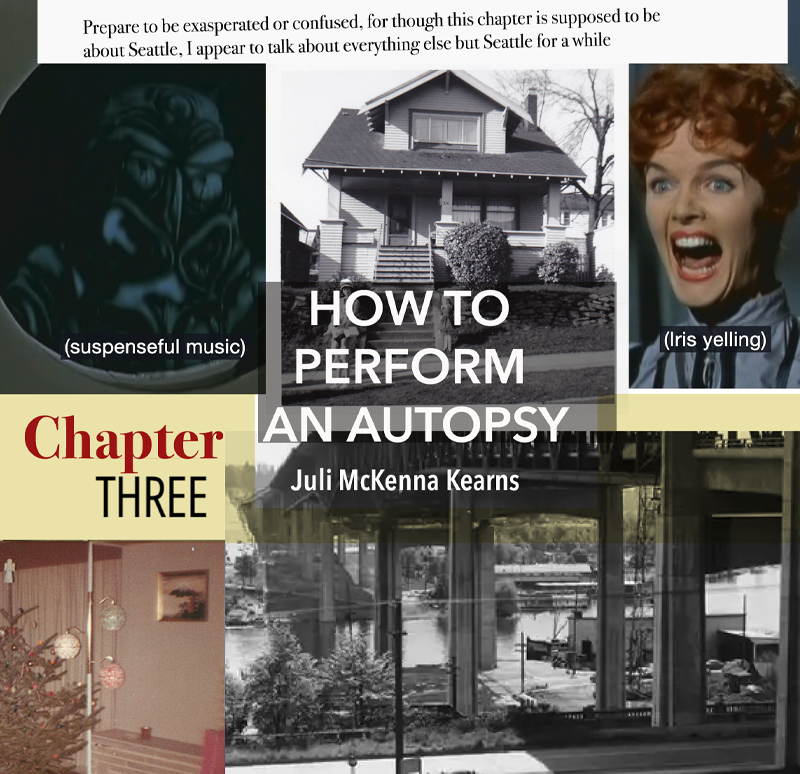
Prepare to be exasperated or confused, for though this chapter is supposed to be about Seattle, I appear to talk about everything else but Seattle for a while
1
Humans are unable to walk in a straight line. Let them loose, with nothing to guide, and they unwittingly walk in circles.
I supposed I was going to write now about Seattle (steep hills, water water everywhere, bridges, a volcano peering down on us all, there are many photos online of the different stages of old Seattle building itself, astonishing images of early Seattle regrading, cutting the tops off its hills in order to create an accessible city and still there were steep hills) and instead find myself in Augusta, Georgia, about thirteen years of age. Taking a break from auditions for the Augusta Choral Society, I stand in a hall to a side exit/entrance of the parish hall of the Episcopalian Church of the Good Shepherd where are some old photos hanging on the wall that I take an interest in and examine for their history of the church that was in 1869 first built and admitted to the Diocese as a parish, then was built better and bigger in 1879, torched itself in 1896, and was rebuilt within the still-standing salvage of its brick walls in 1898. The history of the church is unknown to me at the time, the photos divulged little, everything I now know I’ve looked up, which means digging around for news articles as the church’s current website only gives a few brief sentences. The fire, which occurred on November twenty-second, as reported in Savannah, Georgia’s The Morning News, was caused by a stove in the belfry, which the church used for spillover warmth when it was considered not sufficiently cold for the church furnace. The fire, originating in the stove pipe, burned through the neighboring rope to the bells so they couldn’t be used to sound an alarm. Located in the Sand Hills—also called Summerville—area of Augusta, the church might have benefited from the Summerville community having recently purchased a chemical engine for putting out fires, but courtesy of the burning of the Church of the Good Shepherd it was found they didn’t have the necessary chemicals for their new machine to do its job. While the slow-moving fire burned, the church furniture, pews, chancel rail, altar, pulpits, organ, hymn books, carpet, even its memorial stained glass windows were rescued, though the window back of the chancel fell to the ground and broke as it descended the ladder. If we can picture and hear anything in the organized tumult to save what could be saved, it’s the people on and around the ladder, navigating the salvage of that undoubtedly very heavy and unwieldy window, their expressions and exclamations of ire and disappointment as it escaped their grasp and crashed to the ground, shattering.
One wonders at the arguments that were either begun by or resolved by the realization the new chemical fire engine didn’t have the required chemicals to work.
Who first sensed the fire? Did a child tug on the sleeve of a parent and say she smelled smoke and was shushed? At what point during the service did they realize the destruction of their Sunday peace? If the building held memory of the fire, it never reached me.
In the autumn of 1909, in Chautauqua County, Kansas, my great-great-great-grandfather Crockett, on my father’s side of the family, was burned alive at the age of seventy-seven when the gas stove in his bedroom exploded. This will sound like
Three - 2
ancient history, but I clearly recall when I was ten years of age and told by my paternal grandfather how he was the last child born in the two-story Crockett farmhouse, he having been born there the year that it burned, and as my great-great-grandfather Crockett lived into the mid-1930s, and his wife into the mid-1940s, dying at eight-nine, my McK grandfather would have heard the story directly from them, as well as his Crockett mother and McK father, and Crockett uncles and aunts and grand-aunts who lived nearby. The fire made bold headline news in the local paper with an account of how Sarah, my great-great-grandmother, J. K. Crockett’s daughter-in-law, attempted to rescue the already bed-bound, elderly man from the burning room, but at the door he wrestled out of her arms and fled through the fire back into the bed where he rolled himself up in his bedclothes and writhed as the fire that wholly destroyed the two-story farmhouse consumed him, his “frenzied” family able to see it all. Sarah was hailed as heroic, overcome with smoke, her face, body and limbs painfully burned in her attempt to save her father-in-law. The fire had begun while her husband was at the barn tending stock. The deceased being from Columbia, Missouri, where he still had family, near two weeks after the event a letter to the Columbia Daily Tribune related it would be a while before Sarah would recover from the shock and her injuries. As the house was home to three generations one can fathom the difficulties with the loss of all their household goods and items of sentimental value. The Sedan Lance either had a taste for the disturbing hard facts or didn’t flinch from disclosing them, as it’s closing paragraph on the tragedy, stated, “Only the trunk of Mr. Crockett’s body was recovered. The head and limbs were practically all burned away.”
Onlookers believed J. K. Crockett was still conscious while burning because he was writhing, when instead it is likely he died quickly, perhaps even overcome by smoke inhalation. The writhing would have been an effect of heat shrinking the muscles, causing postmortem flexing and the pugilistic pose observed in burn victims. To ensure my facts are straight on this I’ve scanned a few websites, including the National Library of Medicine on the National Institute of Health website and was unexpectedly treated to several photos of remains that would have been something like those recovered of J. K. Crockett, I guess the NIH imagines if you're looking for information on "pugilistic attitude" and burn victims you don't need a "Warning, disturbing photos below". And I've seen, of course, the images of monks and others self-immolating, the first one being the 1966 protest of the Mahayana Buddhist monk, Thich Quang Duc, I saw that when I was nine, the whole world saw it, which was disturbing enough in the 1960s that Ingmar Bergman included footage of the event in his film, Persona, about an actress who quits talking and the at-home nurse with bad boundaries who becomes abusive with her. While she is in the hospital the actress sees the footage of the man burning and is overwhelmed by it, this event that happened thousands of miles away to someone who has nothing to do with her, yet it is traumatizing. I've seen other images of burn victims as well, but the ones on the NIH page were still surprising in their over-contrasted depictions, their starkness, perhaps surprising because I was seeing them while thinking about J. K. Crockett. And as I was thinking about J. K. Crockett they did make vivid what was left in the Crockett house, and I wondered whose duty it was to collect the remains, was it the county coroner's, and who was the county coroner in 1909. William George Jack, a husband of
Three - 3
J. K. Crockett's niece, Ermie, had been county coroner for four years, I was able to find he probably last served in 1906, and William Naughton was the coroner in 1909. J. K. Crockett's wife died a little over a year after her husband's death, her obituary stating she hadn’t been well since the fire.
When I was seven, in our small rented house on Everest in Richland, my bed was the black-and-white tweed sofa, demoted from living room privilege and stuffed in a sundries room off the kitchen with baskets of laundry waiting to be ironed. I blearily went from it one night, through the kitchen, into the living room, an immediate right turn into the short hall to the bedrooms of my brothers and parents, and to my parents’ bed to drowsily rouse them and tell them I smelled something burning in my room. “You’re imagining things, go back to bed,” my father said and I took him at his word and returned to the sofa bed and that’s the last I remember before waking in the back yard where was also the sofa bed that the fire department had carried down the rear stoop into the yard. I listened with vested interest as a firemen stressed I was lucky I wasn’t dead. The sofa bed had been situated so its back was pressed against an electric radiant wall heater, the foam in the back of the sofa had smoldered-melted and the fireman told my parents it had been near the point of exploding into flames, which was why I was lucky to be alive, because combustion would have instantly consumed it. When I had returned to bed, I had apparently been overcome by the gases or smoke, I don’t know, my parents had woken back up to the smell of something burning, had gone to the catch-all room and found me in a situation beyond their control, had removed me and called the fire department. I can still smell the thick acrid fumes given off by the burning foam. The ghost of them irritated my sinuses, throat and lungs for seeming days. Fire department calls were typically reported in Pasco’s Tri-City Herald. 6 September of 1961, a Tuesday, they responded to a 9:35 morning call to our home on Blue Street for “lint in clothes dryer, no damage”. On 29 January 1967, a Thursday, at 2:46 in the afternoon the fire department responded to a call at our 1803 Mahan Avenue home for a grease fire in the oven, no damage. No report for a sofa fire at 2024 Everest Avenue made it into the news though there was damage. The black-and-white tweed sofa that had been with my parents since they were first married, which they’d replaced in the living room with a new, sleek, dark brown upholstered Danish modern, was destroyed, the back of it burned away. After the firemen determined I was probably all right and didn’t have to go the hospital but said that my lungs would be irritated and if I had trouble breathing the next day I should see the doctor (I felt I wasn’t completely all right and should go to the hospital as I was having trouble breathing but I kept quiet as I reasoned if they couldn’t tell this I must be okay enough), having heard the description of how I was lucky because the sofa had been at the point of exploding, after the firemen left I asked my parents, just to confirm it from their lips, if I could have died, if my life had been endangered, because I wanted them to admit I had been right after all when I went to them and said I smelled something burning. They said I was never in danger, so my brain played tug of war with what I’d heard the firemen say and what my father and mother said. I asked if I’d passed out from the smoke and they said no I had just been sound asleep, and for a long time I thought well maybe that was true, I shouldn’t exaggerate and think I’d been overcome by the smoke or gasses, even though I also knew I had woken up being attended to by emergency personnel, and that I’d not simply been asleep, I had been unconscious.
Three - 4
Because we all for some reason afterward acted like this had never happened, I used to sometimes forget the fate of that sofa and wonder, “Where did that sofa go? It was such a classic piece.” I never forgot about the fire, the firemen, how the sofa being pressed up against the electric radiant heater was what caused the fire, and yet I would oddly forget about what happened to that sofa specifically. As a young adult, again forgetting, I once asked my father whatever happened to the black-and-white tweed sofa and he said he didn’t know. I would try to imagine if it had made it to the basement at Mahan, I would wonder why in the world they would have dumped it because it was such a great sofa, and then I’d recall, oh, that’s right, and I see it again sitting that night in our back yard with the giant hole in its back revealing the blackened and melted interior, and there are the firemen, and my parents tell me I was carried outside the house because I was sound asleep.
The sofa bed instilled in me a deep respect for and fear of fire. When my son was young and we lived in Midtown a serial arsonist who targeted apartment buildings somehow entered the front section of our building despite everyone being on high alert. He set fire to the stairs but the blaze was quickly discovered. He was caught not long after, having set twelve fires, and was a taxi driver who had once been a police officer and had already been in prison. Perhaps someone had propped open the front door of the building, and that’s how he’d gained entrance, which can be problem in apartment buildings with people coming and going who don’t take seriously how a secured entrance is a safety precaution for everyone in the building. I later found the building had also been through a bad fire in 1974 in which fifteen people had to be rescued. An old, vacated, wooden house across the street from our current apartment building was struck twice by an arsonist several years ago, not long after we moved in. The house, only partly destroyed, was not torn down, only boarded up. For several years afterward, when the humidity was just right, the scorched smell of the timber would be revived and drift into our apartment.
OK, I’m looking at information on polyurethane use in upholstery, its role in fires, how it behaves, about the production of cyanide fumes, trying to determine if the sofa had polyurethane, recognizing it as apparently polyurethane, it fits in the window for when began use of polyurethane in upholstery, and now I’ve restored my fire anxiety with enough fuel for a lifetime. Enough, don’t think about it.
Because we never talked about the fire, and I only knew the heater had been “radiant”, when I was older I became confused with this having been a radiant steam heater, which it wasn’t. Looking at photos, I realize and recollect we had vented heat in the other rooms, but the catch-all room had originally been a garage that had been made over into two rooms before we moved in, and for heat had radiant electric installed against the wall. For years, without thinking about it, I’d simply thought “radiant heat”, I knew from listening to the firemen that the radiant heat had been a danger and the sofa shouldn’t have been pushed up against it, radiant heat, keep everything clear from a radiant heat source, and so as an adult when living with radiant steam heat I made sure to keep nothing close to steam heaters, just as with electric space heaters. When I saw others had pushed up things next to their radiant steam heaters or were putting things like textiles on them during the winter, I told them why I worried about
Three - 5
their safety, I'd tell them about me and the sofa bed. I was greatly concerned due my own misapprehension, and while I was perhaps over-cautious, I still read it’s not recommended that objects be placed on or near radiant steam heaters as any extreme heat source can be a danger with a flammable material or can dry out “fairly inflammable” items and make them more susceptible to catching fire from other sources. Straightening out my own story, looking at photos, I find how I was wrong all these years about the heat source but what the fireman said is confirmed. Reading up on polyurethane foam in upholstery I realize the acute danger in which I’d been, that it smolders then combusts, and that it also releases hydrogen cyanide fumes and carbon monoxide, gases that are responsible for overcoming people and causing smoke inhalation deaths. Far more people currently die from being poisoned by these gases than by fire. They are overcome and never have a chance to escape.
Parents are humans are fallible beings are beings who make mistakes who make innocent and guiltless mistakes, they are people whose abilities are conditionally influenced by the environment in which the family exists. Parenting is difficult and is daily burdened with personal and circumstantial regrets. My parents perhaps felt guilty, so we didn’t discuss the fire, and my father said he didn’t know what had happened to the sofa. Or their reluctance may have had more to do with a self-centered fear of exposure of negligence or irresponsibility. There’s a difference. Because the couple of times I did ask about the fire, my mother would ask why I tried to make them out to be bad parents. All that said, I survived, I was rescued. All that said, my parents preferred I not remember.
With the Civil War, southern Episcopalians had also decided to secede. Separating from the Protestant Episcopal Church in the United States for political not doctrinal reasons, they formed the Protestant Episcopal Church in the Confederate States of America, its first convention held at St. Paul’s in Augusta in 1862. The Charleston Daily Courier, on 22 October 1861, reports on the naming of the breakaway church at a convention in Columbia, South Carolina. Judge Phelan, of Alabama, argued that a name ought to be descriptive, that “Protestant expressed nothing” and should be removed, but he wasn’t in favor of instead instituting “Reformed Catholic” because “Reform could not in any just sense be predicated of Catholicity. It was an essential note of the Church, and it would be as well to talk of reformed sun or moon…” Bishop Elliott of Georgia, who had led the movement to form the breakaway church, a lawyer and alumni of Harvard and South Carolina College, argued the retention of Protestant as important because Protestantism memorialized protesting the decrees of the Council of Trent and the supremacy of the pope etcetera. A Rev. Mr. Pinckney was willing to concede “the evils associated with the term Protestant” but he felt the term Catholic was “equivalent to Romanism and just as full of evil as Protestantism.” Others wondered why anyone was arguing about this at all, they weren’t there to make radical changes such as changing the church’s name (as if breaking away from the Protestant Episcopal Church in the United States wasn’t radical). Bishop Atkinson of North Carolina, also educated in the law, alumni of Yale and Hampden-Sydney College, held the word Protestant expressed a spirit, and he couldn’t condone it as a protesting spirit was one of unrest, doubt, denial and unbelief (again, as if breaking away from the Protestant Episcopal Church in the United States because you wanted
Three - 6
to keep your slaves wasn’t a form of protest). A first vote for “The Episcopal Church in the Confederate States of America” failed. A second vote for “The Protestant Episcopal Church in the Confederate States of America” passed. One doesn’t know whether to think “of course” or be a little bewildered by the fact that, as the Civil War commenced, southern Episcopalian clergy and laymen and lawyers found the energy and concern to argue over whether their new church should be identified as Protestant or not. After the war, that church was dissolved at its second convention, and its errant Episcopals reunited with the Protestant Episcopal Church in the United States.
Established in 1736, Augusta, Georgia, in 1861, was the second largest city in Georgia, while Richland, Washington, didn’t exist, and Seattle, a camp in 1851, not incorporated until 1869, barely existed. Seattle had no newspaper until 1863, no telegraph until 1864, in 1870 its population was about 1100, and though it was 3000 by 1880 that fell short of the city of Walla Walla, in the southeast of the state, which now has a population of about 34,000 while Seattle’s is about 750,000, and few outside the Pacific Northwest have likely heard the name Walla Walla.
Hard to believe now, but when we moved down to Augusta in 1967, most people I met had never heard of Seattle, so they certainly hadn’t heard of Richland despite its role in the Manhattan Project. The Seattle World’s Fair of 1962 was supposed to have placed the word “Seattle” on everyone’s lips, and still people in Augusta often didn’t know anything about Seattle, much less Richland, despite Elvis Presley’s appearance in the 1963 film It Happened at the World’s Fair, which was filmed in Seattle. I was elated when the television series, Here Come the Brides, debuted in 1968, because at least the idea of Seattle was home entertainment once a week, I got to hear its name, and I religiously watched the show though it didn’t mend the ache of having been removed from Washington State. The so-called Mercer Maids were the inspiration for the series, brought from New England to Seattle in 1864 because women were scarce, about nine men for every female. That Asa Mercer, first president of the Territorial University of Washington (1861-1863), went to Lowell, Massachusetts, hoping to find females who might be game for relocating to Seattle makes sense when one considers that the textile mills of Lowell had been for several decades a destination for young New England women from poor families who would send money back home, also women who were orphaned or partly orphaned. The experience of independence and bad working conditions resulted in the women becoming activists, staging strikes in an attempt to improve their situation, organizing petitions and the Lowell Female Labor Reform Association. In 1864, production at the mills was down because of the scarcity of southern cotton due the war, so Asa Mercer made his case for female immigrants at the Unitarian Church in Lowell, with the promise of a teaching job in the Pacific Northwest. Eleven women were recruited, several of whom were daughters of a mill superintendent who had been put out of work because of diminished mill production, and he would emigrate to Washington State as well. The second recruitment effort, in 1866, instead targeted women made widows by the war and daughters made orphans, teaching jobs again promised, but the main attraction was the high potential of marriage. Whereas hundreds were said to be expected, only about forty-six women were recruited, including ten widows with and without
Three - 7
children, the poor response blamed partly on newspapers fomenting distrust in Asa’s effort despite the fact he had been appointed Immigration Commissioner for Washington Territory in 1863. The grandmother of my father’s mother had been a mill girl at Pacific Mills in Lawrence, Essex, Massachusetts, not far from Lowell, but she was known to have been there in 1854, the first year Pacific Mills was in operation. Which I mention because I’ve already read up on these mills because of the family connection and so I immediately understood why this would have been considered a potential area for recruitment in cooperation with Unitarians. Had she been at the mill ten years later might she have taken the long ride on that ship to Seattle, hailed as a utopia?
As with Richland, Seattle was not a place in my childhood that was psychically fenced off after we’d left, because I was now a product of Seattle and it influenced my expectations and how I felt about other places, comparing them to it.
When one is a youth in Augusta, Georgia, and is from Washington State, one is going to feel disjointed by how different are their histories. That’s probably true for any two places located in different regions, but Augusta and Seattle were different worlds. Seattle was active and cosmopolitan, a seaport city over which hung in the sky the vision of white-capped Mount Rainier, 29,000 feet high, never mind it is still an active volcano I didn’t know that at the time and never perceived it as a threat. How it related to Seattle, presiding over it, was not unlike the silk art of Mount Fuji, a tall pagoda in the foreground, which hung over my childhood on our living room walls in Seattle, Richland, and then Augusta. When I was ten years of age, while I didn’t imagine everyone had mountains to look up to, it didn’t occur to me that our move to Georgia would change this and would mean no more mountain views. In the silk screen, in the foreground right is the slim architecture of four of five stories of the Chureito Pagoda, depicted in red and black, surrounded by the black silhouettes of cherry trees, and in the background center against the light pink wash of either a sunset or sunrise is the white cap of Fuji, the bottom of the 12,390 foot mountain hidden in cloud. I have only just now learned that it is the Chureito Pagoda depicted in the art. For years I’ve wondered what pagoda this might have been and have finally located it. This painting is a faithful depiction.
And I’m confused as the pagoda was built in 1963, but by the time I thought to question the origin of the painting, which is when we were living in Augusta, my mother said that a red-haired boyfriend who had been courting her before she met my father, one who was quite smitten with her, who was wealthy and determined to marry her, had several of these paintings that he was selling or something something, and he had given one to her as a pre-engagement gift, but then she’d met my father and had decided to marry him instead. This was a story repeated to me as an adult. The problem is that, as I have stated, the pagoda was built in 1963 as a peace memorial, and my parents were married in 1956. The first time this painting appears in a photo is on our living room wall in Seattle, Christmas of 1963. The view in the painting is one like the perspective often seen in professional photos of the Chureito Pagoda with Mt. Fuji beyond, so similar in orientation of the pagoda to Mt. Fuji, though artistically represented with some artistic license, that there’s no denying this is the same pagoda, and the finial of the pagoda in the painting is the same as on the Chureito Pagoda.
Three - 8
On eBay I find old silk embroideries and paintings for sale that show a very similar pagoda with the mountain in the background, but these typically are remote views of a pagoda next to a lake and a red bridge, sometimes a shrine or a house also shown. One piece for sale gives a circa date of 1930, which briefly throws me, and it shouldn’t, their “circa” is simply wrong. After a comparison with tourist sites, I’m inclined to believe these paintings are each a fictional conglomerate of at least two shrine sites near Mount Fuji and reoriented to give the impression of their resting on a nearby lake.
The Chureito Pagoda is part of the Arakura Sengen Shrine, and overlooks Fujiyoshida City. One website shows a photo of the Chureito Pagoda, while relating instead the history of the Fujiyoshida Sengen Shrine, also given as Kitaguchi Hong Fuji Sengen Ninja, that is on the north side of Lake Kawaguchi and was constructed after the ninth-century eruption to appease gods associated with the mountain. Another is the Kawaguchi Asahi Shrine, but the Chureito Pagoda is instead at the Arakura Sengen Shrine between the Kawaguchi Asama Shrine and the Kitaguchi Hongu Fuji Sengen Shrine and separated from each by about a thirty-minute drive. The vintage mid-1900s art I’m seeing online creates a romanticized landscape by giving the viewer everything all at once, Fuji, shrine, pagoda, cherry blossom trees, lake, sometimes one or two small Japanese sailboats, sometimes a red bridge and sometimes a natural brown wood one, sometimes a couple of women in graceful kimonos crossing said bridge. These are not faithful representations of a scene but an imaginary landscape and all are anonymous. These are images that unify in one landscape many of Japan’s touristy highlights but it is not a faithful representation. Most people are familiar with “The Great Wave of Kanagawa”, a woodblock print by the artist Hokusai. “The Great Wave of Kanagawa” is from Hokusai’s Thirty-six Views of Mount Fuji, published 1830-1832, and not to be found in any of those prints is a single pagoda or red bridge. The Chureito Pagoda landmark isn’t shown because it didn’t yet exist. It wasn’t part of old Japan.
In Richland, the painting became highly symbolic for me of the town’s link with Japan through Hanford’s production of the plutonium that went into the Fat Man weapon that was so horrifyingly dropped on Nagasaki, which is an association that isn’t unmoored by the discovery my mother’s origin story of the painting was fake. But—what the hell, why the fake story?
Down the same line, yet not, my husband’s grand-uncle, Harry, gave him an acoustic Harmony guitar when he was a child and told him he had played that guitar riding the railroad with the famed Woody Guthrie “This machine kills fascism” folk singer, my husband only to discover when he was about thirty and had the guitar repaired that it wasn’t made until the 1950s. He now looks on the story as having at least attached him to a cheap and unplayable instrument he might not have otherwise held onto, which when repaired turned out to be a great guitar that he loves, and he had only kept it all those years because of its historic and romantic link to Woody Guthrie. My husband grew up with this story and guitar, he told the story to me, and I knew nothing about his grand-uncle’s history and had no reason to doubt it, just as my husband had no reason to doubt it. Is it possible Harry might have ridden the rails and jammed with Guthrie? I don’t know. He lived most of his census life in Mobile, Alabama, a boilermaker in railroad shops and shipyards, also up in the District of
Three - 9
Columbia where a brother of his was also a boilermaker then opened a restaurant concession in the Treasury Building. Harry was footloose, marrying twice and fathering a couple of children, each marriage to last only a couple of years with his ex-wives immediately remarrying, so he had the freedom to roam. He had a sibling living in California in the 1930s whose husband was a railroad man. Harry’s youngest son had lived in Florida, he was a switcher on the railroad, and he died at twenty-three, several days after an accident in which his leg was crushed during the coupling of two cars, requiring amputation—a story I’m only telling because of the sad but novel peculiarity that his leg was buried by his mother in the short time before he died, when it was thought he’d survive, so he is interred in two different cemeteries in different cities, his leg in Tallahassee, where he did die, but the rest of his body in the Pensacola cemetery, where other maternal relations were buried. On the Tallahassee tombstone the remains are described as Bobbie’s leg, his epitaph revealing he was, like his dad, a musician, “God wanted a song bird in Heaven, so He took our Bobbie away.” I learned about Harry's son being buried in two places when I was trying to assess the possibility that Harry may have met Guthrie, thinking of probabilities of Harry's journeying based on what kinds of jobs he held and his lifestyle. With other stories I’ve since heard about him I can imagine his having once been a traveling man. Guthrie, born in 1912, rode the rails from the mid-1930s to about 1940. All it would take was jamming with Guthrie once for Harry to be able to take pride in saying he’d played with him. We can’t not prove Harry didn’t meet and play with Guthrie, and we can’t prove that he did, just not on that guitar. Which is how things are, life doesn’t supply us evidence for every story passed along to us, not even most of them, because life doesn’t work that way. Sometimes people wildly fictionalize themselves, sometimes their lives are fictionalized by others. Harry would have had other guitars before the 1950s Harmony, musicians remember their instruments like they’re a part of their bodies, Harry wasn’t confused, he would have known when he’d acquired that particular Harmony, and he may have decided his story wouldn’t have been as good if he’d said, “I played a guitar like this with Guthrie.”
The painting of the pagoda. My mother’s fabrication is so nonsensical it’s impossible for me to process. Why attach the story of a man to whom she was pre-engaged about 1956 to a painting she didn’t acquire until 1963? Why make it a gift from this guy with the fiery red convertible when she instead would have acquired it in Seattle? Admittedly, I always thought the origin story behind the painting was a bit odd and had a vagueness to it that made it fuzzy, but it never occurred to me she was lying about it, just that maybe some of the particulars were dusty. It never occurred to me that this wasn’t a painting that she’d had when she married my father.
Except there’s that story of a fire that supposedly destroyed her belongings just before she married my father, and while working on the Lawrence chapter I came to wonder how much of the story was true. It seems if that story was true, this painting would have been destroyed as well, and it wasn’t. But of course the painting wasn’t destroyed because it didn’t exist until 1963, and the story of the fire in Lawrence may still be untrue or greatly exaggerated if a fire did happen.
Three - 10
I keep expecting to look up the Chureito Pagoda one day and every website that says the pagoda was built in 1963 will be changed to a date before 1956, proving my mother right and me wrong despite everything I’ve read.
Well, wait. After having seen it writ hundreds of times the pagoda was built in 1963, after having spent too much time looking for what month it was completed (my hope was to find a more reliable source) and only seeing “1963”, feeling it was a real close shave there with the pagoda being built in 1963 and the painting appearing on our wall in 1963, though this would not have been impossible, I’m now on the Chureito Pagoda Guide page and it states construction was completed in April 1962. When I search using this date, I find also that construction commenced April 1959, nearly three years after my parents were married. I am further rewarded with a photo of the pagoda under construction in 1960, all steel beams surrounded by wood scaffolding.
2
Back to the Church of the Good Shepherd in Augusta, Georgia, that burned up in 1896 but was kind enough to leave its brick shell in which the church was rebuilt. Logically, I ought to instead focus my lens now on Seattle, but I’m not ready yet. I’m working my way there. While I’m working my way there, I may as well mention that part of my great-great-great-grandfather McK’s family was in Seattle not early early but early enough they were called pioneers, arriving a few years before the great fire of 1889. They were several first cousins of his, Bartos/Bartows, children of his aunt Mary McK, who had settled in Minnesota for a while then moved to Seattle as adults, bringing their widower father, Samuel Bartow, with them. In Seattle, the family went immediately from grading streets to pawnbroking, loaning money, banking, real estate, then lawyering, and it seems they did well for themselves, better than their family who went to Kansas and Oklahoma or Oregon. When the great fire of 1889 burned down their pawn slash loan business, along with twenty-five blocks or 125 acres of the downtown business district and waterfront (one million rats died, loss of human life was low), they set up a tent on the ashes and continued loaning money. These were all professions and businesses alien to the other McKs. Samuel Bartow had married Mary in 1839. Samuel’s (believed) sister, another Mary, would marry Robert Eugene McK, a (believed) brother of my great-great-great-grandfather McK, in 1846. She was thirty, which in 1846 meant she would have already been considered a spinster by some. Her husband was twenty-five. They would have six children and then Robert McK would abandon her after the children were grown and lead a life of serial bigamy. They had no bankers, lawyers, or money lenders in that McK line, and none in my McK line. The Seattle branch did a class reset that took them some steps up in the world away from their McK cousins so that a descendant would become the second mayor of Mercer Island, an affluent community, I don’t know how this move up the social and economic ladder works but in this case it had some co-operation and dedication between the generations, plus, they seem to have landed on their feet running from the moment they hit Seattle and I don’t know how that happens either, but a plan was had to move into a top dog position, at least a stage above a number of the laboring working class. In Hennepin, Minnetonka, Minnesota, the population was 1069 in 1880 and 1441 in 1890, while in Seattle the population was 3553 in 1880 and 42,837 in 1890, an increase of 1112.5 percent. They’d decided Seattle was the place to be, they were part of that massive influx of people, and despite the competition they still managed to climb the ladder.
After the great fire of 6 June 1889, Hall’s Standard Safes, of San Francisco, did the same thing they did after the October 1871 great Chicago fire (about 2100 acres consumed) and took out significant newspaper ad space composed of accolades from Seattle customers on how their safes fared in the fire, and Barto & Godfrey (two of the sons changed their name from Bartow to Barto with the move to Seattle) gave a glowing report, which wasn’t only good ad copy for Hall’s but for them as well. “We had one of your 78 jeweler’s steel lined safes in the great fire of June 6, and when we opened the safe found the contents in perfect order. We gladly recommend your make of safes as affording absolute security for jewelry, papers, books, etc., and for ourselves would use none other.” Before the fire, in 1887, they regularly advertised themselves as a “Loan Office. Notes and real estate bought and sold. Money advanced on horses, cattle, wagons, buggies, pianos, household goods, watches, diamonds, and valuables at low rates. Washington st, rear of Horton’s Bank.” The person who initially
Three - 11
partnered with the Bartos in business was a jeweler, George M. Godfrey, who was from Wapello County, Iowa, his family pioneers there in the 1840s, like Bartow and McK relations of Samuel and Mary who had moved to Van Buren County, Iowa, by the 1840s, neighboring Wapello. By 1895 George Godfrey was big Seattle news as an alcoholic from whom his wife obtained a divorce when a hired detective caught him with a prostitute (not described as such but the address where he was caught is the give-away) but had many friends and was well-liked, yet in January of 1905, nine months before he succeeded in drinking himself to death in October (“final collapse due to long-continued alcoholic excess” said the paper) he was also accused by a miner named Dougherty, who he’d met at a Pike Street saloon, of getting him really drunk, taking him back to his home then not letting him go over a number of days, even employing force, keeping him in a state of intoxication, and extracting money from him by various schemes, a lot of money from him, with the help of Godfrey’s cook, Joseph Duteau, and several unnamed women who were there. The miner, near seventy years of age, had come down to the big city after seventeen years up in Alaska, one of the tens of thousands who headed to Alaska at the time of the Kenai Peninsula gold rush of 1888, or maybe he was late for the Forty-mile district gold rush of 1886, he was already positioned for the famed Klondike Gold Rush of 1896, and what the hell does he know about civilization after that kind of isolation, probably lost a few fingers and toes to frostbite, he may have boasted in the saloon about the digits he’d lost and the several good claims he’s gathered, easy to peg as a naif ripe for a “bunko game”, which was what Godfrey’s cook was arrested for as part of this, following an investigation of several days that promised more arrests to follow but I find nothing else in the news about it. By that time Godfrey appears to have been no longer associated with the Bartos and probably hadn’t been for a while. His then business partner, Lee Melleur, several days before Godfrey’s death, had applied to be appointed his guardian in order to get him help. Godfrey’s one child, a daughter, had made the request that Melleur intervene in order to save her father and the “considerable property” he stood to squander away in his state of dissipation. She would become a popular short story writer whose fiction was placed in many well-known magazines of the day. She never married, living with her mother until her mother’s death. They relocated to Los Angeles, California, which I imagine would have been for her career, and I wonder if she may have gotten uncredited work fixing dialogue in scripts. The reason I hone in on dialogue is I went to the bother to read a story of hers and she had the knack for natural dialogue.
Enough description is in the Daniel Dougherty news item that makes it sound solid true, I’m inclined to believe much of the story was true, but I wonder if he may be the same Daniel Dougherty who in June 1906 was reported as going to a doctor in Lewiston, Idaho, with the request he examine him for insanity, as “people were telling him he was crazy and he would like to know. He has some mining claims out of which he thinks friends are trying to beat him.” He may be the same Daniel Dougherty who is in the Washington State Soldiers Home by 1910, the age fits.
Dougherty had been swindled, it hadn’t been in his mind. Was he experiencing trauma from his experience? In 1905, Duteau had gone to prison for grand larceny for the swindle. He had been released in August, on his own recognizance, had gone to a bar where he’d been in a fight and broken his leg, been returned to jail, then was released to the care of his wife.
Three - 12
Duteau, not long after his release from jail, less than a month before Godfrey died, sued him and his partner for wages he felt he was owed for the extra duties he’d been pressed into as Godfrey’s French cook, which included “going to some saloon nearly every night and bringing back Godfrey, whose clothes he had to take off and care for or throw away, and who had to be bathed and nursed back to consciousness after the nightly sprees to which the plaintiff charges his employer was addicted.” Plus, when he was fired, he was locked out of his room and wanted $264.25 compensation for valuable presents and trinkets left behind. After Godfrey’s death, he painted Melleur’s house (did Melleur feel sorry for him so gave him the job?) but did such shoddy work of it that the house needed to be painted again, which made the news as he tried to put a lien on Melleur’s house as he wasn’t paid for messing up Melleur’s house. In 1907 he was sued for $10,000 for alienating the affections of another man’s wife. In 1908 he showed up at Melleur’s office claiming “to have evidence that reflected on a certain well known woman of Seattle” and Melleur drew a gun on him and ordered him out of the building. A 1903 article shows he had indeed been previously married to a “young wife” who he claimed to the police had eloped with a boarder and he wanted them to find her, then returned to say “never mind” as she was staying nearby with her mother. In 1909, don’t ask me how, but he managed to marry the daughter of a well-known lawyer from Hennepin, Minneapolis, he was forty-five, she was twenty, then in 1915, the year her father died, Duteau started his own business as a real estate broker who also did mortgage loans, which he heavily advertised in the paper. So it’s looking like Duteau had been sketchy, and he might have reformed? Not so. He lands in prison again in December 1915 sentenced to six months for real estate grand larceny.
First Robert Barto had moved to Seattle, the eldest son of Samuel, and he would have been Barto & Godfrey. In 1880, back in Minnetonka, Minnesota, he was still farming, according to the census, then in 1887 in Seattle the census says he was in real estate and then in 1889 he gave himself as a lawyer then in 1900 a money lender. I don’t think he was a lawyer like we know lawyering today. His sister, Margaret, had also moved to Seattle with her husband (a carpenter), there in 1887, but they moved on to Idaho then settled in Spokane. The father, Samuel, moved to Seattle to live with Robert and died there in 1890. Before or after the fire, I don’t know, in the year after 465 buildings were built in brick, not wood, a rather astonishing revitalization. In 1900 brother Luther was a laborer/warden still in Hennepin, Minnesota, then in 1910 he is in Seattle and his profession is “own income”. I’m not sure what he was doing and he died in 1919. Horace Barto, a son of Robert’s, in 1910 is given as the president of Barto & Sons’ bank. Between 1900 and 1910 the bank makes several appearances in the Seattle news. The first is July of 1907 in The Seattle Star. The headline is “To End Business of Loan Sharks”, and the story is about how a suit was filed to “determine the validity of salary as assignments by county employees to usurers. W. H. Borrow was employed during May as an expert in the county assessor’s office. On June 12 he assigned his salary to Barto & Sons’ bank, an institution which makes a practice of loaning money to city and county employees at considerable above the legal rate of interest, taking salary assignments as security. Barto & Sons filed their assignment and demanded a warrant for Borrow’s salary, which Deputy County Auditor Brier refused to issue, unless ordered to do so by the courts. The suit commenced today is by County Auditor James P. Agnew against Bartow & Sons’ bank and Borrow, and will determine the validity of these assignments before the salary warrants are issued. If
Three - 13
successful, it will end the business of loan sharks among county employees.” That raises eyebrows over the Bartos and how they loaned money. A 1910 article in The Seattle Star shows the problem was still ongoing, the headline reading “Will Drive Loan Sharks from Hall”. The situation is described as, “Three thousand, five hundred and forty-two persons drew salary warrants in the comptroller’s office this month, and a majority of that number will be affected by this order, as a majority of the city employees are patrons of practically two loan agencies, that of Barto & Sons bank and of Ronald C. Crawford. These firms advance money to city employees and take out at the rate of 3 per cent a month for interest, although the notes which the city employee signs read at the rate of 1 per cent, the maximum allowed under the state law.” The order was that no more assignments of wages would be accepted. Barto & Sons’ bank still appears to have been around in 1919, then Horace is down in New Mexico in 1920, he owns a farm, and that’s the last I see of Barto & Sons bank except for a lawsuit against them that continues on to 1923. I don’t know. Horace was in Jackson, Oregon, by 1930, working as a photographer, then he died.
Robert had died in 1909 but Barto & Co., which had first appeared in 1891, continued on and was still advertising in 1954, situated then at 505 Third Avenue across from the County City Building, having moved there in 1949. They were advertised as “Loans and Insurance”. Joseph, another son of Robert, had become a lawyer, admitted to the bar in 1915, and in 1918 went into partnership with Alfred H. Lundin, the county prosecutor, their firm said to be the “oldest, original law partnership” in Seattle with offices in the Alaska Building and Smith Tower. Joseph became deputy prosecutor at that time. He served on the board of governors of the Washington State Bar Association from 1937 to 1940, and in 1948 he became president of the Seattle-King County Bar Association. Thomas, another son of Robert, in the Seattle’s Jan 1936 The Veterans Review was given as “operating one of the very few legitimate loan agencies in Seattle”, which was Barto & Co. Joseph’s obituary said he had also helped run Barto Loans, Inc.
It sounds like the family was getting itself in scrapes concerning their loan and banking businesses and needed a bonafide lawyer on their side, so it was fortunate Joseph wanted to become one, and not only did he become a lawyer he became a deputy prosecutor immediately, which one could hazard positioned him to make things easier on the family, I don’t know. It may be that he raised the family business into secure legitimacy.
A last image to go with this story, like the Church of the Good Shepherd fire, the Seattle fire moved slowly enough that people were able to retrieve from offices and homes what was important to them—and think about it, where will they carry them that is assuredly safe—by hired wagon their belongings went to the harbor where they were loaded on ships before the wharves caught on fire and the ships hauled anchor and moved out into Elliot Bay to watch through the night as Seattle burned. As a result of the fire, thousands were displaced and “5000 men” lost their jobs, I don’t know if that figure includes women. A lot of people were going to be needing loans.
Three - 14
3
If the brand spanking new Church of the Good Shepherd in Augusta was built in 1879 that means some white, donor individuals were feeling prosperous and motivated, namely Margaret Gould who had been formerly a member of Augusta’s St. Paul’s. Nothing in the South (or nationally) existed in a racial vacuum, so, with reconstruction having ended in 1877, wondering about the mood of White Augusta, I look to the Augusta paper for a random bit of news that might give an idea of how they were picturing racial relationships for readers, and am surprised to be pointed West, back to Kansas. The top news left column in the Augusta, Georgia, The Evening Sentinel, 26 April 1879, was on the Forty-sixth Congress, the headline reading, “The Negro Must Go!”, Mr. Haskell of Kansas denying hostility, but that they just didn’t “consider it wise to have thousands of poor people cast upon one point destitute and homeless.”
1879 was a key year for the exodus of southern African-Americans to Kansas, promised homesteads and the right to vote, and John St. John, then governor of the state, had personally extended a welcome to southern Blacks. The Exodusters, as they were called, in 1879 numbered between 10,000 to 20,000. Between the censuses of 1870 and 1880, the population of blacks in Kansas increased by 27,000 to number over 43,000. African-American rights in ex-Confederate states having been generally abandoned by Washington, D.C., in 1877, with the end of Reconstruction, Kansas held out the promise of equality. The pros and cons of the migration were broadly and heatedly discussed in the Black community, Booker T. Washington for it while Frederick Douglass, then marshal of the District of Columbia, was among those in opposition, some feeling that the fight for liberty needed to continue in the South. Senator William Windom, of Minnesota, due the exodus, had in February brought to the Senate a petition from The Negro Union Cooperative Aid Association, and the Freedmen of Shreveport, Louisiana, seeking an investigation of the loss of civil rights that spurred the exodus. The petition read, in part, “We are a poor, friendless, dependent, defenseless, landless, ignorant class, in a state of modern feudalism, freed by a generous Government, but left to the will of the former slaveholders, a landed aristocracy, and placed at their feet, bound hand and foot.” In case you’re wondering if Seattle caught any of this exodus, in 1880 there were only 180 African-Americans in the whole state of Washington, 1000 by 1890.
In the family photo box, my father's childhood was represented by a photo of him, four years of age, with his only and elder brother, both attired in spic-and-span playclothes, hair parted on the left, combed to the side and pomaded so not a strand will escape to wave in the breeze. A note reads the image was taken “out at the farm” and the printer’s mark on the back reveals it was developed in Shreveport, Louisiana, where they would have been visiting a sister of my father’s mother who had somehow moved to Shreveport during a divorce from her first husband due unfaithfulness and cruelty, Cora was a clerk for a “big oil” company (never named in hometown Liberal, Missouri, news it’s just given as “big oil”) and then they were transferring her from Shreveport to Tulsa, Oklahoma, and several days later instead of moving to Tulsa she had become the wife of a “prominent planter and merchant” whose uncle had been mayor of Shreveport, and whose grandfather had been a plantation owner shown in the 1850 census as having had sixty-six slaves, including thirty-nine women, twenty-seven men, thirty-one children fifteen and under, in the 1860 census that grandfather
Three - 15
was worth over eight million in today dollars. The wealth and status accrued from the ownership of people before the war was still conferring wealth and status long after the Civil War. From Cora’s first marriage to the cruel philanderer, my father and his brother had a cousin, Lena, in Shreveport, but she’s not pictured in the photo, nor is anyone else, just the two boys. Cora had divorced the cotton plantation guy four years before this photo and thereafter spent several decades working as a secretary in the city electrical inspector’s office. When she retired, a photo was published in the paper of her handing over her job to her daughter. Lena, who had been hailed as a pretty blonde on the society pages during the mid-1930s, would go on to marry a divorced optometrist and had one child with him, a son, whose obituary reveals that after attending Allen Military Academy in Bryan, Texas, he went to Principia College in Illinois (a Christian Science-founded school), Centenary College in Shreveport, LSU-Shreveport, and the University of Graz in Austria. Whatever he was studying that would take him from Louisiana to Austria, something somewhere went wrong because all else that I know of him from the news is that he was “well over six feet tall, about 230 pounds” and would chase down “beer bandits” with a claw hammer when working as a night clerk at a Circle K in Shreveport, which is where he was murdered at the age of fifty, in 1991, shot to death in an apparent attempted robbery, thus having the distinction to be the fourth convenience store clerk killed in Shreveport in fifteen months. No suspects, the murder was never solved. I don’t know if my father knew any of this, but I doubt it as after my grandmother’s death in 1985, and the death of her last sibling the same year, the news from that part of the family likely dried up. The photo of my father and his brother, in Shreveport, would have been a record of the visit, sent to his parents from their aunt Cora. Fifty-four years later, Cora is already dead ten years, her husband long before, and their son is found shot in the neck behind the counter of a Circle K convenience store. Did he piss off the wrong person with his claw hammer? Some customers, the paper reported, wondered if that was the case. Maybe it’s only that he was paid by Circle K to be at the wrong place at the wrong time. There was no sign of a struggle. The police wouldn’t reveal to the press if any money was stolen. Any of the plantation privilege his grandmother had married then divorced, if it had filtered down to him, had run out. Less than a month before the murder, the paper had published a notice that real estate belonging to him would be auctioned off in five days to pay off some of his debts. He was given a Christian Scientist burial.
Had former slaves of the Louisiana ancestors of Cora's second husband made their way to Kansas?
The way America unfolded over the generations, families spread across a big country, losing sight of one another, I could have one day, on a trip, walked into that Circle K and would have had no idea I was paying a second cousin for a cup of bad Circle K coffee. Go back seven generations and many of us would be related, though seven generations doesn’t begin to involve us all enough that I am likely to find “family” in any room I enter. This second cousin, his parents deceased, perhaps inherited from his mother letters and photos that may have shown my father’s family and shared ancestors, things I’ve never seen and which became meaningless when he died so made their way into the trash or a flea market. He had a couple of half-sisters from his father’s first marriage but they weren’t acknowledged in his obituary nor in their
Three - 16
father’s obituary, which suggests a break in the family, and with that break those half-sisters were unlikely to have been interested in whatever had passed down to him from his mother’s side, their father’s second wife, a step-mother they had perhaps not welcomed, I don’t know.
Caddo Parish, the home of Shreveport, was spared in the Civil War, it even prospered, and was particularly violent after the Civil War, for which reason it earned the name “Bloody Caddo”, a stronghold for White Supremacy, known as the lynching capital of Louisiana and the second largest site of lynchings in the South. The neighboring Bossier Parish had also escaped fighting on its land, and had violently suppressed black freedman after the war, twenty-six lynchings of black men occurring there. Bossier Parish had been the first to secede and the last to surrender. The Dickson plantation had been on either side of the Red River in both Bossier and Caddo Parishes.
The South wasn’t happy to see its Black population migrate out as they needed agrarian labor. Southerners who wanted Black labor working their fields, as well as those in the North who opposed the migration, circulated counter propaganda on the misery of the migrants in Kansas. The Mr. Haskell cited above was Dudley Haskell, the Haskells a Lawrence, Kansas, family who had arrived in Kansas in 1854 as itinerant farmers from Massachusetts, members of the Second Party of the New England Emigrant Aid Company who were proponents of Kansas becoming a free state. As Chairman of the House Committee of Indian Affairs, Dudley would successfully lobby for Lawrence to be the site for the industrial training school for Native Americans which would become Haskell Indian Nations University, and is its own bag of worms, as they say, for this happened during a time of aggressive assimilation, denial of Indigenous culture, and the boarding schools to which Native children were removed were harsh in their military regimentation and their efforts to supplant the children’s families and ancestral culture with a forced adoption of White American.
In the 26 April 1879 article, The Evening Sentinel reported, “It is really refreshing to hear philanthropist Windom and his fellow saints repudiated…by the Republicans of Kansas. The men who fostered this scheme and deluded the poor blacks of Mississippi and Louisiana to inhospitable emigration, dire distress and early graves are the worst enemies of the negro…”
But, regarding Dudley Haskell, that’s not what had happened. There had been such a recent, dramatic influx of Black immigrants from the South into Kansas that Wyandotte, Kansas, by virtue of its location at the junction of the Kansas and Missouri Rivers, close to the state line, had received about 1000 immigrants in less than two weeks in March and April, equal to a quarter of the population, and they were having trouble finding housing and food for them. Haskell was worried southerners in Congress would kill any proposed resolution to supply tents and rations, so when the governor telegraphed asking him to contact the secretary of war for permission to use facilities at Fort Leavenworth, Kansas, Haskell replied he was willing but that Southern congressmen were “wild over this exodus & they hope & pray (apparently) that enough of the poor creatures will come to want [in Kansas], to deter the rest from leaving.” He felt there was no hope of aid from Congress and that the proposed
Three - 17
legislation, doomed to fail, would diminish private contributions. Relief for Wyandotte came instead by deferring immigrants to Kansas City, then Topeka, Kansas, where temporary barracks were constructed. On April 26th it had been considered that an address should be made that better informed freedmen of conditions in Kansas, but this was then decided against as it was felt the southern press would rework such to their own advantage and wholly repress emigration. Which happened anyway, as we see with the Augusta paper framing Haskell as declaring, “The Negro Must Go!”
Also on the front page of The Evening Sentinel were two columns devoted to the “memorial oration” delivered that afternoon by a Mr. Gary congratulating the South on its commitment to principles rather than policy, upholding the rightness of the Confederate cause. The address, described as “patriotic”, was delivered to the first annual meeting of the Confederate Survivors’ Association. In 1878 there had been the dedication of a seventy-six-foot-high Confederate Monument on Augusta’s Broad Street. To complement the 1879 Memorial Day celebration, The Georgia Weekly Telegraph, out of Macon, Georgia, reported that in Augusta there was a military parade, the Confederate monument was decorated with garlands, and the statues of Robert E. Lee, Stonewall Jackson, Thomas R. Cobb, and William H. T. Walker were crowned with laurel wreaths. And yet Augusta managed to spare paraders for the grand Memorial Day parade that took place the same day in Atlanta. Just imagine all the young lovelies of Augusta, prompted by their busy mothers, seated around tables chatting as they wove the laurel wreaths that would dress the heads of these statues.
1879 seems like a long time ago, but less than a hundred years had passed when I landed in Augusta, and the monument still stood, there was still segregation, and the monument still stands as I write these words. The inscription, in part, reads, “…For the Honor of Georgia. For the Rights of the States. For the Liberties of the South. For the Principles of the Union, as these were handed down to them by the Fathers of Our Common Country. In Memoriam ’No nation rose so white and fair: None fell so pure of crime. Our Confederate Dead.’” Even though I was only ten years of age when we moved to Augusta, I would look at these monuments and understand they were socially oppressive acts, even acts of psychological terrorism against Black individuals, and I wondered why others didn’t see this. But the fact is they did see it, which is a reason the monuments existed.
The wife of the first rector (priest) of the church of the Good Shepherd in Augusta was a Julia McKinne Foster, niece of Margaret Gardner Gould who paid for the $18,000 1879 structure (insured for $8000). Margaret's husband, Artemas Gould, originally from Worcester, Massachusetts, was a wholesale grocer then investor in textile manufacturing in Augusta, then president of the City Bank of Augusta, incorporator of the People’s Savings Bank, director of the Planter’s and Merchant Bank, and had already footed the bill for the land upon which the earlier Victorian Gothic wood and batten building (planks of wood dressed up with, in this case, thin cedar wood strips over the seams of the panels) was constructed in 1869. These were very wealthy Episcopalians who desired to be remembered as dedicated, devoted. We weren’t from the South but as a young member of the church, studying the brass plaque memorials on the “furniture” during Sunday morning mass, I’d taken notice that a Julia McKinne was part of the church’s history. Not knowing anything about
Three - 18
her, not knowing much yet about our McKenneys, I assumed we weren’t related (we aren’t) because my McKenney family had made for the Great Plains, but in my youth it felt a little odd to have my given and family names united in the church’s history. It had the quality of a haunting that was, yes, only accidentally personal, but if a grave is passed that bears a name similar to one’s own and one feels an irrelevant chill, it is still a chill. With their lack of experience, as preteens and teens step over the threshold into a world that, in its chaotic newness, feels mysterious for too many wrong reasons, it’s no wonder the romantic distresses of Victorian Gothic literature would be popular among them. But after a year or so I did convince myself of the absurdity of that sense of haunting.
Apart from the history of its Alphabet Houses, Richland hadn’t much in the nature of architecture to impress, certainly nothing pre-WWII, but Seattle did, and ever since I had been drawn to buildings that might remind me of Seattle, which were uncommon in the Augusta. While this High Victorian Gothic church didn’t recall Seattle for me, its parish hall did, with notes of old public school dark wood wainscoting contrasted by white plaster walls. My mother had begun singing in the Augusta Choral Society after we moved to Augusta, which meant that leading up to Christmas she for months sat on the couch in the living room with the score while on our Magnavox stereo-console she played Handel’s Messiah over and over again, Hallelujah, hallelujah, for the Lord God omnipotent reigneth, Hallelujah, The kingdom of this world is become the kingdom of our Lord and of his Christ, and He shall reign for ever and ever, King of Kings, and Lord of Lords, Hallelujah, hallelujah. For Easter it was Haydn’s The Creation. Others so afflicted will understand how it is that one can come to hate the Messiah, and its “Hallelujah Chorus”, which is breathtaking the first and second time around, if performed by a good choir, then becomes a tiresome, bombastic spectacle for which one must traditionally stand, because nearly a full four decades after its 1743 premiere, it was written that King George II was so awed by the music that its magnificence pulled him to his feet, but when heard enough times the dragging of even youthful bones out of what has likely been a very uncomfortable seat for three hours of Handel feels an imposition only alleviated by the fact this means next is the intermission between Parts II and III, which is not as good as the whole business being done with for another year. Now it’s confessed by historians that King George II likely never stood for the “Hallelujah Chorus” and one wonders how the tradition started and demanded that even audiences in Augusta, Georgia, in the 1960s and 1970s should honor that never-was-action, by also standing, over two centuries distant from King George II and across the Atlantic and on the other side of the Revolutionary War. It didn’t happen out of the blue, someone decided to manufacture a tradition for a reason, one wonders why, which had less to do with the “Hallelujah Chorus” than perhaps a reminder of subjection to royalty, so that over two centuries and an ocean away if one didn’t stand, despite not even knowing who was King George II, then everyone would glance askance like you aren’t being a patriot and standing for the Pledge of Allegiance to the United States of America or the National Anthem. It took me thirty years before I was able to listen again to the Messiah, and only then due a beautiful baroque approximation performance I happened onto on the radio on a drive between Atlanta and Augusta.
Three - 19
When I look to see what information I can find on the choral society, I locate a record of their performance history and if it’s correct then in 1967 they performed the Messiah, Part I and Nos. 26 (“All We Like Sheep Have Gone Astray”), in 1968 they performed The Creation, and the Messiah, Part I and Nos. 33 (“Lift Up Your Heads, Oh Ye Gates”), in 1973 they are listed as performing the Messiah and the “Hallelujah Chorus”, in 1974 they performed Haydn’s The Creation, then in 1974 they performed the Messiah, Part I and Nos. 22 (“Behold the Lamb of God”). So, apparently, we weren’t treated to the whole Messiah ever, and we weren’t treated to the Messiah (originally written for Easter) and The Creation cycle yearly, but I can guarantee that every time the Messiah, Part I was performed, so too was the “Hallelujah Chorus” because the Messiah without the “Hallelujah Chorus” was as incomplete as green eggs without ham. Between 1967 and 1974 the choral society also performed, among other things, Anton Bruckner’s Great Mass in F Minor, Giuseppe Verdi’s Requiem, Zoltán Kodály’s Te Deum, Johannes Brahms’ Requiem, Mozart’s Requiem, and Maurice Duruflé’s Requiem, but I know my mother wasn’t in any of these performances which means it was her choice to stick with Haydn and Handel, and if I remember correctly she became upset with the society and dropped out of the 1974 season, a year before the founder and conductor, Emily Remington, born in South Carolina, graduate of Juilliard, reorganized her life with a move to Charleston, South Carolina, where she then founded the Singers Guild for the Charleston Symphony.
After having heard for years how our mother’s fantasy career as a concert pianist had been unfulfilled, she was finally up on stage, not as a pianist but as an alto in a chorus, she got to dress up in basic concert black and revel in applause. One time, early on, perhaps the earliest time I saw them perform, was at Augusta’s Bell Auditorium, the building a WPA project that opened in 1940, was split into an auditorium and a music hall, and when the main stage was combined sat about 5000 people. To my eye it was a disappointing, shabby place, the interior and exterior displaying a morbid defiance against creative architectural imagination, but a circa 1940 postcard promises it is “one of the largest, most usable and modern auditoriums in the Southeast.” My intuition was the South was against giving nice things to the public because the lower classes were undeserving. In vain, I look for photos of the old interior on the internet, and if there are none this is perhaps because it was as disappointing as I remember. What made the difference between the music hall and the auditorium I don’t know, but if we were likely on the music hall side it had balconies and a large open floor upon which had been set up portable seating. We were in one of the balconies on the right and had a good view of our mother who was on the right in the chorus. Augusta had turned out and the place was packed. I remember her as being in a new long black dress with a fitted waist and full skirt, or no it was a black sweater and less full long black skirt that she wore, the long black dress with the full skirt came later. With her jet black hair she looked elegant in all black with minor touches of costume jewelry. I was glad she had this, it was nice to see her involved. I also wondered if she actually sang during the performances or faintly exhaled the words because I swear I never heard her sing at home, at most she talked-sang with no projection, and from the audience she didn’t look like she was audibly singing she looked like she was blankly miming.
Three - 20
You can usually tell, even at a distance, if a person is singing and breathing and singing and breathing.
My mother had at first been against my auditioning for the Augusta Choral Society. She wanted this for herself, and I find it hard to blame her for looking upon it as her territory and guarding it, even then I didn't protest, but she changed her mind. As it was, I ended up not singing in the Augusta Choral Society, the director was of the school that felt to begin singing when young risked blowing out one’s vocal chords, which it can do, and she invited me to audition again when I was a couple years older. But I sang that summer at Brevard and if you really honestly sang, which we had to do, it was a relatively small a cappella chorus and there’s nowhere to hide one’s voice in an a cappella group, no room for mistakes, it was a workout. Singing in that chorus was also the best time I ever had in rehearsal and on stage because the conductor was every moment on top of and fine-turning every note out of each person’s mouth while also shaping the whole at once, which translated into my first exhilarating experience of impeccable unity in a performance. It was like leaping on an already moving train and if your time and breath failed you would go under the wheels. It was marvelous. After Remington left, my former violin instructor, Eloy Fominaya, took over the spot of conducting the Augusta Choral Society.
Attempting to loosely verify my memories of the the Augusta Choral Society and the Messiah and Good Shepherd (that I had indeed observed a nineteenth century Julia McKinne on a plaque), while combing through newspapers and other available information my attention was drawn to a video of an interview with opera greats Marilyn Horne, Joan Sutherland, and Luciano Pavarotti on bel canto singing, and from there I went on to spend a fair amount of time listening to Joan Sutherland’s high E-flats and E-naturals break the sky wide open, which reminded me of an absurd video I’d come across during my search. It was on the celebration of All Saints Day, a presentation made by a priest at the Church of the Good Shepherd, and had so much echo it’s difficult to dig through the bad recording for his words. By the magic of cheap special effects, his body is translated from standing before a black screen to a blue stairway that leads up to a great ball of light in a sky thick with blue and white cumulus billowy clouds as he talks about St. John’s revelation of the heavenly court with all the people of God in their unceasing praise of divinity singing “Worthy is the lamb that was slain”, relating St. John’s imagery to the communion of all those who have placed their trust in God who are recalled and united in All Saints Day and how though they are unseen one is in their fellowship with the eucharistic prayer at Good Shepherd as the ceiling opens (the background image changes to the angelic heavenly court with trumpets and tambourines, the painting being “Christ Glorified in the Court of Heaven “ by Fra Angelico) and the priest exclaims the whole company of Heaven is gathered with the eucharist’s celebrants, in one’s daily life one is as if at Sanford Stadium in Athens, Georgia, surrounded by the saints cheering one on to fight the fight and stay the course, attain the prize. Then he seamlessly transitions to recalling Handel’s Messiah and its good news of the existence of God and all made in God’s image, saved through Jesus’ embrace alone, the sacrificial love of the Lamb of God. He emphasizes the “alone”, which reminds me of how I was tossed out of that church at the age of seventeen, by the youth pastor, for being a heretic. I had remembered the congregation as strenuously WASP, which is an aesthetic into which
Three - 21
my family didn’t fit, yet there we were, and this priest’s bringing in Sanford Stadium of the University of Georgia and the celebrants of the Georgia Bulldogs football team as a metaphor for the gathering of the saints was right on target for representing everything they were and we weren’t.
Was I a heretic? The youth minister, who tried to act a buddy to teens like ministers in the movies, but always came off to me as being a failure of a double agent, like ministers in the movies, had one by one gone through the youth group asking what each person believed. We were meeting not in the parish hall but on the second floor of an old white wood building that had offices on the first floor, and the meeting room was quite small, barely large enough for the table around which we sat. As I’d been asked, I was honest and I said what I believed and he said I was a heretic and ordered me to leave and not return. In front of all the others I stood and walked out, age seventeen, some individuals I’d know for about six years. I thought it a weird spectacle to make of a seventeen-year-old in front of the other youth, especially as I reasoned likely a good many of the adult members of the Church of the Good Shepherd didn’t believe, many would have been agnostic, but no priest was going to ask each adult, from the Sunday podium, what they believed and then toss them out if they didn’t give the right answer, because the church needed their money. I was always in trouble for what I did or didn’t believe and so in that respect I was unfazed, but my expulsion seemed bizarre. The very uncomfortable part was the silence of my peers, but I should have learned by then that very rarely do one’s peers come to one’s defense when it involves publicly taking on authority or the majority. The priest wasn’t Father Clarkson, who served there from about 1942 to 1979. This was a younger man who arrived in the 1970s. The Church of the Good Shepherd, as with all other churches, doesn’t offer on their website a list of all their prior ministers, which strikes me as less to do with “we are about Christ, not any one minister” than “we don’t want to hear about your problems with any former ministers.” Which is too bad that I can’t find his name because I’d love to say who this was. By definition, I was an official heretic. I would have said I didn’t believe in a literal physical Jesus Christ and that I didn’t believe Christianity was the only path to God, I know I quoted a verse to back me up, it may have been 1 John 4:7, “…love is from God, and whoever loves has been born of God and knows God”, and I may have said I didn’t believe in a personal God, which I felt was covered by 1 John 4:12, “No one has ever seen God; if we love one another, God abides in us…” I probably said I believed one could be an atheist and could still be “of God” if one abided in love. That was my reasoning for church critique. I was surprised this profession got me called out as a heretic, also because this was the 1970s and what Episcopal church would kick someone out as a heretic in the 1970s? That bordered on witch trial fanaticism in the 1970s, when America’s churches were still reeling from and trying to figure out how to deal with Time magazine’s 1966 “Is God Dead?” cover.
Found him. I decided it would be unfair to me to leave him to lurk in the shadows, unidentified, so first I tried checking Episcopal sources for him and that failing I was able to came up with, in Augusta news archives, notices for Good Shepherd services in the 1970s that showed just enough info that I didn’t have to buy a subscription. He was Rev. Arthur Everett Johnson, who is reported in the 1973 Sewanee News for the Sewanee Academy of Sewanee, Tennessee, as having “completed a year’s clinical
Three - 22
internship in counseling and therapy at the Georgia Regional Hospital in Augusta. He is now certified as a professional therapist. He is also beginning his new position as assistant to the rector of the church of the Good Shepherd in Augusta.” From my cursory search of the Augusta Chronicle I find he appears to have left Good Shepherd by December of 1975. Moving on to a search of other news archives, I come upon a picture of Arthur, confirming him as the one who booted me out as a heretic, and I learn that after Good Shepherd he moved on to St. Gregory’s in Athens (“Go Bulldogs!” I’m sure), then was at Christ Episcopal Church of Bay St. Louis, Mississippi, by 1985 where in a news article he says he prefers to be called “Father Nick” (this would be after St. Nicholas, perhaps his confirmation name, but also perhaps carries a nudge wink ho-ho-ho allusion to jolly Santa). From there he went on to other churches, always a friendly smiling face in photos, the counselor priest who cast me out of church as a heretic. Fine, I was only at the church because my family went and I had developed a few friends in the youth group. I didn’t belong theologically but how many of the parishioners did.
Arthur, or Father Nick, may have changed since the 1970s in how he relates to teenagers. If reminded of it, he may now be surprised he ordered me out. His sense of compassion may now be not so compromised by an adherence to whatever church or Christian law he thought he was following when he ordered me out. I don’t know. It’s not everyone who is tossed out of the Episcopal Church as a heretic because they give an honest answer to a question, and because my being tossed out made it clear what kind of church this really was, for me it was then like a trophy, though I’d not lobbied for that honor. What Father Nick accomplished was a natural shunning as friendships I’d believed I’d made in the youth group didn’t survive, it would be the last time I saw any of those individuals.
Taking a “life has beauty” break for a paragraph—opera singers should never die, or at least only half-die in such a way that whenever a recording of Joan Sutherland plays the mundane heavens slide aside to reveal the supernatural and she materializes above as an angel in a thirteenth-century painting by Giotto di Bondone, a vision of heavenly glory like unto Elisabeth Welch singing “Stormy Weather” in Derek Jarman’s The Tempest. A radiant solar queen in yellow and gold, the partial halo of a multi-layered, Medici-style collar, rayed with crisp folds, frames her face as she enters the wedding celebration of Prospero’s daughter, Miranda, to Ferdinand, Prince of Naples. She is divine. Or the magnificent and as divine Jessye Norman singing Henry Purcell’s “Dido’s Lament” from Dido and Aeneas in Jessye Norman: A Portrait, face framed by the large fan of a gold-red collar attached to the back of her dress, on her head a like but smaller solar crown. “When I am laid, am laid in earth, may my wrongs create no trouble, no trouble in thy breast; remember me, remember me, but ah! forget my fate. Remember me, but ah! forget my fate.”
Jessye Norman was born in Augusta, Georgia. She was surrounded by music in her youth and for a number of years was mentored by a woman named Rosa Harris Sanders Creque, who attended Paine College in Augusta, Columbia University in New York, then taught for over thirty years in the Richmond County school system. Jessye’s parents fostered her talent and were involved in the struggle for civil rights in an environment of extreme racism and discrimination. She was about twenty-five and
Three - 23
singing title roles in Germany and Italy in opera companies when Augusta’s schools were integrated in 1970-1971.
Actress and social activist, Butterfly McQueen, was not born in Augusta but was raised and died there. Best known for her turn in Gone With the Wind as Prissy, I would hear her demeaned by older white Augustans, who knew someone who knew someone who had met her and asserted she was a woman of no ability and subnormal IQ who inescapably depicted only her natural simple-minded, childish self and so couldn’t help but be comic—Butterfly McQueen, who several times left the acting world because of her disappointment over the ethnic stereotypes in which she was cast, received her degree in political science at the age of sixty-four and worked with antipoverty groups, and as a waitress, giving tap dance and ballet lessons at Harlem’s Mount Morris Park Recreation Center as a means of helping the Black community. A vocal atheist who argued that Christianity encouraged irresponsibility and bigotry, she was honored with the Freethought Heroine Award by the Freedom from Religion Foundation.
After moving to Augusta, Georgia, my parents left the Roman Catholic Church and shifted to Episcopalian, the Protestant Reformation version of the RCC, attending the Church of the Good Shepherd, which was uncomfortable as any group activity with my family was uncomfortable, but also because I knew we were going there because my mother’s psychiatrist was a member with his family and my mother wasn’t one to not find a way into his life outside his practice. It was years of discomfort of keeping my eyes averted from the area where her psychiatrist’s family sat in what was a relatively small church, and I always wondered how they felt as I knew this was part of my mother’s strategy of enveloping an individual.
I knew of Jessye Norman and was seventeen when I first learned that she was from Augusta. It was after I’d left home, I was renting a room on Central Avenue and I remember standing at my second-floor window that overlooked the street, staring out on it while I tried to visualize Jessye Norman in Augusta, amazed she’d found space to begin to flourish there as a child. When Jean-Jacques Beineix’s movie Diva came out in 1981, a thriller-as-an-excuse-for-lavishing-love-on-art, I must have seen it five times. First I was drawn by the character of the opera singer having been obviously inspired by Jessye Norman, but returned because Wilhelmenia Fernandez, as Cynthia Hawkins, singing the aria “Ebbed! Ne andro lantana” from Act I of La Wally, was as close to heaven on earth as my soul could bear, her voice a drug delivered into my brain via my ears (picture a syringe, its needle entering my auditory canal, that level of intensity). For the hell of it I put on an excerpt of her singing and as the first note leaves her mouth I am immediately near tears. How does this so unfailingly happen? And now I must cut it off because I really don’t want to start crying, not right now. Then of course I must finish listening, after a moment’s respite, and listen as well to the rendition by Maria Callas. Well, then? I will go far away, As far as the echo of the church bell. There, through the white snow. There, through the golden clouds. There, where hope, hope is regret, is regret and pain. Then I return to Wilehelmenia Fernandez because they are so different in their evocation, there is no preferring one over the other, Callas insists I hear her plaint as a witness whereas Wilehelmenia demands I listen from within her.
Three - 24
The evening of the audition for the choral society, when I’m standing in the hall to the side entrance of the parish hall, I had never been in that area of the building before, for which reason this was the first time I had seen the display of photographs of groups of church members from the early twentieth century and perhaps the late nineteenth century. I never drank sodas but I must have been very thirsty as I had a can of Coca-Cola in my hand. Something happened while I was examining one of the photos in which the small face of a man in one of these groupings disoriented me and my world went literally topsy-turvy. My compass broke. Everything was suddenly upside down. Though I rationally knew I was holding my can of soda right side up, my sense of orientation was convinced it was upside down and I was so dissociated that without looking at it I turned the can so it would be what I believed would be right side up and poured Coca-Cola all over the floor. If anyone was watching me, they must have wondered what in the world I was doing for it would have looked like this was a deliberate act.
Elsewhere in the United States, carbonated beverages are called soda or pop. When I moved down South everyone instead called carbonated beverages “Coke”, which is also the common abbreviated form of Coca-Cola, the original recipe of which contained cocaine in the form of an extract of the coca leaf. That is the Coca. The Cola refers to the kola nut part of the concoction. There has been no cocaine in Coca-Cola in any form since 1929. My mother was already a Coca-Cola fan before we moved South. She came into the area which the photographs immediately after I’d spilled the drink and asked what had happened. I told her the truth, that I’d lost my orientation while looking at the photograph. I can’t lie. It was like being mesmerized, such as in the movies where a person sees a face in an old photo and the character feels a connection, time breaks, one is transfixed, discombobulated, because the unexpected sense of rapport is overwhelming.
A similar experience happened about thirty years later, though without the emotional accoutrement. I was with my spouse and son, when he was about three years of age, in what was an unfamiliar store but was part of a chain so that its trappings and colors and manner of displays were familiar. They had gone on while I took a right turn into an aisle to find some children’s socks. I was examining them then looked up and I briefly had no idea where I was because my surroundings were disarranged. I had a moment of real inner panic, primal motherhood kicking in with the horror of not knowing where I was in relationship to my child, though he was with my spouse. Then I realized what had occurred. My orientation had flipped. The store had, in effect, reversed. What had been on the right was now seemingly on the left. As soon as I realized what had occurred I was able to reorient.
My spouse remembers that in 1998, when I entered the great expanse between baggage claim and the check-in area of the Atlanta airport, I immediately stopped and promptly turned the drink I was holding upside down, experiencing the same confusion. I don’t recollect this specific experience but he says at the time I told him I thought it was the impact of all that space and light, that it was perhaps what disoriented me and caused me to flip my orientation. It wasn’t my first trip to the airport, I had been there a number of times beforehand, but something something happened that was just the right combination of things to short-circuit my brain.
Three - 25
I have taken for granted this might be related to my dyslexia, but I don’t know this for certain. In my early thirties, I related the story to someone as to how when I was five years of age and working on a fingerprinting on an easel in kindergarten in Seattle, as I looked at it I realized I had reversed the house I was painting, which was our house. It was one of those heavy gray winter days made grayer by the fact we were in the first story which at the back of the building was level with the concrete playground but in front was below the level of the street, which was where our room was, so our high windows were partly on a level lower than the sidewalk outside them (if you visit Google Maps to see the school you’ll wonder what I’m talking about because that part of the school is no longer there). When I was looking at the painting and realizing my flip, understanding what had happened, I was able to reorient. It’s a difficult thing to describe and perhaps comparable to the three incidents already described. I don’t know. I don’t know if it’s related to how I consistently switch right and left orientation, such as I have to be careful with this manuscript for though I see something on the right and intend to state that it’s on the right I consistently state it’s on the left. Writing plays, I had to tape on my typewriter then word processor etcetera a big red LEFT on the left side and a big red RIGHT on the right side so that I could orient for writing stage directions. My son is also dyslexic (there are different neurodivergencies that are lumped under that category and we each seem to have tapped into a variety) and whenever he asked what was right or left I was able to tell him, and had oriented it by virtue of how our desks, when he was a child, were stationed in relationship to each other in our apartment in Midtown Atlanta. You’re always on the right, I’m on the left, visualize that, I would tell him, physically feel that, your desk is on the right and I’m on the left. Some people suggest making an L shape with your thumb and index finger and this will inform you what is left, but when you can’t tell which direction the L is supposed to go in, which was the problem with me as a child, then that does you no good. When I try making an L shape even now with my fingers I make it with my right hand and it looks all right to me, I realize, because it’s like I’m also visualizing it from the side facing me. I can see it holographically.
Never mind what was happening in my brain when the three examples of disorientation occurred, in the church, the store, and at the airport, a reason I write now about those inversions is because of the genuine sense of being lost. I was lost in the kind of directional disorientation way that might come when one is under water and it dooms them to drowning. Experienced hikers can become lost in the woods. They think they know where they’re going and then they don’t. Without the aid of the sun, even if as an unconscious guide, lost people will walk in circles. Even experienced hikers will do illogical things when lost. I read that this kind of lostness happens when panic arises due the outer map suddenly not matching with their inner map. It’s called woods shock. Another apt term would be woods blindness. It seems to me that there are various myths, most notably the myth of the labyrinth, that portray this metaphysically, broadly interpreted as being journeys of self, but the woods shock terror in respect to lostness is not only left out but eschewed so that modern labyrinths are often portrayed as gentle journeys.
“Hansel and Gretel” is a familiar story of the traumatic abandonment of children by their parents, the siblings becoming lost in the woods when the bread crumbs they’ve littered behind that would help guide them back to civilization are eaten by birds.
Three - 26
Their Minotaur is the cannibal of the gingerbread house that Gretel defeats. My mother hated opera but I remember how in Seattle she told me she loved Engelbert Humperdinck’s 1893 Hansel and Gretel, and I was taught to sing her version of its “Evening Prayer”. At night when I go to sleep, angels round me watch to keep, prayers to them I nightly make, guard me while I sleep and wake. The prayer was lovely to hear sung and was better than the one I’d formerly learned. Now I lay me down to sleep, I pray the Lord my soul to keep, if I should die before I wake, I pray the Lord my soul to take. As a child who had lost twin infant brothers, the latter prayer only confirmed the insecurity of life, and that I had to pray and remind The Lord to remember my soul and receive it made me feel like if there was a God he wasn’t keeping close tabs at all on his children.
One could argue our family was lost from the beginning, that it was certainly lost in Richland with the deaths of the twins. Perhaps it’s more appropriate for me to say that I have thought of myself as becoming lost in Seattle.
Cannibal spirits inhabited not only European woods but the woods of the Pacific Northwest. I think of the Pacific Northwest tribes that have the lore of a cannibal spirit in the forest that causes people to become lost, and how I was, years ago, transfixed by Edward S. Curtis’ photo of the Nuhlimkilaka mask and hands, which is given to represent a “spirit of confusion”. Edward S. Curtis can be a problematic photographer, pursuing a romantic vision of Indigenous tribes that froze them in the past rather than picturing them as how they then lived, but I'm going to bypass all that in favor of contemplating, just a little, his record of the Nuhlimkilaka mask as a spirit of confusion. I understand that I approach this as an outsider, no matter my reading on the subject, I don’t possess essential knowledge and meanings and tread lightly. If I say it is one of my "favorites" of the masks of the Pacific Northwest tribes, I mean that the mystery of it grips my imagination. There are so many remarkable, compelling masks. However, the painted wood Nuhlimkilaka mask that I’m thinking about, pictured by Edward Curtis, is one that is riveting in the way it engages, looks directly at one, appearing human but not, deathly pale, its mouth not an O but a wide triangular gash below slightly protruding cheekbones. The eyes aren’t round, they are shaped like human eyes, dark, each set atop a slight carved mound that projects them. They are further framed by a heavy long unibrow frown above that emphasizes the pained downward slope of the mouth that is less a frown than a beseeching question that hides whispered secrets within. Two wooden oversized hands in the photo are set to either side of the oversized face mask, thumbs out so we see fingernails rather than palms. I read this is a codified power gesture that accompanies the mask. I can imagine how if I came upon this face in the woods it would root me to the ground, and that how forever long it remained still and stared at me, I would stare back in wonder of its expression. I can imagine how the woods would disappear and there would be only this face which so transfixes one that if it slowly moves one will thoughtlessly follow maintaining the originally established distance. The face is not so out of the ordinary as to frighten. It doesn’t scowl. It doesn’t terrify with an alarming expression or giant threatening teeth. It’s not a face of rage and anger that would make one want to run away. It doesn’t repel, it magnetizes in its querying sense of mystery. This is the Bringer of Confusion, and reminds me of the small face that confused me from the photograph in the parish hall so that I became disoriented and
Three - 27
my world turned upside down. I don’t mean they looked the same, instead that they had the similar effect of creating confusion. I no longer remember how this was. What I do remember is that when my mother came over and asked me what had happened that made me turn over the drink, I told her it was because I was confused by the photo, but I lied and told her a man in the photo reminded me of someone. That’s how I remember he didn’t remind me of someone, because I remember how I lied and said he did, hinting at maybe a previous life connection, because I knew my mother would buy that, she liked that kind of thing, she would fixate on that, her curiosity would be satisfied. I have no idea what I was deflecting when I told a lie that felt so silly I regretted it, I’d hoped she’d accept and forget the photo but instead she would bring it up a couple of times over the years, to ask me about it, and so I lied and told her I didn’t remember the photo.
Some time ago I read about an individual who, in the early part of the mid-1800s, out west, past the Missouri River, was traveling through the forest with several others, became separated from the group, was lost for several days and when found he had gone mad and was unable to speak. Returned to the fort, he was said to have never fully recovered. I thought that seemed extreme and wondered what might have already been wrong with him, but then I read modern stories of how people who become lost in the forest will be so dazed when found they’ll be unable to communicate, and that searchers may discover they’d passed very near the lost person and they didn’t respond to calls. A story related about a man named John Grant, who became lost in the forest of New Brunswick in 1847, states he later described following what he thought was an Indigenous family, unable to understand why they ignored him, then after some time realized they were an illusion. Subsequently, his alienation and confusion progressed so that his bewildered senses completely shut down and he was no longer able to hear anything.
In the 1800s a great fear with settlers was the prospect of their children becoming lost. A modern corollary would be the fear over children becoming lost perhaps in a large department store, or at a fair where there are a great number of people so a family might end up separated by the crowd. An experiment on implanting false memories involved individuals being told they had become lost at a shopping mall as children, false confirmation supplied by trusted individuals. However, becoming lost is a primal fear of children. One can easily imagine how a child might feel lost momentarily even if they actually aren’t, if their parents are nearby in a store and have an eye on the child but the child doesn’t know it, then they “find” the parent and the incident is over. Or a child may have even been lost but the situation was relatively quickly resolved and forgotten by all. With false confirmation in such an experiment, it’s not going to be difficult to rouse a real memory of having felt lost or being lost. Such an experiment is also what one should call gaslighting, or adjacent to it. Not infrequently, my husband or son will remember something we both experienced that I don’t, and vice versa, so family and community at its best can be a shared repository of memory. It’s not unusual that some have recall where others don’t, or recall of particular details that another won’t have. That’s not gaslighting. Lying and telling a person about an incident that never happened is deceitful manipulation. Many people have few memories from early childhood and rely on adults to tell them what happened in their lives.
Three - 28
I have wondered what about Indigenous people who knew the land, and trappers who were deep in the mountains. How did they keep from becoming confused and lost? But accounts of the wild man forest initiations of some Pacific Northwest tribes appear to show they were also susceptible to becoming lost. The Nuhlimkilaka, Bringer of Confusion, concerns this. There are different levels to the initiations and some are spiritually focused, but there are also those that are just intended to scare the living daylights out of you. From what I’ve read, the initiations, with some tribes, begin when one is a child, and one is taken out into the forest and told tales, for instance, about lights tricking one and spirits that befuddle and make one lost. Different aspects of the forest wild person are acted out—again, there are spiritual layers to some of these complex initiations—and one may become the wild person who emerges from the forest and must be resocialized. But the most fundamental of these initiations are warnings to children about the potential of becoming lost, of being tricked by a malevolent spirit. I’m speaking very loosely, very in general here, because what I’m interested in are not the specifics, but the prospect of becoming lost, guarding against this and coping with it by means of ritual.
One might be reminded of old Irish tales of travelers being misled by lights and malevolent fairies. I have considered, too, a relationship between such stories and Washington Irving’s Rip Van Winkle who meets strangers in a mysterious ravine, drinks with them, then wakes up a generation later, a fiction which has similar folklore predecessors. With such stories, the person is lost not only physically but in time as well, so that they are profoundly disconnected from society and have trouble reintegrating. Woods shock. I was never in a position to wander by myself in the forest of the Pacific Northwest. I wandered the semi-arid desert of Richland but I never worried about becoming lost there. I was always within immediate reach of civilization, and one could see for miles on the open plain, the surrounding hills and mountains were always within view so one knew where one was. But in Seattle I feel I was acquainted with the spirit of woods shock and that I didn’t wholly emerge from whatever were the woods that consumed me. I will probably never have this sorted out. Our time in Seattle is interwoven with a sense of mystery different from Richland, where mystery, secrecy, had much to do with Cold War years and its WWII era production of plutonium, though what was literal, human-originated, becomes another layer in the psychogeography of a place. I loved Seattle. I loved the hills, the flora, the weather, the fog, the gray, the soft vibrancy of its light, the variety of architecture, the diversity of people, I loved the water, the houseboats, the bridges, and the white cap of Mount Rainier looking down on us. I loved Seattle’s complexity. I felt like I belonged to Seattle. I felt like I belonged to Richland as well. Western Washington State isn’t so much a different world from the eastern part of the state if one appreciates Washington for being a place of dramatic extremes, and what binds the extremes together is what creates them, the mountains. Still, they reside in different psychogeographic atmospheres.
Three - 29
4
People talk about the weather. Enough old letters, in anxious script or sprawling cursive, one to three sentences per side of compact stationary paper, will begin with a succinct statement concerning the weather, which was not insignificant in 1900 when forty percent of the population were farmers (does that count farm laborers), then they’d give the bad news in brief, so the opener about the weather was like a buffer, then they’d sign off because the typical letter writer didn’t care about sharing feelings, observations, interesting stories, or good news, or lacked the literacy rather than the desire. By 1945, only about eighteen percent of the population lived on farms, the majority didn't have to personally worry any longer about how weather would affect their crops, and still we talked about the weather because the farmers before us had talked about the weather for generations, every day they stared at the sky and considered the weather. “Dear Helen, We could do with some rain but otherwise we are fine. You’ll remember George Smith and his family. Henry survived the war but was drowned in the river last month. Lizzy may lose a foot to diabetes. Hope you are well. Write when you can. Love, Uncle Bob.” In casual in-person twentieth century conversation everyone talked about the weather because the weather reports used to leave much to be desired and because it was safe chit-chat about a shared experience--we need rain will it rain we’ve got too much rain it’s flooding when will the rain stop snow would be good up on the ski slopes will it snow or will it ice will we have a clear night for the Fourth of July fireworks the news said it would be clear but it looks like rain. When we now talk about the weather we are often framing it in respect of catastrophic climate change, which demands retrospection on cause and consequence. That is not the same as the casual remarking on weather that shares without sharing much, requires not much effort but is low-level maintenance contact with even people one might actually like and care about, and when making light conversation with a stranger it may still be safe and not a prickly topic. “It’s sunny out,” we say to someone not six feet from us who is experiencing the same, and even though both know it is sunny they will squinting glance up at the sky in unison, at least one raising a hand to shield their eyes, or “It’s a hot one today,” we observe, which the person standing beside one in line also knows but nods in commiseration of shared misery. This is why it’s safe conversation, because hot is blatantly hot and if it has rained or the skies are a pristine blue with no clouds in sight there’s no denying the fact. It has rained or snowed or it hasn’t. It is hot or warm or cool or cold. “That looks like a tornado sky.” Weather brings people even closer together, even if they are comparing notes on whether humid heat is worse than desert heat. In the south, every hurricane season, one gets in touch with Gulf Coast (of Mexico) family to see how they have fared with whichever hurricane that either will have taken out a tree or will pack them off to live in Texas for two years while their former lives are rebuilt. In the south, the weather forecasts become critical what’s up with that tropical depression news from August to October when the giant, entrancing orb weaver spiders, which have been lurking in the background since spring, harmless to humans, become evident in their maturity during mating season, and always there will be someone who has never before seen an orb weaver sprawled on their giant web and encountering one will broadcast, “What is this monster that I found?!” When I was a child, from place to place to place, the weather always had its segment on local news and on national news-talk shows in the morning, in the evenings again on local news, with special effects so simple in 1960s television as to be physical maps on which
Three - 30
were drawn, as on a chalkboard, local and national weather data, sometimes just a sun or cloud slapped up on a board by the weather person, sometimes the sun was anthropomorphized so it was happy and smiling, sometimes the weather person was even a real artist like Bob Hale who jokingly cartooned his way through the weather in Seattle with characters like Sammy Seagull (I have no recall of this, I only know it from the internet), though near to zero percent of news anchors were women sometimes the weatherman was instead the attraction of a pretty weather girl, sometimes the weather was done by the same person who did the afternoon children’s show where they (he) played a clown or a magician or even a trust-your-local-policeman character, like Trooper Terry in Augusta, Georgia, in his beige uniform, sporting a badge and trooper hat, and Bobby or Nancy brought their friends down to the television studio to celebrate their birthday and I don’t know what that was like because I never was a friend with anyone who had an on-air birthday party. The artist Andy Warhol never said, “In the future, everyone will be world-famous for fifteen minutes,” the phrase was either made up by Pontus Hultén, director of the Moderna Museet in Stockholm, Sweden, for a February 1968 exhibit of Warhol’s works, or maybe was originated when Nat Finkelstein was photographing Warhol in 1966 and Warhol remarked on the crowd that gathered, how everyone wanted to be famous, and he replied, “Yeah, for about fifteen minutes.” There are always two stories, at least, except for whether or not the sky is blue at the moment on a particular street corner or if it’s raining the idiomatic and surreal vision of cats and dogs on that street corner.
Before Warhol, who stormed the pop art world with his Campbell’s Soup Cans in 1962, a child could become famous for an afternoon by having their birthday party on local television, and a child might feel they were famous when Romper Room’s “Magic Mirror”, focusing through the television screen on viewers at home, spied you out and your name was called. Whoever came up with this, congratulations, it was a genius trick that made for faithful watchers, children daily glued to the screens, hopeful to be seen, to be recognized, their existence acknowledged. As children we spent a lot of time with television personalities who had shows targeting children, some teaching how to be a conscientious person, such as Romper Room’s Do Bee bumblebee who does everything right, whereas the Don’t Bee was a food fussy. Romper Room had children playing with physical fitness fun balls, jumping up and down on one foot, honing motor skills, and as it was both a franchised and syndicated show there would be local variants but apparently a base script had all the USA hostesses leading their watchers in the Pledge of Allegiance at the show’s beginning. When they had milk and cookies on the show they prayed, “God is great, God is good, let us thank Him for our food.” The Pledge of Allegiance and the prayer must never have impressed me because I don’t recollect them, what attracted me most was the possibility I might be one day seen out in television viewer land, though I knew as I grew even a little older that this was impossible (and had always known this yet could somehow believe I guess in the way one believes in a fairy tale as a child), at which point it became simply the high hope of hearing one’s name that was shared by how many other children it didn’t matter one was still recognized by virtue of that given name. Other children’s shows that figured large for me included Kukla, Fran and Ollie, which was a puppet show, my favorite character being Ollie, a dragon puppet, friendly dragons were an immediate win just like Peter, Paul, and Mary’s folk 1962 trio performance of Leonard Lipton’s
Three - 31
poem “Puff the Magic Dragon” was an immediate win, that poem inspired by Ogden Nash’s poem “The Tale of Custard the Dragon”, Custard being a pet, and how many children didn’t construct elaborate fantasies in their play about secret dragon friends that would be increasingly replaced by and eventually completely forgotten for the concerns of grown-up reality, just as poor Puff was forgotten so he sadly crept back into his cave in the land of Honah Lee. There was the morning mainstay of Captain Kangaroo with its characters Bunny Rabbit, Mr. Moose, Dancing Bear, Grandfather Clock and Mister Green Jeans. Even as old as seven I had a difficult time comprehending this as a “show” and that Captain Kangaroo and Mister Green Jeans were characters, perhaps because they were so natural in deportment, but I also knew they weren’t really real, so they occupied a gray area, as with myths and legends, or should I instead compare it to how people become their jobs, so one’s school teacher has a home life but she is the teacher and it can be impossible to imagine the teacher outside the schoolroom. I don’t know how it might have been in one-room school prairie days when the teacher might have been the elder daughter in a neighboring family or a person hired from outside the community who boarded in a spare room in one’s house, if that intimacy meant a person, such as a teacher, was always graced or burdened with their everyday humanity, they were not only a role.
In Seattle, I wandered the neighborhood. I went to school. Many hours were silent in as much that they had no soundscore other than the natural environment. Many hours had as their backdrop the theater of television.
Local entertainment in Seattle gave us Wunda Wanda. The show opened with a puppet clown in a conical hat singing at a window about taking a trip to Wunda Land where one plays Wanda games of just pretend, then cut to Wunda Wanda, a woman in a harlequin style costume stepping out of her Wunda Land house into a yard filled with the toys that are her friends. She too taught about cooperative living skills, such as putting up one’s toys, keeping one’s possessions tidy, and helping others clean the house. At the show’s end she would display children’s art that had been sent to her. I would have done drawings to send her. I don’t know if my parents might have stuck a stamp on an envelope and mailed any of those drawings in, but I know I would have made drawings for Wunda Wanda. Wunda Wand’s land was colorful but in our 1950s and 1960s world it was all black-and-white and that was even preferable as it was a step removed from reality and left room for the imagination.
My running through these shows is not a matter of sentimental reminiscing, it’s remembering their place in my world that was largely devoid of parents. I recollect one day in Seattle getting smacked in the face by my mother because of something she asked me to do and I had casually retorted why didn’t she do it, that I was tired of taking care of everything while she was in bed all day. Slap. A kids say the darnedest things moment, and I wondered at how that had popped out of my mouth as out of fear of punishment it would never have usually occurred to me to voice this. Why did I say it? I vaguely remember it had something to do with having recently seen my mother so little that I momentarily forgot how to act around her. Suddenly she made an appearance and told me what to do, when I was already doing doing doing all the time without being told to do as it was how we lived, these were already my responsibilities, and I almost felt it was rude for her to presume to tell me what to do,
Three - 32
like I hadn’t been doing it daily. I think I was a couple of months from turning six years of age, but I may have been six.
Characters like Wunda Wanda on television were companions, fantasy figures but still adults who guided one through the world.
The J. P. Patches Show on KIRO gave us a clown who was mayor of the city dump where he lived and through him I felt that if I had to live that way I could, if I was suddenly on my own, that resourcefulness could provide a home for one even at the city dump. Did I watch King’s Klubhouse, hosted by Stan Boreson, on KING? There are a couple of videos of it on YouTube and while it’s less familiar, and heavy on the singing and accordion, the characters with Scandinavian accents stir some memories. Boreson was the grandson of Norwegian immigrants. Around 1900, thirty percent of Seattle’s immigrant population was Scandinavian, in 1940 Washington natives born to Nordic parents reaching a peak of nearly eight percent, while in 1940 the birth and parentage-based Nordic ethnic population in Washington State was about twelve percent. By 1960 this had dropped to about seven percent. Still, Nordic culture had its impact on television and I felt its presence in Seattle as one of the many streams that had fed it, just as I felt the presence of early gold rush times through Seattle having been the Gateway to Alaska.
When I was given a crib for a doll for Christmas when I was six, and my mother harangued me to play with my doll, I was not just irritated, I was angry. I didn’t want anything to do with baby dolls as I was taking care of my young siblings. I took care of the children and played with them and also watched television as I was doing so, television taking the place of parents. When I got up in the morning I got ready for school watching Captain Kangaroo. When I wasn’t in school, I watched all the children’s shows, which fell into two groups, those that were interactive and those that weren’t. There were the ones that taught about cooperation and manners and tended to be interactive, and Captain Kangaroo belonged to this group but also walked the line with non-interactive entertainment that became more personable through his show being interactive. Captain Kangaroo was beloved for its puppets and animations such as Tom Terrific with his Mighty Manfred wonder dog. The simple line drawing that was Tom Terrific had the magical power of transforming into anything it wanted to be, which instructed on the transformative powers of art. Captain Kangaroo would have bits of knowledge about the world mixed in with musicals that featured puppets singing in what almost seemed to a child an ad lib manner but wasn’t, and as it was staged rather than a Hollywood movie there came with it the flexibility and sense of interaction with the audience that has the immediacy of theater. When I return to look at these productions as an adult I appreciate the talent behind them, but even as a child one sensed the same. Even though it wasn’t truly interactive, the playacted sense of theatrical engagement with the audience was very effective.
The worlds of Wunda Wanda and Captain Kangaroo, via their theatricality, the sense of reciprocity of stage and audience, created a space for the shows to become integrated with my world in a way not possible with a story-format television series.
I also watched adult shows. I watched reruns of I Love Lucy, which I loved for her
Three - 33
relationship with Desi Arnez and the times we were shown the “nightclub”, and while I sometimes also watched The Lucy Show, which was produced after I Love Lucy, I didn’t care for it as Desi was gone. But most of all I loved I Love Lucy for the intro with the heart graphic accompanied by theme music written by Eliot Daniel but played by the real life Desi Arnez Orchestra that was an upbeat vivacious Latin rhythm pulsing with congas. When I now examine the intro I find my engagement to the heart was primarily through the music, just as my favorite parts of the show were those in which we got to see inside the nightclub and watch the band perform.
Looking at the 1960-1964 television seasons and a little beyond, for background noise and a feeling of companion activity the television might be tuned to, I most remember The Price is Right (people guess prices of things), Truth or Consequences (trivia questions are posed and if people don’t answer correctly they must perform stunts as a consequence), Concentration (a game of two layers in which as the match game layer progressed a puzzle picture that lay underneath was revealed and one had to guess its answer), The Match Game (a question is asked, celebrities and ordinary people write their responses and matched responses win), Password (celebrities paired with ordinary people try to lead their partner to guess the password), To Tell the Truth (a “blindfolded” celebrity panel is given the description of a person, then presented two imposters and a real person who answer questions, they must guess who is the real person who matches the description), and Queen for a Day (depressing show in which the audience decides which contestant’s life the most depressing or needy), but it was only with Let’s Make a Deal, which began airing in 1963, that my attention was truly engaged through the whole of the show for its dash of quirk theatrical engagement with the studio audience as audience members made either-or deals for hidden items. Most of the game shows would only garner a few minutes of occasional interest. At five and six years of age, I had the idea Password was the intellectual show. The Price is Right got weird and frenetic, but sometimes I enjoyed guessing the prices, after I absorbed what might be typical, and examining the products that were being promoted. What was most enjoyable about The Match Game was the repartee. Queen for a Day was a show I wanted to like, but it was too distressing, the crown and roses and cape and throne that were afforded for a television moment to an ordinary woman in need seemed less a reward than a hard price exacted for competing in the capitalist olympics of you-are-a-loser, and the so-called winners were all in need because of hard times and not having sufficient medical care or services. That is what I absorbed from the show, that the foundation of this feel-good entertainment was an ugly corporate exploitation of need. Would I have said “corporate”? No, and if you’d asked me then what I thought of it I’d probably mumbled something unintelligible in my confusion over how to express what I felt I was seeing, what I was learning from the show about what was exploitation but again I wouldn’t have the vocabulary to describe it as such. Actually, I was given my initial clue as to what the show was about when my mother came downstairs one day and saw it on and she promptly cut it off, saying it was depressing, she didn’t want it on, ever. I had not previously paid any attention to it, I just knew that at the end of an episode a woman be crowned like she was royalty in a fairy tale. Her disdain for the show, her banning it from our home, meant that I afterward watched it in order to discern what was going on that made her so angry, when one was supposed to like women having an opportunity to be recognized as Queen For a Day, and I learned about exploitation.
Three - 34
I remember watching The Loretta Young Show, liking the contrast between the staged intros in which she talked to the viewing audience, then the filmed stories in which she occupied the roles of many different kinds of women. I liked it for not only featuring stories about women, but becoming acquainted with what an actress did through the variety of characters she could inhabit, different from becoming used to actors and actresses playing one role in a television series. If you’d asked me at the time why I was attracted to a show that certainly wasn’t targeting children, I wouldn’t have been able to put it into words, but this is what engaged me, watching an actress act.
I loved The Ann Sothern Show because it involved a woman, Katy, who was the assistant manager of a New York hotel, The Bartley House. I was hungry to watch a woman in a position of authority though its plots and manner seemed from a former age, which was also the perplexity of it, that this woman of a former time had an authority missing from the family shows. Because of a woman being in a position of authority, it was one of my favored shows, but for some reason I rarely got to watch it.
I was actually not very engaged with shows that featured families, like The Donna Reed Show, Father Knows Best, The Adventures of Ozzie and Harriet, My Three Sons, and Leave it to Beaver, because they were so alien, the mothers and fathers (a solo father in the case of My Three Sons) and families were so different from my own experience that I couldn’t connect with them. They even made me uncomfortable, so Middle America that I didn’t watch them until much later in order to see what others had been absorbing. Instead I preferred Make Room for Daddy because Danny Thomas was Lebanese and because he was a nightclub performer, it wasn’t a typical family and so I didn’t feel I was being taught what the typical family should be or might be. Like I Love Lucy it was a “mixed” family, as Danny Thomas was Lebanese, and I felt at home with shows about “mixed” families, not only because I rather felt our family was somehow mixed, but because my friends by and large were of different racial or cultural ethnicities from the White Protestant norm depicted in family shows like Leave it to Beaver. Which was also the big attraction of one of my favorite shows, Bewitched, in their own way they were a “mixed” family, because Samantha didn’t fit in, and their household didn’t fit into the norm, she was always trying to hide what she was but she never could, the person she was behind the facade of normal life was always having to save the day, plus her family was always in turmoil and everyone drank and argued, which I connected with, and everyday life was always chaotic and yet would comfortingly, ultimately be resolved and regulated if even for a moment. I liked The Dick Van Dyke Show, which began airing in 1961, because it was also not your typical family, and because I liked not just Dick Van Dyke for his quirkiness and the fact he was a writer and I enjoyed watching him work out scenarios with Buddy and Sally, but also because I loved Mary Tyler Moore for being a different kind of mother, patterned a little after Lucy but in a more relatable comedy than outlandish slapstick, she was a stay-at-home mom but not, because as a talented dancer she longed to perform and in a way was always in performance mode, it was part of her style. Moore and Van Dyke made a great comedy duo and when I was a child I would have liked to have a mother like her, whereas I instead felt a personal connection with Samantha in Bewitched, never imagining having a mother like her.
Three - 35
The energy behind Dennis the Menace was too manic and threatening for me. It still is. I tried watching an episode to refresh my memory on why I didn’t like it and I couldn’t sit through it.
I loved American Bandstand for not just the music but its engagement with the teenagers who I understood were culturally current.
Because they were prevalent, I also watched Westerns like The Rifleman (it had a young boy and I could engage with that), Rawhide (it had Clint Eastwood, and even at the age of five I could recognize he was not just good-looking he had an extra injection of charisma), and Wagon Train, the main attraction of each of these shows being that they were about unsettled people going from place to place, never at home, and that connected with me. That unsettledness was what connected with a lot of Americans if they thought about it, generations of Americans moving and moving and pining for a place to settle down but there were some who never settled down, the settlers on Wagon Train never made it to their home destination on the series. I watched The Lone Ranger only because of Tonto, I wished they’d ditch the Lone Ranger and just give Tonto, the Native American, his own show, he was the one for which I felt a kinship, and I watched parts of Sky King, about a rancher who flew his plane around rescuing people and capturing criminals, only because I was reminded of the semi-arid desert of Richland and when I was very young I wondered if it was filmed there, and when I found out it wasn’t I watched so I could simply imagine being in Richland again.
The Addams Family came out in 1964 and I now consider it was one of my introductions to surrealism and the absurd. The Munsters came out at the same time but I didn’t care for them as they were werewolves, vampires, and a Frankenstein’s monster who were actually middle class, whereas the Addams were essentially artists who didn’t care what anyone thought about them, saw nothing wrong with creating and inhabiting their counterculture world, and served as a balance to middle class values and a means by which to examine middle class values and expectations.
I wanted to like My Favorite Martian because, again, it involved a character who didn’t fit in with the world, this time an alien, and was having to hide who they were, but it lacked the knowledge and heart of Bewitched, it was masquerading the part of the outlier, probably because it was poorly written. My Living Doll, about a female robot with the appearance of a human, was even less successful, perhaps because she was controlled by men and it seemed more about Robert Cummings coping with her. The Andy Griffith Show was hugely popular for its folksy homespun humor and stories about small town America but the loving father who was so attentive to his son made me itch and I was left cold by the both comic and pathetic ridiculousness of all the side menu characters none of whom were ever bad they were instead beloved and endearing perfect imperfections, for whatever reason I wasn’t engaged, maybe because I couldn’t begin to connect with Andy Griffith as the caring dad, so much so that I couldn’t begin to imagine having a father like him. I even resented and was outright hostile to Andy Griffith.
On the other hand, my mother was always looking for a father figure, for which
Three - 36
reason she always watched My Three Sons, she was so attached to Fred McMurray as the kindly, widower father that she wrote a letter to him (I don’t know what it said) and framed the autographed photo she received in return. Which I found absurd and embarrassing because it wasn’t real, Fred McMurray was an actor and Steven Douglas was a fiction. Plus, I was bitter as my parents were abusive, for which reason I disdained Fred McMurray for years.
I liked film noir movies and the film noir sensibility of Peter Gunn with its incredible intro music. A number of these programs had great theme songs.
The Twilight Zone (1959) and The Outer Limits (1963), tales of the uncanny, were watched by my father, and I paid special attention to them because I’d absorbed they were special, written by leading authors, episodes sometimes based on classic stories by deceased authors, and through them I was first introduced to such names as Ray Bradbury, Richard Matheson, and Ambrose Bierce. I don’t mean I understood then who these people were, but I heard the names of writers rather than actors, that’s what made an episode special, who it was written by, and I grasped the idea of writers being contributors of important ideas that were reflections on us and society. This was my introduction perhaps to the idea of art being an agent of change. When I was in first grade, the buzz at school, before it was aired, was that just watching The Outer Limits might drive a person to insanity, which the intro didn’t promise, it instead spoke of the control the creators of the program had over what appeared on one’s television (true), ending with “You are about to experience the awe and mystery which reaches from the inner mind to the outer limits.” Before it first aired, students at school were caught up in some hype that one would go crazy simply by watching the show, they were convinced this was so, they were both alarmed and awed by the prospect, would they take the risk of watching it or not, and I briefly wondered if this was possible but reasoned it couldn’t be or the show could never have been made because everyone making it would have gone crazy. What I was realizing, though, was art could be comprehended by the audience as having such an impact that it might have an effect on them. The Twilight Zone had a variety of intros during its run from 1959 to 1964, all of which I realize I’m familiar with as I go through them, my favorite being the surreal, fantasy landscapes of 1959, Rod Serling informing that, “There is a fifth dimension, beyond that which is known to man. It is a dimension as vast as space and as timeless as infinity. It is the middle ground between light and shadow, between science and superstition, and it lies between the pit of man’s fears and the summit of his knowledge. This is the dimension of imagination. It is an area that we call The Twilight Zone.” These shows were viewed religiously and had a profound impact on me, as did Alfred Hitchcock Presents (1955-1962), which I know from the intro I watched before the later Alfred Hitchcock Hour, the two having different intros. I understood he was a famous director and I felt these shows were created with extra attention to quality and as such were special. Plus I saw at the drive-in theater the 1959 North by Northwest which made a profound impact on me with scenes that were glued in my head from then on, such as the opening Saul Bass animation of the lines crossing the green screen that became the windows of a skyscraper, and the murder at the United Nations building followed by the sky high shot of Cary Grant escaping, the elegance of the train trip to Chicago with the seductive Eva Marie Saint, Cary Grant attacked by the crop duster in the corn field, the imitation Frank Lloyd Wright
Three - 37
house that had such a dramatic presence by way of its architecture it may as well have been a character, and Cary Grant and Eva Marie Saint escaping down Mount Rushmore.
All the shows I didn’t like or didn’t see are too many to list. Among them was the popular Lassie, which was beloved for the dog but again it had a normal family with which I couldn’t connect. I had no use, either, for shows in which an animal was a central character, except for Mister Ed, which was about a talking horse, and that wore out quickly.
I liked Candid Camera because I liked seeing how other people reacted to the unexpected, I liked watching their brains at work, and it was funny, not humiliating. I liked the naturalism.
On Sundays I watched Face the Nation and Meet the Press and old movies.
I did watch political commentator shows, because to me they were an extension of the news, and I liked the news that showed me all around the world what was happening and because I’d absorbed that politics were important. I didn’t understand a word said on the political shows, only an occasional syllable, and it didn’t matter, I reasoned that if I kept listening then one day I would begin to understand the words and what they were talking about. I reasoned that if I didn’t listen then I would never learn the language and understand. So I listened. It wasn’t like Walter Cronkite, who I did understand, and it was frustrating to not understand what was being talked about. But after some years I began to understand, and along the way I learned that an air of intelligence and intellectual bluster and smooth, big words didn’t mean one was politically “good”. Like William F. Buckley Jr. Buckley began appearing on Firing Line in 1966 and I watched him, trying to understand what was going on with him, what he was saying, and then one day I began to comprehend what he was saying and learned he was an asshole.
My favorite shows were The Adventures of Rocky and Bullwinkle (1959 to 1964), for their culture-tweaking irreverence, and Dobie Gillis (1959 to 1963) because I loved Beatniks and I loved the slang, Maynard G. Krebs’ Beatnik clothes and slouch, the presence of Auguste Rodin’s The Thinker, the constant breaking of the fourth wall to speak directly to the audience, and any and every little crumb that referenced the arts and jazz and philosophy. I easily related it to the campus of the university in Seattle. When I was four I may have even imagined the show had to do with the university, just a few blocks away.
The Jetsons began airing in 1962, and The Flintstones in 1960. The Jetsons was fun for imagining life in the future, The Flintstones for impressing the present on life in the past, but neither were favorite cartoons of mine. I didn't find any of the characters very appealing.
In Richland, when I was younger, two, three and four years of age, my favorites were, on CBS, The Heckle and Jeckel Show at 10:00 a.m., immediately followed by Mighty Mouse Playhouse at 10:30. I waited all week for Mighty Mouse at 10:30 a.m. on Saturday and drew and drew and drew Mighty Mouse even before I was four. I trained myself how to draw, watching Mighty Mouse, preferring black pen over pencil. I
Three - 38
especially loved the episodes in which Pearl Pureheart appeared, which were sung like opera and that operatic quality seemed to me to saturate the animation with an extra and imperative layer of artistic force. These were important dramas for me, in which all the mice of Mouseville and Pearl Pureheart were rescued from evil by Mighty Mouse. One Saturday morning in Richland my mother pulled me away from the show to perm my hair, which she always complained about, and I was furious because she didn’t have to perm my hair right then, she should have known I waited all week for that show, she could have put it off until the show was over. She lied and said I could watch Mighty Mouse any time, and I argued, no, only at that specific time on Saturday morning and she argued no that I could watch it any time, and when I insisted she was wrong she said that I didn’t know what I was talking about that I had no idea what was on and when. We weren’t only arguing over my watching Mighty Mouse, we were arguing because she was lying, and because she insisted I didn’t know what I was talking about. I was arguing for me as a person, an aware and intelligent human being, and I was not so bewildered by her refusal to recognize me as such as I was furious with her for refusing to do so. As far as I was concerned we were at war. I didn’t want or need a hero like Superman. I needed Mighty Mouse, who was small, like a child was small, and defended small and helpless mice. The idea for Mighty Mouse came from animator Isadore Klein (also known for Popeye the Sailor) at Terrytoons, who initially pictured a superhero fly as a parody of and homage to Superman. Paul Terry, the head of Terrytoons, suggested a mouse instead, conceiving of Mighty Mouse being a God-like savior, living up in the heavens, who would hear the prayer pleas of mice and would intervene and save them. That was my Mighty Mouse, who was a valiant and friendly savior and I was in desperate need of a friendly savior who would rescue me. Pearl Pureheart was a fighter too, she wasn’t only a passive character. I remember sometimes feeling so despairing as I sat on the floor and drew picture after picture of mice being tormented by life then rescued by Mighty Mouse that I would cry, because I needed a savior like Mighty Mouse and I knew there were no saviors.
In 1966, The Roadrunner Show would begin airing, and it was different because Roadrunner was a figure that aligned with the child but he was self-reliant and escaped Wile E. Coyote by his own cunning, by serendipitous chance, and Wile E.’s ineptitude. However, rather than the Roadrunner being the focus, the audience followed the hapless efforts of Wile E. Coyote, less a villain than a fool who couldn’t get anything right.
The tricksters resonated with children, the underdogs who cleverly undermined authority, but the trickster was also a fool, such as seen with Wile E. Coyote. Tom & Jerry was a popular cartoon in which a mouse was a trickster, and while I enjoyed it, I wouldn’t begin to fully appreciate it for its artistry until I was older and saw it in color. All of these cartoons I was seeing in black and white.
With years of distance between myself and the war with my mother over Mighty Mouse, it occurs to me that she may have intentionally chosen to pull me away from my favorite show that came on for thirty minutes a week at a specific time on Saturday morning. She could have easily waited and permed my hair afterward, and I knew that then, but it didn’t occur to me that she would deliberately take me away from something I loved.
Three - 39
While babysitting my siblings as a preschooler and later, I absorbed an enormous amount of television which I may not have been focused on but was running always in the background. The children’s shows were special because, though professional, they were filmed to be personable, so that one developed a relationship with the characters, rather than watching a story play out rather like a movie. They spoke to you, looked at you, and invited involvement. My parents didn’t watch most of these shows, none of the daytime ones, so there was no talking about what I was watching, what it was about, what I thought about it or was learning from it. Even if they had watched the shows, we wouldn’t have talked about them.
What does it mean to be raised by television? It provided companionship and the adults on the children’s shows gave me a sense of adult supervision in that I was hearing adult voices and, seeing adult faces, I was being entertained by an adult, and I counted myself as receiving real instruction from an adult. In that way, there was little distance between me and those television personalities. I saw them as more concerned with my welfare and education than my parents, which didn’t strike me as peculiar as these were trusted television professionals. There were many things I knew to do, learned to do, because of people like Captain Kangaroo and Wunda Wanda. Because of them I would sometimes tell my mother or father when they were doing something that one of these television personalities said was dangerous, typically safety measures around the home They would ask where I learned that and I’d tell them it was through Wunda Wanda or Captain Kangaroo and they weren’t exactly appreciative of this and were often dismissive, which would worry me, because I wanted to be safe.
Television had an impact on real life, fluidly interweaving with it, and because of this of course it had commercial influence. When I was six, Cap’N Crunch cereal came out, which I was crazy to have as it had an incredible ad campaign with commercials by Jay Ward Productions, the creator of the absurd and satirical
Three - 40
pause to think maybe it wasn’t a good idea to have us always immersed in smoke). I was pleading for the cereal, reminding him of his promise to get the cereal which had also been promised as a reward for something extra extra I’d shouldered that went even beyond my considerable normal responsibilities. Then he came back out with the cereal and gave it to my younger brother, B, to eat, refusing to let me have any, as punishment for my pleading that he get the cereal, which he’d promised he would get for us. I was crushed that I had to sit and watch my brother joyfully snack on the cereal, but this was also the kind of dynamic that was set up which my parents used to partition my siblings from me. I would get in trouble and they would get a reward. I would be punished by being left out. The message sent to my siblings was that I was the bad one, the problem, and they were good. The incident concerning the box of cereal is so minor as to pass without ever being remembered or remarked upon, but this was our normal existence and while this memory may seem petty it helps sketch a picture of peculiar, senseless denials that serve to train one to not ask for anything or expect anything good to happen. Not even cereal treat level good.
The most profound impact of television on real life, interweaving with it, was however with major news events. The Cuban Missile Crisis of October 1962 played out on television. The internet gives the ability for people to listen to news on their own time, which is an elastic reception like newsprint, but with mid-twentieth century television, when a special televised presidential announcement took place, because we were all watching it together at a specified time, an especial impact was had, one that created an acute sense of community, not necessarily united, for people all had their own opinions, but it was communal as we were all witnessing the event at the same time.
President Kennedy, on television, 11 June 1963, addressed the nation about Civil Rights and for me as a child, five years of age, that was a big thing that I know helped put the issue of Civil Rights on my personal map, it was foundational. I didn’t personally know yet any black individuals but I was aware that they were not being treated fairly, not treated as equals to whites, and this had to change. My apprehension of the problem wasn’t the same as an adult’s, but I understood this was a crucial issue, I already understood life wasn’t fair, and while I didn’t know the history that had made this problem, I knew it had to change and that it was the responsibility of us all to change it. With the assassination of President Kennedy, when I was six, I had the television continually on for news on his death and then his funeral. I may have been watching when Lee Harvey Oswald was killed by Jack Ruby, but if I did see his murder live on the air there was such a commotion and so many bodies in suits in the way and in chaos that I would have had no idea what was happening until it was clearly reported afterward. My father watched the news the night of the assassination then lost interest after that. My parents didn’t watch the funeral on Monday 24 November. I sat at the dining table with the black-and-white television at the foot of it, drawing while Kennedy’s coffin proceeded down the road in its horse-drawn carriage. I was interested in Jacqueline Kennedy as a mother and wife, and daughter Caroline, who was my age, and son John, who was the age of one of my brothers, I examined how they were dressed, how they presented themselves during this traumatic time, how they conducted themselves and coped with enduring mourning on this dramatic, public scale expected of a president’s family. My perception of this was that it was
Three - 41
national mourning, a ritual, and that I was among those performing that ritual, in attendance though not physically there, and I thought the same of all the others who were in their homes watching. We were all of us united in this ritual of the burying of a president who had died in a horrible, public way. Having grown up with television I didn’t feel that one had to be in attendance physically to be vitally present. Television was a window much like the windows of a house that separated one from the exterior world by a pane of glass. The television tube was a pane of glass and on the other side was my world, not as close as it was just outside the windows of our house, but it was my world. By this time we were going to the Roman Catholic Church, and I also absorbed this communal ritual as much like the communal gathering in church for ritual in which we didn’t much participate, we observed the priest from the pew, indeed I didn’t participate at all as I wasn’t yet taking communion, and in this respect the community forged around television seemed very much like church.
5
In Richland it was blue skies and semi-arid desert in the rain shadow of the Cascade Mountains with seven inches of rain a year, none from July to September. In Seattle the yearly precipitation is 39.34 inches a year, raining on average about 150 days a year. Seattle has the reputation for being rain-soaked, but it’s not in the top ten of the wettest cities in the United States. Atlanta averages forty-eight inches of rain a year over 113 days. What makes Seattle seem so wet is because its wetness embraces so many days, though between 1981 and 2010 it was still not the wettest in this respect, Rochester and Buffalo, New York, having 167 wet days, Portland, Oregon, having 163, Cleveland, Ohio, having 155, Pittsburgh, Pennsylvania, having 151, Seattle ranking sixth in the list. None of those cities had as much precipitation as Atlanta during the same time period, they were just wetter longer. What this meant for me as a child was that when I started out for school in the morning in Seattle I often slogged through a foggy drizzle, and I wore rain galoshes and carried an umbrella, items that might not be needed on my walk home which is when they became a burden that I wished I didn’t have to carry, that I wished I hadn’t worn in the morning, but we had a “mud room” and a mud room demanded galoshes, and my mother had grown up in Chicago and that may have been why we had the galoshes, but as I remember it all the other children had galoshes as well, they were expected. Atlanta is wet on average 116 days a year, which is quite a few less than Seattle, and I sense that enough so that Atlanta feels a very different place from Seattle in that respect, in wet aesthetics, but the amount of wet we get helps make up the difference. I like gray skies and still feel most at home under dark gray skies.
At the winter solstice, in Richland, one has eight hours and thirty-six minutes of daylight. On the summer solstice, one has fifteen hours and forty-eight minutes of daylight. In Atlanta, at the winter solstice one has nine hours and fifty-five minutes of daylight, and fourteen hours and twenty-four minutes at the summer solstice. This doesn’t seem dramatically different, not different like it was in Alaska, I was always hearing about Alaska, but it’s just different enough. As for Alaska, we had the Alaskan Way waterfront road, which had been specifically named to honor Seattle’s role in the
Three - 42
Klondike gold rush, which made Alaska feel that much more immediate. There it was, right down at the waterfront, the way to Alaska, and the impressive double-decker Alaskan viaduct built atop Alaska Way.
The quality of light in Seattle was not the same as in Richland, which was in its own way unique, but it wasn’t Seattle light. Recently, I came across a painting online depicting a street I used to walk on on my way to school in Seattle and it had that same light, that so very familiar light, which I’ve only rarely come upon later. It’s a soft illumination that seems to easily glide over all while in turn drawing out some inner light of the subject so there is created a peculiar iridescence of color in the manner of the pointillists, the inner radiance and temperateness of Leonardo da Vinci’s Ginevra de’ Benci, and the egg temperas of Peter Hurd’s New Mexico I saw at the Roswell Museum in New Mexico, which I could have sat and gazed at for days because they have that same light in them but it can only be observed in person, photographs of the paintings are shy about revealing that light. I’ve never tried egg tempera despite my enjoyment of egg tempera works. As it’s more transparent than oil, holding less pigment, light reaches through layers of glaze to reflect off the white primer that’s been laid down on the surface of the “canvas”, that primer itself a special equipage of a white chalk gesso that is slightly absorbent. Some photos I’ve taken in the southwest leaned toward that light, and I was aware of it when taking them and hopeful the light would be captured, which it was. Rarely do I come upon that light in the southeast.
I was moved from the semi-arid desert to Seattle which had just about everything but desert, and I absorbed and appreciated it all, the rich textures of history just beneath the skin of every street, and on every horizon a mirage, because the Seattle that had been, which was several different incarnations by then, no longer was, and yet still all around one could sense all the pasts it had been which would lure like a mirage so that you would start out walking to find what was just beyond and which promised the discovery of a new story, a different aspect of the neighborhood, of the city. We lived in the University District. Our house rental looked down on Lake Union, more precisely over Portage Bay that was the eastern arm of Lake Union, a part of the Lake Washington Ship Canal, where were boats and marinas and houseboats and industry, and when the morning fog burned away one could see the white cap of Mount Rainier. We were surrounded by bascule bridges—the University Bridge, the Fremont, the Ballard—every time we drove or walked across the University Bridge it seemed like it was raised, we’d have to wait for it to be lowered, and I enjoyed the bascule bridges, the way they integrated land and water neighborhoods. So we had the seaport life, living on Lake Union, with Puget Sound a short drive away. University District used to be grasslands that were home to the Duwamish, much of Seattle used to be covered with what is called a “climax forest”, one that has seen little change over a long period, with trees 1000 to 2000 years old and 400 feet tall. Trees that old and tall, they may as well have been supernatural beings to humans. Such trees overwhelm us with their grandeur and age, which is why people make a dedicated journey to visit Hyperion, a redwood in California that is currently the tallest tree in the world at 380 feet high, and one day will no longer exist, it will have been a once was. As a child, I didn’t know the textbook history of Seattle but I could feel how deep and layered it was, I could feel the arrival of the lumber industry kings who sawed down the tree gods, and the Klondike gold rush that swept through, the era of the shipbuilders, and then the
Three - 43
Boeing boom, which was when I lived in Seattle, which would be followed by the High Tech boom. For me it was a place of multiple converging histories, real and mythic, that I didn’t textbook know about but by sprinklings of words, of knowledge gathered here and there, names of places that were windows to the past, what I heard on the news, my absorbing of Seattle’s atmospheres, the poetry of it began to build up a psychic infrastructure of the city in my mind. There was activity always everywhere, boats on the lake, bridges going up and down, students walking up and down the hills, and there remained for me, still, the foundational forest. Down on my child level, at my height, there was a realm of mysterious silence that knotted every part and particle together so that if you put your ear to the ground it seemed you might be able to hear and feel what was happening across distances in both space and time, things one couldn’t see but communicated through the deep root system of the place. In the adult world of my parents they seemed oblivious to everything Seattle was, what I could observe from down low. In Richland, life had been all harsh reality despite my youth. Despite the soft light, in Seattle, as I lost my baby teeth and grew my adult ones, a kind of harsh magic grew up out of the ground and the roots beneath the surface that blurred boundaries with those roots delivering more than three dimensions.
Everywhere has an underground that haunts. I may have been impressed as I was by Seattle’s as it was so different from Richland’s.
My father never spoke about Seattle after we left it, just as he never spoke about Richland, rarely to never spoke about his childhood. I don’t know what he saw there, but I know the Seattle I experienced wasn’t what my parents saw and I felt that they saw very little.
As a child I was aware that Seattle was named for Chief Seattle, the anglicized version of Chief Si’ahl, and that it was on what was previously Native American land, the Coast Salish tribes of Suquamish and Duwamish. Seattle was my introduction to Indigenous art, and I absorbed enough of it that after we left the Pacific Northwest it took me a while to appreciate the art of Indigenous people not of the Pacific Northwest because the powerful magnetism of the carvings and paintings of Pacific Northwest tribes was what I knew, was what spoke to me. That Indigenous art from other areas of the county seemed at first alien to me, its visual language, is a way that I was later aware of just how much I’d taken in Indigenous art of the Pacific Northwest while in Seattle. I absorbed enough to know the difference between Thunderbird and Raven depictions. Ravens were tricksters but were friends. Thunderbird was a mystical being that I absolutely believed was a living spiritual entity that appeared as a bird. I used to have, long ago, a drawing I’d done of our rental house when I was five and I recognized from the shape of its beak and its feathers that I had tried to draw a Thunderbird in the sky to the left of the house. I believe I made that drawing because one night I had confirmation Thunderbird was a living entity because I believed I’d heard its utterly unearthly voice, whatever it sounded like, outside the house. No one else had heard it but I was convinced I had, and because no one else had heard this exceptional thing I decided maybe I was the one person in the home who had the ability to hear it, or I was the only one intended to hear it. A good argument can be made that I likely heard an owl, but at the time I was convinced what I’d heard was the
Three - 44
voice of the great and mysterious Thunderbird, and I will say that because of certain experiences as an adult, which I’ll not go into here, I am inclined to believe the child-me, that this was what I’d heard. The Indigenous art of the Pacific Northwest was so powerful and bold, every being representing a story, that it overshadowed other arts that didn’t possess the same supernatural messaging. No one could describe for me how the formline art worked, the stacked ovoids, the S shape s and so on, simple and split U shapes and their variations, it was far too complex for me to begin to sort it out for myself, but I reasoned there was a “why” for every “how” in the way these very formalized depictions came to be. Words like “formline” didn’t then belong to me, they weren’t part of my vocabulary, but I recognized the intricacy in the variations of lines and shapes, it seemed to me there were patterns formed in how the shapes were used, and that the different parts seemed to communicate with one another in constellating a whole. This was art on an entirely different level from what was classically taught, in which one tried to depict a thing in the way it was seen by a camera, and I understood it spoke in a way realistic art did not.
I’m assuming that when we initially moved to Richland, Washington, my father had plans already to soon get his PhD at the University of Washington in Seattle, which was established in 1861, four years before the University of Kansas. I don’t recall the move to Seattle from Richland. We lived first in a fairly modern apartment complex, though it had radiant steam heat, which was where we were residing when my second brother, W, was born in the spring of 1962. My mother’s middle sister was living in Seattle during this time, who had also been at the University of Kansas. We were still in Richland in 1960 when at the beginning of the same month in which, B, my eldest younger brother was born, that aunt had married in Seattle at the University Congregational Church at 1514 E. Forty-fifth Street to an individual who was born in Lawrence, Kansas, to which they would later return and live. None of this was ever discussed later, but I was given the impression that my parents were very near pioneers in our move to Washington State, when we weren’t, my maternal grandfather having grown up in Leavenworth, a sister of his still there, my paternal grandmother had an aunt then living in Yakima, Washington, and my mother’s sister arrived in Seattle even before us. My mother wasn’t close to either of her sisters, or was close in the way that their relationships were fractured, sometimes on, sometimes off, fraught with arguments, and though her sister resided in the University Heights neighborhood, I don’t believe they would have communicated that much in Seattle before her sister moved on to Santa Clara, California, where Silicon Valley was in its infancy.
I remember newborn B arriving home in Richland in the July heat of 1960, when I was just turned three, and how eager I was to hold him, how I was taught to cradle him so his head was always supported. I was taught when changing his diaper that I was to hold my hand under the cloth, next his skin, to keep him from being accidentally pricked, which I appreciated as a very serious and good sense lesson, there also came a time when I thought to myself that I was pretty young myself and no one cared if my hand was pricked, which is perhaps why I don’t recall newborn W arriving home in April of 1962 in Seattle, for while he was the proverbial new bundle of joy his arrival would have been absorbed into duties I already had in my established role of caretaker. Deliberating on why I don’t remember W’s birth, his appearance in the
Three - 45
household, this is what came to mind, how I was taught to change diapers, the part about the taking care not to prick in such a way that I would be pricked instead (I felt no resentment, instead I felt a great responsibility as the eldest child, a veritable adult), how I felt that was a very caring knowledge for my mother to possess, that instruction about placing my hand so as to receive the prick of the pin, if it happened, and it surprised me and made me feel for a moment she was a mother, because she knew these things and was mindful to teach them to me. When W arrived, caring for an infant was already matter of course, and so he felt more like a fact of life. I recall now how I had been taught to fold the diaper, and I was meticulous enough that I was always offended when I saw infants with diapers that didn’t fit them just right, snug, not falling off, a better job should have been done. It was all a matter of course to me how if I was changing the diaper on the couch I wasn’t to sit down at the foot of the baby but stand beside the couch and block the baby while I changed them so that if they rolled over they wouldn’t accidentally fall off the couch onto the floor (I changed diapers on the sofa or on the floor as I was far too small to reach the changing table and the crib was too high). I had to be careful to wipe the infant entirely clean when changing the diaper so that their skin wouldn’t become irritated, and again to keep their skin from becoming irritated I paid close attention to when the diaper needed to be changed and did it promptly, plus a diaper that was sodden or hanging was unsightly to me and I read it as carelessness or a lack of mindfulness on the part of the caregiver or parent, just as I was critical of a parent who didn’t keep the face of their child wiped clean of snot or food because I was scrupulous about that as well not just for sake of appearance but because I didn’t see how a child could be comfortable with a dirty face and I didn’t want their skin to become irritated and get a rash. After the diaper was changed, even if my mother did the changing, it was my duty to take the diaper and put it in the diaper pail that assailed one’s nostrils with ammonia when it was opened so I’d try to close it as quickly as possible, and when the diaper was soiled with feces it was my duty to first empty it in the toilet, which was the part I hated. At least we had a diaper service that took the soiled diapers and replaced them with fluffy, clean, bright white diapers. Though I can’t imagine myself heating bottles, I must have been heating them as I knew to test the liquid on my wrist to make sure it was the right temperature so the baby’s mouth wouldn’t be burned, and I remember over and over the long stretches of time holding an infant in my lap while I fed them and how my left arm would get so tired and would ache with supporting their nursing head and body so that I’d feel like crying, my right arm holding the heavy glass bottle would weary as well but not so painfully, and still I had to continue because that’s the way life was looking after children, they couldn’t care for themselves and their needs came first. I felt a great responsibility or else I wouldn’t have noticed what I considered to be lapses in the care of other children.
While I wasn’t breastfed, I remember my mother breastfeeding for a little while at least one sibling, I don’t know for how long, and it may sound odd but I was repulsed by it, the sight of her brown nipples dripping milk, my visceral reaction had to do with her having so highly sexualized things that her performing such a fundamentally mothering act was grotesque to me, it felt like another act of sexual exhibitionism, I didn’t believe in her as a mother who bonded. The feeling that I had, which may seem a loaded one, was that she was not “wholesome”, which has nothing to do with the estrangement in the whore and virgin dichotomy fostered by misogyny, instead I
Three - 46
thought of my mother as being unwholesome as in being ill, twisted. Breastfeeding I understood as natural, but not with my mother. The humane response would be to feel compassion for my mother as an ill woman, which she was, one should want her to have the pleasure of bonding with her children, but she was also dangerous, entirely self-involved and daily sacrificing us. This was why I was so surprised, as a child, at her instruction on placing one’s self in the position of being pricked by the diaper pin, in order to protect the child, because I comprehended this as self-sacrifice. I was confounded that she honored this, and thus was able to teach it to me, which was perhaps my first perception of her as mothering, and I felt a connection with her in at least this thing, that this was an expression of love. I was amazed because this was the same woman who a moment later would lash out at me for existing, who would explode with such a rage of blows I feared she’d kill me, and who even in the dispassionate duties of dressing me was so careless with inflicting pain that in Richland I would go to a neighbor for assistance with my clothing, my socks, my shoes until I was forbidden to seek help outside the home.
As I essentially raised three children from when I was three years of age, all the chores that went into caring for an infant, all the caretaking I did has become a blur so that I can’t remember what I did for who, I just remember bits of things, such as the long hours of feeding with glass bottles and feeding with plastic bottles, checking the markings on the side to see how much they’d had, was it enough, when my siblings were toddlers they clung to plastic bottles as they toddled about, and it seemed to me they were comforting themselves for not having a mother who reliably cared for them, for having an absent mother, not having the right kind of mother, and they were too young to know this, but what they did know was I was their sister and not their mother, the primal caregiver, I was well aware of this, and my mother sometimes made me well aware of this because I was the one tending them, it was my job, my duty, but she’d sometimes scold me so that I should remember she was the primal mother. When they had grown into toddlers then I also had to be always attentive to the explorations of my siblings, guarding them to make sure they didn’t hurt themselves. I was responsible for them, but this also made me into the scold, always telling them no, no, no—you can’t touch that, you can’t do that, you can’t grab that electrical cord, you can’t touch that light socket you’ll electrocute yourself, you can’t pull on the drapes as they might fall down, you can’t play with the cord for the blinds because you might hang yourself, you can’t put that in your mouth as it might be dirty or you might choke on it if it was small enough, you can’t grab those cigarettes as they are filthy with tobacco, you can’t have those matches as you must respect fire, you can’t drink out of that can of beer, you can’t stand up in your high chair, you can’t throw your food or spoon, you can’t chew on that magazine or tear up the newspaper, you can’t play in the plastic dry cleaning bag it might suffocate you, you can’t play with plastic wrap because if you put it in your mouth it might choke you, you can’t throw your toys, you can’t drink the bath water as it’s dirty, you must stay seated in the bath so you don’t fall, you can’t run outside naked after your bath, you can’t strip down outside as it’s not socially acceptable to run around without clothes, you can’t eat that flower as it may be poisonous, you can’t drink the gutter water, you can’t go in the street, you must stay out of the street as you might be hit by a car, you can’t go near the street, whether you like it or not you must hold my hand while we’re walking down the sidewalk that way I can make sure you don’t run into
Three - 47
the street—because I was always watching after them and guarding them, always saying no, I was the bad guy always saying no, and my mother could be the good guy who would sometimes give them treats to make up for my always telling them no you can’t. When I was little, my mother would sometimes tell me I was such a good little mother, but I never thought of myself as a mother, I thought of myself as the older sister caring for my siblings, I knew I couldn’t be a mother to them, I didn’t want to be, and rejected that. When my mother told me I was a good little mother—the same woman who sometimes scolded me for being the little mother, so I should remember she was the primal source of life—I didn’t like it worded that way, but I at least knew I was doing a good job. It was praise, but it was also pressure to continue fulfilling the role of the able caretaker, which I did, I wanted to keep on doing a good job.
But those are all habitual actions, I don’t mean done without awareness, but that they were performed over and over again, daily, routine, unexceptional, so that the amnesia of the mundane has silenced them. Rather, I remember such novelties as the slender brass-toned mail slot in the apartment door in Seattle and how we got mail twice a day, in the morning and in the afternoon. Seattle’s phone directory was huge in comparison to Richland’s slim one, and if memory serves the residential was split into a separate book from the commercial, and I took pleasure in this expression of a metropolitan world filled with so many lives and enjoyed leafing through the business directory, perusing the ads that promised so many different kinds of service. One day what I comprehended was a publication in a plain brown wrapper or envelope was slipped by the mailman through the door and I was anxious because I was somehow aware that certain things and publications that were salacious, that had strange images and ads for sex things you could buy, came wrapped in plain brown paper to hide what was inside. I anxiously eyed that package which felt like an intruder. I don’t remember if I saw what was inside it or not, but I told my mother it might be a bad package. My mother said it must have been delivered there by accident. I didn’t know whether to believe her or not, and I worried, because my mind had become somehow sensitized to such things and they worried me. I didn’t want sex toys and sexual publications around, they frightened me, they objectified humans into being sex things manipulated for the enjoyment of others. I didn’t know the word “objectification” but I felt it, I understood how it felt.
I can easily visualize the interior stairs between the apartments where I would sometimes play with an older friend who lived on the floor above and opposite us. I can see the small concrete-paved “yard” area out back, enclosed by a high wood fence. I can kind of picture the laundry room in the basement but only by peering in the back window from the paved yard. I can’t see where the bedrooms were or the bathroom or visualize the layout of the kitchen that is off the living room, but I know it was a two-bedroom apartment and I would have shared a bedroom with my brothers. I have a couple of black-and-white photos of the open garden area around which the apartment buildings, one and two-story, were set, and I appear in these dressed in a wool cable knit sweater, which I remember had been made by my mother’s mother, and a too small skirt that shows my long skinny legs that look extra long and vulnerable as I’m not wearing knee socks I only have on my feet a pair of scruffy red knit slipper-booties. In one hand I carefully hold a fuzzy caterpillar, examining it, and in the other hand a comic book. Another girl stands half out of
Three - 48
frame in one of the photos, and in another is the one holding the caterpillar. She is dressed more warmly than I am in a hooded parka, pants, socks and t-strap Mary Jane shoes with bow decorations on the vamp. She has smooth, straight dark brown hair held by two barettes on one side. These would have been taken in the spring of 1962, when I was still four.
The reason I recollect so well the communal entry hall and stairs outside our apartment is because, when I was four, my friend, maybe a year older than me, and I were playing there and she had with minimal effort convinced me to play a game of “doctor”, not much more may have happened than me unbuttoning my shirt, I remember her pretending to check my chest with a play stethoscope, I do recollect that much and that may have been all there was to it, but the elderly woman who lived across from us suddenly opened her door and sharply exclaimed, “Stop that! I’m going to tell your mothers!” which is when I became alarmed, I’d had no anxiety about our play before then, I suddenly felt exposed and realized oh this is a bad thing I shouldn’t have trusted my older friend, and I worried my parents would be told but I don’t think they were as it was never mentioned by them, I didn’t get in trouble, so I always assumed the woman didn’t speak with my mother. I know that this incident wasn’t the source of any trauma, other than the woman scolding, saying she was going to tell our parents, which alarmed me, and I realized that exposing my chest when playing doctor was a bad thing, that just playing doctor was bad thing. My friend didn’t wait to hear the woman chastise, she flew up the stairs and vanished into her apartment. In the two photos of me out in the common area of the apartments the other girl in the photos is the one with whom I was playing in the hall.
Each time we moved my adjustment period was such that I would look back and see myself as an almost different person for a time subsequent the move, not unrecognizable but a person I didn’t like because I’d the feeling I’d regressed, diminished, and then had to grow back into being me again. It had to do with being in a new place and having to learn a new environment, the skill sets I’d developed for where we were previously living now useless, and I had to play catch up and learn the new place and adapt to it.
I don’t remember moving from the apartment into the two-story wood American bungalow house at 712 NE 42nd Street between 7th and 8th Avenues NE in the University District, about six map blocks from the University. I do remember the day we moved out, returning to Richland, the commotion with men carrying our things out to the big Mayflower truck, but I don’t recall moving in. The Mayflower truck, on which is art that depicts a sailing ship, was so familiar to me, it is due that familiarity that I know that we always used Mayflower and it may be we even used the Mayflower agency when we moved from Richland to Seattle, when we moved from the apartment to the house in Seattle, because my parents never did the heavy carting of boxes and furnishings or even packing, they relied on the movers to pack everything up. The Mayflower truck, as far as I was concerned or comprehended it, was a direct corporate descendent of the Mayflower ship that unleashed about 102 pilgrims on Plymouth Rock in 1620. By the time I was seven and we moved back to Richland, I knew about the pilgrims and understood the meaning of the ship on the truck and why Mayflower was the name on the truck.
Three - 49
The house was painted a yellow-beige color, a shade of dirty marigold that had all the bright cheer sucked out of it. The construction wasn’t a true two-story in that the three bedrooms, all located on the second floor, were set under the pitched roof in such a way that to accommodate them there was a large gable in the front and one to the rear, so it was like a cross gable with the bedrooms and bathroom within the gables. From the large window of the front bedroom the view was unimpeded so one could see clear down the hill and across the bay. Had I been my parents I would have elected to stay in that room but they chose the back bedroom, which was larger, my brothers staying in the front, and for a while I stayed in there as well before I was moved into the middle bedroom on the right. Nearly all the single-family residences in this area between I-5 and Roosevelt Way have since been ripped out and the lots packed with mid-rise apartment buildings that occupy the entirety of the acreage. On the other side of I-5, where I went to school, there hasn’t been a similar transformation so the old character of the neighborhood has been preserved. With the pressing demands of housing to accommodate the university, one could look on the section of the neighborhood where we had lived, impacted as it was by I-5, squeezed between Roosevelt Way and I-5, as one that ultimately would or could not preserve its initial orientation of single family and small apartment buildings. The majority of the houses, over the years, may not have been considered worth saving.
To revive my memories of the house, which had been replaced by an apartment building by the late 1980s (before the wholesale transfiguration of the neighborhood, so the house may have been in considerable disrepair and determined not to be a profitable candidate for restoration) I try to imagine myself in and around it and retrace habitual steps, such as my use of the front stairs every day going to and from school. Such memories are perhaps so casual that they’re easily lost, because when I reflect on our other homes I realize that I have few truly sensory recollections of their front doors through which I daily passed, opening the screen door and twisting the knob to enter, closing the door behind me, or twisting the knob and opening the door to leave and propping the screen door open with my body as I turn to close the front door behind me, then closing the screen door. On a hill, the house had two sets of front stairs, the first that carried one down from the front porch to the level of the front yard that barely existed, which was banked with a stone wall, and then a second flight that carried one down to the level of the sidewalk. I vaguely recall the covered front porch that traversed the entire front of the house but we must not have used it much as it’s not strong in my memory. I have one black-and-white photo of the front of the house and it shows a screen door and that the front door has a square window. I didn’t have a key to the door. I was never a latchkey child as I never was given a key to any house in which we lived. Such was the logic of my parents, if you didn’t give the child a key they weren’t latchkey kid. If I came home and no one was there I sat outside for however long it took for a parent to show up, which could be hours, but because I didn’t have a key I wasn’t a latchkey child. As for the window in the door, sometimes I remember it as being circular, but I’ve always been confused by the circular window memory, never quite confident of it, vacillating between the square and the circular even though the single photo shows the square window. This confusion is also tied up with the 1959 sci-fi movie, The Angry Red Planet, which we saw at a drive-in theater I don’t know when, but I check and it was playing at drive-in theaters in the early 1960s in Seattle.
Three - 50
The film begins with the expeditionary X-1 rocket ship (also called MR1) being sighted by Mount Palomar (I guess the observatory) drifting in orbit of Earth 90,000 miles out in space. It had been missing sixty-one days. The ship is retrieved and holds two surviving crew members of the original four, Dr. Iris Ryan, and Colonel Tom O’Bannion who is out-of-service, covered with a green slimy growth. The haunted Dr. Ryan is debriefed about their journey to Mars, the bulk of the movie taking place then in flashback. But Iris is blocked. There’s a round viewing portal in the rocket and when she begins to tell of going out to hike about Mars she glances up to see in the rocket’s portal a blue alien looking at her and she screams. That cuts short the flashback as she is screaming in the present as well as back on Mars, and she pleads that she can’t remember what happened. Men in suits discuss how she’s obviously had a tremendous shock and that her mind refuses to remember what was so frightening. Her memory is observed to be taking on a quality of “unreality” and her “mind might snap if she is forced to remember the horror that she’s carefully obliterated from her conscious level”. The use of some kind of truth serum on her is suggested, but the feasibility of clear recall isn’t assured. “She’ll be able to remember anything familiar quite normally, although, when we penetrate her mind block into her suppressed memories, her recall will be undoubtedly colored by her mind’s own interpretation of what she experienced. In effect, whenever she’s remembering anything that was alien, frightening to her, we’ll see it as her mind saw it.” How she saved herself was to forget, but she must remember now so that she might provide essential information that could save the life of Colonel Tom. She’s given an injection and the movie returns to flashback mode in which she tells her companions on the rocket ship she had seen something horrible outside the portal, a huge face with three bulging eyes, and her companions tell her nothing is there and that she likely saw nothing. Several rounds of exploration of the very red planet’s wonders and scary bits (the film is colored fiery red for each foray outside) reward them with the discovery of, across a great lake, a great city, but as they paddle toward it in their little inflatable raft a giant monster emerges from the water and prevents them from nearing Martian civilization. The monster pursues them on land and consumes one of the crew. They manage to fight off the giant amoeba thing that envelops the ship, and then as a message from the Martians begins to be transmitted to them, Iris sees the blue alien again in the round window and passes out. As they begin their journey home, another elder crew member dies of natural causes from the stress. Tom sickens and Alice does her best to tend him. The flashback ends, Iris returns to the present, and Tom is saved by Iris who is able to find a cure for the alien contamination he’s fighting that was transmitted by the amoeba-like creature with which he’d come in contact. At the film’s end the men in shirts bring to Iris and Tom the recording found on the ship of the Martian’s message to Earth, which is a warning for humans to not return to Mars until mankind is able to overcome its violent nature.
The movie made a big impression on me. I remember in Seattle connecting the window of the front door to the round portal in the spaceship through which Iris saw the alien being, which she was initially told didn’t exist and which was traumatic enough that she forgot what it was she’d seen. I never imagined myself having seen an alien in the window, nothing like that. I would look at the door and think of that scene in the movie, how the woman was so shocked she had to forget. After we moved away,
Three - 51
it seems the square window of the front door was replaced with a round one in memory due my having superimposed on it the portal from the film.
But I remain unconvinced we didn’t have a round window in that door. The night before we left the house, a couple I thought of as hippies came up and knocked on the door, I remember standing on the stairs to be able to look out the window and try to see who was there, then my father answered and they said they’d seen the rental sign out front and wanted to know about the house, if it was going to be available soon, what it was like, what the rent was, I thought they were cool looking and it seemed to me my father was brusque and uncooperative with them, he told them to call the realty, that he didn’t know anything about it, and closed the door. My father once punched his fist through the front door on Edinburgh, and if he punched his fist through the front door at Edinburgh he may have done the same in Seattle. For all I know, my father could have punched the lights out of the square glass window of that front door and for some reason instead of the window being replaced the whole door was replaced with one that had a small round window, which would have been the door in place when we left Seattle. Because I swear I remember that door having had a small round window of a height for adults to look through so I could only see people outside of it if I stood on the stairs that led up to the second floor. Or maybe something happened where my parents became nervous about having a door vulnerable to intrusion and got another one. Maybe that’s why the door was changed, which I believe it was. I don’t know. I’ll never know. All that I truly know is I was captivated by a movie in which a woman was so shocked by something that in order to survive she forgot all about it. She also didn’t forget about it, at least not at first on the ship, she was instead told nothing had happened, she’d not seen what she believed she’d seen, so the film first had the denial of her male crew mates, then her apparently blocking the event after the second time she saw the alien. However, the recording revealed what she’d seen was real.
In memory I enter the front door and on my right is the living room which joins directly with the dining room in an open-space arrangement, there’s no wall between. The living room and dining room have been already modified from what they were originally. What had once been a functioning fireplace in the living room has been redone so that there is now, built-in before it, a brick kind of side table that is about waist high to an adult and might be confusing for a child who still believes in Santa, because the fireplace that delivers him should be here but is not. Already, at five years of age, I no longer believe in Santa even though my babysitter surprises me by insisting she has seen him. I don’t think of my babysitter as being the kind of person who would lie to me, so her conviction takes me aback. I trust the babysitter but I don’t believe in Santa, and so have to somehow accept her story though I also don’t believe it, her story must be true somehow someway but I still don’t believe Santa exists. When I was five I’d given up all belief in Santa when I looked out at all the lights of the houses around us in Seattle and realized there was no way Santa could visit every house on Christmas Eve, which is when I sorted out that he was a fiction. I’m at that stage of childhood.
Recently I saw photos of a restoration in which the owners of a house began to wonder what condition their fireplace was in, which was hidden behind the same kind
Three - 52
of side table I’ve described. Instead of it being fashioned out of brick, that similar kind of side table was made of plaster or dry wall and they ripped it out and found behind it a lovely, well-preserved hearth with ceramic tile surround.
The furniture from Lawrence, Kansas, and Richland, Washington, doesn’t securely occupy this space as it did elsewhere. The colors are wrong as this space is painted an ill, morose flavor of beige, and everything about these two front rooms feels the oppressively single-note bland and weird that happens when a landlord gets a good deal on an off-off-brand paint that splits society into categories of owners and, “If you have to rent, I’ve no respect for you.” The black-and-white tweed sofa and the black-and-white end tables are overwhelmed. Since Lawrence, we have acquired a few bits of furnishings that when isolated can fit in with the early established black-and-white theme, but when seen all altogether in this space are out of sync. We have two Danny Fo Hong-style woven wicker, rattan and bentwood lounge chairs with wrought iron bases (an identical set costs almost $2000 on a vintage furnishings website) which photos show were likely acquired in Richland. These should fit in with the sofa and end tables, but now my father has a red recliner (it may be vinyl with gold flecks), and there is a floor-to-ceiling lamp from which are suspended, on three staggered stationary brass-tone arms, one on each arm, three plastic molded globes, filigree “Moorish-style” as one retro Etsy ad puts them (I can’t believe I located the lamp on Etsy), and there are either filters in the globes that color the lights or the lights are different colors. One is blue, one is red, and one is normal. As a child I think this lamp is lovely at night but as an adult I can’t imagine it being practical for furnishing light for reading, and I don’t believe there is a ceiling light in the living room, though there is one in the dining room. At night, the living room was enclosed in dusk, while the neighboring dining room was lit up by the ceiling lamp.
The blond dining table and chairs, which just fit into the kitchen in the house on Blue Street in Richland, seem miniaturized and lost in the Seattle dining area that neighbors the living room so it’s one great room that can be separated into two by a large accordion folding vinyl door that slides out to form a wall. Or, no, this accordion folding door is between the living room and the front hall where once would likely have been french doors. Our black-and-white television is on a gold-tone rolling stand and sometimes it’s in the dining room and sometimes it’s in the living room. At the rear of the dining room is built-in cabinetry, upper and lower, separated by a long, horizontal narrow mirror framed as part of the build. In an earlier life these cabinets may have been in their natural wood tone but they are painted the same color as the walls and the rest of the woodwork.
Just before Christmas in 1963 there is a large mirror above the brick, built-in side table in the living room where was once a fireplace. It’s a mirror that would have come with the house, we wouldn’t have brought it with us. Then on Christmas Day in 1963 the mirror is gone, which means it was broken. We have very few pictures from Seattle, some of which record our 1962 and 1963 Christmases. I have previously become preoccupied with the single photo that shows the mirror in 1963, which I used to believe must have been in 1962. I was wearing on Christmas Day in 1962, viewed in a couple of color photos, the same red knit pants and red and black checked knit shirt I am wearing in black-and-white photos taken not long before Christmas in
Three - 53
1963. Because I was wearing the outfit in the color 1962 photos I had confused the black-and-white photos as taken at that time, but in the photos from 1963 the shirt and pants set is obviously smaller on me and my brothers obviously older than in the Christmas 1962 photos. I confused the years because of this black-and-white photo of the mirror, which I kept wanting to push back to 1962. This photo that shows that large mirror is not of the whole mirror, on which has been sprayed in fake snow “Merry Christmas”, and because it doesn’t show the whole mirror we don’t see the entire message of “Merry Christmas”. The photo is of the bottom right corner of the mirror, most of which is consumed by the bright white reflection of the camera’s flash going off, and above the flash is the fake snow script of “istmas”. To the right of the flash is the reflection of my father’s face in the very bottom right corner of the mirror, blankly staring into it. His right arm is extended but lost in the white of the flash. He must have been taking his own picture, and there’s something about it I find discomfiting, the way he’s looking at the mirror. Then in the 1963 long shot of the room, in color, showing our Christmas tree and this area, the mirror is gone and instead the painting of Mount Fuji is up above, awkwardly placed high on the wall.
The mirror was broken between when the black-and-white photos were taken immediately before Christmas of 1963, when we see the “Merry Christmas” written on it, and Christmas Day when the picture of Mount Fuji is instead there, awkwardly high. I realize the painting of Mount Fuji is so awkwardly high because it would have been above the mirror that has broken.
What happened the night the mirror broke before Christmas?
There are photos of both my parents on Christmas Day in 1962, but in 1963 there are none. Except for a motley depressing several showing a couple of toys in 1964, these were the last Christmas photos until I was ten years of age and my mother’s parents came to visit us in Augusta. Then none after that except for an isolated couple from when I was twelve of the Christmas tree in the family room and the stockings for my three siblings hung from the fireplace mantle. I didn’t rate a stocking, maybe because I was the one wrapping the gifts and I was considered too old for a stocking so one wasn’t purchased for me. I was the one who wrote the names of my siblings on the white fuzzy trim at the top of the stockings, because I wanted them to know which was their own stocking into which Santa had stuffed a few extras.
I remember standing on the stairs in Seattle, late at night, looking down into the living room where something has happened to the mirror and our Christmas is threatened with being destroyed as well. I was already dressed in my one-piece pajamas with the footies. I think it may have been the night of the black-and-white photos. Another might be able to conjure a story but I can’t. I know my mother didn’t shatter the mirror. I know my father was drinking and I have a vague recollection of the excuse afterward being that he couldn’t drink a certain kind of alcohol, maybe tequila. Most distressingly, I knew that the promise of the good will Christmas was supposed to bring would unfailingly be blown apart after allowing oneself a few minutes of happy enjoyment, of relaxing into it and believing it was possible, trusting in a smile. Which is why my father’s stealthy self-portrait in the mirror sat for a week on my computer screen so that I could try to comprehend it and his expression, the fact he had done
Three - 54
this at the very end of the roll of black-and-white photos in which I and my siblings smiled for the camera and smiled again, climbing around the washer. Previously I’d thought the image of my father in the mirror was accidental, then when it occurred to me it wasn’t, I blew it up large and returned again and again to examine his expressionless face, he gazing at himself in the mirror, taking what is his surreptitious portrait of himself. Then I realized the mirror had disappeared before the 1963 Christmas Day photo and after decades I heard it break again and was once more on the stairway because of the glass shards that needed to be cleaned up, it was my job to keep my brothers on the stairs so they didn’t go down into the living room and cut their feet on the glass, for they were up as well and both curious and concerned about what was happening. My brother, B, wanted to go down, he didn’t want me to hold him back on the stairs. But I had to keep him from going down so he wouldn’t be cut.
Holidays have always been a problem for me. Chekov’s gun was forgetting to be always wary and suspect and to not expect better. If one showed joy the bullet had to be fired. And yet I was determined to try to preserve holidays for my siblings. When my parents didn’t want to wrap presents I insisted on doing it myself and took great care with using my imagination to create ribbon bows, not having been taught how to make them I had to reason out designs on my own, and cutting and writing little gift cards for the packages. I yearly pestered and demanded we get a tree so my siblings would experience the joy and mystery of the colored lights illuminating the dark winter night, and made paper angels to crown them. Every year my husband and I had a Winter Solstice tree for our son, so he could experience the special magic of it, which we dressed with dozens of snowflakes we cut out of paper and hung with ribbons when he was very young because I was cautious about that kind of thing, so it would be a safe tree and he wouldn’t be accidentally hurt by any glass ornaments breaking or hooks. “Isn’t that beautiful,” I would say repeatedly about the lights, thinking I sounded inane, but I’d say it anyway, “Isn’t that beautiful.” And again, “Isn’t that beautiful.” The years before we had our son, never celebrating holidays before he was born, I strung up multi-colored holiday lights around the ceiling so I could enjoy them all year long. And yet holidays are complicated for me.
In Seattle, beyond the dining room, accessed by a right door, was a back room where for some reason the Steinway had been stuffed so it was no longer part of the furnishings though there was considerable space for it in the living or dining room. This back room becomes the storage room but I remember a folding card table, wood top with black metal legs, set up back there which I used as a play area. I put blocks on the table building city neighborhoods, which was very satisfying. Sometimes I draped a sheet over the card table so it became a playhouse. Sometimes the sheet over the card table instead became the curtains of a theater and I’d do little plays with my brother, B. I don’t remember my mother practicing piano back there, but I was by now eager to learn how to play. One day, when I was five, I convinced her to sit down with me and begin lessons but after what couldn’t have been more than five minutes she threw up her hands and said as a trained pianist she couldn’t stand listening to me, that I was hopeless, she couldn’t bear to listen to my clumsiness, my mistakes. I tried to plead that I was educable but that was the end of my piano lessons with her forever.
Three - 55
When I was a child my mother and father would remark on what a good memory I had for even the smallest details of our lives, I was the one who remembered what everyone else forgot. Despite this, I knew I would sometimes forget things. Such as, even while we were living in this house, I forgot this room existed even though it was directly off the dining room and the piano was back there and I had played back there. It was where I dug out of a bag my bathing suit from when I was three and was surprised when I tried it on and found it no longer fit. Maybe it was before Christmas of 1963 when I went back there to help wrap presents that I was surprised to realize I’d forgotten about the room. We would have a similar “ghost” room on Edinburgh Street in Augusta, a fourth bedroom that for most of the time we were there wasn’t used except for storage, which became the bad-feeling room of the house where all the shadows were harbored. The kind of room you enter only when you have to and then run back out before whatever is hidden in there coalesces and grabs you.
There was a “ghost” house in the neighborhood, down on Seventh Avenue, empty but not condemned, just not occupied. I don’t know who said it had actual ghosts, which I was skeptical about, I’d not really thought about ghosts except for play Halloween ghosts conjured by sheets, and Casper, “the friendly ghost”, which was a cartoon figure I liked as he was another misunderstood outcast. I was with a few other children of whom I can only identify one, and some of them were skeptical as well, but the one or two who professed not to be skeptical sent little electric buzzes of fearful “maybe” doubt through the rest of us as, on the porch, approached the window of the front room to get a closer look inside. It felt empty of anything but the mystery of the previous inhabitants of the house. The believer, or at least she said she believed, a South Asian friend, leaped away from the window with a screech and said she was certain she saw something move inside around the stairs to the second floor. I saw nothing but maybe she had. I wasn’t positive that a live person who had to do with the house might not be occasionally inside doing whatever something that concerned the house and its future, I didn’t know, and if there was a ghost maybe he was it. Even if I wasn’t positive she was lying or telling the truth, I felt it was likely someone connected with the house was periodically there.
A brief memory pops up of perhaps once being inside the house, there is a youngish man, there may be an older woman, there remain a few pieces of furniture in the living room, a chair, his relation who lived there has died and what he’s been doing is slowly preparing the house for the sales market. It’s not a bad or suspicious memory, it’s instead an experience that makes real to me that after a death it falls to a person to clean up and sell the past. This man is in no rush to do so.
From the dining room of the house we rent one directly enters the kitchen on the left. When one enters the front door it is into a hall that opens to the living room on the right but if you go straight down the entrance hall one will be delivered into the kitchen. As one enters the hall from the front door, on the left is a stairway that leads up to the second floor, and under it is a half bathroom, toilet and sink, which has a sliding, corrugated door that is either vinyl or fiberglass, I’ve always remembered it as fiberglass that was both ugly and yet fascinating with the odd nature of the material being embedded with shiny hairs, it seems impractical to have a fiberglass door there yet that’s what I remember. In the kitchen, as one enters from the hall, directly
Three - 56
opposite is a sizable built-in breakfast nook with built-in seating around three sides and a built-in table. This is where we always had breakfast, and sometimes dinner, but sometimes we had dinner at the table in the dining room. In that same wall, on the left, was a door that led to a small back room in which was the dryer, maybe the washer, and from there was the exit to the rear yard. As I recollect it, against the left kitchen wall was the sink with a window over it and countertop area. I’ve always remembered the entry to the basement was through a door to the left of the kitchen counter area, in the wall shared by the bathroom and kitchen, but that must be wrong. The only photos of the kitchen I have belong to the black-and-white photo set from Christmas of 1963 before the mirror was broken. The photos begin in the dining room with me and my siblings seated on chairs before the dining table, smiling for the camera, and I’m holding up what seems to be a Christmas ornament. Then I am seated on a step stool chair before the refrigerator and laughing. My brother, B, is seated on the same and laughing. My mother and both siblings are seated before a top-loading washer. I am dressed in the red-and-black checked knit top with three-quarter length sleeves and am wearing red knit pants, which I imagined put me in the vicinity of Beatnik attire perhaps because the top has big checks and because I am in pants, which I preferred over dresses, and because the style is the type an adult could wear, it’s not little girl clothing. Then, while my brothers remain in the same attire they had been in, I have changed into my footie pajamas and am kneeling atop the step stool chair while I go through a newspaper on the top of the washer and my youngest brother, W, still in his street clothes is laughing and eating a cookie. In my footie pajamas I’m standing with my other brother, B, before the refrigerator, he is still in his street clothes both of us smiling at the camera, I am seated on the step stool chair before the washer and my brother, W, is seated atop the dishwasher behind me. None of these photos capture the kitchen in full, none of them display the rear wall with the breakfast nook and the door to the laundry room, nor the wall where was the sink and countertop. They appear to show that against the right wall, as one entered from the hall, is the stove and refrigerator, there is first a door there that leads into the dining area on the other side of that wall. On the left, as one enters, sharing the wall with the bathroom, is what appears to be only a washer then a gap of space and then the beginning of some counter area that may sensibly connect with the counter area of the wall with the sink, but that area also extends out some three or four feet then cuts in again, as if it encloses a small room or closet. So, if we were able to see the rest of that wall is that where would be the door to the pantry and basement? I don’t believe so, though I have always remembered that as one entered the kitchen from the hall, in the left corner of the room was a door that would have led to a small pantry, and that inside the pantry there was a door to the basement. Logically, architecturally, this would be a good place to have stairs leading down to the basement, they would be located under the stairs to the second floor. The only other possible place an entry to the basement stairs would be is in the hall, under the stairs to the second floor and alongside the bathroom. Hoses that lead from the washer to the wall would logically share water pipes with the bathroom, so it seems the bathroom would have to be immediately on the other side. Maybe the basement entry was on the other side of the bathroom.
I had thought the washer was in the back with the dryer. Yet there it appears to be in the kitchen, the hoses going into the wall and a diaper pail sitting next to it. But I
Three - 57
remember the laundry detergent being in a high cupboard in the back room. There’s a cupboard above the washer, in one photo the doors are partly slid open and we can see a bag of C&H sugar, a canister of Morton Salt, and a box of Minute Rice. If I focus on this too long, I can't think where I would have gotten the idea that a pantry room with a door inside led to the basement. I've never had that arrangement in any other place I've lived so I haven't mixed it up with another house. I was afraid of the basement and only remember going down in it once.
In one of the black-and-white photos of my brother, B, can be glimpsed a small chain link identification bracelet on his wrist. Another photo shows one on the wrist of my brother, W. Those didn’t last very long as they found them annoying to wear. I find in a social media group people from that time period in Seattle discussing getting these ID bracelets in school, some remembered them as Civil Defense Cold War bracelets for identification in case of nuclear war, others remembered them as simple IDs or to alert to medical problems. Everyone associated the bracelets with being issued through school, but my brothers weren’t in school yet. I believe they were Civil Defense Cold War bracelets IDs. I don’t wear one.
Upstairs there is a front room that overlooks the street from under a gable and is the one in which the boys sleep. The middle bedroom opposite the stairs is my room that looks onto the area between our home and the house next door. In the rear is my parents’ room of which I have almost no recollection at all. I may have one memory of entering it. Opposite my room is also the bathroom where I spend so many nights with the croup, wheezing, unable to breathe, and coughing that harsh bark croup cough. The bathtub would be filled with steaming hot water to help my breathing. I got excruciating earaches as well. I was originally in the front room with the boys, then when the croup became bad and was occurring regularly I was moved into the other room so as not to disturb them and a mist vaporizer ran in it all night. As it turns out, science now discloses that humidity only creates the illusion of helping and all that steam and mist was for nothing. I grew out of the croup by the time I was seven when we returned to desert Richland.
I used to sleepwalk and in Seattle this becomes dangerous because of my sleepwalking on the stairs. I almost fell down them once, or did fall down them, I’ve no memory of it, I only know it happened and there was talk of putting up a baby gate, I don’t recollect if that happened. One usually grows out of sleepwalking but I was still sleepwalking in my twenties, and would carry on entire conversations, looking as though I was awake, though my husband would know from my eyes that I wasn’t. I would answer the phone in my sleep, carry on an intelligible conversation, and return to bed without waking. I attribute my sleepwalking, which can be partly genetic, to stresses from my childhood. No one else in my family sleepwalked and my son never did. In Augusta, I woke one morning sleeping outside on the front stoop, having turned on every light in the house and opened all the doors in that sleepwalking episode. Playing psychologist, I thought, "That seems blatantly concerned with not giving space for secrets."
Living in the University District, I know my father is a student but I think of him as more working at the university, which he may do as well, I remember going down and visiting his work area at the university (oh, how impressive, how marvelous was that
Three - 58
university to me, secular Collegiate Gothic reverencing knowledge, cathedrals of learning, the landscaping was beautiful too, I was certain one day I too would go to such a university), and his schedule is like that of a person with a regular job, leaving early in the morning before I go to school, coming home after five, sometimes later if a research project was demanding extra hours. As we live right down from the university, he would sometimes come home for lunch. Because I think of him as not only a student but also working at the university, though we live in the University District I feel we are somewhat separate from student life while also being surrounded by it. Our neighborhood is a mix of Beatniks and student Beatniks and what to me is a broad cosmopolitan array of blue-collar, lower middle-class, and middle-class individuals. I understand we are somehow separate from “class” as my father is a scientist and also a student working toward his PhD.
The people on our left, facing their modest burgundy-red house from the street, are elderly immigrant Chinese who speak almost only Chinese. They rent their second-floor room out to a graduate student who is studying Chinese. I have the idea they are childless and that the student is like a surrogate son because of the way he seems to have been folded into their family. Every morning when he leaves they stand on the porch and wave goodbye to him. He was a little older than the other university students in the area, dressed a little more formally than others, and carried a satchel briefcase. This student never interacts with anyone else, only the Chinese couple, whom I really like and think they like me until one Chinese holiday they give my brothers almond cookies but I don’t get one because I’m a girl. I’m told by my father the boys are favored and the cookies are to bring them luck and because of this my brothers don’t have to share their almond cookies with me as they were gifts for them. This stings that I don’t merit good luck and a cookie as a girl and I feel less friendly toward them after this as I reason that their friendliness with me has been a charade. I’ve been able to learn they were from Wusih, China, and that the elderly Chinese man was a retired professor at the University of Washington who entered this country in 1951, their destination being the Far Eastern Institute of the University of Washington, and they weren’t childless, they had a couple of children in the states, and one in Shanghai and one in Taiwan. Their last permanent address before coming to the United States had been at 320/22 Route Prosper, Paris, Shanghai, China, and he was founder and first president of the Utopia University of Shanghai in 1912, having attended Cornell University in New York from about 1907 to 1909, a graduate in mathematics. Utopia University was established for Chinese, after a disagreement with American academics, and became one of China’s best private universities. Formerly he had been head of the mathematics department of National Chiao Tung University, the first dean of Tsinghua College in Beijing, and the first president of the Chinese Mathematical Society. So, they could very well speak English, but I never heard them speak anything but Chinese. My childish comprehension of them was that they would have fled Maoist China, I understood that, and I was confused because I didn’t know they spoke English, not that they needed to do so, but I imagined they would have needed connections to leave China and land in Seattle as they did. The pieces didn’t fit together for me. Now they do.
On our right is someone who has a beautiful white picket fence along the sidewalk and front garden filled with snapdragons. They employ a Japanese gardener with
Three - 59
whom I try to speak and who teaches me a few words, which I found quite exciting, the fact I was learning a little Japanese from him, but his visits are too irregular for me to learn anything that sticks.
My mother sometimes looks after a mixed South Asian girl, two years older than me, who attends Catholic school, and the girl is also a friend of mine, though we have the usual bossy tension that tends to be part and parcel of being the friend of an older child, and my friends were typically always a year or two older than I was. Her father was naturalized as a Pakistani, but he was born in Siolim, Goa, and had something to do with helping other refugees during the time of the India and Pakistan partition (this was confirmed by my father some years ago). I’ve found the girl was born in Rio de Janeiro, the family came to the United States via Bombay in 1958, and when her father was naturalized in 1963 it was mentioned in the news he’d been welcomed by the governor as the first Pakistani to settle permanently in Washington State. They ran a store selling South Asian goods at the Seattle World’s Fair, which is about all that I confidently know about them. I’m confused about his being Roman Catholic and born in Goa, yet being a refugee, and I believe they still honored Hindi traditions, which suggests he may have been Goan Kinkani, but I don’t know. I met her South Asian grandmother, who spoke no English, at the family home where she lived not too far from us. On the back porch are a number of caged guinea pigs and when I visit the grandmother treats me to homemade cookies and the cookies ease the way with difficulties in communication so that it feels like we’re speaking the same language when we eat and look after the guinea pigs. Because my friend is older and I trust her, whereas I don’t automatically trust adults, she can tell me just about anything and I believe her, sometimes to my detriment, because she isn’t beyond pulling tricks on me. My friend speaks two languages and she has a cousin who is about nine or ten, who lives in Brazil. When she visits she astonishes me by being fluent in three languages. My friend, when not in her Catholic school uniform, dresses in ordinary clothing with which I’m familiar, like just plain pants with an elastic waistband and a blouse with a cardigan, not matching pieces, and I remember the sari worn for special occasions. So I was unprepared for the Brazilian older cousin who dressed differently in what I can tell is a very nice wool suit, a skirt and jacket and a nice sweater, everything coordinated, her shoes look special nice, and she wears jewelry. I think she’s even wearing a light cologne or perfume. She is different also in that she is more formal. She scolds me for not knowing any languages other than English and tells me I’m uneducated. And at that moment I have a culture clash revelation, because though I think she could be a little nicer telling me I’m uneducated, it dawns on me that she’s right, I’ve come to realize that many people speak languages other than English, and may speak multiple languages, and while I’ve not felt uneducated around my friend, I realize with her cousin that Americans can be considered insular, isolationist in their belief that there is only an American way and that English is the only language that matters. She is perhaps the first person I’m aware of meeting who isn’t American or becoming American, people are quite satisfied in their home countries and don’t desire to be American, and I feel the pinch of this, her international knowledge, and that I’m already far behind with my parents and American media and news not taking care to have me better educated, as if simply being American is enough and you don’t have to know anything else. I realize that though my father is considered highly educated—even now, not quite 1.2 percent of the U.S. population holds a PhD, and it
Three - 60
would have been less in the 1960s—he has a significant blind spot in respect of his relationship to the rest of the world. It’s a hard fit for me to realize this but I don’t mind being knocked out of my American tunnel vision mindset because I feel it’s an important step to connecting with the rest of the world. I realize, when she says I’m uneducated, that in my household, in many households, one is defined by what one’s parents do, often enough by what one’s father does, and that I have been defining myself by my father who is a scientist, who has degrees, but that is not a relationship with the world, and I am not that, I am not my father with his degrees, I am just a five year old whose world seems suddenly very very small, which also feels odd because I know it’s not my fault that I’m not better educated.
Granted she’s about four years older than me, but I am literally shocked by the huge gulf in experience and education between this other girl and myself, it’s like having the wind knocked out of the lungs of my brain. But I’m also coming down with chicken pox, like right then. I have no idea I’m sick, then I’m suddenly lying on the couch with a fever, barely able to move, my mother comes in and checks me, I hear the word “chicken pox”, and the visit is cut short, of course it is over, and my friend and her cousin are ushered from the living room to wait in the entry by the front door for relatives to come pick them up. The chicken pox is a nothing kind of story. Everyone got chicken pox back then. My friend says she has already had chicken pox, her cousin has as well. So at least I’m not a plague child spreading disease. From the couch I can hear the cousin in the hall and I’m surprised when she sounds earnestly sorry that I’m sick because I’d imagined she despised me. What is not nothing to me is the unexpected impact of the gulf of difference between myself and the other girl, that I am somehow a product of my family and America in a way I’d not formerly, objectively experienced quite in this way, on top of which I’m also a kind of me that I can’t change. I didn’t know how even children could be very sophisticated, expected to be, I comprehend this is her lifestyle and not only a garment one puts on and takes off. I compare myself to her and think of how I have unruly, frizzy hair that can only be tamed for a few minutes then does whatever it wants. I have hair that’s too red and skin that is so white that the veins plainly show through it and I know those are things that are somehow bad, not refined, too extreme, and can’t be hidden. I’m confronting subjective as versus objective identity, which I’ve done before, which I actually do everyday, and I’ve always rather rooted for myself in response to my mother’s dissatisfaction with me, but this is different. I understand I will never be anyone different, only myself, and the critical aspect can’t be natural appearance, over which I’ve no control, it can’t be clothes or even cultivation, but awareness, being more conscious. Being aware and awake isn’t simply being used to non-white faces and accustomed to culture that isn’t homogeneously American, and hearing other languages spoken around one. Awake and aware is being open to knowing one’s limitations in experience and what that means in respect of others who are, for instance, not American and have no desire to be American. America teaches me everyone who isn’t American is envious of Americans and wants to be American but that’s not so. There are people who look down on Americans. Lying on the couch, profoundly impacted by my meeting with the girl, I may not have had these thoughts in these exact words, but these are the feelings and realizations with which I was wrestling, and it changed how I related to the world. I vaguely remember meeting, not long afterwards, by way of my father, someone who was French who he knew through
Three - 61
his work at the university, he’d brought him over for drinks, and listening to their conversation that went into nuclear issues I was impressed even further with how the rest of the then so-called Free World didn’t want to be American, had moral and ethical disagreements with American policies—there were all these French names coming out of his mouth and I was completely ignorant about them, who these people were, and I don’t think my parents knew who they were either. I understood that he knew a lot more about America than we knew about France, in fact I knew nothing about France and I knew my parents didn’t either. Whatever they were talking about, I remember that afterward my mother felt insulted, I don’t know about my father.
When my friend and her cousin were picked up, this may have been the first time I saw her with her mother, who in a document is described as “White Russian”. I instead remember my friend being usually in the company of a Pakastani woman.
It still bewilders me that my mother looked after someone else’s child as I felt my mother’s presence so little, and I was even bewildered about it as a child in Seattle. What my mother said later is the girl’s mother offered to pay her but she’d refused it, my mother had told her she had several children and what was one more. Babysitting the girl entailed not much more than the girl coming over and playing with me and my brothers while she waited to be picked up.
My kindergarten teacher has Russian heritage, speaks Spanish and is always promising to teach us Spanish, which I’m very excited about, but we never get further than a few basic lessons. I now know she was married to a man whose paternal grandparents were Brazilian, though he was named Koenig, and his mother’s father was from the Azores, so perhaps his family still spoke Portuguese, but it was Spanish numbers and names of weekdays and a few phrases she taught us, maybe to simply introduce us to the fact English wasn’t the only language in the world. Though the children I go to school with aren’t immigrants, I’m so used to non-Anglo faces and other languages in my neighborhood that when a white girl a little older than me moves in across the street she seems to me an anomaly. But she’s different in her own way as well. What makes her different is her parents are divorced and she is profoundly scarred with burns from an accident when she was small. I used to know how she was burned but no longer remember. She, with her mother, showed me the extent of her burns so I would know and so it wouldn’t be a hidden, mysterious thing, instead I would know how things were for her and now we could be friends without that mystery between us. Her father arrives every morning and takes her out to eat breakfast with him at a place down the street on Roosevelt Way and I’m impressed by this and his attention to her. I imagine them sitting eating together at a table in the cafe and I’m envious. My father would never take me out with him to eat. He would never take me anywhere. He doesn’t take me anywhere until I’m a teenager and that’s to buy me an ice cream cone and have a talk with me in the car in the Daniel Village parking lot, conceding how responsible I’ve always had to be at home and how he knew it had been hard and he needed me to continue to bear up under those responsibilities.
Toward the university, around the corner and down the block is an old woman whose home is filled with Siamese cats, which was my first experience with Siamese cats,
Three - 62
which I thought were beautiful and oddly social and demanding. They obviously are the family of the woman, who is introduced to me by yet another older girl, one with dark hair (I only seemed to know older girls with dark hair), who I no longer remember except that once while we were visiting the old woman, and she was getting us milk and cookies from the kitchen, the girl took the opportunity to rise from the table where we were waiting and go through the woman’s belongings and steal a couple small things from her, which shocked me and I felt bad about it. I was afraid to tell on my older friend and get her in trouble, and because the old woman was very nice to us I didn’t want to tell on the girl and ruin that nice experience that we’d had with one another. I told myself what the girl took wasn’t worth much, and she said it wasn’t worth much, but I never returned to the house of the woman with the Siamese cats and stopped hanging out with that friend because I no longer trusted her, the next time we were together and she suggested we go visit another elderly woman I said no I didn’t want to after what had happened at the other house, I didn’t want to be around if she was going to steal again. She argued these old people had so many little things they would never miss them, and because I still said no she got mad at me and that was the end of our journeys together. The girl was yet another person I picked up in my travels around the neighborhood at large, and I have no idea now where she even lived but it wasn’t on our block.
I didn’t steal. I didn’t shoplift. When I was five, I picked up in a grocery store a tiny wooden spoon, the kind they used for giving a free taste of ice cream then they would throw the little wooden spoon away so I thought it would be okay to take it and I thought it was cute. My mother saw I’d picked it up and took me back and had me apologize for taking it though the people at the store said it was fine, it was free, I still had to apologize and give it back. After that I was religious about not taking anything that wasn’t yours, even if it was free. It didn’t occur to me that my mother having me return the free spoon and apologizing clashed with my mother bringing home free give-away items from stores all the time. Indeed, that only now occurs to me and I wonder why the hell she had me return the free spoon and apologize.
As we drive through the neighborhood not long after we’ve moved in, I tell my parents about the people who live in the different houses, and my mother remarked on how outgoing I was so that within a week of our moving in I knew everyone who lived within a several block radius, she said it was remarkable how that was my way, which now informs me as to how much of a wanderer I was, anxious to become familiar with my surroundings, eager for friends. At the age of five I was fearlessly exploring for blocks. There are so many homes and apartment buildings that I remember visiting but no longer remember who I’d met who lived there, such as inside the historic apartment building designed by Fred Anhalt, a Tudor and Norman facade with clinker brick and half-timbering, which in 1958 was moved to the corner of NE 43rd Street and 8th Avenue NE in order to save it from demolition by the construction of I-5. That I was allowed to wander a strange neighborhood for blocks, with no supervision, is another matter.
On our corner was a small grocery store to which I was often sent down to buy sundries, when we ran out of milk or sugar, odds and ends for dinner, but mostly mentholated Salem cigarettes for my mother. The little grocery was already there by
Three - 63
1930, called “Dillon’s Grocery”, and was owned for at least a decade by a widow who appears to have lived above it with her daughter, by 1940 the widow was living in an apartment at 4059 8th Avenue NE, which was another building where I had a friend I used to frequent, that one quite often, I have no idea who she was, she didn’t go to my school, no child I ever met went to my school, but I went to a birthday party of hers and did a fair amount of roaming with her. The grocery store would have passed through I don’t know how many more hands before it passed out of those of the widowed Dillon, before it appeared in the 1961 paper for sale at a price tag of $3500, the owner given as “leaving for Europe”. Whoever purchased it is the someone who would have owned it when we were in Seattle. In memory I enter the grocery store which always seems dark, there is the counter on the left with its cash register, the aisles on the right. Though I wandered, I remember being concerned at how my mother let my younger brother, B, outside in the yard by himself. I became very upset once about this, realizing he was outside, that my mother had left him alone by himself out there, she’d come back inside and wasn’t watching him, by then I was six years of age and I ran out to get him, alarmed because I was aware from my wanderings that the world was a place to get to know but it also wasn’t safe, I thought of myself as an adult and I worried for him as a child three years younger than me, concerned he might be kidnaped or taken advantage of, I was furious that our mother would leave him alone out there by himself, and she laughed at me about this, nothing was going to happen she said. While I was at school, he would sometimes get out and wander without her noticing. When I was attending kindergarten in the afternoon he once ended up down at the same corner grocery store with a collection of Beatniks crossing over into Hippies who were hanging out to the rear of it on the floor. Later, my mother was always offended that when she did realize he was gone and went to look for him and found him in the store with the Beatniks, they scolded her for not knowing where he was, they said that she ought to feel grateful to them for looking after him rather than being angry at them. It became one of the supposedly funny stories she would tell about finding my brother in the corner grocery store with the bunch of Beatniks who she believed were high, which meant they were bad, they were playing music on a guitar and entertaining my brother, and every time she told the story she would always end up in a fury over how the Beatniks had criticized her, telling her she needed to keep an eye on her children, how dare they, it wasn’t any of their business. I don’t know why she told me that story over and over again.
At least a couple of times the store’s owner scolded my parents through me, telling me my mother should come down for her cigarettes, that it wasn’t right for her to send me down to buy them, and that I was to tell her this. I told my mother and she said it was none of his business. One day, finally, he refused to sell the cigarettes to me, sending me home empty-handed. I forget what the outcome was to that, if my father went down to talk to him and smoothed things over. I left the area still having good feelings about the little grocery store, to the best of my memory, but my mother was from then on furious. If I was comfortable again with the little grocery store, my father must have spoken with the proprietor and arranged for me to make purchases again, because after that my mother would never have entered the store.
We lived in the shadow of Interstate 5’s construction between the University District and Wallingford. The construction of I-5 meant tearing out Sixth Avenue NE which
Three - 64
was the border street between Wallingford and the University District. The construction ongoing when we moved in, for me it was like a no man’s land through which I daily passed to get to school. I’d walk down the steps at 710 NE Forty-second, turn right, walk to the end of the block which was near where the street ended and the interstate began just beyond Seventh Ave NE. Turning left at the end of the block, I’d walk down toward the waterfront of Lake Union and at the end of that block I’d cross over at NE Fortieth where I walked up the hill under the new Ship Canal Bridge that had yet to open, which was a very lonely and desolate area to me. Continuing on, I’d turn right onto Fifth Avenue NE where the Latona School was at the end of the block on the corner of Fifth and Forty-Second. It was only a quarter of a mile walk, whereas my walk to school in Richland, when I was seven and eight, was just short of a mile, but this always felt something of a perilous journey that twice daily sent me alone through the underworld that was the lonely underpass beneath I-5 where it transformed into the Ship Canal Bridge. I was almost always the only person to be seen on foot and there was little automobile traffic. One day I saw another little girl, older than me, walking to school under the bridge, which thrilled me that I would have company now and feel a little safer, but I never saw her again after that.
The teenager who babysat me when we lived in that neighborhood, the one who told me she’d seen Santa Claus fly to our house with his reindeer, lived down Seventh Avenue NE with her family. The babysitter’s father, a bone-thin older man, either didn’t work or wasn’t working whenever I visited, stripped down to his undershirt, drinking or passed out from drinking. Their two-story house was narrow, the sofa situated immediately before the front door, and my babysitter would tell me to ignore her father as we’d skirt past where he was settled, across from the television, to reach the stairs that led up to the bedrooms. Her brother, a year or two younger than her, was obsessed with murder and the walls of his bedroom were plastered with lurid black-and-white images of murder scenes from crime magazines, and the kind of loose photos depicting murder scenes that I would later see for sale down on Broad Street in Augusta, Georgia, samples taped up in the windows of certain seedy venues neighboring strip clubs and pawn shops. Though the infamous Moors Murders convictions of Ian Brady and Myra Hindley in England weren’t until 1966, I would eventually confuse some of the images on his walls with that case so that now I’ve no idea what scenes were depicted in the photos that occupied all his walls, but I know some of the murders had to do with bog-like landscapes. The images were high contrast black and white and what they felt like to me was oppressive and that they depreciated life, but at five and six years of age I counted this as a learning experience, seeing how other people lived, the different ways they lived, and I didn’t know what to think about this household other than though this wasn’t how I would have wanted to live I knew this was normal for some people, for this family. My babysitter’s vanity table couldn’t fit in her room so it was set out on the narrow second-floor landing. It was covered with cosmetics, her small vanity mirror even had bulb lights surrounding it Hollywood-style, and I’d watch her, while she listened to The Beatles, put on her make-up and fix her hair, which I found fascinating because she was the only girl I knew who was a teenager and she pouffed and flipped her hair and dramatically lined her eyes and dressed just like some of the girls on shows like American Bandstand. She and her brother and father would get into raging fights,
Three - 65
screaming at one another, and her brother and father used a lot of profanity that my babysitter didn’t but it may have been she tempered her tongue in my presence. Her brother had a switchblade (he was proud of this and demonstrated it for me so I’d know it was truly a switchblade, not just a knife) and would threaten to kill her, chasing her into her bedroom, and she would threaten to kill him, then they would behave as if nothing had happened, and because of that I took none of it seriously. Both my babysitter and her brother lost their adult teeth before they were out of their teens, which was shocking to me, I didn’t know you could lose your teeth that young, but I tried to betray no surprise. Her brother had two sets of dentures, one that was normal in appearance and one that had long vampire eyeteeth. When I told my parents my father said that wasn’t true, that I had fallen for a trick in which he was showing me Halloween wax teeth because no dentist would ever make vampire teeth. But he had shown me. He had taken out the upper part of his regular false teeth and showed me the other dentures, which weren’t play teeth they were real dentures, and slipped them in. He was quite proud of them. “Take care of your teeth,” my babysitter told me. “Don’t drink soda and eat candy. You don’t want to lose your teeth like me. It’s not fun. I regret my sweet tooth now.” She sounded genuinely rueful. As an adult, when I saw Luis Buñuel’s Belle de Jour, the pride Pierre Clementi’s character, Marcel, displayed in his metal-clad teeth reminded me of the babysitter’s brother and his vampire teeth. Though I told my parents about the vampire teeth, I didn’t tell them about the knife or the pictures of crime scenes covering the walls or the fights. It wasn’t an optimal situation at the babysitter’s house, but her brother never threatened me, I wasn’t afraid of him, sometimes a little intimidated, but not afraid. The only reason I told my parents about the vampire teeth was because it was so novel to me. As I considered the babysitter a friend, and the threats of violence didn’t result in harm, and the pictures were just pictures from magazines, though I was curious about the signs of hard drugs that were being taken (she had told me her brother did drugs), I felt my parents didn’t need to know about any of this because it was my parents I saw as wild cards. Though these teens were chaotic, their chaos was out in the open. They weren’t out to hurt me, and I felt that my parents were and was guarded with them, living daily in fear of unavoidable violence. My mother was irresponsible and was reliable in her wild eruptions. As I grew older, my father was becoming more disturbing to me because I’d learned behind any smile he might wear was an even stranger and frightening darkness of the psyche that would contain itself until behind a closed door, then the smile would be dropped, no longer needed as a persuasive element, and he’d become even more violent than my mother. We are in the car one night when I was seven and I remember looking out on the blackness of the waters of Lake Union and thinking that the black waters were like my father and I was suddenly terrified at my dawning realization of this. On one side of the door my father would encourage trust, then on the other side he would violently punish one for trusting him. His true mind and spirit were as obscure to me as the night lake on which any play of light only stayed on the surface and revealed nothing beneath the surface of the water. That’s a drive and realization I wish I could probe further because I feel quite a lot of violence and betrayal behind that moment. A day after writing this, I’m lying in bed wanting to take a nap to clear my head after some intense work, I’d been keyed up but was feeling relaxed, the image of the black lake of water and what I’d written of it in respect to my father sprang to mind, and as I was
Three - 66
relatively relaxed I noticed as my body tensed with a kind of fear flooding it. These are feelings to which one becomes accustomed if one has lived through trauma, and so accustomed that they are the natural state of existence, so when fear or anxiety comes flooding in one often doesn’t know why. But in this instance I was relaxed enough that I was able to associate the fear with the black lake metaphor of my father.
In Seattle the planes of reality around me broke and were rearranged like a cubist painting or sculpture, but it was like that everywhere we lived.
My father was not the black lake outside of our home. But when I tell my son that I didn’t go around telling people about how I was being abused, for one thing because abuse had led me to have limited trust in others, and that I didn’t tell his father until after I’d known him a while, my spouse says, “I knew the moment I met your parents they were abusive.” So there’s that. My ideas of the perceptions of others may be accurate sometimes, but I’m also going to have blind spots.
Out back of the babysitter’s house, I occasionally played with a girl my age who didn’t live in the neighborhood but sometimes visited relatives who lived next the babysitter. The little girl and I one day buried her pet lizard that she believed was dead. Later, I don’t remember what gave her the idea, maybe it was around Easter, she decided to dig it back up to see if it had become a skeleton, only to find it was gone. We were astonished and when we learned her lizard had likely been hibernating I was relieved rather than disappointed that this wasn’t a mysterious event.
The area we lived in was in a state of transition and some blight with the building of the interstate. An adult’s experience of the environment might have been different from mine, they might not have felt so vulnerable in certain areas, but I think we know what interstates do to neighborhoods, how they become uncertain. Surprisingly, the buildings that were across the street from us on Seventh are still intact, a flat-topped square box of a 1920s apartment house on the corner of Eighth, and a long low mid-century modern apartment building. Which was not always there. I have a confusing jumble of memories because I remember another building being there, but there was no way it could have been squished between the two above-related apartment buildings. Then it occurs to me to check and see when the two-story mid-century apartment building was constructed, and it wasn’t until 1962, so it was built while we were living there and replaced whatever had been there before, of which I have strong memories for several reasons. For one, I was climbing around the back of one of the condemned buildings (that would be replaced by the mid-century apartment building) and the rear stairway fell out from underneath me and I plummeted to the ground. The drop was a long one and, the breath knocked out of me, I lay there on my back wondering if I was all right and was for a moment too frightened to move and find out because of all the glass and metal down there, then as I got my breath back I realized I might be a little cut up but that was all. And I was damn lucky and knew I was, I hadn’t broken anything, I hadn’t been pierced through the back by a lethal piece of scrap metal. The area behind the condemned buildings was also a no-man’s land tumult of ivy and detached architectural broken bits and pieces, windows, doors, broken glass, bits big and small of rusted metals, as well as
Three - 67
sundry neighborhood trash that had been abandoned there, what one might expect of an unofficial garbage dump, even an old refrigerator of which I was wary as it still had the door attached and I was knowledgable that children who climbed into such could easily become trapped and suffocate. The Refrigerator Safety Act was passed in 1956 but that meant the majority of refrigerators in America were still ones that only opened from the outside, and though people were supposed to take the doors off when they junked them that didn’t always happen. There were older boys who then played in the area, it was just the kind of wild place to attract them, and we sometimes roamed back there exploring together. I didn’t think of myself as careless but, due the experience of the stairs falling out from underneath me (I was with these boys when this happened, but was the only one on the stairs), I learned to be more cautious than I had been. What had seemed to me solid wasn’t. I didn’t tell my parents about this, of course, because I didn’t want to get into trouble, they paid no attention to my roaming and I wanted to keep it this way. I didn’t want to lose the little freedom I had to escape our crazy household.
In Richland, I had tried to run away from home and realized it was impossible for someone my age. I still wanted to run away from home, and as I walked to school I would desperately fantasize the possibility of joining the circus, given the idea by Toby Tyler of Disney’s Toby Tyler or Ten Weeks with the Circus. Having not seen the movie since I was five, I rent it to see how I now feel about it, and also read the book for the first time. Like Dorothy in The Wizard of Oz, Toby is a foster child, I imagine it was felt that it was too harsh to depict a child who felt alienated by their parents. While Dorothy is with an aunt and uncle, in the novel, Toby is in a foster home. The Deacon who keeps the foster home constantly reproves Toby for being too hungry and forecasts that Toby will make nothing of himself, for which reason Toby runs off to join the circus, but the circus isn’t what he thought it would be. Though he does make friends at the circus, and becomes an acrobat, he’s also badly used. Toby runs away from the circus to return home, joined by a chimpanzee friend he’d made and the chimpanzee is accidentally killed by a hunter, which seems a pointless authorial manipulation toward generating tears. Back home, Toby finds the Deacon sitting aimlessly beside a window in deep depression over having realized how he did miss Toby after all. End of story. There’s really nothing to be learned from it except that if Toby hadn’t run away the chimpanzee wouldn’t have been killed, but if Toby hadn’t run away the Deacon wouldn’t have his change of heart. However, the briefly related drama of the Deacon’s depression seems suspect and again just another authorial manipulation toward a happy ending. The Disney crew took the core of the story and made it a tad more sensible in that they shed the emotionally exploitative sacrifice of the ape. In the movie, as with Dorothy, Toby is instead with foster parents in a family situation. It opens with Toby’s foster father yelling at him and he fleeing. When he returns home for dinner with a free ticket he’d been given (plus one) to see the circus, he’s told by his foster father what a horrible human being he is, a millstone around their necks, how they can’t afford to feed him, his foster father rips up the ticket in front of his face and sends him off to bed without dinner. His foster mother protests her husband’s treatment of Toby, but not so aggressively as to change his behavior. Convinced he’s unwanted, even a hardship for his foster parents, Toby runs away. Though the circus doesn’t turn out to be the great fantasy escape, people who would
Three - 68
abuse and misuse Toby for their profit are found there as well, what it serves to illustrate is the child’s desire for something colorful, beautiful, wonderful in his life, to find a little appreciative applause, and these are things Toby does actually find in the circus, because friends materialize who care for him, who treat him humanely, who defend and feed him, and would be just fine with Toby as an ordinary concessionaire but are also proud when he becomes a performer, a bareback horse rider performing acrobatic tricks. Toby’s foster parents send letters wanting him to return home as his foster father is ill from overwork on the farm. They need Toby, but it’s an uncomfortable need as we feel they only want their servant back. Toby had planned all along to return, but he wanted to return with money he was saving from the circus, which satisfies in the child viewer the desire to be the hero. When he does return, Toby’s chimp friend follows and is shot by a hunter. The end reveals the chimpanzee wasn’t killed, he was instead only wounded, and Toby’s foster parents proudly attend the circus to watch him perform as a featured act. Disney’s approach to Toby’s relationships with his foster parents clearly portrays him as treated poorly by his foster Uncle Daniel, giving him every reason to run away. What Daniel says of and to Toby is absolutely brutal: “He don’t have a right to behave like other boys, he’s got no rights at all, and he knows why. I’m a poor man, yet I took you in out of decency’s sake when no one else would have you. I don’t see why we didn’t send you to the county home in the first place. You’re no kin to us. You’re nothin’ to us. Nothin’ but a millstone around our necks.” We’ve every reason to be suspect when Disney treats us to an unlikely warm reunion with the foster parents at the end, Toby’s foster father asking for his forgiveness, but a happy ending is required, a reunion in which the foster parents become famiily. Still, the final moments of the movie aren’t of Toby returning home, even though this is suggested by the reunion. Instead, in the circus ring, after a grand performance that shows his foster parents how good he is and how valued he is by the audience, by which they are gratified, he takes a bow with his circus friends then runs out of the ring into the back area of the circus, which would seem now to be his real home if we work it out that the probability is he remains with the circus because he’s making good money and likely will send a healthy portion of it to his foster parents to assist them. As an adult watching the movie, to me it seems as much aimed at impressing upon parents the necessity of treating a child as though they are a child and not a pint-size servant, that children must be confident they are loved and be given the opportunity to find beauty in the world.
I remain charmed by Toby, his bewilderment at the world, his eagerness to learn, his tears over cruel words and not belonging, his despair over being blamed for things that aren’t his fault but are due to a lack of experience and adults behaving as though he should intuit immediately all that they know and conduct himself as an adult though he’s a child. A girl about Toby’s age is also featured in the movie, his companion bareback performer, but I didn’t identify with her as a child, I didn’t imagine myself as being her because she travels in the circus with a caring mother. Instead, I had imagined myself as being the girl version of Toby. I also knew that maybe there had been a time when a child could run away and join the circus, but those times were past. What then was positive in the movie was a hint of recognition. The movie was a fantasy that gave a glimpse of abuse, the alienation of the child, so that one felt Toby understood abuse, as well as those who defended him against
Three - 69
abusers within the circus. Much more is going on in the film than stock sentimentality and laughs, though there’s room for it to be interpreted as less potent and damning by those unprepared for anything more than plucky saccharine.
I wanted to run away. I think my mother was always running away in many respects. I think she felt abused by her children.
My mother had surgery for a deviated septum while we were in Seattle. I read that as soon as the second day one can begin to resume normal activities, but she was absent in their bedroom for I don’t know how long, during which we were cautioned to be quiet and not approach the closed door behind which she was as far away as a foreign world and invisible. I don’t recall my parents much at all in Seattle, as if they were barely there. When I picture the rooms of the house in which we lived, I rarely see my parents. My mother doesn’t sit on the sofa in the living room smoking and drinking though I was often running down to the corner store to buy her cigarettes. She isn’t at the table in the dining room. In my memory, I wander through the house, from room to room, and my mother is as absent as she was in Richland after the deaths of the twins, and will be again in Richland and Augusta when she is in the hospital for extended periods of time due to mental issues. I can’t follow the smoke of her cigarette to her. Where is she? Knowing that on Edinburgh she was often stationed at the breakfast bar, she may be in the breakfast nook in the kitchen or she is up the stairs and behind the closed door in the bedroom. She may very well be in the kitchen’s breakfast nook as she must be more present than I remember her as being. She was the one who usually did the laundry, once a week, and I folded and helped fold and carried the folded towels and children’s clothes upstairs to put them away. There were clothes to be ironed, she kept them damp and in the refrigerator until she was ready to do so. There were bed linens to be changed, by the age of five or six she had taught me to do my own military (hospital) corners, with which she was never satisfied, but I don’t recall if I was making up the bunk beds of my siblings. I don’t hear her vacuuming but I know it must have been done, or maybe not much was needed in a house of wood and linoleum floors, I remember my duty was the sweeping because I hated it but tried to be scrupulous. There was the evening meal to be cooked. I don’t know how frequently some of these home chores were done that I couldn’t yet do, I know she went through spells of not attending to them, but in Seattle we lived in a reasonably tidy situation, the home wasn’t in disarray. She sometimes, in Seattle and Richland, had a woman in to do deep cleaning. She had a knack for finding women who didn’t mind socializing and would sit in the kitchen with her and talk. How she entertained herself, what she did for hobbies, I don’t know. She didn’t watch much television but she did watch some and only rarely was the television carried up to their bedroom so she would have watched from the couch. She did sometimes follow As the World Turns and General Hospital, though not as religiously as some women followed soap operas. Otherwise, throughout my time in their home, when she watched television she was usually inattentive, except for a show like Dr. Kildare, which she liked because of Richard Chamberlain, and years later she liked Medical Center because of Chad Everett. When I was fifteen, out of the blue she asked me if I preferred James Brolin, who played Dr. Steven Kiley on Marcus Welby, M.D., or Chad Everett, who played Dr. Joe Gannon on Medical Center, and when I chose James Brolin (because Chad Everett had an air about him that repelled me), she said James
Three - 70
Brolin was for girls who weren’t ready for a real man. I wasn’t surprised to later learn that in 1972 on The Dick Cavett Show he’d described his wife as, “the most beautiful animal I own,” which caused Lily Tomlin to walk off the stage, and Chad Everett responded, "she's very happy, being taken care of by a man, and she has no aspirations to be taken care of by a woman", which was a rough jab at Tomlin who hadn't publicized she was lesbian. My mother didn’t read except some of the articles in women’s magazines like Redbook, Good Housekeeping and Family Circle, far more rarely McCalls, which I wished she got because I liked to cut out the paper dolls in it. She said it was too expensive to buy, but I see in 1962 it cost thirty-five cents an issue, the same as Redbook, while Family Circle was ten cents and Good Housekeeping was a surprising fifty cents. Because of what my mother said I always believed that McCalls was the expensive magazine and didn’t ask for it. Because we only got McCalls twice (yes, that's how much I wanted the magazine, I was well aware we got it only twice) I instead made a shoebox full of paper dolls with clothes that I drew myself. Though I don’t remember many instances of her casual presence in Seattle, I can picture my mother listening to radio programming on the classical station and leafing through a magazine. My parents didn’t buy trash magazines for entertainment, we never had anything like The Enquirer in the house, and she didn’t read news magazines or magazines dedicated solely to home decorating or fashion. She never read fiction and would have skipped any fiction in her magazines. She didn’t care about movies. She did occasionally sew. From place to place she would sew curtains for the kitchen windows when we first moved in. She didn’t ever sew for the boys or herself, she always wore store-bought, the boys always wore store-bought, but she sewed a few things for me, such as the yellow dress in Richland, which I loved. In Seattle the single item of clothing I remember her sewing for me was a coat out of a textured tweed-like material that was deep forest green with fleckings of red, yellow, white and black. I loved the coat, but she swore she’d never make another one, that the heavy material was too difficult. When I was older she told me how they’d had enough money that year to buy coats for themselves and the boys but a coat for me was too expensive, my father said I’d have to go without, so she’d made the coat or else I wouldn’t have had one, which threw some odd shadings on a coat I’d thought was special, the idea that my father was willing for me alone to go without a winter coat so my mother stepped up and made one, if we are to take my mother at her word and on this I did and will. She said she always hated the coat, she wasn’t that good a seamstress to do it properly and it looked homemade, I said well I’d loved it, which I had. During a time we were in contact, I came across in a storage closet at my father’s office, in either a bag or bin, some pristine leftover cloth from the coat and I took it as a keepsake for a while. It was probably intended for Goodwill but ended up in limbo when it was too much bother to make a Goodwill drop-off. I wondered where it had been hidden since Seattle.
We did a few fun things. At Christmas one year we made sugar Christmas cookies decorated with red and green sprinkles of sugar and little silver dragées (I only now learned there’s a word for them). We decorated eggs for Easter and one Christmas we made decorations for the tree out of eggs that we’d drained by making holes in the ends and blowing out the contents then we dipped them in glitter. For Halloween, when I was five my mother made me up as a black cat with a long black tail she had sewn, which I thought was very clever, and when I was six we together
Three - 71
made a cardboard wand and crown that we decorated with gold glitter and I went out as a kind of fairy godmother. One Valentine’s Day she made a strawberry single-layer box cake in the shape of a heart that she decorated with pink icing and red cinnamon candy heart candies. While we were in Seattle, she did these holiday crafts, which were appreciated for her effort at the creation of a special experience and memory. I don’t remember her doing these things later. We occasionally went out for ice cream and she always got orange sherbet. What most delighted me was when we went to watch the Seattle symphony in the park. And the time we went to a Chinese New Year parade. The reason we children didn’t go out more, my mother said, was because it was too much trouble to haul kids around. When we had the babysitter, I don’t know which restaurants or bars my parents frequented and when I was older it never occurred to me to ask, but Harold’s Satellite Restaurant and Galaxy Room would have been one. The counter-culture Blue Room Tavern was a popular student hangout which they may have gone to as it was only two blocks from us, but I’ve a difficult time imagining them feeling comfortable in an environment that hosted well-known poets and authors and leftists, it may have been too radical for them.
In the family photo box was a letter from the advice columnist, Abigail Van Buren, to my mother, which means my mother had written to her. While I don’t know what my mother wrote her, Abigail’s response to my mother was, “In my opinion there are a number of major factors that contribute to a peaceful home and well-behaved children. However, I would say the two most important are LOVE and DISCIPLINE! Hope it helps. Sincerely, Abby.” My mother wouldn’t have realized the “Sincerely, Abby” letter was written by one of her assistants. I don’’t know what she made of the advice. What I can glean from it is that my mother saw her children as the problem, that we were her enemies. But I already knew this.
6
A large painted portrait of Sacajawea, the woman who acted as guide to Lewis and Clark in their so-called Journey of Discovery, hung outside the administration offices at my school. At that age I took it for granted this was Sacajawea, her real image, that the artist knew what she looked like, I didn’t know that no likeness was made of her in her lifetime. I don’t remember why I was seated on the hard bench outside the office, waiting to be seen. Sometimes I wonder if instead the painting was outside the administrative office at Jefferson Elementary in Richland, but I remember the building as the Latona school in Seattle, and if I stand up from the bench and walk to the left a little I’ll come to the entry area just inside the front door that is no longer there, because that addition to the Latona School no longer exists.
The Latona School still stands, in the form of the John Stanford International School, in a much altered state from when I was there. Latona was what it was initially called. The Roman equivalent of Leto, the Greek goddess of light. A couple of school buildings pre-existed but were replaced, in 1906, by a Queen Anne wooden building that housed around 300 pupils. A 1914 photo of the building shows a bunch of children posing, some displaying a very familiar aspect, though they predated me by fifty years
Three - 72
I can see how they went to school in the morning fog off Lake Union wearing all one's rain and cool weather gear and carried much of this home with them in the afternoon. Mud surrounds. Perhaps the area in which they are posing is what has already been cleared for the north wing. In 1917 a three-story brick American Renaissance building was constructed as an addition to the school, the aforementioned north wing, but for all intents and purposes was the main body of the school when I attended, being larger than the original that now served as the east wing. A photograph shows that American Renaissance addition much earlier than when I attended with a few trees out front. Then there is an aerial shot of the complex from 1960 that captures the brick north wing of the school in relation to the wooden east wing, and the concrete playground to the rear—and I see that there was no playground equipment, we had no swings or anything, only our own imaginations and some bullies who entertained themselves beating me up. By 1960, the trees have been removed from in front of the north wing. To the east one sees Interstate 5 under construction between the Wallingford and University District neighborhoods. When the north wing was built I read the school rooms were on the second and third floors with the auditorium and assorted rooms on the first floor (kitchen as well) but I remember having classes on the first floor and gazing out through those huge windows from just below street level, the Seattle sky darkening in the afternoon, and that was always magic to me.
In the 1990s they elected to keep the original 1906 Queen Anne building, which became a Seattle landmark, but tore out the American Renaissance brick addition, replacing it with a building to the south that was designed to not conflict with the Queen Anne building. Students who now attend are from around the city and are in a dual immersion Japanese and Spanish program.
My mother once told me that when I started school I showed no trepidation, that I never was a child who cried or showed anxiety over being separated from parents, my first day of kindergarten she took me to the school, I eagerly went in and didn’t look back. Of course not. School was my chance to get away from home, and I expected great things from school, this prospect of an education was exciting to me. Then I spent a part of my first few months being ruthlessly bullied by two girls who were a grade or two up from me. I attracted their attention when we had our polio shots in the cafeteria. I came out sniffling away a few tears from the unexpected pain of the shot and they ragged me about it. After my shot, my class must have been waiting in the hall for everyone in it to be inoculated before the teacher returned us to our room, because these two girls went in for their shots and came out crying, they saw that I had seen them crying, and that is perhaps what started it all. Still in the hall waiting to return to the classroom, I had witnessed that they had cried as well and remarked on this to them, not challenging but believing this excused my tears as they weren’t impervious. From then on, when we were out on the playground for our recess break, as it emptied with students going to class they would surround me and hold me back until the very last second. As the asphalt cleared leaving no one out there but us, the two girls would stamp on my feet and twist my arm, trying to make me cry, and I’d want to cry but would refuse to dissolve into tears which made them try all the harder. Their prime intention, however, was to try to make me late for class, and I was always confused because this meant they would be late for class as well and
Three - 73
yet they weren’t concerned about it and must not have gotten into trouble, but I did. When my teacher scolded me for being tardy I tried to tell her that I was being held back on the playground by bullies to which she said it was up to me to get to class on time. I was bewildered because I liked my teacher and didn’t understand why I would be in trouble for being tardy when I had an excuse. I was even more bewildered when one time, the playground having emptied except for myself and the two bullies detaining me, a teacher I didn’t know clearly saw what was happening, I called for her help, and she turned around and walked inside. I felt abandoned and I didn’t know why she didn’t intervene. Perhaps I misinterpreted and she didn’t realize my distress, but I believed she’d seen and decided to ignore the situation. I don’t recall how it stopped. Perhaps there was eventually an intervention of which I was unaware. More likely, I think it stopped mid-year when my kindergarten class shifted the time it was in school. Half the year we attended in the morning, and the other half we attended in the afternoon. The two bullies, who I saw as profoundly older, who at that time I’d be unable to conceive of as how they were just children, were in school in the north building, whereas I must have been in the east building as I entered into it leaving the background.
Other than the bullies, I loved kindergarten and I thought the teacher liked me. When my parents told me that my report card said I was very engaged with painting but needed to learn how to clean up as well, I was stung, because I thought this criticism meant the teacher didn’t care for me, whereas I liked her so much that I plucked flowers in the spring to bring to her, and brought her other presents as well. I had read about students bringing a bright red apple to their teacher, it seemed to me traditional, so I brought her a few apples until she told me to stop bringing her apples. I had never had the opportunity to paint before. She taught us the color wheel and we had easels on which we finger-painted and used real brushes as well. She’s right that I wasn’t big into cleaning up, because I was always cleaning up and taking care of things at home, so at first I actively blinded myself to the fact we were supposed to clean up after ourselves at school as well. Because I took care of things at home, I had some kind of block against carrying over into the school space the responsibilities I had at home. I thought, hell no, they shouldn’t expect me to do this at school as well, I should be here to learn. If I’m remembering correctly, rather than each student cleaning up after themselves, each day we had work detail assigned to a couple or several students who were supposed to clean up after everyone, which kind of makes sense and doesn’t. It makes sense in that a teacher might not want a horde of children running around cleaning up, it was easier to manage a small group of children who took turns cleaning up. I can remember glancing back at the cubbies in which we were supposed to store things and my seeing the body of a pink doll in a cubby and my putting up the blinders and not engaging. In retrospect, I think I wasn’t simply opposed to cleaning, without knowing what I was doing I was trying to make school a safe space for me, and cleaning up blurred the boundaries with home. I had to keep home far away from school.
That particular teacher had an impact on me. I’ve no idea who taught me in first or third grade, but I never forgot her name, that I got to paint in her class, or that one of her grandparents came from Russia, and she’d had a relative in Alaska. At the end of the school day, I would hang around her desk a little while, wanting to talk to her, and
Three - 74
somehow I’d picked up these facts which struck me as exceptional and made me feel I knew her just a little on a personal level. But I was also careful to not hang around too much, I didn’t want to irritate by seeming needy for attention. To check out if I’ve correctly remembered these things I learned about her, I look her up and find I’m right, a grandmother had come from Russia and her father had spent some time in Anchorage, Alaska, as that was where he had enlisted in the army. I also find she was a well-known, accomplished artist, that she had graduated from the University of Washington with her Fine Arts Degree in painting, was an associate professor at the university, among other things she had taught children’s art there. Her obituary states she was an elementary school teacher only from 1960 to 1963, which was a very small part of her life. She was active in organizations, as an arts juror, and in promoting design and crafts as art and I gather people really loved her.
A side effect of my looking the kindergarten teacher up and learning more about her, is that when I revisit her in memory she has kind of become two people. There is the kindergarten teacher who was young and had dark brown hair, and there is the artist who had amassed decades more of life to die in 2009. In the present, that decades more of life I easily integrate into the teacher I knew, just as I’ve no problem when I have updates on other people I’ve known in the past, but when I reach back into memory with this particular teacher, standing again in the kindergarten room with her, the woman in the memory resists that incorporation of detail, and what I learned about her as the artist becomes as if a second art teacher that I’d had, which is an unexpected result.
She was one of three authors of a book on design and crafts, published in 1963, that discussed crafts as art in other cultures, providing pictures, and supplied instructions for suggested projects, it’s now on the Internet Archive. Some of them I believe she had us do. Looking through the book, Crafts Design, An Illustrated Guide, by Spencer Moseley, Pauline Johnson and Hazel Koenig, it’s this teacher, Koenig, I would imagine who provided me the introduction to art that opened up my perception to it globally, to art outside the European canon, and confirmed for me the legitimacy and essentiality of art.
Until yesterday, all the works that I’ve been able to find by her, online, have been abstracts, but last night I came across a painting in the Tacoma Art Museum she’d done in 1953 and I was startled that it was figurative, of a part of a kitchen, with everything flattened, three-dimensional representation abandoned. Its depictions of cabinetry, objects and wall treatments remind me greatly of a number of paintings I did about seven years ago. Some of her abstracts and this painting of a kitchen, she appears to have been influenced by Matisse, but her representation of a kitchen doesn’t have the spacious airiness of a Matisse, in which he communicates the leisure of an upper middle class home. Instead, Koenig’s painting is compact, confined to a single wall, is decidedly modern with the type of coffee pot depicted, that is a recent design, but the other objects and furnishings belong to that and prior generations, the kitchen speaks of the non-elite middle class, with baseboard, wainscoting, patterned wallpaper, cabinetry, and choice of colors much like in a few of my paintings. I don’t have any memory of ever seeing any of her paintings as a child, and I’m not suggesting I was influenced by her. It was just a rather uncanny surprise and I wonder if those paintings of mine communicate something I learned in Seattle.
Three - 75
7
As best I can remember, the first thing I was taught in school about the history of America was the story of Christopher Columbus who had been looking for India. If it’s one of the first things you’re taught, you reason it’s got to be one of the biggest deals about America. Christopher Columbus Day wasn’t yet a federal holiday, it wouldn’t be until 1971, the result of a long process of attempting to reform anti-Italian sentiment concerning both Italian immigrants to America as well as a diplomatic measure abroad. Christopher Columbus Day wasn’t a recognized holiday in Washington State, but it was on the calendars of a lot of people. Many Native Americans object to celebrating Christopher Columbus, pointing out how Christopher Columbus Day is a colonialist celebration of a man who called for enslaving as many natives as could be sold “in the name of the Holy Trinity”, demanded a regular impossible tribute in gold from natives and had the hands cut off of those who didn’t supply it, who was responsible for the deaths of many. While Columbus Day is one of ten U.S. legal federal holidays, presently only sixteen states celebrate it as a legal holiday, as opposed to it just being a day upon which he’s remembered, and Maine, New Mexico, Vermont, and D.C. have renamed it Indigenous Peoples’ Day, while South Dakota now calls it Native Americans’ Day. In Rhode Island and Nebraska it is both Columbus Day and Indigenous Peoples’ Day. Wanting to not celebrate the life of a man who committed mass genocide seems in the spiritual best interests of not only the Indigenous but everyone, as well to call attention to the horrors inflicted by Columbus, knowledge of which was long repressed or studiously ignored or considered simply to not matter. Christopher Columbus’ biography was sculpted to sell the colonization of the “Pre-Columbian World” as not only its spiritual salvation by brunt force of the merchants of the Holy Trinity but even all of humanity due the power and influence that America came to wield. Columbus, even in his time, was vile, his brutalities so offensive to his contemporaries that he was removed from his post as colonial governor, that is true, but it is also true that his removal from that post enabled the Crown of Castile to declare they weren’t contractually obligated to then fulfill The Capitulations of Santa Fe, by which Queen Isabella I of Castile, and King Ferdinand II of Aragon, on 17 April 1492, had signed off to Columbus a tenth part of all the riches that would be accrued from his prospective voyage to wherever Columbus believed he was headed when he set out with the Nina, the Pinta, and the Santa Maria.
Imagine Columbus in his old age sitting down to write his Book of Prophecies in which he used Bible passages to position him as the foretold, essential ingredient in the seeding of the world with Christianity in preparation for the second coming of Jesus Christ, also his Book of Privileges in which he argued for all the favors and riches due him, not that he didn’t die an incredibly wealthy man. I’m looking at a lesson put together for middle school students by the Council for Economic Education, in which a play casts Columbus as an entrepreneur and Queen Isabella as his venture capitalist investor. Students are asked to examine what risks Columbus was willing to take, “what is profit”, and how was Queen Isabella like a modern venture capitalist. In the play, Columbus’ plans for his voyage are berated as lunacy by court advisors of King John of Portugal, who are portrayed as villainous, but he valiantly proclaims, “I will wail on, no matter how the winds might lash me!” Next he goes to the church hoping the ecclesiastics will admit the world is round and invest in his dream that will carry the Christian faith to the unknown parts of the world, which
Three - 76
eventually grants him an in to Queen Isabella who recognizes he is a man of faith capable of spreading the Christian gospel throughout the new world, and so finances his name into the annals of history. Having read the play the student is asked to consider how Queen Isabella fits the profile of a venture capitalist, and Columbus that of an entrepreneur. The aim of the Council for Economic Education is to purportedly give young people a real-world understanding of economics and personal finance, believing that it is only by their acquiring such literacy that they “can learn that there are better options for a life well lived, will be able to see opportunity on their horizon line and, ultimately, can grow into successful and productive adults…” Somehow someway, as their website bemoans, it’s lacking “the basic financial knowledge and skills to prosper in life” that has led to forty percent of Americans having less than $300 in savings and fifty percent of America’s youth earning less than their parents.
1492 was a busy time for Queen Isabella and King Ferdinand. Seventeen days before The Capitulations of Santa Fe were signed with Columbus, the Alhambra Decree for the expulsion of all Jews from the country was issued, ordering they be out by the end of July and that they weren’t to take with them any gold, silver, money, arms or horses. In August of 1492 Columbus set sail. On 12 October he landed on the island of Guanahani in the Bahamas. Guanahani is the Taino name for the island, commonly accepted as what is now called San Salvador, which used to be known as Watling Island before it was decided this was the island Columbus had landed on, which he called San Salvador, the Island of the Holy Savior, in honor of Jesus Christ.
Queen Isabella and King Ferdinand are also well known for instituting the Tribunal of the Holy Office of the Inquisition, otherwise known as the Spanish Inquisition, in 1478, which led to the expulsion of the Jews from Spain as well as the Moors from Grenada in the spring of 1492.
“In fourteen hundred and ninety-two, Columbus sailed the ocean blue.” I remember mentally reciting that over and over in the kitchen of the house in Seattle where we lived, having learned it in kindergarten, my go-to imagination of the event being Columbus’ three ships seated between sky and sea, dressed up with bright red crosses on their sails, which bore along even an air of religious mystery, that’s how embedded it was with Christian dominionism, enabled by those bright red crosses. And here I lived in America which was instead named for the explorer Amerigo Vespucci, which brought some confusion when I learned about that. Or maybe, because there are always differing opinions, it was named after the Amerrisque Mountains in Nicaragua, in the vicinity of which Columbus made landfall during his fourth voyage of 1502. When the German cartographer Martin Waldseemuller first assigned “America” to his world map in 1507, his collaborator Matthias Ringmann explaining in an accompanying book that he didn’t see any reason to object to naming it after Amerigo, who discovered the land, it may have been already broadly called America after the Amerrisque Mountains and Waldseemuller and Ringmann had only assumed America meant Amerigo Vespucci. Have I communicated that with sufficient clarity? Probably not, which at least reflects back on the problem’s genesis. All I know is that I was confused as a child and, as it turns out, history has been long confused by Amerigo as well, some disputing the veracity of at least a few of his alleged four
Three - 77
voyages. The fact remains that it was Waldseemuller who popularized “America” as a place. His map was based on an aggregation of sources, including the 1506 Nicolay de Caveri map which instead gave credit of the discovery of Brazil to Pedro Alvares Cabral in 1500, and the Alberto Cantino map of 1502 which was the first to show the reports of Pedro Alvares Cabral’s exploration of 1500. In 1501 Manuel I of Portugal had put together an expedition to follow up on Cabral’s reports, and Vespucci was hired as navigator for the Gonçalo Coelho expedition based perhaps on the Alonso de Ojeda expedition of 1499 in which Vespucci participated, and represented himself as being in a leadership role, when he wasn’t, that expedition encountering the Canary Islands, the Amazon, and the Gulf of Paria of Venezuela. As a child being taught histories boiled down into a short paragraph of encapsulation all I knew was Columbus sailed the ocean blue, to remember 1492 was as important as remembering my birth year, and Amerigo Vespucci was an explorer, and then the English got the idea of making settlements in the early 1600s. It didn’t even occur to me, at the ages of five and six and seven and eight, to question how I got to be in North America, how my parents got to be here. We just were. To the best of my memory, I didn’t think to seriously wonder about it until I was ten, when we left Washington State and I again met the Midwest, where I’d been born, and my father’s father said we McKs were from Ireland, which happened actually after I’d been introduced to the idea my father had American Indian ancestry, but I had already contemplated we had an Irish surname, I’d begun to think a little about that when Father Dolan, in Richland, gave his St. Patrick’s Day talk, when I was eight or nine, on how Ireland was not just green it was also orange.
Columbus Day was a big day in 1962 because that was when the extratropical cyclone that was Typhoon Freda hit the Pacific Northwest and made the Space Needle shiver. It was called the worst storm in Pacific Northwest history. Eight-three mile-per-hour winds forced the World’s Fair to shutter at 9:15 p.m., five hours before normal closing time. The news reported that trees snapped at the fairgrounds, signs were toppled, some exhibits were damaged, and the Space Needle made a sound like a giant tuning fork.
I stood at the rain-lashed window of the bedroom to anxiously watch the storm over Lake Union and am inclined to believe that the coincidence of the storm with October 12 helped etch Christopher Columbus into my psyche. Then shortly after that, from October 16 to October 29 was the Cuban Missile Crisis. Two days later, on Halloween, as a black cat, I went out trick-or-treating to a handful of houses. If the missile crisis had not been resolved, I don’t know if we might not have gone out on Halloween. It was an active month.
It’s a much simpler world when one is very young and accepting what one is taught in school as this is supposed to be definitive and correct history, you’re told that it is, and if there are no voices in one’s proximity disputing what one is taught. Even then, if one’s paying attention, it doesn’t stay simple for long, within a year or two, as history is added to history, it doesn’t take long for it all to become murky terrain, and not so clear as a single date as bookmark for one’s own entire history. When one is raised as an American child of White settlers or colonizers, and one has no family history going back to the Old World other than you know that somewhere back there, across the ocean, is where your forebears originated, Christopher Columbus and 1492 may as well be one’s genesis, like a new creation story providing one not just an
Three - 78
excuse but the authority to be present in the Americas, which I think is the point of the Christopher Columbus story, it’s intended to be the substitute genesis story for so many whites in America whose families had lost their histories. The Indigenous were already here, so that story doesn’t belong to them as a step toward America’s big promise of freedom for all, instead they were abused and killed and what they had was taken from them. The story doesn’t belong to African-Americans who arrived in slave ships.
In 2025, Donald Trump, issued a proclamation on Columbus Day, reasserting Columbus’ place as “the original American hero, a giant of Western civilization, and one of the most gallant and visionary men to ever walk the face of the earth.” Trump discounted the complex and difficult history of Columbus as “a vicious and merciless campaign to erase our history, slander our heroes, and attack our heritage.” That was all over, Trump said. He asserted, “…our Nation will now abide by a simple truth: Christopher Columbus was a true American hero, and every citizen is eternally indebted to his relentless determination.”
Let’s just pretend aliens come to Earth, they seem at first to be OK, you welcome them, and then the next thing you know they’re enslaving you, carrying some of you back to their home planet to pay for their journey to Earth, and they want your rare minerals, you have to regularly collect a minimum of these minerals for them, which are in short supply, and the penalty for not meeting the minimum is you, your family, and members of your community have one or both hands cut off. On the first day of welcoming the aliens there was relief they were friendly, you were friendly, you can’t imagine them hanging around, but they do and now your people are enslaved, and you’re missing a hand. You would not vote that the person responsible was hero material who merits a day of recognition. Only the aliens might. Sure, have him in the history books as one of the people who found their way to Earth, and that others from his star system quickly followed, but he’s not an Earth hero.
8
Politics. Kennedy had been elected in 1960, which I don’t recollect, but I must have been aware of it because I well remember all the talk and worry about electing a Roman Catholic, whether or not he would keep the pope out of the White House.
In the first grade, on 22 November 1963, a Friday morning, I am tasked for the first and only time with taking the milk money collected that day to the teacher’s lounge. Milk money was collected daily in the class room and our nickels and dimes sent upstairs to the teacher's lounge and whomever’s responsibility it was. I was never a teacher's pet and though we'd been in school since the beginning of September, and we likely had about twenty-five children in the class, this was the first day I was charged with carrying the lunch money upstairs. It was the only day I would be selected to carry out that duty that year. I would not be selected again for a comparable duty until I was in junior high. Sometimes I felt that day cursed me to never be privileged with a teacher's trust ever again. To be selected to carry the lunch money to the teacher's lounge was a huge deal for me, a great duty to fulfill. One should guard it, of course, with their life. If the money was for some reason not delivered then riches were lost, ships sank, children starved.
Three - 79
I was feeling very excited and proud even to have been chosen. I would show that I could be trusted to carry out such an obligation. Through quiet, empty halls I went and up the empty stairs that resounded with echo to the teacher's lounge on the upper floor, which was a sacred place I'd never before visited. Leaving the stairs, I crossed the hall to the lounge. I had expected the door to be closed because I had been told to knock on it. But the door was wide open. I hadn't known what to expect of the teacher's lounge but there was a television, and sofas, end tables and a desk or table. I probably had anticipated something more like a classroom, with desks and tables and equipment. This was instead a cross between a living room and a study. Because the schoolrooms only had overhead lights, I remember the softer light of the lounge which was lit by table lamps.
Kennedy had just been shot. No one met me at the door, no one looked in my direction, I was standing there long enough to be aware they had gotten the news first from the radio, this was fresh, in the moment, and while I stood there at the door no one noticing me because of the drama unfolding, the teachers had rushed to cut on the television which was on the left side of the room. Some teachers stood stiff and silent. Other teachers were sobbing. To my recollection I had never seen any adult cry except for my mother. And there I stood upon the threshold of the teacher’s lounge with my responsibility of the lunch money. I well understood what was happening and now had no idea what to do with my responsibility for the lunch money which still had meaning, I was supposed to turn it in, I knew this was important, but it also now had no meaning. The president had been shot and I was the first student in the school to learn about it because I was standing on the threshold watching while these were the adults in the school first to learn about it because they were in the teacher's lounge with the radio and television on. Not even the principal knew yet. I stood and watched, absorbing the chaos, aware that now was not the time to grasp for the attention required for me to be able to hand over the lunch money, also aware that bureaucracy demanded that I deliver the lunch money. Torn between responsibility and the horrifying reality of the moment, I stood there. Finally, someone noticed me, this little six-year-old girl on the threshold, and they came over and shut the door in my face. They didn’t say hi, they didn’t say bye, they didn’t say what do you want, they looked at me like I was a wanton trespasser on the sacred privacy of the inner sanctum and slammed the door in my face.
I knew why the door had been slammed in my face. I was a child seeing what a child ought not to see. What they felt a child ought not to see. No one sought to explain. They were caught up in a tragedy that didn't belong to children I was a pair of young eyes that shouldn't have had a view of the chaos.
I had not delivered the lunch money. What was I to do? Still torn about my bureaucratic responsibility, which tangled with the emotional stresses and historic imperative of the moment and had come up short, I very hesitantly, uncertainly went back down the stairs. I returned to the class room with the money and tried to tell the teacher why I had failed at my task. The teacher was irritated with me, not understanding when I tried to tell her how the president had been shot and because of this I couldn't deliver the lunch money. She said don’t be ridiculous so quickly I knew she’d not considered what I’d said. All she knew was that I had failed to deliver the money. She tried to send me back up to the teacher's lounge, annoyed that I had
Three - 80
failed, then decided I was a lost cause because I resisted, and I don't recall what happened next but she soon thereafter left the class room and when she returned things were very silent. She didn’t tell the class the president had been shot, but now she knew and she would have been dealing with her own shock.
We were sent home by the principal before lunch. I don't believe they announced to us exactly why. I think they just sent us home. School was over for the day. I don't know if they even tried to call children's homes. Perhaps they did but my parents were entirely dissociated from anything to do with me so I never knew what they knew about school except that they always seemed clueless about it and never showed up for any school function as they didn't serve alcohol. So my mother said. If they served alcohol she'd be there, she said, but teachers and the PTA were "goody two shoes" and didn't serve alcohol. She was no longer a child and if school functions wanted her attendance she should be treated like an adult and given alcohol.
Perhaps they only called the homes of children who were driven to school, I’ve no idea now how they handled it, all I know is I was walking home at a time when I shouldn’t be going home, and left behind me was the school where the drama of ending the school day early for every child was being enacted. For me, going home was the solitary several-block walk under the new interstate that had been built. I remember it as being cool and cloudy, drizzly, and look up the weather for that day and it was about 49 degrees Fahrenheit at noon with light showers. I got home and my mother was mad that I was home from school and tried to send me back to school (so she’d not been called), and I kept trying to tell her I'd been sent home because everyone had been sent home because the president had been shot. Obviously, she’d not been called or she would have known Kennedy had been shot, for which reason I was sent home early. Instead she told me I didn’t know what I was talking about when I told her Kennedy had been shot.
Then my father came home from the university for lunch and somehow he didn't know about the president, he was just home for lunch and was upset I hadn’t minded my mother and returned to school. I told him the president had been shot, and he too didn't believe me, he said no he hadn’t been, but then he must have been uncertain as he turned on the television and there it was on the news. I remember feeling proud that I knew before anyone in our household knew, that I was only six but I was able to be informative and tell my parents what was going on in the world, but what difference did knowing and trying to be informative make when people told you to stop making up stories and then didn't acknowledge when you were right because the world was so fucked up at that point they forgot about the wrong they'd done you by telling you to stop making up stories.
On the collective level, I was well aware how great a shock this was, having watched teachers break down in the teacher's lounge. That was like having trespassed on the forbidden, seeing adults you didn't know reacting in real time unscripted, crying, no opportunity yet to corral and negotiate their feelings into what they felt was the best public portrayal. On the personal level, I felt my parents had displayed a decided lack of curiosity about world events, but this was usual, they were never very interested in the news, which I found befuddling with my father considering his level of education. For me, paying attention and being informed was caring. Knowing what was going on
Three - 81
meant a window to understanding what other people were feeling. At least that's how I registered paying attention to the news, and to follow the repercussions.
I don't recollect my parents being all that torn apart by the assassination. Life went on, I know that’s how they related to things that didn’t directly, immediately impact them, and despite the enormity of the news they felt it wasn’t personally large in their lives. The Kennedy assassination was never a topic of conversation in the house, not even in passing, just like Vietnam wasn’t a topic of conversation. At most, news that could trickle down and affect one was an irritation. My mother didn't like news and would actively stay away from it, generally pleased to say she didn't know what was going on. As I’ve earlier related, I sat by myself before the television while I drew, riveted to the television throughout the days that followed, the whirlwind of news, the black-and-white solemnity of the funeral, absorbing the shock of the nation and participating in the communal actions of grief. I knew it was a time of great instability, of foundations unmoored, of people in a state of suspense as power shifted and faces in power changed.
9
Though I didn’t believe in Santa Claus or the Easter Bunny, this was an in-between period in trying to separate fact from fiction. When one begins to lose one’s baby teeth and are replaced with one’s adult teeth. The Halloween when I was five we visited a house before which were a couple of supposed “witches”, who had put a good deal of effort into creating the illusion they were witches, and even had in the background a spooky recording of spooky something radiating out from some speaker into the yard. While I knew they weren’t witches, that under the theatrical makeup there were ordinary faces, I was influenced by the illusion and felt a tingle of awe, despite the fact I knew they weren’t witches. They stood around a large cauldron exuding smoke and gave children the opportunity to drink their brew (cider), which I wouldn’t do, partly because I was confounded by the mystery of the smoke, which I didn’t know was caused by dry ice, and partly because I was uncertain about the etiquette involved as they were using real cups not paper and I didn’t want to stand there the length of time it would have taken me to drink it and I thought it would be rude to have a sip and throw out the rest, I would have preferred the usual candy treat because I could save it and have it later. Though I’d refused the cider, I was profoundly impressed by the fantasy they’d created, remembered it all year long and looked forward to them recreating the scene the following year, which they didn’t do. Maybe they’d moved away but the next year there were no witches, no cauldron, I didn’t approach their house for trick-or-treat as its porch lamp wasn’t lit though there were lights on in the living room. The signal a house welcomed trick-or-treaters was always if the porch lamp was lit.
After that year, from the time I was seven on, the duty fell to me to take out myself and my siblings on Halloween, while my parents stayed home. I didn’t trick anyone until my last Halloween outing in Augusta when I was twelve, no longer bothering with a costume, I went out first with my siblings, then took my siblings home and went out with a couple of boys and a friend to roam which meant no ringing doorbells
Three - 82
for treats, we instead went to the home of one of the boys and played games, spin the bottle, I stood in the closet with the boy I’d been paired with and we didn’t kiss, I didn’t want to and I don’t believe he did either, we didn’t say we had or hadn’t when we emerged from the closet, my aim for the evening was to have some fun causing a little mischief, and we went back out to roam the now empty streets. Eventually, we pranked a house, and somehow I was the one who chose the house, and I may have been the one to suggest pranking it as the house we pranked was the house of a teacher I didn’t like. My trick was to chew up bubble gum and spread it over the window screens, which I thought had the appearance of innocence, nothing was broken, but was stealthy mean as it would be a bitch to get it off when it dried. She had a name that was so southern it seemed near obscene to me in its due diligence to the southern White mindset and she’d been hard on me for being a Yankee from the North. I reasoned if she hadn’t wanted to be pranked she should have been a game participant in Halloween and cut on the porch light, and the fact is that if the light had been on I’d have let her alone.
Whereas I hadn’t been subjected to biblical Christianity in Richland, in Seattle we were now attending church, my parents having decided to become Roman Catholic, and I was learning about such stories as Noah surviving in his ark with his zoo when God flooded the earth, determined to destroy his creation. These stories were taught as fact and entering the age of reason one would imagine I would have immediately discounted them, like a child lets go of Santa Claus, but a problem in the shift to the age of reason, as one is acquiring one’s first adult teeth, is when one is being taught biblical history by adults like it’s reasonable and literally true. After all, I was still being nudged to believe in Santa. There was a business where a man masquerading as Santa would call to speak with your child and you were sent a recording of the call for posterity. When I was five and my mother realized I didn’t believe in Santa Claus, she had Santa Claus call me. The phone rang and I was told it was for me, and it was Santa and he knew my name. I heard this recording once a few years later, before I was ten, the recording was lost during the move from Washington to Georgia, and I was baffled, embarrassed, because I knew I hadn’t believed in Santa and here I was talking to Santa, which was taken as proof I believed in Santa. I didn’t say much during the phone call, Santa kept prompting me to say something and I was tongue-tied, he barely got a handful of words out of me and finally gave up. My problem, as the five-year-old, was that I didn’t know an adult could give someone their child’s name and pay them to call their child and lie to them about who they were. I was confident Santa didn’t exist because I’d realized there was no way Santa could visit every single household on earth on Christmas Eve and that this was a fiction, but then Santa calls me up and I’m momentarily disarmed and have to figure out how this could happen when Santa doesn’t exist.
I believed science and yet I had to somehow believe the biblical history adults were teaching me as literal. I was taught rainbows were supposed to remind us that God would never flood the whole earth again, which was supposed to make the story of the flood a fuzzy warm story of God’s love, but I knew from the news that people died in devastating floods daily. Those weren’t earth-ending floods but the rainbow still wasn’t any help for the people who died. During one fierce storm, I stood at the living room window, looking out over our street, and apparently I’d recently learned about Noah’s ark because the rain kept coming and coming down in torrents and I reflected
Three - 82
on being taught that the rainbow was the symbol of God’s promise to never flood the earth again, and I wondered if the God that flooded the earth could be really trusted to not do it again, and I thought no I didn’t trust such a God and so I worried. No one was teaching me parallel stories from Babylonian, Greek and Roman myths, for all I was then aware the only surviving history of the earth from ancient times was the Bible, which was sold to children as literal. Eve was literally made from Adam’s rib. There was a literal Eden from which Adam and Eve had been driven after Eve had tasted of a literal apple given her by a snake and she had then given it to Adam and their eyes were opened and they realized they were naked and put on clothes. There was a Son of God who had been literally born to a virgin and been killed and rose from the dead. No one was teaching me comparative religion or about mystery religions, how not everyone thought of all this in a literalist way. Not trusting such an angry God to keep a promise, I watched the pouring rain, thinking of how God had supposedly flooded the earth killing everything but the family of Noah and the animals on the ark, and I felt precarity, anxiety, fear, and I wished my parents would come home from wherever they were because I worried that as God had flooded the earth with total destruction before then it could happen again. I knew floods happened still all over the earth and maybe one day the rain wouldn’t stop.
Occasionally I had moments of illumination that made sense of the biblical stories I was taught. Easter morning of 1964, standing in the same room before the window in which I’d watched the biblical torrent of rain, I was riveted by a broadcast of the Sydney Carter song, “Lord of the Dance”, and comprehended how this was the spiritual heart of the Christian religion, the circularity of birth, death, and rebirth, and this felt to me that it was far older than Christianity. If I comprehended Christianity as being modern, though it’s about two thousand years old, it may be because at five my telescope on time was compacted, two thousand years ago was ancient but could be weirdly approached in a matter of seconds as Christianity was current and presented itself as the end-all of religion, the final destination of everything that had come before. However, it would seem impossible I heard the song in 1964, as Discogs doesn’t give Carter’s Lord of the Dance album as released until 1966, but the song was copy-written by Carter in 1963, which makes me wonder if it had a recording life before Sydney Carter’s recording. Searching news articles I find that in 1965 it is already known as one of his Christmas carols, and that at a Cheshire, England, Y.M.C.A. concert of records in January of 1965, presented by a Ronald Cross, held in connection with a congregational church, it was requested by Rev. R. Glyn Jones that Carter’s “Lord of the Dance” be played for the epilogue. Obviously, the song would have been out in 1964. Then I finally find that Donald Swann had recorded it for his Songs of Faith and Doubt album, which was released in 1964, and that the BBC was playing it by February 8 of 1964 on a show called Children’s Favorite Records. I know I would have been listening to a classical radio station or an alternative-inclined radio station that had a mix of programming, and I don’t think I would have been very excited about this revelation of an unending birth, death, and rebirth had I instead heard the Shaker hymn “Simple Gifts” from which Carter borrowed the music for “Lord of the Dance”. There’s no mention of the dance in “Simple Gifts” but there is the line that it’s by “turning, turning we come round right”. I could swear, though, that I had heard the lyrics of “The Lord of the Dance” and had been entranced by the dance
Three - 83
having existed from the beginning, that the dance was in all things, was all things, and that one would spring up from apparent death to continue dancing in the life that was had in the Lord of the Dance. There are songs one waits to hear again, waits for years, and that was my experience with this one. Some years later, when I heard “Lord of the Dance” I recognized it as the song that had so captivated me that Easter morning. I find online the recording of Swann’s version of the song, which is very different from his comedic material. Straightforward, simple, Swann sings accompanied by himself on piano, and several other men enter for the chorus. There’s a reason BBC put it on their show called Children’s Favorite Records, it’s an unadulterated, lyrical and lively interpretation that a child could easily follow along and sing.
I think I know things and I find I maybe don’t know them. In this case, having searched and found the song was released some time in 1964 before February 8, it may be that I did hear it 29 March 1964. Recorded music can travel quickly. It can travel erratically. It is possible that I heard “Lord of the Dance” but it can’t be proven. I accept that some might say I likely hadn’t heard it, but a reason I’m at ease with this is because I at least now know that it was out in early 1964.
I am five and six and daily piecing together knowledge of the Now World from the news and other information flowing toward me from all directions, while at the same time secular education and the church are slipping in underneath this the supposed foundation upon which the Now World rests, one that is composed of myriad islands that float in a great sea of no knowledge, things I don’t know yet or things that no one seems to know not much about, I’m not taught in a fluid timeline format, I’m instead being given bits of headline news events from the past, such as Christopher Columbus’ journey, and the birth and death of Jesus Christ, upon which B.C. and A.D. Rest, which is an adamant instruction both secular and sacred on what is the center of history, there was a world-destroying flood before that, and more recently there was The Bomb that has created my Cold War World, and before that my parents were born, and that there was The Bomb, and here I suddenly am, I can barely compute still how I am now somehow here in a place where things existed before me (and looking back on it as an adult all I can think is what a wild trip that was, how do children manage it at all except that our brains are built to shuffle all that flows into it to form a world view). My permanent teeth are starting to replace my baby teeth that are coming out, I’d no idea my baby teeth weren’t permanent until the first one left me, which went under my pillow for a Tooth Fairy to pluck out from under my head while I slept and leave me a gift of a bit of change, how am I to reason out this Tooth Fairy I’m told exists when I’ve reasoned out the impossibility of a Santa Claus who was a fat jolly elf who was never born and never died. The first morning after the Tooth Fairy was supposed to visit and exchange my baby tooth for money, I looked under my pillow and found my tooth still wrapped in tissue, and was told the Tooth Fairy forgot, which clued me in that this must be just another game that my parents didn’t play very well. I read the Tooth Fairy tradition perhaps comes from seventeenth-century France, something to do with the tale of a fairy who becomes a mouse and bites a bad king all over when he lies down to sleep, even biting him in the mouth, so that he is so bloodied and weakened that his subjects are able to finish the job of killing the hated king by throwing him into a river. If I’d instead been told that a mouse was going to come and take my tooth and exchange it for money, I may have had no trouble
Three - 84
believing this and that I had tossed and turned enough that the mouse gave up. Trying to grapple with a Tooth Fairy at about the same time as the launch of the manned Mercury-Atlas 9, which orbited Earth twenty-two times and was the last of the Mercury Project, in the same school year as the Cuban Missile Crisis and learning of Christopher Columbus, was a peculiar range of realities to be expected to absorb, and I had no doubt about the Cold War or that men were orbiting Earth, I saw all this on the news, and I did not doubt Christopher Columbus because he was taught in school and school was supposed to teach us about real things. Trying to grapple with secular history that came bound with dates we kindergarteners were now supposed to comprehend and memorize was a phenomenal leap in computational ability when previously all we knew about solid dates may have been that we were first one year old (Happy Birthday you get one candle!), then two years old (Happy Birthday you get two candles you should know now what the two candles mean!), then three years old (Happy Birthday you get three candles can you count them!), then four years old (Happy Birthday you get four candles you should be used to this by now maybe you can even read the Happy Birthday salutation on your cake!), then five years old (Happy Birthday now you get to go to school to learn math and how to write your name!), and when you look at it that way it’s astonishing what five-year-old human beings are expected to learn. Trying to grapple with why we were taught Christian Biblical history was literal, yet also belonged to a religious layer of history, which didn’t fit with capital “H” History, created mushy territory into which weirdly and neatly fit the realm of fairy tales and legends that I was now also absorbing, stories that weren’t true but formed their own parallel worlds, parts of which we were expected to accept as the reality of a distant folklore communal ancestral experience that was somehow part of our history as well.
I saw The Wonderful World of the Brothers Grimm when it came out, released in August of 1962, I was five, or maybe I didn’t see it until 1963 when the Seattle Martin Cinerama Theater opened and they were able to present the film in its all its immersive glory, it having been filmed in three-panel widescreen Cinerama. I can’t positively say I saw it in Cinerama, but I had seen it and, aside from falling in love with Laurence Harvey, I’d been staggered by the film and it haunted me for years. In a story within a story form, three fairy tales are told in the movie, “The Dancing Princess”, “The Cobbler and the Elves”, and “The Singing Bone”. In the more traditional version of the Grimm tale of “The Singing Bone”, two brothers set out to kill a boar that is destroying the land, the king having promised his daughter as wife to the hero. To condense a longer story, the younger brother slays the boar, then the older brother kills him so he may marry the princess instead. Years later, a shepherd finds a bone under a bridge, carves it for a flute, and when he blows into it the bone sings the truth of his having been murdered by his brother. In the film, the boar is changed into a dragon, and Terry-Thomas and Buddy Hackett play, respectively, the knight who murders his faithful squire who had killed the dragon. The light humor of Terry-Thomas and Buddy Hackett is so upstaged by the horror of the dragon, followed by the knight killing his squire, that I completely forgot about the comedy that was perhaps intended to make the story less frightening to young children. For an adult, the dragon is obviously stop-animation, but I didn’t know how stop-animation worked and though the dragon didn’t look real it was on screen and moving, George Pal made the unreal real, for which reason as well I was terrified, because the dragon was a
Three - 85
creature I knew didn’t exist, unlike dinosaurs, but watching the film it seemed I could feel how the dragon was encoded in our ancient experience and had materialized out of the deep dark cavern of ancient times to impress upon me its reality. I remember being in our dining room and watching on my mind’s screen the encounter with the dragon over and over again, it was that lively, horrifying, thrilling, that it pursued me into our home. I was even more enthralled by the singing bone that when carved and played as a musical instrument breathed the truth of its origin, giving voice to a man betrayed, murdered, whose memory had been utterly abandoned, buried by nefarious intent and time. That bone had power and sang to me, fairy tales were about bringing secrets to light, they confronted where there were deep wounds in the world and humanity’s psyche, and the arts as well struggled to express such wounds as well as the more numinous realms, the fundamentals of being human, to which biblical literalism seemed oblivious as well as capital “H” History. The singing bone still sings to me, and it strikes me as a little absurd that it’s via my acquaintance through The Wonderful World of the Brothers Grimm and Terry-Thomas and Buddy Hackett, but I may have known already about the fairy tale for whereas in the film a shepherd boy finds the bone under an apple tree beside a brook, a bridge in the background, I instead always picture the bone as being in the sand beneath a bridge, as in the fairy tale. But I do picture a similar stone bridge as seen in the film.
10
Victor W. Voorhees was an architect who moved from the Midwest to Washington State, where he began his architectural practice, partnered with Lewis W. Palmer and active in Seattle from 1905 to 1941. Wikipedia states his residential plan book, Western Home Builder, went through six editions between 1907 and 1911. I was a little amazed when, hoping to find the plan for our rental home, I did a search with a few words describing the bungalow and up popped Plan No. 131, a 1908 bungalow by V. W. Voorhees, which almost exactly duplicated ours. A couple of notable differences is the 131 had a hip roof with gables whereas ours was more like a cross gable roof. The 131 layout of the rooms was identical on both floors to ours, but a few doors were placed differently. With the 131 the entry to the chamber to the rear of the dining room was on the left, whereas in our house it was on the right. In the 131 plan, to the left of that rear room beyond the dining room there was a pantry, which was accessed through both the dining room and the kitchen. That pantry had been converted into what was our built-in breakfast area, and what had been the dining room entry became instead a small dining room closet. In our home there was an entry to the kitchen through the dining room, and that wasn’t in the 131 plan, I suppose because in the 131 plan you could instead go through the pantry to the kitchen. There were pocket doors between the front hall and the living room, which is where we had the vinyl accordion doors. Had the house survived to be restored, those pocket doors would have probably been found in the basement. I believe the bedroom closets were larger in the 131 plan, and the 131 plan had a bay window in the dining room and we didn’t. The 131 plan shows the stairs to the basement as being in the hall, next the kitchen. So our downstairs toilet must have been beside the door to the basement. I know that toilet was a tight squeeze and even at five I assumed the bathroom was a relatively recent addition.
Three - 86
A 1922 newspaper announcement shows a boy born to a Mr. And Mrs. Gust A. Nord at 710 E. Forty-Second Street. The Nords are from Sweden. In 1930, a Bertha E. Pearson from Michigan is at the house on Forty-Second with two sons and a daughter and she is given as owning it. She was divorced from her husband, a lawyer named Arthur, whose parents had been born in Sweden, but he was born in California. A lodger in the household was a horticulturist from Iowa, but his stepmother was born in Sweden, and her brother had moved to Seattle by 1917, he died in 1918 and his widow, whose parents were Swedish, was still living in Seattle in 1930. Strangely enough, Lawrence Nord, son of Gust Nord, is back living at the house in 1940 with his wife and family, this time as renters. Then I find that in 1917 a John Hedberg and his wife, both born in Sweden, were at that address. A stillman, then a fireman at the tarworks, he died in 1918, his wife remaining in the house until 1921. The 1920 census gives her as owning it. Were the Hedbergs the ones who had built the house? Is it any wonder I felt a hint of Scandinavia associated with the house, the way that a residual scent reaches from the past to claim a little territory in the present, and as far as I’m aware there was nothing physical to suggest it. But there may have been, such as the discovery of a piece of paper with a name on it, such as I’ve experienced in a couple of places I’ve lived in as an adult. I had no knowledge of these people, but the children of these former owners and inhabitants were alive, many living in Seattle, and I wonder if they sometimes took a drive by their old home and I had no idea the past was looking on the house’s present, they may have seen me on the front stairs, and to them I was a representation of things not being like they used to be, the present had usurped the past, I was a trespasser on their home territory. It may be that one of them stopped and introduced themselves, and I don’t remember it, but because of it I am prompted to consider them having driven past.
There was a pear tree in the back yard that I would forget about in the winter. Was it planted by the Hedbergs? The horticulturalist? By the time pears were falling to the ground, eventually carpeting it, they would be rotted or partly eaten by wildlife, and I only recollect once tasting the tree’s fruit. The pear tree was like a backyard myth for me, its form and presence were chaotic, the way it could be real but forgotten and I’d be surprised to remember it again and be unsettled by the interval between the present and the past that seemed like a strange rupture in the fabric of space and time.
By the right side of the house, I once made mud pies with my friend whose father was South Asian, the only ever time I made them because it was her idea of having fun whereas I thought it was a mess and worried about becoming dirty and trekking mud in the house. I forgot about this too and then when I remembered it the following summer I was unsettled by the interval between me and then that seemed like a strange rupture in the fabric of space and time that I couldn’t explore, at which I could only wonder at life’s treatment of time that could be as mysterious as a fairy tale.
Stanley Kubrick’s Lolita, was released in June of 1962, his interpretation of Vladimir Nabokov’s novel on a young girl who, after the death of her mother, is carried across America by her pedophiliac stepfather who rapes her from town to town, state to
Three - 87
state. It doesn’t seem like the kind of movie that a five-year-old would know about but somehow I did. I don’t mean that I knew what it was about, but I knew the advertising, the famed picture of Sue Lyon in heart-shaped sunglasses with a lollipop, I knew the Ventures' "Lolita Ya-Ya" song that was a hit single. The only pictures we have from the summer of 1963 show me posing in my new sunglasses in the back yard, the only time I’m ever pictured wearing sunglasses in family photos, the only time I had sunglasses as a child. They weren’t heart-shaped but I was proud of them and comprehended myself as being sexy. Wearing my seersucker sunsuit, which was like a bathing suit but looser with form-fitting elastic at the waist, my long hair back in a long braid, which means my mother had done my hair that day, I’m sucking on a popsicle. In one of the photos I’ve assumed a power stance with my arms crossed over my chest, hips jutting forward on tough-girl stiff legs in a wide inverted V stance with feet wide apart. My mother takes the photos, several of which include my siblings, while my father keeps his back to the camera, stripped down to trousers and what some would call a wife-beater t-shirt as he repaints the swing-set in the background, the one that had been given as a present to me when my father’s parents visited us back in Richland when I was two years of age.
One might have the wrong idea that all men back in the 1960s in tank top undershirts were copying Marlon Brando. My father wore tank top undershirts under all his shirts, and only took off his white-collar dress shirts when he was performing some physical labor that would make him sweaty or dirty. By the time I was seven he had switched to instead wearing always white t-shirts with short sleeves under all his shirts, and his attire every day all day was a suit. When he removed his jacket and his make-believe tie, always a quick clip pre-tied, and rolled his sleeves up a few inches above his wrists he was officially casual. When I was nine or ten years old I came across The Executive Coloring Book, first published in 1961, somewhat subversive, mocking the gray suit uniform brigade. An example from its pages is a man dressing in the morning, attired in t-tank undershirt and undershorts, socks with garters, he holds a briefcase in his right hand, a suit on hanger in his left. The caption reads, “This is my suit. Color it gray or I will lose my job.” I ran to show it to my mother, who appreciated the humor and she purchased it. My father was less amused. While the coloring book was aimed at mocking the corporate world it had a couple of images that targeted the homogeneity of all professions that demanded men wear the gray suit and white shirt that was then omnipresent and to which my father subscribed as he pursued his PhD, and then at Hanford, though while at work he would have been instead wearing protective lab gear and his dosimeter. While there had always been flexibility in men’s fashion, after Seattle my father rarely strayed from the matching trousers and jacket suit, though in Seattle he sometimes wore a knit sports shirt or short-sleeve shirt, and a windbreaker rather than suit jacket. In Augusta, my mother demanded he change with the times and update his wardrobe. The 1960s suits disappeared one day, never to be seen again, magically replaced with professional but more relaxed separates, trousers and a jacket that was typically a congenial tweed or a muted plaid.
Our back yard was a wild place, untended, occasionally mown. Except for a brief time in summer when yard-like grass flourished in a section just behind the house, we didn’t venture into it. The left rear side of the backyard was overwhelmed by the pear
Three - 88
tree, under which were patches of grass and bare earth and mud and rocks. Beyond the pear tree, along the rear fence, grass and other vegetation grew wild, where were vines and big bushes that seemed like trees to a child. Along the back fence the yard was left to completely fend for itself in a way that made it unattractive for any kind of exploration, and was our own little strip of no man’s land. When I was six years of age, I think it was in the spring, no I know it was, I ducked into the far back right area of the yard where no one ever went, not even me. I had that day seen in school a film or slide show entertainment about Thumbelina and it had stirred up unsettled feelings that went with the wildness of that area of the yard where the vines and the bushes were thickest. I had gone back there to hide myself and sort out my thoughts about Thumbelina, who I hated. That’s what was bothering me, how much I despised and loathed little Thumbelina who was just a couple of inches tall inches tall.
In the Hans Christian Andersen fairy tale, by means of a witch’s spell, she is born in a flower, and kidnapped in her walnut shell cradle by a toad who intends for the girl to marry her son. She escapes and is next captured by a May-bug who intends to marry her, but when the other May-bugs scorn her as being ugly, she is released into the wild. Winter comes, and Thumbelina finds her way to the home of a field mouse who takes in the starving child who is near frozen to death, wearing a leaf over threadbare rags. The field mouse introduces her to her friend, the mole, who takes Thumbelina to his home with the intention of eventually marrying her. In her dark underground home is what appears to be a dead swallow, but Thumbelina learns it is still alive, that it had also been near frozen by the cold. She cares for it until spring when it flies away. The mole and field mouse now put her to work preparing her trousseau for she will marry the mole in the autumn. Thumbelina has felt she needed to not run away from the mole as it had cared for her in its tunnel, but when autumn arrives she despairs as she prepares to go live underground again. The swallow appears and carries her away to a land where she meets others of her kind, spirits of the flowers, and she marries the king of them.
The images depicting Thumbelina in the presentation, how small and vulnerable she was, only partly clothed at times, had agitated me, as well her story, for I knew it wasn’t the real story of Thumbelina. Hidden away in the foliage by the back fence, in my imagination I began running through the real story of Thumbelina, the many ways in which she was abused as an infant and child, and deserved to be abused because she was weak, small, pathetic, a simple-minded, dull-witted little girl, in my imagination she was kept stripped naked, not allowed to wear clothes because she didn’t deserve clothes and part of her humiliation was depriving her of clothes, she only deserved to be beaten and tortured. I hated her because they were all powerful and she couldn’t defend herself. I felt possessed by my hatred for Thumbelina, like I had to crawl back in that wild back part of the yard where no one would find me so I could play it out in my head, sort it out in my head, get it out of my head. The abuse she suffered—because she was this weak, meek, little thing that deserved no compassion, because she was so hated—was, I understood, sexual, bewilderingly so, because I didn’t understand what it was to be sexual, I didn’t even know if that word was in my head or just the sense of it, yet I knew the way she was abused and used was sexual and that the abusers enjoyed it and the intensity of its confusing physical
Three - 89
feelings. I played it out in my head like one obsessed, I had to imagine it and get it out, this shaming abuse of Thumbelina that made her even more a thing despised. I worked myself into tears I was so overwhelmed, and overwhelmed with feeling sorry for her, she was barely even a thing anymore, they so used up and exhausted her with pain in their pleasure she was nothing, and then suddenly it was over except for the shame of the filth of her from the abuse, I couldn’t focus to really understand it, it was like a mercury ball that when you try to pin it down it just splits into lots of little mercury balls that cause chaos. After I had finished with running what I felt was the true Thumbelina story through my imagination, after exhausting all that hate, it was like waking up, hatred of her turned into horror, pity and despair, I abruptly returned to the present world, and was so terrified by what I’d imagined that I now had to completely forget it, my feelings of hatred for Thumbelina wiped away by tears. I must make myself forget it and the feelings I’d experienced. The ferocious hatred I had for her, followed by the tears over the sadistic tortures she’d endured, transformed into a deep fear and the determination that I must not ever think of this again. I left my thoughts of Thumbelina behind in the leaves of the greenery into which I’d been staring next to the back fence. I would leave those thoughts and feelings in this far away place in the yard back by the fence, in the wild greenery.
If this is disturbing to read, one can fathom how shaken I was at six years of age, and because it was secret and should have been forgotten it’s difficult to divulge even now. But I do so for sake of relating a child’s confusion, because I remember it well and so securely.
There are things about Seattle I don’t know how to write about. And I also don’t know how to write about Seattle because I’m not sure what happened. I knew that something had happened. I may then have even known what happened. I feel I remember knowing something about it, at least a little bit, and then that went away.
I had the idea I’d been introduced to being an adult too quickly, which had harmed me as I was just a child. I hated myself. I could be astonished with how much I hated myself. I didn’t understand how I could hate myself so much that I loathed to see my face in the mirror. Ugly. Detestable. Used. And I hated hating myself because I felt I didn’t deserve that, I was a worthwhile human being. I liked how I was amazed by the world, a wonder of it which made me bigger than myself, and this was at war with how much I felt I’d been made to hate myself. I felt I had worthwhile thoughts, and that I did worthwhile things. I felt I had something in me that was bigger than those who enjoyed making pain, which is difficult to almost impossible for me to describe from my adult point of view how I felt as a child that there was something more powerful in me than in someone who made pain, how I could survive and feel apart from them, but it had to do with not only that I knew pain and still cared and didn’t want others to feel it, I had also comprehended the emptiness in the hate that abused, that it couldn’t see in the world what I saw, for some reason I had compassion and that was necessary for feeling wonder at the world.
There, in my inept way I’ve tried to describe some of my childhood comprehensions of pain and abuse and fear and hate and power and vulnerability. There is nothing
Three - 90
about these couple of pages that isn’t difficult to traverse. And I wrestle with myself over whether or not to leave in the above paragraph, in part because of the vehemence of emotion I felt in the belief I had in myself, out of self-protection of that, which either felt very private or I kept it private as I didn’t want to risk of endangering was my anchoring core by exposing it, and also for the reason that while I never forgot my amazement at the world, I never made peace between hating my vulnerability, the burden of being made ugly and unclean, and liking how I viewed the world, how I took it in, how I appreciated my spirit which I didn’t create, it just was, open and receptive, how it would look at every little thing in amazement that it contained the entirety of the history of the universe in its becoming.
11
In the fall of my kindergarten year there had been an attempted kidnapping of a student. That’s all I knew about it. Something about an attempted kidnapping, and parents were notified to take extra care of their children and accompany them to and from school for the time being. It seemed very scary but I had to walk to school by myself anyway, through the underpass where was the new construction of Interstate 5 and the Ship Canal Bridge before it was opened. I know it was in the fall of 1962 because the construction was completed (or part of it) in 1961 but the bridge would not be opened for traffic until December 18, 1962, activity around the bridge had slowed, nothing much was happening, yet it was still a construction site cut off from the rest of the world except where I went through the underpass on my way to school.
So, I’m walking down Seventh Avenue and am almost at where it intersects with NE Fortieth Street where I cross over Seventh Avenue NE to walk up NE Fortieth Street under the bridge where no one ever is, there is no one ever walking down here except for me. And this cement mixer pulls up. It stops alongside me, this big cement mixer truck, and the man driving it calls out to me and says that he was going down the street and my mother came out and stopped him and told him to pick me up and drive me to school. Where we lived was back up around the block on NE Forty-second Street, out of sight, and while he’s telling me this I’m imagining the prospect of my mother going outside and calling to him, I picture her dressed up in her outside clothes, a shirt and sweater and pants, and I know this can’t be so because my mother is never dressed in the morning, she is never even up in the morning when I go out to go to school. She had been still in her nightgown and in bed when I left. I don’t know if the cement mixer truck came down Forty-Second and turned on to Seventh because walking downhill my back had been turned to it, but I know my mother would never have been out in the yard looking for someone to drive me to school. I’m not afraid, I’m caught up in pondering the perplexity of his story, reasoning how it can’t be the truth. I shake my head no and I must have told him I didn’t think my mother would be outside, or that my mother had told me never to accept a ride from strangers, because he tries to reassure me that it’s true, he knew my mother and she was
Three - 91
worried about me getting to school on time, he’s supposed to carry me to school. Despite my confidence this wasn’t true, was it possible? This may sound like an extended conversation, or I should say attempt on his part to convince me, which it wasn’t. When I hesitate rather than going to the truck like he wants, he opens his door and moves like he’s going to climb down out of the truck or is climbing down, the door is open enough that I can see past him and inside the cab of the truck, seeing inside the truck is when I feel immediate danger, and I turn and go up the steps behind me to walk up to the house to which they belong even though I don’t know who lives there. That stops him and he quickly drives away.
I had reasoned that going up the stairs to the house would likely make the man drive away, I had reasoned he’d be unlikely to chase me into someone’s yard, and I had been right, but I don’t knock on the door of the house because I don’t know who lives there and I don’t know if they’re home and I’m a little afraid of going up and knocking on the door and standing there waiting only to helplessly find no one home because if the man sees this then he’ll know I’m alone and haven’t found help. As he hadn’t gone in the direction of my school, and I no longer saw the cement mixer, after a little grace period to make sure he hopefully wasn’t still around, I returned to the sidewalk, crossed Seventh Avenue NE, and warily walked up NE Fortieth Street, past Pasadena Place on my right, through the no-man’s land under the bridge, to Fifth Avenue NE where I turned right to go up to my school. Crossing under the bridge, I was afraid, keeping an eye out for his truck, was he watching for me from a distance, might he return, I was focused on being aware of everything going on around me and getting safely through the underpass. If you look at this area on Google Maps you will see why I was always so nervous and frightened going through this underpass as a kindergartner, why I felt so vulnerably alone, and it was far more forbidding, even desolate, in 1962 when it was under construction. When I made it to Fifth Avenue NE I felt a great relief, confident now that I was safe. When I got to school, I would have still been a little excited, pleased with myself for ably handing the situation. I wondered if I should tell my teacher about what had happened and then reasoned it wasn’t her concern because I was fine, there was nothing to be done anyway. When I got home after school I told my mother but there didn’t seem to be any great concern. After all, I had done as one should, I hadn’t accepted the ride, I was all right. But I felt very proud of myself for having been smart enough to think to go up the stairs to the house and elude a potential kidnapper.
If the house were still there, the one I walked up toward to get away from the cement mixer man, I could take you to it and walk up its stairs to it with you. In my early thirties I visited Seattle and the house was still there. I took a photo of it but I no longer have the photo. I threw it away a few years later as it felt like a mine field I had to clear out.
When I was young, I told the story several times over the years, and my mother would remark on how I’d been a smart girl. Then when I was in seventh grade, twelve years of age, and I brought up the story to her one afternoon after school as we sat at the breakfast bar, my mother drinking and me keeping her company (babysitting her) and trying to keep things even keel by listening to her and sharing stories, she grew steely cold and said it had never happened. I argued it had. She then said I had never told them about it. I argued that I had, they'd known since I was five. Then she changed
Three - 92
the story to being yes it had happened but I hadn't told them about the event for several days and by the time I did there was nothing they could do about it, then that changed to being I had told them when I got home and because of it I had been kept home from school for a while because it was too dangerous for me to walk there alone. Then, that evening, both my parents sat me down alone in the living room and very seriously told me it never happened and that if I insisted on believing it happened then I was mentally ill and unable to to tell reality from fantasy, if I continued to insist it happened I was delusional and would be taken to a psychiatrist be hospitalized. It was my decision. I will relate this in full later, when I write about what was then going on, so one has context. I had no idea why my story of the concrete mixer man was suddenly a thing I must no longer believe in and remember, because nothing bad had even happened, for me it had always even been a positive memory because I had acted appropriately and the man had driven off. It wasn't just my conscious world they attacked. When I once told my father about a terrifying dream I'd had--don't ask me why I would trust him enough to tell him--his response was to tell me that my dreams weren't my own, that I was picking up on the lives of other people in my sleep and dreaming about what happened to other people.
The above is partly why I think of Seattle as a place that reverberates with a kind of woods shock.
Everything that happens on Edinburgh links back up to Richland and Seattle.