
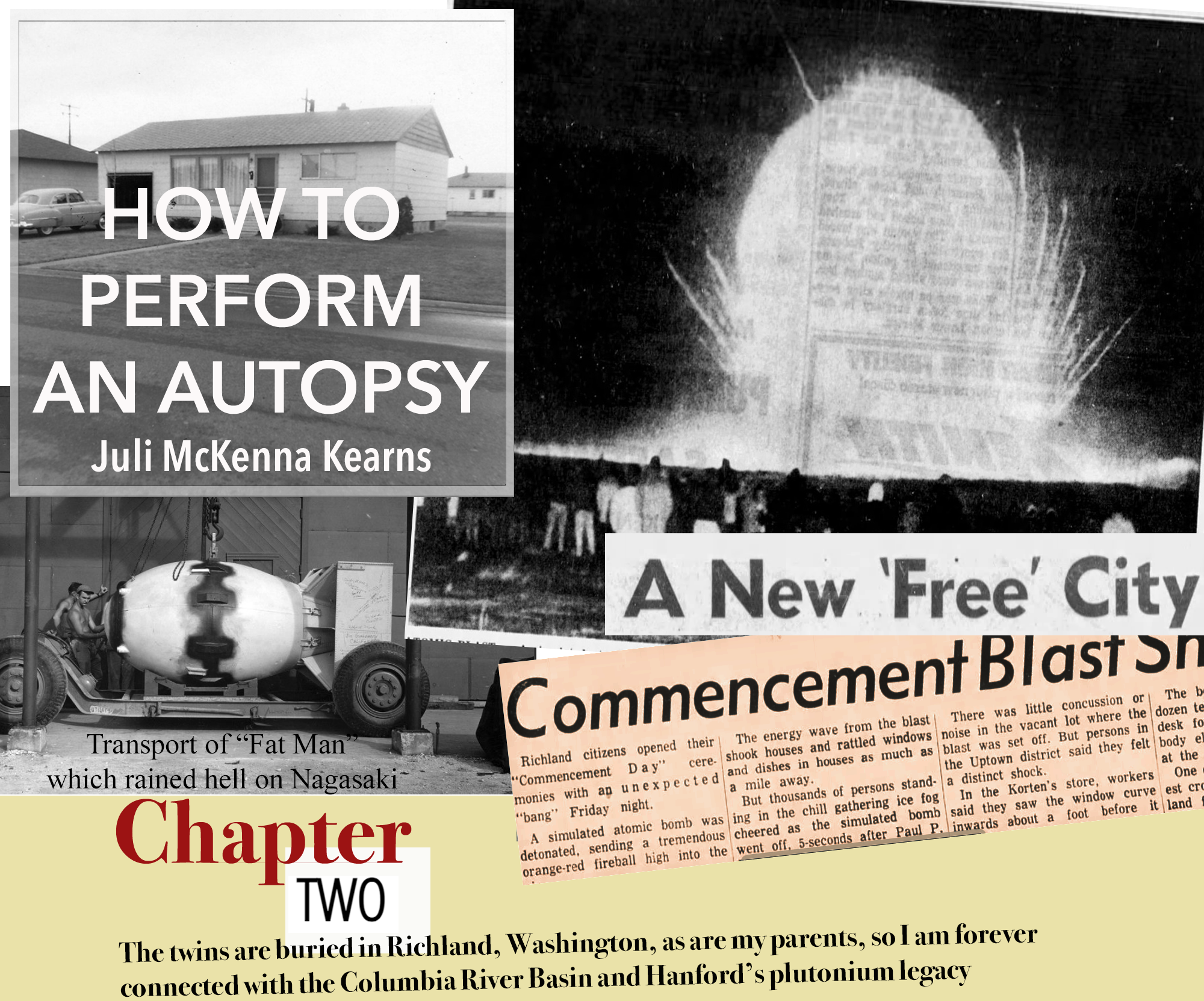
TWO
The twins are buried in Richland, Washington, as are my parents, so I am forever connected with the Columbia River Basin and Hanford’s plutonium legacy
1
Green sea turtles, after hatching from the eggs their mothers have buried in Atlantic coast beaches, are pulled across the sand by a magnetic attraction to the ocean, their little green sea turtle brains hardwired to respond to its siren song, and upon reaching the briny slosh and pulse of its waves make their way to a region of the Atlantic known as the Sargasso Sea, an area rich with brown algae upon which the turtles float, safe from predators, until years in the future another internal clock pings and they venture from the security of their seaweed womb into the ocean world at large. A number of videos are available online of the phenomenon because humans like to be witnesses to what is to us remarkable, even better if inexplicable, which the hatching of the turtles classifies as for a species such as ourselves that is born helpless and spends years being prepared for adulthood by family and society. En masse, sea turtle mothers having laid about a hundred eggs at a time then leaving them to their own devices supplied by their green sea turtle biology, the abandoned siblings bubble up out of the sand and flap flap flap their clumsy but effective front flippers pulling themselves and their portable keratin shell houses down the beach to the water that is their natural home environment. As I watch them in several of the online videos, the flippers act so much like wings that I find myself thinking of them as birds. Left only to our imaginations, we might picture them sedately swimming into the waves, when as they each reach its grip, in several videos I watch, the ocean instead seizes and tumbles them in. From a human point of view the reception can seem a violent welcome, but then life is hard, and though I read that close to ninety-two percent of the hatchlings will make it from egg to ocean, only one in a thousand will survive to adulthood, the bulk of that death toll due a predator higher up the food chain comprehending them as dinner. Even humans. Which is why the sea turtle is now protected under the U.S. Endangered Species Act, and their international trade is prohibited under the Convention on International Trade in Endangered Species of Wild Fauna and Flora. If I were stranded on a desert isle that happened to be host to a sea turtle hatchery, and I needed food and knew enough about sea turtle eggs to know when to watch for their hatching, as they bloomed out of the sands I would be amazed by the spectacle even as I caught and clubbed their cuteness for a meal. One needn’t worry about this prospective, however, as I know almost nothing about sea turtles and would only witness their glorious entry into the world en masse gallop to the ocean by pure dumb luck. Or, for instance, on YouTube.
Viewing the sea turtle’s emergence, what we can’t see is how, with a temporary “milk tooth” (so called to make comparison to the appearance of a human infant’s deciduous teeth when of an age to still be nursing), a carbuncle that will soon fall out after it fulfills its singular purpose, the buried baby turtles break out of their aragonite eggs (aragonite is like calcite but has a different crystal structure), then they must dig their way to the surface of the sand with which their mother had covered them, a task that takes three to seven days. A hundred million years ago they began their existence
Two - 2
as land creatures, that terrestrial heritage observed in their eggs being laid on land, as well their evolutionary migration to the sea evidenced in their scramble for the ocean the moment they surface the sands in which those eggs were buried. If this were a novel, one might now have a character mulling over how such births exemplify the struggle with the task master that is life beating one up from the beginning with the fact that life is hard, but just as you were programmed to be born, you are programmed for giving that life the old college try.
I don’t know when exactly I became aware of growing up, that I would not always be the same, because the “I” of myself seemed always the same to me, what was in me that made me wonder about the world, to want to know it, that examined my experience. In the eyes of a child, adults are such a different breed, it’s difficult to comprehend becoming one, even when you know you will, when I was three I would put on an old pair of high-heel shoes of my mother’s that she kept in my closet and would play at being grown up in them, but I also thought of myself as grown up but in a small body. If one has older siblings, or even cousins hanging about, perhaps it’s easier to comprehend growing up because you see them doing it, and you can anticipate becoming what they are. It may be very psychologically different looking to your older siblings on what it is to grow up, on how to or how not to grow up, than if one is the eldest and has only the adult world with which to compare oneself.
While we inherit instinctual compulsions that would seem as oddly unique to survival and insensible in their specificity as what drives infant green sea turtles into the ocean waves, we are so entrenched in culture and separated from such natural knowledge that for all intents and purposes we are born foreigners to this world and must learn everything either by the casual osmosis of observation or by applied study. Also, we are born utterly and naturally helpless, so that whereas a baby sea turtle follows the command of instinct in its immediate mobility, we are just as naturally intended to depend upon and bond with our caregivers, naturally built to trust them, to share sympathy and compassion, emotions that are fundamental to and part and parcel of the many intricacies of communication and bondedness we are taught and which we seek, and seek as well the rewards of approval that encourage our efforts at mimicry. We come to know what we know by our many ways of being taught, by both personal caregivers and by the broader community, concertedly, and casually, even unwittingly. By the like nature of their own infantile schooling, all these humans share with us the behaviors of what is commerce in the broadest social sense of the word, and the complex histories that are intended to tell us the whys and wherefores before we can form the most innocent and childish questions of context, so that before we know it the world simply is what it is and always has been. And despite and because of this, we learn to make comparisons and judgments that all arise from our most primitive demonstration of selfhood when we one day feel an injustice has transpired, we have been treated unfairly. Eventually we must, or should, determine the real function and utility of all we’ve been taught, and whether it was right and sane. Some feel so at home in their instruction they are comfortable where they are and by and
Two - 3
large accept it with perhaps some personal adjustments. Others may be compelled to, piece by piece, break it down, pry the machine apart, and examine the cogs and wheels of what seemed like truth, when they espie perhaps what might be the slightest tell that there’s a break in the system. We may realize something is wrong but then not have a right thing with which to replace it. We may not be able to trust what is right according to our own experience, because beliefs based on incomplete personal observation can often be in error, but we will know that something is wrong, the machine is not working as we’ve been told it should. Something in the machine itself tells us that it’s not working as it should.
Perhaps one of our most fundamental, perhaps even one of our first introductions to the machinery of the universe, that it works around us regardless of anything we or anyone does, is that the sun daily rises and sets. And so we learn to count our lives by days.
The sun does not revolve around the earth. Galileo, who supported what was then a theory of heliocentrism, rather than a proven fact, in 1633 was found guilty of heresy and placed under house arrest for the remainder of his life, under the reign of Pope Urban VIII. The truth was criminalized, but not necessarily because it was believed to be so wrong that Galileo should be imprisoned for it. It could be argued that Urban VIII knew that Earth was not the center of our universe, but to replace Earth with the sun was, at the time, on par with shoving humans off the pedestal that bore the congratulatory identification of Reason for Which Everything Exists. Pope Urban VIII’s rejection was less a matter of failing to understand how the universe works than selecting the model more beneficial to his situation as Pope. As early as 270 B.C.E. Aristarchus of Samos had proposed a heliocentric system. But even Martin Luther, former Augustinian friar (the emblem of the Augustinian Order is a fiery heart pierced by an arrow, reposed on an open book, suggestive of the search for both divine and earthly knowledge) and father of the Protestant Reformation, excommunicated from the RCC in 1521, was in agreement with Rome and took exception to Nicolaus Copernicus’ theories on a heliocentric system when in 1539 he reportedly said, while at dinner, that Holy Scripture attests Joshua, doing battle with the Amorite kings at Gibeon, told the sun to stand still, not the earth, and that’s that, proof positive the sun revolves around the earth and not the earth around the sun, or else Holy Scripture would have told us the earth was ordered to stand still. One wonders why this bit of history is attached to Martin Luther dining. What is the significance of this that makes it part of the story. But some hold that the Roman Catholic Church early on accepted the heliocentric system theoretically, however feeling the pressure of the Protestant Reformation they backtracked and so banned Copernicus’ 1543 “De Revolutionibus” from 1610 to 1835. It’s now difficult to imagine that in the early seventeenth century the common knowledge was still that Earth was the center of all things. Shakespearean audiences believed that the sun circled them as they sat in the Globe theater. As the sun revolved around him, Hamlet wondered over the philosophical question of to be or not to be. Difficult to imagine that when
Two - 4
Meriweather Lewis and William Clark were conducting reconnaissance in the Northwest Territory for America’s expansion to the west, “De Revolutionibus” was still banned, though the RCC in 1758 had made the determination it wasn’t heretical to teach heliocentrism. As our ancestors moved from the geocentric to the heliocentric model, perhaps there were some who couldn’t take easy passage on that ship and sailed off on their raft into a madness that was their abandonment by God, yet here we are, descendants of the survivors.
Did any of the ancients ever really imagine the sun was Apollo in his chariot with racing steeds or was this only always poetry? I readily confess that though I was early educated on the fact that the earth revolves around the sun, when I gaze up at the blue sky I see the sun as mobile, traveling from east to west throughout the day. That does not make it so. What my perception does reflect is my very self-centered human belief that where I live is the center of all things, but then when I view a night sky unvarnished by light pollution from cities, depending on which way the wind blows, I am either crushed or breathless with wonder at the grand panorama my human brain hasn’t the wherewithal to comprehend. The daylight sky anchors us to Earth as the main stage on which we conduct our lives and business. The night sky, away from street lamps and the gaudy brilliance of LED (light emitting diode) signs, tears away our protective walls and replaces confidence with questions. Even those generations who viewed the fixed stars as light entering through holes in the firmament, revealing the divine beyond, felt the disorientation of grand mystery.
We are not green sea turtles whose biologies can trust that the magnetic pull of instinct is carrying them to where they should be if they are to survive. Humans get ideas in their heads and construct worlds of supposed evidence to support them, which means that the essential instinct of humans is to believe that what they imagine to be true is right.
Humans can’t walk in a straight line. We believe we walk in a straight line but, without a point of reference, if there’s no sun or horizon to anchor us, we begin to circle and become lost. We place one foot in front of another and believe we know where we are going but don’t. If migratory birds have an inner compass that enables them to use the earth’s magnetic field to guide their flights north and south, we don’t have that. Maybe this is why a compass can be so peculiarly fascinating. Underlying our belief that we can walk a straight line if pointed in the right direction is a stronger belief in the little moving magnetic pointer of the compass. We are compelled to trust its arrow even if we know nothing about how a compass works, even if we don’t know what a compass is. There’s an arrow. Follow it. We trust that arrows always know where to go. We are constructed to instinctively believe in arrows.
A great portion of our lives is erroneous information, which is often nothing more than an innocent failure for someone to disseminate correct information, which is incorrect information that is spread about, and even one true account then creates a conflict of information, nothing nefarious about it, but without concrete firsthand
Two - 5
knowledge or sound documentation it becomes almost impossible to sort through varying accounts and conclude what information is correct. Or information may not be in error but different incomplete accounts give different descriptions that break up a thing and make it into something other than what it is. If the accounts are too spare they can generate different stories when people try to fill in the blanks, which is what humans often do, they attempt to make a fulfilling story out of one that has too few words, they try to force out of too few facts a history. And yet humans tend to also not like stories to be too involved. Most prefer a simple story and can take two facts and conjure a whole story in their mind that supplies everything they need to know about who did what and why and what should be done about it.
The great Columbia River begins in British Columbia, Canada. A website, which should know the facts, says the river’s origin is in Columbia Lake in British Columbia, but another website states that the Columbia River begins up at British Columbia’s Kinbasket Lake, when instead at Kinbasket Lake the Columbia River takes a dramatic turn to the southeast and travels 138 miles down to Columbia Lake. Tracing the Columbia River’s path on Google Maps, I find that where the river passes over the border from Canada into the USA, no town has cropped up to celebrate this transition. Despite this, nearby on Google Maps there is supposedly a Loblaw Pharmacy, which is odd as physical pharmacies invariably belong to towns. Loblaw Pharmacy turns out to be a little wood building, painted green, one door, no windows unless there is one on the riverside of the building which can’t be seen on Google Maps. The building is of a size to resemble a little railroad crossing shanty, but it doesn’t have windows looking out on the railroad that’s across the two-lane highway from it, and there’s no railroad crossing besides. There is no corporate sign observable from the road. This little wood building does have what seems a little white slip of perhaps signage by the door, the type that when you get close enough to read will either say “Closed for the Holidays” or may provide, as may be in this case, a small print official reassurance, for those who have perhaps been instructed to come here to pick up their drugs, that they’re at the right place, for I check also a map of “all pharmacies registered with the College of Pharmacists of British Columbia” and this little green closet of a shack is listed and given an address, which is right where this little green shack is. Next to its front door are wooden stairs that lead down to the river, maybe to a place where a boat can dock and a person can climb up from that assumed-to-be but unseen dock and either deliver to the shack or pick up from it medication. I don’t know. The story that the Columbia River began at Kinbasket Lake was wrong but appears to be right if you find it too preposterous that the Columbia River begins south of it, flows north, then turns south again. Where do you think you’re going, river? Why do you behave like a human who’s lost in the forest, but we know you’re not human as you do eventually make your way to the ocean. The little wood shack that is identified as a pharmacy looks like erroneous information, or maybe it is a Google glitch. Or maybe this little green building services the British Columbia side of the Canadian border as an outpost legitimately used by a pharmacy elsewhere to drop off drugs for people who live in the area. I don’t know. This tiny
Two - 6
little thing is a mystery. I made up a story to try to explain a mystery and I have no idea if I could possibly be right, and I could very well be wrong. Nevertheless, there is Loblaw Pharmacy.
Something something happened sometime somewhere. This may have happened but it may have been something else that happened. It looks like such and such happened according to this account, which differs from that account, and even if there’s a working camera in the vicinity feverishly documenting all activity that enters its field of vision we may or may not absolutely know anything.
Yet there are things we know to be true, and there are things we absolutely individually know to be true that perhaps no one else knows the truth about.
What is a thing we know that is true?
We know what the element of oxygen is atomic mass 15.999 u, atomic number 8, discovered in the eighteenth century, we know it is a gas, the most common element on Earth, and the third-most common element in the universe, beaten out by hydrogen and helium. Helium, though the third-most abundant element in the universe, is rare on Earth. Hydrogen, which the universe loves, is only 0.14 percent of the Earth’s crust by weight, but it is common in compounds, such as water, which is made of two hydrogen atoms and one oxygen atom, chemical formula H2O, hydrogen buddies up with carbon and is thus in all animal and vegetable tissues. These things we know are true and many truths about them have been discovered since they were first introduced as facts. While only elements up to the atomic number 94 exist in nature, plutonium being that 94th, many are synthesized so the periodic table of elements has 118 elements, with more still to come.
We know that the earth revolves around the sun and that the G-type main-sequence (G2V) yellow dwarf star which is our very own personal sun is about eighty-five percent hydrogen and fifteen percent helium and that it spends its time, every second of it, manically engaged in a process of hydrogen fusion that every second (“the duration of 9,192,631,770 periods of radiation corresponding to the transition between the two hyperfine levels of the ground state of the caseium-133 atom”, according to Wikipedia) converts four million tons of matter into energy, yet children interpret the sun as a happy, jolly Earth partner and draw it smiling down on them from above, because we are just distant enough from its blinding orb (“Don’t look at it! You can’t stare at the sun!”) to not be burned to a crisp by the largesse of its fire. I was one of those children who sometimes styled the sun with a smiling face, and I still rather think of the sun as a jolly partner for Earth. I have learned to not be too distressed by the fact that one day it will no longer be our smiling buddy, it will become an out-of-control red giant star and then fizzle away into a white dwarf star. These are things adults typically do not tell children out of the fear that a child’s mind would not be able to cope with the knowledge that their very own personal star is destined to burn itself out. At least I didn’t tell my son, as a very young child, that the sun will one day die.
Two - 7
I don’t remember being told, as a child, not to stare directly at the sun, yet I must instinctively not have done so because my retinas aren’t burned out, just as the retinas of most adults aren’t burned out though they were all once children out and about in nature, under the great ceiling of the sky, and they too must have instinctively not stared directly at the sun, for I know parents don’t universally, every one of them, tell their children not to stare at it else there wouldn’t be public service announcements yelling, with every solar eclipse, “Don’t stare at the sun! Wear special glasses!” One way or another we know that staring at the sun is a bad thing.
We know that a rose is a rose is a rose but the appearance of roses varies as there are three hundred species of them and tens of thousands of cultivars, which means that humans, loving roses, have greatly elaborated on them.
We love novelty.
Oh, that’s a pretty drinking glass. Oh, I like the sound of that band. Oh, I love the color of that sunrise. Has someone made it into a rose?
We think we know what a color is until someone who knows Pantone sidles up next to us and lets us know otherwise, or until we try to make sense of the color we’re told turquoise is versus its appearance as turquoise stone. I think I know what the color orange is, in so many shades and tones, but then my son or my husband will look at what I think is red and call it orange. I believe I see the same color they do but interpret it differently.
We grow up knowing that tomatoes are vegetables because that’s what we’re taught—right now go look up “pictorial vegetables chart” on Google and I guarantee you that the tomato will be included, it’s not on fruit charts—then one day a “fun fact!” crosses your eye that informs, “Tomatoes are a fruit!” Which they botanically are. And if you’re young enough your mind is blown. Wow.
In our apartment right now I hear a minor storm that has begun outside, perhaps becoming less minor by the instant, thunder coming closer, the rain beating on the metal of the air conditioner lodged in a window behind me and against the glass above it, now beating harder, and that my son, working on an animation, has just turned to look toward the window. His back is to me and he doesn’t know I’m writing about him. One of the people who lives upstairs is walking about. These are things I know as true until I call to my son and realize as he moves away from his drawing he’s not working on his animation after all, he’s deep into another project.
It is true that there are certain exact things sitting on my desk. I can see them, and as far as things not immediately seen on my desk I think I know what is there because this desk is mine, others don’t normally touch anything on it, we are proprietary in this household about our desks, and I believe I know what I’ve placed on it. But if someone removed one of these things to which I’ve not paid any attention in a while, I
Two - 8
may never notice it’s gone unless I need it. Ask me where it is and I will say it’s on my desk, though it’s not, because as far as I knew it was. My assumptions, in this respect, can’t be trusted, just like I can’t be trusted to walk a straight line due anywhere, point me down a sidewalk and within six feet I’m already starting to turn and walk into the person beside me or a telephone pole. To the best of my knowledge, I’ve always done this. If it’s because I’m neurologically off-kilter in ways that I don’t already know about then I’m fine with not knowing because I manage. I’ve sometimes attributed it to my having the same genetically wonky, off-kilter feet as my mother, though even worse than hers, a characteristic I passed along to my son, and I’m sorry about that though I’d no control over what genes he got.
As for me, I will also know something to be true but sometimes will replace that truth with erroneous information, as many will. I vacuum the floor but if someone calls and asks me what I’ve been doing I may say “nothing” because the vacuuming of the floor wouldn’t matter to them, it’s a household task that doesn’t merit mentioning. If I stand looking out the window and you ask me what I’m looking at I may reply “nothing”, when instead I’m taking in a lot of information everywhere I set my attention, I may be even taking in exceptional information and not know this, which is reduced to “nothing” because nothing may seem worthy of remarking upon, and I might be thinking about something other than what I’m looking at and that’s either not worth remarking upon or I don’t feel like remarking upon it.
I also outright lie, as many will. “How are you doing?” I’m fine. I also know when my opinion isn’t fact, it’s just my opinion, and sometimes my opinion doesn’t matter, I know it can change, and if someone asks me if I like, for instance, a new item of clothing they are wearing that they love, I might say, “It’s great,” because I need instead to look at it through their eyes and see what they see, which is also how one broadens one’s world a little, or by leaps and bounds, understanding it’s not all about your preferences. That’s not the kind of lying that is a harmful breaking of trust.
We compartmentalize and may lie for sake of privacy. Children lie as a process of developing independence, boundaries, a sense of self. We may lie because we comprehend that the person we’re speaking with isn’t trustworthy, they have ulterior motives that aren’t worthy of the truth.
Inadvertently passing along misinformation isn’t lying. I know I might very well hand out erroneous information if I don’t check my facts first, so I enjoy the technology of my little computer-phone in a pocket upon which I can look up available facts and maybe the facts I find are right and maybe they’re wrong, maybe they’re in good faith mistakenly wrong and maybe they’re carelessly wrong.
During my life, I’ve been told a lot of things were true, and to the best of their knowledge they may have been true to the person who told them, they were not lying. I’ve been told a lot of things were true that were also intentional lies or half-truths, and I have no way of knowing all the times this has happened but I trust people do
Two - 9
this a lot, out of a matter of convenience, because it’s less difficult, because they are protecting how they portray themselves, in order to sway opinion, in order to avoid a conversation about how things really are, to preserve one’s natural privacy.
The truth is sometimes what one or another, many or a few, might want not to know, and so people lie about it. And people deliberately manipulate the truth to conceal facts deserved by others.
There are people who whenever they open their mouths they lie, and they are not deluded, they are just liars.
I’ve been told things were true that were misremembered and not true. I misremember things as well. I end up thinking of a lot of things as being true when I can only actually say that much of what I’ve believed to be factual is only true to the best of my knowledge. Sometimes it doesn’t really matter what was true, though one ends up believing an untruth, because it doesn’t impact one’s life. Other times it does matter, but telling the truth, or the truth that one knows, takes time, and that can be very boring to people. It’s too much information. They want the world compressed into a single easily consumable bite. They don’t want a history even though the truth takes time. One condenses and the truth becomes anemic and open to interpretation.
Because I don’t know with certainty some of the basic facts about my life or the lives of my parents, what I’ve been told, today I’m searching the internet hoping to learn how 1950s child safety locks for car doors were installed and how they worked. I come across one that is being sold on eBay, a museum piece still in its packaging, a 1950s child safety lock for AMC, Chevrolet, Pontiac, Ford, Mercury, Dodge, and Chrysler models. Pictures of the packaging are supplied, and on the back are instructions in blue print that tell me little about how these locks, which require no drill, only a screwdriver, are installed. Slightly more informative is a blue and red illustration on the front of the white packaging that pictures the mechanism as attaching to the main gutter of the door in seconds, the device shown on the outside of the car where the door meets the roof. One locks the door by turning the instrument from a horizontal position to a vertical one. Thus positioned, crossing where the door meets the roof, the item prevents the door from being opened from the inside. I will assume that a part of the mechanism on the interior has also turned horizontally. Above and to the left side of this is an illustration of a child of maybe seven to ten years of age lying face down on a street while the car from which the child has fallen speeds on, the driver and passengers apparently oblivious, or perhaps a faded portion of the illustration shows a passenger in the car who looks back in astonishment. I can’t say with perfect knowledge one way or another because the visual information has deteriorated.
A black-and-white photo from June 1958, in Lawrence, Kansas, shows my father on the left, and my mother holding me, standing beside him on the sidewalk before their car. I’ve always assumed they were standing before the apartment building in which
Two - 10
they lived, facing it, and that the house behind them, as seen in the photo, was directly across the street from the building. I’ve always pictured them facing the apartment building for the photo and the person who took the photo thus capturing the other side of the street. I’ve always connected the photo with our being about ready to leave Lawrence and this is like a “so long” shot. However, when I check Google Maps, I find that the background is not, as I’d supposed, the house opposite the apartment building. This large white house with a front porch, across the street from where they stand, is on a significant enough rise that it’s approached by three tiers of concrete stairs overgrown with grass. A Google Maps view of the side of the street across from the apartment building in which we lived in Lawrence, Kansas, shows an old house with a front porch but it is level with the street, as are the neighboring houses. So, I don’t know where the photo was taken after all. My father is dressed in an immaculate white shirt, the sleeves rolled up, and wears light-colored trousers, probably a light beige, held with a narrow belt. His shirt and pants are perfectly ironed, permanent press not yet available, which testifies to the truth of my mother’s expertise at ironing, of which she sometimes spoke with some pride, especially in the case of a company of famous flamenco dancers whose costumes she ironed, which were difficult, and she was precise as a surgeon. I’m in a little sun suit, both my socks stretched out at the toes by about three inches, and I lean away from my mother to look up with an open-mouthed smile at the photographer, recognizing our photo is being taken and responding. My mother’s hair is growing out from her pixie cut she got after my birth. She wears an awkward-looking pair of dark shorts and a long, loose short-sleeve shirt buttoned up to the neck. I am almost a year old and don’t know she is about five months pregnant. This pregnancy follows my birth so closely that one might wonder if it was accidental, but she never indicated that it was.
The rear door of the car doesn’t appear to show a safety lock, but the door is also partially blocked by my parents.
I now turn to a black-and-white photo of the car in the driveway of our first Richland home, developed in April of 1960. I stand beside a girl who is about three years older than me and she embraces a box of Cracker Jack caramel-coated popcorn and peanuts from which she shares about two bits of popcorn with me. Near us is her toy baby carriage she has wheeled into the yard. I’m in a light-colored short-sleeved dress, and she’s in a striped dress with a thick sweater over it, so there’s vaguery about the weather. Her little brother, about my age, is a blur rushing into the picture’s frame from the lower left corner, and I know he’s eager to get some Cracker Jack as well because a second picture depicts her doling out a little to him and grinning big for the camera as she does so. I remember this incident probably because it involved Cracker Jack, and I felt as though she was a little stingy with the candy, the way she parcelled out just a couple of bits for me and her brother, but then it was very easy to want the treasured box of Cracker Jack all to oneself. I wasn’t yet three years of age and she was a little too old to play with a younger child without being bossy, which could be off-putting, but I considered her a good friend. Her little brother I thought
Two - 11
of as infantile as he only communicated with grunts and hand gestures, wore what I looked upon as childish overalls, and I was irritated with children my age who behaved as though they were children. He once walloped me in the mouth with a toy gun, not accidentally but intentionally, because it was the kind of thing he would sometimes unexpectedly do, as if he was unable to control his emotions yet, and when I went crying to my mother about it she told me I was a crybaby, she wasn’t going to fight my fights for me and demanded I go back out and whack him, then was mad with me when I instead went out and, having found he’d calmed down, returned to playing with him because I didn’t want to hit him, I wanted to be friends. Not long before we moved to Seattle he gave me something he’d found in the back yard, the kind of mysterious little thing one finds by chance, a discovered thing, which becomes a prize, and when he handed it to me I realized he liked me, he wanted to please me with a gift of a thing that was special, and I thought of this as my first boyfriend-girlfriend interaction. Whoever took the several photos of us sharing Cracker Jack surprises me with the third photo as they have taken the picture from above, which means they have climbed up to stand on the front stoop in order to get this perspective. They were trying for a photo that told a story about the three children with the Cracker Jack. They had made an attempt to be creative and I would wonder if it was my mother but she hated taking photos, she didn’t like working the camera, she didn’t like framing up a picture.
The reason I looked at these several photos was to see if there was a child’s safety lock on the car door, and there’s not.
2
Everyone needs a crisis within their first year of life, and mine was one that became confusing as there were at least three very different versions of it and I will never know which of those versions is true.
That we move from Lawrence as soon as my father graduates from the University of Kansas means that he would have been applying for jobs before his graduation, and landed one with the pockets to pay for a moving van to carry their apartment’s belongings across the Kansas plain, over the Rocky Mountains, to Richland, Washington, nearly seventeen hundred miles away, a place at the confluence of the Columbia and Yakima Rivers, far removed from any large cities, such as Seattle to the northwest, Portland to the west, Spokane to the north, and Boise, Idaho, to the east. In the semiarid desert way down in the southeastern part of Washington State are the “tri-cities” of Richland, Pasco, and Kennewick. Richland is on the west side of the Columbia River and above the delta formed by its conjunction with the Yakima River, the source of which is the Keechelus Lake in the Cascade Range near Snoqualmie Pass, the Yakima flowing down from the northwest to join with the Columbia slightly below Richland. Pasco and Kennewick are below the delta. A little further below Pasco
Two - 12
and Kennewick is where the Snake River also flows into the Columbia, its path having taken it from Jackson Lake in Wyoming through the Grand Tetons and Idaho. With the contributions of these two major tributaries the Columbia begins its gentle curve to the west so as to create the border between Washington and Oregon States in its grand push to the Pacific Ocean.
If I now describe the rivers and their geographic relationship to the towns that sprang up around them, it’s because when I lived among these rivers I thought of them as vital forces that shaped everything about our lives, and greatly impressed with them forever moving on to elsewhere, far away.
Above Richland, about nineteen miles to the northwest, is the Hanford Project, which is also called the Hanford Site, and during WWII went by Hanford Engineer Works (HEW). A reason that area was selected for the Hanford arm of the Manhattan Project, during WWII, is because they needed plentiful hydroelectric power, and a lot of cold water was going to be to cool the reactors. Also, they needed to be located far away from major population centers.
After WWII, though everyone knew about the Manhattan Project, The Bomb, Hiroshima and Nagasaki, very few people knew about Richland. When we later moved far away from Richland to Georgia and I told others about Richland they would look at me askance, not believing. They might even say, “No, that can’t be,” but it was, they simply hadn’t heard about Richland and its role in the Manhattan Project and they believed they would have heard about such a place if it really existed. When I told them about the whole-body counter through which Hanford ran the schoolchildren of Richland, gathering information on radiation accumulation, I wasn’t believed. When I related that my father had conducted radiation experiments on miniature pigs, and that we had reason to worry about Hanford not being forthcoming about radiation leaks, adults would tell me, “You’re making that up.” They didn’t want to believe because they wanted a simpler world than what Richland was, they wanted to think there weren’t secrets as big as towns. They didn’t even know Washington State held a semi-arid desert and found that almost as impossible to accept. It gets tiresome being told, “You’re making that up.”
Richland began as a secret place, and its origins in secrecy stayed with it even when it purportedly became not secret, but was still secret enough that decades would pass before important information about Richland and Hanford began to be declassified and released, facts that caused the part of the public that was attentive to recoil in horror.
Richland isn’t exceptional in that everywhere has its own pockets of secrets. People will accept that their workplace has its own behind-the-scenes secrets but don’t understand how everywhere people gather there will be the formal facade for public consumption that covers up what’s under the counter. This doesn’t mean that what’s under the counter is toxic, but there are many situations in which it is. In the case of
Two - 13
Hanford, the behind-the-scenes facts were toxic, endangering the Columbia River Basin with nuclear waste leaking into the groundwater from tanks that had been built to last only ten to twenty-five years.
Between 1940 and 1950 the population of Kennewick grew from 1918 people to 10,106, a 427 percent increase. Between 1940 and 1950 the population of Pasco grew by about 161 percent, from 3913 people to 10,228. Between 1940 and 1950 the population of Richland grew from 247 people to 21,809, an increase of nearly 8730 percent.
Richland and Hanford, built far away from civilization, in 1945 was the second-most populated city in Washington State with 50,000 people who had gathered to labor for the war effort. It was a secret place, despite the Hanford site occupying roughly 600 square miles, and what everyone was doing there was a secret, even to the majority of the people who lived and worked there.
That kind of dramatic increase in population immediately tells you a lot about Richland and Hanford. In the old west, gold rush towns exploded in population because the secret got out that here was gold and people came flooding in hoping to get there in time to grab a piece. Richland was a secret and still it exploded in growth, with people drawn there for the singular purpose of manufacturing the plutonium that was needed for Fat Man, the bomb dropped on Nagasaki on August 9th, 1945 at 11:02 a.m., immediately killing 35,000 to 40,000 people, ultimately 60,000 to 80,000. Because of Little Boy, dropped on Hiroshima on August 6th, Nagasaki became a kind of afterthought in history as it hadn’t the privilege of being the groundbreaking first. John Hersey wrote a book about Hiroshima, called Hiroshima, which is a great book, I highly recommend it, and Nagasaki retired further into the shadows because humans are taught to think of everything as a contest and if you don’t get first place you’re a loser. Nagasaki hadn’t even been the destination of Bockscar, the plane that delivered Fat Man. Nagasaki was the second option in the case that the primary target, the city of Kokura, wasn’t accessible. Nagasaki was almost not accessible because of cloud cover, but then a hole opened in the clouds and the crew of Bockscar would have felt they were lucky.
Up to the end of WWII the majority of those who worked at Hanford were only aware they were laboring on something for the war effort, not knowing what. People had cover stories. A stranger might ask you on the bus what you did for work and your cover story was that you made shoes. If you didn’t tell your cover story and you were talking to the wrong person then you were in trouble and out of work. Signs were posted everywhere reminding one of the importance of secrecy. At the end of WWII, the people of Richland learned they had built the plutonium for Nagasaki, which became the identity of the town. In the summers they had an Atomic Frontier Days festival and parade in which they portrayed themselves as pioneers of the atomic age. A 1954 photo shows a float upon which the GE (General Electric) Plastic Man, in his radiation protection suit, shakes hands over a fence with the male representative of two twentieth-century settlers in western farmer-cowboy attire. Plastic Man, looking
Two - 14
much like an alien visitor from a 1950s sci-fi film, stands on a black-and-white checked floor, the pioneers on turf backed by two tumbleweed bushes. Well, wait, I need to make a correction. When I look at the photo again I remember it doesn’t show them shaking hands, but one knows from the dynamics and messaging that they did shake hands and that the photographer didn’t catch that moment. The float reads “Where the Old West Meets the New” and “10th Anniversary Start-Up of the First Hanford Reactor”. After WWII there now came to Hanford people who knew what had been worked on and had other work with plutonium to do and other secrets to maintain during the era that was the Cold War.
Sometimes I have the feeling that my father gravitated to Richland and Hanford because it was a secretive place and he knew how to keep secrets. A manageable life was one in which everyone trusted in secrecy. He may have intuited that where secrecy is prized, it may be acceptable in all areas of one’s life. Secrecy was his basic mode of operation because he never talked about anything, and that need for secrecy was imparted to me, so that eventually when I wanted to tell even a little bit about things that shouldn’t be secret, I tried to do so in a coded way if it was personal, because if I said even the littlest truth about our lives the internal psychic slapback was so profound that I’d feel ill.
My father would have had, of course, security clearance to work at Hanford, everyone had some degree of security clearance, but I don’t know what level of security clearance his was, whatever was appropriate for his radiation research.
I look at a website that has one of the secrecy signs, an example that would have been put up after WWII, because there were still things to be secret about but that the area’s business was one of plutonium production wasn’t one of them else the billboards wouldn’t reference “chain reaction”. The text on the roadside billboard is “LOOSE TALK, a chain reaction, for ESPIONAGE.” The accompanying image is a diagram of what is called an uncontrolled nuclear chain reaction, the type that happens in nuclear bombs. The sign reads like attention-grabbing tips were drawn from advertising for Hitchcock films. Immediately below the sign on the web page is the header “Manhattan Project Locations: Oak Ridge, TN.” The page concerns an interview with a counter-intelligence agent who worked at Hanford and a woman who worked in classified files at Oak Ridge. The website is run by the Atomic Heritage Foundation whose business it is to collect and frame information on the Manhattan Project for the public. The sign, which appears to be identified as in Oak Ridge, Tennessee, was instead, as pictured in the photo, located at Hanford. When information was first being declassified about Hanford and put online on an unnecessarily unwieldy government website with almost no search functionality, I spent some intensive time trying out search terms to learn what was likely to yield interesting results and collected about 850 pictures from Hanford and Richland that were human interest rather than the construction of the reactors. I gathered pictures of parades, safety and fire prevention campaigns, the Hanford trailer city and environment, the secrecy signs, Hanford at work, Hanford celebrating Christmas, the numerous prizes and awards that were dispensed in an effort to build community
Two - 15
https://upload.wikimedia.org/wikipedia/commons/0/06/New_York_Times_Oct_1910_article_on_Edgar_Cayce.gif spirit, vaudeville entertainments, talent shows, the building of Richland, Atomic Frontier Days festivals, Tony the Atomic Clown and his miniature circus, the artists of Richland, not just wartime but early Cold War life in Richland. The photo of the “LOOSE TALK, a chain reaction, for ESPIONAGE” sign was one I dug out of the repository and posted, along with all these other images, on my photography site on Flickr along with DDRS (Defense Data Repository System) details, because identification matters. The document date for this image was 11 February 1954. The description was “Security Billboard on Area Highway.” Its document number was 7653-2-NEG, and its accession number N1D0027007. The picture shows the tumbleweed semiarid desert of Richland partly covered in snow. It is obviously not Oak Ridge, Tennessee. Oak Ridge is not in the desert.
A place is classed as a desert if it receives fewer than ten inches of rain a year. The yearly average for Richland is eight inches of rain whereas the yearly average for the United States is thirty inches a year. While looking at photos of how Richland currently appears, taking in how it currently sees itself, I came across one website that has described Richland as getting a lot of snow and one has to wonder what their definition of “a lot” could be.
A project my father would have been working on in the late 1950s would result in the paper “Zinc-65 Metabolism and Dosimetry,” authored by my father and Roger O. McClellan, introduced by Leo K. Bustad, out of Hanford Laboratories, presented at the 8th annual meeting of the Radiation Research Society in San Francisco, California, May 9th through the 11th in 1960. Six rams (you know, as in male sheep) were used to “determine gastrointestinal absorption, rates of uptake and turnover in the major tissues”. The National Isotope Development Center states that because of its gamma- and positron-emitting properties, zinc-65 is an isotope “commonly used as a tracer in physical and metabolic studies”. A 1959 paper by R. W. Perkins and J. M. Nielsen explores the absorption of zinc-65 in foods and people, the abstract of the paper noting that trace amounts of zinc-65 were disposed of in the Columbia River via Hanford reactor effluent water. This water, used for irrigation, meant a concentration of the radioisotope in humans via farm produce. Both authors were with the Hanford Laboratories Operation, General Electric Company, in Richland.
At Shechem is where the Biblical Abram came to the great tree of Moreh and received the prophecy that the land would be given his offspring, for which reason he built an altar there. The land was then ruled by a king named Abimelech, who took Abram’s wife, Sarah, for his own harem, unaware that Sarah was married to Abram as Abram represented her as his sister. Abram is excused for handing Sarah over to Abimelech as he thought if he didn’t he might be killed for her, but because Sarah was destined to only have a child by Abram, Abimelech’s house was thus cursed and he was temporarily made barren. When Abimelech rebuked Abram for having lied to him, Abram asserted he hadn’t as Sarah was his half-sister, they having the same father but a different mother. Abram’s grandson, Jacob, settled at Shechem and purified his house from “strange gods” by burying their idols under the oak. In the Biblical Book of
Two - 16
Judges, 9:45, is recorded the destruction of Shechem by yet another Abimelech. “And Abimelech fought against the city all that day; and he took the city, and slew the people that was therein, and beat down the city, and sowed it with salt.” The sowing with salt devastates land so that it becomes unusable for farming. Sowing with salt can also be considered a purification rite. A “salted” nuclear bomb is one that is designed to be a radiological weapon with an enhanced level of radioactive fallout that would make a large area uninhabitable. Zinc has been proposed for such a device. Wikipedia states that “A jacket of isotopically enriched zinc-64, irradiated by the intense high-energy neutron flux from an exploding thermonuclear weapon, would transmute into the radioactive isotope zinc-65 with a half-life of 244 days and produce approximately 1.115 MeV (maximal extractable value) of gamma radiation, significantly increasing the radioactivity of the weapon’s fallout for several years. Such a weapon is not known to have ever been built, tested, or used.”
Some of the other projects my father worked on produced papers with such names as, “Plutonium Metabolism in Miniature Swine”, “Preliminary Observations on the Biological Effects of Strontium-90 in Miniature Swine”, “Metabolism of Strontium-90 in Miniature Swine,” “Bone-seeking Radionuclides in Miniature Swine”,“Dosimetry of Cæsium-137 in Sheep”, and “Effects of Dietary Calcium on the Metabolism of Strontium-90 and Calcium-45 in Ewes and Suckling Lambs”.
Sinclair Bio Resources produces miniature swine for scientists. It currently lists four “options” of miniature swine: the Sinclair, the Hanford, the Yucatan, and the Micro-Yucatan. I’m going to assume that the “Hanford” swine is named for Hanford and is the kind upon which my father experimented. Exploring the Sinclair Bio Resources website further I find that my assumption is correct, the background on the breed is that the development of this swine began at Hanford Labs in 1958, the year we arrived there, beginning with two Palouse gilts and one Pittman-Moore boar, later adding more Pittman-Moore and a Louisiana Swamp hog that further reduced their size. The animals are guaranteed to be socialized.
We arrived at Richland—from where my father would Monday through Friday take the work bus out through the desert to Hanford to conduct experiments with radioisotopes on creatures such as miniature swine—in a 1952 Chevrolet Deluxe Styleline 4-door sedan (see Wikimedia Commons for a picture of the exact model). It took me forever, or a day’s research, to pinpoint the make of our car, which I remember as we still had the car in Seattle, and though I well recollected the chrome divider down the center of the windshield, and how it was a beautiful Twilight Blue (code 477), I had to rely on the Cracker Jack photos of it for identification via those photos showing chrome gravel guard accents next its front and rear wheel wells and its five-tooth grillwork.
Or rather, I should say we arrived at Pasco, living for a short while in a furnished rental where my first birthday was celebrated. Five photographs document that June event. The kitchen and dining room form one large room in a furnished apartment
Two - 17
that would have been modern for the time. In the dining room is a built-in bookshelf with various shelf arrangements, including cabinets, one into which the heater for the room is set. In one of the photos we’re granted a view to the left of the hall that interrupts the wall where the dining area shelving stops and we see the kitchen begins on the other side with white cabinetry at bottom and shelves above, a roll of paper towels on display on the counter, the dish towel rack empty. The dining room table is the style with a Formica top and steel tubing legs, the vinyl cushioned chairs also having steel tubing for legs. Seated in a child’s booster seat that has been tied to the chair with string, attired in a little dress and baby shoes, gesturing toward the kitchen, in the first photo I start out happy enough; in the second photo I face the camera looking a little confused about either the prospect of a cake or the concept of celebrating a birthday; my mother helps me cut the small cake with a large cake knife in the third photo; in the fourth photo, seated the length of the table from me, she leans forward to guide a forkful of cake to my mouth, two tall half-glasses of milk now on the table; by the fifth photo I’m sobbing, the camera person’s thumb accidentally, partly blocking the scene. Which would be my father. My mother, looking good, is increasingly heavy with the pregnancy with the twins as indicated by her maternity shirt. Otherwise she remains slender. She elects to wear shorts and slip-on sandals, which was standard summer fashion for her.
This is the apartment where, as I remember it, I learned the left-behind cat had starved to death in the apartment in Lawrence, Kansas. When we arrived in Richland, we would have temporarily stayed at a motel or hotel before living in Pasco while we waited for housing in Richland.
Driving into Richland from the south one crosses the bridge over the Yakima River, and going north on George Washington Highway it used to be that one of the first signs of Richland civilization was The Desert Inn on the right side of the highway, the inn composed of a central two-story building with two long two-story wings extending left and right from it at maybe a fifteen-degree angle in a V formation. Its first incarnation in 1944 was transient housing for Hanford workers, then several years later became what was still Richland’s only hotel in 1958.
The Desert Inn was one of the places where my parents went drinking, the posh place in town, though it used to be government housing, and it bears some remarking upon due its social place in the community. To my memory, I never was inside The Desert Inn so can’t say what it looked like, but one of the Hanford Declassified photos I came across shows a woman in a form-fitting, glittery evening gown, shoulderless, the bust bedecked with “flames”, glittery mask over the upper part of her face, head crowned with a tall “flaming” cap of material that matches the dress (we should imagine this fabric is fiery red), and I’ve always assumed that the room Miss Flame of Fire Prevention Week 1950 is shown entering, guided by a man in a suit who holds her hand, must be at The Desert Inn, because part of a servers’ station, and a couple of round bar tables make it into the photo, and there stretches across a wall beyond
Two - 18
them a desert mural, which oddly enough doesn’t depict the Richland desert, they’ve chosen to make The Desert Inn’s patrons feel they are in the desert southwest of Arizona, the area’s hills and monumental rocks similar to Apache Junction, saguaro and yucca cactus featured, the story focus of the mural being a number of cowboys gathered around a corral fence to watch the battle between a bronco buster and a writhing, bucking horse. What other establishment in Richland during that era will have a mural but The Desert Inn? I turn to the Tri-City Herald and find in 1949 a picture showing a portion of what appears to be the mural, identified as in the dining room where the manager of The Desert Inn, Wally Bowen, is seated with a woman at a table before it, where they discuss plans for “Hello Neighbor Day”. Why “Hello Neighbor Day”? Because Richland was made up of people pulled in from all parts of the country to work at Hanford and there was no natural, home-grown neighbor and family network. The article is on how the hotel is the “crossroads for civic and social functions” and one of the most modern transit hotels in that part of the country since renovations and redecorating performed in 1948 when its 112 rooms ceased to be housing quarters for General Electric and the Atomic Energy Commission, Vance Properties taking it over, which still needed approval from General Electric for their plans. Telephones were added to the rooms, and the hotel was equipped with banquet rooms, a cocktail lounge, Art Williams Barber Shop, Dent’s Candy Store, and a terrace that overlooked the Columbia River at its rear. Another 1949 article is on the opening of the “Corral Room”, Richland’s first public cocktail room, and the adjoining banquet room called “The Round-up Room”, both decorated by Richard Lytel and Associates of Seattle, so we know who was responsible for the saguaro cactus mural. On the ceiling was painted a cloud with a silver lining, the floor was covered with a “dandelion speckled” carpet (as if an in-joke, as Richlanders fought to exorcise from their lawns this wildflower that in the middle of a grassy green carpet became a weed), leather and copper craft was used throughout, the bar chairs and tables were of hickory wood, and “cowboys perched on a genuine corral fence”. A 1958 advertisement relates the hotel has a cafe, dining and banquet rooms, cocktail lounge, and swimming pool. In 1961 the facade was given a new brick, stone and stucco facade, balconies were added to the second-story rooms and outside entrances given the first-floor rooms. Pool-side cabanas were soon added. All of this is precisely the kind of news that should be reported in every community, plus coverage of every meeting and event, no matter how minor, who decorated what, even the 8 May 1949 opening of the thirty-seat cocktail lounge was reported in-depth, every person who was there, what each woman wore, if a dress was designed by a Richlander, who played in the small lounge act that night, and the fact impromptu entertainment was supplied in the form of a bellman performing a tap dance routine. There was also a new exhibit of art in the lobby. If it happened it was there in the Tri-City Herald of that era, and The Desert Inn, billed as one of the best hotels in the Pacific Northwest, was where a lot of it was going to happen, from fashion shows, wedding receptions, church breakfasts, and meetings of local organizations, to regional conventions and conferences. In 1948, the Arctic Fur Company even opened a store in the hotel’s lobby, pending construction of a permanent location, hours “12 Noon Until 8 P.M.”. In May of 1949 General Electric
Two - 19
authorized Vance Properties Incorporated to sublet that space to the Kennewick Flower Shop. I think it was when I was about to turn eight that my mother promised my treat for that birthday would be a visit to the cocktail lounge at The Desert Inn where I would get to drink a virgin strawberry daiquiri, which I thought sounded extra magical birthday special, I loved strawberries, which we perhaps had as a once-a-year treat, and it had never occurred to me before I’d be able to do anything like visit The Desert Inn, much less experience the thrill of its cocktail lounge. I waited, excitedly anticipating the visit to The Desert Inn’s cocktail lounge, but my birthday came and went and nothing happened, the excursion wasn’t mentioned, there was no visit to the cocktail lounge. My mother brought it up again before my ninth birthday, again promising I’d be taken to the lounge at The Desert Inn where I would have a virgin strawberry daiquiri, she said she loved strawberry daiquiris, that I would love the strawberry daiquiri too, it was the best drink in the world. And I waited and waited and it didn’t happen, I think she was in the hospital again, which sounds like a good excuse for the promise not to have happened, but it was more a matter of very few things ever being promised, and the very few things that were promised never happening. I waited two years for that frozen strawberry daiquiri and when we left Richland in 1967 I had yet to visit the lounge at The Desert Inn or have a virgin strawberry daiquiri or ever step inside The Desert Inn at all (obviously this was a huge disappointment to me as I still remember it so well). The old hotel was torn down in 1968 and replaced by Vance Properties with a modern hotel, Joseph Vance had made his money off the Vance Lumber Company, sold the lumber company in 1918 and moved over into investing in real estate and developing commercial properties, he was still alive in 1948 when Vance Properties bet on Richland, the plan had been since 1948 to turn Richland into a resort area, a sunny vacation spot easily accessible to people from coastal Washington, presumably they would want a break from all that rain. And if you were going from eastern Washington to western Washington, as part of their friendly customer service, The Desert Inn advertised an easy experience booking rooms in Seattle from its desk, no doubt at one of the hotels owned by Vance Properties.
I’d say that I think The Desert Inn was named as it was to make you feel you were in Las Vegas, though without the gambling, except Las Vegas’ Desert Inn Hotel didn’t open until 1950. But ground for it was broken in 1948. Or maybe they wanted to call to mind the Desert Inn resort in Palm Springs, California.
As for the mystery woman who played Miss Flame in 1950, during the week of the beware-of-fire festivities, which involved her participation in fire prevention presentations at schools and other venues, the citizens were supposed to guess who she might be, the newspaper supplying clues and the rules for submitting guesses. The full clue given in the paper for Miss Flame’s identity had been, “A tree plus three is part of me. A star then blew the heaven. A step, a stop a beaming light, waste not, plus type 11. The bears, and buoys, my teenage toys, a life of quick gyrations. Grace and poise, a woman’s joys made lucerne my relation. With music’s beat we place our
Two - 20
feet with training and talent in our possession. We enchant them all, short and tall, I and ire Prussian.” On October twelfth, Dr. Stop Fire had been the master of ceremonies for a fire prevention program given by third and fifth graders, at the end of which “the mysterious Miss Flame” appeared, the riddle was read, and I’m sure that the children enjoyed the fact they had no chance of winning as they had no chance at all of making sense of the clues. On October thirteenth, the Lady from Safetyland (a founding member of the Richland Players and Richland Light Opera) announced their radio show would have its own Fire Prevention Week contest, the winnings of which, donated by Richland merchants, would be: a little black cocker spaniel puppy; five one-year subscriptions to comic books; five crayon sets; five cartons of candy bars; five gift certificates good for twenty-five ice cream cones each; ten automatic lead pencils; and three leather zipper loose-leaf binders.
Of everything that went on in Richland, I’m unclear as to what was “official” Hanford, as in government planned community relations, and what was purely public sector. For instance, the Lady from Safetyland is mentioned in a Hanford Works monthly report from January 1951, in the part on Employee and Community Relations Divisions, it being noted that amongst the many news releases made to local and regional news on various activities, press on the show had been sent out. Also, under Employee Information - Women’s Activities, content of the women’s pages for Hanford Works News during January 1951 included, “The story of Bette Szulinski and how she creates her songs and stories for youngsters as The Lady from Safetyland was featured January 12 along with the General Electric Consumers Institute recommendations for cleaner washes.”
Bette’s husband, Milton J. Szulinski was an engineer with the Chemical Technical Division at Hanford. The Lady from Safetyland stories were reproduced by the National Safety Council and aired on more than 480 stations. In the Hanford Works Monthly Report for July 1950, under Employee and Community Relations Divisions, Public Information, Radio Programs, appears the note that “Lady from Safetyland, a Public Functions and Services production, is now a weekly feature of radio station KALE on Saturday afternoons at 5:30 PDT, and is providing real interest for children ages 4 to 9.” A 1951 January news story states they were produced by the Richland Safety Council. A September 1950 report is a little clearer on provenance, giving the shows as produced by the General Electric Public Relations and Services Group, and sponsored by the Richland Safety Council. Since 1946, taking over for DuPont that had administered Hanford for the Manhattan Project, General Electric had been administering Hanford and Richland for the Atomic Energy Commission. The Hanford Works Monthly Reports had on their front page, “Hanford Works, Richland, Washington, Operated for the Atomic Energy Commission by the General Electric Company under Contract #W-31-109-eng-52.” The town did not become self-governing until 1958.
Not at all intending to diminish Bette Szulinski’s achievements, but I would imagine
Two - 21
that having General Electric and the Atomic Energy Commission behind the show aided in the success of Lady from Safetyland and its ability to make the leap from Richland listeners to stations all over the nation.
In 1950, the novelist, Kurt Vonnegut, was employed by General Electric (see census) as a writer, and the Hanford Works Monthly Report for June 1950 notes, under Employee and Community Relations Divisions, that “A very light compliment considered especially noteworthy was paid to the staff of Public Functions and Services by Mr. Kurt Vonnegut, Project Supervisor of 1950 Island Camps for the photography and art work prepared for the presentation of Dr. W. I. Patnode.” I wonder if the “Island Camps” concern the Marshall Islands, maybe Bikini Atoll where nuclear testing, under Operation Crossroads, had begun in 1946, lasting until 1958, the most significant event being the detonation of Bravo in 1954, but I could be wrong. Kurt Vonnegut would not have his first novel published until 1952, but in February of 1950 had his first short story published in Collier’s magazine, “Report on the Barnhouse Effect”, for $750, which would be close to $10,000 today. The story is about a man who discovers he has the power to affect physical objects and events through the force of his mind, which he calls “dynamopsychism”, and when the US government learns of this it tries to make him into a weapon, for which reason he goes into hiding. While in hiding, he destroys all nuclear and conventional weapons stockpiles and military technologies. Kurt Vonnegut quit General Electric in January of 1951.
Miss Flame’s identity was revealed at a variety show at the end of Fire Prevention Week. In the paper, a photo (which also appears in the Hanford Declassified archive) from a performance capping Fire Prevention Week’s activities accompanies the statement that Thelma Hays is the mysterious Miss Flame, who holds a pitchfork and with several firemen prods a costumed devil off the variety show stage. Front page news of that issue of the Tri-City Herald is the tragedy of four children, between the ages of fourteen months and five, having burned to death in a house fire in Colville, Washington, two children escaping to safety by themselves, and two others rescued by the fourteen-year-old babysitter who had been severely burned. The cause of the fire was unknown. The babysitter, hospitalized, too weakened to undergo further questioning yet, had said she heard an explosion. Lest we forget the United States was then engaged in another war, at the bottom of the front page was the news that American casualties in Korea stood at 26,084, including 4036 dead. 1950 being the year McCarthy and the Red Scare grabbed national headline attention, next the Korean casualties is an article by David Baxter informing Americans on how Communism attempts to recruit the impoverished working class and middle class through parent associations and their struggles for medical and dental care, relief for needy children, and the fight against fascism, so be forewarned. The Colville babysitter would later be described as rescuing four children rather than two, and honored with a trust fund for her welfare and education, she had entered the burning house three times in her rescue attempts, and been forced to leap from a second story window on her third trip, not only sustaining burns but her shoulder broken by the fall.
Two - 22
While we’re on the subject of stuff burning down, what Fire Prevention Week is worth its salt without a big blaze presented as entertainment. The newspaper reported that on Friday night there would be a “spectacular fire demonstration”, a promise given of “flames and smoke” that would roar in the vacant lot across Lee Boulevard from Riverside Park, where Richland’s firemen would demonstrate their ability to put out a big fire quickly and safely. General Electric was at that time in charge of Richland’s fire department, so we can look upon the blaze as a theatrical staged by General Electric at the behest of the Atomic Energy Commission. General Electric, for the Atomic Energy Commission, also was responsible for the Richland Police Department. The Hanford Works Monthly Report for June 1950 informed that seventy-three persons were assisted by the police, twenty-five doors and windows were found open, there were two lost children, six ambulance runs, zero lost dogs reported, three complaints about dogs, cats or loose stock, one person was injured by a dog, there were four bank escorts, seven fires investigated, five miscellaneous police escorts, and two complaints investigated. There were zero murders, rapes, robberies and aggravated assaults, four burglaries, six cases of larceny over $50, twenty-three cases of larceny under $50, nineteen bicycle thefts, three auto thefts, one case of “other” assaults, two cases of forgery and counterfeit, eleven “Offenses Ag Fam. & Child.” (i.e. domestic violence), zero offenses concerning drug and alcohol laws, nine cases of drunkenness, ten cases of disorderly conduct, zero cases of vagrancy or gambling, one case of driving while intoxicated, thirteen speeders, six cases of running a stop sign, two reckless driving, eleven negligent driving, one case of driving defective equipment, twenty-four parking offenses and twenty-two other traffic violations, eleven cases of public nuisance, twenty-three prowlers, seven cases of destruction of personal property, eleven cases of malicious mischief, thirteen of vandalism, twelve of dog nuisance, seven of “suspicion”. There were nine missing persons, four lost persons, seven lost animals, eight lost property cases, five found persons, five found animals, twenty-three cases of found property, three cases of persons injured in a traffic accident, thirteen of property damage in a traffic accident, one firearm accident, seven dog bites, and one “mental case”.
The Hanford Works Monthly Report kept track of everything you couldn’t possibly begin to imagine. Jumping around the 385 page January 1951 report summary, I see that the distribution of the Hanford Works NEWS through local barber and beauty shops had been arranged. Something called the HOBSO had been discussed with Kiwanis, Rotary and Lions Presidents to get them interested in jointly presenting the program on the community level, and talks held with a high school principle. The Chamber of Commerce annual banquet was promoted. A report of the Ministers-Educators-Management Meeting was made to Hanford and sent also to New York. The North Richland Chaplain had booked the Atomic Energy Commission film, Bikini Survey, for troop showings (which would be about Bikini Atoll). Two-color art was completed for the hospital patient’s booklet Let’s Get Acquainted. The publication, Our Relations at Hanford Works, was revamped. There had been a lack of nurses at Kadlec hospital in January that resulted in potentially poor relations with the public,
Two - 23
and Hanford’s Special Programs’, for Kadlec Hospital public relations, was engaged in the resolution for new hires and to have several nurses in process at all times so to take care of normal hospital turnover. There were 5710 house leases processed including 78 new leases. There are construction reports, including a private construction progress report for all buildings in Richland. A list of all commercial leases made. Work orders concerning housing were listed, such as replacement of hot water tanks, the number of bathtubs installed, trash and weed removal from the city after windstorms. A condensate tank was installed at Thrifty Drug. Stainless steel soap dishes were installed over the laundry tubs in the women’s dormitories. Matrons were required to give an unusual amount of attention and care to twelve residents of the women’s dormitories who were ill in January. Three dormitory residents died during the month and their personal effects were packed and stored or shipped as required (three dormitory residents dying sounds concerning). 122 pieces of furniture were exchanged during the month between dormitories and warehouses. 7261 dormitory sheets were washed, 3874 pillow cases, 236 spreads, 35 pads and 201 shower curtains. 500 light bulbs were replaced. A spectrochemical analysis was made at 300 Area, Building 3706, relative “to larcenie that were committed in the Trailer Camp bath houses”. C. R. Brewer entertained the Columbia High School Photo Club with a lecture on Flash Photography. B. Widenbaum delivered his “Removal of Radioactive Articulate Matter from Air Streams” to the North California Section of AIChE (American Institute of Chemical Engineers) in San Francisco.
Richland was a place operated for the Atomic Energy Commission by the General Electric Company, and everything that happened in Richland, if it involved the authorities, possibly even if it didn’t involve the authorities, was going to come to the attention of General Electric, operating for the Atomic Energy Commission, which was nearly everyone’s boss. In the 1950 census, if you lived in Richland and worked for Hanford you had this noted next to your declaration of employment. For instance, a fireman was given as working for General Electric, “H”, while his wife was simply a teacher. A “patrolman” was given as working for General Electric, “H”. I am going through page after page of the Richland census in which nearly every male head of household was employed at Hanford Works.
The Hanford Works Monthly Report for September 1950 reported, “At the invitation of the Chamber of Commerce Fire Prevention Week Committee, the Community Relations Supervisor attended an evening meeting of the group and accepted a position on its publicity committee.” And, under The Public Safety Division, “The final Fire Prevention Committee plans have been formulated and a complete outline prepared. The Fire Prevention Committee is made of a group of men from the Richland Safety Council, headed by D. F. McGuire. Coordinators of the program are Bert L. Sellin, P. O. Crowder, and W. Haltoman. The outline is inclusive of the entire week starting October the eighth through the fourteenth. Bill Boards declaring the above date as Fire Prevention Week have been posted. The publicity committee has definite material ready for release. Practically all portions of the program have been
Two - 24
approved. The school program, approved in its entirety, is underway. The Employee and Community Relations Division have given full cooperation to the program and are doing extensive work.” Checking the census, I find McGuire was in the private sector, owning his own shoe repair shop. Indeed, all of the men listed above were in the private sector, not employed by Hanford, and while the Community Relations Supervisor was also in the private sector, there was another more clarifying statement made that month under Program Development concerning several programs that had required “careful planning and utilization of all the services that Public Functions comprises, in addition to considerable time and effort spent by other groups of this division to successfully launch these worthwhile projects”. Under Employee and Community Relations Divisions it was reported, “Fire Prevention Week in Richland will unleash one of the most ambitious community programs ever undertaken in this area, and more especially the most complete ever sponsored by the Richland Safety Council. The Supervisor of Public Functions was selected by the latter group to develop and prepare a program of week-long events both for Richland and Hanford Works. Considerable time and effort was consumed in planning the entire schedule, conducting meetings, developing a theme radio guessing contest, recorded radio quiz shows at schools, organizations and clubs, publicity and photography, parade arrangements and general coordination of all activities.” This Supervisor of Public Functions, who developed and prepared the programs for Fire Prevention Week, was Hanford. Among other things, Public Functions developed the Hanford Works NEWS column, and The Lady from Safetyland was produced by Public Functions for the Community Safety Division. Public Functions had also produced for the Richland Health Council a “Hi, Neighbor!” mental health series program.
Fire Prevention Week was held nationwide, every town and city tailoring events for their own community, and Miss Flames abounded. One might have reasonably expected that, as with many other Miss Flames, Richland’s Miss Flame would be of high school or college age, but instead of a teenage girl, with beaming smile, bearing a bouquet of roses, costume gem tiara on her head, “Miss Flame” banner strung over her shoulder and a demure puffle of full-skirted gown, photos of her Hanford Declassified counterpart show a posing demeanor far more experienced, confidently sultry, plus there are behind-the-scenes photos, rather surreal (and fun), of her smoking, attired in a sleeveless black evening dress and black opera gloves, her identity kept under wraps by a gauzy white veil draped over her head. Richland’s Miss Flame was an exception in that her identity was kept secret until the week’s end, while elsewhere Miss Flame was selected via a contest (beauty, poise) and announced just prior Fire Prevention Week. Thelma Hays was not a Miss but a Mrs. and with Lois Rathvon ran the “Atomic City” Richland Charm and Dance (ballroom, ballet, tap, acrobatic) School, which had also modeling and personality courses. Thelma was a graduate of the Patricia Stevens modeling school in San Francisco, which was begun in 1946 by a man, James Stevens, the name “Patricia” apparently drawn from his mental hat, the general purpose of the school being to prepare women for the work world. Lois Rathvon was an instructor from the Ivan Novikoff Russian-American ballet
Two - 25
school which had been founded in Seattle. The Hays and Rathvon five-week charm and improvement course for housewives and business girls included instruction on diet, posture, makeup, fashions and figure control.
Miss Flame’s husband was a technical chemist employed by General Electric at Hanford (marked with an “H” on the census), and as after 1952 the charm school was no longer advertised, I’m going to assume they had moved on. The only reason Miss Flame would have been in Richland was because she’d followed her husband to Hanford, which is how it was for women when their job opportunities were limited, the husband was going to typically be the one with the more reliable or better salary, and even if this wasn’t the case, the culture of the time promoted the man as the head of the household, the decision-maker, the law-giver of the family rather than a spousal partner, and if the wife had a good job in Anywhere, U.S.A., and the husband’s work (or the husband) decided he should be in Somewhere Else, U.S.A., then the woman was expected to uproot and follow even if his aims were capricious. Because the new Richland was established as a government town, a place without community history or family networks, while there were people who came and stayed, there were many for whom Richland would turn out to be a way station if the job or landscape wasn’t enough to hold them. After marrying my father, my mother’s role was now to follow him, which I think was fine with her. Like my father, she didn’t establish connections with places, she was largely disinterested in them, and I later realized she likely didn’t mind leaving when there were too many memories she didn’t want to bump into, too many faces to be avoided, though she would never have voiced this. Though the college town where one has been educated is rarely where one plants roots, is itself a way station by definition, several years in Lawrence, Kansas, had probably given her plenty of reason to want to put it behind her.
Imagine you are at the end of the long cross-country drive from Kansas to Washington State, 1662 miles, made in your 1952 Chevrolet Deluxe Styleline, which was only $20,137.19 in today’s currency, having cost $1749 in 1952, yet exhibits some flair despite its being an economical automobile. I don’t know where my parents might have spent the previous night, how many miles they traveled that day, but it’s safe to assume they would be tired and wanting a hotel room in which to relax. This is new territory for them, and perhaps my father made a previous trip out for an interview, I don’t know, but this is desert land, Richland is still a brand new town, and it’s not going to compare to the Universityville that was Lawrence, but it’s here my father has a job and for now that may be a powerful enough attraction. I don’t know if he might have had offers for work elsewhere and, if he did, why he might have turned them down in favor of Richland. My mother did grow to be fond of some aspects of Richland, but I don’t know about my father as he never stated whether he liked a place or not.
There are several stories about what happened upon our arrival in Richland in 1958. One is that they had gone to the Desert Inn, then were leaving without checking in, either the Desert Inn was full up or my father had decided it was too expensive, he
Two - 26
was backing the car up when my mother said she felt something was wrong and she looked back to see a rear door of the car was open and I was no longer in the car. She didn’t mention which door was open, but I’ve always pictured it as being the right door from the perspective of the interior, that I had been seated behind her. My mother congratulated her intuition as they stopped the car just in time, otherwise I would have been run over as I had fallen so that my little not quite one-year-old head was lying right behind one of the car’s wheels. They took me to the hospital where it was determined I appeared to not have suffered a concussion, and I was sent on my way with them. When you’re young, that makes for a good “This happened to me when I was a year old, I fell out of the car and was almost run over” story. For a moment you were on the cusp of life or death, but then you were all right, in no danger, you’re not confronted with your mortality so it’s not scary, it’s just a story that makes you briefly the center of attention until someone comes along and says, “That happened to me, too!”
But another story was related as well by my mother. The distance between Pasco and Richland is about twelve miles. They were on the highway between Pasco and Richland when my mother intuited something was wrong, looked back and realized the rear car door was open and I wasn’t in the car. I had tumbled out of it while they were going I don’t know how many miles per hour down the highway but I was unharmed.
I check the Tri-City Herald and using several search terms find that between 1944 and 1960 about twenty-eight instances were reported of children and adults falling from a moving car in the Tri-Cities, and being treated for minor to more severe injuries at the hospital, one by a physician, a couple being fatalities. Two other mentions weren’t reported in the paper at the time of their fall, both of these occurring in Richland, and the vast majority of reported falls concerning Kennewick and Pasco. I wasn’t reported among them, but as I’ve stated two falls hadn’t been reported in the paper until later, one in the form of a letter to the editor by a mother wishing to thank everyone who assisted them at the scene and during the child’s hospitalization. Most reports that were of children were older children, the youngest whose age was given being eighteen months. In January of 1957, Helen Thurston, a Hollywood stunt woman covered in the paper as a human interest article, related that her fee for falling from a car traveling at 15 miles per hour was $250, more for higher speeds. A slugfest cost $150. Falling down a staircase ran $350.
One may notice that my mother was the source of both stories of my fall, which was because my father didn’t tell stories, he almost never volunteered a story of his own, he almost never related his own perspective of a story told by another, and never my mother. My father never gave his own version.
I forget which story came first, and it wasn’t an event that was often revisited. The story of my falling out of the car may have even come up less than a handful of times, perhaps twice at the kitchen table (breakfast bar) on Edinburgh in Augusta, Georgia,
Two - 27
when my mother was typically drunk and I was by then of an age to more fully realize that my mother wasn’t just being “happy” and “funny”, that one didn’t have to be very observably drunk to be drunk. Or I should say I didn’t only realize this once in my youth, but several times, because I was so used to this behavior I kept confusing it with normal.
It itched that I had been told two stories about what had happened, but I didn’t question the differences because I knew better than to do so, and because I had been so well trained to accept conflicting stories that at first I didn’t even think to ask questions. But I would often note when a story had broken. Even while I was trained to accept a thing could happen multiple ways—not as in how people will recollect events differently, but how in the hands of my parents events had a peculiar fluidity and happened one way then another—I wondered at one of the accounts taking place in the driveway in front of the Desert Inn, while the other occurred on the highway between Pasco and Richland, two very different places and two very different circumstances. When I was about twenty-seven, before I cut off my parents the second time, my sister, A, and I briefly, for the first and last time, discussed some of the mysteries of our parents, comparing notes on the many conflicting stories related by them, and she had yet another version she’d been told about my falling out of the car. I wish I could say what her version was, but I don’t remember it. However, that another version existed finally woke me up to how different the Desert Inn and highway accounts were. Still, I didn’t question my parents about the incident because I reasoned I wouldn’t get the truth in the first place. To examine my parents for the truth on anything, had it been possible, would not have been as simple a matter as asking them to reassess their memories or convincing them they should for the sake of all our souls and the sanity of the family come clean with the facts. As in a crime and mystery drama in which detectives in an interrogation situation sit across a narrow table from someone who should be burdened with guilt and try to extract from them a confession, there was no “there there” with which to reasonably dialogue, not when the person sitting across from you has no intention of ever doing anything but misdirecting and disorienting.
When we were in contact again the last time, my mother unexpectedly brought back up the story one day. We were on the phone, of course, as we lived in different states and visited once a year. This time it was not to talk about what happened, she didn’t relate whether the event occurred on the highway or in the driveway of the Desert Inn, and I didn’t ask, she only remarked that she’d had a premonition, before they left Lawrence, that I would fall out of the car, for which reason she’d insisted they install child safety locks on the rear doors. She chilled me to the bone by then saying the reason she had tried to get me into the Roman Catholic Church when I was a young child in Richland, by myself, as they had no interest in going yet, before we went to Seattle, was because she didn’t want me to commit suicide when I was older. I had never been told they, or she, tried to get me into the Roman Catholic Church when I was two or three years of age, I’d always remembered her initial interest in the Roman
Two - 28
Catholic Church being when we started attending while living in Seattle, when I was about five or six.
I do remember when I was three years of age and my mother tried to get me into ballet class because I was quite excited about it, or so she told me at the time she was going to start me in ballet as I was always dancing and she hoped that would deplete me of some of my energy. Then it didn’t happen because it was said I was too young. Ballet imagery directed at girls abounded, as if all girls should have dreams of becoming prima ballerinas, and I had a small lacquered black jewelry box, made in Japan, that began to play music when you opened it and a tiny en pointe plastic dancer in a little net tutu sprang up and revolved before a mirror that paneled the inside of the lid. It was the most rudimentary of little jewelry boxes, with one compartment lined in thin red velveteen, probably given to me by my childless, never-married Aunt (grand-aunt) Thelma who would send gifts for Christmas, sometimes birthdays, until there were too many children and too many toys were broken even before they were unpackaged, and she eventually switched over to small, token checks. However it worked, and didn’t, the little ceramic Pepi the Poodle she sent me when I was eight never changed colors with the weather as it was supposed to do, no matter the encouragement I provided setting it on the windowsill in my Richland bedroom, but we lived in the desert so it never had any exercise and perhaps forgot it had a job description it was intended to fulfill. The little poodle was also unpleasant aesthetically as it wasn’t smooth porcelain, it had a slight sandpapery finish that made me not like handling it, nor was it a pleasing design, perhaps because its poodle torso had no hint of protective hair and felt vulnerably nude while its legs were covered with curls and its snout sported what resembled a very Victorian-manly “walrus” mustache. Whatever might have been cute about poodles for little girls this toy didn’t have, but I wasn’t partial to poodles. I’ve located a copy of this Pepi the Poodle weather dog on eBay, one that doesn’t work, for $24.99, which is in “good” condition except for the fact it doesn’t work and the paint on it is worn. A gold sticker on the stomach reveals the toy was from Italy and instructs that when the poodle is blue it’s fair weather, when it’s pink the weather is bad, violet means changeable weather and gray means snow. As with the weather poodle I’d had, this Pepi’s curls look like they were smudged with brownish soot. I was, at the time, Thelma’s only grand-niece, and she must have become fixated on the notion little girls were fond of poodles, for when I was six she sent me a toy plastic poodle for Christmas, one that was supposed to kind-of walk and bark. Within the first couple of minutes of my Christmas morning discovery of it under the tree, the toy was angrily declared by my mother not to work and that she’d be returning it to Thelma. I don’t know how this is so for when I watch a black-and-white 1963 commercial, archived on YouTube, on the Marx toy, Penny the Poodle, I find that Penny didn’t need batteries and didn’t have a motor, you guided Penny to jiggle-walk by gently dragging it on a leash behind you, and when you pulled back on the leash it would sit. The tail bobbed because it was on a spring, the head moved because you pulled it side to side with the leash, and it barked somehow when you pressed the hand controller to which was attached the leash. The Penny I was
Two - 29
given was light blue and I never had an opportunity to see if it worked. Though I begged to keep the plastic poodle, my mother refused. And it may be that it didn’t work, I read online an account of a person who had a pathetic Penny that kept falling over on its side, which was replaced and as soon as the second Penny was unboxed a leg fell off it. I’m willing to give my mother a pass on this, believe if it was broken I understand her frustration. Ready and eager to dislike Aunt Thelma for any reason, she complained about Thelma’s predilection for sending me toys that promptly broke, clothing that didn’t fit, and she wished Thelma would just send money (ten percent of which would have been spent on me and the rest kept by my mother, no doubt). As for the little dancer in my musical jewelry box, though it stopped working within a day or two, never to respond to being wound up again, it remained a magical thing, partly because I was aware it was a hybrid of cultures, made in Japan, the western ballet dancer mounted in a box decorated with a Japanese design. I’ve no idea what happened to this music box that I used for storing the kind of sentimental trash what-nots that a child will decide are special, but I know my mother was angry at Aunt Thelma for sending a gift that was bound to promptly break, she was always infuriated by the mere existence of Aunt Thelma who she decided was a lesbian, and she may have been, and she may not have been, but my mother hated lesbians while when I was a young teenager I only thought it would have made a rather boring and conservative Aunt more interesting by way of her possibly having what was at the time a counterculture love life that she had hidden from the world. I didn’t like my Aunt Thelma either but it wasn’t because she was boring, the few times I was around her she treated me dismissively, and she blamed me for my mother’s misbehavior, for not keeping her in line. When we were in Carthage, Missouri, staying with my grandparents when I was fifteen and my father was in Colorado, when Thelma came to visit for an afternoon my mother piled me and my siblings in the station wagon and played hooky, not returning until she knew Thelma would be about ready to leave. She was angry about everything we did being controlled by my father’s parents, and she didn’t want to be coerced into spending an afternoon with Thelma who had driven three hours in from Wichita and wanted to leave before dinner for the drive home. Upon our return, about the time my mother knew Aunt Thelma would be leaving, as we entered the house my mother made a beeline for the bedroom to hide, and an angry Thelma confronted me in the living room. Though I was fifteen and had no authority over my mother, she angrily told me I at least knew better, she expected more from me, and she was disappointed in me for not having taken control of the situation. I’ve encountered this often, adults blaming children for events only controlled by the parents, even familial adults seeming to place partial fault on children if one or both parents cut off the rest of the family system, saying that the child who’d also been thus cut off could have contacted them, seeing the child as complicit and enabling and themselves as injured by the child who went along with the parent. It always astonishes me that a full-grown adult doesn’t realize that a child can’t control a parent’s behavior.
Aunt Thelma was a hard core secretary who made it her life, and good for her,
Two - 30
everyone should have a loyal, dedicated secretary like Thelma, she found it rewarding to be a great secretary, I doubt that she aspired to be anything more, in her personal life she probably racked up beaucoup investments, which was her hobby, extracurricular stock market entertainment, as with her brother and sister-in-law, my grandparents. There is no probably about it, I was around to hear all the conversations on stocks. What she lacked was emotional empathy as her perspective was always business mode, she probably transcribed all conversation in mental shorthand, and every move made was automatically tabulated with a view to profit and loss. When I was about twenty-two I made an attempt to begin a correspondence with her and in response I got a letter that was only about and blasting me for how I had used the abbreviation MS for Missouri instead of MO and how I was lucky the post office found my letter’s destination. Once again, she expected me to know better. And I should have known better. That ended our correspondence. Looking back on it, I’m flummoxed because I was writing her in Wichita, Kansas, and it was my grandparents who lived in Missouri. I must have also written my grandparents for some reason and she was chastising me for misaddressing not the letter I sent to her but the one I had sent them. I felt a little stupid for having abbreviated Missouri incorrectly, but I figured screw Aunt Thelma if that was all she was going to write in response to me, “You irresponsibly used the wrong abbreviation for the state. I expect you to know better.”
About the ballet class that I didn’t take. It was a huge disappointment to me when I learned I was too young to be in such an interesting thing as ballet class. I check and see many ballet and dance schools now have dance classes for “tiny dancers” as young as two who are to be accompanied by an adult, this is probably an income staple for dance schools, and while they may be instilling dance appreciation and familiarity with a dance environment, at that age one doesn’t teach a child how to dance unless they’re Shirley Temple, which I was not. For all I know, the dance school in Richland may have accepted “tiny dancers” but a parent had to accompany them and my mother preferred not to do so, which would have been the case with the Roman Catholic Church if that story was true. I didn’t remember any interest in the Roman Catholic Church before Seattle. I didn’t know what to make of how she had apparently thought they could send me to church by myself when a little child, which she said the priest talked her out of on the excuse it was best to wait until I was older. And I didn’t know what to make of my mother worrying when I was two, three, or four years of age that I might commit suicide as an adult. I didn’t even know whether to accept either story as having any factual basis, the one about the child safety locks or the one about her wanting to send me to the Roman Catholic Church when I was about three so I wouldn’t commit suicide as an adult, for which reason my now making the effort to find out what a child safety lock looked like back in the 1950s and then examining photos of the car to see if a rear door showed any child safety locks, which it didn’t. One could suppose that maybe they only had the child safety locks on the car for the ride from Lawrence, Kansas, to Richland, and that they’d removed them afterward. There’s always a “perhaps they did this,” but why would they remove the child safety locks after their child had fallen from the car?
Two - 31
If what my mother said was true, one might propose that when she said she was afraid when I was a child that I’d commit suicide as an adult, she was instead transferring her own suicidal thoughts onto me, but my mother never once mentioned any suicidal ideation and I don’t believe she would have been capable of having such thoughts without ever revealing them. However, I did express suicidal thoughts to them when I was fourteen, then when I was seventeen they attempted to get me to commit suicide by taking Drano. And when I was twenty-three I did attempt suicide.
Pretty much all my adult life I’ve been telling myself suicide is not an option. I’m hesitant to divulge this, and it’s certainly something I would never have discussed with either one of my parents or any of my siblings. I’d prefer not to write it now, but I feel I need to be honest about it being a part of my life and story. I don’t talk about suicidal ideation, I don’t want to burden others with this being continually on my mind, but I almost daily make the decision to not commit suicide, and it can be a pretty difficult decision to make as I’ve had a lot of ideas about how my husband and son would have long been better off without me, would be better off without me, but I also don’t want them to have to deal with the aftermath of a suicide. When seriously contemplating it, I visualize the horror of finding my body, and I don’t want them to experience that. I don’t want to leave them with the legacy of suicide. Also, I don’t want to give anyone the idea that a painful history must end in an inability to continue. And I don’t want to lose the people who are precious to me, no matter how I often feel they’d be better off without me. I want to experience this life with them as much as is possible. I value them, their presence in my life, their souls, their aspirations, their thoughts and insights, their personalities, their company, our shared experiences, our trust in one another, our support of one another’s efforts, how we bolster one another through difficulties, and how we can make one another laugh.
When I was in my early thirties I went through a period of meditating on the car door when my husband was driving and I was a passenger, thinking of how easy it would be to open the door and end it all, or not, it seemed too risky that I might only be instead badly injured, which would mean medical bills, moreover I didn’t want to do that horrible thing to my husband. It was like almost being hypnotized by the road as I watched the door, and then the thought would come to me that I could just open the door, escape life, and sometimes I wondered if there was something deep in my head that was trying to replay Richland and understand it.
Occasionally I’ll have a dream in which I’ll see very clearly something from the past. On the good side, I once dreamed of a painting I’d done when I was about eighteen, which I no longer have, and in the dream I could see it so clearly it was like standing in front of it again. The painting was on an irregular canvas I’d made that was about four feet wide at the top and two and a half feet on the bottom. The bottom third of the canvas was black, and the top was white, upon which I’d plastered a white rectangle, like an abstracted cloud encroaching on the canvas from the right. The painting managed to have a mysterious feel, a tangible sense of suspended animation,
Two - 32
a force stalled. Later, I had covered over that painting with another, which I really liked, then had thrown it and others out on the side of the road in a fit of despair over my failure to make anything of myself as an artist. It was a good dream, to still have that painting somewhere deep in my brain, to be able to examine it closely, every brush stroke, I was astonished at how my mind had stored in it this precise a record, and I wondered at how detailed was this memory hidden in my brain when I didn’t have that amount of detailed recall when awake. I also found it interesting that the dream chose to show me the original painting. The second painting was beautiful, but the original may have been the more salient and enigmatic. On the down side, when I was about thirty-eight, I dreamed I was in the back seat of that old Chevy, sitting low like a child, they didn’t use a car seat, and I was perceiving things both physically and emotionally as a child. My mother was screaming at me and stretching over the front seat to reach me in the back to hit me, she would go into this kind of frenzy when she did that, out of control, hitting and hitting at me, and I would try to dodge her. I had forgotten how she would do this in the car and what it felt like. In the dream I was desperate to get away from this chaos of catastrophic rage and frenzy of blows that I didn’t understand, that left me hopeless. It was as though I was visiting the event again, with no distance, not looking upon my experience as an adult, I was living it as it happened rather than remembering. And when it seemed I couldn’t be more desperate to get away, suddenly the car door was open and I was falling out of it. Here’s where the dream gets strange but I’ll relate it anyway. As I fell time slowed and something soft happened under my head as I struck the ground, and a voice said to me I shouldn’t ever commit suicide. In the dream I was supposedly experiencing my fall from the car on the highway between Pasco and Richland, at the end of our trip, and the dream contributed its own story as to why I had survived the fall, that a kind of guardian angel had cushioned me. I woke up with the distinct impression I had experienced in the dream what had happened in the car. I intellectually believe, however, that there’s no deity making choices about who will be saved from death and who won’t be. I believe that it’s a matter of chance if a rock falls from the sky and one person is hit while the person next to them is not. One person doesn’t live and another dies because a great sky god has decided one is worthier than the other. So the dream gave me footnote material I rather wished I didn’t have, I would have preferred if the dream had kept things neat and clean and just had me trying to escape my mother hitting me and then somehow the car door is open and I fall from the car and thus escape her blows.
The dream didn’t reveal to me how the car door had opened. As I’ve described, the dream was as if I had such direct access to the memory that I wasn’t experiencing it as a memory, instead I was a child immersed in my terror, my despair, and my struggle to escape, and I was only trying to get away. If I did myself intentionally manage to open the car door it was only a means to escape with no real knowledge of what it meant, what would happen. In other words, though it seems like the dream is saying I wanted to literally end it all, as in me, I don’t think the dream was suggesting I was trying to kill myself. I was only experiencing again how I wanted the terror to
Two - 33
end, was desperate for it to end, to get away from what seemed an inexplicable hatred of me, but wanting for something like that to end is not the same as a veritable infant deciding she should end her life. What I woke up thinking was that I had experienced again how hellacious it had been in the rear car seat during that drive, I remembered it again, how out of the blue I would somehow have done something wrong, would have no idea what I’d done that was bad, and would be besieged by mother grabbing at me, hitting me, her rage so extreme that I had no idea how to cope with it. I was only desperate for it to stop.
It’s perplexing to me that I had this dream long before my mother said that those first years in Richland she wanted to get me into the church so I wouldn’t commit suicide when I was older. It’s perplexing to me that she would suddenly come up with a new story of having had a premonition, before they left Lawrence, Kansas, that I would fall from the car during the drive to Richland, for which reason they’d installed child locks, but then she didn’t explain to me how it was those child locks didn’t prevent the car door from opening, they didn’t prevent the fall, and when I examine photographs I find there may not have been child safety locks on the doors after all.
How did I, not quite one year of age, manage to open that heavy 1952 Chevy door? Or had my parents accidentally not secured it and all that was required was for me to lean heavily into the door for it to open?
This is one of the many stories I’ll never know the truth about. There were the different versions of it and I’ll never be able to absolutely say what happened. All I can say, with certainty, is that not only my mother, but my father as well, would go into these terrifying rages in the car and even while driving would imperil us all by turning their attention from the road and hitting and hitting as I (and also later my brothers) attempted to dodge the slaps and blows.
I woke up horrified at the overwhelming despair I felt even at the age of one.
When we left Richland for good when I was ten years of age, we were driving down the highway from Richland to Pasco, and about midway between Richland and Pasco I looked out the back window to see clothing sailing in the wind. It took a second to register what was happening, then I yelled and then my siblings yelled for our father to stop the car. A suitcase that had been tied to the roof of the station wagon had blown off and had popped right open to unleash its contents. It occurs to me now that both arriving and leaving Richland something was lost to the road. Arriving, it was me. Parting, it was the carelessly tied suitcase that almost seemed to demand they remember when their child hit the gravel on the same stretch of highway (or at the Desert Inn). If my parents thought of me having fallen from the car they didn’t mention it. My father cursed under his breath and grumbled, though collecting our belongings was made remarkably easy through the fluke of everything having landed in the same area off the side of the highway rather than all over the road, which meant it wasn’t the kind of story that could amuse others with one painting a picture
Two - 34
of how they’d had to chase and retrieve possessions from all over the road. The clothing was so easy to collect, though I’d watched it sail away from the car, it seemed a weird and mysterious thing the way it had landed in mostly the same area, as if it was a mathematical collection of items that was bound to stay together in an equation, which could have been its own good story, but in the moment, on the highway, I’d thought it anticlimactic, that a good tale would have been more like a movie and had us running up and down the highway to gather our things rather than returning to the one-stop convenience store of lost items.
It’s too awful to consider, but if I put myself in my mother’s place, knowing how she was in her frenzies, I can imagine her fury at me trying to escape her, as best a child under the age of one can try to escape, and putting myself in her place it occurs to me that while in that fury she might insensibly, insanely decide to teach me a lesson, reach for the car door latch and pull it herself, opening the door without my realizing it in the chaos, so that I fell out, and then would be the ensuing panic of trying to hide what had happened. That’s too horrible to think about, but I can well envision this, now that I, for the first time, imagine instead her experience. After decades of wondering as to why the different versions, and the how of my falling out of the car when it’s unlikely I could have myself opened the door, suddenly, as I write, this presents as a possibility. There’s no reason to cover up with multiple variations and premonitions and a nonexistent child safety lock, a door somehow coming accidentally open. Also, I can well imagine diverting blame to me, saying that I’d tried to commit suicide, a cover story that had been perhaps conjured between my parents when I was very young, which they may have even told me, but was later changed to me vanishing from the car. It makes sense to me as when my parents attempted to kill me when I was seventeen, it was done in such a way where the blame would have fallen on me as a suicide.
Still, it’s too awful to consider, which is why I may only have thought of it after six decades. It could even be that when I was collected from the road my mother said, diverting blame to me, don’t try to commit suicide again. If I can imagine such a thing, it’s because she wasn’t beyond doing this, and she would have felt justified, that I’d pushed her to her limit.
It’s only because of my mother’s story about how she wanted to prevent my committing suicide as an adult, when I was three, by sending me to the Roman Catholic Church on my own, that I wonder about this, because even if it’s not true it’s a meaningful falsehood.
But I will never know. What I’ve written above is only conjecture, an attempt to arrange the pieces so they make sense in an insensible world, and the most fundamental reality of my insensible child world was that my mother did insensible things, as did my father, and then they’d try to cover them up and gaslight me into accepting an alternative reality. I only came up with this scenario when I looked back at the dream and this time put myself in my mother’s head, to experience through her
Two - 35
eyes what she was feeling in that frenzy. It surprised me when she reached for the latch, as I’d not previously considered such a scenario as a possibility.
3
We are in Richland. A couple of months pass after the deaths of the twins, their premature births, as I’ve already related, supposedly caused by my mother becoming tired of being pregnant (her story, not mine) and mowing the lawn in order to bring on labor, and now there’s a flurry of photos, likely one roll, from December 1958. Their furnishings from Lawrence are solidly at home at 603 Blue Street and have been for a little less than half a year. My father sits on the tweed sofa in the living room, and we see one of the ebony end tables, and the lamp with its fiberglass shade. A newspaper rests beside him. The window behind, three panels that present as a plate glass view, is covered with drapes decorated with a Japanese influence of cherry blossoms. He wears, it seems, the same white shirt and light trousers and thin belt as seen in what I’ve always assumed was the last photo taken in Lawrence in front of the car. He’s removed his glasses and he’s my father, posed but semi-relaxed, expressionless, before he settled into being only and forever the remote and perplexing Mr. Hyde presenting as Dr. Jekyll, though I also know he may have been Mr. Hyde presenting as Dr. Jekyll always. In another photo my mother is seated on the sofa but sideways so her back is against an armrest and her legs are stretched across the cushions. Facing away from the camera, she turns toward it and smiling plays a little coy, the way she looks at my father who is taking the photo, her thumb tucked between her teeth. Between pregnancies, she’s again in her favored jumpers, yet another one, dark and slim from bodice to fitted waist to what is cut as almost a pencil skirt but would allow for more movement. The jumper is probably black as she wears black tights. She wears under the jumper a long-sleeved turtleneck that is probably red and if I believe it’s probably red it’s likely because I remember it because I loved that outfit. I thought it was fun. I thought she looked like a beatnik. In another photo she is in the same jumper but wears the gray cashmere short-sleeved mock turtleneck sweater that is shown in a photo at her parental home from when I was about nine months of age, those in which the photographer captured her in a mirror. Her hair grows out quickly and is long enough again that she has it up in a high ponytail. She looks great, as does my father, one would never guess that they had lost the twins back in October. But I also imagine the loss of the twins is why they have taken this roll of photos which depicts me in my long flannel nightgown in my kitchen high chair, wide-mouth laughing as I pick up my metal cup, me offering my father a plush toy as he sits on the piano bench in rolled up denim jeans, me in two piece flannel pajamas examining the tweed cloth of an arm of the sofa, me in the same pajamas laughing as my father holds me and we see it’s Christmas as the top of the ebony Steinway upright is bedecked with a number of Christmas cards, me in footie one-piece pajamas happily clinging tight to my chest a soft body cone head doll that is nearly as big as I am and which I
Two - 36
loved for its gentle Pierrot face with a tear at the eye and its pointy question mark of a two-tone hat. In one photo my mother gives me a sip of water from a glass in my crib. In another, my back to the photographer, I’m in a wooden playpen in which my toys are a large empty straw basket, an aluminum pie pan, a small chair, a collapsible wood slat chair that’s half-folded down, a blanket and a child’s play carpet sweeper. The playpen full, I stand backed in the corner, holding onto the guiding rod of the toy carpet sweeper, a toy that’s intended for an older child as the rod is as tall as I am.
Having searched all over for anything vintage like my Pierrot doll, to see if I could identify it, and finding only very nice dolls with porcelain faces, I changed the search terms and eventually came upon what were called “carnival prize” dolls from the 1940s and 1950s, that had soft bodies and vinyl faces, some of which were styled as jesters. So, when I was little, my two primary dolls, one small and one large, had been carnival prizes for someone other than myself and handed down to me, perhaps from my mother. I don’t know why but it guts me that these dolls that I loved weren’t even purchased for me, they were left-over carnival dolls, and I have to stop writing for a couple of days.
When I was little, I used to see my mother as stylish and even uniquely beautiful, though not glamorous or attractive in any traditional way. Slender, not curvaceous, her round face incongruent with her angular double-jointedness, when I was a little older and familiar with popular actresses she reminded me a little of Shirley MacLaine but with profoundly hooded eyes and short black hair rather than red. When I was examining the photo of her dressed in the light-colored jumper and white blouse in Lawrence, holding the smaller-than-a-doll me, my husband passed by and glancing over my shoulder at my computer screen he remarked, “She looked evil even then.” I understand his perspective. She and my father have been horrors since he first met them, he is intimate with the catastrophes they’ve wrecked in my life, our lives, but I know that the casual observer who has no acquaintance would see only a young woman who is often dressed as a fashionable borderline bohemian, while her stylish friends instead wore structured suits ready for a corporate lunch and not in the role of a secretary. My mother’s style ran along Audrey Hepburn’s Funny Face character, Jo, midway through her makeover from a Greenwich village fan of Empathicalism (a mock philosophy, non-existent) to It Girl, or the incarnation of Holly Golightly that sang “Moon River” on the fire escape in Breakfast at Tiffany’s, a movie we went to see in Seattle, at the drive-in theater, and I fell in love with that part, Holly on the fire escape back of the brownstone apartments, and believed that would be the best life to lead, an artist or writer with an eye on the world from a fire escape in the city, a part of what I assumed would be a close-knit community of apartment neighbors, and I was amused that Holly had worn in the film the same kind of mass-produced Halloween masks we had worn for Halloween when I was five, the plastic kind with a thin strand of elastic that slipped behind your head, a misery to wear for more than two houses as even when it was cold the plastic was soon suffocatingly humid-damp with one’s breath so one could hardly breathe or see for one’s breath rising up in the
Two - 37
mask and fogging one’s vision. But my mother hadn’t a shred of real confidant self-assurance, instead navigating the world with the circumspection of a fox, half sly with a view for when she might move in for a bite that would cut one down or to instead bat an innocent eye and curry paternal or sexual favor or aggressively consume the territory until no one but her was left standing and she only looked like a meek unaware rabbit so anyone who happened in on the scene late would wonder how she cleared the table. She kept her cards close to her chest, scoping the scene, so one would imagine she was harmless, retiring, helpless, confused, then she would narrow her eyes and stake her territory, which was everything, and your only business on stage was to be a supporting character. Her voice was soft, querying without honestly questioning, childish, and she never outright laughed, fully heartfully involved, not once, only laugh-giggled in a way that was both diminutive and sexual. When I was young I didn’t realize she was flirting, seducing, but I knew I didn’t trust these behaviors that I came to view as dishonest and vulgar when I was a little older.
My father never outright laughed, fully involved, either. He would half chuckle at most and short-circuit it with a dismissive shake of his head, sometimes bringing his right hand up to touch his forehead, or these things combined were his script for a laugh.
I sound vicious.
One imagines there are things best not said.
I consider the things I’ll probably not say because I still don’t understand them, they are too painful to allow to pass through my mind but for a few seconds every twenty years, and I shake my mind free of them as best I can and retire those shadows to beyond the very back of the closet and plaster them over.
I must remember the coup de grace that happens over sixty years in the future. She is what she seems.
But we all know she was also someone who was harmed. So there has to be compassion for her. The problem is when someone who has been harmed exploits pity to the extremity of willful destruction of another.
The question is then, did I ever really love them or was I always hoping to one day be able to love them when I felt safe enough. Ask me when I was a child if I loved them and I would say yes, a child must say yes, while perhaps I thought yes I loved them when they were nice. Then I ask myself was it really as bad as all that, were their rages as they appeared to me, or did they only seem as horrible as they did because I was small and they were big and because they were big everything they did was magnified as on the big screen of a movie theater and they had no idea and I had no idea, which was compounded by my not thinking of myself as a child, I thought I was a big person, and if I was a big person then they were indeed monsters. If that were the case, and I have blown everything out of proportion, then is anything at all knowable, can I trust
Two - 38
my childhood perceptions or have I been accidentally, inadvertently gaslighting myself all this time because I didn’t know any better, because I wasn’t an adult. Then I become overwhelmed with sadness and grief at all the pain in the world and the ugliness and the horrors that people do when they are out of control, and the atrocities they plan out and commit, because these things do happen, people do horrible things and then attempt to cover them up.
Born on October twentieth of 1958, my brother, M, died twenty hours later at 3:55 p.m. On October 21st. The cause was respiratory failure, with prematurity (spelled premoturity on the death certificate) as the secondary cause. Which means he was born at 7:55 p.m. His gravestone reads he died on October twenty-first.
Born on October twentieth of 1958, my brother, R, died twenty-eight hours and three minutes later on October 21st due respiratory failure with prematurity (spelled premoturity on the death certificate) as the secondary cause. Which means he died about 11:58 p.m. if he too was born about 7:55 the previous day. His death certificate doesn’t give a time of death, only how long he lived. His gravestone reads he died on October twenty-second.
While I’m growing up, my mother will blame the world for the deaths of the twins. When we’re living in Seattle she will blame President John F. Kennedy and Jackie, who had an infant die in 1963, born five weeks prematurely at four pounds ten and a half ounces, three and a half ounces smaller than what I weighed. The Kennedy infant died of Infant Respiratory Distress Syndrome (IRDS) which is how the twins died. Because the Kennedy child received premium care, and the twins didn’t have similar access, because they weren’t rushed by helicopter or plane to a hospital that might have been able to save them, my mother blamed the Kennedys, despite the fact the Kennedys had lost their own premature child despite all the care marshaled to his aid. She blamed the Kennedys as they received a flood of compassionate attention whereas the world didn’t turn all its eyes toward my mother and offer her commensurate sympathy. She blamed radiation from Hanford for the premature births of the twins, though while she was drunk she had finally, at Edinburgh, laughed when revealing she had deliberately brought on my birth by carrying the heavy grocery bags up and down and up and down the steps, and how she had mowed the lawn with the heavy push mower with the deliberate intention of bringing on the birth of the twins as she was tired of carrying them, reasoned it had been long enough, and had consequently gone into labor that day. Despite knowing what she’d told me, as an adult when I later read the suspicions of others that infants had possibly died prematurely in Richland because of radiation exposure, the alternate reality version of the blame being on Hanford and radiation would be partly reinforced, but I would doubt it. Also, I would never know if her doing heavy yard work had actually been a factor in the premature births of the twins.
On October twenty-fourth the twins were buried with a reverend from Richland’s Central United Protestant Church officiating. My mother didn’t attend the funeral as
Two - 39
she was still in the hospital. My father would have attended, and I don’t know if I was with him but I may have been. Or I may not have, I may have been left home with a sitter or a neighbor. They were buried in little white caskets and my mother would bemoan how she’d not seem the little white caskets because she’d been unable to leave the hospital yet. Someone who did this kind of thing for a business mailed them a clipping of the funeral announcement that had been laminated with a floral backing, for which one was supposed to give thanks by sending them a donation for their service. A very similar one preserved the memorial obituary of one of my husband’s great-uncles a continent away, separated in death by two years from the twins, so this at-home business was perhaps advertised in the classifieds as a way to earn money. Perhaps it worked like this, they sent money to an address in an ad and in return were mailed the requisite materials and a sheet that said how to comb the newspapers for death notices, clip them, laminate them, mail them. I don’t know. My mother and father were angry, they felt their pain was being used, they said it was a scam, but my mother kept the funeral announcement in her jewelry box, which would be our only copy of the announcement as no one else had clipped it to save.
After my father’s death, after it went back and forth and back and forth for a few months about how his ashes would be handled, my mother having soon enough decided she didn’t want to be bothered with the ashes after all, not even to pay for an urn, a sibling of mine decided that the cremains should be interred next to the twins back in Washington State, to where my father had never returned to see their graves, neither he nor my mother since we’d left Richland, not in fifty-three years. Lip service was paid to, “This is what he would have wanted.” His children who, at the end, he’d told to get out of his life when they were endeavoring to protect him and care for him, for whom he left no last words though he’d time to prepare them, no parting note, no recorded missive, nothing at all, were struggling to imagine what to do with their dead father, and because our mother had made our lives circulate around the deaths of the twins, it was imagined that so would they have mattered to our father, this was something he must have cared about, and enough phone text messaging communication between us was cobbled together that we all approved the grave marker on which the sibling taking care of the business of the burial decided should also be inscribed the name of a book my father had published, this might be meaningful as well to him, plus it was said he’d made a “nice tribute” to us in the acknowledgements of the book, which was literally no more than the fact that they had “five children” followed by our names as well as a remembrance of the twins, which isn’t what I’d call a tribute, sponsor a YouTube video and you will be added to the name scroll. We said it was nice, inscribing on the gravestone the name of his book, he would have liked this, and eventually his cremains were laid to rest by whoever manages this at the cemetery, none of us present, and a picture of the gravestone was sent around via a phone text message for everyone to comment it did look nice, a nice job had been done. His children floundered about looking for something that mattered, and I agreed without argument that this was what he would have wanted, that this was nice, but I don’t believe any of it would have mattered to
Two - 40
him. He left no suggestion as to how his remains should be handled, which is a thing most people do. He didn’t buy a burial plot for their eventual remains or cremains. I’m not sure the twins mattered to him as he didn’t talk about them. That we all agreed he should be buried next to them had more to do with the twins being the first of us to have a firm hold in the earth, and presuming our mother would likely eventually be buried there as well, though our father left no mention of wanting to be cremated or buried and remembered in some physical way next to her or anybody, and it wasn’t brought up how our mother may want to be buried one day it was only assumed that she would eventually be laid to rest beside him and the twins. So we made things up, and making things up about what he would have wanted, what his burial suggests is that the loss of the twins was what was most meaningful to him as well his life in Richland, the work he did there, the way back when, though he never visited Richland again. We acknowledged the twins meant more than the rest of us combined, not because he had ever talked about them, but because we had to make up what mattered to him. And even as all this was going on and siblings were preparing the belongings of my parents for an auction of their house and goods by the state, we all having agreed to the state managing our mother’s affairs and care the remainder of her life as none of us wanted or could emotionally afford the responsibility but were also assured she had been well provided for by our father who left her everything in a decades-old will, when all their belongings were being prepared to be auctioned off as no one wanted anything to do with them, I was contacted and asked if I wanted my father’s diplomas because no one else wanted them, and I too said no. I said this despite the fact I have gone through as much minutiae as I could dig up on forebears several generations removed to understand who they were, these people who left nothing about themselves to us, at least nothing transmitted down through our grandparents and parents. I said no to the diplomas which were imagined to be what would have mattered to our father as these were the only things explicitly singled out and asked of one another, “Do you want these?” And we didn’t. I remember briefly thinking, “Do I want them?” But we were all apparently primed to reject everything outright, even the diplomas, to not even hold them as mementos for his grandchildren, assuming that one of them would want something physical to remind them of their grandfather one day and this was all he’d left of himself. My son didn’t want them. I asked him. Though we had all been well primed to not want anything, there was a solid politeness to the proceedings, what I knew of them, that gave an abbreviated impression of respect and honor, of taking care to do something proper so that someone amongst us who might care would feel that at least this thing had been done to mark his passing and acknowledge his life. Despite the fact he didn’t even leave a note saying he’d loved us, though he’d been allotted plenty of time to do so if he’d wanted.
There was never the prospect of even a small memorial service, as my mother right off said she didn’t see it as necessary. His death occurred toward the end of the first year of the COVID-19 pandemic, but had my mother wanted a memorial service it would have happened. No obituary was prepared and posted, by her or any of his
Two - 41
children, not on the remembrance wall of the funeral home that prepared his cremains or on a legacy service. No “in loving memory”. No “so-and-so died on this day”, no “his wife and children and many grandchildren survive.” No “his parents, only brother and twin children predeceased him.” No record of the universities at which he’d studied and from which he’d graduated. No record of his career. My parents had presented such a fortress wall against the world, existing only for each other, that I had always imagined my mother would be devastated by my father’s death, when instead she treated him as not much more than a thing that had outlived its usefulness. Not knowing all the facts, when my mother said she didn’t need to grieve, I responded that sometimes people spend their grief during the final illness so that when death comes it’s welcomed as a release for the one who has died and one is relieved for them, and my mother grabbed at this and quoted me to others, holding it was the same for her which was why there were no tears, no sadness, people shouldn’t judge her.
I don’t expect tears. I know grief better than that. I’ve come to know it displays in different ways in its own time. But, whereas I’d always believed she’d crumble at not having him to share her life with any longer, and had feared for her if he should die first—and perhaps I felt even more blindsided for having earnestly held those expectations—she instead wiped the slate clean, promptly found a lawyer and turned to seeing to her own affairs. Within two days we drove up to visit and assist in her locating documents she needed, an essential goal being also my hope to iron out some dramatic family ruptures that had occurred between her and others, the knowledge I had of this given me by my mother. There needed to be communication reestablished in order to deal with the death of my father and what was now to happen. I was surprised to find myself at a table with a lawyer prepared with papers and a pen for me to sign here, here, here on life-altering responsibilities, papers that stated I would now care for my mother and her finances, care for her if she became ill and keep her alive by machine until death itself unplugged her, plans my mother had already discussed with the lawyer and to which the lawyer appeared to believe I’d agreed, at which point I said stop. And I’m glad none of this had been discussed with me beforehand because I might have rationalized myself into taking care of my mother in the belief it would give us an opportunity to be mother and daughter. None of this having been discussed, I thought, my god, I’m being strong-armed, she expects me to not discuss or argue the point or turn her down in front of an outside party, she expects I’ll be thrown off balance and sign because I’ve not had time to think about it. The first paper presented me was on how I would be the one to to usher her into death in the manner according to her wishes, and I’d actually thought, OK, I can sign this, the lawyer saying the specifics about resuscitation or not could be decided later when my mother resisted any discussion on the topic, saying she wanted the best of care and every measure taken to keep her alive. Then the other papers were slipped in front of me, the responsibility for her, taking care of her affairs, and I realized what a fool I’d been, that I shouldn’t have signed anything at all, and I said no. The lawyer said hadn’t we discussed this already and I said no. I still had to convince my mother
Two - 42
to reconnect with her other children, and I forget exactly how I brought her around to agreeing when she’d been so adamantly against it, but in front of the lawyer she said yes. An illuminating phone call with a sibling revealed an entirely different story about all that had happened during the prior months, during my father’s final illness, and which I was in the dark about as no one had gotten in touch to ensure I knew what had been transpiring. I realized for weeks my mother had fed me falsehoods about matters it never occurred to me anyone would lie about, because I’d assumed she’d at least loved him.
As it was in the beginning, now, and ever it would be, such was the ability of my mother to fuck a person over so royally that every conception of their personal identity would be shattered. I’ll be recovering from that one the rest of my life.
In books and movies, fictionalizations about splintered families like to happily tie everything up with tearful deathbed reunions. If a parent has alienated their children or a child they realize at the end what has meaning in their lives and seek to let them know that despite appearances they cared. If nothing else they say I love you in order to have their children say they love them. They want to hear their children say, I love you. They may even tell all the members of their fractured family that family does matter after all and to learn to care for one another despite having been torn apart. The moral of the story is that differences and ancient ills shouldn’t keep people apart as love absolves and covers all. My father, like my mother, wasn’t a watcher of movies or much of a reader of books, other than the many volumes he’d read of Freud, a favorite of his, when he went into psychiatry, so he never absorbed the possibility that there might be a fiction-pleasing alternative ending to our history. My father had no such desire to try to reunite the family, no need to hear from any of his children that they loved him. He had no compulsion to tell them he loved them. And it wasn’t because it’s hard to say goodbye. I don’t hate him for that. It’s as I almost always expected things would be, and as I should have always expected things to be, the penny in the bank that kept open what little account I had with him or he with me being that on such-and-such day in such-and-such year he’d smiled at me and just maybe that was supposed to last a lifetime in that savings account. A thousand betrayals might threaten to wipe out that penny but eventually it would pop back up gleaming. I’m relieved in a way that he didn’t try to connect in the end because it leaves me free to consider the little I know about his life, what happened, rather than feeling a final obligation to not meditate on all that transpired and to keep silence because of a seeming meaningful conciliatory sharing of soul before one’s parent breathed their last.
He remains a mystery. A part of me still likes to think he loved me but didn’t know how to show it. A part of me holds onto this despite his communicating so well his absolute lack of feeling for me. His seeming desire at crucial times to want to crush me totally and demonstrate how little I meant declares instead he did have some feelings toward me, albeit cruel ones.
Two - 43
My father smiled at me on such-and-such day in such-and-such year, which revives my little daughter spirit and makes it say, “See, he did love me,” though the person who checks out my groceries at the store may also offer a smile, and his smile was even less significant than the anonymous person who nods and smiles at me as we pass each other in any of the doorways of this city, total strangers signaling “no harm” with an intrusion on personal space, or just feeling particularly good and currently happy with the world and sharing it around. I know it was less significant because he’d smile in front of others and then when others left he’d drop the smile and become brutal.
“But he tried to kill you when we were seventeen,” I tell that little daughter spirit. “And you know the person who tried to kill you was the same person he was to the end.”
The little daughter spirit in me acknowledges this, says I am right, but still ponders how her father smiled at her on such-and-such day in such-and-such year and didn’t that mean something? Couldn’t that have meant everything? No, I’m sorry to tell you little girl that it didn’t.
In response, always, a memory of my father smiling jumps forward, and if nothing else I feel incredibly sad, and the little daughter spirit grabs hold the memory image of my father smiling and says, “See? See? He loved you if even for a moment, and that’s all that’s required, to be loved for a moment. He must have wanted to be loved in return. Doesn’t that smile earn it?”
4
On Monday, 20 October 1958, the day the twins were born, when my mother decided she was over being pregnant and labored to bring about labor, the Tri-City Herald front page carried the news that thirty million dollars was being sought in Congress for the building of a new reactor at Hanford, beginning in April, with four new reactors projected for construction. In the weather the high for the day was near sixty, the low thirty-two, partly cloudy. The fish count at the McNary Dam on Sunday was ninety-four Chinook salmon, nineteen Jacks, eight Silvers and 709 Steelhead. It cost thirty-two dollars and sixty cents for a round-trip fare on the Southern Pacific Railroad from Portland to San Francisco. When I am seven, my parents will take a train trip to San Francisco and the gifts they bring back for their children are a handful of paper-wrapped sugar cubes from the hotel in which they stayed. I thought the sugar cubes were very special and elegant treasures, the brand of the hotel printed on the paper wrapped about each one.
On 24 October 1958, the day the twins were buried, the Tri-City Herald front page carried the news that an “odd bomber” was possibly at work in the area, using dynamite. On Thursday a mailbox had been blown up, and after dark the Mandarino
Two - 44
home had five windows blown out, a six-by-six foot hole gouged in the ground by the blast, a tree uprooted and their fence ripped up. Dynamite was found in another mailbox but the fuse on the stick had gone out and no damage done. (When I was a teen, kids used to blow up mail boxes with cherry bombs; dynamiting them is a whole ‘nother level.) The previous Sunday there had been two dynamite explosions, one on a country road and another in which a house had been damaged. Also on the front page was the news that a Missouri man, pinned under the wreckage of his truck, had borrowed a pen knife and amputated his own arm. No picture. On October twenty-first the Tri-City Herald ran a large photo of twenty-four-year-old Richard Madrid with his right arm trapped in a meat grinder in Pueblo, Colorado, his hand having been caught when he was grinding hamburger, requiring amputation two inches above his wrist. The photo caption, commenting on the man’s anguished expression, was, “It Hurts!”
The Tri-City Herald gives the impression of being not quite as dedicated to hard news, global and domestic, as the paper in Lawrence, Kansas. The Lawrence paper would never have run a large space-wasting photo of an agonized man with his arm caught in a meat grinder, it wouldn’t have occupied even second page real estate with images of sports celebrities displaying their hunting trophies in the field, as did the Tri-Cities Herald.
Whereas the Lawrence paper ran community births, deaths, and hospitalizations on their second page, the Tri-City Herald reserved these items for the last page, following the comics and classified ads, not as important in Richland, Pasco, and Kennewick as in Lawrence.
In the first issue of the Tri-City Herald, 13 November 1948, it was reported that Kennewick school officials had negotiated a contract with the Atomic Energy Commission enabling them “to handle the first year’s education for all Richland pupils desiring that service.” 600 to 650 Richlanders had been attending school in Kennewick with attendance having leaped from a daily average of 1537 to 2300. More building space was needed. Also, new Richland dorm facilities were being readied to house 240 male permanent operating personnel of Hanford Works. They would be located just north “of the present men’s dormitories” between Gilmore Avenue and Goethals Drive. Each dorm would have 40 single rooms of about 9 and one-half feet by 11 feet, “slightly longer than the present ones”.
Cold War Richland, Washington, was brand new and it felt brand new. On 15 July 1958, Richland had voted to incorporate as a first-class city, which means we arrived when Richland was still owned by the federal government, both houses and businesses, though where we lived, in the Richland Village addition, was not government owned—and it took me a while to figure out what was with Richland Village, as its housing was different from the Alphabet Houses, most of which were built during WWII to house Hanford workers. The Richland Village addition was part of the 1949 Wherry Bill that provided for construction of family housing on or around military installations,
Two - 45
amended in 1952 to include atomic installations. There were two additions made under that bill and were in a gray area so that a 1954 Tri-City Herald article reports on residents having to deal with the complexities of what problems were to be referred to general management of the new development or the Atomic Energy Commission - General Electric. A 1955 notice in the Tri-City Herald has the bold print headline “Richland Housing Restriction Removed,” under which is the information, “Attention is directed to the people awaiting government housing in Richland! Recent change in GE, AEC Housing Regulation makes it possible for you to live in Richland Village or Bauer-Day, Homes and Apartments immediately and still retain your eligibility and status on government housing lists.” 500 homes had been built in Richland Village by 1955. Richland Village, Inc. promised affordable rentals with “play areas in basements, large living rooms, metal kitchen cabinets” as well as Mueller automatic oil furnaces, G.E. ranges and refrigerators, aluminum windows and screens. A 1953 ad further promised steel doors and frames, fireproof asbestos exteriors, large wall length wardrobes, hardwood floors, and tub showers. Bauer-Day promised their Bauer Heights offerings would have reasonable rent, attached garages, automatic gas heat, metal kitchen cabinets, gas range, electric refrigerator, tile bath with deluxe features, plumbed and wired laundry facilities, all houses well-insulated, weatherstripped and screened. Both Richland Village and Bauer-Day boosted abundant play areas for children. For Richland Village, the illustrated ads depicted attractive ranch-style homes with individualizing features that had little to do with reality. There’s a reason that I later thought, “Hey, where we lived looked a lot like temporary military housing.” But a two-bedroom home was available for $77 a month in 1957 which would be $855 today and that was quite a good deal in a compact community where everything was within easy reach and had bus service. In 1956 there was a bit of a situation when the Army wanted to purchase 495 of the units, which would involve evictions of Hanford plant employees, to which the AEC objected and sank that endeavor. By 1957 the Atomic Energy Commission was reported, on 6 November 1957 in the Tri-City Herald, as no longer considering Bauer-Day Inc. and Richland Village housing developments as essential “and would relinquish its occupancy rights if the projects were offered for sale”. The AEC said the relinquishing of occupancy rights would be a mere formality as they would still be presumably available for Hanford plant employees.
On 10 December 1958, Richland officially took over Richland. On December twelfth to fourteenth it celebrated that incorporation with what were called Commencement Days. Students created a sign of baby Richland hatching out of an egg. People wore graduation commencement caps and gowns. On December thirteenth, as part of the celebration, a “simulated atomic bomb” composed of TNT, white phosphorus and napalm was set off in honor of Richland’s plutonium having nuked Nagasaki. The Commencement Days bomb had more impact than was anticipated and blew out windows in the Uptown area. A picture of the blast shows people lined up in a field, at night, watching what looks impressively similar to a baby atomic blast in the distance. On the fourteenth the Tri-City Herald ran a story on the “commencement” exercises
Two - 46
held, caps and gowns occupying the front page, on the second page a picture of the blast and story of how the shock wave from it rolled along the ground, the concussion such that workers in Korten’s Music Store, 200 yards away, watched as their plate glass window curved “inwards about a foot before it shattered outwards.” The blast shook houses and rattled windows and dishes a mile away. The bomb was detonated, at a distance of 100 yards, by E. J. Bloch, director of production for the Atomic Energy Commission, and had been downsized from a test blast in the desert a week beforehand. The scene was described as “everything that the spectators expected, including the fact that at first it didn’t work. Then it did. The fireball rolled and swirled high in the air and the mushroom cloud stood out in the glare of firetruck spotlights.” After the blast, Miss Richland “waved a uranium tipped wand over a Geiger counter, activating electrical circuits setting off gunpowder charges under a tremendous pile of wood”, starting the “homecoming” bonfire.
White phosphorus and napalm. Who are you people? It’s like a community of frat boy scientists deciding they could so they should and they did. Not too unlike how they manufactured plutonium without a clue of how to cope with radioactive waste, they decided that a couple of decades in the future when the containers for the waste had passed their anticipated life span that someone else would have figured out how to deal with the problem.
Richland’s celebration of gaining independence was less than two months after the deaths of the twins and the newspaper reporting there was a dynamite-happy bomber on the loose in the area, blowing up roads and stuff and causing havoc. If the individual or individuals was ever caught, I don’t see it reported in the paper, at least not in 1958 and at least not in the parameter of my searches, which is one search and is “dynamite”.
I don’t know if I was present with my parents to see Richland’s “It’s a successful hatching” commencement bomb of TNT, white phosphorus and napalm, but I hope I was so I can have the privilege of saying, “I was there for that bizarre show.” If I wasn’t in the field with my parents, perhaps we watched at a little distance from their 1952 Chevy, which is just as good. If my parents had sensibly elected to stay home, we would have heard and felt the blast, because I’m assuming that our home, which was about a mile away from Uptown, would have probably been among those shaken, and windows and dishes rattled. While the blast was reported as being 100 yards from people in the field, in the photo the blast looks further removed and of a greater size, but there’s no way to orient perspective in the night desert with no trees or buildings in view, just people in the foreground and the boiling fireball of white phosphorous and napalm and TNT rising up over what appears to be a distant horizon. Even if I wasn’t in the physical presence of that absurd bomb, I was, in as much as we were living in Richland. That was my home. Before Hanford, back in the days of Richland Version 1, before the little town that was first Richland was condemned and razed for the Manhattan Project, they used to grow fruit trees and strawberries, but now they made plutonium and played with white phosphorus and napalm for pedestrian
Two - 47
entertainment. Others might laugh and say it was all in good, clean fun, but Richland so strongly drew its identity from The Bomb that it mad the image of an atomic explosion its Richland High School logo. On Facebook, where a picture of the “Richland is born” blast is archived, some who were there as kids comment on how they went over the next day to play in the crater made by the bomb.
When Lewis and Clark passed through the area on their reconnaissance mission for the federal government, they reported the indigenous people living well on salmon and deer and residing in mat-covered lodges on the shores of the Columbia and Snake Rivers, not a tree in sight. The indigenous tribes were removed to a reservation, and on 28 April 1910 Richland was first incorporated, a place where people relied upon irrigation to grow things to eat and drink, strawberries, grapes, fruit that comes from fruit trees, potatoes that hid in the ground, and hops, the seed cones of flowering vines that are used for the fermentation of beer. Wikipedia has an image of hops bines ready for harvest on the Yakama Indian Reservation, initially created by a treaty in 1855 that led to the Yakima War of 1855 to 1858 because the Yakama and associated tribes didn’t believe that their so-called representatives who signed the treaty had the authority to cede nearly 17,000 square miles of communal tribal land without the consensus of the full tribe, an area about the size of Massachusetts and New Hampshire together.
Though the tribe grows hops, alcohol is banned on the reservation due a problem with substance abuse, which isn’t a surprise considering their history of oppression and the fact that nearly fifty percent of those on the reservation are impoverished.
The Yakama Reservation is only around an hour from Richland but I don’t believe I saw a single American Indian there until right before we moved away the second and last time, they were some individuals with whom my mother chose to have an argument, then when in the car she started in on my father being part American Indian and that he should have have taken up for her by telling them that he was Indian as well, he told her to be quiet in a calm but strained warning tone reserved for her, and she shut up, because my father almost never told her to be quiet and when he did and said it in that tone he meant stop now and she would. One time she didn’t stop when he repeatedly told her to stop, and he stood up from the kitchen breakfast bar on Edinburgh, walked to the front door, put his fist wham through it, and continued on, silent, down the hall to the bedroom. My mother turned into a mamma duck and ushered the children away to the opposite end of the house, her body language such that we knew without dialogue that we were to act as if this hadn’t happened and never speak of it, which no one did. When I went to school in the morning the door had a big hole in it covered up with cardboard. When I returned in the afternoon we had a new door. Any memory we might have had of the incident was supposed to vanish with the new door.
To my knowledge, my father never struck my mother. He beat me and my two brothers but never her. Most of the time people assume that if there’s abuse in the family the wives are victims, but instead my parents formed an abusive unit.
Two - 48
Currently, Richland only has a 0.6 percent population of American Indians and Alaska Natives “alone”.
The Manhattan Project condemned the first town of Richland in 1943, ejecting about 600 people, 247 in Richland proper and those on surrounding farms, so that Nagasaki could be nuked. The first Richland ceased to exist and workers poured in who lived by the thousands in dorms, “hutments”, and trailer camps spruced up by residents with white picket fences, as meanwhile construction was begun on the new government village of Richland (not the Richland Addition), the Hanford Engineering Works (HEW) Village. Because I grew up there I know what is meant when the village’s plan is described as having been informed by New Deal-era communitarian ideals, its streets, parks, business and residential areas, as well as the Alphabet Houses that were so-called because the designs for the homes were each distinguished by a letter of the alphabet rather than being named. Still, though social class distinctions in concentrations of employees by rank in neighborhoods was initially intended to be avoided, it was obvious to me that the best houses were those along the Columbia River front, an accommodation for administrators and more elite personnel that DuPont demanded.
How I came to gather those hundreds of images of WWII and early Cold War Hanford and Richland from the Hanford Declassified Document Retrieval System (DDRS), focusing on the culture of this place that sprang up out of the desert, was because when I started doing searches for specific things in the DDRS I wasn’t finding them, such as there were no results when I searched for Nagasaki or Hiroshima. It was absurd and bewildering to me that out of tens and thousands of declassified Hanford documents, not just concerned with WWII but also the Cold War, Nagasaki wouldn’t appear once. After several more fruitless searches, I naturally wondered, considering the popularity of bathing suit beauties and beauty queens, if in all those records I’d find breasts, so I did a search for just plain “girls” and voila, there were all the Babes in Plutonium Land, so many women posing for PR in bathing suits. I did searches for beauty queens, dancers, artists, gardeners, fashion shows, talent shows, whatever came to my mind, and found a wealth of images depicting activities at Hanford and Richland, how Hanford and Richland portrayed themselves culturally, at least the record made of it by photographers for the government. These aren’t casual snap shots, they are the official pictorial record without much clarification, if any, in the DDRS, usually accompanied by the briefest of captions in the database, such as “Fire Prevention Parade - Floats”, only there are no floats, the photo instead shows children on their bicycles who formed part of the parade, it’s an umbrella caption for a set of images. “Attendance Award - Joanne Goodwin” is the caption for an undated image of a woman with a big smile, in a bathing suit, posing on a photographer’s paper backdrop background on which are the words, “Attendance Award”, and while I assumed this was a PR photo for the award, it later occurred to me I have no idea if Joanne might have won the award, but I think she was just window-dressing. An undated war-time image, titled, “Swimsuit clad girls with traffic signs”, shows smiling
Two - 49
women, a soft wind playing with their hair, posed before a patrol car as they hold new street signs positioned to cover their torsos in such a way that they will recall burlesque strippers standing with their feather fans covering their zones of especial interest. A post-war image captures a smiling woman seated high on a file cabinet, flashing some modest cheesecake leg as she displays a poster for the film, You Can Beat the A-Bomb, which was playing free at the high school for several days. She may have been having a great time, all of these women may have been having a great time, and there should have been no reason for me to be surprised at how women’s bodies were used to attract the eye. But I was surprised. The men at Hanford are even captured viewing the cheesecake with a wry eye. From 1951, an image of ”Haynes and Schuman with Security Posters” parodies such cheesecake promotional tactics with the two men seated on a table, each with a trouser leg hiked up to expose a naughty stretch of white calf, and behind them the signs, “Rumors Too Can Sabotage”, and “Demand Positive Identification, Prevent Sabotage”. From the 1950 Medical Department Dance are photos of smiling women performing the can-can. This activity must have been popular because from 1952 are images, again, of “Medical Department Party - Chinese Garden - Can-can Girls”, and it’s quite clear now that these women in matching can-can costumes, skirts lifted to show garters and panties, are employees for they all look a little off balance and some are wearing their glasses. A good deal of effort went into this with their matching outfits, which I’m going to assume, given the era, were hand-sewn. “1953, instrument show publicity with Myra McMillian - posing with instrument at Mr. Snorf’s house” reads the caption for a photo that has poor Myra, in heels and short shorts and very form-fitting sweater doing a back bend so her hands, braced on an “instrument” set on a table several feet behind her, hold up her body that is awkwardly posed in such a manner as to dramatically thrust her bust forward. She is so uncomfortably contorted that she’s unable to smile. At the 1952 “Instrument Show Display” a woman in high heels and bathing suit smiles as she takes the blood pressure of a man in straw hat, long-sleeve plaid shirt and trousers. There were as many pictures of vaudeville entertainers in black face as there were of black workers, which means there were too many of the former and too few of the latter. An image of a billboard revealed that the Hollywood Esquire Girls, with singing and novelty acts—Free Vaudeville!—had performed at the Hanford Auditorium in 1944, sponsored by the HEW Employees Association (this was not Health, Education and Welfare but the Hanford Engineer Works). The London Circus had performed for the workers, featuring the Flying Shamrocks, a trapeze and balancing act, the Australian whip and rope act of Buck Regan, juggling, and an educated mule. Among other acts, in 1944 Kay Kyser’s band, the “King of Swing”, had also performed at Hanford, and had the distinction to be recorded in the DDRS as having caused a problem with security due the collision of a locomotive with a band bus. “Bus collision with steam locomotive drawing two cars, two cabooses 1750 December 15 at railroad crossing near Hanford due to faulty flagmanship resulted in slight injury to ten bus passengers and more serious injury requiring hospitalization to two others. (REF EIDM MI DLY RPT from Johnson) Kay Kyser contacted by this office immediately upon arrival at HEW and advised as to security regulations
Two - 50
requiring no mention be made of HEW in future.” On 15 December the Spokane Chronicle reported the entire Kay Kyser group had performed for the men of the Fourth Air Force at Geiger Field the evening before. No mention is made of any performance at Hanford. Images from a war-time Hanford talent show feature, among others, children acrobats, a young ballet dancer, a girl playing her accordion, a young woman looking uncertain as she performs a tap dancing routine, and black workers doing the jitterbug. Photos from an HAMTC (Hanford Atomic Metal Trades Council) 1952 minstrel show picture four women singing in black face, dressed up as “mammies”, a man in black face plays an accordion, and a man in black face and straw hat tap dances (before coming across these images, I was naive and had no idea that black face would have been popular entertainment in the Pacific Northwest). There’s a 1956 fashion show with women strolling down a walkway decorated with a white picket fence and tulips. Men and women are publicly weighed in a 1956 “Campaign on Overweight”. A Halloween dance at Dorm 21, shows a wall decorated with a large spider’s web on which are the words, “Won’t You Come Into My Parlor?!”, streamers twisted the length of the ceiling, another image from the same party captures couples dancing before the silhouette of a curvaceous naked witch riding her broom. There are war-time images of men relaxing in their dorms at Camp Hanford. Long lines of workers outside the mess hall. Billiards in the recreation hall. Couples dance before a juke box. A woman poses on steps with an uplifted bottle of Coca-Cola. Many photos from the war-time Hanford trailer park illustrate how they attempted to make their trailer homes inviting, one woman in her trailer home poses with the model of a trailer home she has built as a hobby, another woman in her fairly plush trailer home poses with her cat next to a small fish aquarium, an older woman in a less plush trailer home poses before photos of loved ones while she reads a letter, a woman paints the white picket fence around her home in Trailer City. Photos of the communal washrooms and latrines used by the residents of Trailer City remind that these trailer homes would not have had bathrooms and showers. There are photos in abundance of the post-war Atomic Frontier Days parades and floats, cowgirls and cowboys riding their horses in procession, and the various entertainments, dances, more talent shows, more men in black face tap dancing, young women doing acrobatics, young girls in bikini tops and grass skirts hula dancing. And there are interesting work photos such as a locomotive being decontaminated in 1960, and, in 1958, miniature pigs being measured for radiation exposure. Thus initiated my project of making digital paintings and colorized collages of the images in an attempt to examine the government-approved cultural context of the bomb in Richland and--with the images and commentary--make a bridge between Hanford and Nagasaki and WWII and Cold War Richland, between the atomic era and science fiction of the 1950s and the present day challenge of cleaning up fifty-four million gallons of radioactive bomb-making waste left at Hanford. As far as I was concerned I was only marginally successful, producing a fair number of images but only a few that I thought projected my intent, such as a children’s fire prevention parade that I staged against Mount Fuji, and a fretful couple in their family bomb shelter with a creature based on the Japanese video game character, Kirby. One of the war-time women captured as
Two - 51
burlesque entertainers, holding street signs, I painted so the school sign she held up, covering her body, was layered over with the lettering, “Radiation Danger Zone, Keep Out”.
These government-planned activities were not only for entertainment, they were intended to build a sense of community among these workers pulled from around the United States to an environment so hostile that with their first experience of a desert dust storm, made worse by all the construction, many would pack up and leave. The first mentions I see for Hanford Engineer Works in the news are from May 1943 reporting the expulsions of farmers and home owners from the Richland vicinity, and that those expelled complained they weren’t receiving appropriate compensation, coincident with reports that the HEW would be carried to completion despite a recent WPB order stopping war construction. In June 1943 a Spokane paper reports on the rising of “New” Richland and that it’s a no photography “please” zone, that “please” disappearing as one approaches Hanford. In October of 1943, HEW “War Workers Needed” announcements hit the papers serving (as found in the newspaper archive I use)—Ada, Oklahoma; Sedalia, Missouri; Holdenville, Oklahoma; Okemah, Oklahoma; Shawnee, Oklahoma; Chandler, Oklahoma; Wewoka, Oklahoma; Okmulgee, Oklahoma; Seminole, Oklahoma; Perryville, Missouri; Farmington, Missouri; Idabel, Oklahoma; Antlers, Oklahoma; Henryetta, Oklahoma; Coalgate, Oklahoma; Clinton, Missouri; Flat River, Missouri. In November—Muskogee, Oklahoma; Carthage, Missouri; Pineville, Missouri; Pawhuska, Oklahoma; McAlester, Oklahoma; Neosho, Missouri; Moberly, Missouri. Recruiters were reported to be in other cities. The ads read “War Workers Needed by E. I. DuPont Co. on Pacific Northwest construction project. Transportation advanced. Attractive scale of wages. Work week 54 hours—time and one-half for work in excess of 40 hours. Openings for: structural iron workers; riggers; carpenters; millwrights; boiler firemen; protection firemen; guards; oilers, and greasers; clerical workers; registered nurses and engineers. Must be citizen of U.S.A. Immediate living facilities available for all employed. Men having draft status 1-A, 2-A, or 2-B will not be considered. Applicants must bring draft registration and classification, social security card, and proof of citizenship. Workers now employed full time at their highest skill in war industry will not be considered.” The ads then gave dates and location for the interview process. While Hanford workers came from everywhere, these newspapers reveal the saturation of advertising for workers appears to have been in Oklahoma and Missouri. As this is where my father had family, I wonder at the possibility of extended relations and friends possibly having gone up to work at Hanford, people I’ve not heard about who may have experienced Hanford during the war years. Employees at Hanford were not only warned about what they couldn’t discuss about Hanford, the mail was censored, phones were tapped, but on November 23, 1944 in The Tonganoxie Mirror a letter by Dottie Hubbard is published, a senior typist in the Administration Building at Hanford, in which she relates something of conditions and though it is at times derogatory it passed the censors. She relates how they work six days a week, nine hours a day, including holidays. She is lucky to have a house-trailer, so she wasn’t staying in the
Two - 52
barracks, but she eats at the mess halls for $10.37 a week plus twenty-two percent for taxes and social security and ten percent for bonds, and she complains about the money being deducted automatically for the bonds. The chow is served family style, when one’s bowl is empty you hold it over your head to be refilled, and the food is awful. “There’s not much I can say about Hanford, as Government Restrictions say: ‘absolutely no information about H.E.W.’ It is the largest project in the world.” She wonders what it’s like back in civilization, what people are eating or wearing, and reveals that people hate Hanford so much they’re terminating by the hundreds every day.
Dick Donnell, who did a series of Dupus Boomer cartoons about life in Richland in the mid-1940s, wrote that young Richlanders didn’t grow up to ask, “Where did I come from?” but “Where am I?” And, “How far are we from the United States?” a child asks their father as they stand in the desert looking into the far distance.
It’s said that the first time the term “Boomer” was associated with the post-WWII generation was in 1951 and that it referred to the boom in births, the term “baby boomer” first appearing in print in 1963. In Richland, the Dupus Boomer cartoon began publication in the area’s paper in 1945, and though “Boomer” referred to workers who moved from one government project to another, creating a boom in population, I would wonder if it also was intended to bring to mind the bomb-went-boom for which Richland existed and from which she drew her identity.
Though I don’t arrive until 1958, when I’m one, for the several years before we move to Seattle all that I know about Richland is the house we live in, and its yard, and the homes around us, which are nearly identical, all of them rectangular blocks with almost nothing to tell them apart as the majority are. Stories were told about how the homes were so similar that men returning home from work would accidentally walk into the wrong house. The way I distinguished our rental home was that it was the one with blue trim around the windows and doors. As with the other homes around us, our home had a garage, a living room, a kitchen with an area for a dining table, one bath and two bedrooms, an unfinished concrete basement, and we almost all had the same floor plan, though some were reversed. The greater body of our living room was on the left as one entered the front door, and opposite the front door was a small cubby hall that led to the bathroom with the bedrooms on the right, so I thought the homes that were reversed were those with the living room on the right of the front door and the bedrooms on the left, while those who lived with the living room on the right of the front door and the bedrooms on the left would have thought we were the ones with a reversed floor-plan. Built in 1953, the neighborhood in which we lived were the residences in the Richland Village Addition, not part of the original WWII Richland construction with its Alphabet Houses set more immediate proximity of the town center. Hanford documented Richland’s birth and growth with many aerial photographs and I’m looking at one that shows the new Richland Village addition that hasn’t blended in yet with the kernel Alphabet House Richland. I can see where we lived and where Sharon Tate lived, who was chosen to be one of the sophomore
Two - 53
princesses of the high school in October of 1958, was chosen Miss Autorama in February of 1959, became Miss Richland and Queen of the Atomic Frontier Days in August of 1959, her military father stationed for several years at Fort Hanford, and immediately after gave up her titles as she was moving to Italy. When the Manson murders happened, my mother told me that Sharon Tate had babysat me and I thought “Oh, her, I didn’t know that was her name”, then didn’t know whether to believe this or not, and years later decided it probably wasn’t true as I imagined the Tates would have likely lived in the nice houses down by the river. But then I came across a news article that gave the address of the Tates and found that Sharon Tate lived about a half a block down from us on the street directly behind us. Then I saw on social media, on a group dedicated to the Tri-Cities, a couple of people reminiscing on how Tate had been their babysitter and how pretty she was I decided to believe the story that she had babysat me. She wasn’t the one who took care of me during the day when the twins died. She would have babysat me when my parents went out for an evening. When I was twelve and she was murdered and I was told she had been my babysitter, I did believe I could remember her, and now I don’t. If I try hard to conjure her she’s replaced with blond Laura Palmer of Twin Peaks in a plaid skirt, who perhaps reminds me more of what teenage Sharon Tate may have been like than Hollywood-styled Sharon Tate with the long blond hair (red in Polanski’s The Fearless Vampire Killers) but in high school Sharon Tate had brownish-blond hair fluffed up with 1950s curls and short curly wisps of bangs, and despite her being a teenager I would have thought of her as a young grown-up. I have seen several of the movies she was in and the Sharon Tate in the movies doesn’t resemble in any respect the girl who babysat me. When I try to conjure her all I get is the sound of the radio playing popular music, and I believe she was probably nice and likely to get down on the floor and play with me. And maybe my parents would say they left her a bottle of Coca Cola in the refrigerator and maybe she soon gets it after they leave and as she steps over the threshold from the small kitchen to the living room she is raising it to her lips. Maybe she brought her school books with her and maybe one night she may have worn her hair in rollers which made her look younger, and maybe because of those rollers she told me a story about her needing to go to an event because she was in the running to be a Miss Something, which I would have thought was thrilling but would have been unable to imagine her in a beauty queen gown flashing beauty queen smiles because to me she was a babysitter. Maybe I was even aware of her winning one of her titles. Which could be any late 1950s babysitter, except for the beauty queen titles, but when I think of the other babysitters I had I don’t have pop music playing on the radio come to mind. Reading through social media comments I see people mocking how too many say they were babysat by her, but Richland was a small town where nearly everyone who was there was there for the the purpose of Hanford, which made it even more compact, and people knew her from living just even in proximity of her in the small neighborhood of the compact town of Richland, and from going to junior high and high school with her, being in dance class with her (she took dance class), and no doubt in a town with many young couples with young children she had ample opportunities to babysit when she had the time or still had
Two - 54
the time to do so, when she began winning her titles her time to babysit probably was limited.
One can pay to go on a tour of Richland, riding in one of the Hanford 1954 GM buses. They’ve become an attraction. It’s historic now, and it should be. But the Richland of now is not what it was during the war years, not even when we later arrived.
When I say that when I’m two, three and four years of age and all I know is our house and the homes around us, that isn’t really true, because when we returned to Richland when I was seven, after having left for Seattle when I was four, I was excited when we passed the Little League baseball field and I recognized it. Though I’d never been to a game I liked the lights on the diamond at night and the mysterious activity of the game. On my own, I was able to find my way back to Blue Street where we used to live, despite the houses in the addition all looking alike. I remembered Uptown, and the Columbia River. I would always remember the only day that my parents took me, long before I was two, to eat sandwiches from a paper bag at a dock on the Columbia River and waited to be taken again but it never happened, I remembered Bateman Island, which rests between the delta and Pasco and had also been mysterious to me, I always watched for it when we were driving from Richland to Pasco and back and would wonder who boated over to it and what they did there. I remembered the wading pool and fountain in Riverside Park where I’d had my third birthday party. I remembered the Star-Vue drive-in movie theater, which I partly loved for its name in neon against the black night, and how its lot was covered with gravel that crunched under the car’s wheels. My mother used to marvel over how I remembered everything. I didn’t remember everything, of course. There were different stages in childhood when I became aware of and surprised by absence of memory. There were things I told myself not to remember as well, but they only partly went away. I remember when my memories began to diminish, en masse, all of them. It was when I was twelve and my parents told me there was no way I could remember when the twins died, but I did, I always had, and I described to my parents the babysitter I’d had when the twins died and the kind of car that dropped her off in the morning, and they said yes that was her.
Science has yet to sort out how we lose our initial memories from childhood. Our brains aren’t built to remember everything, to have it all on instant recall. We compress habitual memories into an exemplary one, and so much of life is habitual. First memories, early memories, it seems to me can be elusive as a child hasn’t yet the words to describe an experience and feeling. For my first several years, I nightly held onto and lulled myself to sleep with the feeling of my other mother, the one who preceded the woman I called mother. She was larger than my mother, softer, she was a field of white, warm, receptive, and I would fall asleep to the remembered motion of her rocking me back and forth. She was soothing, she calmed, I felt at peace with her, whereas the woman I called mother was nervous, hard, resisting rather than accepting, and I thought of her as my second mother though I knew she was my
Two - 55
biological mother and she wanted us to look alike. I remember when I finally had the language to describe the memory, this woman who visited me nightly in my memories and rocked me to sleep. We didn’t even have a rocking chair and wouldn’t have one until after Seattle, but I remembered this other woman rocking me. As soon as I had the language, when I was two or three years of age, I asked about this impression of a woman because she was very important to me, important enough for me to hold onto all that time. I knew it was possible my mother might insist the woman was her, but my mother, seeming astonished by my description, without hesitation said it was one of the nurses at the hospital where I was born and had to stay for a while before being able to go home, a nurse who said she’d never before seen an infant with three colors of hair, red, blond, and brown, who had picked me as a favorite and would rock me. I don’t remember exactly what I had said that convinced my mother I was describing that nurse. Identified, a side effect I’d not expected, was that she went away almost immediately, perhaps because the mystery was solved, perhaps because I’d not been prepared to hear it was a nurse who’d tended me in the hospital when I was first born, that had been a surprise but it also made perfect sense to me when I was told this. The mystery of her solved, she didn’t rock me to sleep in my memories that night, as I instead pondered that she’d been my nurse. After a few weeks I realized she hadn’t returned, and wasn’t going to return, which was sad to me, I knew that I was already forgetting her. I missed her rocking me to sleep. The mystery solved, the ghost of my “first mother”, the one with whom I felt safe, vanished.
Is it possible I was remembering this woman from when I was just two weeks old? I don’t know. My mother said that I was, and what she told me made sense, it took care of that mystery. I comprehended how this had been, to me, my first mother. Until my mother made that identification, I’d had two mothers, my birth mother being my alternative mother, the one with whom I lived, but she wasn’t the first mother, the soothing one. My mother, after all, may have been right when she said that when I came home from the hospital I’d rejected her, I’d not wanted to be held by her, but I can’t look on that failure to bond as being my fault. She didn’t know how to hold and to comfort, at least not yet. I recollect when I was ten, watching my younger siblings cling to her, how she accepted my youngest sister, A, lying down with her head in my mother’s lap, my youngest brother and that sister would even fight over who got to cuddle on my mother, and I was amazed and astonished at their level of familiarity, how my siblings treated her like a mother, how she allowed them to cuddle with her and didn’t push them away, I’d never had that relationship with her. When I was ten and my father was out of town at a conference, I asked my mother if I could sleep with her, to me this would be bonding, I imagined it would be like a sleepover party, I wanted to bond with her, and I was happy when she said I could, but we had no fun party and then she woke me up after a short while and tersely told me to go sleep in my own bed, she wasn’t comfortable with me as I moved around in my sleep.
To me, my mother was someone who was always irritated with me, who caused pain. As a child, I liked to think of myself as having always been grown up, despite the fact I
Two - 56
couldn’t completely dress myself when I was very young, and would go to a neighbor for help. I couldn’t button buttons if they were on the back of my dress or top. I couldn’t tie a bow properly. I wouldn’t let my mother put on my socks and shoes. I would go to this neighbor as she was patient, she didn’t get upset, and she’d put my socks and shoes on so that my socks felt good on my feet and my shoes went on nicely over them. This started when one day the neighbor noticed how chagrined I was by the fit of my socks and shoes. My mother always put on my socks and shoes so the socks were bunched up inside my shoes. She took off my shoes, fixed my socks so they were smooth on my feet then put my shoes back on, and they no longer hurt. From then on I went next door for her to do my socks and shoes rather than my mother who would become angry with me wanting my socks to be smooth and just push my shoes on over them and slap at me if I complained they hurt. My mother explained it away as a quirk of mine, that her care of me was no different from anyone else’s and that I was determined to always find something wrong with it. Even years later this was laughed about, my mother saying the neighbor did things no differently from her but I insisted on going to the neighbor and having her dress me.
When my mother brushed my hair, it hurt. She didn’t like my hair’s texture, it was unruly and didn’t do what she wanted it to do. When she washed my hair, she was careless, soap and water always got in my eyes when she washed my hair and I would lose my balance in the tub under her hands and panic, grabbing for something to hold onto. By the time I was seven I was washing and curling my hair by myself (everyone curled their hair back then) because I needed to be grown up, and so I wouldn’t be hurt. When my mother put curlers in my hair they were too tight and the plastic pins that were used to hold them in would gouge my scalp. “It hurts to be beautiful,” my mother would say.
When she dressed me it hurt, so in the morning I’d seek out the neighbor to help with that as well. I don’t remember when exactly this ended, but it was bound to, and it did. I remember my mother telling me not to bother the neighbor, and the neighbor telling my mother it was probably just a phase and was all right, I wasn’t a bother to her, and I believed her, that I wasn’t a bother, because her touch was always gentle. One day my mother, in a rage, told me I was a nuisance to the neighbor, an embarrassment, and forbade me to go to the next door neighbor for help ever again and that ended that.
5
I always remembered when the twins died. I didn’t only remember the mood of the house, I was aware I’d had twin brothers who died. A picture from December 1958 shows I was still in a crib at sixteen months, which surprises me, I don’t recollect being still in the crib. A photo from April of 1958 shows I was out of the crib by then. I don’t know when it starts, but sometime after the twins died, after I left my crib and
Two - 57
moved to a fold-up bed, I started taking all my toys to bed with me at night. Life was tentative, insecure. When I closed my eyes to sleep, I knew I might not wake up again. I thought of my toys less as my needing them, than them needing me. If I died, I didn’t want them to feel left behind, abandoned. I’d the idea that as long as my toys were next to me on the bed then if I died during the night they’d accompany me to whatever the afterlife was. My bed was a portable cot, a thin mattress on a metal collapsible frame, and there’s a picture of me from November 1960 asleep with my toys around me, a practice which I would have abandoned by the time we were in Seattle, when I was four. As I’ve related, I always think of myself as being bigger than I am when I examine my childhood photos, so looking at me in the cot I’m surprised at how I occupy only a small portion of it. With me are several small plush toys, among them a small bear missing a button eye, a baby doll that I didn’t much like because I never liked baby dolls, a toy phone, a basket that I used to carry things in, and a box of a size for storing business papers that is half filled with possibly some children’s books and coloring books, on the top of which rests my large carnival prize jester doll which is only partly observable as a small white department store box lies on top of it. Also partly covering the carnival prize doll is a coloring book that reads Indians. Below the title, one can see on the cover the tops of teepees with their frame poles sticking out the smoke flap, a large hill beyond. It’s the only book or coloring book I can see to identify. These were my toys at the time, and because these things were on the bed, they’d go to the afterlife with me as long as they were in contact with my body. I would panic if I’d forgotten something and wouldn’t rest until it was on the bed. My toys aren’t like those in Thomas M. Disch’s The Brave Little Toaster, yet they are. They can’t talk or interact with each other. They don’t talk to me. They have no personal lives of their own. They don’t move around if I’m not looking. But each has a spirit of its own, a kind of soul, and like the characters in Disch’s novel (which I became acquainted with as an adult, after watching the film with my small son) they would miss me if I went away. My bed is like a spirit vessel for the dead in that what is on it will travel with me to whatever is beyond. I’m like an Egyptian who is buried with everything they will need in their new domain, but all that I need are the spirits of my toys. I’m like a Viking who is placed in a boat that will carry them to the next realm, but I don’t need the sacrifice of people or animals to accompany me, instead I take as grave goods the spirits of the toys with which I play and who are my friends, so they won’t have cause to grieve and feel neglected and forgotten as I’m no longer around to care for them.
When I am about two, maybe even before then, the book The Littlest Angel came into my life. It was a very popular children’s book, a bestseller. In it, a child appears in Heaven at the age of four and their liveliness disturbs the calm of the divine. That lively child mourns for what Heaven doesn’t have, all the mundane joys of Earth. He has, in effect, no parents in Heaven, no one to personally love him and give him affection, as he’s now one of the angels whose purpose is to give glory to God. There are also no other child angels, he is the only small one in this big angel-person’s world. He reacts with great anxiety to the approach of any authority figure, always in
Two - 58
fear of reprimands, the other angels irritated with him. Then one day he gains an audience with the Understanding Angel who is empathetic, and restores to the child a small box he’d left under his bed on Earth that contained his treasures, including a sky-blue egg, his dog’s collar, two white stones, and a butterfly with gold wings. This made the child angel very happy. Then comes the day that Christ is born and all the angels must bring the Christ child a gift. The littlest angel decides to give the Christ child what is must precious to him, his box that attaches him to his life on Earth and all the wonders of Earth as represented by the mundane in which a child finds the marvelous. Seeing how lavish and expensive re the gifts of others, the child feels shame over the poverty of his gift. But then the Divine not only accepts the box but makes it into the Star of Bethlehem.
This is a book that’s bound to communicate with little children navigating an adult world, but it was especially so in my case, and it became the only book I remember ever being read to me as a child.
The twins died and for a little while, I don’t know for how long, a woman comes to take care of me during the day. I used to remember her exactly, everything about her. I remembered the car that would drop her off in the morning and the color of it. I knew what she wore, what color was her hair, how she wore it, the scarf over her hair, her glasses. The household is in a state of extreme grief, and my mother stays in her room, she doesn’t come out. The woman’s job is to take care of me because my mother can’t come out of her room to do the basics, she can’t feed me, she can’t tend to me. When she does come out, such as to go to the bathroom, I’m not to call for her or try to go to her. I’m no comfort for her and she doesn’t want to be around me. In some ways I’m fine with a woman having come in to care of me, because she pays attention to me and is reliable. I’m supposed to not make any noise, I’m supposed to be like I myself no longer exist, because if I begin to make too much noise and laugh my mother will come out and scream that she can’t take it, don’t I understand, why am I laughing, why am I hurting her like this, she is grieving, she can’t bear to hear me playing, keep me quiet. Sometimes she comes out and the woman quickly moves to hush me and make me quiet as possible, and my mother will gesture and say it’s all right, she understands I need to play, but keep the noise down. I never know which mood she’ll be in when she drifts out to use the bathroom and sometimes go to the kitchen. But the woman is taking care of her as well, so my mother doesn’t have to go to the kitchen to prepare her meals. She never comes out to stay and I wonder why I, a child who is still here, is not a comfort at all.
I remember being aware at least one evening of my father making an effort with me, to socialize with me, he seeming to understand that night that I need to be allowed to exist, to play. I don’t know if he takes any enjoyment in it, because I don’t recollect our ever playing together. Perhaps he read to me sometimes when I was young, but they would have been short children’s books if he did. He never read stories or regular books to me, nor do I remember my mother reading anything to me other than
Two - 59
The Littlest Angel, and I only remember this because I’d memorized it so that eventually I read along as she read. I loved the book but I also thought it was an odd thing to read to a child whose brothers had died and who felt very close to death. I understood that it was teaching about self-sacrifice, the way the littlest angel gives up his most treasured belongings, and I felt that very unfair to do to the littlest angel, so though I got the message of the love expressed in self-sacrifice I thought it was too much to ask of a child. The ending of the book would make me cry for this child who had died and now had to give up their treasures that reminded them of what they’d formerly loved on Earth and had lost.
We never played games. We didn’t play board games of any type or cards. My father would read his paper or study or watch television, which was the extent of his interaction, to be in the same room. And when I think of the times when we did “play”, it was instead bullying. The extent of my father’s physically playing with me was to hold me down and tickle me, which would start out with laughter because tickling made one laugh but soon I’d be pleading for mercy, to be let up, because it was painful, even excruciating, I’d finally be sobbing and pleading with him to stop, to get up off me and let me go, that I had to go to the bathroom, it wasn’t fun for me, and he wouldn’t let me go until I felt like I’d been beaten up and would almost be unable to make it to the bathroom. The result was that one wanted to be as far away from my father as possible, which may have been the point of that game, other than the enjoyment he took in the bullying. He did it up into my early teen years and each time was agonizing, he wouldn’t stop even when you were screaming in pain and near too exhausted to scream any longer. I suppose one could say that my father didn’t know how to play. I don’t remember when I comprehended that he wasn’t actually trying to play during his tickling game, that it was an intentional infliction of pain and humiliation masked as a game, but I did realize this. When my son was young it never even occurred to me to tickle him, nor did he ask to be tickled.
To imagine what it was like when I was young, I take my cues from later years and how we didn’t interact. But I know now this is when begins my lifelong relationship with my mother as a sick woman, being taught to make every allowance and take care of her, the caution that I must think first about her, she is the priority, I can’t think of myself and what I need, I must think about her and what she needs. I mustn’t stress her or upset her or demand anything of her. And I imagine that now is when I begin to be trained that my father is also a priority but in a different way, he comes first in that I must feel sorry for him. And I must not ask anything of him because my mother is the one who asks everything of him, he can only deal with so much as well, and my mother comes first and is everything. I am to feel sorry for my father as my mother is sick.
When the woman stops coming to care for me I am then confined to my bedroom. Perhaps this is when I become preoccupied with the play of light on the floor from the window, becoming aware of how it changes throughout the day. I’m not going to
Two - 60
hazard an estimation of how long I spend in my room by myself, because I know a child’s sense of time can be skewed.
My mother remains inconsolable, and when she sees me I am only a reminder of how the twins have died. I know she yells at me why am I alive and they’re not because I remember one day the shock of her saying this, and struggling to understand why they are worth more than I am though I am still here. I don’t understand how losing them makes her wish I wasn’t there.
I remember loneliness, confinement, erasure, exile, becoming self-reliant in as much as I am my own companion. I remember the sense of instability of when my mother appears, never knowing what’s going to happen, how she will feel about me today. Or in an hour. Ten minutes. She does begin to sometimes make an attempt to be around me, and it’s not too unlike her later drinking, where it is fun for a little while but almost inevitably ends in drama and upset, somehow I have become again too much, done something wrong, and in the breath of a moment the world collapses. Was she drinking then and I didn’t know it? I have no idea.
A photo of me from about this time shows me sitting out by a rear fence in our back yard. Our yards weren’t large, just as our rectangular box of a house wasn’t large, but I remember feeling like I have removed myself far away, sitting next to the rear neighbor’s fence. I have a toy phone and I’m so preoccupied with talking on it, head down, tucked in around the phone, that I may not have noticed my photo was taken. I wonder to whom I was talking, what stories I was sharing with them, who was the compassionate imaginary phone friend who was eager for talk and to listen, and to whom I listened. They were enough of a friend that the phone was one of my toys I made sure was on my bed with me at night in case I should die, so that I could take its spirit along with me, and not leave it behind, abandoned, lonely.
There’s a political commentator I follow on social media (one among many others) who a few years ago would post photos of his young daughter on social media. At first they were simply, ah, cute photo posted by a proud father, but his daughter was blond and as she hit the age of about one she began to remind me of myself at that age, which was a surprise, I’d not expected to be reminded of me, I’ve never seen a child who reminded me of me. As she advanced to the age I was when the twins were born and died, it was a peculiar thing to watch her development and consider how I might have represented to others when I was that age. Perhaps a reason I didn’t experience this with my son was because he had dark brown hair, and I was just so focused on his being from birth his own unique individual, His Own Person from the first moment, that I rarely looked at him and thought, “Oh, when I was this age, such and such was happening in my life.” But it was different with this other child online, when the father began to post short videos of his blond little girl, I began to see myself, though I know I developed differently and was a walker at a very young age (like my son, who had begun walking at nine months, I had compared us in that respect), and I kept marveling at how no matter what I remembered, how I had perceived myself and my
Two - 61
world, I would have been so much a child when the twins died, so near being an infant, utterly dependent, I’d look at this child’s limitations in communication, and wonder at how I could clearly remember the deaths of the twins and the confusion and loneliness at being virtually abandoned and left to my own devices, my own little world, kept in my bedroom all day with no one to look after me after the babysitter departed. Sometimes the bedroom door was closed. Other times the bedroom door was open but there was a child gate across it and I don’t remember ever thinking to unlatch it when I was small. I could see the living room from my bedroom and I’d wish to be in it instead, but it was also dead quiet with no activity. The single window in my bedroom was too high for me to see out it, so my only entertainment from it was to examine the light, to watch as it moved across the floor and walls and how dust particles drifted in it. In the living room I’d at least be able to kneel on the couch and look out the window but there wasn’t ever much going on outside.
Yes, of course, I have sympathy for my mother and her pain. What happened was a tragedy. But though we should and must make allowances for us all being imperfect (which I have a difficult time doing with myself), when I was growing up I was too absorbed into my mother’s pain, having to give over my life to it. When I was looking at those short videos of that little girl I connected with the care I needed, that wasn’t given, how isolated I was with no one to foster my growth or be excited about my accomplishments, even my existence, because it was rejected. Yes, I have sympathy for my mother’s loss, but I’m amazed that at that age I began to be trained to be my mother’s caregiver, when a child that young can’t even care for themselves. Even then I felt it was unfair that my father would task me with giving up myself in order to care of my mother, because I intuited I’d the right to live as well. Even then I felt it unfair my mother would reject the child she continued to have, who hadn’t died. As I’ve noted, years later, my father would come up with the story that I was the one who rejected them at this time and that this was where the troubles began, with my rejection of them. My parents waited about a year after the twins, then my mother was pregnant again and not long after I turned three I had a baby brother who was born at the naturally appointed time, after the twins my mother stopped bringing on early labor. I wasn’t jealous of my new brother, I was excited to have a sibling, a built-in playmate. By the time he was one, I introduced him to a favorite game of mine. Grocery shopping. It was a miracle to me, that you gave money and they gave you stuff in return at the store. I liked the transactional element. For the pretend game of grocery shopping I had a few empty boxes of food and other products—a couple of empty cereal boxes, an empty Quaker Oats box, empty laundry detergent box, some cans of soup, things like that, and I excitedly included my little brother in this game during the hours we were forbidden to leave the room we shared, having to play quietly. Playing at grocery shopping and going through the check out line was a quiet game, no noisy toys involved. The boxes that were grown-up and real world were what made the game fun because they weren't toys, they had real world designs and print. I remember as well the day I woke up from the spell of the game and wondered at how I’d been able to occupy our imaginations with it for hours on end, it felt
Two - 62
impossible. I was like the Irish Setter my spouse and I had who when she was three and I threw the ball for her she took a look at it and sat down. The game of fetch was over. At that moment, she’d woken up to the fact that if she brought me the ball I’d just throw it again and she’d have to get it again, which was pointless. It was just as a man at a gas station had once told me. He had remarked on my Irish Setter, riding in the back seat, that she was a pretty one. I asked when they calmed down. He said the moment they turn three. She wasn’t yet a year old and I had thought and hoped he was kidding. He wasn’t.
Certainly there were good things, for every day to be relentlessly desperate and lonely is tedious.
My mother, with another neighborhood mother, held a birthday party for me when I was two, three neighborhood children attending, which is probably just the right size of a party for a two-year-old. In small black-and-white Kodak prints we are pictured in the middle of the kitchen seated around a card table that has been covered with a tablecloth with a plant vine print at the four corners. We each have on a little paper cone-hat with a tassel at the tip, and each have before us a slice of vanilla cake on a paper plate, some kind of drink in a paper cup (probably lemonade, one of the children next me has spilled their drink so the tablecloth is wet and their cup has been removed to the counter), a little individual tub of vanilla ice cream, and a tiny little paper cup in which are a few nuts and M&Ms. We each also wear bibs to protect our Sunday best. Though this is a manageable number of children, none of us look happy, in ten photos not a single one of us ever cracks a smile, I’m not making a judgment, just an observation, but two year olds aren’t great at co-ordinating. I had gotten a rocking horse, the kind where the horse bounce rocks via being attached by thick coil springs to a wooden frame (which is wild to me, how did that happen) and I well remember being indignant that the others wanted to take it over, and was especially indignant with one girl who I didn’t like at all because she was still a child-lump of a person with no personality. By means of the photos I now see she is obviously a little younger by at least a couple of months, a little bit shorter, but I know I saw her as my peer, in my age group, and she infuriated me, I thought she was old enough to not behave like a baby and still suck on a pacifier, I had never used a pacifier, and I didn’t get children with pacifiers. I see she is the child who spilled her drink, but I don’t remember that having any impact on how I felt about her. In one photo another girl with short, curly dark hair is on my horse, and I got fed up with her taking too much time on my rocking horse as I am depicted in another photo trying to climb up on the horse while she still is riding it. Then in one of the photos I am pulling on the dress of the girl I didn’t like at all as she tries to walk away from me, she looking only bewildered, and in another photo she is standing before the sofa looking at something, her back to me, and I am walking up to her from behind with my right arm raised, preparing to hit her. Did I hit her? No, I well remember I was derailed by an adult, it would have been the other mother as my mother would have been the one taking the photo. I felt fully justified in my contempt because the girl had no personality, she wasn’t a friend of mine, I never played with her she was just someone from the neighborhood, and I didn’t know why, when it was my birthday, I was
Two - 63
supposed to let them take over my rocking horse and ride it throughout the party because it was the polite thing to do. Also my guests were of an age to not know why I was the one to whom they were giving gifts and were trying to reclaim the little dime store gifts they’d gifted me--rather, their parent had gifted me. It was all very frustrating because we were as different planets connected by a central force, in this case the party, and we didn’t interact, I was well aware we weren’t interacting, there was no playing together, I preferred older kids who did things with you, at the time I had an older girl as a friend who was probably about six, a very patient, attentive, lanky girl with shoulder-length curly dark hair, who would soon move away, and I loved being around her as we did things together, for some reason she liked me too even though she was several years older and I was half her size, she had become a regular playmate but she wasn’t at the party as she was too old for it, this was for the younger kids. At just turned two years of age I was aware my peer group was generally incapable of meaningful and extended interaction with one another, as evidenced by my frustration with their acting like planets otherwise disengaged except for the gravitational force of the birthday party to which they’d been invited. But it was nice to have a party.
The photos show that at two I’m wearing little black patent-leather shoes that have a T-strap over the top of the foot, typically called Mary Janes, which are looking rather worn out, these were shoes that I wore every day for every type of activity, and I didn’t like them, didn’t like the T-strap as the center of the T was always slipping. I thought shoes were constraining, and in the summer they made my feet sweat in the desert heat, they were no fun to play in, I preferred bare feet or my flip flops.
When I was an older child, the few times I visited these photos, I used to be amused by my ire. Well understanding that how I behaved wasn’t the way a host should behave I made room for the frustration I’d felt because I was still fully connected with my reasoning that day, I knew exactly what I’d been thinking, and because of that I still didn’t like the girl and saw her as being my size and likely as old as me.
From what I know I was typically good with other kids, good with sharing, I remember being good with other kids and when I was young my mother used to remark on how I was vey sociable, good at playing with other children. But at the age of two, at least at my birthday party, a couple of my three guests could attest I was the meanie.
Something happened when I turned three, I don’t remember what, but I don’t believe it had to do with my mother being very fully pregnant with B as she used to say she never felt better than when she was pregnant, she loved being pregnant. A birthday party was thrown for me, but it was a confusing one, it didn’t turn out well, and I don’t remember why. Once again, it was only three guest children, so four total, and was this time at the Riverside Park next the Columbia River where we played a little while in circular concrete wading pool, all of us in cotton one-piece bathing suits, three the kind with tiny little skirts at the hips, this was a popular style, peeling yourself out of the all-cotton suits when they were wet or had dried on you while wet was a near
Two - 64
impossible, miserable experience, but putting the suit on it could feel like the potential for a great time. As I seem to remember it, one of the girls interacted with me in the pool, but the other two confused me by behaving as if they weren’t members of the party, not an intentional sleight, children of that age still mostly do parallel play, and I began to wonder if I’d misunderstood the situation and they weren’t there for my party after all. After wading, we had birthday cupcakes at one of the park’s picnic benches, the metal kind where the benches are attached to the table so they can’t run off, and it’s possible we had sandwiches before the cupcakes though I see no evidence of this in my single photo of the table. We had tiny birthday paper hats and party favors like whistles that when you blew into them an attached tube of paper would inflate and roll out and they’d make a musical buzzing toot sound. Though we had our cupcakes, that came from a bakery as evidenced by a big bakery box, something went so not well that day that I am pictured later having a lovely little bakery-made birthday cake at home, I’m seated on the sofa, wearing a Sunday best dress that I loved, and a little cake is on a TV tray before me waiting for me to blow out the candles. I loved that dress, which was yellow and though cotton the fabric had a beautiful high sheen, it must have been one my mother made as on its wide one-piece collar it had two decorative rows of yellow rick-rack which may have marked it as the work of an amateur but to me were lovely. This was an appeasement cake that I’d been promised, because something had gone so wrong on my birthday that a few days later I was told I may have another birthday celebration with a cake in order to make up for what had happened. I believe the appeasement cake happened in July, a rare promise that was fulfilled, and I was very happy with the appeasement which made up for my birthday. I felt very grown-up in my yellow dress with my cake on the TV tray and things were in control whereas at my party in the park things had felt off and I had felt uncertain and small. For all I know my mother got a little beer-drunk and had a disagreement with one of the other mothers, in fact I’m pretty sure this happened, I can feel this uncomfortably happening in the background, next the picnic table, can hear her defending herself later, but that was no reason for me to have an appeasement cake, I don’t believe that argument was the cause for it, that was just my mother being mother and whatever happened she would have justified and felt no reason to make up for it. My parents never apologized for anything, and yet my birthday was such a disaster that I was granted an appeasement cake.
The photo of me at the TV tray shows by the age of three I was wearing single-strap Mary Janes, thankfully out of the T-strap, which had a little bow but below the little bow there was a little decorative hole in the top of the toe-bed of the shoe, which was unfortunate, because it was a sizable hole over the toes, not flat against the foot, and little pebbles off the street would find their way through that hole all the time and would make walking miserable so I was often having to take them off and shake them out, a lousy design for the shoe of a child living in the desert.
A home portrait made by a real photographer was also taken of me in that dress, same shoes as well, seated on my mother’s piano bench. When I look at that professional
Two - 65
photo I appear to me like a child with a child’s aspect, whereas in my Kodak instamatic birthday photos I see me as a grown-up child of about six, though I know I am three. The studio photo was black-and-white but there also was a beautiful color version, which may have been hand-painted, and was protected in a photographer’s cardboard frame with cover. Whatever happened to it, I don’t know, but it disappeared after I left home, and when I decades later was scanning the family photos and asked my mother about that print she said she had no memory of it.
The Kodak photos of my birthday party and the private celebration weren’t processed until November of 1960.
That third birthday hasn’t ever called upon me to think about it, except that I liked the wading pool, and when I later looked at the photo of me with my cake on the TV tray, though my brother wouldn’t be born until mid-July, I would blend it in with his birthdays but without any real conscious recognition of this fact. It was the last photo of me with a birthday cake until the very last photo of me with a birthday cake taken when I was ten, nor were there any photos taken of my siblings with birthday cakes until the year I turned ten. After this, birthdays were unrecorded for seven years and there were no birthday parties to which friends were invited during that time. My siblings did always have cakes on their birthdays, and the lighting of candles, the singing of “Happy Birthday”, just no photos of them blowing out candles.
My mother was later so frequently in the hospital that if birthday parties with friends happened for my siblings I was the one putting them together, which I did several times.
That yellow dress made me very happy and my mother was responsible for it. And I was very happy with that third special birthday celebrated by just me and my parents with the very pretty cake.
I liked the wading pool in Riverside Park and I liked to think of myself as enjoying it often, despite my knowing I went wading there only once, which was on that birthday, and never again. Instead, the wading pool existed in the park, and because I’d been in it that once, and because it existed, I transformed that single experience into an affection that suggested multiple visits, though I knew otherwise, nor would I say that I had frequently visited it, I just allowed myself to feel like I had, though I didn’t imagine I had. In that way I could own the pool as being a substantial, meaningful part of my childhood in Richland, because it existed.
There’s a crack between that wading pool birthday party and my third birthday cake on the TV tray at home. I’ve tried to imagine the end of the party, cleaning up, the ride home in the drying bathing suit, trying to mend the crack. But there’s no filling it in.
After writing about these two birthdays, and trying to remember when I had my first pair of tennis shoes, which meant no longer having to play in the uncomfortable Mary
Two - 66
Janes, I dreamt I had attempted another reconciliation with my parents, at least my mother, intended to be a brief reconciliation for the purpose of my possibly retrieving some more memories, to try to talk with her and maybe gain some insights. I arrived prepared to stay at my parents for a weekend, and then in the morning I see that part of the ceiling has fallen in, beginning with a part of the ceiling just above a door, as if caused by water damage, maybe a leak in the roof, then suddenly almost the whole ceiling in the room has fallen in, my parents had already fled the coop before I’d gotten up, my father had come and picked up my mother and intentionally gotten her out before I could try to talk with her, leaving me there, they are already living in another house, and though it looks like only that ceiling has crumbled, pieces of it and plaster dust everywhere, I’m told or realize the whole roof is caving in and everything of mine is already destroyed. As the roof is in the process of collapsing, I keep hearing the warning that I must leave immediately so I don’t become trapped, injured, perhaps even killed by it when it completely caves in, yet despite this I try to sneak a few minutes in the hope of locating and carrying away what few belongings I’d brought with me, but I find I’ve lost even these, so I’m left with nothing. While looking for these lost things I return several times to examine the curiosity of a clothesline full of blue Keds sneakers hanging from it, strung across the room where the ceiling has caved in, I’m trying to decide if any of these were mine as a child, but they aren’t, they are too large, they are for a woman, not the size for a child, I reason one pair was probably for my mother, I don’t know why the others are there. And, in fact, I didn’t have blue sneakers in Richland. When I was ten, I had red Keds sneakers.
Certainly there were good things, but I think I experienced them in an isolated way, privately, they weren’t shared experiences, which may be why my interest flowed toward these two birthday parties when writing about pleasures, because parties should be pleasurable communal events, but we were not up to that as young children, when we are very young we are naturally self-centered, it’s the nature of being human that our initial experience of the world is egocentric, which isn’t bad, it’s how our cognition of the world awakes, we do care about others from early childhood, but in order to have a “self” with which to relate to the world we first develop a personal perspective. The “I” must take form (else we can’t later go through the crisis of ego dissolution). So my initial memories of pleasure are private. The play of light through a window on the walls and floor, examining how it cut shadows in the air and brillianced dust motes. The hard wood floor of our home under my feet was good, as was the prickly grass of the yard. Fabrics that had pleasurable textures created good memories of some of the clothes I’d worn. The cooler air of the desert at twilight was good, the softening of the atmosphere and sound as the sun went down, its light still visible, the world quieter, insular, turning in on itself, and the birds chattered unseen in the trees then also fell asleep. Music was better than good, music was grand, it had power. Music reflected and manufactured emotion. It made me feel joyful, it gave me a place to feel sad, music was like an aural design choice that could change the temperament of a room, of a space in time, of life itself, and that was mysterious and something to contemplate. Music made living possible. As did words
Two - 67
in books. I couldn’t literally feel print beneath my fingertips but the tips of my fingers on the pages of books understood here were thoughts, here was “other”, here was understanding, I would run my fingers over the words as if one could absorb them, they were beautiful, when I was young I imagined all books must be good and true. The feel of the properly and freshly sharpened pencil tip on paper I learned was good and pleasurable while a dull pencil was bad, and the nibs of some ballpoint pens were better than others and these good nibs were very pleasurable for drawing. The satisfaction of any food when one is hungry as opposed to the satisfaction of food that is novel or luxurious, both are good but different, I would include these things as early private pleasures but I don’t have memories of taking much or any delight in food, perhaps because my parents themselves weren’t foodies, they didn’t prioritize experiencing food as good. Western vistas that run on forever gave me opportunity to watch as theater the transformation of clouds in the skies, and it was pleasurable to view nature visibly and rapidly altering itself, as so much change happened near imperceptibly however with dramatic results, such as one day your shoes were too small for your feet though you hardly felt yourself growing, another morning you stepped outside into a yard that was amassed with yellow dandelions when before it was all grass. I appreciated electric light that was warm in tone at night, I liked looking at the windows of others shining in the dark and feeling surrounded by life, curious about how others lived, that doesn’t sound like it would be a sensory experience, yet it was, because it was a feeling of energy, of human activity, of environment. Having not yet lived in a city, I was attracted to the painted backdrops on television that depicted residential mid-rise cityscapes at night, imagining that was the best world in which to reside because you weren’t boxed away from one another in houses, the stories of others happened all around one and you were a part of it. The image that may have had the most impact on me was the urban skyline art for CBS’ The Late Show which was accompanied by Percy Faith’s “The Syncopated Clock” as its theme, a piece that sounds upbeat but for me was mysterious as it functioned like a doorway, the syncopation in what was otherwise light orchestral pop may have had an odd effect on me as I’d hear it and feel myself sliding into an alternate reality. Another image may have been the one used under the title for the soap opera The Edge of Night. I found and just watched an episode from 1959 and it couldn’t have been more clunky cheesy, to count it as an influence is on par with remembering your mother bedecked in a king’s ransom of jewels only to find them in a forgotten box on the floor of a derelict closet and realize they were paste. I consider what may have been so attractive to me about this show, which surprises me by having been a close cousin to film noire mystery and crime, and it may have been this is what set it apart from other soap operas my mother might have watched and in which I was never interested, I was possibly attracted to close-ups and medium close-ups of people on studio sets depicting a corner of an urban apartment or other urban locations, and as it was video it felt more immediate and real to me than the artistry of movies. So, at the age of two and three I knew I belonged to this thing that was humanity but, as shown with my birthday parties, children and adults from outside the home were from other worlds, I felt they couldn’t see into and connect
Two - 68
with mine, they weren’t interested, while all their windows were mysterious to me, how did they live, I was happy to watch a person go through the process of selecting a box of cereal in a grocery store, how they conducted themselves without thinking about it, how they moved. I was hungry to watch people. No, I don’t mean I ever wanted to voyeuristically watch them through their windows, that would never have occurred to me, I understood that would have been a frightening invasion of privacy. Instead, people fascinated me, how they interacted with the world, how their bodies all moved differently, they all voiced themselves through their bodies with idiosynchratic articulations of movement and expression.
Pleasure.
I was watching a video last night that explained how all mammals have in their skin C-tactile afferents, unmyelinated nerve fibers that are like uninsulated wires, low-threshold mechanoreceptors that have a role in bonding, which means both positively and negatively. A person can’t themselves activate these nerve fibers. Mothers are said to “instinctively” stroke children at just the right speed and pressure to activate these C-tactile afferents so that the child is reassured, lowering stress and even slowing an infant’s heart rate. That would be pleasure. As an adult, I’ve realized how often this physical bonding is depicted in movies, fiction, and memoir, between a child and parent, showing it’s understood as natural, a dialogue of engagement, and though I was very affectionate with my son when he was a child, I remain amazed when others talk about having a physically-bonded, affectionate relationship with their parents. When I was forty, I realized how that had been lacking when I was a child, and how deeply this estrangement had impacted me.
Victorians are known for parents distancing themselves from their children, and perhaps those who weren’t too damaged by this had nannies who supplied maternal affection, perhaps some households expected the nannies to serve as surrogate mothers in this regard, but denial of affection wasn’t peculiar just to the upper crust of society. However, with the advent of psychology, accepted as a real science, recommendations of withholding of affection were entering the mainstream from about the 1890s with, for instance Luther Emmett Holt’s The Care and Feeding of Children, A Catechism for the Use of Mothers and Children’s Nurses, which was published in 1894, and went through seventy-five editions, which is a staggering outreach. He advocated milk pasteurization, which was good, but he was also a big one for a regimented by-the-clock rearing of children, was adamantly against the rocking of a child to sleep which he said was “a very useless and sometimes injurious” habit, and advised that, “babies under six months should never be played with, and the less of it at anytime the better for the infant”, as he thought playing made them nervous and thus was bad for their developing brains, absolute quiet was better, if infants were to be played with “at all” it should be in the early morning or after their afternoon nap. He was writing for at least the upper middle class as his manual was developed for the Practical Training School for Nursery Maids, and expected a child
Two - 69
to have its own nursery in which it would spend “at least three fourths of its time during the first year”. When a child went outside it was to be in a carriage, there was no advantage “whatsoever” for a child to be carried “in the nurse’s arms” during the first five or six months. Because of his concern over disease transmission, he felt it better if children not be kissed. Toys were to be kept in an orderly fashion on a shelf, and the child should select and play with only one thing at a time and “taught to put away in its place before another is given. They should never be allowed to have a dozen things strewn about the room at one time, with none of which they are occupied.” He had good advice on toy safety, but gendered child development, which was typical, with his suggestion that housekeeping sets and dolls were for girls, while boys wanted blocks, balls, engines, cars, and toy soldiers. Girls were thus disciplined for nurture while boys were disciplined for engineering, and displaying courage in war time. The advice in his 1894 edition was the same philosophy as in the later editions of his book, but I’m quoting from the 1924 edition which expanded upon the 1894. In 1946 his book was selected by the Grolier Club (a book club) as one of the one hundred books published before 1900 that most “influenced the life and culture of the American people.”
Holt was jolly in comparison with John Broadus Watson, the psychologist who informed early twentieth century parents that it wasn’t okay to display affection ever. In his 1928 book, Psychological Care of Infant and Child, he wrote, “Treat them as though they were young adults. Dress them, bathe them with care and circumspection. Let your behavior always be objective and kindly firm. Never hug and kiss them, never let them sit in your lap. If you must, kiss them once on the forehead when they say goodnight. Shake hands with them in the morning. Give them a pat on the head if they have made an extraordinarily good job of a difficult task.” He felt mothers shouldn’t be allowed to breastfeed—all that messiness of bonding, plus he felt a mother’s attachment to her infant got in the way of her being sexual and came between her and her partner. In order that no child should become dependent on an adult, he advised nurses should be changed weekly, and to foster independence a child could be placed in a fenced yard for large parts of the day and if the parents wished to keep an eye on them it should be inconspicuous. Toilet training was to begin at six months (he began training his own at four months). But he was progressive about sex, he thought young children should know all about it. In preparation for marriage, he advised that boys in early teens should practice with “hired women”. Which begs the question of whether the girls trained up by his books should be among those hired women. I don’t know how he felt about a father’s love but his view on maternal love was that it was to be avoided like the plague. “When you are tempted to pet your child remember that mother love is a dangerous instrument. An instrument which may inflict a never-healing wound, a wound which may make infancy unhappy, adolescence a nightmare, an instrument which may wreck your adult son or daughter’s vocational future and their chances for marital happiness.” Adults who had aches and pains had experienced too much mother love. It was better for a mother to form a cool businesslike relationship with her children. Ideally, a child
Two - 70
should be removed from the mother by the third or fourth week to prevent an attachment from forming.
A 1929 news item relates that Watson hoped that one day all children would be “passed around from one home to another, living a certain length of time in each, to the end that he might not develop any parental attachments, and might come to maturity with no sense of parental or family ties and in complete ignorance of the identity of those who had brought him into the world.” He apparently wasn’t concerned about people thus inadvertently incesting. At this point, with the dread of “sticky” bonds and the determination to alienate children from their mothers, the only policy that separates Watson from John Humphrey Noyes (a name that may seem out of the blue at this point but I cover him in chapter eight) is that Noyes selected the parents of his “stirpicults” for purposes of his eugenicist determination to prove his choice of best genes produced best people, and as he thought he was all the best genes, he fathered many of them. Watson, in some respects, is so similar to Noyes that I have begun to wonder if he didn’t study relevant aspects of the Oneida Community.
Watson’s views on women were contradictory. He believed they were intelligent, that they could become as accomplished as men, they simply had not had the same opportunities as men due the demands of motherhood, but he seemed against women gaining power and held it would never happen in America. Despite being a behaviorist, adamant that he could take any child and raise them to be a specialist in whatever random career might be selected for them, he felt women weren’t suited for the workplace due their biology and psychology, they were intended for the home and the rearing of children, just as long as they weren’t their own and had no attachment to them. In his version of utopia, women would be interesting entertainment for men, and large women and “ill-favored women” wouldn’t be allowed to breed. Though he thought women were intelligent, in a 1930 article he went on at length about how all women were predators and how this guided their actions. Men, he said, were happy with playmates, but women stopped being playmates the moment they were married and became fat (yes, he said that, it’s in newsprint), and yet he also held that all women, even married women, were predators always seeking the better catch. If one didn’t believe this, he said a married man, at the next house party he attended, should go to the kitchen to crack ice with any other married woman, suggest they have lunch, this would rouse her hunting instinct, she would immediately accept and “you will find yourself going beyond summer heat”. Younger women, he held, were always out to win over husbands that had been proven to be good catches, they would insist to a married man they weren’t interested in money, only him, by which means they would get hold of him then immediately consume thousands of dollars worth of diamonds in the form of engagement and wedding rings. In 1920, he began an affair with a student of his twenty-three years his junior, and was planning a way of sloughing off the wife when she learned of the affair through a wealth of love letters and pursued a divorce. That scandal was enough to
Two - 71
incline John Hopkins University to seek his resignation as a professor. He then married his student.
Watson, internationally famous as a behaviorist (he was even consulted on how should be reared the child Romanian king, Michael I) became an ad man, and did well at it, he enjoyed priming the public to purchase via psychology.
His daughter by his first marriage attempted suicide a number of times as an adult, as remembered by her famous actress daughter in her memoir. His two sons by his second marriage each attempted suicide and one succeeded on his second try, dying four years before his father at the age of thirty-four. News articles on their rearing of the two sons, with the second wife as interviewee, had her reporting on how successful were their experiments with the children. For instance, they had taught the eldest to crawl at four months, not by imposing upon him, but placing his bottle out of reach, which made him cry but not inclined yet to crawl, then placed a heater behind him and he thus learned to crawl in order to escape the heat and realized by his own locomotion he could reach his bottle. As they grew up, she affirmed she had never kissed the children, nor held them unnecessarily. As for punishment, it was accomplished without scolding, by quiet discussions with their kind father, and I don’t know if that’s the truth because Watson’s actress granddaughter wrote her mother told her that though he only spanked her once, he used to beat “the living daylights” out of the son by his first marriage.
In his idealized future, Watson believed children would be reconditioned by doctors for “conduct deviations” in order to eliminate “unsocial ways of behaving.” This reconditioning would have doubtless included homosexual youth as I gather he was homophobic. Those who couldn’t conform to or accept his utopia would be “restrained always, and made to earn their daily bread in vast manufacturing and agricultural institutions, escape from which is impossible”. In other words, Watson was a fascist and a proponent of concentration camps! He also believed poets and artists should be retrained to be productive citizens (John Hopkins Magazine, April 2000, which gave no source on this, but if they say so I believe them), though exactly what this means I’m not sure, unless he was such a materialist that he saw no use for the arts in society, unless productively employed in advertising, or he believed that all artists, by nature, were deviant.
What did Watson have against artists and poets?
6
I’ve tasked myself throughout this to sometimes confess things about myself, even often, that I have struggled my entire life to hide. Things that I find demeaning, which are a source of humiliation. For example, I will now talk about public restrooms. If I
Two - 72
locate an individual public restroom that locks, rather than one with multiple stalls, I still have problems, even if someone stands guard I still have problems. My situation is so extreme that when I was seventeen I had to go to an emergency room to be catheterized when I was on a social trip for several days with friends. I had to go twice to the emergency room, and I lied to the few who knew and said I had a bladder infection. I was ashamed of lying, but I would have been more ashamed to tell the belittling truth. “You should go to a doctor,” the emergency room physician said, who looked too perplexed, and I don’t remember if I nodded my head yes or not because I knew the problem was entirely psychological. When I was a youth I was perplexed that my parental home was traumatizing and unsafe and yet I could use the bathroom there, which made no sense to me at all. This has had a not insignificant impact on my life, and has been embarrassing, a matter of shame, to be hidden from everyone (along with adjacent problems), this will never have a “Me, too!” moment of solidarity, not that one is wanted, it’s too absurd, demoralizing, and awkward, though reportedly around seven percent of the population is affected, typically men, and nearly everyone experiences it at least once. Weirdly, some say it is performance anxiety, which feels even more belittling. Instead it’s as if there’s a deep internal lock that clicks shut, and you try to negotiate and rationalize with it to no avail. It is a problem that follows you everywhere so affects you at work and when you travel, when you are shopping or at the home of another. I’ve always known it was a psychological, and I’ve tried to desensitize. There can be a correlation between it and PTSD, no big surprise there, and maybe it’s a little easier to handle if I just say, “It’s part of the traumatic stress.” As a child, I just knew I didn’t want anyone aware of this or other problems because I had to keep attention off of me, I couldn’t have anyone asking, “What’s wrong?” Because for the child-me anything wrong like that felt like death. I wanted no questions. I had to deflect and hide. That was a part of self-protection. If I bring it up, it’s because of this chapter, a couple of photos, and a dream I had.
A problem while I’m writing this “autopsy” is that I sometimes have dreams that are stirred up by what I’m writing. I’ll wake up crying out for help because something horrible is pressing down on me, rats are crawling on me, someone threatening has caught hold of me and I’m in danger. Anxiety dreams. Not all are like this. Some dreams seem entirely meaningless, such as I’m struggling to remember something, to hold onto it, but the information I’m trying to hold onto is senseless, has nothing to do with anything, and I’ll lucidly enter the dream and try to tell the dream this has nothing to do with anything. Then there are dreams that require some rumination. Among the photos from our first stay in Richland are two of me sitting on a child’s potty, and though I have always cringed at the word “potty” I suppose I’ll have to use it as it’s the common term, or maybe I’ll substitute training or kiddy toilet. In one photo from December of 1958 when I’m eighteen months I’m in the bathroom on the kiddy toilet that has a wood frame and a plastic tray, like a high chair, and is opposite the sink that’s next the grown-up toilet and I’m trying to tear off a few sheets from a toilet paper roll in a holder that’s set into the wall beside me. In another photo, processed in April of 1959 (that doesn’t mean that’s when it was taken, this may be
Two - 73
before I was twenty-two months old), I’m seated on the kiddy toilet that is in a regular room with a hard wood floor, pressed up against the heating vent of an otherwise empty wall. I’m wearing a dress that I know is one that has a small blue-and-white check print, my big girl underwear down around my knees, and I’m smiling up at the camera with my hands resting clasped together on the kiddy toilet’s tray. Though I’m smiling, I remember how much I hated, when I was very young, having to sit on the kiddy toilet while I was having a meal. I mean I passionately hated it. I felt I should be fully clothed during meals, that the toilet and eating should not mix, and I also felt that I shouldn’t have to then spend an hour sitting on the training toilet after I’ve eaten until I’ve “gone”. It was an affront to my sense of dignity. I felt the toilet was private and belonged in the bathroom. My plan was that if I was going to mention these photos I was going to save them for one of the many examples of how what we see in photos doesn’t mean they were factually representing a situation, if I’m smiling in them it doesn’t mean I’m happy, I wasn’t even confident I’d write about this but I had a dream yesterday and I wonder if it was influenced by those photos, and it comments on the writing process. I dreamed that I was in a rather spacious but rudimentary bathroom, a green fluorescent light shining down, in which there was a sink opposite me, maybe six feet distant, with a mirror above, and a second toilet on the right side of the sink. The door, which was on the left side of the sink, opened and my father came in, shutting the door behind him, and sat down to use the other toilet, staring at me, silent, refusing to let me alone. I was uncomfortable that I wasn’t given privacy, and I left and went to another bathroom in which there again happened to be two toilets in much the same situation. Again, he followed me and came in and sat down to use the toilet, possessively staring at me, he wouldn’t give me time to myself. It was the sense of emphatic possession that was overwhelming in the dream. He never spoke, and I don’t remember if I voiced my displeasure or if I just kept silently getting up and leaving, trying to find privacy. This happened two more times. At which point he kissed my neck, pressing into me, no longer on the opposite toilet, which became confusing to me in the dream. Whereas previously I had been in my body, as soon as this happened I was knocked out of my body by the shock of it, was watching from outside myself, and was uncomfortable with where this was going, I thought the dream was getting out of control and I must stop it, not let it go any further, I tried twice to rewind the dream to go back to him sitting on the opposite toilet and erasing this part. In the dream, I was resolute to try to stop what had been happening. I climbed into the front old-style bench seat of the car beside my mother, the old 1952 Chevy, she was driving, and I told her about my father in the bathroom because I needed her to acknowledge this was a problem and protect me. Instead she told me it was not a problem at all, that how he was acting was perfectly normal, and refused to hear anything more about it. I realized she would be no help and woke up.
Never mind what anyone else might think about this dream, I’m reminded of that daughter spirit who is pursued by the fact that on such-and-such date in such-and-such year her father smiled at her, and because of this maybe he cared for her after all and just didn’t know how to express this, but his smile is not the attempt-to-connect
Two - 74
smile the daughter spirit believes it to be, instead it’s a manipulation that denies me the right to remember and consider the facts. I can remind myself over and over again of what I absolutely know, that he went so far as to once, with my mother, try to kill me, and when that didn’t work out they promised they would get rid of me and make it so that no one would remember I had ever existed, not even my siblings. I know this is the person he really was and that he never changed, that he could smile at me like it meant something and make me believe him, and, for instance, agree to return home (I did) because things are going to be okay now, and as soon as I’ve returned home and the door is closed, the smile vanishes, it wasn’t real, and he tries to destroy me. The smile was a ruse, a decoy, it was believable in as much as I was supposed to believe it and follow along like a little cartoon lamb trotting faithfully after a wolf in sheep’s clothing. Writing all this, I am daily, psychically having to deal with a deeply internalized father figure who seeks to impose the rules of silence, which is exhausting. Even when I’m not conscious of it, he’s somewhere in my brain, following me from room to room, denying me as an individual with my own rights, which ties in with that little daughter spirit who clings to the memory of her father having smiled, which is a part of that control. He follows me around in my brain just as when, after he died, it struck me there was now no physical, geographical distance between us, I was again vulnerable, because one can’t lock a door against a decorporealized spirit. Even though I didn’t believe his disembodied spirit could visit, the CPTSD part that overwhelmed me wasn’t convinced. Any little sound made me jump. I began again only sleeping during the day and if in bed I looked over to see the closet door open I would get up and go over and close it. One morning during this period, I was lying in bed trying to go to sleep, listening to a podcast, and I must have begun to drift off without my realizing it and had a hypnagogic hallucination, but I believed I was awake and I both heard and felt the comforter move beside me as something seemingly climbed into the bed beside me, and I screamed. That didn’t actually ghostly happen, I reassured myself, I must have briefly dropped off and dreamed the crackling sound of the comforter being moved beside me, but it shot any attempt to get to sleep. I risk making my father sound like a monster, just as I risk making my mother sound evil, and I can’t do that because the moment they become only monstrous then their multi-dimensionality as humans ends and they become like fictional villains.
To be clear, my father had poor boundaries with me and when I was twelve I would realize there was a dangerous sexual subtext to his physical abuse and I told him I knew it and if he ever touched me again I’d kill him, but I don’t believe he sexually abused me when I was a child. His father sexually abused me, my father did not. My father instead was psychologically, emotionally and physically abusive. It’s true that when I was about eight I began to become wary and worried that he might cross over into outright sexual abuse, and so was always nervous when I was alone around him and kept my physical and emotional distance and avoided eye contact except when I was challenging him. The couple of times he touched my hair, when I was a teenager, I froze and stopped breathing, and waited for that untenable stroking of my hair to stop, because I was terrified, because he never touched me affectionately, I don’t
Two - 75
think he knew how to be affectionate, I don’t think he cared to be affectionate with me, he didn’t respect me as a daughter, much less a person, and I worried he didn’t know his boundaries because I didn’t know what his boundaries were, and I feared escalation. Literally, he touched my hair twice that I remember. The first, I can’t pinpoint exactly how old I was but I may have been thirteen, I had entered my parents’ bedroom in the early morning, just after the alarm had rung, for some reason it was necessary that I go in and get him up, it probably had to do with needing something while I was getting the kids ready for school, my mother was in the hospital at the time, and he called me over to the side of the bed, told me to sit down, and he reached out and began a slow, leisurely stroking my hair. I was frozen throughout, waiting for him to stop, unable to speak, scared this would escalate into something else, and he finally desisted and I was able to get up and leave. Then when I was sixteen he once entered my bedroom and sat down on the bed beside me and began stroking my hair, not on the surface, but underneath, musing about how soft it was, how it didn’t look like it would be soft like that. Again, I froze and waited it out, for him to stop and leave. One may wonder at what this meant that I permitted him to stroke my hair like this, when I had told him, when I was twelve, that if he ever touched me again I’d kill him. I’ll describe all this in a later chapter, but it had to do with a certain kind of physical abuse. As far as ordinary touching, my father didn’t touch me affectionately, not even to touch my shoulder sometimes, or my arm, certainly not to hug, there was never this kind of engagement between us.
My father was abusive enough without my accusing him of anything beyond what I remember.
I become lethargic and entirely dispirited working on this section and for a couple of weeks have to take a break and work on another part.
They say SBS is a “social anxiety” problem, but the above dream kicked off a spell for several weeks in which the lock was stubborn even at home. My mother had her preoccupations that made me feel sexualized and unsafe.
Such as the underwear wars. Those didn’t belong only to my early childhood. Do I write about how when I was three I wanted the security of underwear under my nightgown and how my mother and I fought about this, my mother insisted I should go to bed without underwear, I insisted on wearing underwear, she was struggling with me, trying to pull my underwear off, I was struggling to keep it on, and she slapped me and yelled at me what made me think I was so special and better than others that I could wear underwear when I went to bed, and I thought oh there is something very wrong with my mother here, that she may have been sexually harmed as a child and she’s taking it out on me. I remember this clearly, this is exactly how I thought of it, though not in those words, and I wonder how did I already, at the age of three, know about sexual harm so that I would believe my mother may have experienced it? How was I already so aware of a violation of sexual boundaries that I saw her as unconsciously, or even consciously, taking it out on me. The key word for
Two - 76
me was “special”, that with my insistence on wearing underwear I was protecting myself, and what made me think I was “better than” that I be allowed the privilege of trying to keep myself safe? When my mother said what made me think I was “special” and “better than” it was like a lightbulb turned on in my head how this had to do with sexuality and vulnerability, she was saying I didn’t have the right to protect myself. I remember thinking with some astonishment how little self-awareness she had to say this.
What the hell was going on?
It was a soft flannel nightgown with a print of tiny little rosebuds, that’s how well I recollect the moment, as I stood in the little hall off our living room that joined the two bedrooms and the bathroom in our rectangle of a Richland Village house. I remember it because it was a huge fight, and though I was only about three I realized my mother was taking out on me her own vulnerability as a child in demanding I be sexually vulnerable as well. I remember it because that was a huge realization that fell into my head and made me know my mother wasn’t simply ignorant of safety and privacy, she demanded I be vulnerable.
That nightgown had initially been a favorite when my mother sewed it for me. It was warm, cosy, had long full sleeves, and went all the way to my feet.
I wanted underwear with stretch elastic in the legs and waist, always. I hated anything else because it wouldn’t stay tight and close to my skin, the leg holes would stretch out as the day went on and I’d feel uncomfortable, insecure. The underwear wars played out more than once over the years, becoming a social embarrassment. When I was twelve years of age I had spent the night over at a friend’s house and my friend walked me back home the next morning. My mother was already drunk. Our back door, like many of the houses on Edinburgh in Augusta, Georgia, led from the carport into a small laundry room and then into the kitchen. My friend and I had entered the kitchen and had been stopped by my mother who was at her place at the breakfast bar table and we got no further than that because somehow the subject of underwear came up, I’ve no idea how it came up but it did, my mother talking about how she didn’t wear underwear, she felt free without it, she kept trying to coax some kind of admission out of my friend that she felt freer without underwear as well. I was horrified, this adult woman, giddy, high, going on at my friend about how she liked the air moving freely down there, how it made her feel sexy, didn’t it feel sexy. My mother mocked me for how I refused to go without underwear. Wasn’t that silly? Wasn’t I uptight, a strait-laced, puritan? My friend was agreeable, oh, yes, she kept saying, pacifying my mother, but I knew that after escaping she would never return and that this was a social nightmare. She was the only friend who would still drop by the house, the rest had already been scared away, such as the girl who spent the night once, when we were eleven, had already changed into her pajamas to go to bed and then seemed to have become spooked and called her parents to come pick her up and refused to tell me what had happened and why she was leaving, she never would tell me but she never returned to my home.
Two - 77
I don’t care if my mother chose to not wear underwear, to go without it or sometimes wear g-strings (it was my duty to sort the laundry from an early age which meant sorting out the g-strings as well), but she would expose herself. When I’m a teenager, we’re all of us sitting at the breakfast bar at Edinburgh having our morning cereal, and my mother’s in her light blue nightgown that was almost sheer, and she’d put her feet up on the breakfast bar so that one would have a glimpse up her nightgown, which she’d then pull down around her knees giggling, cigarette in her hand, and say, “Whoopsie!” Always she’d giggle, “Whoopsie!” My father’s right there sitting next to her at the breakfast bar, my father and mother in the king and queen thrones of their colonial chairs on the side of the table opposite us he on the left and she on the right as I’m facing them and he usually says nothing but sometimes he will say her name in a scolding way, not harshly, a tone of coaxing exasperation that reminds her she’s being a bad girl, and she’ll get mad if he does that and ask what’s to be ashamed about, we had come out of her vagina, what’s the big deal as we came out of her vagina, it wasn’t a bad thing. You’re eating breakfast and your mother knowingly flashes you and there’s nothing you can do about it because, as she says, it’s her table, we’re only there because she gave birth to us, she owns the table, she can do as she wants. And my brothers are sitting there as well. I once got up saying I couldn’t eat any more, and she yelled she wasn’t going to be shamed, not at her table, there was nothing to be ashamed about, it was natural. Sitting in the family room, my mother on the couch in her nightgown, her legs bent up with her feet on the cushions, my mother and we children only have the couch to sit on, while my father has his recliner, my mother is always in the corner of the couch nearest the kitchen, I’d have to get off the couch and move around to find a spot on the floor where when I looked up I wouldn’t risk seeing straight up her nightgown but if one was on the couch one had an uninhibited view. I wondered if my siblings, who seemed oblivious, understood what they were seeing. I remember the embarrassment of my mother preparing to go out shopping or to a bar to drink with my father and putting on one of her crochet dresses she’d made, her breasts were always protected by a bra but she’d have nothing else on underneath and would talk about the tease of men trying for a look through the dress at something they couldn’t have and didn’t they wish they could, how exciting it was, and she’d giggle. I flash back to the sleeveless blue and white stripe cotton housedress she’d wear in Richland while we were on Mahan Avenue, which buttoned up the front, a seersucker cloth that had a little ruffle around the neck that went down either side of the front button placket, and how my stomach would turn as she knowingly exposed herself in it, not just raising her feet, but often leaving it partly unbuttoned in front so it would open at the crotch area as she moved about, every time she bent over and it gaped in front I would want to scream at her to just stop it, stop it. It was frustrating, too, because she looked pretty in that housedress, her black hair during those years pulled up in a French twist, when I was eight and nine years old, there was something about that simple housedress so that she somehow managed to always look chic in it. I was proud of how effortlessly pretty my mother was with her dark black hair in the French twist in that blue and white seersucker dress, but it was such an opportunistic dress, one in which she could so easily expose herself, that I got so I
Two - 78
hated it, just like I hated her nightgowns. As an adult, I would never wear a nightgown, I hated nightgowns. My mother in her sheer cotton nightgowns, invariably light blue, with her feet up on the sofa or on the table was too seared in my brain, the coy childishness of her exhibitionism.
When I’m sixteen and taking a bath she uses the bobby pin in the lock trick to get in so she can get a look at me without clothes on. I hear the picking at the lock then she comes barging in while I’m in the bath and she stands and looks down at me and proudly says,“You don’t have so much hair down there. I have a lot more than you do.” She did. I was well aware that she did.
When I’m twelve years of age, my body changing and I’m aware of it but in some ways not, I have this set of pajamas that I love, yellow, a short-sleeved top and shorts set in a polyester fabric that isn’t gross, it’s soft, I wear underwear under them but not a bra, I wear a bra with my regular clothing but the idea of wearing a bra with my pajamas has never occurred to me, I had a couple of friends who were developed but I was barely in a AA cup if that. I’m wearing these pajamas I’ve worn a hundred times before to the breakfast table and as I walk through the family room to the table in the morning in my pajamas my father screams at me from the breakfast bar where he’s seated with my mother and all my siblings, literally red-faced, livid, in front of everyone, he yells, “Don’t you dare come to the table like that ever again! Get out of here and put on a bra!” I was humiliated, horrified, made to feel like I had flashed everyone when I had no idea that my pajama top might even be slightly see-through, if I’d known that it was I would never have come to the table in my pajama top. More than anything else I was confused that suddenly over night my pajama top had become risqué, that what was appropriate the day no longer was, and no one had warned me, instead I was screamed at. I went and stood before the bathroom mirror and couldn’t see through it but I threw the pajama set away and never wore it again.
These problems we had when I was older had already begun in Richland when I was little and I know how I feel, I know how I feel violated, there are no boundaries, there’s no door that can ever be securely locked in our home against anyone, the bedrooms aren’t safe, the bathrooms aren’t safe, there is no privacy. Because of this I don’t know what boundaries my mother might have violated when I was little, because as I developed my early sense of boundaries it was with a need to protect myself. When I was four years of age and in the tiny fenced concrete area behind our apartment in Seattle I was riding my tricycle and accidentally fell on it so that I hit my urethra and vaginal area. The pain was horrible but I didn’t tell anyone as I didn’t want them to know, I didn’t want to risk anyone wanting to look and see and finding perhaps blood, that something was wrong, even if there was anything bad wrong I wasn’t going to tell anyone as I didn’t want to go to a doctor. I would sooner die than go to a doctor and tell him anything had happened down there. This was my secret and my secret was near paralyzing in the intensity of it, the sense of death and dread. I went to the bathroom to check my underwear, fully expecting to see blood, but there was none and I felt a little relieved though still suffocated by death’s shroud having psychically covered me.
Two - 79
When I was in my teens and Our Bodies, Ourselves came out, which encouraged women to gynecologically examine themselves in a mirror, part of feminist empowerment, and I read of women examining themselves in groups, which horrified me—fine for them but not for me—I wondered well then was I a puritan prude, was it my mother who was right. But I knew also my mother wasn’t right, that boundaries had been violated. Yet when I was thirteen and trying to insert a tampon for the first time, and I was having difficulty with it, when I went to my mother, sitting at her usual place at the breakfast bar, drinking and smoking, and I asked her about it, she screamed at me about how retarded I was, what was wrong with me, and not to ask her again.
Exhausted by returning to this section after some months and working on it a little more, feeling insecure about it, feeling, well, vulnerable, reassuring myself that if all this is overexposure it is at least in order to make a point, I have trouble staying awake while laboring over it. I take a nap and have a nightmare. I had gone into a bathroom to sit on the toilet and heard a little kitten mewling. I looked down in the dark, the lights off, and there were two baby kittens barely able to creep about, their eyes still closed, the mother cat down there as well. I picked up one kitten that looked rough, the one that had caught my attention as it had crawled away from the mother, and I worried a little over it as it wasn’t in very good shape, not ill, but it looked like it was untended, the mother cat hadn’t been grooming it, a bit of its downy fur on its abdomen was matted with blood and I wondered what was going on that had caused her to neglect it. Then I saw hooked to the inside of my right wrist, over the vein, a gigantic black widow spider the size of a baseball, and I didn’t know if it had already bitten me or not. I tried brushing it against the sink in order to frighten it away without it biting me, but it didn’t budge, and I was scared to touch it, scared of provoking it now that I had tested it and realized it wasn’t going to simply flee. The only thing I could think to do was to put my wrist under the water faucet and turn on the water with the hope that would make the spider run or dislodge it, but it instead dug in and I woke up yelling for help.
What’s obvious is that everything that would happen later, the foundation for it was already laid when we were in Richland the first time. As well as the violence. My insecurity over that, the knowledge that I lived in a vulnerable situation. Almost everyone, I realize, has their first-attempt-at-running-away-story that often happens when they are quite young, and because of that everyone looks at a child attempting to run away as a rite of passage, something that all children do and is otherwise meaningless, a first stab at independence that is an assertion of selfhood, that one is a separate and distinct being from one’s parents. The difference with me is that I tried to leave home when I was three because I honestly believed I was in danger. I forget now what my mother had done except that it was another episode of over-the-top craziness in which I felt that this time my mother could have killed me, and I had no reason not to believe she didn’t hate me. It was a Saturday morning and I put I don’t know what in a little blue suitcase that I had that was cardboard covered in textured
Two - 80
vinyl. I realized as I was packing it that I had no idea what to carry with me, some clothes, or should it be a couple of my toys that I worried would feel abandoned with my leaving. This, I realized, was a too grown-up effort for me if I couldn’t make such a decision, but I was determined not to be stopped because I had to save myself. I don’t remember what I chose to carry with me, but I probably split the difference and went with a change of clothes and a toy, I do remember agonizing over which one to take. My mother was of course aware and to my surprise she didn’t argue, she just mocked me as I tried to figure out what to pack. She knew my attempt to leave home at three would end in failure, while I hoped to convince a neighbor that my mother was dangerous.
I went out with my little suitcase, down the steps of our little box of a home, down the driveway to the street. Now I had to decide who to go to for help, which depended on who was home. The car was in the driveway at a house across the street, catty-corner to us, where lived a girl and boy, about my age, who I had played with and whose mother was familiar with me. My mother was behind me, at our door, waiting for me to fail but I soldiered on and went up to the neighbor’s house and knocked on the door. I imagined I was being brave and sensible. I really did believe that when they understood I was afraid my mother would end up killing me that they would realize I was endangered and help me, I’d no doubt of it because that’s how passionately I felt about it. The neighbor woman was surprised to see me there with my little suitcase but after a moment’s hesitancy she let me inside. The television was tuned to Saturday morning cartoons but the children were dressed up like it was Sunday. I said I needed help, that I was running away, and tried my best to express that I feared for my life, that my parents were dangerous, that they hurt me. The neighbor woman said that they were on their way out to go to the photo studio to have their pictures taken and that I could watch the television for a few minutes until they left. I was confounded, didn’t she understand that having photos taken didn’t take priority over securing the safety of a child? I stood there looking at the hopelessness of convincing them I was endangered, if the woman was going to so easily turn me away because they were having their photos taken then there was no chance of being taken seriously, that I wasn’t just acting on a childish whim and that this would all blow over. As an adult, I understand the woman’s response to this small neighbor child knocking on her door with a suitcase in hand. What could she do except notify the authorities if she witnessed anything she felt was dangerous, and I don’t think our neighborhood in Richland would have been the kind of place where people would feel they should become involved, not with everyone working for Hanford, not with Hanford professionals perceiving the households of other professionals as inviolate, not in an environment that depended upon radical secrecy. It ends in being not much of a story at all. The woman looked out the door and saw my mother standing outside our home, and they waved to each other and laughed together about silly children. The realization fell on me that adults weren’t going to take me seriously, that there was no help out there for a child at risk. I couldn’t trust my parents, and I couldn’t look for help outside. Profoundly defeated, I reluctantly went back out the door and retraced
Two - 81
my steps home. I was not a green sea turtle whose biology had equipped me to confront the ocean. I set out across the beach and had to return to the broken egg in the sand.