
EIGHTEEN
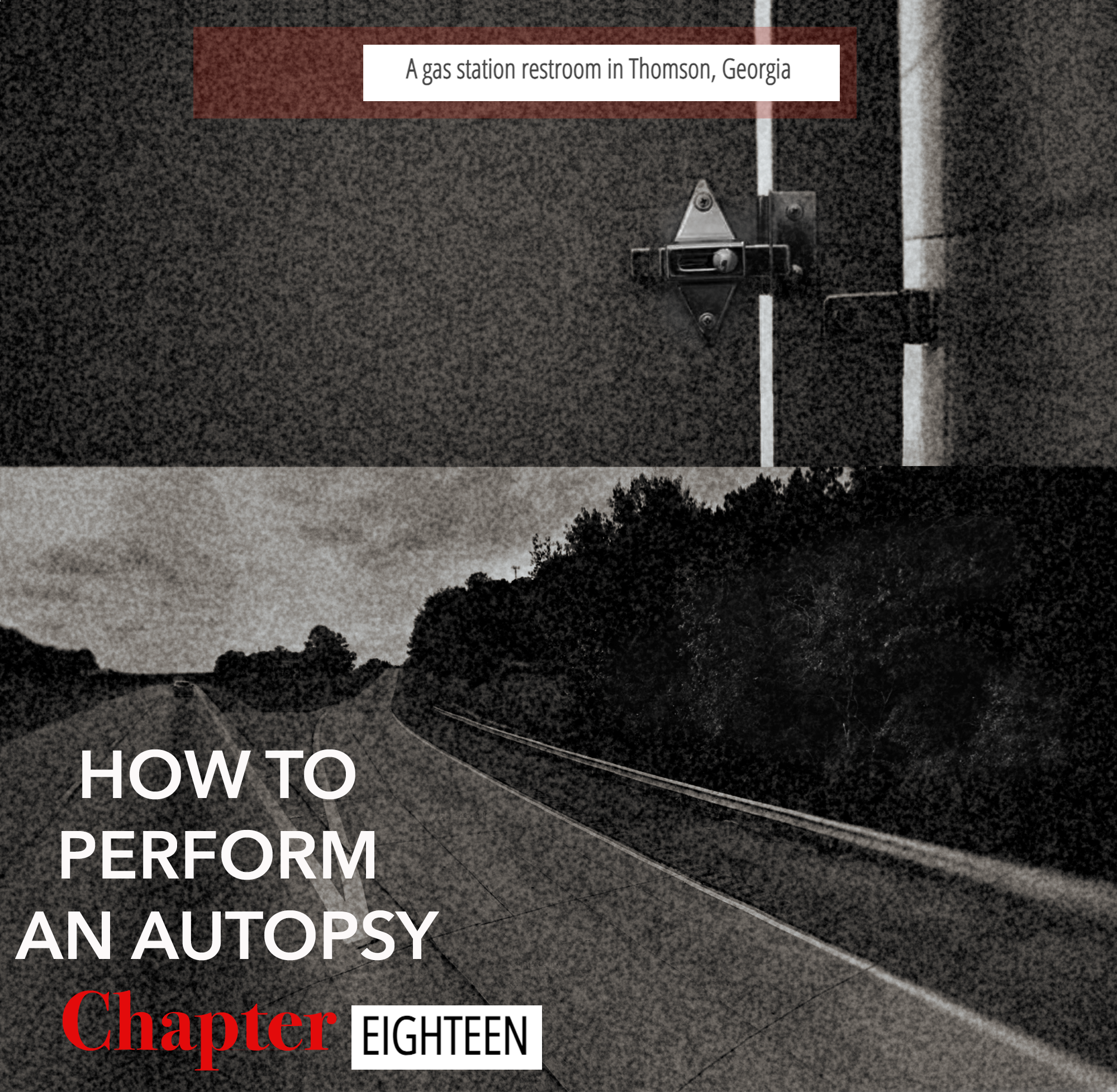
A gas station restroom in Thomson, Georgia
1
First, I’m going to discuss the road, an interstate, a long gray artery as a bridge that is a vast emptiness slicing through a particular year, a day, a thread that links past and future but in which the present is suspended by the hard alienation of the road as it only knows the state that is transition. One can say interstates are the same everywhere and that would be true. One can say interstates are different everywhere, and that would be true, as between interchanges their vistas mutate and eventually east becomes west, west becomes east, south becomes north, north becomes south. Sometimes that transition visually startles with how abrupt it can be but the change of landscape is typically a gradual process. Some stretches of highway feel especially isolated, and this will seem apocryphal knowledge, easily disproven, but at least among many traveling musicians the stretch of I-20 between Atlanta, Georgia, and Augusta, Georgia, is well-known as a long and lonely island. One enters it and loses contact with the world at large. Left and right there is a wall of trees, the occasional break of a grassy field beyond which might be observed a silent house, no person ever glimpsed outside working, left and right it is as monotonous as the gray blank of road in front and behind. Over the decades the traffic has increased so the cars and trucks are now a continuous stream but that only means it’s now a blank space with anxious people passing one another, being passed, and hoping there won’t be an accident that stops travel cold for an hour. On the road elsewhere can be had the excited expectation of an encounter with novelty, variety is easily supplied via mountains, hills, and mesas, even the change of crops over the year, the shift of shadows as the day progresses, but between Augusta and Atlanta there is never anything remarkable to be seen (if I leave out the days of petrifying sameness of Texas it’s because Texas is itself a novelty), which is not only a matter of my familiarity with those 145 miles, it’s because of the wall of Georgia pine to either side that cuts off a more distant view with the sameness of all that Georgia pine, and cuts off as well a view of the sky. Out West, much of the grandeur of the interstate is the ability to see from horizon to horizon the great country of the sky and to be entranced by the formation and changes of its super powers that are the clouds, great sculptures of water wrapped around microscopic particulates that are otherwise invisible until water condenses around them and they visually amass to form a grand parade of ever-shifting personality. On I-20, between Atlanta and Augusta, a long view is only occasionally granted and seems abbreviated even then. On this stretch of interstate, one only drives and drives and drives some more between those walls of Georgia pine, which are perhaps predominately fast-growing loblolly pine, which is paper mill, pulp, and lumber pine and not especially interesting until one hits the limit of the Piedmont area, if one is driving east, and the coastal plain part of Georgia begins. This brings a noticeable shift in the feel of the land, as if the continent is already declining toward
Eighteen - 2
the still-distant Atlantic Ocean, and is also a difference in feel that has to do with what is called the Fall Line, which I used to think must incomprehensibly have to do with autumn somehow someway but now I know has to do with the rock under one’s feet changing from the crystalline of the Piedmont Plateau, a chain of ancient eroded mountains, to the sedimentary of the Coastal Plain. The mountains that make up the Piedmont were, millions of years ago, an unbelievable 20,000 feet tall, their peaks higher than any of the current Rocky mountains, result of the American continental mass and Africa mashing together in the formation of Pangaea, way back in the Permian period of the Paleozoic era, two hundred and fifty million years ago when occurred “The Great Dying” that killed off ninety percent of the planet’s species, reptiles walked the earth but as yet no dinosaurs, mammals or birds, pine trees didn’t even exist yet but conifers did, they had appeared in the period previous the Permian, which was the Carboniferous, and it had its own crisis event with the collapse of the rainforests.
Because I’m not among landscapes I prefer, for we all have preferences, while on that stretch of road I imagine what once was there, meaning the mountains, because I contemplate how I’m on such an old stretch of earth that the past has been about worn away. Every place is special for its own unique reasons and for me that erasure is what makes this Piedmont Plateau landscape interesting. And the Fall Line. The Fall Line is where the crystalline basement rock of the Piedmont Plateau meets with sedimentary rock and rivers become falls and rapids, which disrupts travel on them, and because of the need of water-faring travelers, exporters, and importers, to change from boats to not boats to boats again, this resulted in the building of what were called “Fall Line cities” such as Augusta.
For the first time ever, it occurs to me to wonder where are the headwaters of the Savannah River—having grown up on the Columbia River it took me years to begin to think of the Savannah as a real river—and there floats to the surface a memory of a documentary of the river that I worked on as a student at Augusta College in 1977, a subject I’ll return to in a moment.
According to some sources, the Savannah River begins at Lake Hartwell in North Georgia, but that’s a manmade reservoir into which the Tugaloo (Cherokee word) River flows. Before Lake Hartwell’s construction in 1962, the Savannah River had its root in the confluence of the Tugaloo and Seneca (Seneca is a Dutch word meaning “furthest out” that was applied to the Onöndowa'ga' Indians) Rivers. The Tugaloo River is formed at the confluence of the Chattooga (“probably” a Cherokee word) and Tallulah (Cherokee word for “leaping waters”) Rivers, while the Seneca River is formed of the confluence of the Keowee (Cherokee word) River and Twelvemile Creek. The headwaters of the Keowee River are up in Transylvania County, North Carolina, and the headwaters of the Chattooga are at Cashiers Lake, North Carolina. Follow the wildly bendy Chattooga River down to where North Carolina, South Carolina, and Georgia meet, and the Chattooga River, which until an 1816 treaty reduction flowed through the Cherokee Nation, forms the border of South Carolina and Georgia down to Lake Hartwell (named for the Revolutionary hero, Nancy Hart) from which flows the Savannah River down to Augusta and thence to the Atlantic Ocean at Savannah, Georgia. I wonder with all the indigenous names attached to these rivers, how the
Eighteen - 3
Savannah came to be named the Savannah as it’s a Spanish word for a treeless plain, but as it turns out the Spaniards acquired it from the Taino Indians, however in the case of the Savannah River it may have been a Shawnee or Algonquin word. Because history is messy. The bulk of place names in the United States of America may be White British (the collective of UK ethnicities) and European, but that the names of so many waterways are indigenous speaks to a time during colonialization when the map was indigenous, those from across the Atlantic learning their way around via reconnaissance of long-established indigenous routes. While some tribes may have had different names for waterways, in the present remains plainly viewed, on every map that shows these indigenous names, a linguistic architecture of place that transports us back to before the removals of the tribes to what was then the far west beyond the Missouri River.
From about 1829, a year before the Indian Removal Act of 1830, the Army Corps of Engineers had been tasked with maintenance of the Savannah River, that responsibility transferred over to the Georgia Ports Authority with its creation in 1945. In 1979 barge traffic between Augusta and Savannah ended with the Georgia Ports Authority quitting its maintenance, dredging and unsnagging, which had already declined by 1977 to the extent that the revivification of the Savannah as a viable river for commerce and recreation had become a subject of interest, as in look at this historic jewel which, with tender loving care, would be a great attraction. That’s where the 1977 film, The Savannah: Renaissance of a River, came in. Augusta news articles report the film was funded with a grant by the Georgia Ports Authority, and under the direction of Jimmy Thomas and Frank Christian of Cine Southern Film Productions was made by fourteen Augusta College film students in a class taught by Dr. Charles Willig, and won the highest award in the documentary film category at the Film South 77 (the annual festival existed 75-79) workshop and competition at Converse College. I was one of the fourteen students, and it’s through working on that film I first became aware of some of the river’s history and the difficulties had by river traffic on the Savannah, but creatively we hadn’t much if any input, even with those members of the class who were very engaged throughout, I remember some shooting, a boat ride down to Savannah (I was leaning on the boat’s rail with the river wind blowing my hair back as we started out when a fellow student by the name of Pete took a photo he later gifted me, in it I look happy, which I was, I loved filming), being introduced to analogue editing, and we must have done enough that it didn’t feel like a stretch to me that we would collectively win an award for our work, I don’t remember feeling like “We didn’t earn that”. I learned enough hands-on that I was soon thereafter able, with a borrowed camera and editing equipment, to make the film by which I was accepted into the NYU film school. But I never later mentioned the river documentary as being a thing on which I’d worked, perhaps because I felt a certain amount of alienation as a female, that in 1977 I wasn’t being taken as seriously, and I don’t mean by Willig, he wasn’t like that, but with others the film shoot immediately took on the spirit of a boys’ club, girls not explicitly barred but expected to quickly get the hint that camera tech and photography were masculine pursuits. Not everyone was this way but all it takes is a key few to set the mood.
Obviously, as barge traffic closed in 1979 and dredging completely ceased, a renaissance of the Savannah River didn’t happen. As for what became of the film after
Eighteen - 4
its completion, with the exception of its March fifteenth premiere at Augusta College, and the Converse College film festival held in late January, I find no record in the news of its availability to the public except for a showing in August of 1977 on Channel 6 in Macon, Georgia and Aiken, South Carolina in a 3:30 p.m. Saturday slot. I have no idea if it was viewed by any political body or even the Augusta Chamber of Commerce. There’s no record of it anywhere online except for an archived mention in a weekly paper for the college, and a few local news reports from 1977, it doesn’t appear as part of any historical archive. Except. There are archives online the holdings of which aren’t indexed in search engines. Eventually I come across The Georgia Anchorage, the official publication of the Georgia Ports Authority, I wonder if it might have mention of the film, locate the HathiTrust list of issues 1966 to 1997, and as it happens the only issues available for a full view online are those from 1977. What luck! In the September-October issue is a full page article titled, “The Renaissance of a River”, which begins with the sentence, “The Savannah River from the Atlantic Ocean to Augusta, Georgia, is coming of age”, and goes on to report the Corps of Engineers award of a dredging contract to Parkhill Goodloe Company, Inc. for work to be completed between mile 27.1 and 183.2 below Augusta in November of 1977, and that the U.S. Corps of Engineers was expanding its maintenance effort comprised of dredging, bank revetment and construction of pile dikes over a five year period. The work would “make Augusta truly an Inland Gateway to World Trade”. The article, penned by William J. Jakubsen, Project Manager of Rivers and Harbors, Georgia Ports Authority, has several paragraphs on the history of Augusta as a trading post and port, extols the facilities of the Georgia Ports Authority’s Augusta river terminal and the 100 acres of prime river front sites in the industrial area. Yet, despite the name tie-in with the film, the film is nowhere mentioned, even though it would seem the film was funded by the Georgia Ports Authority to promote their desire to keep open commercial river traffic between Augusta and Savannah. Now I find that on 4 November 1977 The Atlanta Constitution published an article stating the conservationist group, the Friends of the Savannah River, had also approved of the plan to build a nine-foot channel in the river from Savanah to Augusta, predicting environmental enhancement. The secretary-treasurer of the authority foresaw a revival of the city’s port facility and there were plans for developing new terminals in Augusta. “River business is going to be here for the asking,” he said. “We’d like to get it back to that inland port that it was years ago.”
Online the usual date given for the Georgia Ports Authority quitting maintenance is 1979 but I have now before me a 16 March 1980 article reporting that the Army Corps of Engineers was on its third year of a five-year plan to improve the Savannah River and maintain a 9-foot channel and they were saying there wasn’t the river traffic to justify it, though the Georgia Ports Authority maintained their 1974 study justified improvement, that “if we had held up building Interstate 20 until we had X amount of traffic, we never would have built Interstate 20”, and the river was the “cheapest way, energy-wise, to ship cargo to the port.” A 1978 report has the Army Corps of Engineers already asserting the river traffic didn’t justify the expense of maintaining the nine-foot channel needed for barges, that year the river was only expected to carry 130,000 tons, far less than the 600,000 to 700,000 that they said would justify the channel.
After locating the above information, I’ve checked with Augusta University (was Augusta College) and it doesn’t appear to have a copy of the film in their archives,
Eighteen - 5
which is too bad as the film would have had unique footage from 1977 of the river between Augusta and Savannah. I’ve not seen the film since 1977, I’ve no idea if it was any good, I don’t care that my name is attached, but footage was taken of the Savannah River during a trip from Augusta to Savannah on the river and some shots from that boat trip will be in the film and may or may not now be considered historical.
From 1975, my last year in high school, and my first year in college, until when MK and I leave Augusta (not for NYU, I cover that elsewhere), we travel back and forth on I-20 between Augusta and Atlanta innumerable times because I am desperate for the cinema showing at the art houses in Atlanta. Drive 145 miles to watch a movie and not eat because we only had money for gas and the price of admission to the theater then make the return trip of 145 miles. 300 miles to see one or two films. One could either call that insane or dedication to film as an art and what we were having to do in order to see the world of movies that would never pass through Augusta. Many people who didn’t think twice about regular trips from Augusta to Atlanta to see touring bands wouldn’t understand chasing movies, it would make no sense to them, in the 1970s the bulk of movie-goers refused to go near any movie with subtitles, but we were making those trips not for sake of film as simple popcorn entertainment but for sake of film history, film as art and commentary on society, what was current, what was several years old to decades old, cinema from around the world as best as all of this was represented in Atlanta in its art houses and repertory houses. To try to make sense of this wealth of film history one would focus on directors, as one became familiar with them, and movements in cinema, and watch for when their films became available. We had publications on film and the Evergreen Black Cat books on film that we were collecting, and one could hazard that directed our focus as well, helping to form the list of films we were eager to see, but more often than not I already knew of the directors when buying the Black Cat books. But I was seventeen, eighteen, just starting out, and in the grand scheme of film had seen very little so point me in the direction of an art house or repertory cinema and there was bound to be new territory. What Atlanta didn’t have was experimental independent film much of which wasn’t feature length and even the die-hard art houses in Atlanta tended to stick with feature length films, so my self-education in film was limited to near nothing in that important and vital area.
Cinema was our adventure. Every trip to Atlanta to see a film would mean a new revelation on cinematography, editing, sound, development of a story. Almost every time I exited a theater, my world had been reformed, substantially enlarged, my vision even felt altered, possibilities expanded upon. Sometimes I was shaken and had then to sort out why. Sometimes what I thought was a film I didn’t like would years later become one that I now understood and valued. To put it simply, I was in love with the minds and eyes and ears of others, hungry for their perceptions and perspectives.
2
After our move to Atlanta, after my second estrangement from my family, for decades
Eighteen - 6
we make the drive between Atlanta and Augusta a couple or several times a year for sake of MK’s family, always feeling like I’m entering enemy territory because of my experiences in Augusta, and at some point I start wondering what isn’t loblolly pine I’m seeing in the woods that line the highway, what might be another kind of pine common to the area, I’ve been forced to meditate on the pines because of the boredom of this stretch of road, because I want to find something worthwhile to ponder, I’ve assumed it’s almost all loblolly, the loblolly pine is the most prolific pine in South Carolina, Georgia, Alabama, Mississippi, Louisiana, Texas, and Florida, but before white settlers came pouring in, before the industrial revolution, longleaf pine was the most prolific in these states, then the hardwoods and longleaf pine were cleared away by settlers and business and replaced with loblolly. Loblolly pine is prolific because it is highly adaptable, a swamp tree, and though it is an inferior-wood tree, in twelve years it can be harvested for paper and lumber products, and now loblolly pine is the most prolific tree in these states. For a number of years we lived next a photographer who labored to stir the public’s awareness of how rare was old-growth forest and the importance of its preservation. I started paying attention to the loblolly, which makes for so much landscape sameness, my spouse’s maternal Louisiana grandfather had worked for a paper mill and other ancestral family of his was given as having had a small sawmill in Louisiana, if you look at old news articles one sees how many of these small sawmills existed. A Louisiana relation of my spouse who was then 82, in a 1994 news article remarked on how he remembered the twenty miles from Franklinton to Bogalusa as once solid with long leaf yellow pine trees that were harvested in the early 1930s, and that with reforestation other varieties of pine were introduced. A 1925 article in the Bogalusa Enterprise and American reports that fifty acres of virgin forest was being cleared daily, 15,000 acres in a year for the “monster” sawmill that was the Great Southern Lumber Company at Bogalusa which had the capacity of cutting a million feet of board a day. It was estimated that in twenty-five years the company’s remaining acreage would be exhausted, thus the experiment of reforestation with loblolly and slash pine, which was a source of pride as it was reported that, of the Southern States, Louisiana alone had encouraged reforestation.
The territory of the longleaf pine, a slow-growing, dense tree, once covered ninety-two million acres in the South, and while its normal height is given as from eighty to 120 feet, dependent on the fertility of the soil, before extensive logging trees would grow to above 150 feet with a diameter of forty-seven inches. In their life cycle, at one to seven years they resemble grass with the focus of growth being the development of their root system, only after thirty years does the tree produce cones with fertile seeds, and at seventy to one hundred years cease to grow. Looking at a map of its territory I’m surprised to see that in Georgia longleaf territory seems to have begun, in much of the state, at the Fall Line and extended all the way to the Atlantic and down through the state into Florida, southern Alabama, southern Mississippi and the Florida Parishes of Louisiana. The territory of the loblolly, which grows to a height of about sixty to ninety feet, begins at about the Fall Line, below this in west Georgia, and in comparison with the longleaf originally had a relatively narrow home territory that broadened into north Georgia in the western part of the state extending into Alabama where it was the predominant pine. Mississippi had some loblolly territory
Eighteen - 7
north and west of the longleaf and in Louisiana there was little of it to the west of the Florida Parishes. The loblolly can produce fertile cones when it is about twelve to eighteen years of age, but seed viability is not high until twenty-five.
When rivers were the highways, the sawmills were located next to waterways and timber floated down the river to ports, which limited the impact of logging and deforestation. The railroad changed that.
The railroad is what gave birth to Atlanta, the Terminus settlement built in 1836 where was the founding of the railroad that would link Georgia to the Midwest, that terminus point moved in 1843 to the what is now the junction of Forsyth and Magnolia streets and renamed Marthasville, which became Atlanta in 1845 when the first Georgia Railroad cars rolled in from Augusta, then the Macon & Western railroad that connected Atlanta to Savannah, and in 1851 the Western & Atlantic was finally completed, connecting Atlanta to Chattanooga and the Midwest. In 1854 there was added a fourth rail line, the Atlanta and LaGrange, which connected the city to the southwest, which is how Atlanta became the rail hub of the South.
Driving east from Atlanta to Augusta, I wait for that Fall Line, the subtle change in atmosphere. Driving west to Atlanta, which for decades has been always at night after a day of visiting with MK’s relatives, I watch for the distant lights of our metropolis that has grown to span, according to one website, twenty-eight counties, while another website says it’s twenty-nine counties and over 8000 square miles. But most Atlanta voters and workers who live within the loop of I-285, the Perimeter, will think of Atlanta as Fulton, Dekalb, Cobb and Clayton, and some will think of Atlanta as Fulton and Dekalb, and finally some will think of Atlanta as Fulton. I say “our metropolis” with some hesitation, because the West will always feel like home to me, I will always be a transplant, and because Atlanta, like so many places, feels like it is more and more owned not by its people but by land developers who are forever pushing the rest of us around. And I say the “grandeur” of the interstate with hesitation as well, because its construction destroyed so many communities, optimizing white flight out of the cities into the suburbs even as it eradicated established black neighborhoods. Between the cities, the interstates killed off towns that suddenly found the spidery network of roads that linked them unable to compete with the speed of traffic had on the interstate with its scarce and select outlets and inlets. Not that those small towns were welcoming to everyone, or were safe for everyone, so that some travelers felt safer bypassing them. How many horror movies have been made about even white travelers fighting to survive a stop in Small Town, USA, much less the real risks experienced by black travelers and other minorities.
However, the conceptual history of the interstate system reveals that the small towns were already dying, by 1930 the population was half urban, city density having tripled since 1890, and super roads, in the 1930s, were being studied as a way to address current and projected problems of equity in urban areas where hard divisions between poverty and wealth were extreme. The interstates were also inspired by Hitler’s autobahn, as well the need to transport weapons.
Eighteen - 8
With modern travel by automobile, we were sold the friendliness of the road by way of franchises that offered gas, hotel, and food, which were largely the same from place to place so one knew what to expect. Tourism said, “Come, have fun! We love strangers!” But not every place was this way and there were areas where it was uncomfortable to dangerous to be the stranger in a strange land.
“Highwaymen” was the term used in the seventeenth up to the nineteenth centuries for the armed robbers on horseback who made travel unsafe, who were also often romanticized as Robin Hood types. At least that’s what they were called across the Atlantic, sometimes in America, where you know it had to have been dangerous to travel, but from the stories handed along one sometimes gets the idea that white colonials and settlers were less concerned with road agents and bandits than the American Indian. In 1835 a book advertised in newspapers was “English Highwaymen—Lives and Exploits of English Highwaymen, Pirates, and Robbers, drawn from the earliest and most authentic sources, right down to the present time.” In two volumes. In the W. Callahan Circulating Library it was publication 2628, sandwiched between 2627 The Highland Smugglers; by the author of the Kuzzilbash, the Persian Adventurer. Also in two volumes. And at 2629 Julian Farquharson, or, the Confessions of a Poet; by the author of Jeremy Levis, described as “not a very amiable, although it is an exceedingly powerful production. Its hero is an infidel and a voluptuary and his strain is an impassioned narrative of a strange, wild, and wayward career—we read with mingled feelings of disgust and admiration.—N. Y. Mirror”. Edgar Allan Poe liked it, saying it was a “medley of fact, fiction, satire, criticism, and novel philosophy. It is a dashing, reckless brochure, brimful of talent and audacity. Of course it was covertly admired by the few and loudly condemned by all of the many who can fairly be said to have seen it all. It had no great circulation…” Also available, by Madame Junot, was Memoirs of Celebrated Women of all Countries, which was exclusively populated by nobles. And you could buy, “by an Old Sailor, Tough Yarns; a series of tales and sketches to please all hands, from swabs on the shoulders down to swabs in the head.” Frances Ann Kemble, a well-known English actress, was also selling her memoirs.
If I do a quick online search for women, travel, and the problem of rape in early America, though I don’t expect much from something so broad, yet specific, what I get are studies of the in general problem of rape in that time, with slaves, with servants, with family and friends and others, plus an interview that reminds of the belief (which I was about to bring up) that if a woman survived or didn’t fight as viciously as it was felt should be expected (unto death) then the inclination was to believe the woman secretly wanted to be raped, which has long been a consistent trope in thriller romances, that the hot dream of all women is to be raped by a highwayman and all it takes is a couple of slaps to break through her denials and convince her of the fact. Women have always had more to fear from men they know, and it’s true that before late Victorian times a solo woman traveler was rare, but I’m not talking about the woman tourist or adventurer, I was thinking about the safety of the woman traveling for sake of moving one’s household, the woman traveling to the elsewhere homes of relatives, the woman traveling from home to the cotton mill where she would find employment. Women were likely to be traveling with others but companions didn’t guarantee safety. The dire circumstances of war rearrange worlds, at least for a time, and during the Civil War, along with the popularity of the railroad,
Eighteen - 9
women had more autonomy in travel. A few years pass and they have more autonomy, especially if they were widowed or single. People who appeared on this earth within the past twenty to forty years might not appreciate how much freedom women now have compared to their ancestors, but there’s also a reason that women tend to go to the bathroom in pairs, there’s a reason women tend to go to bars in pairs and keep an eye on one another’s drinks. And in the grand scheme of things it wasn’t so fantastically long ago that tea rooms flourished for women, while establishments that served men refused to serve women without a male partner.
Though we might enjoy the idea of the open road, by its nature it can be an insecure, uncertain territory. Hell, most women aren’t going to feel safe walking alone through a park at night.
Road insecurity. I’m going to include a road insecurity story that has nothing to do with being a woman alone. When our son was three years of age, having just returned from a cross-country trip dedicated to visiting someone on an Indian Reservation in South Dakota, then having immediately to travel to Augusta afterward, on our way back to Atlanta from Augusta, in Taliaferro County, Georgia, we were pulled over by county sheriffs on the excuse of one of the bulbs of a tail light on our musician’s Ford Econoline van being out. It is best knowledge to decline when the law asks to search your home or car without a warrant and without probable cause. We were congenial, compliant. The sheriffs had my husband on the other side of the car outside of my view, with an inexplicable gun on him. The sheriffs had me out on the passenger’s side of the car, more than six feet from it, but I was permitted to stand so that our three-year-old son, still in the van in his car seat, could see me and not become upset at being separated from me. We consented and said, sure, yes, search the van, because we already felt at risk due our son and were hoping compliance would work in a favor. As we stood there in the deep black of the night, cars and trucks speeding past buffeting us with their wind, my husband out of my sight, the police questioning my husband and me separately about where we had been, my son kept separate from me, they went through the bags we had yet to unpack from our trip, and took much of our van apart and then put it back together, then let us go with a warning about the tail light bulb. I can guarantee that my parents never experienced such, I know that my husband’s parents never experienced such, and I can pretty well guarantee that my siblings have never had their vehicle taken apart either. We’ve had it happen twice, the other time when we were traveling and entering British Columbia for a day, which meant not being able to see anything much of Vancouver as too many hours were spent at the border. They even went through my thick notebooks page by page. Being harassed entering Canada was annoying. The Taliaferro stop was harrowing because the police kept me separate from my son. I hadn’t known about the gun they had on my husband until afterward as I was unable to see him on the other side of the van. I still feel nauseous when I think about it.
I’m meandering, because for every thought I’m having in this chapter I’m also zigzagging to a disavowal. Travel is often thought of as an opportunity for novelty and the unexpected, but the novel and unexpected can happen at home, anywhere. Danger and friendship can be experienced both on the road and at home. A stress of travel is the removal from a support network in which one can trust, the reassuring
Eighteen - 10
comfort of the ability to retreat to a place of safety, even if it is only a familiar chair. But that familiar chair isn’t safe either. It can disappear. I’m meandering here because I know how travel can be stressful (and wonderful) but when I posit the insecurities of travel, such as expressed in the threat of the highwayman, I also know that the highwayman can be present within one’s home, it can lord over one’s home due circumstances of state and politics. I experienced insecurity too early, and too often, so that there’s always a part of me that’s nervous about the world falling apart at any moment, and knowledgable that the world in which has perhaps been found some security isn’t permanent, it is disintegrating due entropy and outside forces beyond one’s control.
3
Because novelty and variation in landscape is minimal along I-20 between Augusta and Atlanta, walled away by the pines planted alongside I-20 after it was built, and as I know Atlanta and Augusta so well, the interstate can seem like the traversing of the separation, by several hours and a couple of hundred miles, of one familiar neighborhood from another, and despite the familiarity that in-between can still be an unsettled dislocation. Before the cell phone, the interstate had an undercurrent of anxiety. If one stopped on the interstate that meant trouble and nothing else, if one saw another car stopped on the interstate that meant trouble, perhaps even tragedy, and nothing else. Before cell phones, one felt disconnection, and a state of estrangement, suspension. Help was not a simple call away if something went wrong because one had first to reach a phone, but one is used to this, and used to it on the interstate. It must be understood that this is entirely ordinary, one is used to this, and one is used to hoping that nothing will go wrong, such as when, traveling from one gig to another, in the middle of the deep black night our car broke down toward the middle of the stretch of the twenty-four mile long Lake Pontchartrain causeway driving into New Orleans. Every trip is an adventure, no matter how minor and ordinary, despite one being used to simply hoping that nothing will go wrong. One listens to music. If one is with company one enjoys, one talks. When one is young, between the dots that are the past and future, in this state of suspension, one can even propose whole new worlds as one talks, and just by traveling from here to there it may be felt that one is even driving towards those new worlds.
There is so little that is remarkable on this stretch of road between Atlanta and Augusta, every little part of it becomes linked with memories of the most mundane sort. Such as whenever we pass by the exit to a certain town that bears the name of a politician that I dislike, I always think of her, and wish that association would go away. On different stretches of the interstate here I’ll also pleasantly recollect what music we were listening to on previous trips. When we pass over Lake Oconee, if it’s daylight, I remember to check the water levels, which comes of years of news on drought and no drought and when we are close to being in a drought.
In 1975, I-20 between Augusta and Atlanta is a long stretch of interstate with minimal services for the traveler, only a few interchanges with reasonably okay chain gas
Eighteen - 11
stations, one or two choices for chain hamburgers, and a couple more interchanges that are nothing but a run-down gas station. I am seventeen. My boyfriend and I are used to driving back on forth on this stretch of interstate, traveling from a smaller city to a bigger city to see concerts and art house and foreign movies that won’t make it to Augusta. We know what feels relatively safe and what doesn't, and we always avoid the exits with the run-down gas stations because this is the nineteen-seventies in the Deep South where even in urban situations will only be found a few blocks of people who don't confront "counterculture" with icy side-glances or outright hostility. Long hair and a certain style of clothing is all it takes to be counterculture, which is viewed as dangerously anti-establishment in the conservative Deep South. My boyfriend has to worry about being beaten up simply because he has long hair, that is all that it takes, and when we are are driving somewhere we are anxious too about all those in-between counties with law enforcement that would love to manufacture a reason to drop two counterculture youths in jail for a few hours or days. So when we need gas we always try to stick to chain gas stations that look like they get a fair amount of activity. The more national the chain, the cleaner it is, the safer it at least feels, that's just how it is. The safety of the chain at least ameliorates the odd looks and stares one gets. But today is different for some reason because we pull off at one of the Thomson exits on I-20 that only has the one run-down gas station, an exit that we have always avoided. I don't remember why it's different, why we stop there on our way to Atlanta, but we do. I don't recollect feeling anxious as we pull up to the station. The gas station is what it is and it's a good feeling day. We're looking forward to seeing a couple of great films in Atlanta and we’ve plans to visit with a friend of his. Today is different too in that I leave my boyfriend with the station's attendants fueling the car while I ask where the restroom is. This is different because I usually try to avoid gas station rest rooms, and if they have outside entrances I have my boyfriend keep watch nearby.
I check on Google Maps to see if the gas station is still there and it’s not. It was an old style one and has been replaced by a motel and modern station. I have to check on Google Maps as all these years we never took that exit again.
I am already afraid of public restrooms so I must be desperate to use it. Perhaps I was on my period and needed to change a tampon. The women's restroom here is inside, past a counter and down a short hall on the left. The station, as far as I can tell, is empty as I enter it. I don't know about the adjoining garage but there is no one at the station’s counter. That is reassuring to me. I have the place to myself. I enter the restroom and am surprised to find that it is modern and clean. That's nice. I hadn't expected this. Beyond a single wash basin, there is one stall. I’m surprised how well I remember this and the tan tile floor and the tan metal of the stall beyond that single wash basin. I enter and bolt the stall door and sit down. Though there was only a single stall in the bathroom there was no lock on the door, which is not unusual in the case of a restroom outfitted with a stall whereas a bathroom without a stall would have a lock. Not long after I enter the stall, I hear the restroom door open and close. I hadn't seen a woman outside but a woman could have arrived at the station after we did, while I was entering the restroom. I cough to let them know the stall is occupied. They jiggle the stall door. "Someone's in here," I say. Then they shake the door hard. "Someone's in here," I again say. It's an odd thing to write but it is a normal thing to
Eighteen - 12
say. I know, thinking back on it, I can't see anyone's shoes so the stall's wall and door--with a gap above and a gap below—must have gone low enough to the floor that I was unable to see identifying shoes that would tell me if this was a woman who was for some reason being insensible. I couldn't see shoes, so I leaned forward to look through the crack beside where the door was bolted. And I pull back when I see through the crack a man's eye pressed up to it staring back at me. Just this horrible, seeking, livid eye looking back at me. All I saw was the shock of his eye and I promptly pulled back, stunned. The man on the other side is shaking the stall door hard now, trying to break it open. I'm in a vulnerable position with my pants down. I have been in dangerous situations before and one's responses can be strange. I don't scream. I don't move. I feel like if I move that will be dangerous. I have not frozen, as in a fight, flight, freeze, fawn situation. I have consciously chosen to not move. Instead, I say to the person "Get out, now" in as firm and cool a voice as I can manage. I don't want the person to hear fear. I'm reasoning that this is an individual who has been bold enough to follow me into a restroom while there are people out by the gas pumps, who may have even seen me with my boyfriend. I'm reasoning this is a person who has the confidence I likely won't be heard, they have the covering security of music being played on speakers outside the restroom, and I have the feeling that if I scream or move they won't run but will throw all their weight into the stall door and break it down and incapacitate me before I can be heard. As they were so bold as to follow me in here, despite people being outside, and then not flee when they first couldn't get the door open, I have the fear I'll be killed. I don't again tell them to get out again as they've already heard me and for some reason I don't want them to hear me again. I feel like I shouldn't speak again. I am very quiet. I make no noise. I breathe shallowly and softly so they can’t hear me breathe. They stop trying to get the door open and they turn on the water in the sink full blast. I still don't scream or move as it feels dangerous to do so. I am waiting him out. I don't hear him doing anything. I don't know what is happening. I don't move a muscle, just waiting him out. I feel like he's waiting me out. I'm wondering if he thinks I might now become frightened enough I will try to make a run for it. I can't guess. I wait him out for I don't know how long, wondering and wondering if I have made all the wrong decisions.
Then the water is cut off and I hear him go out the door. I immediately pull myself together. But what if he's just outside waiting for me? For some reason it doesn't occur to me to immediately run out the door shouting someone had tried to break in the stall. It just doesn't enter my mind. I don’t know why. Instead, I think I may even wait, unsure if I’m safe yet. Then when I leave the restroom I’m only concentrating on escape, I’m on wary, high alert for what may or may not be outside the door, around the corner. At a glance, no one is in the station that I can see. There is a door to the garage area on the right, beyond the cashier desk, and there may be men in there but they sound actively engaged in their work. I go out the main entrance and am expecting my boyfriend to be with the car at the gas pumps but he’s not there, another car is there that I quickly walk around, and find my boyfriend in the parking area at the far end of the station's asphalt. As I’ve exited the station, I’ve glanced around at the few male faces milling around, dispensing service and being serviced. There are no women. No one shows me any notice. I see an older man at the gas pumps with an attendant, he is getting back into a cream-colored car with two little blond girls in fancy Sunday dresses. This car wasn’t there before I went in to use the
Eighteen - 13
restroom, it’s the one that was there in place of my boyfriend, the car that I quickly walk around. Could the person in the bathroom have been this old, a gray-haired grandfather in Sansabelt slacks. Would an old man have the strength to have risked attacking me in the bathroom? Whatever he'd planned on doing? Now is the time to open my mouth and yell for someone to call the police, but I have no idea who had tried to break the stall door down, I didn’t see them. And I already don't trust most people, or the police. So I don’t trust anyone here. I have already been in situations where people don't care, don't help. I know that most people look on any declaration of trouble as the trouble itself. I am miles from home. We are in the boondocks, an interstate exit with a single independent run-down gas station, no town nearby. Something happened. And nothing ended up happening. More than anything else I trust I won’t be believed as nothing ultimately happened. I had seen three entrances to the counter area, one from the pump area, one from the garage area on the left as one entered the station, and one from perhaps an office area behind the counter, and I have no idea where the person might have gone and if they are still there and watching me. Is it the person I assume to be a grandfather of the two small girls? What if it is? What about those girls? I worry about their safety. But I have no idea who tried to break down the door and if he is innocent I don’t want to make him a suspect in front of his two granddaughters. That’s the problem, I saw no one and have no idea who was in the bathroom. Now, I am simply afraid and in running mode and want to get away from there quickly. Though I am in running mode I stay as composed as possible, alert to everything but not looking directly at anyone as I quickly walk past the gas pumps. I must stay as composed as possible because I don’t know what my body will do if I falter or pause for a second and look directly at anyone, if I meet anyone’s eyes. I don’t know if I will make it away without coming unglued and screaming at no one and everything. Acting as if nothing has happened, I quickly cross the lot to where my boyfriend has parked the car after getting gas and is waiting for me. I don’t let him know that anything happened. I wait until we are about ten minutes down the road before I tell my boyfriend, because I can’t talk for a while, I have to pull myself together to be able to tell him what happened, which I don’t want to do, I don’t want to tell him about what happened as there seems no point, there is nothing he can do. I don’t want to tell him and have him become upset and insist we go back to the gas station and contact the police. I don’t want to be trapped at that gas station for no point, by people who won’t believe me, when I have no means of identifying my potential attacker. Also, I simply need distance and time before I feel like I can safely speak.
As we drive down the road, I feel guilty, because I didn't call the police. I’m conflicted. I’m running away because I have to get away, and I feel like a coward. I want to be told I'm not a coward for running. Even though I didn't see who it was, I want not to feel guilty for not calling the police. Who will the potential attacker do this to next? I didn't stop them. They will do this to someone else. Some other woman would have been able to do just the right thing, she would have been able to see who they were and stop them so they wouldn't do it again. I wonder if I misjudged the situation and handled it all wrong. If I had screamed, would he have simply run and I could have run out after him and seen and identified him? Instead, I waited him out and fled. I feel I have left the door open for someone else's tragedy. I feel that I haven’t protected
Eighteen - 14
those two girls with the grandfather if it was him. But I didn’t see who it was, and they never spoke a word throughout so I wouldn’t even be able to identify them by voice. I’m thinking since I didn’t see who it was nothing could be done, and then for the next four decades I will periodically think of this and how I failed to protect those girls that day if it was the older man with them. However, there was no way possible I could identify who had tried to break down the stall.
What I really want is to be told something happened. I want to be told that yes I was in danger. Maybe it's so important to me because this was complicated by my long history as a subject of violence and sexual abuse and that I'd only recently escaped my home. I want to be told yes I was in danger because the person wouldn’t go away and tried to break open the door, that I wasn’t imagining I was in danger. I want to be told yes I was in serious danger and that yes I did the right thing because I made it out of the situation without being raped or killed. My boyfriend, who will one day be my spouse, says maybe it was a person who was confused. I feel like he’s trying to reassure me I was all right, because he wants things to have been all right. I feel like he’s trying to reassure himself. No, this person well knew what they were doing, I tell him, feeling I’ve somehow failed to communicate how terrifyingly deliberate and determined was the person who had never said a word. He asks me if I want to go back and call the police and I tell him no because it’s past that, and I couldn’t identify the person. In Atlanta, I do something I never do, and I immediately confide in my boyfriend’s friend. My boyfriend and I are no sooner in the door then I tell his friend as well about what happened, because I need to hear someone say yes I was in danger, that something happened, and I escaped. My boyfriend had believed me, but had responded with reassuring everything was all right, that I’m safe. I am quite calm, and I’m safe in that the situation is passed, yet this is somehow not finished for me. The friend also seems to have no idea how to respond, he is a complete blank. He looks at me bewildered and I feel I shouldn’t have told him, I should have kept quiet, I should have kept it to myself. My time to yell for help has come and gone and now I have no right to speak about what happened because I didn’t take action at the gas station.
I hadn’t screamed when I should have, but I hadn’t screamed because I didn’t know if anyone would hear me, not with the music going. I hadn’t screamed because it seemed my best risk. Though I had made conscious decisions, I had still played the fight-flight-freeze rabbit that takes their chances on becoming breathlessly still until they have the opportunity to flee.
The problem was that it wasn’t over for me. The person was still out there, an unknown entity, and I hadn’t known exactly what they’d intended to do, and would never know, I just knew it would have been bad. No, I was no longer at risk from that person, but it wasn’t over.
There is no safe pocket in society for all the times when nothing happens. There is scarcely a safe pocket in society for the times when something happens. There is no reception area where you can go to after the times nothing happens and walk in and talk about how something happened but then nothing did and they will understand and give you coffee and something to eat and a hug and tell you that you’re all right, you did the right thing and are all right. I didn’t tell the story to anyone else for decades, and even now, having related the story to others a couple of times, I am met
Eighteen - 15
with blankness, people don’t know how to respond. No one grabs my hands and gives me a hug and says, “Oh, my God, don’t say nothing happened, something did happen, you might have been killed. You did just the right thing. You’re alive. That is terrible. I’m so glad you’re safe. You’re safe now, you made it out, you survived. You’re safe now. You’re safe.”