
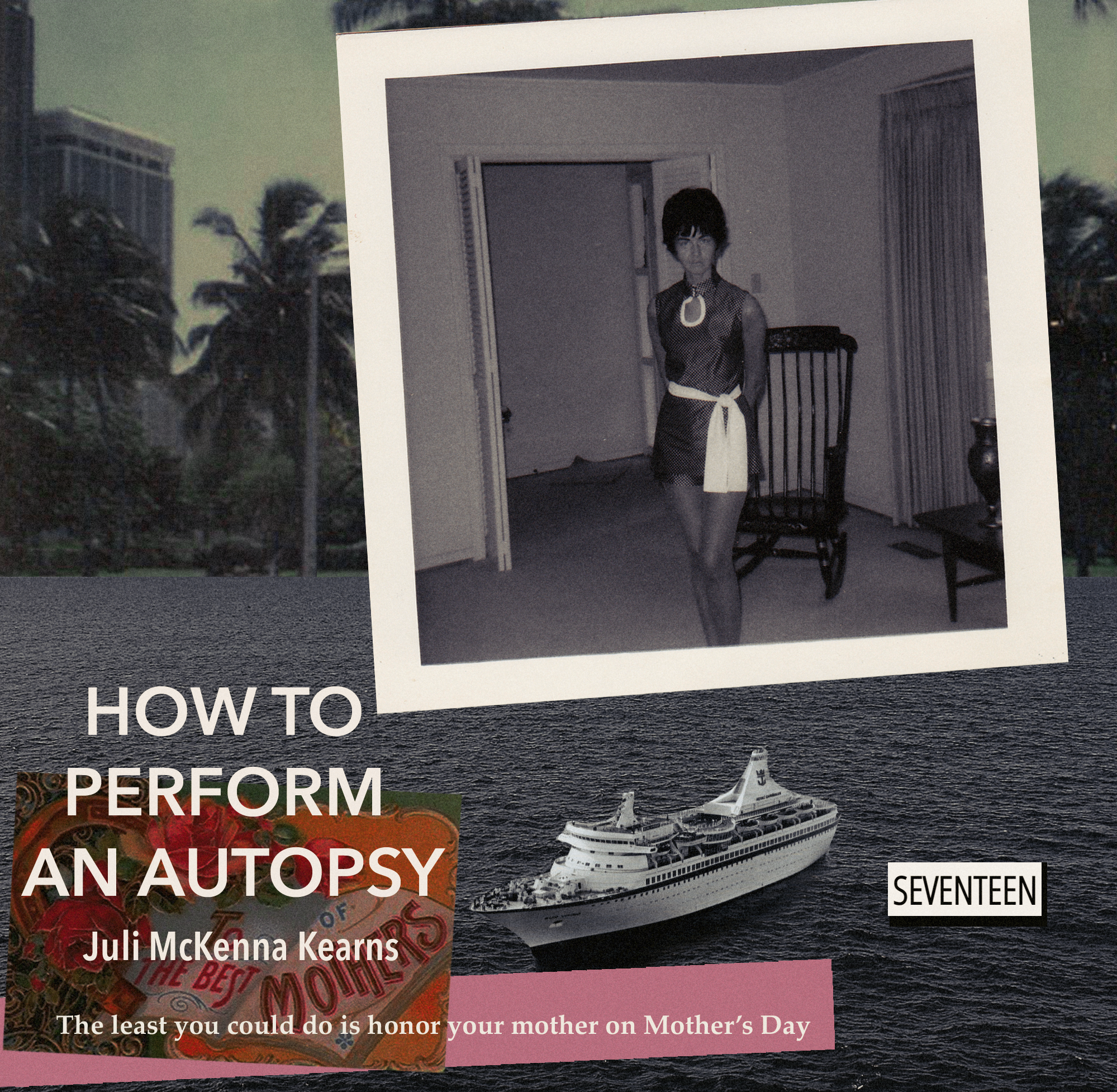
SEVENTEEN
The least you could do is honor your mother on Mother’s Day
1
When did our species carve out an afterlife that made us like unto gods.
In some 1940s pulp science-fiction fantasy publication there’s likely a story in which our lovely planet is an adventure vacation spot for ethereal beings from an alternate dimension who have confident proof in their immortality. Their travel brochures promise the trip of a lifetime to Earth, the gamble is that you won’t get to choose the vessel you’ll inhabit or what happens to it, and that’s alright with the being from the alternate dimension because when their Earthly body dies they know their immortal alien self will return home and won’t there be a lot to talk about, comparing their experiences with others and whether or not a return visit is worth that gamble, considering the horror show parts. “But, you know, if you have it good on Earth, it can be really good. And even if it’s bad the sunsets and sunrises are nice. No matter what, you always have the prospect of a beautiful sunset or sunrise that someone will capture in a photo and share on social media. However, they’ll up the saturation on the photo to dramatic, unrealistic levels of color, so you’ll need to learn discretion in identifying what’s fake so you don’t go chasing what doesn’t exist.” You’ll notice I began with a 1940s story and then shifted to the twenty-first century with social media. I’m happy to point out that a fair amount of writing comes apart in its first run through the wash and we don’t even notice. But to return to our lives as travel packages, curated rather than happenstance in my mother's version, she more than several times tried to talk me into believing that we select our parents and experiences before we are born, no, she didn’t endeavor to persuade, she left no room for discussion, she matter-of-factly told me that I chose them as parents before I was born, she informed me of this at the gold-flecked formica breakfast bar on Edinburgh when I was sixteen, and again on the phone about thirty-four years later during our last period of contact, she said I had specifically chosen them to be my guides for learning what it was I needed to learn on this planet, in this lifetime, the point of which was that as I’d selected them I couldn’t complain about anything for I was here to learn specifically from them whatever it was I needed to learn. I didn’t agree but I didn’t argue either as there was no point, but she never talked about having chosen her parents, who she hated, and the reason she didn’t talk about this belief in respect of her own life is because the bullshit fed to the goose didn’t apply to the gander. She would have come up with a reason for how her parents weren’t the ones she’d chosen. Some, who have had a brief taste of death, report that at its bright light gate our family members who passed on before gather to guide us over to the other side, to
Seventeen - 2
ease the transition, to take away our fear and anxiety, to welcome us in love, our mother and father, grandmothers and grandfathers, they describe the joy of the occasion, and, I’ve never been anything but horrified at the prospect of my mother and father and grandparents appearing with smiling faces to welcome me into eternity. Fine if there’s infinite compassion and forgiveness for everyone, no matter middling faults or if one is a despot who has murdered millions, if we do survive our physical deaths, however this may be, I don’t wish that my parents and grandparents should suffer, it would be great if they have their a-ha moment in which they are perfected by divine love, but give me some space please so I’m not forced into the arms of those who constituted for me hell on earth. Maybe after billions of years of therapy and distance I’ll be ready to say, “Okay, as long as they respect my boundaries.”
MK’s maternal grandmother had her druthers about who should and should not be in her heaven, and her expectation of the afterlife was a segregated one, she didn’t have a problem with black people going to heaven, she wanted them to be “saved”, she just didn’t think God should or would have them roaming the same air space as her. I don’t know if her god went by the “one drop” rule or not, but her imagination of heaven was such that skin color, one’s DNA, was indelibly also part of one’s resurrected or raptured spirit body, even one’s soul. Her God, the creator of the forever system in which she had faith every single one of us abided, a God who had contrived his universe so that in order to escape hell all humans had need of acknowledging and accepting as real and perfect that system and his Lordship over it, had fashioned also the mortal body’s race as an absolute forever divider of humans that decided one’s place in a tiered and segregated heavenly abode. This is grotesque to me, yet also sad, that the measure of her life, from birth to death, wouldn’t have caused this deeply Christian woman, “devoted student of the Bible and dedicated teacher of Bible School” (from her obituary), to ever meditate on her prejudices in respect of her comprehension of an eternal repose in Christ, but as an Assembly of God woman she also believed in a literal hell and that most of us were destined for it so one was kind of lucky to make it to heaven at all, despite the fact it was segregated. Having escaped hell, who was going to care if heaven were segregated? Well, she cared. Keep it separate but equal. In 1989, the Assembly of God Church adopted a resolution in which racism was not only condemned, it was labeled a sin. She would have been eighty-three when this resolution was adopted, then lived twelve more years, and as far as I’m aware her views on race demanding equal but separate heavens—otherwise heaven would be hell for her—never changed. I don’t know what her views on Jews were, I’ve not heard about her being considered antisemitic, like everyone else they just needed to be saved, but she must have felt they wouldn’t be a proper fit in the family as she never knew the husband of her eldest daughter was the son of a man whose parents were Lithuanian Jews, no one in MK’s family knew until Jewish relatives of his contacted me online long after my mother-in-law’s sister and her husband had died. His family wanted to connect even if only for the duration of a few emails, to make certain we knew a little about his family history, who his father was
Seventeen - 3
and his relatives, to share where they were buried. I don’t know if, as with Orthodox and Conservative Jewish communities, my spouse’s Assembly of God maternal grandparents would have felt their son-in-law wasn’t Jewish as his mother wasn’t, but there must have been doubt about their acceptance of his Jewish heritage, even if he had been raised Christian (I don’t know what his private beliefs were), else the family would have been told. I don’t know how well her husband knew his father as his parents divorced when he was young, but his wife knew his father was Jewish and it was a secret she kept. I eventually found she placed a notice in the paper seeking her husband’s father, based on his last known location, after the birth of their first child, and it wasn’t the first time he was sought in the paper, twenty years earlier his parents had placed a notice seeking him, his whereabouts unknown since about the time of his divorce. If my spouse’s maternal grandmother might not have welcomed Jews into the family, she also believed Roman Catholics weren’t proper Christians so were destined for hell, and because she was told I had been raised Roman Catholic she thought of me as one of the damned. There’s a reason we didn’t visit her, not to mention she said we were not to visit while MK had long hair. Yet I made a point of traveling to Mississippi to see her after AK’s birth. Maybe it was sentimental nonsense on my part, even MK’s parents said this was a thing I didn’t have to do, they hadn’t suggested it, I wasn’t pursuing this visit with any idea of a change in our relationship with my spouse’s grandmother, I didn’t care about changing what she might think about me, it didn’t matter to me what she thought of me just as I knew it didn’t matter to her what I thought of her, I didn’t imagine she might even care to see her youngest great-grandson. But I thought it important, she was ninety-one and I wanted her to meet her youngest great-grandson, when AK was older I wanted to be able to tell him he’d met and been held by his great-grandmother who had been born in 1906, nearly a century before him, when he was older if he ever took note that she was still alive when he was born and asked, “Did I meet her?” I would be able to say yes, I’d made that effort. When she saw me breastfeeding him she cried, because she equated breastfeeding with maternal devotion and bonding, she made it clear she didn’t condemn mothers who didn’t breastfeed, but she was overcome with emotion and in those tears I felt the dissolution of harsh judgment, at least for that moment, maybe longer, I don’t know. We didn’t meet again and that was alright. I’d fulfilled for my son what I felt was a prospective obligation of connection.
Considering her faith in a segregated heaven, what’s ironic is that the spiritual root of the Assemblies of God is acknowledged as being in the 1906 Azusa Street revival in Los Angeles, ministered by William Joseph Seymour, an African-American, born in Centerville, St. Mary Parish, Louisiana, to former slaves. He believed that receipt of the Holy Spirit was evidenced by speaking in tongues, the Holiness Movement was an out-growth of Methodism that taught Christians should separate themselves from the secular world and believed in the Second Coming of Christ, he’d been introduced to the Holiness Movement first in Indianapolis through David S. Warner who would be a founder of the Church of God, then in Cincinnati he attended Martin Wells Knapp’s integrated theological school, in Texas he hooked up with Charles Parham’s Apostolic
Seventeen - 4
Faith Movement, Pentecostals who believed that on 1 January 1901 the first expression of the baptism of the Holy Spirit by speaking in tongues had occurred since Biblical times, and from there he went to Los Angeles to pastor a holiness mission. He arrived in Los Angeles in February of 1906, preaching the speaking in tongues, baptisms by the Holy Spirit proliferated, and to accomodate attendants the group moved into an African-Methodist Episcopal church on Azusa street. The baptism by the Holy Spirit was conceived of as egalitarian, forming a “unity in Christ” fellowship that crossed race, gender, class and doctrinal beliefs. However, the mingling of whites and blacks fell afoul with Parham, also a difference in interpretation of what it was to “speak in tongues”, Seymour believing it to be glossolalia, a divine language, rather than any earthly language. Another product of the Holiness Movement, the Church of God in Christ (distinct from the Church of God) was formed by Charles Harrison Mason in 1897. After introduction to W. J. Seymour, the Church of God in Christ was reorganized in 1907, and though principally African-American it also licensed white ministers. Parham’s movement would fall apart after he was arrested for sodomy in 1907, as well the subsequent murder of three members of his movement by their fellows performing exorcisms on them. In 1914, in Hot Springs, Arkansas, 300 white ministers from the Church of God in Christ and other Pentecostal or Apostolic Faith Assemblies gathered to found the Assemblies of God, with the blessing of the Church of God in Christ represented by Bishop Mason. In 1915, Warren Faye Carothers, one of the founders of the Assemblies of God, and former associate of Parham, wrote that “God’s purpose to preserve the racial purity and integrity of the different nations he had made is plainly indicated by His appointment of the bounds of their habitation. Nor would there ever be any ‘race question’ if men would but observe the divine arrangement and live, each nation in his own country, even as each family should live in its own separate home.’” That describes the heavenly segregation in which MK’s maternal grandmother believed. As she was Louisiana-born in 1906 and the segregated white form of Assemblies of God didn’t come into being until 1914, she wasn’t raised Assemblies of God. The two ministers who oversaw her father’s funeral weren’t Assemblies of God but they were from Pentecostal churches and as Pentecostals were a product of that Holiness Movement I don’t know what the family was before that.
An influence on my wanting my son to meet his great-grandmother was certainly my having been many years estranged from my birth family, I wanted to forge this great-grandchild bond with his father’s family. She asked me to make sure he got to heaven so she could see him again, and I knew she meant she wanted him to be churched, which wasn’t going to happen, but in the spirit of hope of a reunion of souls in whatever transpires after death, I promised her, “Yes,” that I would, or at least I would raise him, as best I could, to be a person of empathetic and thoughtful conscience. What she wanted, at heart, was to not lose her loved ones, which is something over which I have no power.
However, this was a woman who MK and I never visited, just that one time toward the
Seventeen - 5
end of her life, because MK had long hair and around the time we were married she said that until he cut off his hair she didn’t want to see him. So, even when he did soon enough cut off his hair for a few punk years, we didn’t think about visiting his grandparents, because that’s what happens when you’re told “don’t come around here” for bullshit reasons. If one is going to be alienated because of a hairstyle or clothing choices, or because of non-choices like when one isn’t a straight CIS person, a relationship of mutual love and respect likely already didn’t exist, so we weren’t missing much, yet we also did care in that there’s an injury inflicted when you’re put on the excluded list. One might protest, “I don’t care”, and mean it, but there are different levels of “I don’t care, it doesn’t matter”, and on a less superficial level the rejection registers on the level of a religious ex-communication or the loss of one’s state citizenship. If the family is sacred, one has been made profane. By the time AK was born, the long hair didn’t matter, I don’t know when it ceased to matter, but the world of MK’s grandmother had broadened to tolerate long-haired men. But not gay people, however as she didn’t ever know MK’s youngest brother was gay she never banned him from her presence. I was amused when I learned one of her favorite 1970s shows was “Three is a Crowd”, which is about a man who platonically lives with two women but is only able to do so as long as the landlord believes he’s gay. The gay part went straight over her head, and instead she just thought they were “cute”. Which is vaguely amusing, except that she believed homosexuals were destined for hell. One could excuse her with, “That was what she was taught,” and it’s true. But she didn’t believe in equal rights for homosexuals. Had she lived to see her grandson married to a man and met their daughter, she might have been won by the great-granddaughter and begrudgingly accepted her grandson had rights, if only for sake of her great-granddaughter. I don’t know. But I doubt it.
My spouse’s family, to my knowledge, isn’t one that does estrangement. At least not down his mother’s line, because she always saw her parents as loving, she was puzzled by the ways they weren’t, but she accepted any emotional pains inflicted, typical ones such as the favoring of one child over another, they were her parents, and she’d had a good life as a child with many good memories. I’ve reason to suspect that if one dug a little beneath skin deep, into the muscle of the family, in all persons of several generations, a profoundly sore nerve would be found, that would flinch at the finding and have one or two words to say, then the nerve would burrow deeper underground, because family is family and injuries are accepted and weathered for sake of the family as a whole. Classic patriarchy, the rule of the fathers, laws laid down were not just family but were considered Godly given, and ultimately, one did not defy God in the form of the church that maintained itself as the family backbone, for those members of the family who didn’t believe as the God of their fathers and mothers demanded, instead of defying God and the church in the presence of one’s elders, they lived as they wanted elsewhere. It was considered pointless even disrespectful to one's elders to make waves and directly challenge what was maintained as God’s word and will. Rather than lay down the law in the form of the word of a mortal, the eternal God as rule maker is always preferred. But I’m not here to sort this out. I only bring it up because hard estrangement doesn’t exist in many families. They argue and hold
Seventeen - 6
resentments and distance but by hook and by crook they manage to not estrange. Some members may be unwelcome (see above), which is a form of estrangement, but the system itself doesn’t take it very seriously, the matter may even be joked about, and hard estrangement doesn’t happen. It’s by no means a great family system, it’s not healthy, it's superficial, but it’s more than good enough for the majority, enough family members find others in the family with whom they can have a relationship, history binds them and provides community, they share stories, names, places that span several generations and family branches, people may like one another and not see one another for years and because they are are family they are still considered bound by the strong thread of not even so much as blood but relatedness, some families are so close that as parents die the adult children shift to aunts and uncles and great-aunts and great-uncles for emotional support, people may not like one another at all they may have difficulty tolerating one another but it’s family and they love each other as family and if they don’t they are still family, someone is always upset with someone else usually for decades but while dysfunction is manifest the system is not morbidly, pathologically ill, people belong whether or not they are accepted, they belong by virtue of the family bond which operates as earthly law above even church law, even if one is outcast by the patriarch and matriarch the family bond will eventually take precedence, you may be ostracized or side-eyed for the lifetimes of the elders, you may feel effectively excommunicated and not acceptable, but you are a member by default. You don’t have family members outright killing one another or threatening to do so.
2
This happens on Mother’s Day a few years ago. MY CHILD (passing behind me): What are you doing? ME: Looking at a photo of my mother. MY CHILD: Here's my crazy, psychotic bitch of a grandmother. We're never going to see her again, thank god.
He has a caring relationship with his paternal grandmother, and I’m glad for that. He’s not going to think about my mother unless the subject of her has entered the conversation, and the thought of her will not linger, he doesn’t even hold any resentment against her, she was bad trouble who was on her best behavior the few times they were around each other and still she had a negative enough impact that no attachment was forged, instead she had been a person to avoid, he felt her chaos and lack of care for others. When he turned eighteen he said he’d prefer not to take the once a year drive of several hours to my parents to spend several hours with them for Thanksgiving then turn around and drive several hours back, I said of course, and if that wasn’t the last time he saw them it was the next to the last. He said it was like visiting the dead, and he didn’t mean the rapid diminishment of their vitality in their eighties though they were still relatively healthy, and despite the fact they were always nicely turned out, still taking care of themselves. When we pulled up in their driveway once a year they would come out the front door into the patio area of their suburban twin villa to meet us, smiles on their faces, my mother rubbing the palms
Seventeen - 7
of her hands together as she did when she was excited, my father asking how the drive went. When our son stopped accompanying us they would mention how they were sorry he couldn’t make it, but neither ever had much to do with him when he did visit, he would spend his time playing with my mother’s Shih Tzu, a dog which through no fault of its own has made me wary of anyone who has a Shih Tzu. These few moments outside was even a good part of the visit for me, if always a little awkward, even before the first estrangement and then the second of about two decades we were uncomfortable physically around one another, my parents and I didn’t hug, no cheek kisses, I’m still awkward coming and going when visiting MK’s family, the ritual of hugging his different family members at the beginning and end is something for which I mentally prepare for about ten minutes though I make a point of doing it and am glad that I do. When we arrived, I would like seeing my parents still looking relatively healthy, even as they weakened, I would like to see them smile. Though we were there for Thanksgiving it wasn't a traditional Thanksgiving dinner, no turkey and trimmings, a heated canned vegetable and maybe slices off a small store-prepared holiday ham, meals so minimal and nondescript that I rather being confident in what we had I instead remember what we didn’t have, but this also meant no stress over preparation and clean-up. Before and after MK would sit with my father in their living room that compactly yet distantly enough joined the kitchen and dining room that I couldn’t hear what they were talking about while I was in the dining room with my mother, and I would never speak with my father as my mother immediately had me at the dining room table she wanted no one else around to compete with her demand that all my attention be on her as she spoke about I don’t remember what, how she had proven she was a gypsy (not), the actor with whom she'd somehow become friends who she'd visited in New York, rather than having photos of any of her many grandchildren on the walls there was the signed publicity photo of the soap opera actor who danced in Oklahoma above her work table next the dining table staring down at us (I never did get the story on how she managed to become friends with him or how much they actually corresponded, she was classically evasive about their friendship so that it always remained a mysterious fact though I imagined she had taken him hostage and I wondered at how that came to pass), she and her sister weren't talking again or were talking again, she would go from the time we arrived to when we left about subjects that hadn’t changed for years, maybe she would pull out her photos of what she identified as suspicious contrails, she’d pull out the squares she was crocheting for people she complained didn’t appreciate them, when she was painting or drawing she’d pull out what she’d been working on, she once pulled me over to her computer to show me one of my photos from a gallery on my website and how she’d downloaded and improved it by lightening it up, “See, don’t you agree it’s better now”, she expected me to thank her for demonstrating how to properly process a photo, she had taken a course in Photoshop while living in Sedona, which was I believe the only time she mentioned any of my photographs, she didn’t comment on composition or content or style of processing, I’d sent her links to photos I’d done of Sedona and the Grand Canyon after having visited them in Arizona but she never remarked on them any of my own work wasn’t a subject, she did take one of my photos of AK at the Grand Canyon and made a clumsy, lifeless painting of it
Seventeen - 8
that expressed nothing of him or the Grand Canyon his excitement over the vista and the wind battering us, she made a gift of it to him and he felt no guilt over not liking it and wanted nothing to do with it, he called it embarrassingly bad as his features and nothing else about it fit together, there are innumerable instances of good bad art and art that is good that people don’t understand and believe it’s bad so it’s difficult to describe how my mother’s painting of AK was a bad one but it was. I have to make a correction as I now remember that soon after we reconnected she did express appreciation for a digital painting I’d done of AK at the age of six at a window of our Midtown apartment which I liked but considered it a rather conservative approach I worried would be only perceived as sentimental though it was a frank unvarnished view through a barred window and exterior sash with cracked and peeling paint however of a smiling child with one hand raised before the glass gazing out over a windowsill filled with books, I’d considered it an experiment in realism which was a style I’d not cared to pursue with acrylics or inks, at least not since I was a teenager, I did several digital portraits of AK as a child because I admittedly had a decided preference for him as my child who I thought was a beautiful subject, which gave him the idea of dressing up as a bird or a robot and having me photograph him and process the photos to better express his fantasy, they were collaboratively made photographs in which he had agency as a creator, I didn’t want to make of him a subject without choice, I didn’t want to use him and deprive him of voice, he was always an artist and I wanted him to instead learn from these endeavors and appreciate his active role in them as an artist. Neither of my parents ever remarked even on the photo series with AK, and I know they saw them. But my mother did comment on Aaron’s art, the sculptures he was making when he was small child, she sincerely appreciated his talent while he was young then distanced herself as he matured. We made three cross-country drives to see them in Arizona after reconnecting, before they moved to Tennessee, the first two of these trips had a few hiccups but went well, my mother was living in Cottonwood after having initially resided in Sedona and my father was a couple of hours south in Scottsdale, we visited both places but though they lived apart on the weekdays it was obvious they were often together, he came up to Cottonwood while we were at her place and she joined us at his place in Phoenix, part of the trick in making things work was to daily get out and explore, we went to the Grand Canyon, we saw the Heard Museum, Taliesin West, this kept us engaged in the present and my vigorous and honest enthusiasm of “Oh, what a great place that was” coupled with my earnest appreciation for their living situation was my reach to maintain buoyancy, then on the last of these trips my mother was determined I not do anything but sit and visit with her. We made one initial excursion which was a surprise visit to a student art exhibit in which my mother had several pieces, then after that she attempted to block any outings, I knew my mother’s mind and I could tell she had been likely complaining to my father that when we visited we shouldn’t be out sightseeing even though we only went with them, I could read the air and knew she had built up a resentment of our exploring where they lived, that she felt we should be there only to see them and nothing else, the few times we did manage to get out she refused to engage in what we were doing, and of course we had to get out and do something as AK was a child and he couldn’t
Seventeen - 9
sit around their homes all day, my parents accompanied us but then my mother would abruptly leave saying she was going to sit in the car, and so each of the few things we attempted to do was cut short as we couldn’t leave her to sit in the car. I had made plans to visit a couple of galleries to see if some of the art I was making of the desert might be a good fit, and she sabotaged my attempt to do this, I made it to one gallery then she refused to go in she said she didn’t like these places and she didn’t know what I wanted with them, she went elsewhere to wait so I only did a quick walk through, distracted, and we joined her as my father was in step with my mother in cutting short all our attempts to go out. The trip was wrong from beginning to end with her not even letting me speak, every time I began to talk she’d interrupt and take over, which was so obvious MK and AK remarked on it to me. When we went out to eat it was to a miserable buffet at a Chinese place and when I broke open my fortune cookie and unfolded the little slip of fortune-bearing paper within it was too weird that it read, “You’re talking but no one is listening.” Soon after the trip my parents remarried and moved back to Tennessee on the excuse that she liked her dentist there, but upon returning to Tennessee she became upset with that dentist and found another.
As for my father and these Thanksgiving visits, he at least loathed Trump and so we had that in common, immediately after our initial greeting outside we’d exchange a couple of sentences on Trump which would be the extent of our conversation before my mother spirited me away. When we first got back in contact I used to think the way my mother demanded my attention completely meant I never got to talk with my father which I imagined was unfair to him I imagined we should talk as well but then the couple of times I tried I realized he had no desire to talk to me. He’d put on the smile when we first arrived, which I welcomed, we’d get out of the way the few noises we had to make about the heinous thing that was Trump, but beyond that the couple of times I extricated myself from my mother to try to talk to him, with any subject I introduced the smile would quickly drop, the black-eyed chill would take its place to freeze me out with a repelling disinterest, he would say “I really wouldn’t know” to any combination of words I’d think to put together. When I tried to dig deeper into the subject of politics, knowing it was safe territory as he didn’t like Trump, he one year cut me off with the statement offered like zen wisdom that, “Well, what I’ve observed is it’s like a pendulum, it swings in one direction and will always swing back in the other.” I thought yes that’s fine for you in your comfortable home to say but what about all those whose lives are destroyed, what a glib aphorism. However, the statement was intended to shut down the conversation which it did. Still, in that very controlled frame of space of a once-a-year Thanksgiving dinner for which we’d arrive in the early afternoon and leave early in the evening, I kept making the attempt to talk to him for a couple of minutes, the subsequent silence causing me to realize again oh he actually does not want to talk with me at all, he’s not willing to put on a pretense of even small talk, then on the very last visit, when I made an attempt to engage, accompanying the clipped and concertedly flat tone of his response was a measured parting of a convivial mask to make me aware of the hostility beneath, I was being afforded the glimpse of the face of a brutal insect staring black-eyed back through the cornstalks, go no further down this path, no the only reason you are here is for your mother to have your full attention, for her to extract from these meetings whatever it
Seventeen - 10
is she desires from them, if you think I want your attention you are wrong, the look only occupied a couple of seconds but in it was communicated how I was nothing and should know this, I should know we had nothing to talk about, that he had no desire to know my thoughts and had no desire for me to know his, I was a zero and should be smart enough to realize this and stop, to accept the public smile and pursue nothing more.
I believe I’ve pictured my father aptly, then when I return the next day to read what I’ve written above, his guarded version of a welcoming smile grabs me again, as it always does, the smile wants me to believe him a thoughtful and caring person who just couldn’t perhaps express it, though my experience of him is that the smile was a lie, a mask, he was beyond brutal, he had no love for me he may have even outright hated me.
My mother was less mysterious. My father saw me and hated me. My mother didn’t see me. She was only ever the real one in the room. I was there to give her approval. To tell her she was right about everything. That’s what she wanted from me. To hear all her complaints and let her know she was right and that she was good. I didn’t even have to agree with her, it was enough for me to sit there and not protest, if I voiced a difference in opinion she would bristle and begin to become combative. So I tried to guide to agreeable subjects. Such as with her watercolors I could ignore what I saw as her determination that everything she did be brilliant, instead I could pick out those things at which she was actually very good and discuss them, plus I was happy that she was doing art, because it was growth, something new, it gave her an opportunity to get out of herself enough to attempt to portray a still life or landscape. She painted her conception of mandalas which I knew others would enjoy even if I wasn’t partial, they were a cross between new age and greeting card art, and she was good at it, she had a hand for delicacy, and I’d tell her these were good and would mean it. She had everything she painted framed and gave me several works which I hung on my walls because this was a positive thing for my mother and gave us something positive to be in communion about. My spouse and my son didn’t like anything she painted, perhaps only because they knew how my mother was, and after what was for me her final, devastating betrayal I threw out all the art she’d given me, and felt a little guilty about it. Because some of it was pleasant-enough art and she had reason to be proud of it.
One of the last things that might be ever mentioned about my mother was she was a hoarder but not out of control perhaps because she lived with my father. She was a hoarder by way of endlessly purchasing, I knew, whatever she wanted in catalogues or in new age stores, I guessed she spent a fortune on not-inexpensive trash. Their two-car garage was packed full with purchases that would never be used but which were all, the last I glimpsed, neatly put away in stacks upon stacks of plastic bins. The hoarding was restrained in this way and that it didn’t spill over to the house where she had collections under control in bins and on display. My spouse and son didn’t care for her taste in decorating because they didn’t care for my parents, but I could see her artistic bent in how she put a room together, what she collected and I could appreciate this and that some things were nice. She had a respectable collection of rocks and crystals. She had some nice knick-knack art she would have picked up from
Seventeen - 11
the new age shops when she was living in Sedona before moving to their final home in Tennessee, she liked Talavera or Talavera-style dinnerware and had nice pieces of this on display. Her kitchen was enviable for all its very good pots and pans and various appliances I knew they rarely-to-never used. Her furnishings were a hodgepodge of expensive brand display hutches and cases and overstuffed sofas and chairs. Her bedroom in their last home, with her choice of colors, vaguely reminded me of Arizona, which I knew she missed, and yet she had for some reason propelled them out of the southwest and back to Tennessee to live near her youngest daughter, and though she had chosen to live near that youngest daughter that’s not why they had left Arizona, I could tell, too much of something had happened, she didn’t want to go out in public there any longer, she was done with it, I couldn’t fathom moving across country for sake of a dentist, and knew she was instead fleeing. I guessed rather than simply moving from Sedona to Cottonwood she had instead fled Sedona for Cottonwood, she had at first liked the few art courses she took but by the time she was done with them, when she surprised us with the visit to the student exhibit in which her art was displayed, the teacher and all the other students were enemies, I don’t know what had happened but it was time for her to get away from bad memories. But she had loved the Arizona landscapes, its sun, the nights, the monsoons, the native plants, the perfume that is sage and juniper and desert pine, the heady scent of creosote rain.
They should have remained in Arizona. The final betrayal, coincident my father’s falling ill and then his death, would never have happened.
Mother’s Day. After the last betrayal.
Many were posting photos of their mothers on social media and relating fond memories. I pulled up the photos I had of my parents, almost all of which are digital because they are scans I’d done of analogue photos when I was reunited with my family for a time. A sibling loaned me what had once been the contents of the cardboard box of family photos which had come into their possession, the photos had been at some point transferred to a milky-white, semi-opaque plastic container with a blue lid, no more than six inches deep, mixed in with the old were also some images taken during the near twenty years we’d not been in contact, places and people I’d never seen, no stories ever attached as being kind-of in contact again did not mean the freedom to have discussions or even be in communication. I went through the laborious process of scanning the photos so we would all have copies, and wondered at some old images from my childhood that should have been there as I’d been told this new box contained all the photos from the old box, but some were missing and I knew there was no point asking about them though I did try to inquire about one professional photo, taken at the house on Blue Street in Richland, and no one remembered it—by no one I mean my mother and the person who’d been given the box who had gotten it from another sibling who didn’t want the responsibility of caretaking it any longer, and I don’t blame them. I kept original scans of the photos as is, but also did restored versions, fixed scratches and dust spots, corrected color and contrast and fading, which was a tedious job, and not very rewarding as there’s only so much that can be done with small low-quality Kodak instamatic prints from the 1960s and 1970s, most probably taken on the lowest end model, the Kodak Instamatic
Seventeen - 12
100 that appeared on store shelves in 1963 and looks like the model we had, as my family rarely took photos there was no call to replace that camera with another unless it broke in the 1970s and another lowest end model would have been purchased. Place a few photos on the scanner bed, close the lid, scan, open the lid, remove the photos and place in others, over and over again for I don’t remember how long it took to work my way through the photo box, digitally clip out each image to be saved as its own individual file, import to Photoshop where I did the restorations individually, no filters, there were no AI photo restoration filters then and even now the results of those can range from, with very simple restoration, “hmm not bad but why did I bother with the AI as I could have easily done that by hand and better”, to horrendous (to make sure I’m not simply prejudiced against and that miracles can actually be achieved I check out several current how-to videos and what I see is complete butchery plus people having been acclimatized to the plasticized fakeness of online social media filters). The photo box and all its contents were returned to the person from whom I’d borrowed them, and I uploaded both the original and corrected versions to a password-protected photo-sharing site so that everyone could explore and download what they wanted. Maybe only one or two in my family ever visited because each photo has a view count and this testified to zero interest. At first I felt a bit of a sting and wondered if my hand in the matter was being rejected. More likely, my assumption that everyone would want copies of images concerning the family, especially if themselves, was wrong, and after I scanned the photos I too went years without looking at them, not because of simple disinterest but because they would become too strong a connection to the past while also entirely divorced from its reality. In this way they were akin to being presented with AI “hallucinations” of the past that focused upon and sharpened a few inessential details, disfiguring the whole, which goes to show that while photos can record some of the obvious facts of the moment, emotional truths and the broad context can’t be captured by a photo. The password-protected photos are only available online as long as I continue to pay for that site, and I’m confident my siblings, with whom I’ve no connection, have long since forgotten about them as well as lost the password. One day, inevitably, that site will cease to be available, the yearly bill will no longer be paid, and the contents will disappear. These photos concern a very few people, the camera was rarely to never used to make a record of a place, we didn’t do vacations so there are no casual tourist snapshots that would at least provide a record of what this or that attraction or city or landscape, popular or random, looked like in such-and-such year, and the loss of these photos will have no impact on the world, but the archivist in me angsts over the void that will eventually swallow them up even though, for the most part, it’s a chaotic collection of artless and uninteresting older Kodak and Kodak Instamatic photos and Polaroids, the unifying factor being how bereft nearly all of them are in any attempt to express or capture beauty or personality. They evidence no interest either in the value of the mundane.
As for my son’s comments. I don’t know whether I was right to do this or not, but because he was distanced from my parents, they were on the other side of the continent, and because he was about eight years old when we reconnected, I
Seventeen - 13
didn’t share with him much at all of my personal history with my parents. I hadn’t spoken about them before that period of reconnection, and when we were reconnected I wanted to give him a chance to form his own opinion of them, to even have a decent relationship with them if they turned out to be able to have a decent relationship with a grandchild, which I had hoped might be managed with contact being minimal. Then it blew up in our faces in ways I had never anticipated. My son was distanced enough, however, that his experience wasn’t personal injury, instead he would never be left to question, “What if?”, “Maybe they’ve changed?”, “Maybe my mother has exaggerated and fictionalized things?”
Dealers in professional mental health note how fractured families are systemic, if there is a fracture in one generation then this may be repeated in the following generation, and one is given the impression that it’s a thoughtless, knee-jerk, inculcated by familial habit response. When I was a child, I was well aware of how these fractures happened generation after generation, and while I understood, I also wrestled with becoming part of a pattern. What if that pattern could be broken? What if I didn’t become another “me too” in a family of fractures, couldn’t understanding at least moderate with tolerance, for sake of continuity and blood. Movies sold that it could. But in our case? No.
3
My mother and the Song of Norway and hot pants. I was looking at photos of my mother because it was Mother's Day, the day social media fills up with people’s posts about how great their mothers are or were and if their mother is dead they speak of how much they miss her. That’s fine and expected but if one skips over to the local news one will be horrified by the stories that highlight how everyone’s mother is not wonderful, some are so not wonderful that just reading the headlines that summarize the pain inflicted on their battered and abused and sometimes horrifyingly dead children is akin to having flesh flayed down to agonized bone. One reels away and grabs for a psychic bandage after glancing over news stories that tend to be composed of two or three single sentence paragraphs. In some of the news items, there’s little question of how it got so catastrophically bad, a probable cascade of crises including a collapse of social services, of support networks, of finances and housing and jobs and health care, of not having at least the bottom line met for daily decent food and a safe bed, the world is less love and light than a struggle to keep one’s feet from hitting the bottom of the abyss and we don’t all have a family parachute that you can pull the ripcord on so it inflates like a safety preserver and fills in the rapidly widening cracks that erode sanity with abject helpless doom. Never mind that a situation doesn’t have to reach the far end point of ACE (Adverse Childhood Experience) test score of badness to have devastating consequences. The more toxic stress one undergoes as a child the far greater is the likelihood that one’s adulthood will be plagued with depression, poor health, alcoholism, drug addiction, and abuse, and yet not everyone who’s gotten a bad draw of luck goes on to inflict that pain, as gross harm, on their children. Ever the mystery is why some do and some
Seventeen - 14
don’t, taking into account that every human naturally imparts to their children distillations of their own history, consciously or unconsciously, both the traumatic and beautiful, even if it be by avoidance, their hope to do better, to give more love than not love.
The psychoanalyst, Alice Miller, who wrote so profoundly on the effect of trauma on children, that children were forbidden by their parents to understand and comprehend the abuses inflicted on them, was later revealed to have emotionally abused her son, nor did she intervene when his father beat him. Miller’s The Drama of the Gifted Child came out in 1979, followed by For Your Own Good in 1980 and Thou Shalt Not be Aware in 1981. In the late 1980s and early 1990s I read Alice Miller’s books and would end up buying multiple copies as I kept passing them along to friends. It would never occur to me that in 2018 I would read the book of her son, Martin Miller, which credits his mother with being a brilliant woman, but a distant and traumatized one who was unable to benefit by her own insights and thus inflicted on her son her unresolved traumas, emotionally abusing him, rejecting him, and allowing his father to beat him. While I was surprised to learn of Martin’s history, I wasn’t shocked. My father returned to school to become a psychiatrist when I was a teenager, and a great portion of the public is going to trust that psychologists, psychotherapists, psychiatrists, and psychoanalysts must have dealt with their own problems if they are to have the wisdom to treat others. Psychiatrists especially wield remarkable authority and power over people’s lives, to a frightening degree. Because my father didn’t veer from research into psychiatry until I was a teenager, I didn’t grow up in a situation where I might have been groomed to see him as an all-powerful doctor of the mind, instead I feared the power of his degree coupled with his field. How could I tell anyone about the abuse I experienced and expect others to believe me when my father’s profession was that of a healer, a person who would not only deny my story, but had a medical degree that could invalidate my reality with his informal diagnosis that I was delusional and/or a liar.
I’m not bitter with envy over people who have or had good families or even merely adequate ones. I’ve questioned if I am, but think that if this were the case, I’m not sure that I would have had the capacity to love my son, to try to nourish him with good experiences and affection, to feel for his joys, have real pain over his sorrows, to try to teach him the value of his unique perceptions so that he might find his passions in life. Rather than feel bitter about good families, I am pained over the expectation that good will always flourish and not wither with despair when dust bowl winds leave people stranded in a hopeless landscape. When a person says, “I’ve found that problems always work themselves out”, I’m flabbergasted. I feel pain over a cultivated blindness toward others who’ve not had it so good, the pronouncements that parents always do their best or want the best for their children, and the preference for silence, that those who have been failed should not speak about their experience and if they do they should have a second part of their story that is survivor success, like a feel-good novel or movie in which the lesson is despite all there is not only absolution of the past through healing, the survivor does better than succeed, they rise victorious above their history. The lesson is that no matter how one has been harmed, by virtue of everyone being born equal (good luck with that), they have the personal
Seventeen - 15
resources which can be drawn upon, if only one has the appropriate courage, to become as successful and happy in life as everyone else.
The occasional person will acknowledge that “not everyone had a great mother, and I’m sorry about that, but I did have a great mother so thanks my mom happy mother’s day you were wonderful and I miss you,” which manages to miss by a mile a more sympathetic expression of, “I know it must hurt when people write about how wonderful their mothers were, I wish everyone had a great mother like mine who gave you the gift of love, which is an amazing thing.” I don’t want anyone apologizing for the fact they had a great mother, I’ve not asked for that. I wish everyone had a great mother, and yet it can ring as combative when others who hold they had a great mother might write about their experience on Mother’s Day with the qualifier of “I know there are others who may not have had a good mom, and that’s too bad, but I did.” They feel it’s good form to express sympathy of some sort, so they’ll do so, but they also then sound as if someone else writing, especially on Mother’s Day, that they had a crap mother, purposefully suffocates their pleasure in having had a good mom. There remains considerable hostility against those who write about having had bad parents, whether slightly bad or grotesquely bad. To write about bad moms remains bad form. It’s scary. Women are supposed to be a primal positive life-giving force, and if they weren’t great moms they are to be honored because of the contribution of the womb to growing another human being and you should be grateful for their having brought you into this world. But, because a woman has given birth to one, is that reason to celebrate her as the reason for one’s existence? For having carried you around in her womb?
“For God commanded, ‘Honor your father and your mother,’ and ‘Whoever reviles his father or mother must surely die.’” That’s Matthew 15:4 of the New Testament of the Christian Bible. That’s the ancient and respected wisdom of the ages that is drilled in from birth and means you shall obey and honor regardless.
What does it mean to honor one’s father and mother?
4
Happy Mother’s Day is not inescapable because of social media. Before social media there were Mother’s Day cards. Mother’s Day was in itself the command to buy cards. What’s kind-of mostly accepted as the first modern Mother’s Day was in 1907 perpetrated by Anna Jarvis who organized a celebratory service of worship at her Episcopal Church for her mother. The year her mother died, 1905, was the nascence of Ann’s campaign to make Mother’s Day a recognized holiday. Anna’s mother, Ann Reeves Jarvis, died on 9 May 1905, so in the creation of the holiday Anna selected the second Sunday in May as the day for honoring mothers and made the official emblem a white carnation, because the second Sunday in May would always be close to the anniversary of her mother’s death and because the white carnation was her mother’s favorite flower. Anna Jarvis must have been a force of nature because what she kind of
Seventeen - 16
set out to do was make her mother an American saint by way of this honoring of her death. Ann (the elder, not Anna, the younger) was a woman who had about fourteen children, only four of whom would survive to adulthood, and was dedicated to social activism. She formed women’s groups to help with health and unsanitary conditions, to impart education that reduce infant mortality, to supply medicine and help families whose mothers were stricken with tuberculosis. She had apparently talked about how there should be a day for memorializing and honoring mothers, which was satisfied through Anna’s efforts, it becoming in 1914 a holiday that called for the display of the American flag.
I’m a mother. Please never honor me on Mother’s Day with the display of the American flag. Flowers? Sure. I like flowers, even cut ones that mean the killing of the bloom but it’s going to die anyway. Look at the history of Mother’s Day cards and one will see that as a rule flowers of all types are depicted as the gift of choice. A 1915 Mother’s Day postcard on one side shows a bouquet of white carnations and on the other side is an invitation to appear at church where Mother’s Day will be observed. Early postcards for Mother’s Day show it was also celebrated at school, one side bearing white carnations, and the flip side reporting the day of observance and the request that students “not fail” to bring along their mothers for honoring. A 1908 article on Mother’s Day repeatedly stresses that “A mother is a mother still, the holiest thing alive” and that the object of Mother’s Day is for honoring the best mother who ever lived—your own. The white carnation was to be on the breast of everyone in testament of the truth that “A mother is a mother still, the holiest thing alive.” She is “man’s first and best, most constant and most unselfish friend.” Which sounds more like what one would say about a dog. In Fort Worth, Texas all policemen were called upon to wear the white carnation in honor of their mother, and if they didn’t do it themselves then Chief Maddox was going to even provide the carnation to ensure they weren’t derelict. Ella Wheeler Cox called for “mother hymns” to be sung and white carnations to be handed all around at Mother’s Day services, for the idea would “surely find approval in every heart, even in the hearts of hundreds of men and women who know their mothers were far from being the ‘best mothers on earth.’”
Mother’s Day is not a public holiday, but it is a national holiday, and no one is saying that just because there are some bad mothers that Mother’s Day shouldn’t be celebrated by those who enjoy it and wish to honor their mothers. Because of commercialization, dinners out and flowers and perhaps presents might be expected, and certainly a phone call. Before email, when greeting cards ruled the world, to not present one’s mother with a “You’re the greatest mother in the world” card, on a day when everyone was supposed to do so, was not an insignificant sleight.
I will allow to that in times of yore, whether a mother was having a child every other year, or only had one, and she did any due diligence as a mother, the likelihood is she would have been taken for granted, before women’s rights women were deemed as inferior by the patriarchy, they absolutely were workers were laborers, they weren’t fit to be thinkers or to have careers, to be artists or writers to be creative it was men who were creative, in some cultures they could teach, especially teach girls, they could be caregivers but rarely doctors, they couldn’t vote, they were second class
Seventeen - 17
citizens without rights, so Mother’s Day was at least something. When Mother’s Day was instituted, women didn’t yet have the right to vote. So if a mother was only conceived of as the family housekeeper and caregiver and not credited with having a brain and feelings and a right to a life apart from being the bearer of children then the least you could do was give her a card once a year.
5
My father happened. My mother happened. That’s as far as any of us know for a while, that we had parents because we are here.
The past few years, I will sometimes look at photos of my mother as if I could try to figure her out by examining a photo, what it says and doesn't about the person inhabiting it, because no matter how much I try to figure her out she will in some respects always remain a mystery to me. As he had passed by my computer screen, the photo my son saw me looking at was from 1970, of my mother in hot pants, the year hot pants went viral when I was thirteen, and my son’s response was, “Here's my crazy, psychotic bitch of a grandmother. We're never going to see her again, thank god.” My mother had gone to Whites, a department store anchoring one end of a shopping center called National Hills, across from the Augusta National Golf Club (home of The Masters, people with clubs hit balls into holes in the ground) and purchased several co-ordinated outfits of hot pants in different fabrics and colors, then brought them home and showed them off to me in the kitchen before my father came home, looking to me for assurance that she needed more than a couple of sets as they were cute on her and as they cost so much money and we didn’t have the money to spend, and had me take photos of her standing solo in the living room in the outfits and being appraised by my father. Despite her being very white, my mother always readily tanned brown, never burning red, and she still wore some of her summer tan, no bronzer ever she didn’t even wear foundation makeup, while the legs she was determined to show off as still being better than good legs were brown because women then wore “nude” (varying shades of tan to brown) hosiery with their hot pants, though her hosiery was the same tone as her tanned skin. The Instamatic Kodak had been unearthed and handed to me to capture a few photos of my mother in her new hot pants because mother in hot pants was a sexy event to be commemorated and celebrated, proving that she still had it at the age of thirty-six, that she was desirable, that she sizzled more than any other woman in our suburb where there were no single women heading households, only wives (maybe briefly a divorcee or two), and the wives wore sporty golf culottes that looked like skirts, and cardigans over blouses or polo shirts. My mother hated all other women in the world and was the kind of person who used to boast about how all the men in the neighborhood hungrily eyed her as they were married to sexless matronly drudges. I hated taking those photos of my mother posing in the weird impoverishment of our home in which "life" somehow never happened except for the usual daily torrent of sadism. My mother putting on the hot pants show embarrassed me, which was not just a matter of my being a disgusted young teenager. She and my father were well on
Seventeen - 18
their way to being soused as my mother had spent a lot of money which she said we didn't have and what she would do when she spent a lot money on something is she would quickly pour several drinks down my dad when he got home, flirting wildly, and get him loose and convivial, before she announced what she’d spent too much money on, which in this case was buying the several sets of hot pants, after which she'd put on the hot pants fashion show. What we're seeing in the photo is that phase of drunk where she's no longer jovial, a good bit of energy has been expended and she's beginning to crash a little, but the performance isn't near done as next she must go out and show the world how she looks in her new hot pants and that she's got great legs. After I took the photos, they headed out to their favored bar at National Hills where they were regulars. And though I hated taking the photos, at least mom and dad were focused on the hot pants, how sexy my mom was, and I wasn't being abused so it was what one would call a relatively good time, a brief safe haven, and I praised her appearance as well, even while thinking it was all somewhat sick. Which can make a child feel a bit of a betrayer. I would have enthused and said things like, "You look great!" because as long as this distraction was going well then nothing overtly bad was happening, but instead I was thinking, "This is all sick, and you are very cruel people who I fear." As a child and young teen, I’d feel guilty about that split, that I was mollifying by praising, hoping to purchase a calm evening of no abuse. If my parents had cultivated anything in their lives for a hobby beside being sadistic, if they had loved anything besides themselves, if they had taken the time to appreciate something anything about the world, to say something nice, to notice a flower, to enjoy a movie, I probably wouldn't have felt this way. There's nothing wrong with a suburban woman in the 1970s wanting to look sexy in hot pants. But that's all the entertainment we had in our house, drunk mom mocking every woman in the world and hating everything in the world and being flagrantly performatively sexy when she was happy drunk. She was the center, the primary mover. She was the queen bee. You can't tell it from this photo of her in the hot pants though. I'd be hard pressed to produce a photo in which one might view her as a queen bee, because she was not a magnetic individual, just a woman who insisted she be the center of everyone's existence.
Hot pants were part of the fashion war that kept overtaking the headlines with the question of whether women, who had replaced their wardrobe with short skirts, would continue to bare their legs in miniskirts or allow designers to cover them back up in so-called maxi skirts for daily wear, whether tailored or hippy casual. In the midst of this, hot pants were suddenly everywhere, often with knee-high stretch boots. Women contested against one another for who had the hottest legs in hot pants competitions. Airlines put stewardesses in hot pants. A stock photo from 1971 shows housewives Brenda and Carol sporting hot pants to the laundromat where they do their washing. In 1971 Yoko Ono wore them to promote her book, Grapefruit. Elizabeth Taylor strutted hot pants legs for the paparazzi, and wore them in the film X, Y and Zee (1972) as a socialite malignantly raking her marriage back and forth across the razor’s edge she makes of the sexual revolution of the 1960s, seducing the woman she sets up to become the empathetic shoulder for her husband. Speaking of which, it’s remarkable the ease with how hot pants can pin a date a movie, because suddenly there are women and girls in hot pants, and a couple of years down the road
Seventeen - 19
it’s instead sex workers in hot pants. Shelley Duvall in Robert Altman’s 1975 Nashville capped the artificial craze, bolstered by sky-high platform shoes, in a barely there hot pants outfit, sporting also the beret look of Argentinian Marxist revolutionary Che Guevara, long bands of shoulder bags crossed over her chest so to resemble a crisscross of ammunition belts as she stands beside an airport sign pointing to a line-up for screening for weapons, with a hint of Patty Hearst kidnapped in 4 February of 1974 and transformed by torture into the public relations glam face of the Symbionese Liberation Army. Hot pants were not simply short shorts, at least not in the beginning. Shorts weren’t new. Hot pants were often co-ordinated with tops, and came in velvets and textured fabrics. This distinguished them as fashionable high style suitable for parties, not “sporty”, which was what was new about hot pants, that they were intended to be worn out on the town, to restaurants, in some rare places one might even be able to wear them to the office, but in most settings women were still expected to wear skirts, not pants.
While feminism attempted to educate the public on equal rights for women who were bound in subservient roles by virtue of being the lesser helpmate of Adam who had led him astray and out of the paradise of Eden, the sexual revolution professed to divest women of shame over their sexuality and body parts, even while they lined up in hot pants competitions judged by men. It was a shit show of mixed messaging, and while my mother’s hot pants gave the impression of legs freed by the revolutionary modern, her cultural views, as well as my father’s, were that real women were made to be mothers, feminists were lesbians, and women in professional positions, women who wanted equal pay, were stealing money and jobs from men who were intended by cosmic law to be the sole breadwinners bringing home meat for the family, their wives motivating them with good looks and the promise of sexual release.
I vaguely recollect a pair of claret red hot pants with an overall bib, also a popular look for a time, made of a nasty, scratchy cheap fake velour kind of fabric that I hated and out of which I quickly grew as I was thirteen and going through a growth spurt. But it’s my mother’s hot pants tailored suits for day and the satiny fabric set for evening (sleeveless top with a keyhole cut-out over the chest) that were the big deal, photographed for posterity in our living room, which is why I’m writing this.
Autumn can bring with it a positive feeling of fresh starts and looking forward to work to be done and finished, but there is also a negative autumn in which a hint of its prospective chill is a dark hole opening on the near horizon. The two hot pants photos always remind me of the autumn of the second type because my parents were dark in spirit, like horror film dark, spiritually dark. If you have a happy relationship with your parents, don't take it for granted that everyone loves their children. If you have a vaguely unhappy relationship with your parents but know they still love you, don't take it for granted that every unhappy family still has a primal love bond. Society tends to assume that all parents love their children, like it's at least a biological imperative, and that parents will do anything for their progeny. Some people just shouldn't have children. I shouldn't have been born. My parents should never have had children. My parents were first and only and forever bonded as sexual partners, never as parents, though having had children legitimized my mother as a woman
Seventeen - 20
since she was a woman who looked upon women who didn’t have children as having something wrong with them, we children were just proof they did have sex (for my mother, I think my father would have been happier had there never been children), and as beings of consequence of their sexual relationship we weren’t as human as they were.
When I was about twelve or thirteen years of age, I got up one morning and went to the breakfast table where my parents were ready and waiting for me with a special and formal announcement to make. The formal announcement they had to make was that if we were like on a ship and something happened and my father had to make a choice between me or my mother, or my mother had to make the choice between me or my father (they were speaking to me, not my siblings, my siblings weren't at the table) they would save one another and sacrifice me. If my father died then the bread-winner would be gone, and if my mother died then the giver-of-life (my way of phrasing this) would be gone. What they told me was that if I died they could always have another child. So, in a situation where one of the three had to go, it would be me. I was not to expect either of them to save me. They would live and I would die. They had made the decision and they were announcing it to me so that I wouldn't expect otherwise when I was being overwhelmed by the ocean. I don't know why they felt the need to announce this to me that morning with grave seriousness. It wasn't a joke. (Well, I say I don't know why but when I was twelve was when I told my dad if he ever touched me again I'd kill him, and that's when things shifted and went into killer overdrive with psychological mind-trips abuse. So it does kind of make sense.) My parents held hands as they told me all this, affirming their love for each other, then kissed on the lips as if to solidify their pact, after they said I'd be the one to sink. I sat and stared. For some reason they'd just told me they'd made the decision that I would be the one to drown, and they had no grief. It was all a made-up situation, a fantasy, but it was a very real pact that they were announcing to me. I had never wondered about any situation like this occurring, but now I knew and I was supposed to agree and say this was the most sensible thing in the world because they were married to each other and I was a meaningless by-product for whom they had no sense of commitment. I was helpless to do anything but stare as they kissed. I understood their mentality, how they saw things, and couldn't argue with it. Someone had to die. It would be me.
Coincident with this, my mother became fixated on taking a cruise and the way my mother's fantasies and preoccupations worked I didn't feel like these things were not unrelated. Back then people didn't talk about taking cruises. It wasn't a big thing in the 70s like it is today. The Love Boat television show hadn't aired yet, it wouldn’t hit the screen until 1976. I was uncomfortable with all the sudden cruise talk, but couldn't quite put my finger on why, I just saw it as a bizarre fixation, and I also saw it as something that must not happen. So for the several years thereafter when my mother would bring home literature on cruise ships, talking about the great big boat we were going to take a ride on, I would wonder how I could plot it so that the cruise would never happen. You have shelves on which you put books and shelves on which you put computer stuff and sometimes you have places on shelves that are dedicated for
Seventeen - 21
specific things like a painting or a piece of pottery. There are a lot of things from my childhood for which I was never able to find any shelf, and the big boat was one. There was just suddenly this fixation on the big boat. But they never talked about what we would do on it. They never talked about the Caribbean, they never talked about wanting to see island ports or Mexico. They never talked about wanting to lie around on deck chairs and watch the ocean. They didn't talk about wanting to do cruise things like eat tons of food and be entertained by shows featuring live musicians and comedians and magicians. There was only the fact of the boat. One day we were going to go ride on a great big ship.
We didn't do pleasure trips. When I was about ten we went for a night to Jeckyll Island. The summer I turned seventeen we made a miserable drive to Miami and only when we were in Miami was the reason revealed to be so my mother could stand and look upon the cruise ship that would be the boat on which we would ride. I remember, it was blistering hot, and my father drove the car right up next to the enormous ship my mother said was the one. She had brochures. Up to that moment I had thought the obsession with the boat was so incredibly bizarre that it must melt away as mysteriously as it started, but here we were driving right up next to the big boat, and I was sinking down in the back seat of the station wagon at the horror of it all, that this was for real and had attained this level of definitive reality that we were going to ride on that boat despite the fact I knew this absolutely must not happen. It turned out we had really driven all this way to Miami to look at the boat, which I realized meant that my parents had to plan to make the trip down so the boat would be in dock when we were there, after which we turned around and drove back home after a miserable night at some sad motel on a dirty beach. My mother stood at the dock's edge, thrilling over the massive ship, and as she spoke about how we would go on the trip that year I thought about how that was a cruise that couldn't ever happen with me on board, that I needed to be out of the home before then. Not that I thought, "Oh, they will throw me off the damn boat." I never consciously considered that ever. I was always just very uneasy about all that talk about the big boat, just this great big boat and nothing about the pleasure of a cruise, no plans to see anything, just for sake of our taking a ride into the ocean on that big boat. Plus, since their announcement about how I'd be the one sacrificed to the sea, whenever I saw a boat I thought about how I was the one who it was agreed would sink beneath the waves, but I wasn't paranoid about it, I didn’t connect dots and think, “Oh, maybe my parents are planning to drown me and that’s why I’m afraid of that cruise ship obsession, for me it’s a threat.” I just didn't understand why there was this sudden, unrelenting preoccupation with taking a ride on a big boat and why my mother kept going on about it. To me it seemed whatever was driving the preoccupation came from some place insane, and I didn't get it, except to know I didn't want to be a part of it. I felt threatened by it, not just vaguely threatened but vitally threatened, I must not be on a boat with them ever.
And it didn't happen. I had fled home by February, before the cruise ship outing was supposed to take place, and they never went on a cruise.
Decades later, after we were reunited, my mother made a point of bringing all this up
Seventeen - 22
on the phone one night, telling me that the desire to take a cruise just magically left her that year I left home and she never felt the need to ride on a big boat again. And I remembered Miami and how bizarre it was standing before that enormous boat and taking a photo of my parents in front of it, the boat they said we would take the cruise on. My mother had demanded I get out and walk up to the side of this ship so I could appreciate just how enormous the boat was. I said I didn't need to do that because I could see it was big. She said no, I wouldn't appreciate how big it was until I was right up next to it. And I was overwhelmed, because she was right, it was bigger than I had ever imagined, and not in a good feeling way like the Grand Canyon is staggeringly huge and you stand and stare at it in glorious awe at its beauty. No, that ship was not wonderful. In later years, my mother only mentioned the cruise ship that one time. It may have been the same night she told me that she wasn't interested in becoming a Roman Catholic when I was a child, but she had tried to get me into the church when I was three because she worried about me committing suicide when I was older. We were on the phone, she couldn’t see me, but I had frozen when she said that and didn't remark anything on it because the story she had always previously told me was that she wanted to find a church with good music so we eventually started going to the Catholic Church after we'd moved to Seattle. I let it slide.There were lying lies here but what kind of lies? Why would she say that when I was three she worried I'd commit suicide when I was older, so she talked to the priests in Richland about somehow having me go to church by myself, without my parents, because they didn't have time to go to church, they just wanted me to go, but the priest said no to that, so they had to wait. Who says that when their child was three they knew they'd try to commit suicide when they were older? This was not projection on my mother's part. She was never suicidal. Trust me on this. It wasn't part of her nature. That conversation sent me into a tailspin for weeks because of certain other things that had happened when I was a youth, which I hadn't really put together yet.
When my mother got the hot pants sets, she had fantasized about wearing her new sets of hot pants on the cruise she kept saying we were going to take, even though we wouldn't be taking it yet, we wouldn't be able to take it for a few years. Despite the talk of how good the hot pants would look on a cruise, the time frame for the cruise was several years in the future at that point. The trip was several years in the future until I was seventeen and we were in Miami, having made that special trip down, and my mother announced this was the ship we would take the trip on later that year, like in the following summer.
Out of curiosity, I look up the history of cruising and it was in 1970 that "The Song of Norway" was hatched, "one of the first ships purpose-built as a cruise ship. She was the first ship of Royal Caribbean International when she entered operation..." She operated out of Miami taking passengers on cruises for seven or fourteen days. There are scans of old pamphlets online. It would have been The Song of Norway that my mother was getting pamphlets about. It was The Song of Norway my mother had us take the drive to Miami to see, where I stood on the edge of the dock and took a photo of her standing with my father in front of it, and I thought that no matter what they said I would never get on that ship. That couldn't happen. One of the things that bothered me, that I did have in mind, was that as long as we were standing on dry
Seventeen - 23
land I could run from them for miles and miles and miles. I could run all the way across the United States if I had to. If I got on that boat, I would have nowhere to run. I knew that’s why I couldn’t get on that ship with them.
They say that when a person is being abused in a domestic relationship, the most dangerous time for them is when they try to leave. I never understood why, when I left at seventeen, they tricked me into returning, then tried to kill me. Protecting my family was deeply embedded in me, and I would never have tried to get them into trouble. It took me decades to put two and two together and realize, oh, one of the reasons they lured me back then tried to kill me is because it's when a person who is in a dramatically abusive relationship tries to leave that they may end up being killed. But it's a Catch-22 because you're trying to get away in the first place because you fear for your life. Every time I look at a bottle of Drano I think of my mother trying to wrestle me to the sink, trying to force my hands around it and drink it. Drano is a household staple for clogged drains, so I think of that every day. Just about everything I can look at has a bad first-association memory through my parents. Every time I hear about cruises and big boats I think about how my parents called me to the table to announce I'd be the one to sink into the sea and that they'd replace me with another child. Do I seriously imagine they might have tried to throw me off the damn cruise ship? No. I still don't imagine they would have thrown me off the boat. If I said I had any suspicion they might have planned to do so, I would just sound crazy for thinking that. But then before they tried to make me drink Drano I never thought they'd try to make me drink Drano. I just had feared they were going to kill me because I knew they had decided I must not have a future. I didn't know how my death would happen, I just knew I had to get out before it did. Then when they got me back and tried to get me to take Drano so it would look like I'd committed suicide, it was like having my fears confirmed. After I fled home, I remember when I heard my mother had become pregnant after a year and had another child, and I thought, "So, they replaced me after all." The thing is, people expect that violence is going to happen in the heat of the moment. But there are people who plan things. Who perform one thing for the world but are living something else. My parents planned things. Like the Drano. My father went to my school and smiled and told me lies and convinced me to move back home. I got my things together and the following day moved back into the house and while I was moving back into the house they were both making nice and being pleasant with MK, who was helping me move back in (he had begged me not to do so) and were all smiling and friendly with him. My parents then showed us both the floor plan for a new house they suddenly had decided they were going to move into, which I'd never heard anything about, this was actually something as very new and sudden as it seemed, they said they'd just decided to do it either that day or the day before, I don't recollect which, they hadn’t purchased it yet but they had the floor plan, and I noticed that even though they had convinced me to return home there was no room for me in that new house into which they had just decided to move. I was so bold as to point out how they had described what would be the rooms for my siblings (all younger)--one for my brothers, and one for my sister--but there was no room for me? Or was I going to share a room with my sister? They said my sister needed her own room, and she had chosen a bright pink carpet and
Seventeen - 24
was very excited about it. So my bedroom they said could be double duty with a small den that opened directly onto the dining room, which they had already described as being where they were going to store things like my mother's yarn for her crochet (stacks of bins upon bins of yarn for crocheting one entirely useless square after another), and where they would put my mother's piano. I said it wasn't a bedroom, I would have no privacy as it opened onto the dining room, and the way it would be dual purpose it wouldn't have space for me would it, where would I even sleep? Where would my things go, it didn’t even have a closet? My parents said well I wasn't really going to be living there after all so I wouldn't need my own room. I didn't know what shelf to put any of this on. I couldn't parse it. I remember thinking this didn't bode well, that something was off about it all, and I ought to leave right then. I thought, here they are showing me plans for the new house they are saying they will move into very soon, they are already suddenly in the process of selling this house, and they've convinced me to return home but there isn't a room for me? What's going on? I thought, well, that's just the way things are, I'm not really a person who needs a room, I need to not pay attention to how I'm a marginal person who will kind of have a room in the storage area. I remember thinking I just couldn't think about this as it made no sense, so don't think about it, because they were smiling and smiling. I remember I helpfully pointed out to them that there weren't enough outlets in each room and they said wasn't I always smart to be the one to notice things like that and they thanked me and they marked where I said there needed to be other electrical outlets. Then as soon as MK left, the moment he crossed the threshold and they closed the back door and locked it and he drove off, the fake smiles and happy pleasant theatrical niceties dropped, they sat down at the same table where they'd made the announcement I would be the one to drown, they turned cold as ice, and they demanded I pick up the Drano and drink it. The fact all this happened in this order has always been so utterly incongruous to me that I've always had trouble holding it sequentially together in my mind. The events splinter so that instead they have nothing to do with each other. I looked at the floor plan for the new house they had bought, yes, but it didn't fit on the shelf with the drano incident that immediately followed, so in my brain they have always been as if on separate bookcases in different rooms in my mind. These things happened within minutes, and I think of them as happening in entirely different universes. That's how trauma fractures things. My youth is a disarray of traumas split up with no shelves on which to go so there are even events that hang there in mid-air because they are so divorced from any plausible shelf. I grew up in a damn mad house. There are things my parents did that I can't begin to describe because they are so outside the experience of the everyday world. So I have always lived in two worlds. There's the bright every day world where it seems insane to even think about my parents and the kind of people they were. In that bright every day world they smile and say things are fine. But that was all an act. The bright day world was a lying mask over killer mentalities that I can't begin to explain, and for whom I was supposed to feel sorry, and caretake by permitting myself to be sacrificed for them. These are the easy things to write about. The cruise ship is something I laugh about. I'm uneasy about it. But I laugh about it. Actually, I never managed to get myself to really think about it until last night, when I looked at my mom in those hot pants and it triggered a number of memories that I have ignored
Seventeen - 25
and suddenly lined themselves up on a shelf. "Oh, yeah, that's why they didn't need a room for me at the new house. It's because they were going to murder me by fake suicide that night. Okay. And they had said they would make it so my siblings would never remember I even existed, so the mysterious and immediate move to a new house where there was no room for me fits in, it would be that much simpler to make me very forgettable if they had succeeded in getting me to consume the Drano that night." I mean, that's so simple! I should have reasoned all that out long ago, but emotionally it's a long road. Rationally, yeah. Emotionally, it's tougher.
I'd like to consider what I have to divulge about bad family dynamics as being educational and contributing to the pool of knowledge about trauma and abuse and how confusing it can be for a child.
6
Throughout, I’ve tried to be careful not to fictionalize, but one could say—even I could say—that I’ve constructed an artificial narrative, tying the declaration of my parents, that they would leave me to drown, with the subsequent idea of the cruise ship vacation that was near daily mentioned for several years, and of my determination that I must not be on that cruise ship because I’d have nowhere to run. It seems I’m doing more than suggest that my parents would have thrown me off that ship and into the ocean, I am planting in the reader’s head what is an artificial story.
But when your experience is that you fled home because your parents did attempt to kill you, and having failed then promised to disappear you so profoundly that you would not be remembered by anyone, not even your own siblings, after a few decades you might be excused for taking another look at what preceded your fleeing home and, for instance, the reason you perceived the promise of a family cruise as a threat because there was no place to run from mom and dad on a boat, and I don’t mean in the way a teenager might not enjoy a family trip for teenager reasons, I mean when I was standing on the concrete strip beside the boat, looking up at it, my body responded with an electric charge of flight or fight adrenaline in concert with my mind realizing, in the physical presence of the boat I’d been told about for several years, “If I get on that there’s no where to run from them.”
That prospective trip has a vague dreamlike quality to it, so I looked around online to see if I could find a photo of where that ship would have been docked in Miami, what it would have looked like at that time, and was surprised to find two photos from that period. Even though they were black-and-white I was able to drop down onto the pavement and into the body of me walking from the car to stand beside the boat and stare up at it. Because I wanted to see the deck railings that were the boundary between life and death, I looked until I found also a video of a walk-through of a similar ship from the same time that was no longer operational, and what can I say about the rails but it’s remarkable the trust the world has in such a fragile boundary between life and death, that only operates by means of an en masse mutual even hypnotic agreement that the rail is inviolate, like when you’re a Roman Catholic of a
Seventeen - 26
certain generation and to trespass the communion rail was unconscionable. Some boundaries beg to examined and tested while others decidedly are for one’s protection. Boundaries can be threatening such as when you’re a member of a society in which freedom and personal rights are so fragile that boundaries exist to make one an outsider and prisoner. A cat’s fear of cucumbers is posited to be an instinctual response to snakes. One can wonder if the human response to a boundary is taught, or if boundaries work as they do because of an instinctual avoidance of the chaos exterior the Ouroboros represented by a snake or dragon eating its tail, which is said to represent the eternal cycle of life but that pat description denies the profundity of the mysteries that were once represented by world maps in which the Ouroboros represented the extent of the known. Those who trespassed the boundary were either shamans, fools, or criminals with no respect for norms that supplied order. Presently, an average of twenty-nine million people a year enjoy a ship cruise, and, on average, around nineteen to twenty-five people go overboard for one reason or another. That’s some very powerful mutuality in the agreement that the ship’s rail is beneficial, protective, and to be respected.
When my mother died, it had been five years since we’d had any contact, and I did not mourn her, not even for the relationship we never had. During that time, maybe once a year I would get a text message sent out to all the siblings, from the one in touch with her lawyer, concerning her financial situation as a ward of the state in a nice elder care facility. As I lived as though she were already dead, it seemed the drawing of her last breath would be anti-climactic, I’d imagined if I felt anything it would be a lightening of weight with a legal prospective becoming reality. I was surprised when, upon receiving the text that she’d died—it didn’t say if they’d had warning but it seems they must have as a sibling had been standing vigil but wasn’t present at the exact moment of death—I felt a Poesian horror, an irrational panic swept through me as though I was one cursed, an awakening that it had been pounded into my child brain the sole purpose of my existence was her, and now that she was gone so was my future, the last brick had been slid into what was my own crypt’s wall. This was an alarming surprise as I’d lived the greater part of my adult life in estrangement, and never during her last five years had I felt a sense of dread.
A sibling sent out a text that as our mother lay on her death bed this sibling had told her how we all loved her, and my gut response was that this was presumptuous for her to speak for me.
I may feel love for her in the form of compassion, I didn’t wish her harm, but I didn’t love her as a mother.
“For God commanded, ‘Honor your father and your mother,’ and ‘Whoever reviles his father or mother must surely die.’”
And I’m still not sending my mother a Mother’s Day card. She doesn’t get an after-life makeover. I don’t have warm-fuzzies imagining that I can get a big hug from her now that she’s dead, nor do I want them. This isn’t vengeance on my part. It’s guarding reality. My mother blamed me for every assault she committed against me, all the assaults she later said didn’t happen. Her truth was always the only one permitted
Seventeen - 27
to exist. For sake of peace, and imagining that in moving beyond was healing, I forgot as best I could when I wasn’t attempting to outrun her, but that’s not true because when a person is a threat you can’t forget, because you must be ever alert to potential harm. I keep reading, still, the assertions that one must forgive, but I’ve never attempted to forgive them for literally attempting to kill me. Forgiveness, to me, means to wipe the slate clean, to shed blame, and I couldn’t do that, they never apologized, they had choices, they didn’t have to act as they had, I didn’t wish them harm, but I would never forgive and forget for their sakes. For my sake, for sake of the future, I attempted to let bygones be bygones, to not be ruled by the past, but no matter my exorcisms of that past, my attempt to outpace, and to accept, in multiple dimensions of affect and effect a human being is not a building that can be stripped down and renovated.
Some cultures feed ancestors that have passed, portions of meals are reserved for them. One imagines this is based on respect. An explanation is that this ensures the deceased are sustained in the after-life, but surely the literal urgency of the dead requiring the essence of food in order to “survive” their death is a misapprehension, and the act is instead one of veneration, of love, of keeping their memory alive. The primitive horror in my response to my mother’s death, as a person who has never worried about the commandment to honor one’s father and mother, suggests to me, however, propitiation offered the terrible dead, those gods that rule the unconscious, is real.