
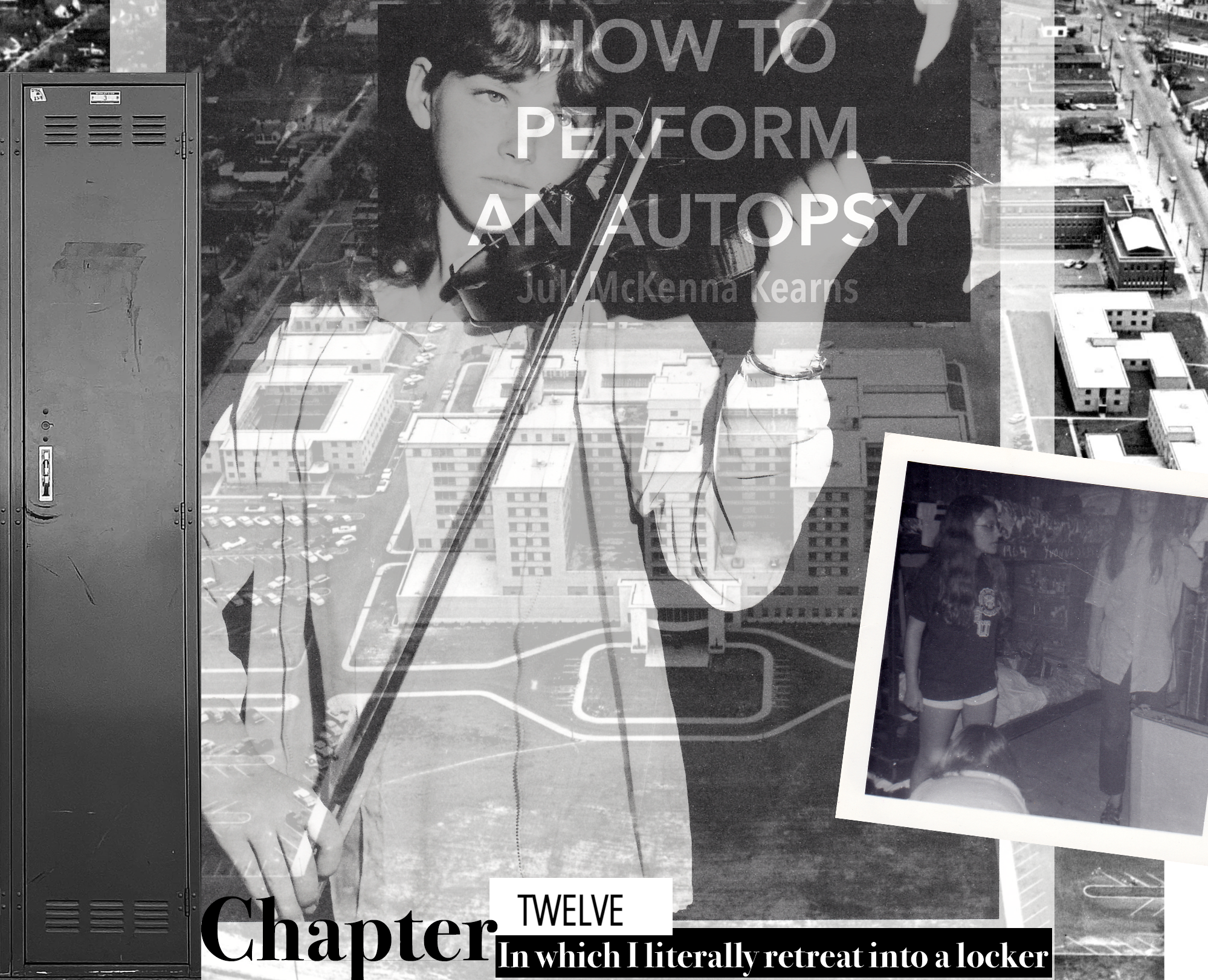
TWELVE
In which I literally retreat into a locker
1
Fate has a way of trudging along like an exhausting if unintentionally cruel monster that just happens to shit out enough beauty so we don’t promptly lie down and die as the most rational response to life that lets everyone know from the beginning the spoiler that all our work, the struggle for our daily bread, ends in death. Even for Christians who believe in an eventual literal resurrection of the body and salvation of the soul through their God, death comes first, unless one’s around for the prophesied Rapture that promises to translate the elect directly to the heavens. As a potential member of the elect, the hope for a Book of Revelation’s apocalyptic scenario to happen in the believer’s lifetime means not to have to suffer the insult of death and decay, the unholy aroma of what it is to be human, hoorah for the blood of the lamb that takes away the sins of the world. As conscious beings who can vaguely comprehend the eternal, but have mortal bodies, to hold the belief that one has an immortal soul means to deny the overwhelming daily evidence of death in favor of assurances of immortality made by other mortals who also die, which is difficult territory in which to reside when people die, die, and die, emphatically, resolutely, there are so many ways in which to die, maybe about 117 billion of our species so far have died, that’s a lot of people over which to grieve and to perform funerary rites, yet about seventy percent of those now living (give or take, there are polls on this) cling to the belief in the survival of a personal consciousness after death sips our final exhale of breath, the terminus of our transforming into carbon dioxide the fiery energy-producing (insert chemical equation) miracle of oxygen which began to be produced by a new breed of photosynthesizer, cyanobacteria, about 2.5 to 3 billion years ago when our 4.5 billion years old earth was (subtract) about 1.5 to 2 billion years young. Cyanobacteria weren’t named until 1977 and now that we know about them we can offer these creatures the awe which they so appropriately deserve. ”Why so long?” they don’t ask before not stepping out on stage to deliver their “Thank you” speech, because they’re not human, they don’t care whether they’re recognized or not, though cytoskeletal structures are in all cells and can be cited for the emergence of proto-consciousness, which means information processing, communication, intelligence, I really didn’t mean to go here when starting this paragraph, but will still insist cyanobacteria won’t care if you present them a medal for their achievements.
2
Fate. The reason I brought up fate was because of the psychological conflict I experienced, having studied violin as a youth, when decades later we would live for several years under a professional and talented violinist who sometimes spent all day
Twelve - 2
or evening practicing at home, and because I know the how of practicing, the necessity of it, I didn’t think in terms of minding or not minding that she played the same few measures over and over again then would advance to another part of the piece to play it over and over again, but it took me a while to come to peace with a violinist having moved in above us, as if fate was testing an old fracture to see how much it still pained, and eventually the pain shifted so I’d be sad at the prospect of her and her husband moving out, every time I heard what sounded like the commotion of furniture being hauled down the back steps at the end of a month (as every renter knows, immediately before the first of the month is when lessees depart) I’d hope it wasn’t them, even though they twice flooded our bathroom. The building is near a hundred years old and we still have the old style porcelain tub and the porcelain sinks in the bathroom and kitchen (rust-stained, no longer glossy, difficult to clean as the porcelain is pitted and worn in spots, I would prefer better porcelain but I’d hate for these to be replaced as their design fits with the age of the apartment which has not been remodeled which I like and is rare, not so fine that the pipes needed replacing and were always clogging up but the bedroom wall was finally briefly torn out for new pipes to be installed) and the tub doesn’t have a secondary drain so if you’re filling it for a bath and aren’t used to not having a secondary drain and forget about it then the tub will overflow, which happened a couple of times with the couple above so the water rained down on us, pouring through the ceiling. They apologized with a nice bottle of olive oil and a house plant.
On her part, she would be relieved to have, by happenstance, moved in above musicians—both my spouse and son are musicians, my spouse a professional, he had even recorded her and said she was great to work with in the studio—because we weren’t going to complain about the practicing as we understood its necessity, that it is a must as part of her life as a musician. The manner in which she practiced at home wasn’t the same as when a group practices a piece together, at home she was working on where she might be having problems, thus the intense repetition. People rehearse differently and at home she tended to be concerned with speed and concentrated on aggressively fast tempo sections. Not infrequently the material inclined to what sounded like the Romantics, and sometimes it seemed she might be working on solos, for though I didn’t recognize a work it would have the dramatic flair and acrobatic complexity reserved for a solo violin. Then for a while she toiled over Baroque, and what she practiced over and over would have had to do with upcoming performances and/or recordings. I love Baroque, a lot of people don’t, they find it too mechanical, they don’t hear in Baroque what makes it vivid and heart-rending, what makes it a philosophical plea to fate and the eternal to have mercy on we mere mortals who are predetermined born of The Great Machine that keeps making and destroying in its blind quest for beauty and meaning, the communal prayer and the hope to address what we experience as a body, humanity as a part of relentless nature that is devastating in its impersonal acceptance of our anguish and losses, our inability to preserve our lives and loves in the midst of the Greater Than that is so absorbed with the perfection of its toy that pain as part of the process is perhaps never perceived as much more than good color and interesting texture on the whole of whatever canvas it’s painting. Baroque has a different ego than the Romantics. Rather than rallying against the crushing wheel of life as the Romantics do by blatantly extolling the individual, Baroque fine-tunes the ear to perceive the individual voice in the herd to
Twelve - 3
which we all belong. Baroque is the photo-journalist who goes to the battlefield, records what is, then permits and relies on each individual viewer of the photograph to sort out how the entire spectrum of emotion and intellectual travail is represented in every moment. We need both, those who exert their individuality, asserting themselves above the morass, as well as those who introduce the intimate through our mutual enigmas.
She was once practicing a piece by Vivaldi, just a few bars, over and over, stopping before the resolution of the phrase, and I could do nothing throughout but sit, gazing up at the ceiling, and wait for that resolution to happen at least once, which never happened, and she had no idea that in the apartment below her I listened.
With fiction, even if built on fact, accuracy sooner or later gives way to poetry, and if a real person has served as inspiration they transform into a character by virtue of fiction channeling its own ideas. However reflective the story may be of life, it can only handle so much reality before it fractures under the weight of the complexity of the real. The same can easily happen on these pages no matter how I attempt to capture what’s true, so I am always having to stop and re-examine and determine where my imagination has filled in what’s elliptical, and as we aren’t all-knowing deities our lives are full of ellipses. I can imagine the violinist’s relationship to a piece by how she practices it, and build up a story based on this, but it may not be true. I only heard a portion of her practice time and none of her rehearsals with her fellow performers.
We are a thing and become another. We are children and grow into adults, but the ghost of the child remains. I was once a musician. Now I just appreciate music. I’m being somewhat self-dismissive when I say that, though I don’t play any longer, as I do a little more than just appreciate. I married music when I married a musician, and have been supportive of my spouse at every stage of his career, kept saying don’t give up, from band to band, touring, his move into engineering and producing after his wrist was shattered by a car falling on it (the changing of a tire, the jack broke, his wrist was momentarily trapped between the auto body and the tire), I’ve been there to physically labor, carting and breaking down equipment, not the kind of supportive that is oblivious to the business, I’ve heard all of it every step of the way, the good and all the miserable bad. Sometimes I give my opinion on instrumentation and mixes. It helps to know music if you’re filming it and I’ve assisted our cinematographer child with filming musicians while my spouse records them, I have slithered around on the floor filming musicians from below for divergent angles. If I’m self-dismissive it’s because I don’t play, I haven’t played in decades except to have occasionally picked up another instrument to try it out for a couple of years then put it down, and musicians can thoughtlessly tend to be egocentric, not my spouse, not all musicians, but many position themselves as the center of attention and often take for granted the help and support from the sidelines, especially if they perceive one as being not-a-musician, not-a-performer, not part of the club, a person who has never juggled notes, being just a spouse or partner. I am a not-a-musician, a not-a-performer, not one of the initiated, and even if people knew I did once play I would still not be one of the club as I've always been a spouse. But I did once play.
Twelve - 4
However, don’t many play an instrument as a child? Studying doesn’t necessarily make one a musician. If any knew I once played in the long ago I’d be classified as the kind of not-a-musician who had a few lessons in grade school and that was the extent of their musical education. Just because you studied science in school doesn’t make you a scientist. That expectation may be my own prejudice, but I also know how musicians are or tend to be.
Someone placed their bonafide Stradivarius violin in my hands when I was eighteen or nineteen and I played a few notes, that’s all, then put it down. There are occasional violin wars online in which people protest Strads aren’t all they’re said to be, and while we must take into account my lack of acquaintance with the quality of instruments currently produced, I don’t know what they’re talking about when it’s said that the elevation of Strads is a matter of branding rather than quality, because with no effort on my part that Strad sang with an immediate clarity and depth of emotion that was astonishing to experience and near to touching the hem of divinity. It was a shock and a revelation. The individual, not a professional musician but an elder amateur who was very good at the thing in which he was a professional and thus had money to invest in an instrument he very much appreciated and did play in concert. He seemingly liked what he’d heard of my playing and enthusiastically offered to let me play their Stradivarius whenever I wanted, which shows a great deal of trust, faith that I would respect the instrument. I said thank you so much and didn’t tell them I’d no desire to ever touch the instrument again—which I didn’t. For one thing, it made me nervous to handle a violin that expensive. For another, it was painful to have left music and now meet an instrument that had such innate genius it both invited and challenged one to use it to its full advantage, because that’s why it existed. The instrument had power. And I rather wouldn’t have wanted to explore that potential on an instrument that I couldn’t afford in several lifetimes. One develops a relationship with their instrument. To play an inspiring instrument that belongs to another was almost threatening in that I didn’t want to develop an emotional attachment to it. I wouldn’t have felt free to explore it. I didn’t want to be inspired by it. I knew that with an instrument like that a casual acquaintance would only be agony as such an instrument wants you to think and feel through it and you can only do that if you live with it as an extension of one’s body. And I didn’t want to put either of us in the position where I would come to feel silently greedy about a violin beloved by its owner, which wasn’t only an investment to them. That said, I’m also aware that had I been given the opportunity of money and to test a number of other newer instruments, I’d have undoubtedly found more than one that, even if different, likely carried the same soul resonance.
I dive into newspapers and other materials to find bits and pieces of evidence of people, places, events that had a part in the musical life of my youth, but there are perhaps some things I won’t bother with trying to look up. Among those things will be a newspaper announcement that I’d won, at thirteen, a scholarship to the Brevard Music Center Summer Institute, a seven-week program for students about twelve through about eighteen who are “gifted”. It was a Georgia Power Company scholarship program that allotted a handful a year regionally. My violin instructor, who the 1971 Augusta College yearbook (located online) gives as chairman of the Fine Arts Department, one afternoon brought into the small practice room H. J., Director of Fine Arts Activities according to the same yearbook, but I remember H. J. as also
Twelve - 5
being chairman of the Music department, which his obituary says he was,. My instructor, E. F., told me to play and I did, it was a piece of Romantic period music I was supposed to be working up, I forget what it was but I didn’t like it and though E. F. told me I was doing well with it I knew that I wasn't, I hadn’t begun to connect with it, as yet the piece felt senseless to me and beyond my control. As far as I was concerned I played poorly but the next thing I knew I was the recipient of the scholarship. I will never understand the faith these two individuals had in my possible future in music. H. J. had graduated from the Eastman School of Music in Rochester, New York, and Northwestern University in Chicago, had played with symphonies around the world and started the Augusta Symphony for which he served as conductor. E. F., my instructor, according to his Wikipedia entry had been a child prodigy who played at the White House before the age of ten, soloed with the National Symphony Orchestra at fifteen, studied at Juilliard, got his PHD in music from Michigan State University, and was associate conductor of the Augusta Symphony. Beginning at the age of fourteen I kept trying to drop out of studying violin, telling them I wanted to be a writer and artist, and they kept pulling me into H. J.’s office to lecture me on how I had to stick with the violin, I must stick with the violin, they said I could write and paint if I wanted but I couldn’t give up the violin, the violin would give me a certain career. Which was insane. Few have a certain career in music. As a young teenager, I reasoned that these were men who should know better, so the energy they exerted in trying to get me to stick with the violin was bewildering unless the pickings were just that scrape-the-bottom-of-the-barrel dry as far as students were concerned.
My studies began when I was seven, having received a violin toward the end of my second grade year as a surprise gift after my mother’s first hospitalization, the violin was my reward for being so adult and responsible during that time and taking care of my siblings. If I’d been given a choice, I would have opted for piano lessons, I’d never been near a violin, but I was presented with a violin, which also disqualified me from receiving a present for my birthday that was several weeks off, my mother couldn’t stand to hear me play piano and she said she’d always wanted to play violin thus this gift of the violin, and my brother, B, also was given a violin and we both became students of Lydia Woods, concertmistress of the Mid-Columbia Symphony of Washington State, founder of a chamber music society in Richland, a graduate of the New England Conservatory of Music with a master’s degree in solo violin performance, which I didn’t know at the time but now makes perfect sense that she had a master’s in solo violin performance considering her focus with me and how I was aware ever after that no subsequent instructor I had knew how to teach soloing like she did. Wikipedia states that the New England Conservatory of Music is considered to be one of the best music schools in the world, having produced almost half of the Boston Symphony Orchestra, six members of l’order des Arts des Lettres, fourteen Rome Prize recipients, fifty-one Guggenheim Fellows etcetera, but when I was studying under Lydia I didn’t know anything about her history, I just could tell she was good, she communicated well what was crucial and why seeming small things were important. I appeared in recital in Richland in June of 1966, along with my brother and twenty-eight other students, which I’m surprised to see, in a news article, included my mother. I don’t remember her taking violin as well from Lydia. Charles de Beriot is also given in that article as one of those students, but that is an error, one of us would have instead been playing a piece of music by Charles-Auguste
Twelve - 6
de Beriot who was a nineteenth-century Belgian violinist and composer. We performed again in recital 4 June 1967, both recitals being at Lydia’s home on the Columbia River. A modest white wood house when viewed from the street, the interior felt as though it was tailored to be a teaching space, large enough to be comfortable for performances before a small audience, and the view of the Columbia River was spectacular. Her husband worked at Hanford as a Douglas United Nuclear consulting engineer, he waas also there during the war as a technical advicor to reactor design and operation. Because of course. In Richland almost everyone’s husband worked at Hanford.
Lydia also did three years of post-graduate study under Russian-born Jascha Brodsky, who after coming to America had studied under Efrem Zimbalist (not the actor, the actor, Zimbalist Jr., was his son). Some years after Brodsky’s death in 1997 at the age of eighty-nine, he would be investigated for sexual abuse and assault of some pupils, In 2020, it was at least concluded that in 1985-1986 he had raped a fourteen-fifteen year old student. She had reported the rape in 1986, and when she said she was going to report it to the police the head of the school, the Curtis Institute, told her, "Oh, for God's sake, who do you think they're going to believe? Some 15-year-old kid or someone who has been here for decades?" She was from Canada and was at Curtis with a younger brother, which made her particularly vulnerable. Brodsky had warned her if she told anyone he’d have her and her brother kicked out. Twenty other students, between the 1960s and 2010s, had accused Brodsky of abuses, sexual, emotional and verbal, the paper doesn’t clarify when they made their accusations, but they could not be corroborated by investigators. Of course, I don't know if Lydia, who was only eight years younger than Brodsky, ever had a problem with him, and I'm not suggesting she might have. I include this because the world of music has a problem with abuse.
Lydia must have genuinely liked me and believed me promising. I was eight-years-old, she had a daughter, sick in bed with mononucleosis, who had me visit her in her bedroom. Lydia said her daughter wanted to meet me as she so enjoyed listening to me play. The visit instead was for the daughter to secretly ask me to be the student to carry to Lydia, on the symphony stage, a gift of roses for a special recognition Lydia would be receiving. The daughter said I was a favorite student, which was why she was asking me to be the one to present Lydia with the roses, she knew it would please her. Which made me feel good. For this I got to get a new dress, which I was able to choose as my mother was in the hospital again, one styled with a high empire waist red skirt and red and white-striped bodice and long sleeves. I loved the dress. I enjoyed carrying the roses on stage to Lydia and witnessing the thrill of her smile under the stage lights with the dimly-viewed audience beyond applauding. It felt good to see her receive recognition and to be a part of it. And studying under Lydia felt good. I don’t know how I knew she was a good teacher, but I knew she was. She made me feel confident. She said I picked up things quickly, but what really impressed her was how from the beginning I naturally had a beautiful, sure, full tone. She said she’d not heard anyone start out with such a tone.
Despite the fact I couldn’t practice. It wasn’t that I didn’t want to practice, but I
Twelve - 7
couldn’t. She didn’t know this.
People say things and you don’t know whether to trust them. Such as when you are told you are good, and you are hiding that you don’t practice and feel guilty about it. I trusted what Lydia said but I didn’t see how it meant much in my life, though she taught me to identify myself as a musician.
Damn, now that I think about it I believe I do remember my mother practicing violin at home for that first recital, the mention of her in the paper as being also a student of Lydia’s wasn’t a flub, and I don’t know whether she was heroic to make a try at the violin after her supposed life’s training to be a concert pianist, the fruits of which never began to materialize, or if my being started on violin was only a cover for her desire to take lessons. As in, “As long as my children are taking lessons, I’ll take lessons as well, I'll be able to help them with their studies.” My brother was on a 1/2 size instrument, I began on a 3/4 size instrument, and that my mother was taking violin means they had at the same time purchased the full-size 4/4 violin to which I later moved over. And I don’t just “believe” I remember my mother taking violin, other bits of memory are returning, such as how perplexed I was by the situation, my mother must have had a history of not following through as I didn’t see her sticking with it, I thought she’d become exasperated, but she stuck with it long enough that she was in that 1966 recital. The idea that I’d received the violin as a special gift for being so responsible during her hospitalization falls through when one considers she got a violin as well and so did my brother. The reason I find this a little disorienting, that she was taking lessons, which I’d completely forgotten until I saw her name in the program in the news article, is because, from near the moment I started taking violin, my mother didn’t permit me to practice. We were still living on Everest Avenue, which means this was either at the end of my second grade year or the beginning of my third, and one morning when I started to practice, before going to school, my mother, screaming at me to stop, came running in from the kitchen as I was practicing scales, grabbed my violin bow from me and chased me from one room to another around the small house whipping me over the head and about the body with my own bow yelling at me that I was so bad it was painful for her to hear me play, with her perfect pitch she couldn’t stand it. So it was thereafter forbidden me to practice, which meant every week when I showed up for my violin lesson I would play what I’d been assigned the previous week, not having practiced, and somehow I got away with it. My improvement was congratulated, how I was a quick learner, and with each lesson I kept being moved on to newer, harder things despite the fact I never practiced. When we moved to Mahan Avenue I was in the youth orchestra and that at least gave me opportunity to play a little more than at my lessons. During the summer, rehearsals for the youth orchestra were held at the high school. I’d pedal across town on my bike with my violin hanging from my handlebars. I felt free and capable, and when I stopped at the Roman Catholic church to light a candle for my mother, who was in the hospital, it was prompted more from the guilt of my wishing she wouldn’t come home again.
One may think that when my mother was in the hospital I would have been free to practice at home, the barrier of her removed, but it wasn't so simple, I was uncomfortable practicing at home after being whipped for it. When I tried to practice
Twelve - 8
at home I felt bound, I had to be quiet so the house itself couldn't hear. I was defeated by the listening air of the house. And from then on every time I opened my violin case and pulled out my bow, I was returned to the back room off the kitchen in the box of a house on Everest Avenue, the room in which my mother’s upright Steinway was kept after we returned to Richland from Seattle, where had been the couch that had served as my bed in which I’d come close to being burned to a crisp. Where I had set up my music stand to practice, the light was dim, I hadn’t turned on a lamp, I began to practice my scales before going to school and there was suddenly my mother bursting into the room to grab the bow from my hand, beat me with it, forbidding me ever to practice. As I ran from her, my first thought was that I had to protect the innocent violin, I managed to secure its safety by, even as I ran, pausing to place it out of the way so she wouldn't accidentally break it, which slowed me down just enough there was no outrunning her that day. One has revelations periodically and as I began to run with the violin still in my hands mine was that the violin was vulnerable, not permanent, if I was hit I healed but the violin wouldn’t and it wouldn’t be replaced and that would be the end of the violin which was precious, the violin needed me to protect it more than I needed to outrun my mother. The violin was art to me in how it had been crafted to make music that connected one to all those who had beforehand played the notes of a piece one was learning. The shape of the violin was art, the waist that seemed to want to imitate a human form, its delicate bridge, the f holes refined so to me they seemed to connect the instrument to a musical staff, the scroll of the headstock that fit so nicely in one's hand as one stood receiving instruction. I understood that the violin wasn't just its strings and the bow, that the particulars of the violin's body and its wood had everything to do with resonance, vibration, acoustics, but I didn't know how. To peer into the violin through the f holes was as if trying to peer into the mysteries of the church. I don’t know why but the violin’s interior reminded me of a cathedral perhaps because a cathedral was reserved space that one entered under special circumstances, peering through the f holes one could only see a little in the shadows so it was mysterious. Except for the soundpost, a solitary column, which made the sacred room of the violin’s interior seem vast, there was nothing there, but that nothing and how it was shaped by the violin’s body was a crucial part of its acoustic architecture and when I held the violin always demanded a few fascinated seconds of consideration of that space as inviolate.
Protecting my violin I thought of myself as also protecting my mother, just as when she chased me with things that could really injure me I outran her as much to protect her as myself, to prevent her from having to face the consequences if one day she broke me and I couldn’t be fixed.
From then on, every time I opened my violin case I experienced again my mother chasing me with my bow and whipping me with it. I eventually comprehended that for as long as I had that memory the bow hurt me, no matter that it wasn’t responsible, which was absurd, but that's the way it was. When I was fifteen, that memory still came to mind when I opened the case.
When I was sixteen or seventeen and I briefly attempted to take up the piano after quitting violin, my mother laid down much the same law. I had been diligently practicing at it when one afternoon both my parents, for some reason my father was
Twelve - 9
required for this announcement, sat me down at the kitchen bar and told me I was prohibited from not only playing the piano in my mother's presence, I was never to play our piano at all. Never? Never. The piano was my mother's instrument, not mine. My mother overseeing the laying down of this law, watching my response, I suppose its impact on me, my father said my mother was the pianist, the piano belonged to her, I wasn't allowed to learn it because it was my mother’s domain. And that ended that. I was more than astonished, I was grief-stricken at the cruelty of this, that I was forbidden to play the piano, which had been for me a means of meditation, a solace, a profound means of expression. I had understood the same with the violin, and by the time I quit I was caught in the vise of trying to balance how the manuscript outlined what a piece should be, and how one heard it could express more, could be interpreted in a vitally personal way, this was all up to the conductor, I had known clockwork conductors, and I was only a player and playing around with time and dynamics, with the emotional and psychological tenor of a piece, wasn’t my business as a player, a player played what they were told. Of course. It had to be that way for an ensemble, an orchestra, and one could take great pride in being able to meet the demands of others, it was satisfying to be a part of a whole composed of many parts working “in concert”, but I knew a commitment to playing in orchestras meant a consumption of all one’s hours and no room for anything but that. When I quit music, I told E. F. and H. J. that was one reason I was doing so, I didn’t want to be locked into always and only expressing as another demanded, and I had control over self-expression in art and writing.
No one ever said, “Then maybe you want to be a conductor,” because women weren’t conductors. I’m not sure how I would have responded if anyone suggested that because women conductors didn’t exist. At that time, there was still sexual bias against women even being hired for orchestras, in 1970 the percentage of women in orchestras stood at about six percent, which was why blind auditions were introduced in the 1970s and 1980s, to combat sexual and racial bias. I was being trained for a career in violin at a time when my sex dramatically impacted opportunity. The same biases existed also against women in other artistic fields—in 1970 ninety-five percent of artists represented in leading New York galleries were men, art by women was rare in museums, and literature belonged to men while women who wrote literature were seen as writing for only women, but I reasoned at least with words and art I would be expressing myself. Plus I was drawn to words and art, it was as simple as that.
Lydia had been training me to play solo, I would realize later, and I felt I was starting to get somewhere with it when we moved to Augusta, Georgia, when I was ten. I had liked working with Lydia, after two years I now thought of myself as a violinist as she had treated me like a violinist. I was confident. I was even a little proud of being someone with potential. However, I didn’t take lessons while I was living with my grandparents in Carthage, I don’t believe my violin was even left with me there. When I was situated in Augusta, the violin languished under my bed as if all of that had never happened. As nothing was mentioned about my starting violin back up, I thought it was over. I had gone for so long without playing, during my time in Carthage, that I was scared to pick up the violin, though I missed holding it. Then for
Twelve - 10
a short time when I was eleven I studied with a woman who was, if memory serves, Principal Second Violin in the Augusta Symphony. As I’d not touched the violin in over a year, it was nerve-wracking to pick it back up and begin study under another person, I believed I was already a lost cause because I knew from my mother that performing musicians had to be accomplished when young, yet after several lessons this woman said I needed a teacher more advanced than what she could provide and she was the one who passed me along to E. F., the Principal First Violin of the symphony, under whom I know I was studying by the age of twelve, and playing with the youth orchestra he rehearsed at Augusta College.
At minimum, I should have been practicing an hour a day. I knew I was a disaster because, as I couldn’t practice at home, I would go the entire week without playing then right before my lesson I’d occupy a practice room at the college, play my pieces through once or twice, time permitting, then go in for my lesson. Many times I didn’t have any time to do that, I went straight into my lesson with no practice. And somehow I got away with it and I kept being moved along to more advanced pieces. When I was fourteen, E. F. one day told me he could tell when I hadn’t practiced beforehand. I was terrified and asked how, knowing I never practiced. He said it was because when I hadn’t practiced I would break out in hives. I’d no idea I was breaking out in hives, and that I was breaking out in hives at some of my lessons shows the kind of emotional stress I felt. And guilt. Unworthy. Afraid of it being found out that I couldn’t actually play. But through this conversation I realized that E. F. had no idea I never practiced.
I was breaking out in hives from the stress of playing an instrument that I was never able to practice because my mother beat me with my bow because she said I made her ears bleed as she had perfect pitch. As far as I then comprehended it, my mother didn’t want me to practice as I wasn’t perfect, but one can’t improve if one doesn’t practice, so how did she expect me to improve. As a musician she should know I had to practice. But that was a rational response. My mother, who had started me on the violin, was instead punishing me for possibly becoming a musician. Which begs one to wonder why they didn't just say, "No more violin." The violin lessons were the only thing my parents paid for concerning me, their only investment in me, I never then wondered why they continued to pay for the lessons when they were determined I do nothing with them.
So, imagine. Here’s a student who isn’t allowed to practice their violin at home. Somehow I’ve managed to skate along to more and more difficult pieces, but I not only feel I can’t play worth a damn, I know that I can’t play. I know that I’m lacking. I know that I haven’t progressed as I should have, could have. Lydia had been teaching me the confidence required to perform solo and that had been blown apart with the move, E. F. hadn’t prepared me for soloing and I knew the difference all along. The piece with which I won the scholarship, I had been unable to practice at home because I couldn’t practice at home. No wonder I had no grasp of it, plus I knew nothing else by the composer and I was given no recordings of the piece to help me comprehend it through how others had interpreted it. I get this scholarship, and I wondered how that happened, I felt I’d played very badly and wasn’t worthy of the scholarship, and now I have to prepare for a recital luncheon at which will perform
Twelve - 11
the winners from across the state, maybe there were six of them, we each were the winner from a region. E. F. kept telling me not to worry, he said I was prepared and was going to do great. My mother was now screaming at me that I never practiced, so in preparation for the recital I try to practice at home even though my mother was there, and I’m terrified of her hearing me, I’m in the dining room and she’s at the bar in the kitchen, drinking, because when I lived at home she was always drinking, the door closed between us, she’s quiet as I practice so I think maybe it’s going to be all right, but then I hear her scramble from the table and she bursts through the door screaming at me that I can’t play and shouldn’t have gotten the scholarship because I don’t deserve it and for me to stop, stop, stop, it’s too painful for her to hear me. Then she has to sit back and be quiet in the kitchen for several rehearsals I have with my piano accompanist in our dining room on my mother’s Mason-Hamlin parlor grand piano, the one she grew up playing and which she acquired from her parents when we moved to Augusta. The piano accompanist is a young woman with long brown hair and I’m terrified to have her in our home because I wonder if she’ll see how sick our family is. My mother hasn’t really heard me play the violin since at my recital when I was eight years of age, she didn't hear me when I was nine as she was in the hospital, and I can feel her in the kitchen sitting there smoking and drinking and listening and criticizing and I know I’m going to catch hell as soon as the pianist leaves. I feel the rehearsals are all a disaster, I may be able to play with the accompanist but I know I’m not performing, I know I’m not secure, I feel completely unprepared but the piano accompanist keeps telling me I’m ready and things are going to go great. I feel like she’s lying. She’s being paid to be my accompanist and I imagine she’s lying to make me feel better. As for E. F., I feel like he’s clueless and for some reason has no idea how bad I really am.
In fact, when you think about it, I did warn everyone. I didn’t try to hide the fact I didn’t feel prepared. I kept telling E. F.and my accompanist, “I don’t think I can do this. I’m not prepared.” And they kept telling me I was prepared and it would go great.
This may be irritating, how I keep saying, "I felt" I was bad and couldn't play. I do so because though I felt that I was bad it also leaves room for doubt, taking into consideration perhaps my lack of perspective, how it was so colored by my mother, who was the one person in agreement with me on how bad I was, who had told me all my life I was bad. After the piano accompanist would leave, my mother, who had been all nice smiles around the accompanist, would harangue me on how terrible I was and that she didn’t know how the accompanist was able to tolerate playing with me. While she humiliated me, sitting across the kitchen bar from her I would silently watch her and wonder how she, who had prepared for so long to be a concert pianist, felt with this woman in our home playing on her piano accompanying me. It hadn't occurred to me until I was working with the accompanist that my mother had never volunteered to accompany me on the piano, not even for the just plain fun that can be had when people play together, but of course it hadn't occurred to me as she wouldn't let me practice. On the non-music end, other bad things were going on at home, my parents fucking with my head, tearing me apart and shredding my sense of self. That didn’t help matters either. I had friends who would, when mad at their mother, fume, “She’s such a bitch!” The words, “You bitch,” never once entered my mind concerning my mother, nor did I ever think of my father as being, “You bastard,” no matter what they
Twelve - 12
did I had a hard wall up against such thoughts, and not out of respect for them, it may be I didn’t find such words an appropriate response as they didn’t describe the levels of harm my parents inflicted, for which reason I still never think of them in those or akin terms. I don’t believe I’ve ever said to MK my mother was a bitch or my father was a bastard because those words seem weak and irrelevant.
My mother must have said something to the pianist on the side, because the pianist tells me to not mind about my mother, that I’m prepared and that when I got up on stage all my preparation will automatically take over.
That didn’t happen. It went very badly.
The day for the recital came and my mother, who won’t let me practice at home, who has beaten me with my bow when I tried, who screams at me how I make her ears bleed, is now riding up with me and my father and my pianist to the city in which the award luncheon will take place. I’m in agony in that trapped environment of the car for two hours and thirty minutes with my insane mother and sociopathic father who are forced to behave in front of this pianist like they’re normal people, it’s horrifying, and I’m trying to convince myself things will be fine, just like E. F. and the accompanist say they will be, but I feel they have been giving me false confidence and that I’m an imposter, a fake, and now everyone will learn how I’m an imposter. Whatever the piano accompanist and my mother talked about, I’ve no idea, but I know I wasn’t a participant as I was too freaked out by the situation, and my father wouldn’t have participated as being a man and a scientist precluded him from interest. It’s cold, lightly snowing when we arrive, which was unexpected as snow wasn’t predicted for Augusta where it’s very rare. The snow has no impact on anything except that I hope it doesn’t unpredictably snow harder and strand us up here, unable to drive home on icy roads. Just from the ride up with my parents and the accompanist, I’m maximally stressed. My father was convivial and I doubt the accompanist can tell it’s a performance, my father has never expressed pride in anything I’ve done, no approval, the scholarship I’ve won is meaningless to him, he never said congratulations and I didn’t expect him to do so, that’s the way he is with me, I know he considers his having to drive us to the luncheon a great imposition, that he likely resents it, he hasn’t heard me play the violin since my recital when I was nine and cares nothing about any of this, he’s doing what he can to mask and keep his anger at me in check, that he’s had to participate. Then the luncheon has begun and I feel unsettled at our table with my parents and the pianist because I see how out of place my parents are compared to the others there, and I am as well, I am thirteen and this is the first time in my life I’ve been in an environment with my parents in which we are enduring any length of time with someone who isn’t a member of our insane closed system of a family, that in itself has been a shock to my system, having worried the whole ride up about the pianist listening to my parents and what she might be thinking about them, how we’re not right as a family, and going from that situation into this luncheon without a break where I’m with the winners and their families and people who have to do with granting the scholarship, as well some Georgia music society. I realize it’s a first for me dining anywhere just my parents and me not including my siblings and I have rarely ever been out in public with them. We did go as a family to church, that’s
Twelve - 13
true, I was trapped with my parents in church in public on Sundays but that was only for an hour and you don’t dialogue, you’re not making conversation with other people, and it was still painful and claustrophobic, I felt wildly exposed yet imprisoned, I may as well have been in shackles with a stun baton held over me at all times. It’s difficult to communicate how much of a shock it was enduring that car ride with my parents and the pianist for 150 grizzly minutes too long that was also too short as I never wanted to arrive, and then the conference room with all these people, the godawful tension of watching my parents pretend to be interested, sociable, listening to them make small talk, and feeling the illness of us oozing out from under these costumes of selves, they are always a community of two and I may as well not be there, they ate, I remember the pianist ate, I was too distracted to eat, but the food is not the point and knows that it’s not. Over five decades later and it makes me shaky to remember it, but I realize I also only now am permitting myself to revisit and feel the stunning revelation of it all on me when I was thirteen.
A couple or several of the other winners play, who are older, and then McD plays, another winner my age, he is a person who is obviously talented, very prepared, he acts as though this is his daily routine, and he will go on to be a world-class violinist, I knew watching him that day he would go on to be world-class. Listening to their introductions, I realize how much support these other youths have had. McD’s mother is a concert pianist and music teacher and I don’t imagine her beating him with his bow. And the others are on good instruments that stay in tune. I play on an instrument that now keeps falling apart, the back of my violin keeps separating from the violin’s body, so my violin buzzes, this has been going on for several years, E. F. has to periodically glue it and clamp it together, and the tuning pegs are so worn down that there is no keeping my violin in tune. Though I like my violin’s tone, I am now in a continual battle to have it not fall apart and I can’t have it fall apart because I know my parents won’t get me a new one. (McD prided himself on being able to tune any violin, and when he saw me having trouble at Brevard with my violin before a performance he assumed he could master it, and he worked and worked to get it in tune but it kept falling out of tune immediately, it was a matter of pride for him to conquer my violin which was why he kept trying, and he finally handed my violin back to me saying it was hopeless because it was.) As far as my home situation goes, at thirteen I have become increasingly less able to cope, but I’ve rationalized that the level of dysfunction on which we operate is normal for us. That rationalization of “normal for us” fails at the luncheon. At the awards luncheon here I am having the sudden illumination that these other winners have parents who appear to care, who appear to be proud, watching the interactions of the other winners with their families, listening to the introductions and how the parents have been involved or else the winners wouldn’t have the experience and kudos they’ve received, I realize I’ve never thought about the support other youths might get from their parents, it’s never entered my mind, I’m fully absorbing that the situation from which I’m about to step up onto the stage is a very sick one, in which I’ve not been offered any support, not even in the form of harsh coaching but practical criticism of how I could be better instead it was demanded I not practice from the age of seven because my awfulness tormented my mother. Even now I feel like I’m going to vomit. To make things worse, E. F. had a previous engagement and isn’t there, so all I have are my mother and father and the
Twelve - 14
piano accompanist. With this realization of how ill my home situation is in comparison to all these others whose introductory credentials at least make obvious the long-term support they’ve had from family and others, I increasingly feel the aura around my family must be observably bad to everyone, though the pianist is pleasant and even reassuringly calm. The abnormality of my situation so oppressively thickens the air that I can barely move. All I’ve known from my parents is violence toward me, emotionally, psychologically, physically, and I feel that suppressed violence as I sit there. I’m wearing a new dress and I hate it because even that feels abnormal and bad-wrong as my mother cared enough to get me a dress so I look nice but that’s all there is to me, I am a pale blue dress, and I’m suddenly now also confounded by this dress and what it means. My mother kept telling me how bad I was but was attentive to the dress, so that now there is only this dress on an empty me. The time comes for me to play and I have veritably no introduction because no one has ever thought of my future and how a lifetime of preparation and nurturing in the present prepares for the future. I get on stage and I’m not ten bars into my piece when I freeze. I can’t move my fingers because the music is gone, my mind goes blank on what I’m supposed to play, it’s like watching the music vanish phrase after phrase, and as I’m frozen for a moment then two then three I’m thinking it’s already too late to salvage the situation. I knew everyone would negatively judge me for how I played, they would wonder how I got the scholarship, I knew they would think, “What is she doing here? She doesn’t belong with the rest of us!” That was bad enough. Now I can imagine the overwhelming judgment of them over my having frozen and not playing and it comes rushing at me in my mind, all that judgment, I think I should I must start playing again maybe if I start playing the music will return will flow but my mind is both chaos and empty at the same time my parents have only crushed me they've never supported me they said I didn't deserve this and they're right and despite the fact this shouldn't matter I've a responsibility to fulfill I literally drop my violin on the ground, how does that happen, not even when my mother was chasing me to beat me to keep me from practicing did I ever drop my violin, I have always taken great care with my violin, I can't metabolize this and it undoes me, when I drop my violin to the ground is when I unfreeze with the pitiful, pitiless event of it incomprehensibly leaving my hands, I find myself fleeing from the room to run down a hall to lock myself in a stall in a bathroom. My mother actually is nice and smiling, she doesn’t come in and tell me how horrible I am. Instead, she comes in and gives me pills to take to calm me down and tells me it’s all right. I’m surprised at how fine with this outcome she is. She’s completely relaxed.
I remember nothing about the ride home. E. F., when he learned what had happened, at my next lesson was furious with me and said had he been there he would have made me get right back up on stage. I wonder if maybe had he been there, none of this would have happened, I’d have been able to play for him like I do during my lessons, but I’m not confident about that. I don’t know. I had been dealing with shock upon shock of being in public with my parents. I’d imagined that I was only unprepared to play, that I wasn’t good enough, but at the conference the situation was more complex than that.
This is not a matter of a child being ashamed of their parents who stand out as not
Twelve - 15
fitting in and then the child awakes to the fact their parents are worthwhile as they are, it’s okay that they don’t fit in, and they stand on their side, they love their parents and their parents love them. Enough movies have been made with this as a plot, and we were not the characters in that film.
It took me decades to realize my mother was fine with the outcome because this was what she’d been rehearsing me for all along. For years she had beaten me around when I tried to practice, had beaten me physically and emotionally with my own instrument, had told me always how horrible I was, making her perfect pitch ears bleed (which, when I think about it, is odd, because not only was I told I had a beautiful full tone, I was also always told I had excellent pitch, E. F. always called on me to play parts as an example for the youth orchestra), and now I flee from the stage and my mother comes in and soothes me and tells me that’s just fine and gives me tranquilizers. For the first time in my life my mother was there to back me up and comfort me, which is confusing. She tells me I don’t have to play. And in the bathroom stall, as I cower there, humiliated, I now also feel guilty because I’m aware of the lie that this is performance anxiety I’m experiencing when it’s not, now I feel feeling guilt from agreeing with others that it is a bad attack of stage fright when instead what’s happening is I know for a fact I’m terrible and should never have won the scholarship. I have observed how others there have had support that my parents never gave me, I’ve seen the pride of the other parents and it suffocated me with how my parents never cared except to pull me down. And as I cower in the bathroom stall I keep thinking about the dress my mother had chosen for me to wear, and how it is screaming at me its real meaning but I can’t put my finger on it. It took me decades to realize I had been dressed for failure.
3
We return home from being out with others, and I ask, “Did I do all right? Was I okay?”, MK tells me I was fine, and not to do that, I don’t have to do that. He tells me everything was good and that people like me. But I know it wasn’t okay, I can feel my parents bleeding out all over the floor through my pores, only I’m never able to acknowledge this outright and say, “See this? This is what you get with that quality of family sickness. You think it’s over and done with, that life moves on, but it will never be over and done with.”
4
When I was thirteen I was at Tutt Junior High. The Tutt Junior High campus, when I’m attending, is several 1959 to 1968 no frills school utilitarian buildings connected by walkways. It’s 1970, the first year of school desegregation by busing, which is why I’m at Tutt, previously a Black school in a Black neighborhood, instead of the school to which they previously sent middle school students in our suburb, the resources allocated for Tutt would have been less than at the white school and bringing in white
Twelve - 16
students is expected to rectify that problem, not a bad looking school Tutt is put together like a college campus the way it’s composed of four separate buildings, an administrative building that’s combined with the cafeteria and theater, a 1968 addition of a two-story main building of classrooms that’s down a hill behind the administrative and cafeteria building, to the left of the administrative and cafeteria building is another one-story building of classrooms that is obviously older than the new two-story building, not 1960s modern, then further to the left beyond that is the separate gymnasium, only one walkway between the buildings is enclosed, the one that connects the administrative and cafeteria building with the one-story classroom building, which made no sense to me as we’ve no protection from the elements the several times we change buildings during the day, it’s obvious this is a school that is dry on resources and basic equipment, and that’s just the way things are while I’m attending, all the pluses that would have been had at the previously white middle school, Langford, are not here, and though Tutt is more advanced than the grade school, A. Brien Merry, from which I’m coming, which had serviced the neighboring white suburb, just as I’d recognized with Merry how far inferior it was to schools in Richland, Washington, Tutt is nothing like the middle school, Chief Joseph, I would have attended were I still in Richland and which I had looked forward to attending beginning in sixth grade as middle schools in Washington were for sixth through eighth graders. Though I know we don’t have any advantages at Tutt I feel fortunate to experience the lack of privileges and education investment for Black children because this gives me insight, I am well aware that separate but equal doesn’t work, there is no separate but equal.
Augusta’s Tutt services those in the eighth and ninth grades, and white stretch vinyl “crinkle” boots are in style. With money I’ve earned babysitting, I’ve purchased myself a pair, which are not very expensive despite being in style, probably because they are vinyl, and am walking from where the school buses let us out, down the sidewalk that leads to the one-story classroom building where I have my homeroom, I am with a friend and we are laughing, I feel good, it’s the first time I’m wearing my new boots, I like them I like myself in them, then we must part ways because whoever she was disappears from this story. Every morning and during lunch, a gang of white bully boys hang around outside the door to the building where my homeroom is located. They are led by a guy I’ll maybe call Billbully, who is bigger than everyone and is a grade ahead of me but may have been held back a year and is two years older than me. For some reason his focus turns on me this first day I am happily wearing my new boots and he sneers at me something about how he bets I think I look hot in those boots, a remark phrased to be beyond disparaging, ugly, which immediately shames me because he’s right, I do feel happy and good about myself in those boots, a style which many others are also wearing as they are trending but somehow I’ve been called out and shouldn’t feel happy about my boots. That part of the memory, I’m watching myself from a distance, from a grassy neighboring area, as it happens, as in a movie. I shift back into my body as he blocks the double doors and lets others past and into the building but not me. He and his gang close around me, towering over me, and the verbal abuse he pours out on me is not only ugly and vulgar, he is genuinely threatening, not just scornful. This guy hates me, truly hates me, and I don’t know why. I don’t know why he’s targeted me. It’s a repeat of the bullying I experienced in
Twelve - 17
kindergarten in Seattle with the two girls who would hold me outside the school on the playground and not let me in until the bell had rung and I’d be late. He does this with me so that I’ll be late for homeroom not just this day, but the next and the next and the next, despite the fact I never wear my white boots again. Because of this guy bullying me about my boots, making me feel ashamed about them, I only ever wear them that one time and then hide them in the back of the closet until I decide to throw them out, then give them instead to a friend who wants them. It’s not his fault, actually, that I never wear the boots again, because if I’d come from a healthy background I wouldn’t have perhaps felt so profoundly shamed that I was proud of my new boots. Every day I ignore him as I stand there surrounded by the gang at the entrance to the school building, I don’t respond as he becomes increasingly physical, pushing me, pinching me hard, he even squeezes my arm hard with that stupid “Indian burn” grip that children do and I’m surprised that a childish manner of bullying is employed by this big teenager, the group is so tightly closed around me that I don’t even know if anyone outside the group can see me isolated and stranded in the center. I’m resolute in my determination to not react in any way, because I reason that if he gets a rise out of me then he’ll really let me have it. This happens every morning and every lunch time, and is agonizing. Every day, I’m terrified of approaching that entrance in the morning and after lunch. There are two other doors to the building, so at this distance in time I question my not using them, but for whatever reason when I’m thirteen I don’t, perhaps because one of the other doors is only accessed through an enclosed walkway, one would have to go through the administration building to reach it via that closed connector walkway, and the third door is at the very rear of the building and is never used as it doesn’t give access to anything but a narrow dirt path and a steep hill, it may even be that rear door is exit only and provides no ingress. As for asking for any help from teachers, I don’t recall doing so, maybe because I trust they won’t do anything. Maybe I did tell my homeroom teacher I was being bullied and was told to deal with it, that would be typical and I wouldn’t be surprised, even teachers didn’t want to involve themselves. Other kids who are aware of what’s going on aren’t going to do anything because they don’t want to attract the attention of the bullies. My memories fragment as regards the bullying, such as I recall one day we are just inside the door instead of outside it, I’m not being blocked because Billbully and his gang are instead lining the hallway, but Billbully says something, and I retort something back and he acts like he’s going to punch me out, his friends grab him and I keep walking. I feel less like I care, almost reckless, I’m not strong like BillBully but I’ve found a button that moves him past bullying to losing control, a button that bothers him, I am so tired of this that I’m ready to push that button. One day, having reached my limit when I’m surrounded outside, I again retaliate and say something to him that makes him wild. I’m unable to remember what I said, I didn’t call him a bastard that isn’t something I would have said, but I made just the right remark that stung him, that got him, his face turns livid red and then he goes ballistic, saying he’s going to get me for this after school when no one’s around to protect me or see, he says he’s going to kill me. I don’t think he’ll kill me but I know this threat is serious, I am terrified that after school he’ll attack me when I’m waiting for the bus, I am positive he will make good on his word. He promises he’ll get me within the next couple of days, it’s not a threat he’s putting off to infinity which will never happen instead this is a solid framework in time, he tells
Twelve - 18
me not to think I can avoid this by not coming to school he’ll get me anyway, and I feel that there is also a sexual component to the threat so that I worry I’m going to be sexually assaulted. Whatever he said, it causes me to picture my being dragged into the woods beside the gymnasium and that I won’t walk back out, when I’m found they’ll have to carry me out. That afternoon or the following morning I do something I never do which is I look to my mother for help, I tell my mother I’m being bullied to which she responds that he is bullying me because he likes me, I think how childishly absurd her response is and tell her no he doesn’t like me he hates me, she says bullies never do what they say they’ll do, which I know is wrong. I am fiercely on guard those two days fully expecting the worst. But nothing happens. Nothing happens because Billbully miraculously disappears from school. He’s just suddenly gone. I mean completely gone from school. A rumor goes around that he threatened and may have attacked one of the female teachers, who is coincidentally also now absent, who has the classroom immediately opposite my homeroom, the rumor is he may have even sexually assaulted her or tried to which is why she’s not in school she is recovering and may not return, but no one who has absolute knowledge is talking about it and I learn nothing more other than he’s not just gone he’s gone for good, the reason I take seriously that he did something to the teacher, whatever that might have been, is because she’s absent, I realize how the attack on the teacher has left me freakily fortunate, he attacked her before he attacked me and got in bad trouble for it, this is why I’ve been released from his bullying. It’s a relief that he’s no longer there, I can breathe again, and it’s odd to watch his gang literally dissolve without him, they don’t hang out at the entrance to the building any longer, I hear administration had a hand in breaking them up after Billbully’s attack on the teacher. Not long after he disappeared, for some reason I’m not in class and am walking down the enclosed walkway between the administration building and my homeroom building on my way from the single-floor classroom building to the two-story one. The enclosed walkway is all glass from about the waist up, which means that when you’re in the walkway the classrooms looking out on it from surrounding buildings can see anyone in it. One of his former bullies is also out of class and happens to be on the same walkway. As he passes me, he threateningly draws close and says, “Bitch, you’re dead.” I spontaneously yell at him, “Fuck you!!” I don’t know I’m going to do it, it just happens, I am enraged and yell with all my force. He draws back, surprised, speechless, as I walk on, and from then on he never bothers me again, he doesn’t even ever direct a malevolent glance in my direction. I had yelled at him so loud that when I returned to class everyone knew about it because they heard it and could see from the classroom windows that it was me who had yelled at him. It’s one of those stories where all anyone knows is that I was the one who caused trouble because all anyone else saw was our passing one another in the walkway and then I yelled, “Fuck you!” Decades later, I tell my spouse about it all, about Billbully I still remember his name and he not only knew the person who had disappeared from my school but had been also bullied by him at the middle school he was attending with him before Billbully ended up at Tutt. My spouse’s family and his family had known one another and my spouse knew to where Billbully had disappeared. He had been sent off to military school. I wonder what became of him, if he’s maybe even on social media and look up his name and he is, a religious MAGA who posts pictures on Facebook of sunsets, saying one day God will call you to heaven, and how we should gather within ourselves the beauty of the
Twelve - 19
sunset and make it a gift to others. Also, he believes all socialists are evil, and if you cheat to get into college in America you’re sent to jail but if you’re an illegal immigrant you get to go to college for free, his far-right messaging conveyed via popular picture memes that are always unfailingly grotesque content due the racism and sexism, the plaint of them is that whites are superior yet are the victims of the world and “woke” campaigns against Christian family-oriented religious and cultural values.
By the time Billbully's reign of terror at Tutt ended and I exploded on a friend of his I was on my way to being the strange, problem girl who you didn’t know what was going on with her but you kept your distance. Though unplanned, the day I yelled “Fuck you” so loud that most of the school heard, it was a dividing line. I developed a hands-off reputation that would snowball when I was fourteen, a combination of a few facts, fictional rumors, assumptions based on facts and rumors, which is how these things are, I didn’t know what was being said about me and didn’t think much about it because I was tied up with trying to survive, but I was good with being hands-off, that was to my benefit, a protection. I also felt some imposter syndrome, and that I should say, "That's not me," because I was harmless. There was confusion about me because I wasn’t the stereotype of the bad girl, I was known as a serious, thoughtful person, a musician and artist. Yet I was associated with trouble.
Several years later, a senior in high school, I began to relax, feeling a little bit better about myself. But always, when I had my head in gear and wasn’t tuned out on psychotropics (which I often was when I was fourteen through sixteen) I’d not been one to shy from raising my head and giving a viewpoint, whereas most students wouldn’t do this, few would engage in a discussion with the teacher. And I would express my viewpoint with fellow students, whereas many girls wouldn’t, they’d sit quietly and let the boys talk. One day in class, the school year was winding down, nearly over, I forget exactly what was going on but this was a study period only there wasn’t much left to study, a group composed of students who happened to be friends and acquaintances of mine would gather in the seats by the windows, on the other side of the room were people not in that group, and the center of the room was composed of a few who had some association with those by the windows but were quiet and didn’t engage, the people in the group to which I belonged were active and could get boisterous, we were wasting time but we also had productive discussions, a teacher was over us but I only remember her coming in periodically, at the beginning of the study period and at the end, she seemed just as anxious for the year to be over as we were, and she wasn’t present for this event. I was expressing my viewpoint in such a discussion, one that I didn’t see as in any way inflammatory, I thought it a convivial exchange, I was animated, enjoying myself, and suddenly a boy with whom I’d never had any engagement, who was typically quiet, suddenly threw himself out of his seat, while he yelled, “Shut up!”, grabbed my arm and twisted it around my back so I was bent down on the ground. No one said a word. No one came to my defense. I was stunned by this unprovoked attack. He then backed off and returned to his seat. I pulled myself up from the floor and looked around in disbelief as everyone kept their eyes averted. I wondered, what, did they think I deserved this? Did they hate me and I hadn’t realized it, just like I hadn’t realized how this boy must have hated me all that time? Or did they think because it happened I deserved it? I had been through hell with leaving my family, that had already happened, but I was winning awards in
Twelve - 20
writing and art, I was beginning to like myself, to not feel so defensive, to open up more, and now this peer, who was in my class but I'd never spoken with him, we had nothing to do with one another, had strong-armed me down to the floor. He didn’t just yell at me, he physically assaulted me, grabbed, jerked around, forced me down on the floor in pain with my arm bent high and back behind me, I could feel that all that was needed was one little twist and it would be broken. I felt incredible shame over this, as if I was somehow responsible, what did I do to bring this on, while also knowing there was nothing I had done to cause this to happen, and that there was no excuse in the world for him assaulting me. Still, it was a tug of war in my mind, with everyone turning their eyes away and ignoring what was an assault, young women and men seventeen and eighteen years-of-age. Why? If no one would even look at me, and as no one approached me afterward and even said so much as, “That was horrible”, then what was wrong with me that would have them accept this? I was at war with myself on how I’d attracted this attention, how no one had stood up for me, even though I’d long since learned that no one is ever going to step forward or speak up if you’re being abused. If I’d asked someone “Why?”, what was the reason for the attack, just as victims of rape were often blamed and told they’d invited it by how they were dressed, I might be told I was too animated, drawing too much attention to myself, but instead I thought this was pure misogyny, that I was being reminded why women typically didn’t speak up, why they kept quiet, why they didn’t voice their opinions even though it was 1975. I’d the intuition I was not attacked because I was perceived as weaker, but that the attacker had felt threatened. I had been feeling good about myself and self-confident, and I was being reprimanded for feeling self-confident, not submissive enough. I was feeling good about myself no matter all that I’d been through, and that was due in part to the awards I’d collected over the years. Friends would joke when an announcement was made over the intercom about another award picked up by a student of the school, that my name would follow. Which isn’t a brag. That year I would have second thoughts about the awards, I would realize they are fickle things, that there was no “best” in any of the creative arts, not with so many different genres and styles, not with so many voices, one day it descended on me what was a simple revelation of the facts which were that getting an award was more a matter of pure luck in respect of the preferences of judges. When one is raised to believe in awards, as we are, that they are absolute proof of better and best, it’s quite a personal event when you’re seventeen and it occurs to you, even as regarding your own work in which you’ve had some pride, which has given you some self-esteem and the confidence you have value, that awards you’ve won were pure luck because your style that year happened to hit the right spot with the judges, and had the work been placed before other individuals you might not have been so lucky, or even before the same individuals in other years. This is not me devaluing myself, it’s a simple truth. My thoughts on this had nothing to do with Brevard and my inner turmoil over having been awarded the scholarship, because there’s a difference between the creative arts and skill, in certain categories recognition of an individual as a better musician is all to do with skills which can be objectively appraised.
I felt insensibly blamed by people who were supposed to be friends, and I wondered, when people don’t speak up for someone who has been victimized, is it because though they don’t want to think of themselves as cowardly, they don’t want to become involved, the immediate inclination is to passive withdrawal, and because they
Twelve - 21
wonder if they should take action they may even feel some animosity toward the victim because the fact of a victim has pressured them to make a choice in becoming involved or not. Rather than feel guilt over looking the other way they become upset with the victim. Though I could intellectually understand this, I felt no better, and the friendships were corrupted by the event, never the same, dissolved not with any animosity but by a discomfiting distance.
A few years later I learned MK’s mother knew this boy and his family as they went to the same church. When I told her how he had treated me she said oh no she couldn’t imagine that he would do that, he came from a good Christian family, she couldn’t accept my story, then a couple to three decades later she brought up his name and related how it was all too bad, but he had a problem with anger and had assaulted his wife.
These bullying events haven’t been a cloud over me throughout the decades. They come up now because I’m writing about a certain period of time and things that happened that contributed to the turmoil in my life.
Leaping forward about fourteen years, when I was in my early thirties, there was a play (not one of mine) in which I served in multiple areas as creative designer, and I had some trouble with one of the actors, who I’d learned was in anger management because of something that had happened (so I’d heard, through the grapevine) concerning his wife who had separated from him. Then during a rehearsal I came upon the director in dialogue with him on his anger problem, giving him reassurance, protectively supporting him. This anger problem was a concern to me as the actor had irrationally decided I was out to get him, to make him look bad, because I didn’t agree with an item of clothing he’d brought from home to use as part of his costume. Having learned the actor had an anger problem, I discussed the matter with the director, should I pursue the issue with the costume or just let it go, and the director said I was right and should pursue it. So this was the second time I’d addressed the actor about his costume and how what he’d selected from home wasn’t going to work. He said I was trying to humiliate him, to make him look bad, to make him look like a fool. Absolutely not, that was the last thing I wanted to do, I assured him this wasn’t the case. Why would I sabotage the production by making the lead actor look foolish? I was wary of him but I didn’t back down. I almost always got along well with actors. I didn’t want to argue, I was trying to impress upon him how his choice wasn’t right for the character. He was suddenly upset. His face reddened with rage. With the sudden reddening of his face, the anger that consumed it, and other physiological changes that warn when a person is about to attack, he made a move that caused my flesh to prickle, call it years of training from childhood but I could sense from the muscles of his body, his arm was just beginning to draw back and I knew the follow through would violently land on me. All of this transpiring in an instant, I whirled away from him across the full floor of the stage as I yelled, “Don’t you dare touch me!” The room fell silent. No one spoke. I knew I’d just saved myself from being assaulted. The room remained silent and kept remaining silent. The director didn’t move. My pulse was racing, my heart hammering. I had to get out of there. I went outside. No one followed me to see how I was doing, and to me this was unconscionable to abandon someone on set who had so obviously been made uncomfortable. I didn’t return, I left rehearsal.
Twelve - 22
A person who had been there told me the next day that no one knew what to do because no one had seen what had happened, all anyone knew was that I was the one who had suddenly yelled at the actor and it seemed unprovoked. Well, fuck that, so no one had seen what had transpired, why I’d acted as I had, I wasn’t going to let someone hit me in order to have it proven he was a threat. There seemed an implicit suggestion I had at least over-reacted. I knew I wasn’t over-reacting when I had, fight-or-flight activated, without premeditation, vigorously hurled myself out of his reach, and shouted at him, I knew from his face, his tensing, from everything about him that I was saving myself from being hammered by an out-of-control angry man, a big man at that. Also, what I had done had given him pause, it had stopped the abuse, he didn’t dare carry through on his threat in front of all the others and pursue me. In that respect the situation was saved, I had prevented him from harming me and that saved him. But as he was also only now silently standing there, room was had for others to believe I was the unpredictable one, causing such a huge stir on set, which I also knew some might feel was near unforgivable because you didn’t have confrontations on set you took them off set. What was instead wrong was that the director knew he’d an actor on his hands who had an anger problem, and he didn’t step forward. He didn’t see if I was all right. He allowed me to appear to be the one who was out of control. I reasoned he felt he had to protect his show and the leading actor, who he had been treating as fragile. I understood protecting the show, but I thought he did it in a shit way, that it could have been done differently.
My heart had been pounding, and I’d had to get out of the theater, but it felt good to have saved myself, to have flung myself out of reach and alerted everyone to what was happening by yelling as I had. I felt strong and never had any trauma over that incident, though any trust I had in the director was extinguished. A couple of nights later I returned to the production for opening night, to watch the play, to attend the after-party. Of course I stayed clear of the actor, and he must have steered clear of me because I remember nothing about him from that night, no discomfort over seeing him again, no fear, I scarcely recall him on stage, I don’t remember him at the party though I knew he was there. I danced, I had a good time. I went to the party after the party. People got drunk. I was sober. I had fun. I didn’t return to the theater the duration of the play’s run. I’d done my job and my thread of attachment to the show had been broken.
A few weeks later I was told that the actor, homophobic, had become irritated with one of the gay actors, and without warning, no cause, struck him so hard in the dressing room during a performance he was knocked out. The actor who had been struck, who had a minor role, quit the show.
5
Now is time for me to dig around online for information on the Brevard Music Center Summer Institute in the mountains of North Carolina, located in the county of Transylvania, which was formed in 1861, several decades before Dublin Irishman Bram Stoker’s 1897 Dracula and I imagine not too many Americans then knew about
Twelve - 23
about fifteenth-century Romania’s Vlad the Impaler aka Vlad III Dracula, Dracul meaning “dragon”, a name passed along from his father who was known as Dracul and was associated with the knightly order that was The Order of the Dragon. An 1861 newspaper calls this area of North Carolina upper French Broad country, which is meaningless unless one knows the French Broad River runs through it, believed to be one of the oldest rivers in the world, so there’s that for special, and until I read that bit of information I’d never considered that there was an “oldest” river of the world. If you want to see what is currently imagined to be the oldest you will need to be in Australia, but you’ll need to be there at a specific time as that river, known as the Finke or Lara Beinta (take your pick of the colonialist name or the indigenous, I think we should opt for the indigenous), 400 to 350 million-years-old, only flows a few days a year after heavy rainfall. The French Broad River is so old it was flowing before the Appalachian orogeny 325 to 260 million years ago, an orogeny being what happens when continental drift causes compression at a convergent plate margin, which in this case resulted in the ancient formation of the Appalachian mountains. The headwaters of the French Broad are in Transylvania County, and as there was already a Broad River, it was called the French Broad River because at the time the French held the territory into which its northbound waters drained. Before this, marking the eastern boundary of the Cherokee homelands, the river was called Tahkeeostee, or “Racing Waters”. The county was named Transylvania because the Latin
Twelve - 24
him. But Transylvania was formed from parts of Henderson and Jackson Counties, and while Henderson County is said to be named for Leonard Henderson, a chief justice of the North Carolina Supreme Court, I find his father was land speculator and jurist, Richard Henderson, also of North Carolina, who attempted to establish in Kentucky a settlement called the Transylvania Colony, result of his Transylvania Company which was all about land speculation. The book, American Sovereigns, recounts how Henderson failed to convince the Continental Congress to make Transylvania America’s fourteenth colony, one with a proprietary government, which was on land illegally purchased from the Cherokee, all seventeen million acres of it, a deal transacted in secrecy. The colonial governors of Virginia and North Carolina deemed the affair to be a fraud by an “infamous Company of land Pirates and freebooters”. By 1776, settlers in Transylvania were petitioning Virginia for protection from the proprietors who had more than doubled the price of land from what they’d initially asked. The claims of the proprietors were consequently prohibited, the county of Kentucky was made out of Transylvania, and the Transylvania claim declared void.
I would think that the Transylvania Colony settlement is for what Joseph Jordan was naming Transylvania County, that it had nothing to do with the Latin meaning of the name, and instead was inspired by Henderson, Jordan symbolically associating Henderson’s scheme for the proprietary Transylvania Colony, in which the proprietors had ultimate say-so over laws etcetera, with the secession of the Confederacy from the United States. Some had felt that the Transylvania Colony settlement had been “invaded” by Virginia and North Carolina, though its limits were within their borders. The Confederacy believed in states rights, in as much that this was a confederacy of states that believed in slavery.
How the Brevard Music Center came to be is it was originally begun in 1936 as a summer music camp for boys at Davidson College, a private liberal arts college in Davidson, North Carolina, above Charlotte and 135 miles to the east of Brevard. Due to World War II the Davidson Music camp was canceled in 1942 then in 1943 moved to Queens College in Charlotte, which had been an all female school, and the camp became one for girls and boys between ten and seventeen years of age. Then in 1944 it was moved to Brevard, became the Transylvania Music Camp, a festival was instituted in 1945, and the name Brevard Music Center was adopted in 1955.
Now you know more about Brevard than I did when I arrived, having just turned fourteen a few days prior. All I knew about Brevard was that it was a great opportunity and that it was fated I be a failure there because I didn’t merit this opportunity.
We received a list of things I would need for my summer at Brevard and my parents displayed their usual concerted disinterest with preparations. Since I was twelve I had been obliged to pay for most of my clothes on my babysitting money, which means I don’t have much in the way of clothing to pack for Brevard. Because it’s rainy in the mountains and can get chilly the list warns to be prepared for this. I dig a blue, lightweight, nylon windbreaker of my mother’s out of the Goodwill bag and an old white, sleeveless, button-up shirt of hers and a pair of old jeans she had never worn that aren’t Levi's jeans and are too short, all of these things years out of style. These will be my everyday clothes. Because they are my everyday casual clothes they are the
Twelve - 24
ones I will be wearing when one afternoon a photographer from the Augusta paper shows up, surprise, they were in the area on another assignment, so while they were up there they were tasked as well with dropping by Brevard to capture a photo for the paper of me playing the violin, which means I will have the news item to remind me forever of my wearing my mother’s old clothes at Brevard. I instead spent my money on a couple of skirts and blouses for attending performances as it was stated we needed to wear appropriately dressy clothing for these. I also needed a black skirt and white blouse for performing in the youth orchestra, the times I would be on stage, but my parents promised to purchase these for me. Instead, the day before I was to leave, my mother dug out of the Goodwill bag an old black skirt of hers that I couldn’t recall her ever having worn. It was ugly, with an elastic waistband, and was made out of an odd nubby, unpleasant knit cloth of a type I’ve never seen since, the material was just that grotesque. I had to double the top of the skirt over at the waist by several inches to try to keep it up as it was so large it dropped down on my hips and in length went down to the middle of my calves. The cloth had a hint of an open weave to it so it needed a slip, and my white slip, another Goodwill bag hand-me-down from my mother, showed through but there was nothing to be done about that. For a top I wore a white short-sleeved blouse of my mother’s she dug out of the same bag, kind of a peasant blouse but not, also too large and mature for me, made out of an unpleasant poplin fabric that was stiff and had no drape, which was the only top I had that I could wear with the skirt as it was hip-length with a straight hem and amply covered the top of the skirt thus concealing the awkward bulkiness of my having to turn the waist of the skirt over. I had never seen my mother in that blouse or that skirt, or at least had no memory of them, and suspected she may have gotten them to wear early in her pregnancy with my younger sister, when I was seven. For casual shoes to wear at Brevard, I dug out of the same Goodwill bag a pair of cheap moccasins my mother had never worn. After Brevard, if I could have had a ritual fire and burned all these clothes I would have. Clothes are important to a teenager socially and personally, they express one’s identity, and digging through thrift stores for clothes that suit one’s personality isn’t the same as making do with one’s mother’s cast-offs.
I left Brevard in about as much disgrace as I arrived. All students were committed to spend the entire seven weeks, which is reasonable, we formed a performing orchestra and you don’t want your orchestra disappearing on you. My parents decided this didn’t matter and scheduled a trip to visit my father’s parents which meant I’d have to leave a week early, which I didn’t learn about until a couple of days before they picked me up. Henry Janiec, who was the center’s artistic director as well as primary conductor, called me into his office, that’s how I learned about it, my parents had contacted the camp to say when they were picking me up and I needed to be ready to leave. He demanded I come in with my parents for a sit-down when they arrived. Though I had nothing to do with my parents’ scheduling of the trip, though I was powerless over their pulling me out early, he raked me over the coals for such conspicuous irresponsible disregard for commitment to performance, also not honoring my scholarship by leaving early, and then when my parents arrived, when we gathered in Janiec’s office for him to scold them, they didn’t care except for my mother to say “how dare you” and my father to tell Janiec that the music center wasn’t going to run their lives and tell them what to do, if they wanted to take me out early
Twelve - 25
then that was their business. I was told by Janiec, in his reproving voice, that this was too bad as I’d had positive reports, I’d done well, and if I left early I’d never be permitted back, which meant I wasn’t going to be permitted back as my parents were certainly taking me out early, but that didn’t matter because my parents would never have considered sending me to Brevard on their own dollar, I was only there due the scholarship.
What transpired between my arrival and departure at Brevard was nearly as bad and entirely my own fault. By all my own fault I mean that by December I would be hospitalized on a psychiatric ward and my time at Brevard was a confusing one that helped launch me toward the ward.
I half arrived at Brevard full of excitement that I would be away from home for the bulk of the summer, which meant freedom from my parents and the insanity of our household. I anticipated being now able to concentrate on the violin, to practice, hoped to make friends and maybe even have a good time. Problems instantly arose, the primary one being that things weren’t better for me at Brevard. Instead, I was bewildered with the realization of how bad things were for me at home because getting away didn’t give the expected relief with separation. I was living in a cabin that was two cabins, one for younger girls and one for older, bound by a communal toilet and shower area between, and my body shut down with the lack of privacy. Mentally I could cope with the living situation, I didn't understand how I couldn't cope when I wanted to cope, but my body refused to cooperate. Because my body wouldn’t cooperate with me, I always felt I was on high alert, that my body was demanding I pay attention to the toll of abuses my body and psyche had suffered over the years. I began to suspect there were things unremembered also ruling my body, trying to speak through it. It’s difficult for me to describe how this was so, because I was not just troubled, I was terrorized by this idea, I was just-turned-fourteen, unable to escape being twenty-four-hours-a-day hyper-vigilant in what I’d anticipated I would experience as a safe setting, and paired with that was a completely new thought that what I was experiencing was not just fallout from known abuses but also due to a profound dissociation from my nighttime body in the past, almost like a shadow body, with which my hyper-vigilance had brought me into contact. All I wanted to do was live a normal life like everyone else with a body that did as it was supposed to do. I didn’t know at the time the language of CPTSD (Complex Post Traumatic Stress Disorder) or PTSD (Post Traumatic Stress Disorder), because these were terms and ideas that didn't exist yet, no one talked about, "When bad things happen to a person, they can lock you into trauma response.” So how to describe what I felt was going on, how I interpreted it, way back in 1971? I can say I immediately understood part of this was the trauma I experienced at home not letting me go, you might take a vacation from trauma but trauma didn't take a vacation from you. I thought of it as a part of an unconscious somnambulist brain having gone renegade in the way it wouldn’t cooperate with my rational, daylight brain that was trying to keep me going and operational. It felt to me that my body was united with my unconscious brain in a nightmare from which it couldn’t be released, all the abuses and stress I’d experienced, and more that I now feared I couldn’t remember, at Brevard it began to haunt me that things I couldn’t remember were ruling me from an unconscious horror show zone. I reasoned that now that I was in a “safe” place, away from the trauma of my familial household, instead of getting to live an ordinary life, my unconscious brain
Twelve - 26
had taken possession of my body and was desperately attempting to get my attention, was simply not able to stop living in a state of perpetual trauma, and in the hyper-vigilance was trying to protect me in a safe situation and as I was in a safe situation it only made for disorder. I understood that much, which was fairly insightful for a just-turned fourteen-year-old.
It was at Brevard I started waking up in the middle of night already in a state of dissociation, whatever had been taking place just prior in my sleep it spread like a great black cloud of ink throughout the darkness, a shuttered reality that was escaping containment. And I wanted it to be contained, I wanted nothing to do with it, I was thankful for not remembering, I had no desire to confront this, I just wanted that reality that had been sleeping deep within to cooperate, to wholly return to its subterranean realm, to let me live unperturbed by it. In this cabin of so many other souls sleeping, breathing, in that multi-layered pitch dark, I'd lie awake perplexed, terrified, bargaining with that sleeping self to leave me at peace. I feared it would pester me to death, that it had the power to kill me by throwing my system completely off balance. While the rest of the cabin slept, every night I would wake up and lie there in a panic, and often would get up and go into the communal bathroom to sit and be by myself, but I couldn't get away from this thing that heartlessly, relentlessly refused to cooperate, to release me, I couldn't make this somnambulist dream brain that clung to my body, obstructing normal life, demanding my attention, listen to me and respect that it was to the best interest of my body as a whole that it operate normally, then I could live successfully and everything would be all right. What was happening, this sense of the "hidden", which was now wrestling me to death, what had been unknown and I didn't want to know it, was entirely novel.
Yes, I was well aware of abuses I’d suffered at home, but I’d considered myself a survivor, strong, and I couldn’t integrate into that survivor the idea I’d been victimized in ways from which I’d been unable to escape.
To distract myself, I immediately got into trouble, without trying to get into trouble. We weren’t bad kids, I’ll argue that. I was in the cabin reserved for the youngest of female attendees, there was one girl who was a little younger than myself, and I was the next youngest. This other girl, who had short blond Shirley Temple curly hair, and who wasn’t a friend, was a primary cohort with me in causing trouble because of our egging each other on in our initial nightly resistance to what I, at least, perceived as the absurdity of hyper-authority at the camp. We had two counselors in our cabin, one couldn’t have been more than nineteen, and was helpless against us, while the older one, the lead counselor, seemed to stay disengaged in an effort to get the younger counselor to learn how to cope. We weren’t mean. To the best of my memory what we would do was, when it was lights out and we were supposed to shut up and go to sleep, we would begin exchanging absurd, nonsensical stories and quips that would get us both laughing so hard we couldn’t stop, which meant we had the fire to keep on with more nonsense. I don’t remember how many other girls were on our side of the cabin, double-bunked—maybe twelve?—and the junior counselor was sleeping in a cot with us while the senior counselor had her own little room between the cabin and communal latrine. When lights went out, all the other girls agreeably falling silent, the junior counselor would try very nicely to get me and my cohort to
Twelve - 27
stop exchanging absurdities and laughing, and when we didn’t stop she would immediately start despairing and conjuring reprimands. Her despair and reprimands seemed nonsensical and exaggerated in response to our silliness, which just kept us going. I don’t know about the other girl, but with me it was partly a safety valve, I needed release from all the stress I was under and the back and forth with the other girl was it, I needed to laugh, and we just happened to be a good fit that way. Plus, I was hyper-vigilant and had a difficult time sleeping. I was hoping laughter would make me forget the darkness, would retune me and make me all right. For our sins we ended up doing juvenile delinquent duty which was sweeping out the practice cabins for maybe a week. I don’t remember much about the girl with the blond curly hair after our initial nighttime rebellions, which really weren’t mean-spirited but the junior counselor finally broke down in tears over her inability to get us to quiet down, and the senior counselor didn’t only get on our cases for causing trouble but also on the junior counselor for inviting trouble. I don’t recollect how long it took us to calm down, acquiesce, and stop this behavior completely but it didn’t go on for too many days, plus the senior counselor asked us to take it easy on the junior counselor and when it was phrased to us like that we took pity. The other girl stopped getting into trouble, but I managed to keep getting detention duty. I don’t even remember how I did but it didn’t take much to be always on detention, which involved cleaning and kitchen labor. I don’t recall any of the other girls in my cabin getting detention nor did I meet individuals from other cabins who were on detention, I seemed to be the only one. I didn’t take it very seriously as it was nothing compared to home. I didn’t see how anyone there could take it seriously.
When I say I was partly acting out against what I perceived as hyper-authoritarianism at the camp, I came from an abusive household, I was sensitive to over-bearing authority, and my thoughts were, “You think you can scare me into quivering submission with your threats of detention for every minor infractionary nudge against a rule?”
Our schedule was tight. We daily rehearsed with our orchestra for our weekly concert (or concerts, depending) plus we had other musical activities, of which all were mandatory, such as theory classes, attendance at the recitals and performances of others, personal rehearsal time to prepare for concerts as well as a lessons with a private instructor. Our free time daily was when we had meals, and Sunday was partly free. As far as I observed, all my peers at the camp were devoted, willing to be worked to the bone, uncomplaining horses in the harness, yet they were also subjected to an in-general threat of what would happen if they didn’t sacrifice themselves twice over, this was the invisible canopy hanging over the camp, and I felt what use was that threat over people who were unfailingly agreeable and passionate about what they were doing? It even made me furious for my peers at times.
Our schedule was so tight that though we were in the middle of the mountains it never occurred to us to explore, to take even short walks in the woods. We didn't have the time. The single communal, recreational outing I remember being taken on by our counselors was to a place called Sliding Rock, less than a half hour away, but we'd no chance to explore, we slid down the very abbreviated, amenable waterfall a few times and then were on our way back. Toward the end of our time there we had a
Twelve - 28
watermelon eating contest with the neighboring cabin, and whichever side won got an evening of fun (maybe it was even several cabins in competition). I was slender, even skinny, but I was determined, I loved watermelon but only had it once a year at home, I had no doubt my love for all the watermelon of which I'd been deprived would win our cabin the evening of fun, everyone said I couldn't eat enough watermelon to win it would be impossible for me, but I had such fierce determination I was confident I would win, plus I hoped that if I won this for the cabin everyone might forgive me for having been always in trouble, I hoped it would help me make amends. To everyone's astonishment, I won the contest for our cabin. I don't remember what we did but got dressed up, we were able to take dates and some of us had dates to take. Did we go to a restaurant? What did we do? I remember winning the contest but I don't remember anything about the festive night because I was in such a state of psychic misery that it hardly made an impression though I did my best to have a good time. I did appreciate it. I thought it was a nice thing to do for us, though at the expense of losers who didn't get to participate in this nice thing. Afterward, I immediately forgot that I had won the festive night for our cabin. I remembered winning at eating all the watermelon, but not that it was for sake of a special night for my cabin mates.
With no complaints, I did my detention, and settled into just trying to keep up with my schedule while dealing with a body and psyche that were in heavy ruled-by-post-trauma mode, feeling heavy shame over this, and having to hide it from everyone. I had a difficult time focusing because of what would now be called PTSD and CPTSD (one must first diagnosed as suffering from PTSD to then receive a diagnosis of CPTSD which is accepted by the World Health Organization and internationally, but not by the American Psychiatric Association supposedly, at least in part, because of the significant ninety-two percent overlap of symptoms with PTSD) but I did my best and kept up with orchestra and did all the requisite things and more. Plus I was probably already pretty much allergic to the world (to be confirmed as a young adult, along with “silent asthma”), which meant everything in nature, all trees and grasses, dust and mildew and mold (I think my food allergies didn’t start until I was seventeen or didn’t become acute until them) and at that time Brevard’s “dorms”, at least what we underlings experienced, weren’t much more than shacks, it rained every afternoon and mildew was our way of being. Twenty-five years later I would do a drive-thru of Brevard to show someone what the place was like, the old cabins were still there, they’d not been replaced with air-conditioned niceness, and when she saw them she literally gasped at how primitive they were in comparison to the summer camp cabins she’d experienced as a child and teen, and then we drove over to see where she’d camped and, yes, her cabin was a cabin whereas our cabin was more like a shanty. If one didn’t have allergies, they were probably fine, but it seemed everyone had allergies, or allergies were considered as a potential for everyone as we all had sitting beside our beds little paper cups with several servings of Sudafed, and some or another painkiller automatically dispensed to us by the camp nurse. But it was, all of it, with the exception of the threat that one could never sacrifice enough of themselves, great immersive training, a fantastic experience for being in a regularly performing orchestra with a large audience, and I loved watching opera in the outdoor amphitheater, that made me an opera fan for life. I saw “Lucia di Lammermoor”, “Pagliacci”, “Il Trovatore”, Gilvert and Sullivan’s “H.M.S. Pinafore”, and Broadway's “The Music Man”.
Twelve - 29
I even made a couple of friends, who were a little older and had already been to such music camps/intensives as the prestigious Tanglewood and Interlachen. One Sunday we walked the mile into Brevard, on a road that at that time was all woods, no sidewalk (I read it is now all sidewalk) and had nothing to do for entertainment but go to the local Roman Catholic Church (they did little shredded wheat biscuits instead of wafers which was bizarre to me) as the churches were the only thing then open in Brevard on Sunday and the smaller than small town was devoid of people except for one very scary person who stalked us My friends at first didn't realize we were being stalked (Augusta may have had more of a problem with this than where they lived) and a couple of times were worrisome to me in how ignorant they were. When we got into town the stalker parked out of sight at the rear of a small shopping center while we were in the Roman Catholic Church, so when we got out and passed by the shopping center he began to follow us again. I said there he is, and at least one of the other girls resisted the idea this was the same stalker, she couldn't imagine it. The town was dystopian empty of any human life and other cars on the street, for all appearances we were in a post-nuclear disaster film in which everything looks normal except for the fact there are only one or two actors wandering about. We did decide to try to find a payphone at the shopping center so we could call the police, a plan that for some reason didn't work, though I remember briefly huddling around the phone booth, if one of us did manage to talk to the police, no car came around. One of the girls (I know there were at least three, at most five) decided it was probably all very innocent or could be handled with direct confrontation. He had kept calling out to us, trying to get one of us to approach the car, I think he pulled the ruse of asking for directions, and she finally approached the car. I know he tried to get her into the car, I don't remember how, she yelled and moved away, which is when he finally drove off and didn't return. I can't be more precise in my description because I was standing at some distance when this encounter happened, no more than about ten car-lengths away, but not immediately at hand. This is also a case of an event that has been obscured by too many years of periodically calling it to mind and only remembering it vaguely as, “This guy relentlessly stalked us when we walked into Brevard,” rather than thinking through what had happened and keeping the details in mind. We walked back to camp, and that was our one and only Sunday excursion into Brevard. I wondered at how brazen was this person, but I wasn't traumatized. I believe we even set out another Sunday, this time not dressed for church, walked at most for three minutes, decided it wasn't worth it, too hot and muggy, and turned back.
Then came the night that got me permanent juvenile delinquent duty of sweeping out the practice cabins every afternoon.
And I had been doing so well, not getting into trouble, the senior counselor scolded me.
The first time I remember dissociating in such a way that I went into an almost trance, that I realized I was in an altered state, was when I was seven. I don't know what kicked it off. My mother was in the hospital, it was in the morning before school and I was at the counter making sandwiches for everyone for lunch when the world shifted into slow motion, the quality of light seemed even to change, and I felt clean, empty, without any emotion whatsoever, and without any emotion all was in
Twelve - 30
complete control and I wished I could preserve this pristine and removed state-of-being forever, one in which I was emotionless, but I had to come out of it in order to communicate with others, in order to live in the world, I knew if I tried to remain in that state it would be noticed, I also liked engaging with people and didn't want that kind of a wall to separate me from feeling, from being part of the world. Dissociation is experienced in different ways and I’d dissociated in other ways that had remained in memory but I didn’t know that’s what it was. When I was seven and just standing there making sandwiches, made this state distinct and memorable was the sense of otherworldly escape accompanying it, and also that I knew I had experienced this before, I couldn’t remember when, but it seemed like visiting a place where no time had elapsed between my experiences of it because the feeling itself was a place.
I don’t know what kicked off the dissociation this particular evening at Brevard. I wasn’t performing that night, I was attending a performance of the Brevard orchestra, and I’m not sure that I was completely fine when I was dressing for it, which meant a nice skirt and blouse in the summer of 1971, I now believe I'd begun dissociating before arriving for the performance. The only piece I remember being played was the soundtrack suite from the 1960 film Exodus so it was probably a pops concert. I didn’t like pops concerts but I liked the music from Exodus, I’d probably seen the movie once before, though I couldn’t remember it, but I recalled the music from early childhood, and it had always been powerfully moving to me, an experience that escapes me now when I listen to it again as I instead find it at turns bombastic, and stridently sentimental. However, when I was very young I was always affected by it, even moved to tears, the music seemed so heroic and tragic. I didn’t cry that night. (And it may be that what I remember from my youth is not the soundtrack but the Exodus theme as played by the duo pianists, Ferrante and Teicher whose recording of it was number two on the Billboard Hot 100 in January of 1961.) As I sat listening to the orchestra, the evening light waning, staring out into the green field next the amphitheater, beyond which I could see the bridge over the lake that we’d cross going back and forth from the amphitheater to the main campus, I was deeply dissociating by the time I half-realized it was happening, and by then it was too late. Intermission came after this piece, and when I stood I was so absent from my body that I fell like a dead-weight to the ground, knocking over several folding chairs around me. It had been quite a fall I’d taken, and those around me questioned if I had hurt myself, but I was so profoundly dissociated that the fall didn’t knock me out of the trance state, if I’d been injured I doubt I would have been aware of it unless I’d been left unable to walk. Insisting I was all right and that I didn’t need any help, I left the amphitheater, crossed back over the bridge in a daze and climbed the hill to the cabin I was staying in, quite alone and aware I would be alone for some time as everyone was back at the concert. I wasn’t overwhelmed with personal feelings of anguish, I wasn't even depressed, instead I was blank, gone, and already had an idea that I was going to do something that would end it all, but I was too dissociated to give any energy to what this meant and what I was going to do. I just wanted everything to end and I had no emotions arguing with me otherwise. There wasn’t any intensity to my wanting to end it all, no despair. It may have seemed like I knew what I was going to do as I made directly for the cabin, but all I was thinking was I wanted this to end and wasn’t now a good time because for the moment there was no inner voice to object, to say no. After I’d entered the cabin, it may have seemed I knew exactly what I was going to do as I
Twelve - 31
went to every camper’s little white paper cup and downed their daily allotment of Sudafed and Tylenol or aspirin, but there was no prior planning involved. I wasn’t outside of my body looking down on myself, I felt I was slightly levitating by a couple of feet within my body, light, airy, remote, acting automatically without any emotion to get in my way, and I saw the pills in the cups and thought how easy this was and spontaneously took them. Anyone watching from outside would have thought I’d planned on doing so. It would be impossible for me to project the amount I’d taken as I don’t recollect exactly how many individuals were in the cabin—I think twelve—but I had downed all that was there, a not insignificant amount, when I could hear people beginning to return up the hill, the concert was over, and I began to come out of the state that I was in, but at least an hour had passed. To me it seemed as though not much time had passed, maybe ten minutes. Noise replacing the silence that had surrounded me, I ceased levitating in my body and resumed a normal state. Very suddenly, I was back, I was disoriented, but I had exited the trance. As activity was around me now with people returning, I began to panic, comprehending what I’d done, and told the senior counselor when she came in, who expressed disbelief and thought I’d simply thrown out everyone’s pills, she even went to look outside to see if I’d tossed them out there. I insisted that I wasn’t lying, I’d taken all the medication. The other campers, checking their cups and finding them empty, were mad at me in the way someone is mad when their space has been violated, which baffled me, but I was also still in a daze. The counselor went and got the camp nurse who also expressed disbelief that I’d done this and said she thought I was lying. That was alarming to me because what if I'd taken enough to hurt me and I couldn't get them to believe me. I assured the nurse I had done this and I remember her calling a doctor to see what to do. I still don’t think it was believed I’d done this, and I don’t remember the outcome except for my pleading with the nurse to not call my parents, and I don’t know how I managed to convince her but she didn’t. That was my main concern, containing the incident so that my parents didn’t find out about it. I was frantic to keep them from calling my parents and both a little surprised and profoundly relieved when they said they wouldn't. Maybe they didn't call my parents because they were troubled by how frantic I was that they not call them. That's all I remember about that night after taking the pills and telling the counselor and nurse about it, the relief in learning my parents wouldn't be called. I don’t recall whether I went down to the nurse’s cabin where she lived with her family, though I believe I did. I’d already been down to the cabin once before, when after several weeks I’d had to finally go to her for laxatives. She’d said it was impossible I’d not had a bowel movement for several weeks, I was always having to convince people I wasn’t lying, and I wasn’t lying, I didn’t want anyone to know this, this was a deep shame for me, and I wouldn’t have gone to her but for the fact I was afraid as this had continued for so long I thought it was likely unsafe, not to mention I was nearly debilitated with discomfort, and after calling a doctor she provided me with a couple of enemas and kept me at the cabin until they worked. It was a long night, during which another camper was ill with appendicitis, a boy I know, and I sat with McD, who was a friend of his and kept him company until he was taken to the hospital. That I was having to face the nurse again and convince her I’d taken the pills was humiliating.
The senior counselor was angry with me about my taking the pills, saying I had been doing so well, not getting into any trouble recently, this was a great disappointment,
Twelve - 32
and how she handled the matter was to punish me by having me sweep out the practice cabins every afternoon for my remaining time there. It occurs to me now to wonder who was sweeping them out when a little delinquent like myself wasn't tasked with the duty.
Why. I was asked, “Why?” I was helpless to answer why.
For decades I’ve always thought of myself as being “bad” and difficult at the camp, which is why I ended up daily sweeping out the practice cabins, which made obvious to all my disgrace, when instead I’d been in extreme psychological distress. For decades I thought my being “bad” began with having some very juvenile fun with another camper, joking around when lights were supposed to be out, ignoring the pleas of our junior counselor to quiet down and go to sleep. We were disobedient and getting our ya-ya's out in this new environment, feeling also the weirdness of being the youngest in an environment more geared for older teenagers and young college students, but we weren’t “bad”. I initially, intentionally broke some rules, it might be said I was testing boundaries, to see how far I could go, that would be the armchair psychologist approach (professional as well, for some) and that enforcement of the rules would be important for reinforcing boundaries that will make the child comfortable. However, I was confused by my body leaping into hyper-vigilance, unable to relax, and was trying my hopeless best to regulate, because nothing I did helped. Also, I already had a history of fighting back against what I perceived as injustice (the willingness to get into trouble in elementary school for the flagrant disregard of separation of church and state), and threaded into the high pressure atmosphere of Brevard I comprehended an authoritarianism that I thought was unfair and I flexed against it.
None of my violin instructors were ever sadistic, they were all decent with me, with E. F. there was never any hint of potential sexual impropriety, he never made me nervous. Yet I so associated sadism with the world of classical music—which means I still absorbed a healthy amount of it—at seventeen, when I first heard the album recording of Monty Python’s Pablo Casals routine, in which he’s introduced as playing Vivaldi’s “Sonatina in E Sharp” while jumping from a height of 400 feet into a vat of boiling fat, and he begins to play his cello, then we hear him screaming as he falls, I laughed and then couldn’t stop laughing, as if that one comedy skit broke open music’s sadism vault and disempowered it, I’d already exited the world of classical instruction and with that one skit I felt myself freed of the absurdity within its sadistic structure, its manipulations, its system of humiliations and rewards, the grueling stress, so that when one met a musician, conductor or composer who wanted one to instead feel joy it was intoxicating. For instance I tried out for choir at Brevard, got in, and our choir director was one who worked us no less hard, what we did was extremely demanding, he never intimidated but used the joy of creating music to invite us into it, which gave us the strength to scale the stress of the demands and cohere as a unit. In my early personal experience I learned to equate classical music instruction with my mother’s sadism, which was confusing as I would associate the sadism of the music world with a pressure to succeed whereas with my mother it was a pressure to be humiliated and fail, which may be flip sides of the same coin. Though I wasn’t treated poorly by my instructors, I felt sadism throughout the
Twelve - 33
world of classical music instruction, it was endemic, it permeated Brevard through music being used as the punisher, a god for which one must sacrifice all of one’s person without question, forsaking all else, a sacred marriage. Two of my cabin mates, fifteen, or sixteen years of age, would reveal they were engaged in sexual relationships with instructors back home, one seemed to take it as a matter of course, she was muscular, compact, cooly pragmatic, while the other, long as Virginia Woolf and dreamily never quite put together, was confused but protective of her abuser, a mentor to whom she felt greatly indebted, who told her she was special, their relationship was special, that through their intimacy she would reach the emotional heart of music. She felt guilty, she was trying to make it make sense to herself that her parents were paying her instructor who had begun this secret relationship with her, and was struggling. Both were immediately defensive, they’d entered the adult world of serious transactions and if one questioned these relationships then one wasn’t sophisticated enough to understand this was how it was on that higher plane.
They were classical musicians, not minors.
Rather than testing for sake of a cliche notion of finding order in rules reinforced, coming from an abusive home situation, I sniffed the power structure, and mildly rebelled against a few boundaries at Brevard, ones that weren’t critical to the music, because I felt authority needed rebelling against. I was also in free fall as I realized how badly damaged I was so that even though I wasn’t at home my body was still on high alert. Then several weeks later in a dissociated state I’d taken everyone’s allotment of medication with some vague idea of ending it all. To add to that disgrace, my last day there, leaving early as my parents picked me up on their way to Missouri to visit my father’s parents, I decided to cap the experience with what I believed were normal camp and had put pine straw, a few pebbles, and a couple of larger but easy to move rocks in the beds of my closest cabin mates and short-sheeted them. Nothing dangerous or outrageous, I’d wanted to create an annoyance that wasn’t too difficult to clean, but I heard from one of my friends afterward that no one was amused. Which submerged me in regret, I’d expected a response of moans and groans, but for the ire to be appeased by some fondness, a communal understanding these were simple camp pranks, but all I’d done was burden them with a mess to clean up, they were harassed enough with the practice and performance workload, I’d wanted to leave in my wake a break from the seriousness of it all, but Brevard was no normal camp, I felt guilty for years and still feel bad for that error in judgment. I look up on the internet to see what are now common camp tricks and see an article in which an individual with a Master of Education degree in school counseling provides ideas for light-hearted pranks that are part of bonding, including putting sand in beds, making fake S’mores out of whipped cream and unsweetened baking chocolate, fake lemonade out of banana peppers, spicing people’s drinks with hot sauce, sprinkling the dining hall with chocolate sprinkles so people will imagine they’re mouse droppings, putting hand lotion in people’s hair while they sleep and coloring their faces with make-up creams or powders that will easily come off, hiding water balloons in people’s pillows, putting mud in toilets, smearing melted marshmallow on tennis shoe laces, and more. My tricks were annoying but rather pale in comparison with those suggested so maybe I needn’t have felt like an asshole for decades.
Twelve - 34
The classical music world had pounded into my head from when I was young that in order to make it in music, in order to make music, one had to start young. Imagine my awe, watching the documentary, The Only Girl in the Orchestra, on Orin O’Brien, and hearing her story of how when she was sixteen she went to the conductor of the school orchestra, said she wanted to be in it, she was told they needed a double-bass so was told to pick a bass from the closet, study for six months, and they’d let her in. She studied hard, but she didn’t start studying until she was sixteen, and in 1966 became the first female musician in the New York Philharmonic. In the world I came from, I was told that was impossible..
6
I don’t know when I exorcised the belief I was “bad” at Brevard, but it was fairly recently, and then the very last of it while I was writing. That doesn’t mean I feel comfortable or all right with what happened, there’s still some shame there. To a certain extent, well knowledgeable of how poorly I performed as a musician there, I was disappointed in myself and yet not, because I was powerless over the situation, it was at Brevard I became aware I was struggling with trauma, now that I was separated from home I understood my body and mind were expressing the effects of past trauma. Also, it was all I could do to keep from being eaten alive by something of which I’d been previously unaware, which I could only comprehend as a deep dark sleep self, a place of experience entirely dissociated from me, of which I was terrified, of which I’d somehow become cognizant as I lay there late at night listening to the unconscious others around me in the cabin, this chorus of people breathing in their sleep, I knew this dark dissociated something had to do with my body being able to operate physically without my knowledge, and since I knew it could do that, when I went so long without my bowels operating, I began to hope maybe that dissociated dark night self was using the toilet at night but my day self had no idea, which sounds crazy, I know, and I also knew this wasn’t happening, but I also felt if this dark night self was so dissociated then maybe if I talked to it and got it to listen to reason then it might help me out physically, if I couldn’t consciously use the toilet then maybe it could, which meant that though I feared the idea of there being a place in my mind to which I had no conscious access, though it terrified me, I still looked to it as something that could help me. Which it didn’t do. Like god. “Please god help me out this once.” And god does nothing. I didn’t think of it as being like sleepwalking, and it wasn’t like a separate dream self that acted on its own initiative, instead I comprehended it as state of unconsciousness in which the body was still kind of awake in that it wasn’t asleep, but the conscious “me” was cut off from it. Anyway, as I was saying, I was disappointed in myself, and not, because I was aware my body was in lock-down mode from trauma and that I had also the great weight of this new thing, that I’d a new inkling that deep in the recesses of my brain were experiences I couldn’t remember that were part of this tumult. It was one thing to have trauma over things I could remember. What I couldn’t understand, for the life of me, was why I
Twelve - 35
would be so profoundly experiencing the weight of what I couldn’t remember. Why didn’t it just lay low. If I couldn’t remember it, why was it making itself felt. My day time self was flailing against trauma of which I was conscious and unconscious, and I was so uncomfortable with simply existing that I knew I had legitimate reasons for not performing well, which was why I wasn’t so disappointed in myself at Brevard. But I did think of myself as “bad”. I was a student who kept getting detention, then I behaved and people trusted me, then I took all those pills for no apparent reason and no one could trust me again.
Confronting that year after all this time has been exhausting, I’ve rewritten the prior section at least a dozen times, trying to make it communicate. And I haven’t even included the time I nearly drowned in Brevard’s “Lake Sonata”, perhaps because it isn’t essential, and if I mention it now it’s because it didn’t leave me with long-term trauma. I was midway across the lake when my leg suddenly tugged me under water with a cramp. I surfaced and couldn’t yell. I knew I was in the process of drowning, I was momentarily terrified yet intuited if I could somehow relax and not fight I’d live, and I knew if I didn’t do this I’d die. My friends, who had remained on shore, we had just eaten lunch by the lake, had no idea I was in trouble, because it was just like they say, I wasn’t thrashing up and down, Illustrations show that a real drowning has a person with their head tilted back, barely above water, their mouth at water level, they are vertical in the water, their limbs struggle to move as as if climbing a ladder because they’re trying to keep their head above water but they’re a dead weight and with each climbing motion they’re getting heavier and heavier, but no one can see that from shore, from the shore you just see the person’s head. I couldn’t call out for help, I couldn’t wave, I couldn’t signal. I was fruitlessly climbing that ladder, perplexed and horrified I couldn’t swim, but then an intuition fought through the panic that if I was to save myself I needed to stop fighting, stop climbing that ladder, I needed to release, relax and float, so I stopped the fight against drowning, I managed to relax enough to barely float on my back, my eyes focused on the sky, not a normal buoyant floating as my limbs were heavy and my legs were low, I was violently exhausted by the cramp and it took a while but I managed to get back to shore. I came out of the water having learned drowning was nothing like in television shows and with great respect for the catastrophe of a simple leg cramp, I had no desire to try out a lake again but I wasn’t traumatized, the lake hadn’t intended to kill me. I read that Brevard now has scheduled swimming hours and a lifeguard on duty. There was no lifeguard when I was there.
The exhaustion I’m feeling right now is somewhat like what I experienced with the drowning and then floating back to shore.
No, I didn’t keep up with my violin studies. Well, I did, but I didn’t. Despite E. F. and H. J. encouraging and completely resistant to my stopping, what my experience at Brevard taught me was the high level of engagement parents had with the other musicians I’d known, the support they were given, also I didn’t have a proper instrument and there was no way my parents were going to invest in another instrument for me. Having seen what was crucial to continuing a music education in a
Twelve - 36
meaningful way, I knew mine was going to go nowhere. Plus, I was still being forbidden to practice at home and castigated by my mother for being a miserable musician. After my hospitalization when I was fourteen, I believe that was when I first told E. F. I wanted to quit. At the age of fifteen was when I began having conferences with E. F. and H. J. about how I wanted to quit. I'd say I was going to quit and they'd pull me in for a talk in H. J.'s office. They refused to let me quit—and now I wonder, as to why my parents kept paying for lessons, if they ever went to E. F. and said they were going to stop them, and did he tell them no I must continue, and in order to not draw attention they went along and said all right, but with no intention to ever really allow me to pursue music. When I was sixteen, now in a baroque chamber ensemble under E. F., which I loved, this was what I wanted, to play baroque in a chamber ensemble, I convinced my mother that I had to be able to practice at home for an upcoming concert in which I was a soloist, she said yes then she came in every five minutes to tell me how horrible I was and that I shouldn’t be playing. Which finally did it. I wanted to play this, and my mother came in every few minutes to tell me I was an embarrassment. I was involved for the sheer love of baroque, and though E. F. said I was playing beautifully, my mother finally convinced me for once and for all that I was horrible, telling me over and over again, with every note I played, that I wasn’t prepared and would never be prepared, that I destroyed music and would humiliate the orchestra, that if I quit now the orchestra still had time to find someone to take my place, that I owed it to the orchestra to quit. A week or so before the concert, I bailed, E. F. took my place, and that was the end of the violin for me.
It was such an end of the violin for me that I never picked it back up. Literally, by now, each time I tried to play the violin I’d produce a couple of notes, my mind would empty of everything except my hearing how horrible I was, and I wouldn’t be able to continue. When I was eighteen or nineteen, I borrowed a violin and did play in a Christmas concert for my spouse’s father, who was a music minister for a church and every Christmas put on one of Augusta’s big Christmas concerts of classical music, but it was a Herculean feat for me as I’d not played since I was sixteen. I did get through the music just fine, but I had zero faith in myself and at every instant wanted to put the violin down. I didn’t even consider myself to be playing. I was pretending to play, it was a masquerade, I felt I shouldn’t be there. But throughout my twenties, with every recording of an orchestra I listened to, with any performance I saw televised, muscle memory had me playing along with the violins. I couldn’t help but note when someone got their bowing wrong and how it fought against the music.
Though I haven’t called myself a violinist since I was sixteen, I like to think I remain a musician.
My mother-in-law, last Christmas, told my son I was a great violinist when I was young and she wished he could have heard me. What I wished was that she’d not said this. For one thing, I wasn’t great, and I don’t know where she has gotten the idea I was, she only heard me practice for and play in that single Christmas concert, after I’d not played for a couple years, and I was unremarkable. For another, what I spent my life doing instead was writing, also photography and art. I studied violin long ago and
Twelve - 37
might have been a violinist had I stuck with it, had I the resources to stick with it. If I had I would have moved over to viola.
It was when I was preparing for that Christmas concert that a fellow orchestral member introduced me to his Stradivarius and invited me to come over and play on it whenever I wanted. And I never did.
7
The summer I’d turned fourteen we had visited my father’s parents after I was picked up at Brevard, but I have no memory of our time there that year. The year I turned fifteen, my mother, siblings and I lived with my father’s parents in Missouri for the summer while my father was working on getting his medical degree in Colorado. This was between junior high and high school. Then the summer I turned sixteen, between my sophomore and junior years, my parents sent me out to Missouri after my brief second hospitalization on the psych ward of two or three days, and despite my desire to be far away from the stresses of my life in Georgia I shortly fled back to Augusta. I’d been driven over to see my cousins in Kansas, then back to Carthage, and I was supposed to go visit with my cousins again, they were expecting me to stay with them, and I was looking forward to it, to getting to know them, but something shifted for me in the space of a day, I realized I’d made a mistake going to Missouri and insisted upon returning to Georgia, which made everyone upset but I was determined to leave, my plane ticket was purchased and away I went, the capping memory being a tumble on the small plane’s rolling stairs as I was having problems with an injury I’d had to my right ankle on my sixteenth birthday, which has bothered me ever since. For years after, the visits of those three years were squashed down into an amorphous jumble of brief concrete placeholder clips I never thought about, then when I later tried to sort them out I was unable to do so for a while because I’d misplaced the summer I was fifteen into some nonexistent summer between the summer I turned sixteen and the summer I turned seventeen. What was causing the problem with sorting out what happened when is though I well remembered our living in Missouri the summer my father was at school in Colorado, I had wholesale wiped out the summer I’d turned fifteen as a space in time, memories from it remained but they couldn’t fit on a shelf that had been knocked out of the timeline so they hovered aimless in the aether. I knew we hadn’t lived in Missouri the summer I was sixteen, but I had to keep rediscovering that the memories didn’t fit in with that sixteenth summer, which was the year I’d gone there alone. I kept trying to make myself not be fifteen in those memories, tried over and over to home them during a summer that didn’t exist between my sophomore and senior years. The sensible place to put them was where they belonged, the summer I’d turned fifteen, between junior high and high school, but it was a computer drive that rejected anything being written on it.
Before the summer I turned fourteen, there was at least one other visit after my living with my father’s parents when I was ten. If we visited when I was twelve or thirteen,
Twelve - 38
I’ve no recollection of it, I’ve some photos dated 1969 but I’m uncertain about these. I know we were there for Thanksgiving when I was eleven years of age, I remember parts of it well and have photos of all of us on the front porch of the home of my grandparents, my father’s brother and his wife and their children, my grandfather and grandmother and my grandfather’s sister, my great-grandfather on my father’s side was there as well, my father’s father’s father, with his second wife. My mother, just out of the hospital, wearing a shirt-dress, is a little heavier than usual because of a new medication she was on, that is what I always used to think about when looking at these photos, which shows I was marking time by my mother’s hospitalizations, and during this period of time the meds she was on exceptionally dulled her and stripped her of personality without making her better. I wear a red plaid shirt dress that I really liked, I have short hair now that is worn close to my head. The reason I remember the visit is because my cousins and I climbed over the fence to the sports field of the junior high across the street from my grandparents, I accidentally caught the high inside of my upper thigh on a barb of the wire so I’d had to reach down and separate my thigh from it (the problem of being a girl, being the only one in a dress, my cousins in trousers), I was surprised at how it didn’t hurt at all, I didn’t let it stop me as I was determined to show even though I was a girl I could keep up with them, and though there was blood enough that it ran down my thigh and stained the top of my white knee sock, it wasn’t so much blood that I wasn’t able to clean it up on the sly and didn’t tell anyone what had happened so I wouldn’t get into trouble. For many years, I’d a small white scar from the barb. I don’t know why I was worried about getting in trouble for trespassing on the junior high playing field when we were doing it in what was pretty well full view of everyone, the adults weren’t outside at that point but we were right across from my grandparent’s house, we could be easily viewed through the large living room window that was right over the sofa on and around which they’d have been congregated talking, and my older cousins must not have been worried, they felt free to scale the closed fence with impunity.
Norman Rockwell's 1943 painting, "Freedom from Want", shows hungry, happy Americans of several generations surrounding a pristine table upon which the family matriarch is in the process of setting down a huge roast turkey as the patriarch stands behind her looking on in pleased anticipation of carving it. When I remember childhood Thanksgivings I remember this image, which was painted years before my birth, because I’ve no memories of the sitting down together and eating part. I don’t even remember the preparation of or partaking of most holiday meals, and not this Thanksgiving dinner though we’d driven across country for it, though it was exceptional for the various relatives brought together under the same roof, I only know there was the table for the adults and at least one children’s table, probably even two of them, I would have been at the children’s table in the small solarium right off the dining room because I vaguely remember my eldest cousin also sat at the table and I was impressed with how he wasn’t perturbed by being a teenager stuck with children, he was very nice about it. Throughout the visit, my mother’s dullness made her a blank around which everyone circulated, and I think I was thankful as she didn’t cause a single problem. The other women, who knew each other well, chatted away but around my mother as she wasn’t going to be participating. My father barely spoke
Twelve - 39
with his paternal grandfather, and though his paternal grandfather’s first wife, the mother of his three children, had died in 1933, the year before my father was born, and he had married his second wife in 1935, so she was the only paternal grandmother, however a step, my father had known, he was distant with her in a way that communicated she wasn’t yet accepted as a part of the family even after thirty-three years. He didn’t call her grandmother. If he called her anything, I believe he called her by her first name, even though she had been the only paternal grandmother he’d ever known. She was nicer than my great-grandfather who was eighty-four, seven years older than her and had no use for great-grandchildren and not much for anyone else, but the manner in which she smiled and was nice had the aura of a long-term girlfriend. When my father’s paternal grandfather died, in May of 1971, he took the call in the dark of the early morning hours, then informed me he’d died, and that was it. My mother must have been in the hospital as she wasn’t around to talk about it or be there in the master bedroom where he took the call. When he expressed no emotion, though he never spoke about his grandfather so I knew there was no connection, without posing a direct question I sideways asked if had any feelings about the loss. He only said he’d been wasting away with cancer for a year or two, and that he weighed around ninety pounds when he died. In other words, it was time for both my grandfather and everyone else that he’d died. I had no cause to mourn either as I hadn’t known him, he hadn’t spoken to me when I was around him, plus he was eighty-seven years of age which seemed to me a very long life.
8
The summer at Brevard, I still have no idea why I dissociated during the Exodus concert, during which, during which, as an automaton, I’d returned to the cabin and made a vague motion at suicide. It wasn’t a cry for help because I wanted no one to know about it, the only reason I had told the counselor was because it was as if I’d woken up after taking the pills, but how much of an overdose was it, I didn’t know, I’d taken maybe at minimum twenty-four pills, going from paper cup to paper cup tossing the over-the-counter medication in each down my throat, without water, and I didn’t know if that was too many for me to pretend this hadn’t happened and hope to get through any physical repercussions on my own, the counselor and nurse didn’t believe I’d taken the pills, they looked around the cabin to see where I’d thrown them out, which was absurd, then they decided maybe I had taken them and were furious with me. I don’t know how I managed to convince them to not notify my parents, which would likely be impossible in this day and age. A couple of months later I would begin harming myself, my arms, legs and torso, I did it partly because I was awed by the fact I couldn’t feel it, what I’d do is I’d repeatedly sew a needle and thread through concealed areas of skin then rip the thread out, I thought this should hurt but it didn’t, I experienced no pain, not until a little while afterward, the swath of torn-up skin would start to hurt, then I’d worry about infection and would clean it, and it was very easy to hide that I was doing this, and oddly reassuring, I could look at the wounds and feel a detached calm from seeing the hurt that was on the inside now on
Twelve - 40
the outside, but I was also attacking myself, punishing myself, because I hated myself. For a while it acted as a pressure release valve, but that eventually stopped working. One day my flesh resisted with pain and I could no longer do it. In December, because I said I was suicidal, I landed on the psychiatric ward of the state teaching hospital in Augusta, which was at that time called the Eugene Talmadge Memorial Hospital. I don’t remember what had pushed me over the edge that day, it was a lot of things piled together and my mother had done something, she was daily after me and I don’t recall what exactly had happened but my ability to cope had collapsed, I had been psychologically beaten into such a state of hopelessness that suicide seemed my only option. Or was it? What if I could instead get away? So I showed my parents my swaths of torn-up skin and said I was suicidal.
I was fine with going to the hospital as I wanted to escape, and I don’t know if it’s possible I might have done serious self harm that night if I’d not gone to the hospital, but I remember how desperately trapped I felt. What I did was akin to an animal in a steel trap gnawing off their own leg to escape, because it’s not as if the hospital was going to be paradise, but anywhere was better than home.
There are clearly identifiable steps that led to the hospitalization, and not just the in-general situation of having grown up abused and taking care of my siblings because of a mentally ill mother who had been in and out of the hospital for six or seven years. The first step was when I was twelve and told my father if he ever touched me again I’d kill him, because I’d realized when he was beating me he was becoming sexually excited, which I wasn’t going to be a part of, that it was sexually exciting for him was enough for me to threaten to kill him, to me it was already sexual assault and I had to stop him. My fear of him was such that when I was sixteen I was standing in my room before my dresser, the light was off, my bedroom door was open, my father stepped into the room, I glimpsed him enter in my peripheral vision, fight or flight kicked in and I reflexively, without forethought, picked my old clock-radio up from off the dresser and and pitched it across the room at him with such force that it shattered against the door as my father ducked out, and he was gone, just gone. I stood there in the ensuing silence, waiting, and he didn’t return, we never spoke of it. What I’d thought was, when he didn’t return and never mentioned it, “He’s afraid of me.” This occurred to me several times when I was a teenager, and it always confounded me. I’d also thought, “This isn’t normal behavior for a girl to be so spooked by their father’s shadow that they’d pick up a radio and throw it at him.” How I’d come into possession of the clock radio, I don’t remember, but it had previously belonged to my father’s parents.
I survived, at twelve, telling my father if he ever touched me again I’d kill him, but there were bound to be repercussions.
The second step, not long after the above, happened the evening of the day I’d related again to my mother the story of the man in the cement mixer truck who had attempted to pick me up when I was walking to school, who’d said my mother had told him to pick me up, how I had believed he was trying to kidnap me and had walked
Twelve - 41
up some stairs to a house behind me, hoping that he would think I was going to alert the people in the house, and he drove away. We’d talked about this several times over the years and my mother had always said I’d been a smart girl, which was why it was a feel good story to me, I’d done a smart thing by going up the stairs and had saved myself. I’ve related this story earlier, when I wrote of our time in Seattle, and how that day my mother grew steely cold and insisted it never happened. But I also need to tell it in context of what preceded my hospitalization. My mother's unexpected response that day wasn't just cold, it was explosive, furious, anxious, “Why do you always tell stories that make us look like horrible parents!?” If those weren’t her exact words, they were close to it. “Why do you always try to make us look like horrible parents.” We’d been having a good time, I’d been doing my daily duty of keeping her company while she sat getting drunker and drunker, my job being to try to keep her in a good mood, to listen to all her stories and sympathize, to laugh when she was joking and try to keep her laughing, to try to prevent the meltdown rage that was inevitable. She had been telling stories and mine hadn’t come up out of the blue, I would have related it as I felt it was a natural part of the conversation, I’d told this story about the cement mixer man several times over the years, and what I’d expected was her to tell me I’d been smart, I’d been clever. I remember her as becoming steely cold, but it was also a violent shift, because she’d yelled at me. It was a surprise attack, I was startled, and then she’d coldly denied I’d ever evaded a kidnapping by a man in a cement mixer truck in Seattle, she said I’d never previously told them about it. I wasn’t about to let my story go, I knew it was true, I defended it, I reminded her of how we’d talked about it several times, they had known about this since I was five. She then had readily admitted I’d told them but she gave several different versions of my telling them about it. That I’d come home and told them. That changed to I’d not told them until several days later and by then it was too late to do anything about it. The last version she gave was as I’ve always partly remembered it, there had been a kidnapping or attempted kidnapping of a girl—I’ve always believed this happened in the Wallingford neighborhood north of the school, but I could be wrong, I just know it was not in the University District where we lived, it was on the other side of I-5—she said the school had called parents to tell them to drive their children to school, but as my brother, W, was ill, my mother had to stay home with him and couldn’t drive me, so I instead had to walk to school, and that when I came home from school I’d told them about the man in the cement mixer truck attempting to pick me up, and they called the school to tell them I wouldn’t be back for a little while because they had to keep me at home until my little brother was no longer ill as my mother couldn’t drive me, then when he was better I was permitted to walk to school again on my own. This epilogue was new info to me, that I’d been kept home afterward for a while because my mother couldn’t drive me to school while W was ill. I’d no memory of being kept home nor had my mother ever previously mentioned it, but I didn’t question her about it, I was content with her admitting they’d always known about this, that we’d talked about it several times over the years and how smart I’d been to go up the stairs to the house. There are stories that are fundamental in how we think about ourselves, and this was one of those stories. It captured in it the danger I’d felt in Seattle, my discomfort at having to walk alone to school through what was then a forbidding area because of the construction on I-5 and the I-5 bridge. I had been endangered and was proud I'd been
Twelve - 42
able to protect myself. The event had been burned into my mind, if we’d had the ability I could have taken them that day and shown them where I had been standing, what steps I’d climbed to what house, up to the porch, how I’d not gone up to the door as I didn’t know who lived there and was afraid what if they weren’t home and was afraid what if they weren’t home and the cement mixer man saw that I’d not actually gotten help he would grab me, so I’d waited a bit after he’d driven off and then had finished walking to school through the wasteland under I-5, looking up and down 40th Street, especially worried about how 40th Street was split by a big island, on the either side of which traffic ran both ways, it was a confusion to me on my mind map of the streets, I thought of them as two separate streets, the lower one of which was feral and wild, there were two blind spots where I couldn’t see down on the lower street and I worried he might have parked in order to watch for me. I was worried when traversing the area under the bridge as there was nowhere for me to run if he had suddenly driven up. But he didn’t return, and I never saw him again. That day, when I was twelve, my mother having given me the additional information of how I had been kept home for a while afterward, I thought the conversation over and done with. Then a couple of hours after my father came home from work that evening, during the time when they’d usually be watching the evening shows on television, my siblings in front of the T.V., my parents had called me into the living room for a continued discussion on this, the story again having changed to my never having told them and that the incident had never happened, my father said I couldn’t tell the difference between fact and fantasy and if I continued to insist the attempted kidnapping had happened they’d have me see a psychiatrist and I’d have to be hospitalized. My choice. Either I accept their story that that this had never happened or there would be no choice but to have me hospitalized as I was mentally ill and a danger to others. This was extremely destabilizing, to be told I couldn’t trust my mind, that I was not only making this up but that I absolutely believed something had happened which hadn’t. Not only that, but if I continued to insist on believing in this memory, which my father said was fiction, I was now a danger to others? Such a danger that I must be locked up away from society? Even though I knew my parents were lying—I knew they were aware I had told them about this, we had talked about it several times over the years, my mother had even admitted it and further confessed they’d kept me home for a while after it happened as she couldn’t drive me to school as W was ill—when one is a child, and told by two very calm adults speaking in very measured calm tones about how you believe something to have happened but it didn’t, that is mortifying, it was a shock to my system. It wasn’t a shock to me that they were lying, they’d always lied, every day was lies from one end to the other, they lied about everything. Still, this mode of attack was new.
Several hours earlier I had been me. I was a girl who was dealing as best she could with a difficult, abusive home life, which made up a big part of me, but I was also the me who very responsibly took care of my siblings, who loved to read, who people thought of as an artist, and I did as well but I also wanted to write. I was me. I thought one of my better features was my mind because I was curious and liked to ponder how things were as opposed to how they were often falsely promoted as being. I didn’t like injustice, which meant I believed to know something about justice. Now,
Twelve - 43
because of my determination to not be talked out of the cement mixer man memory, I was a person who couldn’t tell fact from fiction, my mind was not good at all, it was not to be trusted, and I was a danger to others. If I didn’t deny my story, agree with my parents the incident had never happened, and never tell it again, I was such a danger to others, my father said and my mother agreed, that I’d have to be locked away in Milledgeville, the state asylum. I knew what this meant. I’d heard about Milledgeville. It was for the hopeless. People went in and they didn't come back out.
The cruelty of what my parents did that day is astonishing.
What always puzzled me was why they chose that particular memory to push back against after seven years. Only recently, I 'd told them I could remember when the twins had died when I was sixteen months old, they'd said that was impossible, then I described for them the woman who cared for me during that time, what she wore, her scarf, her glasse, the car that would drop her off in the morning, and my father had, with some astonishment, conceded that I was remembering correctly. Both my parents would sometimes marvel over how good my memory was. When we’d returned to Richland from Seattle, though we’d left it when I was four and was now seven, I’d said I remembered everything about it and to test me my father had me tell him where to drive to go to our old home. And I had been right. I knew there were things I didn’t remember. I knew there were things about which I was fuzzy. I knew when I was confused on events. But I was also confident about a great deal of my memory, and certainly about that walk I’d made to school every day when I was in kindergarten and first grade, and the day the cement mixer man had stopped and lied about how my mother had told him to give me a ride to school, which I knew meant I was in immediate danger. There had been no witnesses, at least none that I could see, when he’d stopped me I had looked both ways up and down the street and observed no one, but that’s how it was at that time of the day, I never met anyone when I was walking to school, it was a lonely few blocks. I hadn’t thought in terms of, “There are no witnesses to my story,” I had instead thought of how I could see no one else at all which meant there was no one to help me, no one to see what might take place, I had only myself to rely on. When I later had told my parents, I had known that they had to take me at my word, which they had done, or they’d acted as if they had, but I hadn’t seen any reason why they wouldn’t take me at my word because I didn’t make things up. I believed strongly in the Aesop’s fable of the boy shepherd who, out of boredom, had lied about his flock being attacked by a wolf, then when it happened no one had believed him and the wolf devoured his flock. That fable had made a great impression on me when I was young. And I knew, also, while my parents were telling me my memory hadn’t happened and that I was a danger to society for believing it had, that they weren’t there that day, they hadn’t been with me on that street corner, and it was a confusion they were for some reason insisting an event hadn’t happened when they weren’t there.
They were also adults, and I counted on adults to always be believed over a child.
Even then I knew I was being gaslit—that the plan was now to unbalance me, to make me think I was crazy and couldn’t trust my memories, and if I did continue to believe
Twelve - 44
my memories then my parents would lead others to believe I was insane and put me away. What I didn’t connect was that it might have anything to do with my having told my father I knew he was becoming sexually aroused when beating me and that I’d kill him if he touched me again. Did it have anything to do with that? I don’t know. But when I look back on it all, and see how had made that accusation against my father, determined to stop him, I hadn’t won as easily as I’d believed. He had become enraged, he had sat for a moment as if absorbing what I’d said, I’d thought he might strike me when he finished absorbing it, instead he stormed out of the room, noisily throwing open the door, and my mother must have been immediately outside the door or close by in the hall because she was promptly on him demanding why I wasn’t being beaten, complaining, shouting, and without looking at her, pulling away from her, he’d yelled, “I’m never touching her again!” as he continued down the hall to their bedroom. Which had silenced her, had made her glance at me in shock, then she had followed him down to their bedroom. Usually, after beating me, they went into the bedroom and had sex. I didn’t think that would be happening this time. What might their conversation had been, I don’t know.
We never spoke of it again. Not even my mother. I never wondered what my father might have told her.
A short while later, because of the cement mixer man, I was a person who didn’t know fiction from fact, who couldn’t tell a real memory from a false one, and if I didn’t agree with my parents the incident had never happened, I would be locked away in Milledgeville because I was a danger to society. I didn’t think of it then, but how convenient to tell a girl, who has accused her father of something near sexual assault, that she couldn’t trust her mind, a memory she believed was real was false, and if she didn’t shut up about it she’d be put in Milledgeville. Which doesn’t explain the why of their choosing that particular memory to attack to initiate this attack.
We never spoke of it again. Of course not.
The third step leading to my hospitalization, unknown to my parents, was when I profoundly dissociated at Brevard and took the overdose of pills. That was an undeniable red flag, but I didn’t recognize it as such as I’d had no idea what had motivated me.
Soon after I got home from the visit to my grandparents after Brevard, I escaped being assaulted, or worse, by a man who instead raped and nearly killed a woman in a house neighboring where I was babysitting that night. The situation was more complex than I've presented it, and I cover in a later chapter, but I’m including a mention here because it had an effect on me. Because I’d escaped harm, I didn’t believe I could own the event having had an effect on me, I didn’t talk about it, but then I felt I couldn’t own that anything had an impact on me.
Was it immediately after I had panicked and been unable to perform at the dinner for the Brevard scholarship recipients that my parents started to send me to a child psychiatrist whose office was at Talmadge? Or did I not go until I was fourteen, after
Twelve - 45
I’d begun ninth grade? I’m fairly confident I didn’t go until after I’d started ninth grade, and I believe I had only one or two appointments at most, then stopped, before I went into the hospital. Had I gone to the psychiatrist before I went to Brevard, I’d have some trace awareness of this, I’d have perceived the trouble I experienced as one who had already been to a doctor.
My mother went to a psychiatrist, I certainly didn’t want to go to a psychiatrist, I didn’t trust it, that was my mother’s domain, and what had it done for me as her daughter, it had made my life no better. Then my mother announced she was no longer going into the hospital, that was over, she would no longer see a psychiatrist either, and my father announced he was returning to medical school to become a psychiatrist, which I felt was so that he could personally manage her with medication.
No background was ever given as to this very sudden and momentous change in my mother’s life, which meant our lives. I could only reason she must had a major falling out with the psychiatrist she’d been seeing since our move to Augusta, whose name she never mentioned again, which also gave a clue as to the why which I would never know, nor did I think to ask, I’d well-absorbed not to ever ask about her treatment or hospitalizations, despite her frequent and long hospitalizations we acted as if none of that was happening, it was a taboo subject, though she had as a friend for a few years a woman she’d met on the ward. What was wrong wasn’t discussed, her treatment wasn’t discussed, I knew she was greatly dependent on her doctor and somehow I was well-versed on transference and knew he was a father figure to her, though not old enough to be her father, I was aware of this even at the age of ten and eleven, and it was through my own comprehension of the situation, not through Freud, she was always looking for a father figure who would be wholly devoted to her, I knew this, just as I was aware no one would ever meet that need, to which she was blind, she had no self-awareness as to what was driving these relationships with prospective father figures. She hadn't spoken about her treatment with the psychiatrist, but I'd heard enough about how he was wonderful beyond measure, then he would be horrible, then he would be wonderful again. I do know that her psychiatrist was terminating treatment with him and had passed her on to another individual, who I believe she only saw once or twice. But as far as what had occurred before the psychiatrist, who she’d seen for about three years, let her go, and any explanation for why now she would decide she would not continue with any care, that it wasn't needed, I've no idea. I assumed she'd finally overstepped boundaries in such a way that the psychiatrist felt there was no choice, that suited her profile, I'd worried about this ever since she had started having us go to the church he and his family attended.
Freud. My father may have also already begun to remark on his interest in Freud, and I was already very aware of Freud and his Oedipal Complex, that if any female complained about sexual abuse it was because she had an unconscious drive to pair off with her father or paternal figure and so was fantasizing this had happened. Which meant, I knew, you couldn’t complain ever about sexual abuse because not only would you be told it hadn’t happened, but that you desired it, which horrified me, to have an abuse be so twisted that the person abused be considered responsible as they desired
Twelve - 46
it, and the abuse denied to have happened as the desire had created a false conviction it had happened. Sexual abuse was a secret thing. While there were exceptions, witnesses would not exist because it was secret, and the abuser wasn’t going to confess. In a situation with no witnesses, Freud had granted a “get out of jail free” card, with his theory, for the abuser. Only much later did I learn Freud had a theory before the Oedipal Theory, which was the Seduction Theory. He had originally written of the many female patients who reported having been sexually abused as children, which he believed was a cause for their “hysteria”, but this made a lot of people uneasy, including Freud, childhood sexual abuse and incest were supposed to be rare, so he went back to the drawing board and came up with the Oedipal theory.
Hysteria. An old word loaded with history, you will recognize that hysterectomy comes from the same source which gives a clue that it’s from the Greek, hystera, meaning womb. I grew up observing how in movies and books women become hysterical, not men, women would start “hysterically” crying or laughing or ranting about something awful that has just happened or is happening right then or is just beyond the threshold, and a man slaps the hysteria out of them right across the face and the woman stops crying or she stops laughing or she stops talking, she’s shocked into the ability to take instruction and carry water. In a film I recently watched a woman was crying over the death of a close relative and had the hysteria slapped out of her. In Chautauqua County, Kansas, the second wife of my third great-grand-uncle, died of “acute hysteria” (second among the three wives that I know of, a news mention once gave him as having said he’d been married so many times he forgot his maiden name) in January of 1883, one year and thirteen days after they’d married, he was forty-four and she was forty-one and never before married, which is a little unusual but not unheard of. He was a thin man with a thick yet slender mustache, who looked like my third-great-grandfather, his brother, only not quite as skinny as him. Ben had married his first wife a couple of years after serving the Union in the fifty-fourth Illinois infantry, company D, of the 1342 men enlisted in it only twelve died in battle, 173 by disease or accident, which fell in line of the casualty rate norm of a regiment being ten to twenty percent, in a major battle this could leap to forty to eighty percent (I asked AI for that average after researching lists of concrete percentages and it’s about what I’d supposed). After nine years and two children that first wife divorced him, then married again after two years and had ten more children. His second wife was Minerva. Her parents having died, she was living with an older brother’s family in 1880, another brother residing next several families of mine, which would be how she came to know Ben. Her two living older sisters had married in their twenties, and perhaps Minerva wanted to not be a burden on her siblings, or they wanted her not to be a burden, or maybe she was charmed by Ben, or maybe she just wanted a home of her own, who knows what led them to marry in 1882. Seven months after Minerva’s death, who in a second news clipping is stated to have died of congestion, he married his third known wife, she brought three children into the marriage, a widow of eight months, and they divorced after seven months. She was married again in four months and had a child five months after so she was four months pregnant when she married, having become pregnant right about the time she and Ben divorced. Her obit mentions her first and third husbands in a way that
Twelve - 47
one imagines she was married twice, Ben not named. It may be Ben was married more times than I find but if not three marriages wasn’t that many I wondered how common hysteria was to blame for deaths in Kansas, and perhaps it wasn’t too common as the only other death was thirty years later, a seventeen-year-old girl whose “feeble-minded” mother said her husband, the girl’s father, had long been sexually abusing her, which was why she lay paralyzed in bed, unable to move, her jaw periodically opening and snapping shut. The newspaper assured the woman’s accusation was the figment of her feeble mind, and they put her away, and put away her husband too who was diagnosed as epileptic. The girl was hospitalized but soon died after it being reported her condition was improved. It used to be believed that hysteria could be cured by having children, in Plato’s time it was believed that a bereft uterus wandered about the body, causing hysteria, Saint Augustine thought it to be caused by satanic possession and women would later be tried as witches if diagnosed as an hysteric. In the seventeenth century belief of hysteria’s cause moved into the emotional realm, and by the eighteenth century both men and women could have it. The Sedan, Chautauqua County, Kansas papers of 1882 and 1883 advertised several cures for hysteria. Dr. Guysott’s Yellow Dock and Sarsaparilla was sold as a cure for indigestion, the wasting of muscles, blood impurities, blotchy skin, loss of memory, painful urination, cough, despondency, nervous weakness and instability and hysteria. Another cure for hysteria was Dr. E. C. West’s Nerve and Brain Treatment, which also cured dizziness, convulsions, fits, headache, depression, softening of the brain that would lead to insanity, premature old age, barrenness, erectile dysfunction, and spermatorrhoea caused by over-exertion of the brain, self-abuse or over-indulgence. One box had a month’s treatment, six boxes for five dollars was guaranteed to cure anything. An illustration showed Dr. West in a chair, his left hand extending the treatment to a gentleman of means seated in his study reading a book, over which was the word “Brain”, and the right hand extending the treatment to a young couple, the male reaching his hand out to receive the box, presumably for his wife, the word above being “Nerve”. Another cure was Samaritan Nervine, used for epileptics, spasms, convulsions, St. Vitus dance, insanity, apoplexy, paralysis, rheumatism, neuralgia, all nervous diseases, and hysterics. It worked by destroying “the germs of the disease by neutralizing the hereditary taint or poison in the system”. But wait, it cured also female weakness, painful menstruation, ulceration of the uterus, inflammation of or irritability of the bladder, heart palpitations, asthma, bronchitis, and erectile dysfunction, “to you, young, middle-aged, and old men, who are covering your sufferings as with a mantle by silence, look up, you can be saved by timely efforts, and make ornaments to society and jewels in the crown of your Maker, if you will. Do not keep this a secret longer, until it saps your vitals, and destroys both body and soul.”
Another school of thought was that idleness and ignorance were the cause of hysteria in women. Others said overwork was at fault. A 2025 article used interviews with male predators to educate women on how they targeted their victims based on how they walked. Females were said to broadcast themselves as victims with short strides and arms held close to their sides. Yet they also broadcast themselves as victims with long strides and their arms held out.
Twelve - 48
In September of 1882, in Sedan, Chautauqua County, Kansas, population about 665, four months before Minerva died of hysteria, a women’s home circle meeting was entertained with selections from the authors Lord Byron, liberal poet Alice Cary, and Constance Fennimore Woolson, a pithy article by Josh Billings, then a portion from Shakespeare’s Macbeth, a household department lecture on how to avoid taking cold, the relative merits of cotton and woolen underwear, magnetism as an aid to the circulation, the use and abuse of anesthetic agents, and that hysteria was not to be ridiculed but discussed with a hope for finding a preventive or cure. They had time to also explore a new method of pie making.
What was in these hysteria medicines? Sodium bromide, first given as a remedy for epilepsy, then during the Victorian era a cure for nerves, stress, hysteria, plus it subdued the libido. A problem was that it built up in the body with continued use, causing bromism, the symptoms for which were cognitive issues, hallucinations, psychosis, slurred speech, tremors, and something similar to acne. Bromism was said to be responsible for five to ten percent of psychiatric admissions to hospitals. A tranquilizer, bromides were taken off the United States market in 1975 due their toxicity. The bromo in blue-bottled Bromo-Seltzer was replaced with sodium bicarbonate.
Niece of Ben Sparks, my second great-grandaunt, Martha, born 1859, sister of my second great-grandmother, in a picture from about 1892, stands in a line side-by-side her sisters and mother and likely a brother, backed against the side of a plain but well-constructed prairie wood frame house. The eldest sister, Mary, is dressed as her youngest, Belle, in a dark dress with a high neck decorated with a brooch, the bodice slender, the sleeves puffy over the upper arm, the fashionable mutton sleeve not having quite arrived yet but on its way. On the far right is their surprisingly very tall and thin mother, left of her is Belle who was the tallest of her siblings, left of Belle there’s Mary who was a decade older than Belle and always looked younger than her, then there’s Martha, a shade shorter than the others, heavier emotionally and physically. Her shoulders droop forward, dragging her body down, which also leans unbalanced to the left, her head hanging down to the left, expressionless, she is supported by the (supposed) brother who stands beside her, a lappet cap with long lappets that extend past her waist visually drags her down even further. I’d seen this posture once before, near identical, the body pitched forward, shoulders pulling my spouse’s great-grandmother down on her wedding day, she lists to the side, as does her drooping head with its drooping eyes and mouth, creating an undeniable dissonance with her classic Gibson girl hairstyle and white dress, everyone else in the wedding party stands straight up and proud for the camera before a modest Louisiana wood frame house with porch set up from the ground because it’s lowland and gets et there. She looks like she’s ever blown by a hurricane. When I once remarked to my mother-in-law on it she said she didn’t see anything wrong, but there is, and she had remarked on how her mother had a tough life taking care of her siblings as her mother was frequently ill, in bed, then after her father’s death she had some kind of crisis and was briefly placed in an institution. Then I happened to come across another nineteenth century photo in which a woman was burdened with the same
Twelve - 49
posture. And I don’t know if what we’re seeing with these women is a pose brought on by illness or a medicine that they were taking, but there was a lot of pain going on and people seeking to escape their psychic and physical woes.
Do a search for mentions of opium and morphine in old newspapers and here and there pop up those who committed suicide by narcotics.
A 1910 article advises against using the following remedies for coughs and teething: Mrs. Winslow’s Soothing Syrup (morphine sulphate), Children’s Comfort (morphine sulphate), Dr. Fahey’s Pepsin Anodyne Compound (morphine sulphate), Dr. Fahey’s Teething Syrup (morphine and chloroform), Dr. Fowler’s Strawberry and Peppermint Mixture (morphine), Dr. Grove’s Anodyne for infants (morphine sulphate), Hooper’s Anodyne for Infant’s Friend (morphine hydrochloride), Jadway’s Elixir for Infants (codeine), Dr. James’ Soothing Syrup Cordial (heroin), Koepp’s Baby’s Friend (morphine sulphate), Dr. Miller’s Anodyne for babies (morphine sulphate and choral hydrate), Dr. Moffett’s Teethina Teething Powders (powdered opium), and Victor’s Infant Relief (chloroform and cannabis india). Already, in 1882, an article was run in Topeka, Kansas, on drug deaths of children due the popularity of such medicines as Godfrey Cordial. The popular use of drugs containing narcotics was such that many drugs were sold with the promise of curing without narcotics and even curing a narcotic habit. They wouldn’t be selling cures unless there was a great demand for them. By 1900, the typical opiate addict being a middle- or upper-class white woman. In 1889, Brown-Sequard’s elixir was advertised as having cured a sixty-year-old woman who had been a morphine eater for twenty years, since 1869, a date that’s significant because with and after the Civil War narcotics were used to ease the pains of veterans. Morphine was routinely used for the relief of menstrual cramps, morning sickness and “diseases of a nervous character”. Hill’s Double Chloride promised, without sickness, to cure an individual of their alcohol, tobacco, or morphine habit. Allen’s Lung Balsam promised relief from consumption without opium.
In 1900, in Vermont, which had a population of 343, 641, druggists sold “conservatively” 3,300,000 doses of opium a month.
Did you even know what you were purchasing over-the-counter or through the mail? It wasn’t until 1906 and the Pure Food and Drug Act that medicinals were required to disclose their ingredients.
Perhaps the most revolutionary idea that Freud gave us was talk therapy in the mid- to late-1880s, then he had to screw it up for survivors of child sexual abuse with the Oedipal Theory. Before that, who was there to listen to one’s problems? Clergy. Maybe. One could bare their soul in the Roman Catholic confessional but as its primary purpose was asking for god’s forgiveness a lot of victims of various sorts of abuse were likely framing themselves as culpable, if only for the moral failing of being a victim. I suppose the original talk therapy was, if one was a believer, talking to god, but then that was dependent upon the culture to which one belonged and the god in which they wanted one to believe. I hesitate to push back into history on this because there has always been the fundamental problem of power and who owns whose body
Twelve - 50
and that the person with power gets to manufacture history. In systems where nearly everyone is subject to being owned by another then it’s difficult to define problems of abuse because abuse is built into the system. Chattel slavery is the clearest example, but then there are the rights of wealth and upper classes over classes lower and those without wealth, and within those tiers were the patriarchal rights of men over women and children. Freud started me down this path. That and the novel concept of talk therapy, by which I mean the broad field of psychotherapy, never minding the many different theories advanced, though acknowledging the differences between a psychologist versus a psychoanalyst versus a psychiatrist versus a psychotherapist. The Age of Enlightenment brought about the first institutions for those with “disordered” minds, which enabled the birth of modern psychology, public and private hospitals, whereas multi-generational households were the norm in agrarian society and in them support for those with illnesses might be had there (not always, and, really, in the case of illness caused by trauma within a sick household that home care wasn’t much help) by the mid- to late- nineteenth century institutionalization was morphing into warehousing of those with mental illness, and let’s not forget those also who went against society’s grain so were put away, those generally of a lower class who suffered from “mental illness” were the ones who would land in a public insane asylum and their seams began to bust as some struggled to evolve humane care, even hope for recovery, while others were horror shows.
The original idea was to give a place of rest and order where a person could recover, and they must have understood home life may have been what some needed a rest from as visits from family were discouraged. But in a short length of time they became overcrowded, housing double their capacity, a significant number of people admitted had conditions for which there was no cure, such as epilepsy or severe intellectual disabilities, and were degenerative, such as senile dementia or neurosyphilis, so the institution’s resources became consumed by the demands of custodial care rather than rehabilitation. Looking at the St. Louis Asylum as an example, I’m surprised at how many were admitted who only spent a few weeks to a few months, who were suffering from melancholia, mania, or addiction, the percentages between these three groups was about even and were the preponderance of diagnoses, dementia being the greatest, periodic insanity or neurasthenia (aches and pains, fatigue, weakness, obsessional ideas) the less common. As the statistics seem to indicate most weren’t chronic, long-term patients, I’m surprised when I hit the paragraph that states the most frequent outcome at the St. Louis Asylum was death, which wasn’t only due those diagnosed with dementia or tertiary syphilis, a problem in sanitarium was infection disease, pneumonia and gastrointestinal complaints. In the case of the St. Louis Asylum, as funds became scarcer, a good number of patients were discharged to the poorhouse where there was no treatment for mental illness, despite the fact that the early reason for asylums was to get those who were mentally ill out of the poorhouses and jails.
I notice that the statistics concerning the St. Louis Asylum don’t seem to include consumption (tuberculosis), of which one in seven Americans were dying in 1882. In 1907, Osawatomie would open a section devoted entirely to TB. People with even
Twelve - 51
minimal funds were instead going to situations promising good air in Colorado, New Mexico, and Arizona.
When I was eighteen, I carried around for Thomas Mann’s The Magic Mountain for a fair amount of time, as it took me a while to make my way through it, which was published in 1924 and concerns a man who goes to Swiss TB sanatorium and ends up staying for seven years rather than several weeks, interesting for its exploration of the cultivation among some of illness as lifestyle, which separated and could elevate one from the norm (people are dying up at the sanatorium, they aren’t just relaxing), in the protagonist’s case leading him to a greater knowledge of the world and self. Then along comes WWI and despite his illness he volunteers and likely dies in the War That Was Supposed to End All Wars it was just that bloody ugly and useless and ate up so many lives. An example of an alternative for those who had funds to pay for mental health rest cures was The Punton Sanitarium Association, which opened in 1897, an “elegant home…combining all the features of a quiet, secluded home, and a modern scientifically equipped Neuro-Psychopathic Hospital built expressly for the accommodation and treatment of persons suffering from various forms of Nervous and Mental diseases, and selected cases of Chronic Gastro-Intestinal disorders wit Neuro-Psychopathic complications. The building is located in the most aristocratic residential portion of Kansas City…A strictly Ethical Institution…No noisy or violent patients received, but the Superintendent will provide a suitable place for such patients in a separate institution.” Then one day someone sets up a shop outside the institution that offers “talk therapy” which is a game changer that births counseling.
Not to mention other twentieth century developments.
The first prefrontal lobotomy was performed in 1935, the first in the United States was performed in 1945. By 1951, 20,000 had been performed in the United States, the majority on women. Ice-picking meant not having to talk about anything. Think of it, between 1945 and 1951, 20,000 people had their brains ice-picked in the United States, that’s a hell of a lot. Walter Freeman, the man who popularized it in the America, described the best result as a “surgically induced childhood”, a patient who was “smiling, lazy, and satisfactory…with the personality of an oyster.” Freeman literally used ice-picks to perform his hit-or-miss lobotomies through the eye sockets, the first such said to have been chosen from his kitchen drawer. Even Rose Kennedy, President Kennedy’s eldest sister, had a lobotomy performed on her, without her consent, she was rebellious and developmentally slower than her siblings, which was frustrating that she couldn’t keep up with the rest of the Kennedy accomplishments. Her lobotomy, performed in 1941, which it could be argued her father pursued in order to protect the family’s reputation from the unpredictable nature of Rose (she engaged in sex), greatly compromised her ability to walk or talk, necessitating life-long institutionalization. Rose’s mother hadn’t even been told she was going to be lobotomized, which means that Rose’s mother would have said no.
Then along came lithium in 1949, Thorazine in 1950 to 1954 and antidepressants and tranquilizers in 1955 and the birth of psychiatric pharmacology.
Twelve - 52
No one in my family was going be in the Punton Sanitarium.
In 1883, Minerva, the wife of Ben Sparks, who died of “acute hysteria” wouldn’t have had anyone to whom she could just go to talk.
When the Osawatomie hospital first opened, in 1866, its lodging capacity was ten people, but by 1868 funds were allocated for a sprawling so-called Kirkbride Plan mega-building. Rather than keep institutions smaller and local, people were to be sent away away to their very own isolated town.
Ben’s sister, Martha, whose aspect was disturbing, never was hospitalized, but several of her children were. Her eldest daughter, Clara, born 1885, married a person who appears to have been an alcoholic. A mother of three, one of which was an infant when she was declared insane in 1908, possessed by religious hallucinations and continuously laughing, and carted away to the Osawatomie state asylum, it being said she could likely be cured. The children were placed in the care of the county poor farm. The infant child since having died, several months later the father legally gave up the children, who were then declared, by the county, destitute, homeless, abandoned. Clara died in 1910, at the age of thirty, at Osawatomie, I don’t know the cause. Whatever became of her children, I don’t know. I’ve discovered their names from the paper that declared them abandoned, but if they lived, perhaps adopted, they must have had their names changed. I find no guardianship papers for them. As far as I’m concerned, something bad wrong was broken in the family for no one to step forward and claim these children, for there were family members who were middle class and could have done so.
Clara’s cousin, George, born 1874, son of her mother’s sister, Mary, had been declared insane in 1906 and committed to Osawatomie. He died there in 1916, age forty-two. Neither Clara or George’s remains were claimed by their families. They were buried on the hospital grounds.
After bearing five children in the space of seven years, in 1914, Martha’s third eldest daughter, Carrie, born 1885, was twenty-nine when she was declared violently insane, afraid that someone was out to murder her, and committed to the Napa “insane asylum” (common lingo used in the newspaper) which had opened in 1875, another Kirkbride Plan mega-building—which was beyond imposing with its multiple gigantic turreted double-capped towers, there’s a reason the asylum was called The Castle, it was a mile long in circumference, about a third of a mile long, made Osawatomie look modest in comparison, and it was all for people who couldn’t live in general society for either a while or forever. The reason she was in the Napa asylum was they were out in California where Carrie’s husband had a number of family. Four of the children were placed in a Detention Home, and were so poorly kept that their probation officer appealed to the public for clothing donations as they were “destitute”. The eldest child, a dumb and helpless “cripple”, age eleven, was also institutionalized, and at this point becomes untraceable. The newspapers said Carrie currently had sisters who were also institutionalized, which is erroneous, she only had one other sister, Edith, the eldest having died at Osawatomie four years before. It may be that Edith was
Twelve - 53
institutionalized for a time. In 1910 she made news for having abandoned her husband to run off with a man (a blind merchant sometimes in trouble for bootlegging) who the day following threatened a lawsuit against the paper, saying this was entirely untrue, that he was still in Pawhuska. At any rate, Edith, who had left a note for her husband declaring how she couldn’t live without the other man and had run off with him was, it seems, nowhere to be found. Later that month, her husband, arrested for selling alcohol to Native Americans, was handed over to the custody of the federal court, and the county hoped to have “gotten rid of” him for good. In 1913 she divorced her husband who would be killed three years later in a drunken argument. So, it may be that Edith had gone through some kind of crisis and had been institutionalized.
Back to Carrie who had been hospitalized at the Napa asylum in 1914. After she was released, in 1916 a probation officer was concerned that the eldest girl was not being sent to school, went to visit the household, Carrie locked the doors against him, brandished a gun, and threatened also to beat out his brains with a club. The father, found at work, could give “no satisfactory reason” why the child was not in school. The mother was again committed to the insane asylum, and two of the children were taken from the family and placed in the Home for the Feeble-Minded. The news reported Carrie currently had a brother and sister who were institutionalized. Was Edith hospitalized at the time or did they mean a prior hospitalization? They had four brothers, and if one of them was hospitalized, I don’t know which one it might have been. Carrie had a child in 1917 (who would die as a child), left her husband and returned to Oklahoma with her children. By 1920 she was in the Eastern Oklahoma Hospital for the insane in Vinita, which had been opened about 1911, she was still there in 1930, and may have been in it the remainder of her life as she was buried in Vinita. Her husband married second a woman who in her old age would resort to the sheriff to arrest him for battery. Except for a school record for the eldest girl in Pawhuska in 1917, the children disappear until they are adults. And, as far as I’m concerned, something bad wrong was broken in not just the immediate but extended family for no one to step forward and claim these children. The husband’s family, in California, appear to have had the resources to help but no one did, they didn’t even clothe them. I see no indication of their having been taken in by the mother’s family in Oklahoma. Maybe they were and I don’t know it. I do have a photo of Edith, from about 1917, with an unknown woman, and I've concluded that the unknown woman must be her sister, Carrie. It's a studio photo of them dressed in nice, white dresses, and Edith stands next to the woman I believe is Carrie, who is seated. One may see in Edith a careful protectiveness, and I have wondered if Edith, who two years earlier had married a man she'd be with the rest of her life, saw an opportunity to have a photo taken with Carrie before she was hospitalized again. If this is Carrie, and they do look like siblings, at least at this moment she appears cared for, healthy. Edith would die nine years later after a short illness, and Carrie isn't listed among the survivors though she was still alive but institutionalized. She would die in 1973, surviving all her siblings.
Rosa, Carrie's only daughter, who in 1916 had been kept out of school, about 1912 sent a school photo of her second grade class in California to one of her mother’s brothers back in Osage County, he was fifteen years older than her, which was included in a massive windfall of images sent to me by an extended relative a couple of years ago. On the rear of the postcard photo she’d written, “…here is one of my shadows
Twelve - 54
and please don’t get scared of it.” The children are arrayed on four long steps outside the Oroville school (this had begun as a mining town, her father had been born in a mining camp) and she stands on the top step at the far left (screen left), the weight of the world seeming to bear down on her, which makes her appear no older than her seven years, instead she looks astonished by what’s been thrown at her, withdrawn, her eyes pitifully sad.
One of her shadows. And please don’t be scared of it.
Seven years old.
I showed the photo to my son and asked if any of the children stood out to him for any reason. He didn’t know who any of the thirty-three children were and immediately selected Rosa, remarking on how unhappy she looked.
She’s not the kind of sad but cute that would make a couple want to adopt her, take her home, and watch her flourish. She’s got the thousand-yard stare.The thousand-yard stare repels people.
That particular uncle may have visited them in California, for how else to have known him well enough to want to send the uncle a picture of herself. Maybe her mother also liked that uncle. He would soon enough be serving in WWI, a nurse at an army hospital in Norfolk, Virginia. He would die in 1958 of shock from a gastrointestinal hemorrhage, chronic alcoholism contributing to his death.
Among Martha’s children, that’s two female siblings dying in institutions, and one other female sibling and one male sibling also having been possibly institutionalized. Plus, a male cousin had died in an asylum.
The second eldest daughter of Martha’s sister, Mary, died in 1905 from a disease, caused by STDs, that the physician said she’d suffered from for nine years, since she was fifteen.
That was a gut punch.
She had married in 1898 and in 1901 her husband had sought to divorce her, his claim being she was too lazy to get up and fix him breakfast, that she'd let their hogs escape, and had let their garden go to waste. He said she was lacy, indolent and wasteful. The divorce must not have gone through as they were still married when she died. The obituary didn't mention any relatives other than a brother who had died a few months prior of consumption, the cause of her disease and how it had been a chronic condition for nine years seeming to be emphasized. It did say that she was living (boarding) in the household of a Pawhuska butcher, when she died, the census showing he and his wife took in boarders. I don't know if I should wonder why her family didn't take her in during her last days. Her cousin Edith, was at least in the household in 1900, likely helping her out.
Mary’s third daughter, Weltha, in 1910, landed in the news for having attempted suicide with carbolic acid. A month later she divorced her first husband for
Twelve - 55
abandonment and drunkenness, and his name every so often was in the papers for drunkenness, selling alcohol, or fighting while drunk. In 1911 she married a widower with two children. She died in 1913, and from the tone of the obituary, which mentioned no illness, I would guess she’d died by suicide.
In the early 1900s, suicide by carbolic acid was so popular that newspapers were printing articles calling it an epidemic. Its popularity was due easy access as it was used for cleaning. Articles gave it as one of the most painful ways to die, the agony such that if a person survived they never attempted suicide again by that method. In 1891, Mary’s eldest daughter, Katherine, then ten, on the fourteenth of August was abducted by a Henry Lutz (sometimes given as Lentz) who was twenty-two and had been friendly with her, “escorting her to neighborhood functions with the full knowledge and consent of the mother”. Katherine had told her younger sister, May, that she was running off with him to be married. Maybe nine-year-old May believed Henry was going to marry her sister, at the very least she must have felt her mouth bound shut by the promise to her sister to keep this secret, but she didn’t reveal her knowledge of the matter until the following day. An accomplice, a cousin of Henry's, said the plan had been to carry the girl down into Oklahoma via Arkansas City. By the fourth of September it was believed Katherine may have taken her up to Nebraska. Then some time in the week before September twenty-fifth, she was found abandoned nearly one hundred miles away, but she wasn’t down in Oklahoma, she had been left twenty-five miles northeast of Eldorado, Kansas, on the prairie, and was stated to have been “shamefully treated”. Lutz had still not been apprehended in March of 1892, and three months later State vs. Jack Burton (the accomplice) and Henry Lutz was dismissed. I can find nothing else on Lutz though I can’t imagine him not continuing to offend. The brevity of the reports means not much is provided in the way of concrete facts, other than that we can imagine perhaps a little of what happened with the girl. It wasn’t disclosed in the paper how she came to be found on the prairie and how long she may have been out there by herself, if she had been provided food and water or left to forage as she set out to find a farmhouse, ranch or town.
Because of Katherine’s ordeal, if any other member of that family was going to have been institutionalized, I would have imagined it would be her. But what I know of Katherine is that she married, had two children, she and her husband divorced, and she spent the remainder of her years running a boarding house and marrying occasionally. I wonder how Katherine dealt with her trauma, which would have stayed with her throughout her life. Was she allowed to speak of what happened? Had she anyone to talk to about it and just how she was “shamefully treated”? Or was she pressured to act as if the abduction hadn't occurred?
My ancestress who was sister of Martha and Mary, to all appearances she and her children managed to escape the difficulties visited upon some of her siblings and their children. The manner in which I write of these lives, one may believe all of these were stories passed down through the family, to which I would have added details from researching them, when very little history of family was passed down to me,
Twelve - 56
with the exception of a few concrete facts concerning my paternal grandmother’s family, their role in the witch trials at Salem and later participation of my branch in socialist movements of the nineteenth century. The discoveries I’ve written about above, about my second-great-grandmother’s family, were through my own initiative, examining censuses then wondering to where people had disappeared, then finding institutionalizations and pieces of the drama that made it into the newspapers. My paternal great-grandfather on the McKenney side, who was contemporaneous with much of this, born in 1884, lived until I was thirteen, dying a month before I went to Brevard, and a sister of his lived a year longer than he did, much of this would have been known by my paternal grandfather as these weren’t families living in different parts of the United States, they were congregated there in Osage and Kay Counties in Oklahoma, and Chautauqua County, Kansas.
A reminder of a thing of which I’ve written about earlier, my mother’s aunt, Gertrude, born in 1896, was declared incompetent in 1941, and died in 1947 at the Eastern State Hospital in Medical Lake, Washington, the diagnosis being coronary thrombosis and exhaustion from psychosis due to chronic mental disease of more than seven years. Her father died there several years earlier of senile dementia, but my grandfather’s story was that he was an alcoholic. While I don’t know of anyone in my grandfather’s maternal side being hospitalized, his only first cousin, and his wife, were killed by their thirteen-year-old son who then turned the gun on himself, which prompted news reporters to explore the family’s history of death by murder or suspected murder.
My mother once said that her mother used to threaten her with did she want to grow up to be like her aunt.
Which is different from my parents, when I was twelve, unless I gave up my story of the cement mixer man from when I was five, threatening to put me in Milledgeville’s Central State Hospital, which in the 1960s was the largest mental institution in the world. What happened with these families? To throw all their ills in the “it’s genetics” pot is too simple. Genetics may have played a role, but genes can be flipped on by stress and trauma, and we don’t know their histories. All we have are a few signals that things had gone wrong. No stories.
9
The situation. Ninth grade. An aunt of my mother’s had died in an institution. My second great-grandmother on my father’s father’s side belonged to a family in which there were several institutionalizations. My mother had been in the hospital for years.
While life at home was always miserable, and I feared my father, it was especially hell when my mother wasn’t in the hospital because she was then inescapable. When she made the announcement to me that she would never again go in the hospital, we
Twelve - 57
were in the hall next to the in-wall laundry hamper next the bathroom me and my siblings used, and my heart sank in disbelief even as I felt a rush of panic adrenalin. My father had always a firm understanding with me that my responsibility was to take care of my mother, to cope with her moods and her drinking, to keep her entertained, preoccupied, under control, which was also how I naturally behaved in the attempt to protect myself from her, to keep her occupied and even amused, but it remained that from moment to moment I never knew what was going to happen, when she’d swing into a rage. I had been raised not to talk about what went on in the household not just outside the home but inside it, not to talk about any of my mother’s attacks, and the few times I dared bring up an incident my mother would always say that it had never happened. This was what I was caught in daily, going home to hell from the hell that was school, and none of it was happening, I couldn’t talk about it with anyone, I had to protect my mother from her illness, only she was now supposedly not ill and had never been ill. The hospitalizations of my mother so disappeared from our history that I found, in my twenties, that my youngest siblings had no knowledge of them.
Much of this may seem superficial and irrelevant but it factors in. Between seventh and eighth grade I had shot up inches. I had started my period. My body kept changing and I felt amorphous. Adolescence is difficult for everyone, and I entered it encumbered with the complications of not just an unsupportive home environment but an overtly destructive one. My mother was still in and out of the hospital and I was having to handle taking care of my siblings, balanced with babysitting work which was my only source of money for clothing and art supplies. I dealt with profound bullying during the first part of the school year. The second half of the school year I had the boost from winning the Brevard award but also the defeat of not feeling I’d deserved it. No one was keeping up with my dyslexia and I was close to failing eighth grade English, in which so much of our grade was dependent on sentence diagramming, which I couldn’t do, my teacher happened to be wonderful and had me come in at lunch time to tutor me but after several sessions I was still unable to grasp it. Perplexed, she gave up, and told me, “I’m supposed to not pass you but I’m going to anyway. What’s important is that you love reading and writing and I don’t want to kill that.” She’s still remembered with gratitude. I entered the ninth grade even taller, confused by my troubling experiences at Brevard, increasingly distressed, alienated, and completely fed up with punitive and controlling adults, and that meant school, which was populated by punitive, controlling adults. In response, I started pushing back harder against adults who I saw as unfair.
How absurd and banal this battle I waged all year must now seem. Girls were by then allowed to wear pants at school, but not jeans. Many girls wore pantsuits. I was dressing myself on my babysitting income, I didn’t have money for outfits, I never had a single pantsuit (nor did I want a pantsuit), I had enough for two, at most three pairs of jeans and a few shirts, I was excited when I was able to afford one sweater. So I wore my jeans to school. My homeroom teacher said she was going to have to send me to the principal, and I told her what I could afford was jeans and if the school wanted me to dress otherwise they could pay for it. And I’m sure I said it was sexist that boys could wear jeans but girls couldn’t. And I’m sure I said something to the
Twelve - 58
effect it was classist to punish kids who couldn’t afford a by-the-rules school wardrobe, and I’m sure my teachers looked at me cross-eyed if they knew my father was a professor (associate) at the Medical College. About once a week she’d tell me she was going to have to turn me in, but she never did. My reasoning was this was a non-offense, that this no jeans policy would change soon enough and we would be allowed to wear jeans (which was the case, by tenth grade in high school we were allowed to wear jeans). I wasn’t causing what I thought of as intentional trouble. I was doing my schoolwork. I felt mine was a legitimate grievance, this was a cause, a mission of mine, and it was the school that was invading my space. I wasn’t heated about it, I liked my homeroom teacher, and for a long time things continued this way, I wore my jeans to school, I wore what I could afford, and I don’t think the vice principal, who was also the coach, and a “gotcha” conservative adult bully, started taking notice of me and giving me detention for it until the second half of the year, after my hospitalization. My reputation for rebelliousness increased throughout the year because of this, because I wouldn’t give in, that I persisted in wearing jeans no matter that I was told I couldn’t wear them. And I rather wonder now how I got away with it, though I didn’t exactly, because I did end up spending long weeks in detention, which will also give one a reputation. I didn’t care. I had so much going on in my life that doing detention was nothing.
Plus, I had trouble all year with a teacher who had taken an intense disliking for me, or rather she had a year-long war against me. The best I remember, it began when another troubled girl, who sat beside me in this teacher’s class, was acting out. At first I joined in with what I saw as harmless, rather absurdist antics, but this girl even had me wary of her and though I backed off the teacher still had it in for my pretending to pick fruit off trees (don’t ask me, it was a spur of the moment thing, the girl and I stood on our chairs and mimed picking fruit off trees and though it wasn’t during class proper, it was before class, the teacher wasn’t having it). After the fruit-picking incident, I kept my head down, I didn’t want to get in any further trouble with this woman who had it in for me. One day the other girl was upset with the teacher, she picked up a pile of books to throw them on the floor and I instinctively reached out and put my hands under the books to catch them, to try to keep the situation from getting further out of control, and as I did so I looked up and saw the teacher looking at me and in surprise I withdrew my hands and the books crashed to the floor. The teacher either mistook me for tossing the books or decided to blame me. I went to her after class to try to talk to her but she shut the door in my face, to which I yelled, “Fuck you,” because I was pretty high strung by that time, exhausted by a world of adults who didn’t listen, and I turned to see my science teacher standing in the hall watching, he shook his head sadly as I walked past him into his class, but he never got on me. He was always fair with me. That’s all I wanted, was for a teacher to be fair with me. Then the teacher who had taken a disliking to me, when I was on my period and asked to be allowed to go to the restroom, told me no, she said I was always going to the restroom. I protested that I’d never once asked to go to the restroom, that it was several of the other girls who were always going, and she wouldn’t listen. I walked out of class to go to the restroom rather than have my clothing soiled with menstrual blood. She sent me to the principal. I was suspended for several days then was
Twelve - 59
brought in for an interview with the principal and my parents (who were silent and disinterested throughout), the decision was going to be made whether I should be expelled, and I frankly explained I’d been on my period, that’s why I walked out, because she wouldn’t allow me to go to the bathroom. I was permitted back in school and the principal sent me back to class with the message that she was never to send me to him again. With that little victory, I kept my head very low, I really didn’t want any trouble with this woman in the first place, and I felt like I was on good terms with the principal and wanted to keep it that way, he’d treated me fairly, and I didn’t want to cause problems for him. The teacher told me that she had accumulated such a huge file on me, her hands indicated like a two-foot-tall pile of papers, that I would never be able to get into college, she said I would have no future because of it, which I reasoned was ridiculous, I was in junior high and no college would be interested. At the very end of the year, I don’t remember what happened, but she once again blamed me for something another girl had done—I swear, I had done nothing, I wanted no trouble with her, I would admit it if I had provoked her—she pulled her, “With everything I have on you, you have no future”, and I guess because she had been told to not send me to the principal’s office again, she sent the two other girls with whom she was actually having trouble, along with some file on me and a statement on my involvement, and they came back without the principal, and plopped my file on her desk saying that he said he wasn’t interested and she wasn’t to bother him again. The teacher was so crestfallen, I almost felt sorry for her. The other two girls were laughing, which I didn’t join in on.
Because I was also taking into consideration this had been a black school until school bus integration and a flood of white kids appeared, including me, in eighth grade. Most of my teachers were black, and the black principal who had been formerly over the school remained as principal. As far as I was aware, the only teachers with whom I had problems was our white, female, physical education teacher (she didn’t like it that I wasn’t good at sports and was out so much of my ninth grade year because I was in the hospital), the white coach who was also a teacher, was never my teacher, but would stop me in the halls and put me on detention for wearing jeans, and this home economics teacher who was black. It bugged me that she was black and this had happened. I was aware some other former students really loved her. By the end of the year, I was wondering if, with all my problems that year, I had not taken into consideration her history, the school’s history, and how she might see me as a provocateur, and I’d had attitude but that attitude came from all the problems I was experiencing at home, from the crisis I was experiencing much of the year. I remember those last few days in school looking at all the mementos from her former years that were on the classroom walls and wondering at how this had happened, had I been perceived by her as openly flaunting her authority, did she take it as me being against her as she was black, when that wasn’t the case. I wasn’t going to go apologize to her, I’d tried going to talk to her once and she’d closed the door in my face. Hoping to find history on Tutt that might divulge her name I consult social media and instead come upon a group solely devoted for Tutt pre-integration, “all-melanated”, there are photos of the band and majorettes, very smartly dressed, sports teams, which makes clear how it was a solid community of students, at thirteen and a proponent of
Twelve - 60
integration I had no idea that the manner in which integration was done, how the school was split up, we might be considered a disruption, because the school was not previously a junior high, it served all grades and a class of seniors that looked forward to graduating from Tutt were shifted over to spend their senior year at the integrated Westside High School.
Every few years I've wondered what happened with her, so I now to try to look up the other girl who was in that class with me, who was profoundly troubled. One might imagine as I was secretly self-harming, and she was obviously self-harming, we might share this with one another, but it’s not like that, or it wasn’t like that with me. We weren’t friends, we didn’t share confidences. I’d always imagined she’d be a good candidate for dying young in a bad way connected with her demons. Instead, I find she married and had children, which makes me hope that she possibly made it, that she may have been able to climb above whatever her traumas were and have a good life. Then I find that she died fairly recently, her gravesite page online states that she had no known family and no headstone, and the only comment left on her obituary page is that her family had been looking for her for a long time.
At the very beginning of the year, I’d made unlikely friends with a very quiet girl who was in my gym class, someone who didn’t make trouble, and yet we became friends because we were both out of place at school, didn’t fit in, she was a very delicate person, not frail, we were both the losers in gym class in which all activities were highly competitive, even an inability to do pull-ups was treated as a profound failing in life, I felt she was being treated unfairly by the gym teacher, as was I, and despite her being what I thought of as prim, she was non-judgmental, empathetic, kind, I knew she was religious but she didn’t talk about religion, just a very decent person. She dearly loved her father, didn’t get along so much with her mother, and she understood I had problems at home, which I suppose was an even more fundamental commonality, we both had a troubled home life. Then one day her father made the evening news having died fleeing the police in a car chase, he’d robbed a bank, and he was identified as having robbed a bank about a year before. One can imagine the trauma, and yet after a few short weeks the gym teacher was belittling her again, it was incomprehensible. Our friendship wasn’t one that extended beyond the school, I only visited her at her house a couple of times (her mother wouldn’t have approved of me), we didn’t talk on the phone, but we were an emotional support for one another at school, without even speaking in-depth about our problems, because we simply accepted one another and cared for one another’s well-being. We had no contact after junior high, but years later she included me in her wedding as an expression of that friendship.
A catalyst for my disintegration that year was a brief relationship with a boy a couple of years older than me who was in high school. When we met, I didn’t know him, and based on how I met him I believed he was a normal stoner as he liked to get high and listen to music. A lot of my friends did drugs but I didn’t as I was worried I’d have control issues, and I feared accidentally opening a door onto an area of my unconscious that would destroy me. One hears tales of kids pressuring others to do drugs, but none of my friends ever did so, as I was thought of as the creative one they
Twelve - 61
said I didn’t need it, my mind was already open. But it was because I believed he was a stoner I thought he was okay to go out with, he wouldn’t be conservative or start talking religion. He wasn’t pressuring. He just wanted to cuddle all the time, to hold me all the time, to stop on the street and nuzzle and kiss and walk some more and stop and kiss and walk some more. I already was trapped between two untenable situations—school, and home. It’s difficult to communicate how school was hell for me, but home was worse hell. My only safe space was the time I had in the afternoon when I was miserably trapped between school and home but at least was not in either environment. And now here he was, daily waiting for me, surrounding me with his arms, wanting to kiss, cuddle and hug as we walked and talked. He was American-Italian and since at the time he was a stoner I thought he was like the other American-Italian Roman Catholic stoners I knew who were Roman Catholic by birth, so carried with them the history of ritual, but the church didn't direct their personal lives. I was once a Roman Catholic so I understood this and we had this in common while neither of us spoke about religion, it didn’t factor. We talked a lot, or maybe he talked, but I don't remember what we talked about. I know I didn’t talk about my home life or troubles. He was nice, he was sweet, and he knew nothing about me except what he saw. He didn’t know any history about me, he didn’t know about my inner turmoil, he certainly didn’t know I had begun self-harming. My peers thought our being together was great. And I proceeded to combust because it was time for me to do so. He happened along at just the right hour of very bad and became the next-to-the-last straw on the camel’s back of the need to escape, and partly because I was confused because I couldn’t breathe when he was near. When he was close to me, and he was always close to me, I literally couldn’t breathe, I would feel like I was suffocating. This was a person who never did anything to harm me. Actually, with the exception of one, none of the individuals I ever went out with, none of the boys who were foundationally embedded in friend groups I hung out with, ever physically or sexually harmed me. What broke me is still mysterious to me, and seems so minor.
Earlier in the day that I would enter the hospital, at school I was given the little task of carrying some administrative papers from my homeroom to a teacher in another classroom down the hall. Halfway there, I regressed in time to when I was six years of age, at my school in Seattle, was given the task of carrying the lunch money to the teacher’s lounge and I walked into Kennedy having just been shot in Dallas. At the time, I knew what I was witnessing was mass trauma, but I wasn’t personally traumatized, I didn’t feel personally imperiled, I observed the teachers in the lounge first amazed, then breaking down, I watched for a while aware now was not the time for me to impose and deliver the lunch money, what was happening at that moment cancelled my task, then when it was noticed I was standing at the door observing the door was closed in my face with no explanation, because a child shouldn’t witness the panic and grief of the teachers. If anything had caused me some distress it’s that when I returned to my teacher with the milk money still in hand, she didn’t believe my story, then personally went to deliver the money. Then we were sent home from school early, at least those of us in walking distance, and first my mother didn’t believe why I was sent home, and then my father, coming home from the university for lunch, didn’t believe my story. I had felt the dismay of a messenger with vital news
Twelve - 62
who had been discounted. At the point of making my deliver in junior high, I was standing at the door of the classroom to which I was to make the delivery, and I couldn’t go any further, I withdrew, I’d begun to panic. What was I to do now? I couldn’t make the delivery for some reason and I couldn’t identify why, but it was insensible, so how could I return to my home room. As I walked back down the hallway I stopped midway, at the point where it intersected with the enclosed walkway to the administrative building, and I slid into a corner, even further regressing to my Seattle school, and I knew it wasn’t because of Kennedy, but because of something else down there in the same memory bank where all that was. I was aware, however, of how I’d been triggered. I froze and couldn’t continue, trapped. The weight of Seattle pinned me in place, and all the years since then, an unidentifiable cause that I couldn’t process but had commandeered me. I don’t know how long I stood pinned to the wall in the corner, but I knew I had to move, I couldn’t remain there, I couldn’t be found in this traumatized state, dissociated from the present, in the hallway. If this were a movie demanding special effects, now is when you go for the classic horror fish eye lens used both subjectively and objectively to communicate oppression and terror. Pulling myself together because I had to, I slowly slid down the hall’s wall toward my classroom, but I was on the opposite side of it. If this were a surrealist movie, one might think it appropriate to fill the hall with mud against which one must labor, but that wouldn’t really work as part of the crisis of crossing the hall was that it was a vacant space, there was nothing to stop me, I felt there should be a force pressing me back but I knew if I stepped into the hall the reality would be no resistance and I didn’t know how to navigate this truth physically, it was appalling even to me the disconnect between the oppression I felt and the fact that the hall was empty. I didn’t know how my body would respond to that lack of resistance. However I managed to cross the hall to the classroom, I don’t know, but I did and silently handed back the papers to the homeroom teacher with no explanation as to why I’d not delivered them. She was befuddled, she didn’t know how to respond, because I was mute, I could give her no explanation for my behavior. I think I finally managed to say, “I can’t.” I remember myself as being next at home but that’s not the case as I rode the bus and would have had to spend the rest of the day there, would have had to ride the bus home, but I don’t remember anything about the rest of that school day and how I managed to get through it. My next memory after giving the papers back to the teacher is that I’m at home, by reason of my existing my mother had delivered another remarkably abusive harangue and promise of punishment for I don’t know what, it was nothing, and I’m in my bedroom where I self-harm, which made no sense to me why I was doing it, but the escape valve aspect wasn’t working, but the pressure upon me from all sides seemed comparable to a deep sea diver who can’t surface without dying, I couldn’t bear my home and my mother any longer, and I couldn’t return to school because my school had pancaked into Seattle and I didn’t know why but I couldn’t face going back. I showed the cuts to my parents and told them I was suicidal and needed to be admitted to the hospital. This was my way of trying to find a safe space for myself. The hospital would be my escape pod.
Admitted to the psych wing, as I stood outside the nurses’ station, I briefly ran into the boy who had been kicked out of my fifth grade class, a story I’ve related earlier,
Twelve - 63
and thought it made perfect sense we would meet again here, but he was on his way out to somewhere else, wherever that was, we wouldn’t meet again. Reason tells me I first should have been taken in for a physical exam as soon as I got there, and I know I received a brief one, not a full exam, if I had to remove any clothing I know I didn’t have to remove my jeans. But it must not have happened until after I’d met a resident doctor who was on call who took me down to the room with the pool table and proceeded to play pool, probably thinking to relax me, make some connection. You feel suicidal? What makes you think you’re suicidal? I didn’t feel like talking but I also felt I was there for a reason and they should know how I was in a bad place, they should try to help me cope, and I showed him how I’d been self-harming. As far as I could tell, it seemed to me his response was scornful, he said oh I was attention-seeking, and that made me hate him and believe him an idiot because the self-harm hadn’t been attention-seeking, I’d hidden it from everyone until that day. I wasn’t ready to talk, I wasn’t going to talk. I looked at the pool table and thought it would be cool to learn to play pool, I would have liked that, but I was disinterested and from the way he played I knew no one like a resident doctor would teach me while trying to get me to open up because ego was going to always insist they demonstrate how good they were, look at me sink that ball and that ball, I was unimpressed, I was somewhat scared now of all the tears in the flesh of my wrists and the soft underneath of my forearms and on my stomach. There were a lot of fresh tears and I didn’t want them to get infected. However, I was for the moment feeling somewhat better as the pressure off, I was out of my home and I didn’t have to face going to back the next day to my school which had sandwiched down into Seattle. I was surprised how much better I felt in that way, but that would collapse just like at Brevard, being in a relatively safe place would not so much as give me the freedom to fully melt down, instead it would provide all the trauma an opportunity to yell, “I’m here, guess why!”, and give me warning that I didn’t want to dig deep into it.
The resident doctor was just biding time, I think, until my psychiatrist arrived, who took me briefly into the exam room.
When my parents called me the second night I was there, I don’t remember what my mother said but whatever it was my ability to cope was gone, if I had been fooled into thinking I was feeling better and was doing better that evaporated because I dropped the receiver of the pay phone and went running off the ward down the hall into another ward which was empty as it was night and was dark, where I hid under a table. It took a fair amount of time for them to find me and then after finding me they had the problem of coaxing me out. I think as much for the convenience of the nurses, as to give me a little space, my family was instructed to not phone me for a while. And at least for a little while, the staff became more cautious and stopped leaving the doors open to the rest of the floor, which, as I said, was empty at night, the only wing on it occupied at night by patients was the psych ward.
The boy I’d been seeing called me at the hospital and told me he’d gotten a gift of some cologne for me that he’d planned to give me at Christmas. He wanted to visit me. I told him I didn’t want the cologne and to never call me again because I was in the hospital, didn't he understand, things were not good in my world, he should give
Twelve - 64
the cologne to someone else, and I hung up. That's how I split up with him. I unceremoniously and rather rudely dumped him because he was stumbling into some bad territory and had no idea. By bad territory, I mean me. I wanted to bruise him a little emotionally so he would get the idea and not pursue the matter. I didn’t want him to waste his time waiting around.
In the hospital I didn't talk because I had big dark secrets that would devour and kill me if they came to the surface, so I just kept asking for pills. I begged for anything that would make me forget I was alive. Nothing could quite do that, but I had pills strong enough that they could take the edge off. They would end up erasing a good bit of my memory of those years because I was trying very hard to not be a conscious human being. I was the only one in my school, at that time, to land on a psychiatric ward, which made people wary of me, and I was fine with that. I believed no one cared and didn’t want the pretense of anyone caring. After I’d been in the hospital for a while, I was released and attempted to go to school, but on my first day, when a teacher remarked, during class, on how she was sorry I’d been ill, with no premeditation I’d yelled something to the effect of not to feed me that bullshit, she didn’t care, I fled out of the room, and straight back to the hospital I went because I was obviously not ready to be back in school.
The hospital wasn’t a cushy affair. It was the psychiatric wing of a state hospital, the place where my mother had spent quite a bit of time since our move to Augusta from Richland. The psychiatric ward, what was it like. It was like a state hospital that had been built in the 1950s. Hall walls entirely of easy-to-clean tile in a dull color, and I don’t remember if the rooms were white or a dull institutional green. As one entered the ward, through the double doors that were sometimes locked and sometimes left open (the rules for whether they would be locked or open were never clear to me), past some closets and small rooms that had nothing to do with the patients, on the right was the nurses’ station at the “crossroads”. If one went right you went through double doors where electroshock therapy took place, where were some medical rooms, rooms for patients who shouldn’t be out in the general, and “safe” rooms where a person was taken if they were out of control, where they couldn’t hurt others or themselves. If you went straight past the nurses’ station there were patient rooms on the either side and at the end was a recreation room with a pool table. If you went left at the crossroads one entered a long hall lined on either side with rooms that ended on a the solarium, which is a fancy name for a large room that simply had several windows, I know it had an out-of-tune spinet piano, and I believe there was a television but to my recollection it was normally off because what one person wanted to watch likely was not to be what another person wanted to watch, I can imagine they watched the first moon landing on it. There was a phonograph in the solarium and I don’t remember it being used, probably for the same reason the television wasn’t used. At the crossroads, catty-corner the nurses’ station, was a small room with a large window so everything was observable in it and from it, and for some reason this was the place where a few of the more vaguely counter-culture patients gathered, and where one of the male nurses (I think he was a nurse, he may have been another intern) would set up a phonograph and take up residence to chat with everyone while current music popular was played that people under thirty enjoyed, which meant that people over thirty weren’t likely to be in there. We were urged to
Twelve - 65
use the solarium but anyone under a certain age tended to congregate in the small room with the single viewing window onto the ward, and I’ll revise “under a certain age” up to around fifty, because maybe there were a few people in their late-twenties on the ward but most were in their thirties through sixties. The men’s rooms were on the shorter hall that led down to the rec room. There were more women on the ward and they were on the hall that led down to the solarium. The rooms for the patients ranged from housing two to four, rarely a single patient, I ended up with my own room as no one could sleep in the same room with me as I was screaming in my sleep all night. I was the only teenager on the ward except for a brief weekend when a fifteen-year-old girl was there who was experiencing a crisis as her parents had forced her to have an abortion. This was before 1972, abortions weren’t legal yet, she must have had a DNC or maybe she’d had an abortion in one of the few states where it was then legal. I would say it was boring to be the only young teen, the only teenager at all on the ward, but I wasn’t there for having fun. And during the day there were sometimes teenagers on the ward who were outpatients which made me not feel so out of place, but we were all rather guarded with one another.
Finally, I was seeing where my mother had been vacationing all these years, and after the first few seconds I ceased to try to picture her, I wasn’t interested, I didn’t want to imagine her on the ward, but I was a few times reminded of her by a couple of nurses who knew her from her time there and I think it was rather bad form to bring her name up to me at all.
Like in The Cuckoo’s Nest patients formed a long line for their meds first thing in the morning, but in this case the nurse rolled out a little med trolley just outside the nurses’ station and dispensed meds from that. In your right hand went a little paper med cup and in your left hand went a little paper water cup. You took your pills and downed them with water in front of the nurse so she could make sure you were taking them. When you first arrived and if you weren’t doing very well, you had your meals on the ward, but if you were good then you got to form a group that was led down to the hospital’s cafeteria by a nurse, we’d go through a short line where there wasn’t much of a selection of food but there was so much nothing to do that when one began to care it was pleasing to be able to make a choice as to what one was going to eat, one of the women who dished out food always had a big smile for me and something nice to say, not saccharine or super sunshine she instead had a personal, gregarious demeanor but you’d feel her eyes do a quick slide over you first as she gauged your mood and adjusted to respect it, I had the feeling she paid a little extra attention to me as I was the only teenager, then after we’d gotten our food we sat in our own section to eat, I don’t remember it ever being more than a couple of long tables pushed together and maybe a couple of smaller satellite tables. For a state hospital, you’d think there would be a good number of patients but there weren’t and I don’t know if they were at the new University Hospital that opened in 1970 or what. I was instead in the “teaching” hospital. The reason I was there was because my father was a professor teaching at the Medical College, this was the Medical College teaching hospital and so the care there was free, When I was fourteen, I didn’t think twice about it, but afterward I realized I was likely at Talmadge because it was part of
Twelve - 66
the Medical College, my father was with the Medical College and my care would have been no cost to my parents. The time I required eye surgery, when I was sixteen, my parents filed with Blue Cross to pay for it but then kept the money for themselves rather than giving it to the surgeon, because doctors would provide services to one another’s families at no charge as a matter of professional courtesy. I was embarrassed and thought this was dishonest, that the money should go to the surgeon. Only later did it occur to me that my parents had made money off my surgery and felt like they had also cheated me as they hadn’t favored me with a few dollars.
Where teens with troubles who needed in-patient hospitalization were being taken, I don’t know, maybe over at University Hospital.
After a short while, it concerned me that my father was not just a professor at the Medical College but a student going for his medical degree in psychiatry, I worried about boundaries.
What wasn’t like The Cuckoo’s Nest is that there was no outdoor time, day in and day out one was only seeing hospital walls. There was literally nothing to do, and I was mentally in a position where I was fine with that for a long while. The student nurse or student doctor who would sit and smoke with a few of us in the little room with the big window across from the nurse’s station, to give us a change one day took a few for a “swim” down in a physical therapy room one night (I wore my jeans and a t-shirt) where we all just climbed into a physical therapy pool that was about two feet deep max. He also introduced us to The Kinks’ album Muswell Hillbillies, which came out in 1971 and had some great songs that were perfect for our situation, amusing “We are so fucked up” songs, such as, “Acute Schizophrenia Paranoia Blues”, “Here Come the People in Gray (to Take Me Away)”, and “Complicated Life”. When I got out of the hospital I wouldn’t listen to it for years because it was the hospital album and I didn’t want to be reminded, but I purchased it about five years ago and can appreciate it again.
A thick-knit but slim-fitting, dark brown, ribbed, cotton sweater with a zipper closing from neck to bust. I’ve not thought about that sweater since perhaps that winter and it comes to mind, I couldn’t afford sweaters as they were expensive, but I’d found that in the Goodwill bag, my mother had never worn it so I dug it out and made it mine as it carried no attachment to her, it was free of her aura, straight from whatever the store was from which she’d purchased it, and it formed part of my daily costume while I was in the hospital, that and a wide-legged pair of blue jeans, and a light purple Mao jacket. Plus a pair of nice brown suede boots that I loved. The big floppy leather hat I made to better hide behind, that too, and a man’s oversize corduroy jacket, I have no idea where I picked it up, that was my cocoon into which I effectively disappeared. During that winter I needed a transportable shell in which to hide, and I wore the man’s winter jacket well into spring though it was uncomfortably warm. (The “Acute Schizophrenia” song starts playing in my earbuds and I immediately start singing it, I know those lyrics by heart courtesy of the hospital.) Though I was fourteen I was still sometimes doing caricatures in the style I’d begun when I was
Twelve - 67
twelve, influenced by Don Martin of Mad Magazine, they were easy and quick, no thought required, wildly exaggerate a few unique features of a person and and they’d be recognizable even while looking nothing like the individual. Though I’d long since quit doing these caricatures as my close girlfriends didn’t like them, adolescent vanity rebelled against them, I’d done a last couple while I was in the hospital, one of myself in that outfit, standing with a person who’d been a friend for about two years and was no longer a friend, we’d had a falling out when we were thirteen because she had a boyfriend who was raping and sodomizing her, she’d accepted this was a natural part of a relationship, but she had called me threatening suicide, she described to me in detail how his assaults were becoming routine, she had no idea that he was a rapist, she had no idea either of the power imbalance instead he was desirable as a boyfriend because he was so much older yet found her attractive I was distressed because I knew it would be the end of our friendship if I called her mother, plus I had no reason to trust her mother who I’d always viewed as a blind fool but I knew her mother at least cared for her, so I had called the girl’s mother and told her what was happening because what if I didn’t and she killed herself and because her so-called boyfriend was violent and raping her, he was at least five years older than her, I believe he was in his early twenties, I had been with her when she met him, we were hanging around at some old school after a Saturday festival with which her mother was involved, everyone was gone, we were on a second-floor balcony walkway overlooking a courtyard, there was no one else around, we were alone, and he’d been walking at the edge of the courtyard, initially with another male his age, he was obviously not a schoolboy and I’d wondered what he was doing there, he had looked up and taken notice of us and my friend hurried down to the first floor where she could make herself available for him to speak to her, me tagging along and irritated, I had been amazed at the swiftness of his latching onto her, I’d watched as he’d focused on her with laser intentness, as if no one else existed, and she was immediately aswoon, they were a couple within ten minutes, but she was also very approachable, I had been with her before when she’d hook up with an unknown guy and plunge into a deep relationship, or one she’d imagined was deep, she’d once purchased a friendship bracelet and had the name of a boy engraved on it who went to another school, this person began with giving her gifts, had convinced her he wanted to marry her, they couldn’t freely go out together as he was so much older so he was going over to her house when her parents weren’t home which is where he was assaulting her in her own bedroom. When I think of the end of our friendship I think of Pink Floyd’s Atom Heart Mother because that was the album that served as backtrack for all of this, she was crazy about it, I was unimpressed by the music but liked the album art, the holstein cow in a meadow that gazed at the viewer, which had no immediately discernible connection to the album’s title, completely absurd, and yet it was such a statement on its own the cover being only the image, no album name, no name of the band. So, because I’d called her mother and said, “She’s being sexually assaulted by her boyfriend and is talking about suicide,” we were no longer friends, we didn’t speak again, but I accepted it as unavoidable, I couldn’t sit quietly by when my friend was being raped by not even a peer but an adult, I could live with her scorning me forever after because we were thirteen and I understood her thirteen-year-old brain hadn’t the reasoning power to know an adult who was sexually assaulting her wasn’t in love
Twelve - 68
with her even though he said he was, this wasn’t the great romance she’d believed it to be. The other caricature I was sketching that day was of a girl I didn’t even like who was a close friend of the girl whose father was a bank robber, the girl disliked me because she had one of those best-friends jealousies that I saw with a few girls, which I never experienced and which I thought was a naive way of approaching friendship, I had even been very back-seat in our friendship because I knew the other girl was territorial and I didn’t want her to feel threatened, I wasn’t interested in friendship competitions. In the caricature the three of us were standing side by side, I was drawing it while sitting on the floor of the hospital hall outside the door of my room, which means I had quit hiding in my locker full time. We weren’t supposed to sit on the floor in the hall but I was left alone, maybe because it was considered a move in the right direction at least that I was no longer cocooning in my clothes locker. I don’t know why I did the caricature after a year of not doing them, it seemed like a last hurrah, I don’t know why I had chosen to caricature the other two girls, except that I had so often previously caricatured the girl who had once been my friend, and the other girl was just easy to caricature, as for myself I was also easy to caricature in my big floppy hat and the man’s jacket hiding me, in a sense I was drawing a portrait of myself in my hide-away costume. I was wearing that sweater in the caricature, which was why I remembered it used to exist, because my sitting in the hall sketching the caricature first came to mind, a nurse or someone stopping to remark on it, which I knew was welcoming my presence in the hall, and I was a little irritated to be recognized in this way, I didn’t want anyone to make a big deal that I was out of my locker, but with this it was also communicated they were going to tolerate my sitting on the floor in the hall and I appreciated that. As I was drawing myself in my floppy hat means that I was already becoming active in the hour allotted for occupational therapy, because that was where I’d drawn up a pattern and figured out how to make my hat, but I had been still isolating myself from the rest of the ward.
Once we were out of our beds in the morning we weren’t supposed to return to them, despite our having nothing to do, we were supposed to meander between the solarium, the Muswell Hillbillies room and the rec room, and just like at school I’d reasoned they couldn’t tell me to not wear my blue jeans, I reasoned fuck this, I wanted to hide, I needed to hide, and so I spent my days sitting in the clothes locker in my room, which was essentially one of those tall, think gym lockers. The nurses reproved me at first, trying to get me out of the locker, trying to get me to cooperate and go out on the unit, but I was resolute, I ignored them, they’d open the locker door and first they tried telling me this was against the rules but I stared mutely ahead, and later they simply tried coaxing me, they’d tell me they didn’t see how this could be comfortable, and I mutely stared ahead ignoring their appeals because it was easier to do that than verbally argue for my staying in my locker, besides which just as I wanted to be enclosed in the dark I had no desire to talk. Though I’d always been afraid of the dark, I covered up every cranny in the room that allowed light in so it was dark as possible in there, pitch black at night. I needed to escape and this was how I escaped. Something was chasing me down and I was doing my best to hide from it. What had happened is I’d been in the hospital about a week when I had the only dream I would have the duration of my stay. In it, my psychiatrist (who was a woman, a child
Twelve - 69
psychiatrist) was performing surgery on me and I woke up screaming because she'd hit the black horror I sometimes dreamt about, which couldn't be confronted, I didn't dare let it touch me or else I'd die. Literally die. I feared that it might, no, I knew that it had to do with something sexual that had gone absent from my memory. Whatever it was, I couldn’t even think about the dream, even the dream was dangerous, I had to try to forget it as well. And I dived into a shell. I took refuge in the locker. I entombed the room. All those hours sitting in the black interior of the locker I didn’t even think, I don’t know how I achieved that, I know that when I got out of the hospital I was in the habit of counting, I zoned out in class by running numbers through my head, I’d begin counting and the next thing I knew I was counting in the tens of thousands. I don’t know what I was thinking about in the locker, I never slept in there, my eyes were always wide open, me staring into the dark, trying to keep at bay what was chasing me, and also hating every adult because none of them had kept me safe and now here I was in this locker because no one had paid attention so why should I bow to their rules now. I was able to cover every light source in my room, to do what I wanted, because I’d run out the woman who initially shared it with me, though I didn’t know I’d run her out, I thought they were just doing a reshuffling of people on the ward and for some reason I suddenly had a private room, no one else occupying the other bed. We had group therapy sessions that did no good, they were even harmful, and after about a month I found out why the woman had moved into another room. We all sat in a circle in the solarium for these sessions and all these adults took their turns, going around the circle saying whatever they had to say, sometimes about what they were feeling, sometimes talking about something they’d like changed on the ward, and the woman who had shared the room with me, a well-tended blond in her thirties turned on me, a fourteen-year-old, and started yelling at me for my keeping the whole ward awake because I was screaming all night. I had no idea I was screaming all night, no one before had mentioned it to me. I was confounded and insisted I had no idea I was screaming all night, as far as I knew I was going to sleep at night and not waking up until morning, but she insisted I was doing it on purpose trying to get attention, and when I turned to the two nurses overseeing the group therapy to defend me they agreed with the woman and said they thought I was doing it on purpose, to get attention, they said no one could scream like that and not wake up and be aware of what they were doing. I wondered what in the hell was wrong with them all, turning on a fourteen-year-old that way. And I wondered that they instead didn't realize there was something very wrong with a fourteen-year-old who was screaming all night in their sleep, someone who had no idea it was happening. Learning that I was screaming all night in my sleep alerted me further to how bad wrong was the something that I was trying to escape. After one particular nightmare I’d had, I had stopped remembering any of my dreams and thought I was sleeping straight through every night, from the moment my head met the pillow to when the nurses woke us in the morning.
Why had no one told me I was screaming?
Decades later, I’m still awed by the incompetence displayed in their treatment of me. The nightmare. The nightmare I had, after I’d entered the hospital, that terrified me
Twelve - 70
and ensured I would keep my mouth shut. In the nightmare, the psychiatrist was performing surgery on me, she had cut me open and had hit the deep black horror that I didn’t dare encounter as it would kill me. I had woken up in a panic, because I knew I would die if I confronted whatever that horror was. I’d be unable to cope with living any longer and die. This put me in a panic that I needed to stop the therapy with her, but I had to do it in such a way that no one knew it was because of the dream. I knew I couldn’t talk to her again, afraid of what might end up being unearthed with which I couldn’t live, that would kill me as soon as I came in contact with it. I couldn’t be more serious, I thought if I learned what it was I would be so horrified I’d instantly die. So, of course I didn’t tell the psychiatrist about the dream because I didn’t want to alert her to this and have her go digging. Thereafter I sat silent in her office through our appointments except to beg her to put me on pills that would make me forget I existed. I even begged for shock therapy because I knew it erased memory and I hoped it would burn out my memory banks but she said no to that. I also demanded another psychiatrist, because I was desperate to get away from this woman who I dreamed had operated on me and found the horrible thing that I dared not only confront, but I should have no idea there was something to be unearthed. I pestered them until they let me speak one time to another psychiatrist, to plead my case for why I wanted to change psychiatrists, I think I just said I didn’t like her and didn’t like being around all the children’s toys in her office, but no one else who was at MCG (and I was only given the option of seeing a psychiatrist who was at the Medical College) would take me, I was told I’d started with this woman and it was best that I stay with her. Maybe if I’d been willing to talk, but I wasn’t willing to talk, for months I just sat in the woman’s office and said nothing, I even continued to see her occasionally after I got out f the hospital, throughout high school, and still I never spoke about anything meaningful with her, though after a while, to show that I was at least becoming social, I’d talk about things of no consequence. I certainly didn’t talk about my father, because he was a student there, that was too close a fit, she knew my father through the Medical College and I didn’t dare talk about him, and the little I said about my mother was what everyone already knew, which was that she was crazy and abusive, but I remember her once telling me, when I brought my mother up, that we were there to talk about me rather than about my mother, so why didn’t we talk about me. I did demand of her several times, “Am I at risk of becoming like my mother?” She reassured me, no, I would not become like my mother, and for some reason I took her at her word, though I had to ask several times.
My mother must have still been going after me with things because I remember telling her about my mother taking after me with the hose from the vacuum cleaner which was so wild, like, “Come on, you’re going to beat me with the hose from the vacuum cleaner I’ve been vacuuming the carpet with?” Which is what I had been doing, vacuuming the living room carpet. This was just a regular vacuum cleaning I’d been doing but when I was trying to make my mother happy and not abuse me I would work all night doing a deep clean of the house and hope for her to notice it in the morning.
Twelve - 71
I know I did tell her about the concrete-mixer man and how my parents said it hadn’t happened but it had. I didn’t know what they might have told her, if they’d given her their own concocted back story of how it had never happened, how I was making up and believing things to have happened that hadn’t. I wanted her to know that this had happened and I didn’t understand why they said it hadn’t when they weren’t even there.
I didn’t tell her about different physical problems that I had. Every morning, a nurse came around and asked me if I’d had a bowel movement that day. I always lied and said yes because I wanted to attract no attention to anything “down there”. I’ve written about how when I was four I was riding my tricycle and fell on it in such a way that my crotch hurt so much I was certain if I went to the bathroom and looked at my underwear I’d see blood, and I believed I might die, but I didn’t say anything to anyone about it because I didn’t dare attract attention to this, I was terrified, if I died then I died. My determination to keep all of that private had more to do with those feelings of dread than the offense I used to take when I was two years of age and my mother having to periodically give me an enema, which I hated. Plus, I knew about Freud and a bit about his ideas of psychosexual development and its stages, including the anal and toilet training, the anus as an erogenous zone, and anal-retentiveness, I thought it was all bunk, just like I hated the Oedipus complex, but I knew a lot of higher-ups didn’t think it was bunk and culture at large had snapped up anal-retentiveness as an accusation about personality, I knew there were some fucked up ideas about toilet training and those like a lot of things in one’s early life could fuck you up, but, please, keep the anus as an erogenous zone and sex out of it. Keep your Freudian ideas about sex away from me. I was the one who when I was eight and nine years of age and taking over so many of my mother’s responsibilities felt like I had to be careful with my father because I didn’t want him forgetting I wasn’t his wife and expecting sex from me as well, beginning when I was eight and nine I intentionally put an extra distance between us when my mother was in the hospital and I was doing all the home care duties so he wouldn’t think of me as eager to step into my mother’s shoes, I didn’t want him thinking I was overly eager to please him and misinterpreting.
I know I didn’t tell her about when I was I know younger than two years of age, on my cot in Richland, it’s day, and I’m watching (I assume it’s) my mother insert a pencil into my urethra, the pencil end with the glinting metal that holds the eraser to the wood. I didn’t feel traumatized at the time, it was something like a game, but it must have disturbed me at some point, perhaps it began to hurt. All I really remember about it is sitting there watching it happen, it was such an alien thing to me. When I was twenty-eight, I thought I’d dealt with the pencil incident, confronting it during that period of time it felt like trauma and I was trying to process it in context of everything in Richland. Since then, if it ever enters my mind I immediately push it out. It took me several years to deliberate on whether I would write of it here. I know I didn’t talk about it when I was fourteen and in the hospital or at any point with the child psychiatrist as it would have been too difficult, too personal. And I really didn’t know
Twelve - 72
on what shelf the memory belonged, this little clip, as I said, it was supposed to be like a game, what does a child less than two know about games, I didn’t know what this meant that it was a game. I must have felt violated. I know I felt violated. But it was my mother.
I know I didn’t tell her about when I was five and walking across the University Bridge with my babysitter and my siblings, she was pushing the littlest one in a stroller, and I was so intensely uncomfortable I didn’t want to walk any longer but was afraid to say anything about it, because it concerned my anus feeling greasy and irritated, and I wasn’t going to talk about my anus. Some things you just don’t know how to process when you’re young and I associated this with, well, if I’d been able to wipe it I expected to see what I would have best described as a whitish kind of mucous. Which isn’t what would have happened, but it was what I expected, which I found confusing, because I had to sort out that one’s anus didn’t produce that kind of mucous. It took me several years, as a child, to sort out what I associated with a greasy, painfully irritated anus as opposed to what was natural, it was disorienting for me to realize that the anus didn’t produce white mucous, I wondered how did I get the idea that it did. I’ve never told anyone about that and it’s been over six decades and I’m still thinking I shouldn’t tell anyone about that, which is why I didn’t write about this in the Seattle chapter but it occurred to me it belonged here, things I didn’t tell the psychiatrist when I was fourteen and in the hospital. Just like I didn’t include the bit about the pencil in the Richland. I wasn’t ready to include it, then I hit this chapter and it seems to fit in here with things I didn’t say but had thinking about a long time.
I didn’t tell her about when I’d been triggered by the story about Thumbelina when I was six, or about how I’d abused a doll when I was seven, which I had to forget about, I forced myself to forget about it because I couldn’t live with myself, the intensity of those feelings, the hatred for something so abused when I should instead feel compassion, I know I should because I’d cried, then was desperate to forget again. I didn’t tell her about my hyperawareness about sex when I was young and always believing I’d been sexually abused but not being able to put it all together, when I was six and seven I reasoned these feelings didn’t come out of nowhere, they had history.
I didn’t tell her about how when I was twelve I’d told my father if he ever touched me again I’d kill him. After all, my father was a professor there, and now a psych med student as well. I did tell her that I didn’t like all the children’s toys and dolls in her office, that I’d prefer not to see them, they made me uncomfortable. She never suggested we find another place to have our talk therapy sessions.
The few things I did tell her, she sat quietly, never saying anything in response, she didn’t ask me how I felt, she didn’t tell me in the case of a bad thing that it was bad and shouldn’t have happened. Which is what I really wanted. I wanted someone to tell me, “Oh, that was bad, it must have really hurt, that shouldn’t have happened.” I knew her silence, her not expressing any emotion, would have been just a therapeutic style.
Twelve - 73
But I wanted validation, I wanted to feel I was really being heard, that the person would understand what all this meant, and I knew I’d never have validation from her. On the other hand, the couple of times I’d told a person about the tiniest bit of menial abuse, what I considered the day-to-day norm of my existence, and they’d expressed shock and said that was terrible and validated me, I’d panic and push them away and never talk to them again. I didn’t trust them after that. I didn’t trust the validation. I didn’t want them to see me, also, through that lens, so that when I looked at them I saw them viewing me only as the abused person.
Sometimes I felt she was on the side of my parents. But when I first entered the hospital and had panicked and run when my mother called, she was the one who told my parents it was best for them not to call for a couple of weeks. And when I kept begging her to give me electro-shock (which I hoped would would wipe out of my unconscious the very bad thing that I believed would kill me if I confronted it) she refused to do that. She also did tell me I wasn’t crazy.
What got me to crawl out of my locker after spending weeks in it? I don’t know. I couldn’t read in there, in the blackness. I couldn’t write in the blackness. I couldn’t draw in the blackness. I did nothing but escape in the blackness of the locker. I know I felt betrayed by the fact the nurses and others on the ward believed I was consciously, intentionally screaming all night (they said I was waking the whole ward with my screaming), I couldn’t trust them if they didn’t accept this was in my sleep and wasn’t waking me up, that I’d had no idea. I felt if they didn’t believe me on that, I couldn’t trust them with anything.
My psychiatrist didn’t direct me toward the occupational therapy room, and I don’t remember how I found it. Maybe a nurse was responsible. Now that I think about it a little, I vaguely remember a packet of leather and leather strips landing on my bedside table one day. What was this? If I wanted to, I could make a leather wallet with this kit. A crappy little craft packet wallet? Had I not been in the hospital I would’ve turned up my nose, but, sure, why not. I made the wallet and the nurse told me about the supplies for other arts and crafts available in the occupational therapy room, and one day I went down there. The occupational therapist was nice to me. She was no threat. She didn’t ask me questions. She wasn’t going to prod at my brain or my history. She acted pleased when I took interest in one thing then another. Oh, there were bolts of leather in the storage area? I would make myself a hat. She didn’t know how and didn’t have a pattern but she acted impressed when I managed to do it. She couldn’t tell me how to make a belt but I figured out how to make a couple of belts, one that I split so that it had two small buckles rather than one large one. She seemed excited that I was making use of things that she said no one made use of, that had been sitting there a long time. She never said, “No, you can’t do this.” I liked taking supplies that no one was using and making something with them. Oh, there was yarn? I crocheted shawls. Oh, there was a loom? I’d never seen a loom before. I made a small rug. By the time I became aware of the loom, I was about ready to be released, or else I would have
Twelve - 74
made a bag. The woman in the cafeteria, who served up our food, the one who treated me nicely, the first time she saw me in my hat she asked where I’d gotten it, she said she’d wanted one just like it, a hat with a floppy wide brim, but hadn’t been able to find one, I told her I’d made it and she asked me to make one for her and she’d pay me for it. So I made her a hat and from then on she was wearing it every time I went down to the cafeteria. That made me feel good.
However it happened, I one day stopped taking refuge in my locker. I don’t know when but there came a point when I was going “home” for either full weekends or on Sundays. I don’t remember how I felt about going home. It would have been stressful, because I know that I returned after one such foray and went in the bathroom and immediately huffed my aerosol deodorant. It didn’t do anything to make me feel better and I never did it again. As for the self-harm, I stopped it immediately when I was hospitalized and didn’t try it again until I turned sixteen, felt suicidal and landed in the hospital for a weekend. While in the hospital, I went to the bathroom and stabbed myself with a pencil. That time, I felt like I was jarred awake. Instead of having any pressure valve release, it occurred to me that this was addictive, that it didn’t do anything to help the situation, that it was a coping skill that was no longer a fit for my toolbox, and I resolved not to do it again. I realized the hospital wasn’t a good fit either, I didn’t want to be there, and got out.
In my mid-thirties, I contacted the psychiatrist to inquire what was the explanation that had been given for my beginning to see her, and she wrote back that I had stage fright, performance-anxiety with my violin, that was the reason I had been seeing her. When I was seeing her, sometimes I felt she was on the side of my parents, not ethically, but professionally on my father’s side, which made me trust her even less than I did, and I hadn’t trusted her at all. If I wonder at what might have happened if I’d told her of my memories and fears, if I might have gained anything from it, that response made me think, no. Also, there’s no sense wondering “what might have” because I wasn’t ready to talk and wouldn’t be for a long time.
I've always remembered her as, out of the blue, dropping by our house on my fifteenth birthday to give me a gift certificate for a music store downtown. No one gave me presents and I was really touched, and confused as well, because I took this as a caring gesture and I was grateful for it. But at the time of my fifteenth birthday I was in Missouri, which is a summer that my brain treats as having happened out of space and time, but not when I turned fifteen. So maybe it was instead around the time of my sixteenth birthday, but that seems impossible as well because it was a chaotic time but I suppose it could have happened. I know I feel it's also such a surprise because I'm o longer seeing her, she has by then transferred me to a young resident. I don’t know if I was in the hospital for a total of two or three months. Perhaps more like two that felt like three. I went in before Christmas. I am at least confident I was completely out by spring and was able to spend the last several months in school. Every day I had to walk down the hall in which I’d regressed to being me at five and six in Seattle and being so terrified I couldn’t move. I never figured that out but I was daily reminded of it. Now I had a new thing to cope with which was having been the only student in my school to be hospitalized on a psych ward, which created its own little box around me. I didn’t much care. I never tried to find out what others might have been saying about me, what rumors might have been spread. At least to my face, none of the other students gave me any trouble, no one bullied me about it, no one even asked any questions about it.