
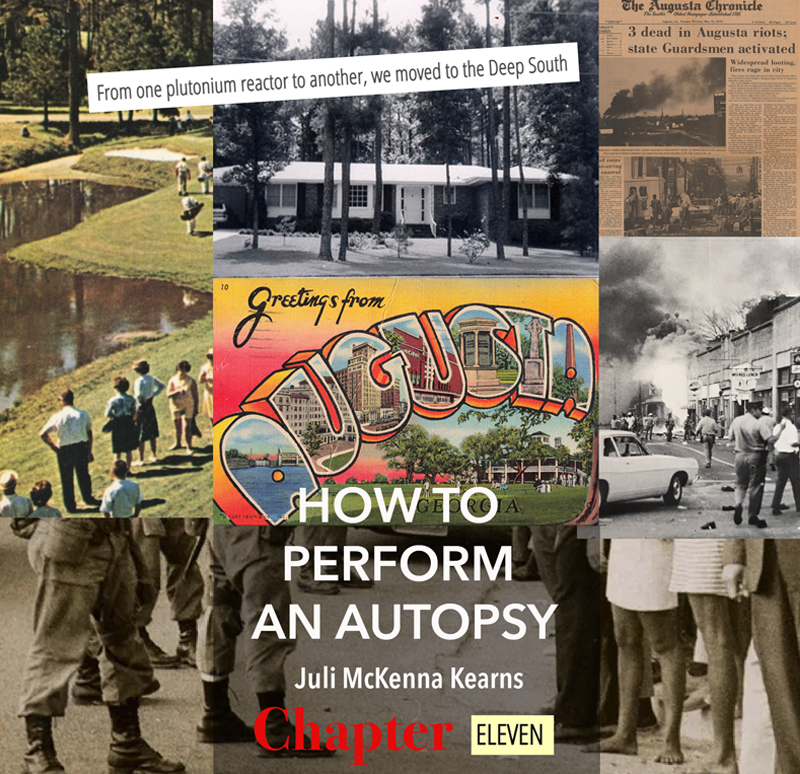
ELEVEN
From one plutonium reactor to another, we moved to the Deep South
1
Memphis, Tennessee, was named for the great, famed, extinct city of the Egyptians, because their Memphis sat at the head of the Nile delta, just as Memphis, Tennessee, rests at the head of the great Mississippi delta. Its birthdate, 1819, follows immediately after the (Andrew) Jackson Purchase of 1818 which forced the Chickasaw to cede the land upon which Tennessee’s Memphis would be located. Twenty years earlier, Napoleon Bonaparte, during his invasion of Egypt and Syria, had confirmed where Egypt’s Memphis lay hiding, which was big news. Mapping and excavations had begun, and Europe and America became Egypt-obsessed, the interest invigorated by the publication, from 1809 to 1829, of the Description de l'Égypte, ou Recueil des observations et des recherches qui ont été faites en Égypte pendant l'expédition de l'armée française, publié par les orders de Sa Majesté l'Empereur Napoléon le Grand, a series of elegant volumes in which dozens of scholars and scientists and artists endeavored to catalogue the land of the Pharaohs and its antiquities. Because Memphis of Egypt had pyramids—and perhaps because of the great amount of Hollywood publicity put out in 1954 concerning an upcoming Howard Hawks’ film, Land of the Pharaohs, in which the great pyramid of Giza would appear to be constructed—so it was that an architectural rendering artist, in 1954, conceived of a plan to build three pyramids in Memphis, Tennessee, after the great pyramid tombs of Giza, which was I guess a bite too big without the descendants of the sun god, Ra, overseeing construction, and after years of occasional promotion by various people was downscaled to be one great big glass pyramid that was the fifth-largest pyramid in the world from 1991 to 1993, a distinction that ended when the pyramid of the Luxor Hotel in Paradise, Nevada, claimed the title by a difference of nine feet, which must have been dispiriting. In search of a reason to be, after its failure as a sports and entertainment arena, the Memphis pyramid, as of 2010, with a half-century lease, became a giant Bass Pro Shop, which is its own kind of “special”. The Bass Pro pyramid holds also a Big Cypress Lodge, atrium decorated with a fake swamp that has honest-to-god real water filled with honest-to-god real fish native to the area, bridges and boats and little islands of fake Cypress trees decorated with moss, the opportunity and obligation to shop, shop, shop surrounding because it is after all a big box store. “Features 100-foot tall cypress trees” read descriptions on the internet, without the qualification they are fake trees, because what does it matter (except it does). To this Bass Pro diorama, where taxidermied deer and bears roam and waterfalls cascade over fake rock walls, a woman took her two young children for a weekend vacation at the Big Cypress Lodge, and in her online review of the experience she enthuses the pyramid provided such great entertainment that they didn’t leave its environment the entire weekend and so saw nothing else of Memphis. I don’t know how old one has to
Eleven - 2
be to gain admittance to the attraction of the Bass Pro shooting range, I don’t know if the shooting range is well-insulated from the rest of the pyramid or if one is regaled with the continual pow-pow-pow of gunfire, but I’ve difficulty imagining an oversize Big Bass Pro store having the requisite elements to captivate children for a few hours, much less an entire weekend, when the touted child-friendly activity is an elevator ride to the pyramid’s top, which as of 2025 was $10 per adult and $5 per child per trip. For a family of two adults and two children the cost is $30 for a few seconds of zipping up, down, and you’re done, let’s go back to look at the fake big cypress trees and buy more stuff. Maybe the view is worth the expense, and the opportunity to turn to one’s companion and with reverent satisfaction inform, “This is the tallest freestanding elevator in the United States. The Great Pyramid of Giza doesn’t have an elevator. They don’t even let you climb to the top anymore.”
A main plot point of Land of the Pharaohs involves an enslaved architect who cleverly designs Khufu’s pyramid to be impregnable so the treasures that accompany him in his tomb afterlife won’t be burglarized. Maybe that captured the imagination of the architectural rendering artist, complicit a fascination with Joan Collins who is featured panting after Khufu’s gold as she conspires to rise from concubine to queen. Plus, it was Biblical-adjacent, because many then believed that Jewish slaves built the pyramids. That same architect would serve GEM, the “Greater European Mission”, founded about 1952, which was and is an evangelical ambition to bring its own brand of the light of Christ to “a continent now considered to be post-Christian”. I’m looking at a research paper on the post-WWII interest of evangelicals in missionizing Europe, and while Europe did have churches, evangelicals didn’t think they were the right kind, they believed secular humanism, anti-Christian philosophy, theological studies, and university Bible criticism had set the stage for Nazi Germany, and were concerned with reconstruction Marshall Plan Europe being monopolized by traditional Protestantism, Roman Catholicism, godless Communism, and liberalism. The evangelicals rushed to get their toes in the door before the World Council of Churches, formed in 1948, became what they feared would be a monster church of ecumenical traditionalism that would shut them out.
Because the Pyramids of Giza are epic, the architectural renderer would have believed the Memphis Pyramids would be epic as well. A December 1954 news headline reads, “How to Build a Pyramid”, the story being an account on the writer’s witness of the sort-of construction of a part of a pyramid, for the film, on the edge of the Sahara Desert. The hollow stones were made of fiberglass and weren’t so difficult to pull around, so lightweight that the real difficulty the civilian actors had was making it appear they didn’t contend with marshmallows, but the temperature was a charring 128 degrees and sweat was in earnest. At the article’s end, the writer remarks on how it might be good to have a trace of authentic history in movies, which means they were either already worried there wouldn’t be much or were hopeful of facts over fantasy. Haitians hadn’t appreciated it when the 1952 film, Linda Bailey, depicted a white Baltimore lawyer as “really the savior of the Haitian revolution”, rather than slave-born General Toussaint L’Ouverture, and the article’s author hoped that Land of the Pharaohs would do better, by ancient Egypt, than “certain of its predecessors”.
Eleven - 3
Then it’s 1955, and “Filmed with a cast of thousands!” reads advertising for Land of the Pharaohs, because massive crowd scenes with people not in modern street clothing used to be a big draw. “Her treachery stained every stone of The Great Pyramid!” was another advertising lure, with Joan, dressed for a vaudeville harem dance in a bedazzled bikini, kneeling near the Pyramid of Khufu. “The barbarous love that left Egypt’s Great Pyramid as its wondrous landmark!” reads another poster, and there were probably many viewers who believed the fiction was truth and that Khufu was murdered by “the soft lips of the concubine for whom the seven sins were not enough.” Instead it was the fantasy of Howard Hawks and three screenwriters, including (for the Nobel Prize prestige ) William Faulkner.
When I first saw the Memphis Pyramid, not long after it was built, I was surprised by how unimpressed I was, even a little alarmed by how it hadn’t a trace of beckoning siren song. Though MK and I were on a cross-country trip and I was anxious to capture photos of roadside novelties, we didn’t care to even drive a couple of blocks over from our route on I-40 to get a look at the pyramid’s great fiberglass copy of the statue of Rameses the Great. From the Hernando de Soto (Spanish conquistador explorer who died on the bank of the Mississippi River in 1542) bridge, I grabbed a photo of the pyramid as we crossed the Mississippi River. Alone, not part of a greater complex, absent the anchor of any real meaning, it looked not just existentially but physically small.
The first time I see Memphis, it is 1967, I am with my paternal grandparents, they are driving my brother and me down to Augusta, Georgia, to reunite us with our parents and siblings who have already moved into our new home. For me, to be in Memphis was to be in proximity of great shapers of the history of Black Music and Blues and Rhythm and Blues. Reflecting back on my excitement, and that in Richland my exposure to music by black musicians had been primarily Motown, I’ve no idea how I know about Memphis and Beale Street when I’m ten but I do, I am but a few footsteps from true legends, and I’m the only one in the car who cares. As a youth, I never did understand how my grandfather could be in radio and not care about music.
First, to cross over the Mississippi River (which Hernando de Soto only saw as an obstacle in his journeys) was a near religious experience because of its history as an untamable waterway and gate dividing the American East from the American West, the eastern boundary of the Louisiana Purchase that was an insane French land grab Napoleon decided to release in a big fire sale not just because of his need of funds with the threat of war between France and England, but because the French loved France and great numbers of them weren’t going to willingly give up the pleasures and troubles of breathing French air in order to keep the Brits from flooding across the Mississippi River in their fevered quest of the Pacific. I knew the Mississippi River was where Samuel Clements rode up and down on a picturesque steamboat, because the first part of my fifth-grade school year was passed in Carthage, Missouri, and because of this I had read Huckleberry Finn and The Adventures of Tom Sawyer, Mark Twain essential to a Missourian’s education, but, frankly, I’d been bored by Huckleberry Finn and Tom Sawyer, the romance for me was the Mississippi River as a natural boundary between the country of the West and the country of the East.
Eleven - 4
Another divider was the Mason-Dixon line, and though I was aware that Missouri had been a slave state, having been told my ancestor Crocketts had slaves (an examination of all the family censuses reveals down that line, in 1850, James Rayburn Crockett had one female slave, 25 years old, and in 1860 one female slave, 35, likely the same woman, and his son James Kelly Crockett in 1860 had one female slave, 35), I didn’t think of Missouri as Southern, because Missouri didn’t secede from the Union, it didn’t join the other Confederate states, and because it was instead “Mid” to me, a part of the Midwest. Arkansas seceded from the Union but I’d not given Arkansas much thought except as a place where an aunt of my grandfather then lived, and a Carthage friend from school had moved to Little Rock. As far as I’m concerned, crossing over the Mississippi River into Tennessee, from Arkansas, I am encroaching on the Deep South for the first time, and we are staying in a Holiday Inn so that is my initial environmental introduction, the chain named for Bing Crosby’s Holiday Inn film, which I’ve not yet seen, and the big deal about it is the hotel is taller than the one- and two-story motels my grandmother is complaining we’re not in which means she is even more terse than usual. Because of her fear of fire it’s a hard and fast rule she will not stay in any motel or hotel over two stories in height, she will not stay in motels and hotels with rooms that have only interior doors, she doesn’t like it that we are high up in a hotel room with a view of the Memphis River instead of a two-story motel with a quick exit to the parking lot, for some reason the bigger hotel was all that was available, there must have been a convention or some other major happening that weekend in November. The Winecoff Hotel fire of 1946, in Atlanta, killed 119 people, the worst in American history, and must have been on my grandmother’s mind, fueling her anxiety, and I understand her fear but I’m ten and I’ve missed the high-rises of Seattle and appreciate escaping the flatlander perspective for once. My grandparents don’t care about music, my grandmother is fretting about being above the second floor, that’s her story for the day, and for my grandfather the big story is that Memphis is the home of the world’s first Holiday Inn built in 1952, while what grips me and won’t let me go is I’m looking out the night window on a Mississippi River swallowed up in the black of night and down there is Memphis with a street full of Blues music and clubs dotted with neon and I can’t imagine that I am in Memphis for a night and we’re not hunting music because this is a momentous opportunity, the musicians of Memphis are right now out there sharing their distillations of history and life in that music, essential food for elucidating the soul, I don’t care that for many white people Memphis is important as the home of Elvis Presley, Elvis doesn’t count in my world, my ears find his music anemic, without soul, I think of Elvis as a barrier to Black music, fake window dressing double-timing as both not-a-real singer and not-a-real actor, I’ve reasoned that if you’re a real musician you wouldn’t go into acting because music has to possess one fully, I care about Beale Street and, at the age of ten, a person who has never stepped inside a nightclub, I’m of the belief that if we just get out there and walk half a block we will be in the middle of what matters, that it’s wide open and waiting for us to enter and listen, because I believe that music belongs to everyone.
How I knew about Memphis’ place in the music world, I never questioned for years, because it was part of my bank of knowledge when I was ten and so it didn’t occur to me to question thereafter how this was so. I spent the previous three years being the
Eleven - 5
fourth Supreme with my best friend and her two sisters, who were African-American, which was why I was the fourth Supreme, they were Diana Ross and Mary Wilson and Florence Ballard and were always fighting it out between themselves who was going to be Diana Ross today and I was the tag-along, the adopted fourth Supreme. For several months in Carthage, Missouri, I’ve only been around white children and I feel like a part of my body has been cut away, it’s not natural. In Richland, we performed the songs of The Supremes out on Cecelia’s carport or in the living room, “Where Did Our Love Go”, “Come See About Me”, “Baby Love”, “Stop! In the Name of Love”, “I Hear a Symphony”, “You Can’t Hurry Love”, “You Keep Me Hangin’ On”, “The Happening”, rehearsed choreography, excitedly gathered before the television set to watch The Supremes in elegant motion when we knew they were scheduled to appear, they were so cool, transcendent, at their best the epiphany of their music wasn’t one of huddling over a verse then letting loose on the chorus, but starting near the top of a staircase they rose by repetitive micro-steps incrementally into the heavens as emotional vistas evolved and deepened and then opened onto a 360 degree horizon of superbly controlled, mantra-induced bliss. It was a brand new sound and as far as its placement in time, in the universe of then, The Supremes are sometimes given short shrift when classified as light pop R&B tailored to cross over into the white audience. In order to absorb it as we heard it then and there one has to flush out of the ear canals everything that came after, and consider what separated The Supremes from the adult cocktail hour soundtrack of your life aspirations of Dionne Warwick and Burt Bacharach, and the enthusiasm of Petula Clark as your best buddy girlfriend urging you to get out there and feel good. I love Dionne Warwick and Burt Bacharach and Petula Clark, they were just coming from different places spiritually, sonically, atmospherically, the Supremes were, in the 1960s, at least to me and Cecelia, a veritable blazing hot social revolution owning the expectations of civil rights. But I’m in Memphis, The Supremes were Motown, and I’ve now, decades removed, no idea how Memphis was so big in my imagination that I was consumed with the fact that stuck up high in the Holiday Inn hotel room I was missing out on history that exerted a fierce magnetic draw. Stax Records. Booker T. & The M.G.’s. The Bar-Kays. Otis Redding. I stand looking out that window at Memphis, not just sad but desperate over missing out on live music, and the next thing I know I’m standing in what I’ve always remembered as my initiation to Georgia, a convenience store slash gas station—not a self-serve, and not a truck stop, not a chain like a Stuckeys, but a gas station with a shop—that we stopped at west of Atlanta and was filled, every surface, nook and cranny, with Confederate, White supremacist, Yankee-hating memorabilia for sale, The South Shall Rise Again, which was a shock to me, a child of the North, that the Civil War hadn’t stopped, it was ongoing and being fought with such psychological and territorial ferocity. This memory then blends in with the interstate in Atlanta where I’m in the station wagon with my family and my father has lost his way and finally exits the interstate and stops in a black neighborhood to ask directions.
But I didn’t travel to Augusta from Carthage with my parents that first time, I was with my father’s parents, and my memory does switch back to being with them as we rode into what was my new neighborhood in Augusta and my realization that my tree-climbing days, my wandering in the desert times were over, as all the trees were tall
Eleven - 6
pines with skinny trunks that didn’t branch into their narrow canopy until three stories up, there was no desert anywhere, there was nothing resembling Rattlesnake Mountain, there was nothing like the snow-capped Mount Rainier, there was no Columbia River, I wouldn’t be biking around town as I did in Richland, or walking a city neighborhood like Seattle because we were deep in the suburbs where it was street after winding street after street of houses settled into expansive lawns with those toothpick slender pine trees the canopy of which was too high to cast shadows or provide respite from the sun, the closest shopping center was National Hills which was over three miles of suburbia away, and I immediately comprehended the southern suburban development as a prison.
When my grandparents said no we couldn’t go out to listen to music, I thought but I may never be here again, it was a forever lost opportunity, which pained me. My grandparents were right to not go music hunting with us, my seven-year-old brother and I wouldn’t have been allowed into the clubs. But I was right in that I knew they didn’t care about that music.
For decades what were two different trips melded to become one and I somehow never noticed that this meant I began the trip with my grandparents in their comfortable, luxury sedan, then switched to the Bonneville station wagon with my parents and all my siblings. I only realized this while recently examining my memories, critically revisiting them in depth, and I was and am confounded at how for decades I’ve overlooked the mismatch. They are all memories of actual events, not fantasy, but they don’t belong together. After Memphis, my grandparents almost completely disappear, and I am then with my parents driving in Atlanta, which is a mismatch. How I realized the mismatch is I was remembering how I-20 between Atlanta and Augusta wasn’t completed yet in 1967, I knew it wasn’t because I remembered at least one trip with my family where we took a state highway part of the way traveling between Atlanta and Augusta. To confirm my memory I looked up what date the interstate was completed, and also found on a 1968 map (available on the internet in a surprisingly bandwidth-hogging PDF) the likely route we’d taken, which is when it dawned on me that though I was right about all these facts, I had jammed two trips together. When I try to reason out when the trip with my parents occurred, the one in which we become lost, which would have been in 1967 or 1968 as the Interstate to Augusta wasn’t finished until 1969, I wonder if we may have driven to visit my mother’s parents in Huntsville, Alabama (I don’t know when they had transplanted down from Chicago, they were already there in 1967), but if that’s the case I don’t understand why we become lost in Atlanta at night, for if we were on the way back from Huntsville that’s a drive of less than four hours to Atlanta, plus over two more to Augusta, and even if we hadn’t started out from Huntsville until noon we would still be in Atlanta long before nightfall. But, wait, we visited my father’s parents in Missouri in November of 1968, which is likely when we became lost, on the return trip we would have certainly been driving through Atlanta at night.
This may be confusing to read, but it’s confusing for me to realize and sort out. My first astonishing brush with the Confederate rebel flags and “The South Shall Rise Again” paraphernalia had to have been during that first trip with my grandparents,
Eleven - 7
given my shock, and the awareness descending that I was in a completely different country, one that was still at war with the United States.
I realize I do vaguely recollect driving into Atlanta with my grandparents and looking for a motel at which to spend the night because I saw a Travelodge bear and wanted to stay there, I liked the sleepwalking bear with the night cap. For whatever reason, I never had a teddy bear as a child, but the teddy bear is a wildly popular plush toy, often represented as a comforting companion tucked in the arms of a child in their bed, and the sleepwalking, sleepy-eyed Travelodge bear, named “Sleepy”, was branding that demanded children in every voyaging car beg, “Please, please, I want to stay with the sleepwalking bear.” My grandparents thought it a subpar chain and I remember my grandmother saying “No” but it remains that I also have a memory of being in the lobby of the Atlanta Travelodge with my grandfather, looking at business cards and promotional materials, and I don’t know what my expectations had been but I was disappointed with how the sleepwalking bear wasn’t a feature, it was just a logo, just as my grandparents had said would be the case. The memory of my father getting lost in Atlanta at night would be from the next year, when we were driving back from Carthage after a Thanksgiving visit that left me with few memories other than photographs made with my only paternal cousins, children of my father’s only sibling and brother, on the porch of my father’s parents house, then slipping away, while the adults visited, to clandestine climb with those cousins, all older, over the tall barbed wire-crested fence into the football field of the junior high school across the street, the boys were all in trousers but I was in a shirtdress (red plaid) and the barbed wire caught high on my inner thigh so that I had to pause and extricate the barb from the flesh of my thigh, I was literally stuck on it, an injury I hid from everyone, hoping the blood that had run down my leg to stain my white knee sock wouldn’t be noticed as I didn’t want to get into trouble (I kept a faint scar for years). Whereas my father would always make the trip between Carthage and Augusta in two days, with my grandparents it was three days, around six and a half hours from Carthage to Memphis on the first, around six and a half hours from Memphis to Atlanta on the second day, then on the third we drove into Augusta, because with my grandmother’s diabetes we had three real sit-down-for-dinner stops a day, plus an afternoon snack stop, and they preferred to get off the road early in the evening rather than press on and exhaust themselves.
We were also, I now realize, in Carthage before this, in August of 1968, when the Prague Spring revolt was crushed.
I credit the confusion of the two trips with, I don’t know, maybe it’s a natural compression of memories, or in retrospect I wonder if it has something to do with my brain editing out bits and pieces of my childhood and reforming history around trauma holes. But it may be a natural merging of this thing being similar to that thing so make it one thing.
We had, I believe, two connecting rooms at the Holiday Inn in Memphis. My grandparents stayed in one and I was with my brother in the other. I remember, at night, staring at the connecting door next the dresser and wondering if it would stay closed or not. I don’t know where I stayed with my father’s parents in Atlanta, but the Travelodge that had caught my eye was backed up to the interstate downtown, the Travelodge bear looking over it, and for as long as the Travelodge and its bear were
Eleven - 8
there, looking over I-75, whenever I afterward passed the advertisement I was confronted with and skated over the scrap of memory that began with my wanting to stay there during the drive with my grandparents then became a memory black hole painted over with the time my father was lost in Atlanta at night but we drove straight on through to Augusta. My parents never stopped at a motel in Atlanta.
A search on the internet for any photos of that Travelodge bear sign that so prominently beckoned, what was once a landmark, results in only one that shows the bear on the side of the motel but in a different position and style from how I remember it, as well as several other people similarly hunting, hoping to find the bear they remember sleepwalking above I-75. With Google’s street view it is now possible to see back in time in Atlanta to 2007 on many streets, which is useful for clocking how the city has changed. In almost every area, block after block of cityscape has been ripped out and filled with new buildings, and I find that because what has replaced the old is so different, whole neighborhoods refashioned, it can be difficult to picture what was there previously. As for the sleepy bear in its old-fashioned nightcap and nightshirt, it disappeared long before the advent of Google Maps. I locate a Travelodge in Los Angeles that still displays the same sleepy bear that I remember, and visiting it on Google Maps feels a close second to the real deal.
Missouri didn’t secede during the Civil War, but it was a battleground state. When I was living with my father’s parents I saw nothing touting the old confederacy—which doesn’t mean it wasn’t there, White nationalism just perhaps wasn’t as overtly out on display as part of Missouri’s identity, but I feel that instead of seeing the Deep South, when southern Missouri looked in the mirror, it saw the Ozarks and embraced them because the population was far enough removed from the abject poverty of earlier times that Ozark culture could be reframed as entertainment stripped clean of politics, except maybe the New Deal that separated the Ozarks from that abject poverty. While different from the Pacific Northwest, Missouri felt to be part of the U.S., much of its culture recognizable if lagging behind the West coast. On the drive down to Augusta, culture shifted so dramatically as to seem one was in another world, and its foods, its language, its mannerisms, traditions and approach to religion were less the property of a natural affection for the South than the expression of a resolute determination to not let the Yankee within its border walls that were more effective than physical brick-and-mortar because they were fevered electric barricades of the psyche over which a very public war was being waged. Outside of the Deep South, I’d never been smacked in the face with roadside billboards promising salvation from sin through the blood of Jesus, and the further south we went, the deeper into miles upon miles of Third World impoverishment, the more frequent and demanding was the Jesus advertising that looked home-brewed, black signs with white print demanding one turn to the Bible and Christ, and bright yellow signs with brown crosses dripping red blood that declared without Jesus one was damned to hell. “Are you saved?” the signs didn’t question but emphatically wanted doubt of one’s eternal destiny now, tomorrow and the next day. That anyone might insist I needed saving, whatever that meant, struck me as vulgar and invasive. One night on television in Richland there had been the peculiar sight of a man named Billy Graham preaching Jesus Christ, hell and damnation to a stadium filled with people, he bragged he was a
Eleven - 9
counselor to presidents, which was supposed to legitimize him, but he was also, to me, from an alien culture (born in North Carolina), his language, vocabulary, how he spoke, the way he moved, his style and relationship to the audience, the manner in which he whipped them up to be receptive to his suggestion that they required a thing called salvation. Now here I was in the Bible Belt where Billy Graham, however conservative (he maintained his home in North Carolina but traveled the world), would be reviled for his belief in integration, for he asserted there was no racial discrimination in the Bible, and had demanded there be no racial discrimination at his crusades.
The South to which I was shipped was an apartheid state with “White Only” bathrooms, fountains, schools, pools, neighborhoods. Certainly, the North was racist as well, but just as I’d never before been assailed with “Are you saved?” signs, I’d never before confronted “White Only” signs either. Everywhere, the South yelled at one on signs to make sure everyone was in line with Southern values. Even the psychological violence in these practices and enforcing of a strict social hierarchy was stunning, constant, unrelenting, and the manner in which I heard women and children speak of their refusal to integrate fountains and pools and bathrooms was not only an ugly loathing but a horror of those with dark skin, as if they were carriers of a disease that was color. I read others interpreting this as White supremacist hate that masked a fear of venereal disease, but to me it was deeper, metaphysical, as if the disease that was not-white could reach through the air and water and infect one in a way that you couldn’t see at first, it didn’t show on one immediately when you stepped out of integrated waters or drew one’s lips away from an integrated fountain with the water still fresh on one’s mouth, and no one explained how and what would happen when the virus of color began to manifest in one, there was just this fear of it, like of amebic meningitis. That’s how strong color was, that it would utterly overwhelm whiteness, the one-drop rule was not just a matter of genetic inheritance but any kind of physical, social and spiritual contact which when taken to its natural conclusion ultimately expressed a fear of not-hatred, of successful integration. The dread of blackness as a contagion was difficult to comprehend when I saw no fear in the Southerner of black people as servants who cooked one’s meals, washed one’s clothes, cleaned one’s home, took care of one’s children.
In 1956 sixty-one percent of Northerners believed schools should be desegregated while only fifteen percent of Southerners were ready for integrated schools, which was undeniably a significant difference, but better than 1940 when only two percent of Southerners believed in integrated schools. In 1957, Eisenhower federalized the Arkansas National Guard to protect the African-American “Little Rock Nine” as they entered Little Rock Central High in part of a minimum-standards plan of gradual integration that had been agreed upon by the school board, but the governor had called out the National Guard to prevent the students from entering, thus Eisenhower federalizing the Arkansas National Guard and also ordering in the 101st Airborne Division of the United States Army. The battle was hardly won as in September of 1958 the Lost Year began with Governor Orval Faubus closing all four public high schools. In 1960, U. S. Marshals escorted little six-year-old Ruby Bridges (an uncredited Department of Justice photographer took that iconic photograph of her in her
Eleven - 10
perfectly ironed and starched dress, plaid book-bag in hand, on the schoolhouse stairs) through a chaos of raging hate flung by women dubbed as “cheerleaders”. Their husbands at work, women homemakers avidly took up the White war against integration, ferociously pursuing six-year-old Ruby with their hate and rage as she entered the previously White-only William Frantz Elementary in New Orleans. Due to a White boycott, a near empty school awaited Ruby once she was inside, often the only other child in attendance being the white five-year-old daughter of Rev. Andrew Foreman, a Methodist minister who had refused to bow to the boycott and kept his child in school. Another white girl who continued to attend school was Yolanda Gabrielle, also in first grade but taught in a separate room from Ruby at the principal’s direction. The Foremans had to leave their home due bomb threats. Yolanda Gabrielle didn’t remain in the school long as her father, because of harassment by co-workers, was forced to quit his job as a meter reader and, unable to find unemployment in New Orleans, moved his family up north, after the National Conference of Christians and Jews found work for him in Rhode Island. The boycott continued so that in September of 1961 only sixteen white children registered at William Frantz, along with Ruby Bridges, while at McDonogh 19, another New Orleans school where integration had taken place in 1960, five African-American children were enrolled and six white children. By 26 October 1961, the news was reporting enrollment at William Frantz, which had 571 students before integration, was up to 100 students. At the beginning of the 1962 school year, enrollment at William Frantz was up to three black children and 144 white and the school was considered successfully integrated.
2
Identity. Problems concerning personal identity are everywhere. It’s a stretch to call Napoleon “French”, whose name was plastered all over History when I was a youth, partly because he was so famously painted with his right hand stuck inside his vest, similar to my spouse’s great-uncle who was missing a finger and did his best to hide it in photos, and no one later could tell me whether he lost the finger during WWII when he was a POW in Germany at Stalag IIB or afterward when he chose an isolated profession of commercial fishing and hunting alligators in the bayou of St. Tammany Parish, but pictures of him before he was sent overseas show he still had the finger. Napoleon was born on the Mediterranean island of Corsica, in 1769, to an Italian family, because for much of Corsica’s modern, Common Era history it has been associated with Italy, but in 1768-1769 the French won it, thus Napoleon was educated in France. The history of Corsica is like a game of Hot Potato, Corsica tossed back and forth. Napoleon, whose native tongue was Corsican, was a Corsican nationalist in his youth, but by age thirty he’d staged a coup which made him France’s First Consul for Life, then at age thirty-five proclaimed himself Emperor of France. At twenty-four he had become critical of Corsica, abandoned it, and as emperor would quash Corsica’s bids for independence. It occurs to me, considering the Corsican reputation for exacting vengeance, that in Napoleon’s dreams he saw himself as the Corsican Emperor Over France. Corsica, through him, had no need to free itself from France as it was France through Napoleon.
Eleven - 11
At the age of ten, leaving Missouri then Arkansas, entering Memphis, I had been driven out of Louisiana Purchase Territory, those lands west of the Mississippi River handed over to the U.S.A. in 1803, into lands east of the Mississippi that France had ceded to America in the Treaty of Paris in 1763, which was then an Indian Reserve, Tennessee joining the Union in 1796, the Territory of Mississippi organized in 1798, then Mississippi joined the Union in 1817, and Alabama in 1819. I don’t remember the route we took from Memphis to Atlanta, I know it wasn’t through Nashville, but my body progressed into Georgia, one of the thirteen original colonies, and it may sound absurd but I do remember this, that I could feel the transition, I didn’t know how at the time, only that there was a metamorphosis in both character of the land (the effects of slavery and Jim Crow) as well as a change in the appearance of whiteness. A change in the appearance of whiteness? When I later began to learn trends in migrations of peoples in the United States, I wondered if I wasn’t seeing the effects of that (though I’m willing to be disabused of this notion, and convinced that the difference was instead appearance affected by culture). Those who early moved into what became the Deep South didn’t leave it for generations, at least not through the Mason-Dixon line. As they moved into Alabama and Mississippi, they settled, and some moved on and they settled in Louisiana (my spouse’s maternal lines in the the Florida parishes east of the Mississippi, what France had ceded to Britain in 1763 and Britain gave to Spain which passed the land into U.S. hands in 1812), some of those Deep South migrants went on to Texas and they all stuck hard and didn’t budge, by 1804 the Northern states had largely become non-slavery states, and because of the slavery issue those who were in what was now the South didn’t move into the North (Quakers were an exception) and those who were in the North didn’t move South. Check the censuses. Or if people did move from a slave state to a no-slave state or vice versa it was uncommon and political. Up North and in the West, people tended to be from everywhere and had parents from everywhere though not many from the South, while down in the South, in Louisiana for instance, page after page in older censuses will be filled with people who were born in Louisiana and had parents who were born in Louisiana or in Louisiana and Mississippi. Exempting the pre-Louisiana Purchase French, who were these white peoples who early moved into the South? While there were some Scotts, Irish and German, the settlers were decidedly Anglo-Saxon, the Brits of the British colonies. The estimate is that in 1790 83.5 percent of the white population was English. In Georgia, 83.1 percent was English, 11.2 percent was Scotch, and 2.3 percent was Irish, while 35 percent of the total population was black, which means, enslaved, though I find occasionally a free black family and I wonder how in the hell they survived, such as the white man with a mulatto wife and children who lived next to my spouse’s no slaves family in Alabama in 1850. How did that happen? Why in the hell would they stay in Alabama? (They didn’t, but they also didn’t leave Alabama until after the Civil War and the 1866 death of her husband. In 1880 Sarah and her children were in Maury County, Tennessee, where they were entered in the census as white. Birth relations of Sarah’s who had continued from Alabama to Louisiana were by 1850 listed in the Louisiana census as white while her family in Alabama was mulatto.) By 1860, nearly half the population of Georgia was black, 3500
Eleven - 12
of whom were free, and a good bit of this black population was lost after the war as they headed North. Currently, thirty-one percent of Georgians identify as black or African-American, but there are other population shifts that will be impacting that contemporary percentage.
In 1880, Alabama and Mississippi had point two percent Irish population, Georgia had point three percent, and Tennessee had point 4 percent. North Carolina somehow had zero percent with a population of 611 Irish. This will have been native-born Irish, but it’s a significant population to include as, from what I gather, a number of those native-born point three percent Irish, delivered to Georgia by Ireland’s Great Hunger, would become part of the impoverished work force of the cotton mills. Margaret Mitchell’s Gone With the Wind great-grandfather, Phillip Fitzgerald, born in Tipperary, Ireland, had a Georgia plantation worth $30,000 in 1850, and in 1860 his real estate was valued at $21,000 and his personal estate at $40,000. Farms with slaves averaged a personal estate of near $20,000, while the average for free farms was $1188. Phillip was one of the Irish freaks who came over here and made good. Ireland was not the land of wealthy Irish, else the great diaspora of famine Irish wouldn’t have happened. I was going to take it for granted Phillip had money when he came over, but decided to look it up and saw some websites that made him look like a pull-yourself-up-by-your-bootstraps Irishman who came over with nothing. But then I found a website that provided real data, and got a better picture. His elder brother, James, who also came over, was said by the family to have graduated from Trinity College in Dublin, due this they were likely to be middle class at the least, and while I don’t know Phillip’s education, both he and James were initially employed as teachers in America, which means Phillip was also educated. Within three years, James opened a dry-goods store in Fayetteville, Georgia, then died in 1835. Phillip went on to become a planter who owned one slave in 1841 and thirty-four by the time of the Civil War, which is statistically considered to be in the realm of the large planter and he was one of the largest slave owners in his area in Georgia, the main body of his plantation being about 2400 acres. According to Wikipedia, in 1860, there were about 46,200 plantations, of which about 20,700 people were large planters, holding about twenty to thirty slaves, about 2300 were planters who held over one hundred slaves, and the remaining 23,000 or so plantations were between the simply large and the wowza-large. Seventy-five percent of white southerners didn’t have slaves, and the majority of those who had slaves had fewer than twenty—and don’t get me wrong, twenty is a lot of people, when I say “fewer” that doesn’t mean, “Oh, that’s just a few.” The 1860 census gives there as having been 393,967 individual slaveholders and that about fifty percent held fewer than five while ten percent held twenty or more. Considering how much a slave was worth, even five or less was a major investment. One slave was a lot, I mean if a person was later held as not being a “real” enslaver as they had only one slave, why not give that slave their freedom in the first place, like my Crockett family who had one slave in Missouri? Margaret Mitchell’s grandfather, John Stephens, born in Lusmagh in County Offaly in 1833, immigrated during the Great Hunger, went to one of the leading colleges in Tennessee then became “one of the most successful people that had ever been in business in Augusta” as in Augusta,
Eleven - 13
Georgia. He’d come over with some money. He married Annie, a daughter of Phillip Fitzgerald, and after the Civil War started a wholesale grain and commission business in Atlanta. These people were of an entirely different class than the vast majority of Irish immigrants, including my pre-diaspora Irish ancestors and my spouse’s diaspora Irish ancestors.
Margaret Mitchell. It’s not that I have anything personal against Margaret, except that I do, because Gone With the Wind, which of course I read, I was twelve or thirteen and living in Georgia, every girl I knew read Mitchell’s Gone With the Wind. My mother, knowing my views, was astonished, she said, “You’re reading Gone With the Wind?”, which she hadn’t read, she just knew about it, I don’t know if she’d even seen the movie (which I hadn’t), but I felt obligated, I ought to know why it was a book I probably wouldn’t like, I ought to be able to say why I didn’t like it. I don’t know when the classic romance bodice-ripper novel was born, but it struck me as that, and while people would keep trying to explain away Margaret Mitchell as being not at all racist, in her book freed slaves were bad, good slaves shunned freedom and stuck with their enslavers, Northerners were diabolical, the old plantation life was one of gracious harmony in which the plentiful cornucopia of the good life just kind of fell round about and all over them like manna from heaven, then the dastardly Civil War forced them to think instead about making vulgar money instead of being gentlemen and gentlewomen. I’ve downloaded a free PDF to take a glance and it can all be summed up with the declaration, on page 542, that “The South had been tilted as by a giant malicious hand and those who had once ruled were now more helpless than their former slaves had ever been…In spite of war, fire and Reconstruction, Atlanta had again become a boom town. In many ways the place resembled the busy young city of the Confederacy’s early days. The only trouble was that the soldiers crowding the streets wore the wrong kind of uniforms, the money was in the hands of the wrong people, and the negroes were living in leisure while their former masters struggled and starved.” So on and so forth, plus the Ku Klux Klan was good and necessary, the only reason it existed was for protecting the honor of white women. Those weren’t the subjective opinions of characters, they were the voice Margaret.
At the age of twelve, my blindness was that I had difficulty comprehending Scarlett O’Hara as Irish-American and her father as an Irish-born slaveholder. Why were the Irish fighting for the Confederacy? Why did this Irishman have a plantation?
Though my ancestry was a mixed bag, my surname is Irish, which I previously comprehended as Irish but at the age of ten in Augusta, Georgia, I was now really feeling it because I was surrounded by a different kind of white people than in Washington State. “How would you notice?” but I did, and the reason I did is because everyone else noticed and let you know you were the odd-Irish-person-out in respect of the solid antiquity of Georgia’s British colonialism, whose isolation from the North had formed a people that, to me, looked different, like they had been separated from the rest of the United States—because they had been. I don’t mean in the cousins marrying cousins way that is a stereotype of white populations of Appalachia and
Eleven - 14
other impoverished areas, a stereotype that is weirdly ignorant of the practice of consanguineous marriages in a number of cultures around the world, and with some for the preservation of wealth and status. When I hear Appalachians mocked as inbred, I think of of the royals of Europe and England who were all marrying their first, second, and third cousins, keeping all that wealth and power in their highly dysfunctional family system. In the South, I heard English names that were strange to me, just as a Mac Irish person was for them an oddity, and our spelling of McKenney was unheard of, it was usually McKinney (yes, that “e” instead of an “i” made a difference, at least for my family). Not only was I a Damn Yankee, though my Irish ancestors had been here for generations, it wasn’t long enough, not in Georgia. West of the Mississippi was the Melting Pot America. Pockets of various ethnicities were, yes, everywhere but it was still a melting pot. In the Deep South, east of the Mississippi, it was also a melting pot but it was the melting pot of those who had early migrated down into slave states.
My memory is not deceiving me, when I do a search for “McKenney” in the 1950 census in Richmond County, Georgia, the result is one person, a woman named Shirley, and she doesn’t count as when I look for her father I find he was a William McKinney at the textile mill. Richmond County had a population of 108,876 in 1950. Of these 108,876 souls were forty-five who had the name McKinney, nineteen of whom were black, two were in the military at Camp Gordon (transient), and the remaining twenty-four were whites who were mill worker families or came from mill worker families, with the exception of one who worked for the railroad. William, the father of the above Shirley, was a section man at King Mill, and his wife, Oleater, was a spinner at the mill. Charles was a conductor. Laman managed a tire store, but came from a family in which his father, in 1930, had been a twister at a mill and his mother had been a spinner. Mattie was a weaver at a mill. Harry picked up garbage but in 1930 his father had been a carder at King Mill and his mother a spinner. Lloyd, who turns out to have been a brother of the above Mattie, was an oiler at King Mill, and his wife, Florence, was a spinner at the mill. Lynn and his wife Mary were both machine operators at King Mill. George, who turns out to have been the father of Laman, was a city park laborer but had previously been a laborer at a cotton mill. The rest of the white McKinneys in the census were dependents in these families. A brief dip into their roots reveals that none were Irish of the Great Famine, which surprises me, they had been part of the migration South before that, which leads me to suppose they were locked into a caste system from which a certain brand of Irish or Scots-Irish was unlikely to escape.
The second town established in Georgia, after Savannah in 1733, was Augusta, founded in 1736 by British General James Oglethorpe and named after Augusta of Saxe-Gotha, German-born princess of Wales, mother of King George III who was careless enough to lose the American colonies to the United States of America. In 1736, Princess Augusta was then sixteen, recently married to Frederick, Prince of Wales, and still playing with dolls. So I’ve read and have no reason to doubt it because I want the story to be true of Princess Augusta being scolded for openly playing with
Eleven - 15
her dolls before a castle window. How she would have felt about a small settlement way over in the wilds of Georgia having been named after her, I don’t know, but I have difficulty imagining she would have been greatly honored. In Seattle, everyone knew the city was named for Chief Seattle (anglicized form of Si’ahl), but when I arrived in Augusta, only the resident historians would have known or cared for whom their city was a namesake, though in school we were taught about James Oglethorpe being the founding colonial governor of Georgia that had been named for King George II, father of Frederick, Prince of Wales.
Augusta grew and the the Civil War happened but General Sherman, in his March to the Sea, spared Augusta, then the second-most important city in Georgia, and didn’t burn it to the ground. Augustans liked to believe this was because, while stationed at Augusta’s arsenal in the 1840s, Sherman had a girlfriend there who he wanted to spare, maybe even an illegitimate child buried in Augusta soil. Sherman’s explanation for not attacking Augusta was that he didn’t want to be “bogged down”. During his march, he did feint toward Augusta, which sent Confederate troops rushing there and meant less resistance in his progress to his objective which was Savannah and its seaport. What surprises me is I only now learn that Augusta was “moderate” politically and in the 1860 presidential election the two individuals who walked away with Augusta’s votes were Unionist, Stephen Douglas (promoted war against slavery) and John Bell (was anti-secession but not anti-slavery).
I also read that some twentieth-century Augusta boys, whose families had been in Augusta during the Civil War, worried that Sherman bypassed Augusta as it didn’t express appropriate opposition, and thus they had a guilt complex, which I certainly believe.
My parents had moved to Augusta in August and rented a place to stay while they looked for a house. For years I believed they lived in housing for families who had a parent stationed at Fort Gordon (Camp Gordon until 1956), which was named for Confederate general, first Commander-in-Chief of the United Confederate Veterans (1890 to 1904), and former Georgia Governor (1886 to 1890) John Brown Gordon (excuse me while I take this opportunity to listen to Pete Seeger sing the abolitionist “John Brown’s Body”), and has since been renamed Fort Eisenhower after the general who so enjoyed the Augusta National Golf Course that “Ike’s cabin” was built at the Augusta National to house him. We often drove down Berckmans Road (back then everyone I knew spelled it Berkman, but old maps show no one could decide on Berckman, Berckmans or Berkman) past the Augusta National, well hidden behind tall fences and dense foliage, and it was once pointed out, right there just off the road, that was the red brick Georgian-style house where Eisenhower stayed, right there, that house, which was a big deal, like when my father’s parents drove me through Lamar, Barton County, Missouri, and pointed out President Truman’s birthplace, and I cared less about that than Eisenhower’s-brick-home-which-wasn’t-Eisenhower’s because going past it all the time I always thought about how it was Eisenhower’s. However, Ike’s cabin, was instead near the tenth hole and was and remains a white
Eleven - 16
wood affair that looks simple enough but is actually three stories and has seven bedrooms. Not-Ike’s-cabin was passed regularly as it was on the main drag to the National Hills Shopping Center where was for a long time our suburb’s closest grocery store, pharmacy, clothing and shoe shopping, a large movie theater, and Schwartz’s deli, and every time I passed that red brick house, until Mamie Eisenhower died, outliving her husband by some years, when I saw a car or someone outside I’d wonder if Mamie or a family member was there, which they weren’t because it wasn’t Ike’s Cabin. That’s an example of the misinformation gotten from the ill-informed, or misinformed, which gets spread about because no one thinks to question it, why should they, the supposed fact is a minor decorative element not critical to their lives though it may be an embellishment.
At least my mother gave the impression they lived in housing for Fort Gordon families, what I pictured was a residential complex of small brick duplexes because we’d once driven past such housing off Fort Gordon Highway and my mother said that was or was like where they’d lived. She’d made a friend at the complex whose husband, she said, was Army, and he was, I’ve seen a photo of him in uniform, but civilians can’t live on base, which I didn’t know, and one time when I was a teen and mentioned their living in Fort Gordon housing my mother bristled and said she didn’t know where I’d gotten that idea, they hadn’t lived at Fort Gordon in base housing. When I say my mother bristled, I mean that her mood dramatically altered in an instant, she became suspicious, her face went rigid and stern and her eyes narrowed and focused on me as if on guard and ready to attack, which was always the stance she assumed when I was about to be told I had the wrong idea about something, or my memory wasn’t correct, which would put me on guard and make me retreat in surprise and fear, eager to calm the sudden tension. How I would have gotten the idea they had lived in housing for military families, I don’t know, unless it was through my mother, and it had made sense to me as my father was in Augusta because of the plutonium at the Savannah River Plant, he was teaching at the Medical College of Georgia but we were there because plutonium was essential to research he was continuing to do, and the ten-year-old me assumed there might be some kind of arrangement between the Medical College of Georgia or the Savannah River Plant for temporary housing for incoming researchers, what did I know, it was an innocent enough mistake for a child who had lived in what was originally rental housing for workers at the Hanford Nuclear Reservation. What were the boundaries between the Department of Defense and the Atomic Energy Commission I didn’t know when the plutonium for my father’s radiation research was produced where the plutonium for the U.S. Nuclear weapons program had been made. I think what had happened is they lived at a complex that had a number of military families in it and because of this, and knowing nothing about the military, I was unclear as to whether it was on or off base, the confusion was as simple as that, nothing for my mother to get weird about. The duplex apartment would have been furnished as their household belongings from Richland were in storage until they’d purchased the house on Edinburgh. My mother would talk about how easy it was to keep their first place in Augusta clean because it was so small and
Eleven - 17
how she enjoyed the sense of community with her neighbor who performed on the weekends with her military husband in a lounge act, both singing, the husband a nightclub pianist. My mother occasionally wished she still lived there. Maybe because her friend would come over in the morning and drink with her. They’d go together to the community laundry and do their dirty clothes while laughing over beers and commiserating over I don’t know what, except that they were women with children and they liked to drink. The friend moved away early on, and I don’t know how many husbands and partners she accumulated, she would get together with someone new who she would say was an amazing human being and then they would turn out to be abusive and they’d split up, and she would get together with someone else and repeat, but eventually she stopped drinking through a twelve-step program, at which point my mother wearied of the friendship as her friend had become a bore with all her talk about sobriety, but I believe they were off-and-on in contact until her friend’s death. This friend had a deep, husky, distinctive voice, and her manner of speaking was precise, deliberate, as if she was framing every word in her mind before it left her mouth perfectly phrased and pitched. I don’t know what her singing voice was like, and as far as I know she stopped performing after she divorced the pianist husband with whom she had the lounge duo, but she would have made an excellent public speaker. She made a cassette tape recording of herself reading her favorite chapters of The Prophet by Kahil Gibran and gave it to my mother, who also had the book, probably a gift from her friend as my mother didn’t read, but because it was one of our few books I read it and wondered over the accompanying art work and how the book had become so popular. The friend sounded lofty and wise in the recording, which was also her conversational voice, a cultivated presentation that never relaxed into a natural self, as if she was always on stage, and I was ten and circumspect of her for this reason, and of Kahlil Gibran as I didn’t trust dispensers of spiritual wisdom or my mother and thus I didn’t trust friends of my mother. To me, too much of Kahlil Gibran sounded like what destructive personalities could use as an excuse for behavior that harmed others.
My parents must have moved into the house on Edinburgh shortly before my arrival because I was there when the woman who lived next door to us, on the right if I was facing the street from the house, came over to pick up a housewarming dish she’d dropped off, maybe a casserole, said to be an example of traditional southern hospitality and a weird custom to us that felt invasive, a way to get into one’s home and spy. Not long after, because we were Yankees, telling us to go back to where we came from, her two sons hit my brother, B, in the head with a rock, knocking him unconscious for several minutes. The police were called and let it go “this time” but told their parents the world was changing, they were going to have to accept neighbors who might be Northerners, and that if it happened again some sort of action would be taken. There were no more problems but the relationship was a tense one of each pretending the other didn’t exist. The war between the states continued.
We got up one morning to find a neat rectangle burned into our lawn, next to the mailbox. The area was fine the day before, then in the morning I walk down to the end
Eleven - 18
of the drive on my way to school and there is this prominent black rectangle, about the size of a sofa, burnt into the lawn right next to the curb. We puzzled over that one, it was obviously not a natural fire, not with its very precise shape, which was odd, the sharp delineation of rectangle, and the grass refused to grow back in that spot ever after, it eventually had to be sodded. The fire that had burnt this rectangle appeared to have been deliberate, but for what reason. Because we were Yankees? Who had done it? If it wasn’t caused by a “who” then what mysterious anomalous event had been the cause? Had we been visited by a very small alien spaceship? It felt like we’d been marked as in a neighborhood where everyone had pristine lawns, ours was the house with the stand-out burned rectangle right next the curb. What did it mean? We never knew.
Augusta had a downtown but it was about seven miles from our house, to the east, not clever enough to avoid being several times daily cut off from the rest of the city by a railroad track with trains that tied up street after street with miles upon miles of boxcars, then moving west away from downtown there was, not necessarily in this order, the big Sears building, the old mills, the Medical College of Georgia, Paine College, Augusta College, older upper-class neighborhoods, older upper-class neighborhoods that were now lower-class, older middle-class neighborhoods, older lower-class neighborhoods, and desperately poor black neighborhoods, all this eventually giving way to, near the National Golf Course, one-after-another suburban southern ranch house style neighborhoods wrapped up and separated from one another by woods and creeks and tangentially united by Berckmans Road (sometimes Berckman) and a highway named Washington Road that was never not ugly, lined with gangly commercial businesses that popped out of the ground individually or in short stretches of shopping centers and became ever uglier by the year as commerce and fast food establishments propagated down it.
Almost all these suburban sections built post-war had no immediate access to stores and demanded automobile transportation to access anything.
The National Golf Course separated the town, the east from the west, Berckmans Road its west border, Washington Road bordering north/northeast, and the Vineland neighborhood on the east. The National Golf course was and remains a paradise isle of green lawns and gardens in the middle of Augusta that admits but few Augustans, 365 acres of beauty that can be ogled once a year by the few selected by lottery to feast their eyes upon golf heaven in person during the Masters Golf Tournament. For everyone else, there is the television. The beauty can’t be seen by passers-by. It’s seems not very democratic to have acres and acres of “You don’t belong here” occupying the middle of a city. Membership at the National Golf Course is by invitation, the initial fee being (according to Wikipedia, which says this is a maybe) between $100,000 and $300,000 and dues “less than $30,000 per year” in 2020. The first African-American member was admitted in 1990, and the first women in 2012, Condoleeza Rice, who had served as U.S. National Security Advisor under George W. Bush from 2001 to 2005, then Secretary of State, again under G. W. Bush, from 2005
Eleven - 19
to 2009, and Darla Moore whose spouse was billionaire Richard Rainwater. The club is said to have maybe 300 members, of which maybe seven are now women and maybe nine are black, no one knows for certain because the membership roll is private, but it is known that there are a number of billionaires. Living in Augusta means becoming blind to how the National is a secret compound of golf, azaleas, and networking around which everyone drives when going from things west to things east, walled with fences and shrubbery so that the outsiders can’t see in and the insiders won’t be bothered with any views not paradise scenic. The National used to have suburban ranch houses along its western flank, people rented out yards for parking during Masters week, people rented out their houses to visitors, Augusta’s restaurants were booked solid, then the National purchased an entire neighborhood and razed it for parking, around 100 acres, rerouted Berckmans Road further west, built the VIP exclusive Berckmans Place on the grounds, 90,000 square feet worth of restaurants and merch shops that’s open only one week a year to service the Masters, accessed by means of thousands of dollars worth of a badge ($10,000 in 2019 according to The New Yorker) through corporate sponsors, members, etcetera, I’m not sure how this all works except that the general admissions public on the golf course can’t do a walk through to use the marble bathrooms and those who are gifted with a badge for a day through a corporation crow with delight over that door to a once-in-a-lifetime experience. More recently, the National purchased, across Washington Road from the course, the National Hills shopping center for twenty-six million and turned it into an exclusive restaurant/entertainment area, at least a part of it open only during the Masters (again, I’m unsure how this works), for which weekly passes are $17,000. The per capita income of Augusta is a little over $30,000, while the median household income is about $53,000. The poverty rate is twenty-one percent. There’s talk of the National getting its own road from I-20 to the course, which means one could visit the Masters and never ride through the city unless one was coming from the airport. Who knows, maybe they’ll build their own airport and Augusta proper can be completely avoided and the Masters visitor won’t be in the position of risking an encounter with the Augusta middle class or poverty level citizenry, viewing where they live or shop.
In 1975, Lee Elder became the first African American to compete at The Masters. Clifford Roberts, co-founder of the Augusta National Golf Club in 1932, and the Masters Tournament in 1934, chairman of the club from 1931 to 1976, famously said, "As long as I'm alive, all the golfers will be white and all the caddies will be black." A number of black golfers had previously qualified but had gone uninvited, including Elder, but in 1974 Elder won the Monsanto Open, and the Augusta National had recently implemented a new bar, which was that winners of every PGA Tour even would now receive automatic invitations. In 1977, a year after he stepped down as chairman, Roberts committed suicide on the banks of Ike's Pond. From then on, anyone with any knowledge of the history of The Masters might stand on the bank of the pond and associate it with a gun, blood, and death. One might imagine, he was just that offended by integration, but he was ill, and his mother, suffering depression, had committed suicide by gun when he was young, and his father, when he became
Eleven - 20
profoundly ill, died by train, which The Brownsville Herald, on 3 November 1921, states was an accident but the description and framing strongly suggest suicide, which is confirmed in a few articles on Cliff.
I was never an appreciator. I said it was racist and was fiercely reprimanded it was marvelous and that The National was very good to Augusta. I've compared it to Augusta's promise of heaven, when a Masters' fan dies they know this is where they will go. The ire that could be raised if one was critical of The National and The Masters Tournament revealed just how it had been ably promoted and purchased as a sacred institution. Where Cliff Richards shot himself on Par 3, undoubtedly he wrestled all his life with the suicides of his parents and compassion must be had for this, which doesn't make up for his being racist.
At least some Augustans seem now to be more open to saying, in response to the elitism of The National, “What the fuck?”
The General Highway Map of Richmond County, issued by the State Highway Department of Georgia, gives Berckman Road in 1957, Breckman in 1966 and 1973 (obviously a typo that wasn’t corrected), back to Berckman in 1982, but now is Berckmans Road. A 1957 topographical map shows Berckman Road and that for all intents and purposes West Augusta, above Wheeler Road, didn’t exist yet. The sprawling collection of neighborhoods where I lived, constructed by Bailey Co. and Perkins Construction Co., was not yet laid out.
One hears about how the Augusta National was built on Fruitland, a large orchard, and doesn’t that sound fanciful. One also hears that maybe Fruitland had slaves. Many articles that mention this aren’t sure if there were slaves, and then a few say yes there were, that the Augusta National was built on what was once a slave plantation, but sources aren’t provided so it all sounds very vague, for which reason I turn to the census and a variety of historical quarterlies.
Most often, abbreviated histories of the Augusta National only mention its history as Fruitland Nurseries, owned by immigrant Belgians by the name of Berckmans. Sometimes it’s added on that the Berckmans had purchased the property from a Dennis Redmond. Rarely is it said from whom Dennis Redmond acquired the land, and who can blame an abbreviated history for not wanting to dig into historical quarterlies.
In 1854, Benjamin Holmes Warren, about fifty-six, originally from Virginia but had been in Richmond County since about 1823, sold 315 acres to twenty-nine-year-old Irish indigo farmer and horticulturist, Dennis Redmond, who named his new venture Fruitland. Redmond, who had come down to Georgia from Oneida, New York, is also sometimes given as having purchased part of a neighboring farm, known as Bedford, which he joined to Fruitland. The Bedford plantation was large, 800 acres, owned by James Lindsay Coleman, of Georgia, and had on it an orchard of 130 acres already producing fifty varieties of apples, forty of peaches, plus plums, apricots, and nectarines. The Coleman land was given as bound in the north by the Savannah River
Eleven - 21
and lands of Joseph Darling and William Summerall, in the east by the lands of George Robertson and Benjamin H. Warren, in the south by “the road leading from Augusta to Washington and lands of Augustus B. Longstreet”, and on the west it was bound by the lands of Elizabeth Skinner (I went to school with a girl named Skinner, she had to have been from the same family). In 1852, James Coleman experienced financial difficulties, his land was foreclosed on, purchased by a Henry H. Cumming, and then by Benjamin Holmes Warren, who was married to Mary Ann Colemen, a sister of James Coleman. One only questions why Warren didn’t acquire his brother-in-law’s land before Henry H. Cumming, a lawyer whose father was the first mayor of Augusta when it was incorporated in 1798. It was Henry Cumming who dreamed up the Augusta Canal, his hope being to make Augusta the Lowell, Massachusetts, of the South, a city of mills and industry, he was brother of Alfred Cumming who was a mayor of Augusta from 1836 to 1837 and second Governor of Utah Territory from 1858 to 1861, not elected but appointed “to negotiate the Mormon question”. And, actually, having learned all this about Henry so that he’s more than just a “who’s that”, I’m not going to wonder any longer why he came into possession of the Coleman land before Warren. Wealthy lawyer dealing with the wealthy. The wealthy have their reasons and ways and means. Coleman died in 1861, his wife was already living without him in the 1860 census and she wasn’t faring badly, she had $8250 in real estate and $21,800 in personal estate. His mother, widowed, lived beside his wife and had $7600 in real estate and $23,700 in personal estate. No, they were doing quite well.
An indigo farm. Indigofera tinctoria is a bush, an edible member of the bean family, good for improving soil, and produces pink blossoms from which comes the blue that gave us blue jeans which have been dyed with synthetic blue since the early 1900s as the synthetic is more consistent and cheaper.
However Dennis Redmond came by his wealth I don’t know, but in June of 1854 he purchased from Warren the 315 acres that appears to have included the 130 acre Bedford orchard, but I may be misinterpreting the situation, it’s hard to say as Warren had acquired Bedford. Many give Redmond as having purchased the land in 1853 but this is instead when he took occupancy of the property as a renter. Redmond, who was a proponent of crop diversification in the South and less reliance on cotton, also a correspondent for the Southern Cultivator, set about salvaging the Bedford orchard, growing, among other things, peaches, apples, grapes, figs strawberries, and ornamental trees and shrubs. Dennis Redmond built a house on Fruitland called Fruitland Manor, which still stands as the National’s clubhouse. The design of the house, based on West Indies tropical colonial architecture, is a two-story construction with concrete walls, verandas surrounding a simple box with cupola, and was presented as a “model” home in the Southern Cultivator just as Fruitland was intended to be a model of reformed agriculture. In 1855, Redmond’s Fruitland Nursery was advertised as having “ten thousand choice trees”.
If one starts with a sapling peach, it will take two to four years for it to become fruit-bearing, and it will take a sapling apple two to five years. Grapevines from cuttings can take three to five years to bear fruit. Strawberries produce the first year and are productive for about three years, though they can live for five to six years. I’m going
Eleven - 22
to imagine that Redmond, though he had an orchard to rehabilitate, also planted new trees that would have taken two to four years to become fruit-bearing, so in two to four years he would be ready to sell his fruit producing orchard, and to my uneducated eye it looks like this is what happened.
In 1857, transplants to America from Belgium, having determined Georgia was the place to begin their family nursery business, Louis Mathieu Edouard Berckmans, fifty-six, and his son Prosper Julius Alphonse Berckmans, then twenty-seven, settled in Augusta, purchasing from Warren 144.7 acres, known as Pearmont, which neighbored Redmond’s Fruitland, and the announcement was made that Louis was transferring his 20,000 pear seedlings from New Jersey (where he’d briefly attempted a nursery) to Georgia. In 1858, the Belgians became co-partners with the Irish Redmond, then Redmond sold the 250 acres known as Fruitland to the Berckmans. Redmond removed east of Fruitland and Pearmont to 112 neighboring acres that he purchased from Warren, where he would for a few years develop vineyards, for which reason it was named Vineland.
I will forever be confused because Coleman’s Bedford plantation was described as bordered on the south by what sounds like Washington Road (the road that ran from Augusta to Washington, Georgia), yet the contiguous tracts of land that were Fruitland, Pearmont, and Vineland were all on the south/southwest side of Washington Road rather than north of it. Maybe it has something to do with being bound on the south also by the lands of Longstreet, I don’t know, I’d have to find where Longstreet’s lands were and I’m not going to do that. Even in well-researched historical articles there are discrepancies between them on many of these points.
Because it was a modern highway, I’d always thought Washington Road was as new as the ranch houses of west Augusta, it never would have occurred to me it was already in use in the 1850s, and why should it have, even for a city that was as proud of itself as Augusta was, we weren’t taught much about its history, except I remember the then-called Mackey House being a big thing, down at 1822 Broad Street, across from Sibley Mill, now known as the Ezekiel Harris House because as it turned out it wasn’t the Mackay House aka the Old White House where thirteen Revolutionary War patriots, one for each rebellious colony, were hung from its stairway by Lieutenant Colonel Thomas Brown, a British loyalist, Augusta in the hands of the Brits from 1780 to 1781, plus Brown was said to have have handed over other captives for the Indians to torture, and it was said the Indians chose to burn some and roast others. No, 1822 Broad Street wasn’t the Mackay House at all. Brown was from England but had a 5600 acre plantation outside Augusta, reported by one source to the northeast, by another source in Appling which was northwest, of which he was deprived following the war and ended up plantationing on St. Vincent Island in the Caribbean. Brown was said to be seeking revenge with those hangings because in 1775, when the Sons of Liberty showed up at his plantation demanding he choose sides and that the side he must choose was that of the Patriots, he said no, then fought when they tried to seize him, he shot a ringleader, Chesty Bostick, through the foot, and they stabbed Brown and fractured his skull with the butt of a musket and tied him to a tree “where he was roasted by fire and scalped before being tarred and feathered”. He was unconscious
Eleven - 23
for two days from the injury to his skull, and lost two toes to the fire. Letters from the time attest to this. When the story was told of his later seeking his “bizarre revenge” at the not-a-Mackay House, it was further dressed up with his gleefully viewing the hangings from his sickbed, having been shot in both thighs. The facts are that he had, in fact, been shot, and twelve or thirteen men had been hanged “who broke their Paroles and came against Augusta” as reported by Sir James Wright. As for the Indians, in 1789 Brown had been made superintendent over the Creek and Cherokee Indians, they were allies, and maybe one to some Patriots were executed by them. A 1969 article reveals Brown's “weird revenge” was even depicted in a diorama at the not-a-Mackay House, “one of Georgia’s most historic shrines” recently restored by the Georgia Historical Commission. And, oh, yes, after some searching, hoping for a visual record of this diorama, I have finally found in the Daily Press of Newport News, Virginia, an article that has a photo of the diorama, Brown at rest on his bed, raised on one arm to better view, immediately before him, a man hanging from the stairwell on the first floor porch. Alongside it is a photo of a Mackay House “decoration” that is a tea service made from melted down silver coins. Below this is the photo of an elder woman, described only as an “attendant”, who stands next to the stairs as she points to where the hangings took place. A somewhat stout figure, gray hair coifed and cut short with side-swept bangs, she is dressed in a knee-length dark dress with elbow-length sleeves, against which a light-colored necklace stands out. A light-colored sweater, showing what is probably a floral print, is draped around her shoulders. She faces the camera, her right arm hanging at her side, her left arm raised and pointing at the stairs. The 14 Dec 1969 article is titled, “Augusta, The City That Likes to Remember” and first remarks on how Augusta is the home of the Augusta National, and that the city’s best known and “handsome” monument is that of a Confederate Sergeant looking down Broad Street from a tall column, accompanied by Generals Lee and Jackson and two others on the foundation of the column.
In 1975 the truth came out the Mackay House was instead a house built after the Revolutionary War, in 1797, by Ezekiel Harris who raised tobacco, and don’t you know how hard it would have been for devotees to give up that diorama for the lesser distinction of the house being a fine example of Federal style architecture.
I don’t know what was the size of the diorama, but the photo shows it was quite elaborate.
I’ve pulled up an old map that shows Georgia’s early roads and trails from 1780 to 1850 and there seems to be little left of that old route from Augusta to Washington, which was nearly a straight connecting line, and may have gone up through Appling, which at one time was the political, educational and religious center of Columbia County (see Wikipedia which itself says a citation is needed for that info) but is nothing now (let’s not get into an existential argument over that). First, the Georgia Railroad from Atlanta to Augusta was put in south of it, and then a tornado ripped through in 1875 destroying what little there was of Appling. Though Appling remains, in name, the county seat of Richmond County, all Columbia County’s government and judicial offices are in Evans, which is right outside of Augusta. Washington, Georgia, however, has some cool buildings, a nice town square, a number of historic buildings. It’s also
Eleven - 24
the town in which the Confederacy voted to dissolve itself, on 5 May 1865, Jefferson Davis held his last cabinet meeting there. One can stop by and say good riddance. I’d visit, but I find that I don’t do well with photographing historic bits of towns, or I should say I can get some good captures but they leave me empty, the question of “why” stares back at me. A good photo of a place isn’t enough, at least not until fifty to seventy years in the future when someone wants a good photo of a place, but by then no one much cares about whether or not a photo is good, they just want how it appeared to be and usually adequate is better received as it doesn’t communicate the eye behind the camera.
The Berckmans don’t appear on the 1860 slave schedule as owning any slaves. Dennis Redmond, who no longer owned Fruitland, in 1860 was shown as having one male slave, age fifty-five, and he had also freed one slave.
The 1850 census for Division 73 (Richmond County) shows James Coleman was a planter worth $47,000 in real estate. In the 1850 slave schedule for Division 73 he held thirty-five slaves. In the 1840 census he was instead in District 119, living next to his brother-in-law, Benjamin Holmes Warren, who had married James’ sister in 1818. In the 1840 slave schedule Benjamin Holmes had fourteen slaves. In 1850, Benjamin Holmes, in Division 73, had 97 slaves. It looks like Division 73 was the same as District 119 and one source says it was.
Benjamin Holmes was a very very very rich man.
The 1860 census for District 119 shows a German nurseryman living in the 2624 household of farmer Joseph P. Wing, of Georgia, who only had real estate worth about $500 or $600 (difficult to read). Next, in household 2625, was farmer William Skinner, of Georgia, whose real estate was valued at $10,000 and he had $26,000 of personal estate. At household 2626 was “dentist” William Clarke, from Alabama, whose personal estate was $14,200. At household 2627 was another farmer, from Holland, William Schneider, who only had personal estate worth $50. Two of his sons were born in Holland, a three-year-old had been born in New Jersey, and a one-year-old in Georgia, so we know the direction of his travel. Louis Berckman had first briefly had that nursery in New Jersey and I’m going to assume that this Schneider had come down to Augusta to work for Berckman.
At household 2628 was Prosper Berckmans, a nurseryman, real estate valued at $18,000 and personal estate at $8000. Other than his family, including his father, Prosper had also living in the household a twenty-nine-year-old laborer from Belgium, a nineteen-year-old clerk from New Jersey, a twenty-three-year-old woman from Ireland who was a servant, and a thirty-year-old nurseryman from France whose real estate was worth $800 and his personal estate worth $300. I think we can assume the laborer, French nurseryman, and clerk were all working for Berckman.
At household 2628 was Robert Douglass, the Scottish owner of an omnibus line (a carriage company) whose real estate was worth $7000 and his personal worth $15,000. Next to him, in household 2629, was Dennis Redmond, agricultural editor, with real estate valued at $10,000 and a personal estate of $2000.
Eleven - 25
Benjamin Holmes Warren, who had sold the land to Dennis Redmond that Redmond had sold to the Berckmans, was then in Augusta’s Third Ward, a merchant worth $135,000. He held twenty-seven slaves, His son, Lindsey Coleman Warren, in District 119, was at household 2620, which was eight households removed from Prosper Berckmans. Lindsey Coleman Warren, who had real estate worth $50,000, personal estate worth $116,000, held ninety-six slaves.
In 1860, William Skinner held thirty-one slaves, William Clarke held eighteen, Herman Schneider held one, and the owner of the omnibus held ten slaves. What was William Clarke, a dentist, doing with eighteen slaves? Did he hire them out? Maybe he was a farmer who preferred the title of dentist. Did Berckmans hire slaves for labor from Clarke and/or others? I don’t know. What I do know is that Berckmans held no slaves, and that James Coleman, who had previously held Berkmans land, had thirty-five slaves in 1850.
In the 5 November 1859 issue of Augusta’s The Daily Constitutionalist, information provided by the 1859 Fair of the Southern Central Agricultural Society, P. G. Berckmans & Co., of Augusta, was listed as having the largest and best collection of southern seedling apple trees, peach trees, pear trees, and evergreen and hot-house plants.
In the 29 Dec 1860 issue of The Daily Constitutionalist Dennis Redmond is announced as having purchased the interest of Mr. W. Jones in The Southern Cultivator, also edited by C. W. Howard. Below this is an article from the Charleston Mercury, “Charleston was yesterday morning thrown into a state of the wildest excitement, by the news that the United States Troops had been transferred from Fort Moultrie to Fort Sumter…”
Prosper, who became known as the “father of peach culture in the South”, over the years would plant more than three million peach trees in Augusta. But the Berckmans family produced far more than only peaches, leading Fruitland to be known as the Southern Horticulture Mecca. A 60,000 square foot greenhouse, near an acre and a half, was on the property. They expanded into landscape and garden design. All Amur Privet Hedges in the United States are descendants of the ten that Berckmans introduced to the states in 1860. Some credit Fruitland with popularizing magnolia trees in the South, and they were known for their camellias and azaleas. Augusta is covered with camellias and azaleas. My spouse’s parental home is a hot color explosion of azaleas when it’s their blooming season, and has a huge magnolia tree in the front yard. In 1908, Prosper died. In 1912 his sons sold the entire year’s peach crop to a New Jersey firm for about $100,000 which was the largest peach deal ever made in Georgia. Then in 1918, ten years after Prosper’s death, the Berckmans shut down the nurseries and sold the name, Fruitland Nurseries, to R. L. (Rufus) Wheeler, who had worked for them as a foreman. On land he owned east of Washington Road, across from the Berckmans’ property, he opened his own nursery which is stated to have been in business into the late 1960s, at 2505 Washington Road, land that later became a shopping center which the Augusta National acquired when it began eating up neighboring lands, and away went the shopping center as well as an International
Eleven - 26
House of Pancakes. In 1925, the Berckmans family sold their land to J. Perry Stoltz, who intended to turn it into a resort with a golf course, Augusta being by now a winter retreat for wealthy northerners. He began construction of the Fleetwood Hotel, which would be similar to one he had in Miami, then a hurricane hit Miami, Stoltz’s fortunes faltered and that ended the Fleetwood Hotel. In 1931, golfer Bobby Jones and his business partner, Clifford Roberts, with I don’t know who else, under the name of Fruitland Manor Corporation, purchased the former Fruitlands, which would become the Augusta National.
My spouse’s parental home is in a neighborhood on the east side of Washington Road across from The National, the suburb is one of 1960s ranch homes that was likely part of the original Bedford plantation. While we were in college, MK worked at a place called Bedford Nursery in that same neighborhood, near the Savannah River. One day a loose glass pane from the ceiling of a greenhouse came plunging down and struck his neck, slicing it wide open to either side of his jugular vein, the vein spared by a small chip in the glass. Our young lives were blown apart then blown apart again when he became seriously ill from a tropical virus introduced via the cut. But the accident became one of those things that was regarded as an almost that wasn’t a big deal because he hadn’t been killed, one of those things also where the person to whom it happened was the inconvenience rather than the accident itself being a problem. Things happen, glass panes fall, you shouldn’t have been standing there. The nursery still exists, under different owners.
3
That education wasn’t a top priority in Augusta, I immediately gathered from the fact my elementary school, despite being new, opened two years before my arrival, had no gymnasium, no supplemental rooms for arts and music, and the design for the cafeteria that doubled as a small auditorium felt old, indeed the school felt old, already worn-out, inadequate. In Richland we’d had dedicated rooms for the arts, a theater, a gymnasium equipped with all the goods such as ropes for climbing hanging from the high ceiling, which I hated and was hopeless at, climbing, I was always disappointed when I walked into the gym and the ropes were prepped for us with exercise mats underneath, but I loved the large trampoline and was disappointed it wasn’t set up more often. While education fundamentals can be taught without too much investment, furnished with a few books and a pencil, children can learn to read, write and do math, today’s world is not the same in which Abraham Lincoln lived, when we were growing up we heard much about how Lincoln had almost no formal schooling, he was held up as the pull-yourself-up-by-your-bootstraps scholar, but try becoming a lawyer on an informal education today, only in California, Vermont, Virginia and Washington States can one take the bar exam without a law degree, and one must have a bachelor’s degree and fulfill other requirements. A library and books can open the door to the world for one, but they will only take one so far. What I felt was that public education, in the South, wasn’t a priority, which meant to me that
Eleven - 27
children who hadn’t the funds to go to a private school weren’t a priority. I’ve dug up National Education Association statistics on state rankings from the late 1960s (the PDF was no longer linked in the U.S. Department of Education website, but I had the PDF name and was able to find it on a Google search) and the Estimated Expenditures per Public-School Pupil in ADA (Average Daily Attendance) as Percent of National Average for 1967-68 showed Washington tied with Minnesota, ranking 18 at 102.4 percent, with Georgia ranking 40 at 77.9 percent, while Mississippi ranked 50 at 57.4 percent with New York ranked 1 at 161.5 percent. The Estimated Current Expenditure for Public Elementary and Secondary Schools per Pupil in ADA, 1967-1968 showed Minnesota and Washington both ranking 18 at $649, while Georgia was ranked 40 at $494. The Per-Capita State and Local Expenditures for Local Schools (Including Capital Outlay), 1966-67 showed Washington ranking 14 at $156.77 while Georgia ranked 41 at $115.47. Alaska ranked 1 and New York 7 while poor Mississippi ranked last. Dozens of tables are supplied that will impact interpretation of the data, a warning is given that “These rankings are not suitable for combining into composite rankings for the 50 state school systems” but they remain suggestive. An Atlanta Constitution article from May of 1967 reveals that Georgia again ranked 41 with Estimated Expenditure per pupil in average daily attendance, the superintendent of Dekalb County schools remarking that 1967 revealed, “In spite of what we like to point at with pride in our accomplishments, we have even failed to hold our own compared to the rest of the nation in many categories.”
I am aware that schools in Richland were perhaps a cut above the norm as it was a town full of scientists and the bulk of these scientists wanted a good education for their children. Regardless, and because of this, I felt cheated by my family that they would move us to a state with schools that wouldn’t provide the educational advantages we had in Washington.
I felt cheated because we were moved from my beloved desert to a place imprisoned by apartheid. I felt cheated because I was known and liked in Richland and had left behind friends and two boyfriends. I felt cheated because I no longer had my nice violin teacher who liked me and believed I had talent. Many children have experienced dislocation, this is no great revelation I would have had struggles with every move, the problems associated with it are known though often sublimated with a silver lining of gains had, and there’s the necessity of dependents adapting to such trials as pressed upon the family system through the family head who determines such moves as essential, or by crisis. My parents had both moved as youths and neither spoke about them, as if they had no effect: as far as I’m aware my father only moved once, when he was thirteen, from Ponca City, Oklahoma, to Carthage, Missouri, and while it was a change it was pretty much in the same cultural region, family spread throughout; my mother’s moves were more complex, beginning in Chicago, then in Glen Ridge, New Jersey, when she was seven, in Wheaton, Illinois (a suburb of Chicago), by the time she was nine, in Cleveland, Ohio, by the time she was thirteen, then back to Chicago when she was eighteen. While studies show that children who move suffer academic struggles, a drop in self-esteem, social defeat, and bullying, it’s also often stated that they bounce back after three to six months. However, those
Eleven - 28
who had moved four or more times have a sixty percent heightened risk of experiencing psychotic symptoms (hallucinations, delusions, confused or disturbed thoughts) as teenagers, which was partly due an increased risk of bullying, yet a co-author of this particular study, which involved interviews with 4000 children, 185 of which had moved schools repeatedly, says, “Although school mobility appears to be a strong risk factor for psychotic symptoms in early and late adolescence, the majority of children who experience repeated school moves will not develop psychosis.” I guess that means that while psychotic symptoms may be experienced, full-blown psychosis is rare. How military kids cope varies widely but though many seem less impacted as they live in communities acculturated to these moves, and many enjoy the different slices of life experienced with moves around the world, some feel they lose a feeling of rootedness and their relationships become superficial.
I’m looking at a forum in which an individual writes that she teaches in the South and how children who come to her school from other parts of the county experience culture shock, especially when from areas where relations between teachers and students is not as formal, they have no idea what’s expected of them in the alien land below the Mason-Dixon line, plus she recalls the culture shock she experienced as a youth with being bullied by a teacher for not knowing to address her as “ma’am”, and though she quickly learned, the teacher continued to bully her, which means that as she experienced this as a child she is sensitized to children who still suffer the same.
My school records didn’t make it down to Georgia from Washington State. They had been given to my parents and I don’t know if they even made it to Missouri. I entered Georgia schools with no academic history and I was scolded for it even though I had nothing to do with the disappearance of the records, they had never been in my hands. My fifth-grade homeroom teacher said that as I had no records I had been placed in fifth grade because I was ten, which shouldn’t have been done, she said, I needed and should have my academic records to legitimize the placement. She kept insisting that I locate and bring them in and I was powerless to provide them. What did she expect? Why were children always blamed for adult-world responsibilities over which they had no control? As in Richland, the burden of parental irresponsibility fell on me, and I internally defended my parents as my mother was mentally ill and I felt sorry for my father because my mother was ill, he couldn’t be bothered with the small things, such as keeping track of school records. But that’s not the only reason why things didn’t go well for me in Augusta.
Everything is why things didn’t go well for me, the number one reason being that I was considered an enemy Yankee, and number two being that my parents didn’t care how things were going for me.
While I understood the speech of my peers, perhaps because television had begun softening accents, I don’t know, many adults had very deep accents and may as well have been speaking a foreign language. In school, if I asked them to repeat themselves as I couldn’t understand them, I was told that wasn’t their problem, it was mine, and they weren’t going to slow up the rest of the class with repeating things for me. Or a
Eleven - 29
teacher might say, “You know very well what I said.” The adult response to the child from another region was one of irritation, the adult resisting the notion they might have to adapt themselves to cope with the outsider child or help the outsider child cope in their new situation, adults consistently expected me to understand their speech and their regional customs, some because they seemed unable to comprehend differences, though they were well aware differences existed, and others because having to cope with regional differences was a challenge to Southern identity. The most profound and difficult Southern accent was possessed by our elementary school music teacher, an older middle-aged woman who stood out for her hair, makeup, nails, and attire being fine-tuned for society lunches, always with complementary shoes and jewelry, meticulous, she had an auburn beehive hairdo, wore bright coral-red lipstick, her style wasn’t appealing or attractive to me but she was undeniable perfection shellacked from head to toe, she struck me less as a teacher than a woman who was there because she had some authority and power and envisioned herself the Johnny Appleseed of music for children, except that she communicated no love for music. She occasionally appeared in the classroom and while we sat in our seats she would sound her pitch pipe then would lead us in unison chorus through a couple or three songs of banal material, I can’t remember what, and she must have sometimes been tapped as a substitute teacher because I remember her giving several oral spelling tests, calling out a word for us to write down and I would raise my hand and say I didn’t understand what she had said and she would scold me that I knew what she had said and that if I really didn’t then it was my problem.
Soon after my arrival, when a teacher spoke of the Civil War in such a way that made it sound like the South had won, I raised my hand, confused, because I was certain the North had won but we hadn’t studied the Civil War in Washington State. Not in jest, she told me that the South had won, which I knew was wrong, and the boys cheered. The War Between the Sates continued. I was surrounded by boys whose obsession was the War Between the States, they carried armfuls of books on the war, knew all the battles, when and where they were fought, the terrain, the names of all the officers involved, and would excitedly discuss their heroics and battle plans. Some would bring to school old pistols and swords they said had been passed down through the family from ancestors who’d fought in the war. “The War” always meant the Civil War, all other wars so dwarfed by it that they barely existed. They loved the Civil War.
And they loved James Brown. They were racist, but these kids were crazy over James Brown, who was then only thirty-four and a legend, “Godfather of Soul”, born in Barnwell, South Carolina, a small town about an hour southeast of Augusta, but from about the age of four or five had grown up in Augusta and by 1968 his record sales “topped fifty million and he headed up a business empire that brought in four million dollars a year”, 5 March 1968 it was announced in the Augusta paper he had purchased WRDW 1480, Augusta’s first radio station, go about a block past the Magnolia Lane gate to the Augusta National, heading east, turn left on Eisenhower Drive and at 1480 down by the Augusta Canal was the station, which is not the fabled station location before which James Brown legendarily shined shoes and danced for Fort Gordon soldiers, that was the WRDW in the top floor of the Masonic building at Broad and
Eleven - 30
Eighth. I now read that some white Augusta high schoolers were already listening to black artists on WAUG and WTHB, and with Brown’s purchase of WRDW he flipped it to an R&B format. What I remember is at about lunch time (I say “about” because this was in the classroom) one of the boys would pull out their transistor radio and in a fever they’d all gather around to listen to not so much R&B but specifically James Brown, they were crazy about James Brown which befuddled me, that they were good with racism but loved James Brown. His 1965 “Papa’s Got a Brand New Bag” is what is credited with winning his white crossover audience, his first top ten pop hit, which also won him his first Grammy, and there was that magnificent performance of “Please, Please, Please” at the 1964 T.A.M.I. Show. “Cold Sweat”, released in July 1967, went to number seven on the Billboard Hot 100 for 26 August 1967. At 5 was Aretha Franklin’s “Baby I Love You”, at 6 was Stevie Wonder’s “I Was Made to Love Her”, at 8 was Diana Ross and The Supremes’ “Reflections” and at 9 was The Temptations “You’re My Everything”. Procol Harum’s “A Whiter Shade of Pale” was at 10. At 4 was The Doors’ “Light My Fire”. The number 1 spot was occupied by Bobbie Gentry’s “Ode to Billie Joe”, 2 was The Beatles “All You Need is Love”, and 3 was The Monkees’ “Pleasant Valley Sunday”. In September of 1967, Augusta’s mayor publicly praised James Brown for his accomplishments, maybe that was the stamp of approval for Augusta in-general to accept James Brown. Then in 1968 Brown recorded “Say it Loud, I’m Black, and I’m Proud”, and Brown credited that with diminishing his white audience, I don’t know, he was still “the” presence in Augusta, everyone knew where he lived on Walton Way Road and drove past it during the Christmas holidays because his house was guaranteed to have one of the best displays.
It felt like a really big thing to have James Brown living on Walton Way and to know where he lived and pass by his home occasionally.
Had James Brown changed his name, as Cassius Clay did to Mohammad Ali, I doubt his popularity would have survived. In 1967, Ali, who had been beloved as Cassius Clay, was in everyone’s faces on the news as Mohammad Ali who refused to be drafted as he was opposed to the Vietnam Not-a-War, a conscientious objector, and many white people were upset with him as much for opposing the war as for changing his name. White people believed, as a boxer, he should have stayed out of politics. People weren’t supposed to change their names, especially not to Mohammad. Athletes weren’t supposed to express political opinions.
As the enemy outsider child from the North, it was preferred that any alternative view I had must be wrong. For example, I had heard on the evening national news that the earth wasn’t perfectly round, it was shaped more like a pear. It was Walter Cronkite or Peter Jennings or a well-known anchor person like that who related to the nation this factoid and who wasn’t going to trust what a trusted anchor person had to say about the shape of the earth. I understood Earth was still a globe, but the anchor person was now refining it as a pear-shaped globe. A few days later when we were asked in a test at school what shape was the Earth, thinking it was kind of a trick question I selected “pear” out of the multiple choice responses rather than “globe”. I was marked wrong. When I told my teacher the news had said the Earth wasn’t perfectly round but was pear-shaped she said she didn’t care what the news may have said and that
Eleven - 31
the Earth was round. I pleaded that my answer should be considered as correct as I got it from the news, but she wasn’t to be persuaded. Whether I liked it or not, whether the news liked it or not, she said as long as the textbook said the Earth was round it was round, and would stay round as it was stupid to say it was shaped like a pear. A year later, in the sixth grade, I was staring at the big map of the continents hung at the front of the room, and it occurred to me how South America and Africa fit together like a puzzle, and I excitedly raised my hand and pointed this out to the teacher and said they looked like they’d formed one land mass and had broken apart. I was told I was an idiot. Which in this case I didn’t believe, I trusted my eyes and that these shapes fit together was not a giant coincidence, and maybe one day someone would prove it true, for certainly I couldn’t have been the first person to notice this. What I didn’t know was that this had been observed as early as the sixteenth century, and that in 1912 Alfred Wegener had proposed the concept of continental drift, the continents had all once fit together in a great landmass he called Pangaea, but it wasn’t until the late-1950s and 1960s that evidence had been sufficiently collected for what is the modern theory of plate tectonics.
Cultural differences. Neither in Washington State nor in Missouri had I ever heard any child answer an adult yes or no ma’am or yes or no sir. Up North, as well as in my home, we simply said yes or no, and after I was slapped for not using ma’am or sir I vowed I never would. The first day in school I innocently replied to my homeroom teacher’s inquiry with a “Yes,” she said, “Yes, what?”, I said, confused, “Yes?”, she replied, “Yes, what?”, I replied, “No?”, and then I was slapped. She said I well knew how to respond. But I didn’t. I had no idea I was supposed to add ma’am or sir to every yes or no. The war was on. I would not bend. I haven’t a clue how I managed it but I never said ma’am or sir. I refused. Indeed, as far as I was concerned, to have to respond with ma’am or sir represented a chain of authority that was linked to the upper classes demanding deference from the lower classes, and I wasn’t going to be forced into it by oppressive authority when we were supposed to be equal. Everyone who tried to make me honor the convention must have quickly wearied of contending with my obstinate refusal and decided to let it pass, because how else did I manage to continue to only say yes or no, I have no idea. Seriously, I have no idea, because the “yes, ma’am/sir” and “no, ma’am/sir” was obligatory and my refusal to comply always and everywhere would have rankled but was permitted. After I learned what was expected of me, the “yes, ma’am/sir” and “no, ma’am/sir”, when I said only “yes” or “no” I would stare the person hard in the eyes, belligerent, fierce, defiantly intending that they understand and accept that this was sufficient response, I would go no further. And that was the end of that. I didn’t see this cultural difference as harmless. I saw it as training from youth to submit and obey, learning conformity to their class system. "If ma'am and sir are signifiers of respect for adults, aren't adults to be respected as one's superiors?" No, I had no respect for brutality and what I daily saw was adults treating others brutally.
In Richland, playground equipment, stationary and portable, was communal, and because it was communal all children shared it, no child could pick and choose who was to participate in any games played with communal equipment. At my elementary
Eleven - 32
school in Augusta, there was barely any playground much less playground equipment, and what there was of portable playground equipment was given by the teachers to the teacher’s pets to decide who and who wasn’t privileged to play. I wasn’t privileged to play, being from the North, and I went to the youngest teacher I had to complain because I hoped that, as the youngest and most entertainingly convivial with the class, she might not be as aggressively disposed against Yankees. We stepped into an equipment closet off the classroom where I told her that it wasn’t right that a select group of students got to choose who could play jump-rope as the jump-rope was school property and as such it was paid for by everyone and was for everyone’s use. She brought me out in front of the class and announced that I was a communist and then told me I should go back up North with the other communists because that’s not how things were done “down here”. Again, the South was at war with the North, now classified as the communist North by the teacher. I had liked her as she was the only teacher who would playfully laugh and joke with the class. She also read books to us. She had read Charlotte’s Web to us. Charlotte's Web was a story about the friendship between a spider and a pig, and the spider saving the pig. It teaches compassion and caring. But she didn't express caring for me, she made me an enemy, and now she was my enemy, but she soon left the teaching profession and became a stewardess (what they were then called), which meant I at least didn’t have to look at her anymore and live with her making fun of me for being a “communist”, such as, she might scoff during a lesson, “Or maybe our communist visitor from the North thinks that’s wrong”, which didn’t offend me because she didn’t know it but I had Fourier-communist ancestors, I was proud of them, they had tried to create a community in which everyone was taken care of, plus I was confident that I was right about the playground equipment, that it was our communal property, no one should be ostracized because of race, religion, sex (boys and girls were separated on the Southern playground, not on the Northern) or just plain favoritism. There was a boy in our class who was boisterous, but in a good-humored way, he wasn’t trying to cause trouble but he kept making jokes, with this teacher as well, he was really funny, he would come up with these extemporaneous monologues built of joke made upon joke relevant to the subject at hand, she’d laugh and you could see he wanted her to laugh, he wanted us all to laugh, then one day she abruptly threatened to send him to the principal because of his joking, he said but you were laughing, and you could see the wall slam down, she became hostile, she said no she wasn’t laughing, he said yes you were laughing, she said no that he was disruptive and was at risk now of being suspended, that none of his classmates found him amusing either, he looked to the rest of us and said she was laughing wasn’t she, she had been laughing, he was pleading with us to take up for him, that the truth was the teacher was laughing and sometimes bantering with him. She sent him to the principal. And then he was gone, not only from our class but from the school, he’d sealed his fate when he said she had lied. That’s what finished him, the fact that, in front of the class, he’d called her out for lying. When I entered the mental health ward at the state hospital when I was fourteen, he was on his way out. We were both standing in the dim of the evening hall outside the nurses’ station, I was being checked in and he was waiting to leave. I looked at him, thought, “I know this person”, then realized who it was, that boy from fifth grade, his name popped to mind, I said hi to him, and it made so much bad
Eleven - 33
horrible sense to me that here was where we’d meet again. I didn’t know anything that had been going on with him since the fifth grade as he’d been removed from my elementary school and hadn’t been at my junior high, but I could see a straight line to this from the child who couldn’t stay quiet in his seat, who kept making funny jokes, whose teacher had become furious with him because she had laughed, she’d obviously found him funny, then she had lied and said she’d not laughed and he had became desperate for her and all of us to acknowledge the truth, to back him up. I had understood the desperation the day it happened and I’d raised my hand and said she had laughed, we had all laughed, and the teacher told me to keep quiet or I’d be in trouble. And it was really sad because he’d been hilarious and now he had no smiles left in him and looked profoundly medicated. When I called him by name, he struggled a moment with placing me, then he recognized me, I’d hoped he would light up like he used to light up in fifth grade, I wanted to see that person again, but he was washed out, there was no light there, his face was dulled. I knew it was one-sided, that he likely didn’t remember me well, had only recognized me, but I felt a real kinship with him because that blond teacher, who had become a stewardess, had zeroed in on us both, we each had fallen for what we’d believed was convivial behavior on her part, we’d expected her to behave as an empathetic human being, when instead she was among the worst of the guard dogs and had gone after us for being different, doing what she could to marshal our peers against us. Now here we were four years later in this hall outside the nurse’s station on a psychiatric ward. I didn’t, no, blame it on her, why we were there, I hadn’t thought of her in years until seeing the boy again, but she was part of the system, and a particularly brutal part of it because she built trust before singling you out for rejection. When she announced to the class she was becoming a stewardess, I was only ten but I thought it was too bad she hadn’t become a stewardess before she’d been given the opportunity to harm students. At the time, becoming a stewardess was a big deal, I think she was Delta but the qualifications for United Airlines stewardesses required one be female, between twenty-one and twenty-seven years of age, five-foot-two to five-foot-nine, not over 135 pounds, a high school graduate, have 20/40 vision or better without glasses, have three years public contact experience, unmarried with no children, and one had to possess not only a pleasant personality but be attractive with no blemishes and have neatly groomed hair in its natural color no longer than shoulder length (thank you to a veteran flight attendant’s blog for that information). She was a classic Southern Belle with blonde hair who had the appearance of a beauty contestant and could give the impression she cared. She’d be a good flight attendant.
This is not a simple list of personal childhood grievances, and the boy and I weren’t students who were acting out in such a way that we posed any harm. We were in a place where authority so routinely abused individuals, had created such hard-core hierarchies that its tactics and aims went unquestioned, children separated like the wheat from the chaff so that they submissively slid into their future roles in the hierarchy. I knew this. I saw how the same system that abused African-Americans was the same that rewarded their obedience, was the same that trained white children through punishment and rewards to submit to where they would eventually fit on the low or exalted tiers.
Eleven - 34
We didn’t have prayer in school in Washington State or Missouri. I knew it was illegal to have prayer in school. I had read about this when I was ten, an article in the paper about the Supreme Court’s decisions concerning corporate prayer and Bible reading in schools. The article had been in the paper on either the first or second day of my being driven down to Augusta from Missouri by my grandparents (a check of news archives shows that from early- to mid-November newspapers were carrying articles on the Supreme Court continuing to back secularism, beset with numerous lawsuits since the 1962-1963 decision that outlawed officially sponsored prayers or Bible devotions by state-run schools). Why it caught my attention, I don’t know. We were seated not in a booth but at a table in a restaurant, my grandfather was reading the paper and when he was done I picked it up so I could read the article. Maybe it mentioned resistance in the South to the Supreme Court ruling, and so I felt this was important for me to know as that was where I was headed. Maybe one of my grandparents had mentioned the article. Before I was ten, I hadn’t had to think about what church separate from state meant and how it was illegal to have prayer on public school grounds, because I’d never encountered it, but now I was moving South it was a good thing to know my rights.
In the South, we began each school day not only with the Lord’s Prayer but a student was assigned to read aloud Bible verses, which I knew was wrong. At least this was how it was in the sixth grade. I don’t remember if it was a problem in the fifth grade, but this is how it was in the sixth. I protested along with a Jewish friend and we both narrowly escaped being suspended or expelled (we were threatened with both) due to the intervention of the lawyer mother of a student who was moving away, she had learned of the situation as her son had taken up for us in class and thus he had been sent to the principal’s office along with us, but he had only been reprimanded. His mother read the school the riot act on the law, and I promptly fell in love with that boy, which was too bad for me as he had spoken up for us on what happened to be his last day at school as he was moving away. My Jewish friend and I weren’t punished, meaning we weren’t expelled or suspended. The prayer and Bible readings didn’t stop but from then on my friend and I were permitted to step outside into the hall until the Bible reading and prayer time was finished. Was that legal? No. The syllabus for Abington School District v. Schempp 374 U.S. 203, decided 17 June 1963 states, “Because of the prohibition of the First Amendment against the enactment by Congress of any law ‘respecting an establishment of religion,’ which is made applicable to the States by the Fourteenth Amendment, no state law or school board may require that passages from the Bible be read or that the Lord’s Prayer be recited in the public schools of a State at the beginning of each school day—even if the individual students may be excused from attending or participating in such exercises upon written request of their parents.” The Schempps were Edward Schempp, and Sidney, his wife, and their children Roger and Donna, who were Unitarians in Germantown, Philadelphia, Pennsylvania. At the high school Roger and Donna attended bible readings were broadcast over the intercom system at the beginning of each school day, followed by the Lord’s Prayer and the Pledge of Allegiance. In Pennsylvania schools that didn’t have an intercom system, the above was conducted by the homeroom teacher. The Schempps elected against Roger and Donna simply
Eleven - 35
excusing themselves from participation, which they could do, because they rationalized this would affect relationships with peers and teachers. The case was consolidated with that of Madalyn E. Murray, Murray v. Curlett, in which the appeal had been made concerning the question of “whether the daily opening exercises of the Baltimore City public schools—wherein the Holy Bible is read and the Lord’s Prayer is recited—violate the constitutional rights of a student and his mother who claim they are atheists.” Madalyn Murray O’Hair, who didn’t shy away from publicity, in 1964 was said by Life magazine to be “the most hated woman In America” (it's too bad what would eventually happen to her and her family, let's not go there). What our homeroom teacher and the school of A. Brian Merry were doing violated the law and my constitutional rights when they dealt with the situation by simply permitting my friend and I to not participate, but you’ll notice that adults were involved in the legal actions that were intended to clarify separation of church and state in the schools, and my parents didn’t care, I didn’t consult them on what I was doing, and I’m not sure how my friend’s parents felt about the matter but they would have been aware of all that had happened and must have decided to not protest the school’s actions, perhaps because they were Jewish and concerned if they pushed the matter it might bring a backlash of antisemitism and make things difficult for them. I know my Jewish friend protested because she was Jewish, and I protested because, though I’d been raised both apart from religion as well as Roman Catholic, I was aware of my freethought forebears and appreciated how important was the separation of church from state, I knew the Bible readings and Christian prayer framed Christianity as the State religion. When I say we protested, I mean that we refused to participate in the readings and the prayer, we spoke up about this in our homeroom, we weren’t carrying placards outside the school, though if we had been suspended or expelled I’m not sure we might not have taken this up. Would we have? I don’t know. At the age of eleven, it was indeed important to me to say “No” to conservative authoritarians who kept ignoring what our rights were, and in this case we had the law firmly on our side. My friend and I both already were confident none of the other students in our class would be interested, so I was astonished when the boy who sat catty-corner behind me spoke up for us, but then of course it was his last day and he was moving away. Then without his lawyer mother around to come to our defense, when we were told we could sit outside in the hall while the bible readings and prayer were held, we had no idea that this was nonsense, absolutely illegal, we thought we’d kind of won what separation of church and state rights remained to us in a place where we were at least permitted to stage this form of protest. Did the school know this was illegal and that we were getting one over on us now that our friend and his lawyer mother were gone? Probably?
We knew as well that it was a mark against us with most teachers and our peers, that it made us the outsiders rather than part of the group, but that didn’t bother me as I didn’t want to be part of a group that would exclude others.
Then one grows older and what one did as a child no longer matters. But for me, when I was eleven, this was a big stand to take, I thought of it as defining who I was. And I think it was a big stand for a child of eleven to take, knowing they could be suspended or expelled.
Eleven - 36
One may also take stands they later regret, which I did. When I was fifteen, I did an in-class debate where I was against abortion and the boy I was debating against was for it. With debates one is supposed to be able to argue for or against despite one’s personal views, one is supposed to be able to debate both sides, but I was then leaning against abortion, for all the wrong reasons, and I even knew it, I was uncomfortable because I knew it, the boy had the strong side for abortion, his personal views were for abortion, he was prepared and wiped me up, my side was weak and I knew it all along, I was trying to be sympathetic with my mother who was then against abortion, what I was thinking of were the twins who had died when I was small which had nothing to do with abortion I just wished they were still alive, I wasn’t really thinking of abortion rights at all (except that when I was in the hospital at fourteen I knew a girl who was fifteen whose parents had forced her to have an abortion she didn’t want, and I was still upset that she’d been forced into it), everything was muddled for me, at least I realized it during that time period and came to an understanding that what I was conflicted about had nothing to do with abortion rights, in which I did actually believe. I remember the debate and looking at the boy debating against me throughout and being embarrassed because he was so right and I was wrong, I felt rather ashamed that I had permitted a lot of unsettled personal emotions and family persuasions that had nothing to do with rights to take over my brain. So we can change with time on some things, we can have periods of confusion and sort ourselves out, but the person I was at ten and eleven, the person who was against authoritarianism, who believed in separation of church and state, was the person I remained.
4
These vast tracts of suburbia, I’d never seen anything like them up North, I had lived in a progression of small rental homes and apartments, then an unassuming middle-class home on a small slice of land, always there had been in both Seattle and Richland an ease of connectivity with the city, if via one’s neighborhood, we were part of the whole, in close contact with shopping and culture. Down South I was astonished by the exclusionary monotony of Augusta’s urban suburbia, how these developments were part of the city yet removed from the life of the city, our massive subdivision with its expansive lawns fenced in back open in front elaborated upon with tall pine trees and greenery that flowered neon pink and fuchsia in the spring and summer, a driveway that wasn’t just one or two but six or eight car lengths from the street, we were over three miles through hill and dale from the nearest grocery and drug stores the distance made longer by no sidewalks on any of the suburban garden hills roads lined by rivers of golf course like green split into monumental yards, no sidewalks along the main arteries that connected these distant suburbs to the 1960s shopping plazas, to hazard a walk on those roads outside the house-lined suburbs was to stumble in the ditches that ran alongside through woodlands over creeks down a highway no one was ever seen out walking those connecting roads, hardly anyone was ever seen even on the winding streets of the suburbs not even children walking home from school no children playing as they were inside or hidden
Eleven - 37
in the back yards no strollers not even bicyclists only the occasional small pack of young adolescents not of age yet to drive, the relationship of the individual to home to work to shopping to entertainment to everything was wholly designed for everyone’s lives to be ruled one hundred percent by the automobile many station wagons ferrying to and fro through and between neighborhoods that went on block after block street after street after street of nuclear family hermitages, the particular vintage of our new previously owned home was the vision of 1963 modern America which was constructed around the same time the shopping center plazas serving these suburbs were built and the year John Fitzgerald Kennedy was assassinated.
Back in Richland, the house on Mahan, probably about 1350 square feet (excluding the basement which was ready to be finished but was only used for laundry, total living area for it now is 2278 square feet but one of the subsequent owners also turned the garage into a room) was on a 9148 square foot lot, or 0.21 acres. The house on Everest had been 768 square feet (with a partially finished basement) on a lot of 6970 square feet. The house on Blue Street would have been of a comparable size.
The house on Edinburgh, in Augusta, was 2058 square feet on a 0.33 acre lot or about 14,375 square feet. We were squirreled away deep in suburbia, distant from any homes that weren’t pretty much just like ours and reflecting an equivalent status in the middle class.
The construction boom of ranch homes in Georgia in the 1950s and 1960s was a dramatic population explosion into middle-class staging, thousands upon thousands of them occupied the state like kudzu their designs largely based on several 1948 prototypes for “semi-modern beauty” with “space for entertaining” published in a book of plans and specification forms titled Homes for Better Living, their red-brick distinctive appearance due the nutrient deficient clay that dominated the region, they even garnered national attention when featured in a 1952 issue of Better Homes & Gardens magazine as the epitome of the should-be of the middle-class ranch with its avoidance of the “triteness of the Traditional as well as the starkness of the Modern”. The southeastern ranch preferred closed rooms to open spaces so that every room had a designated function, and rather than facing the street, with a contemporary wall of privacy, the hospitable open face sandwich style was preferred so a visitor easily knew where to find the brass knocker on the front door, the walkway always leading up to it from the same driveway that led up to the carport door, if you were a visitor you knew to approach the formal front door only friends went to the carport door none of the walkways to the front door ran from the street to the door, instead just as one reached the carport there would be a sidewalk that led from the driveway around the front of the house to the front door and even though the carport door might be one car length away if you weren’t intimate with the family even if it was pouring rain you would turn aside from the covered carport and take the uncovered walkway all the way around the front of the house to climb the stoop to the formal door with its knocker so you would be received into the living room rather than what was often the laundry room onto which the carport door opened and then into the kitchen. This was the culture. Front door versus back door. The front door was the only appropriate manner of approach for strangers and acquaintances, maybe even
Eleven - 38
friends on formal occasions. Only family, close family friends, and children did the back door.
An uptick in wealth meant nicer, more expansive two-story or split-level versions of the above, more baths, a basement game room for the kids and teens. A downtick in wealth meant the above but with lesser grade materials, a smaller footprint, smaller rooms, lower ceiling, a lower ranking ZIP code. Lifestyle was not like this everywhere in the nation, a region, a state, a city, but the suburban ranch with its pine-paneled family room or den was one of the relatable norms, the mid-century norm from which much of the middle class eventually longed to break with only by moving into bigger versions, the later McMansions of neighborhoods that marked themselves as more privileged by being quadruple patty hamburger size, more accessory rooms, no pine-paneling though, glued together by the gated community with clubhouse in which they were enclosed. But the middle class norm of the 1950s, 1960s, 1970s wasn’t upwardly mobile white collar only. There were ranch home neighborhoods for lower income middle-class, there were ranch home neighborhoods for middle income middle-class, there were ranch home neighborhoods for upper income middle-class, there were ranch home neighborhoods for white people there were ranch home neighborhoods for African Americans and never the twain would meet they were all separate one could go for miles and not see an African American in the neighborhood to which I was transplanted in Georgia, at least African American men were not to be seen on the street except for early in the morning once a week when the garbage trucks quietly rolled through, while white men drove the truck those who swung the waste from the trash cans into the compactor were always black. As for black women, they were seen every day they would arrive on city buses that existed to twice a day ferry from the segregated black neighborhoods to white neighborhoods African American maids who cleaned cooked babysat the white children, they wore white uniforms and white rubber-soled shoes like they were nurses and one never saw them on the street except briefly in the early morning when the bus dropped them off at the corner, in the afternoon when they went down to the mail box at the street after the mail was delivered, and then at around 5:00 p.m. when they briefly gathered at the street’s end again for the bus to pick them up. In 1967 and 1968 nearly every household had a “colored” or “negro” maid, they were called colored or negro until around 1970 when the schools integrated, years after the Civil Rights Act had passed, the restrooms were finally integrated and the restaurants and the pools, everything integrated at least in principle, and “colored” and “negro” designations were replaced with black or African American like an emphatic line in history, a choice to define the new territory of rights and empowerment from the iron grip old territory of white supremacist rule.
These suburbs were a shock to me because they were huge. The separation from “city” was a shock. In Richland I had lived across from my friend who was black, whose father was a professional engineer at Hanford, so to only see black men in our neighborhood one day a week on garbage trucks was a shock, and to only see black women working as maids for white families was a shock. Like being ripped limb from limb and not being put back together again.
Eleven - 39
My mother was immediately back in the hospital and would be in the hospital more on than off from when I was ten until I was thirteen. A stab was made at enlisting housekeepers or babysitters, we went through around three who didn’t stay on long, and then I was enlisted to take care of my siblings before and after school, on the weekends, and during summer vacation. In a way, I preferred this as we children were now hostile to outsiders in the home. I can’t speak for my siblings, but I was afraid of the secrets of our family being exposed to outsiders, I knew they couldn’t be hidden with close contact, even my mother spoke of how housekeepers quit as they disapproved of us, of her drinking which she felt was none of their business, she had invited them to drink with her and they’d declined, and she felt they judged her for her drinking and hospitalizations. She marked this up to the conservatism of the South, though she’d not been neighborly in Richland either as the neighbor women there didn’t do alcohol at their coffee klatches and were also wary of her and her hospitalizations. The first black woman hired to babysit and help out my mother, who was mostly in the hospital, appeared as a maid in white uniform and white rubber-soled shoes, but this was immediately a failed experiment, in some part arranged to fail by me as I didn’t want a black maid in our home, I was horrified by my parents sliding into the role of whites with a black servant, and just as I was confounded by the few black women who passed through our home, who seemed frozen in a way of relating to white people that I didn’t understand, I could tell they were every bit as confounded by my family. The first woman my parents employed was perhaps in her mid-fifties to early sixties and whereas I’d imagined empathy and curiosity were natural bridges you could tell she didn’t understand certain aspects of the culture we brought with us from the North any more than we understood the South, she cooked a dinner for us that we didn’t understand at all, I quickly realized that she had a lifetime of what she conceived of as appropriate boundaries impressed upon her through servitude under segregation and while our household was problematic she also had ideas of the servant employer relationship that made her feel that these people from the North were wildly inappropriate as they didn’t know proper Southern etiquette. Perhaps she had found or formed something in these Southern boundaries that protected her personhood that kept the integrity of her soul inviolate under the black maid’s mask. I knew, too, that my mother being drunk by noon every day was a part of the problem, not only for the maid but eventually my parents perhaps realized they didn’t want outside eyes examining the household, and if the maids had a social hierarchy amongst themselves based on the desired respectability of the family for whom they worked then my family would supply a maid no status because we had problems, to put it lightly, and because we were almost wholly rejected by the Southerners amongst whom we had settled, except that my family happened to move into an area in the vast subdivision where lived a number of reform Jewish families, the reform synagogue had around 150 families, the total population of Jews in the city was about 1400 roughly two percent of the population yet a Jewish family lived two doors down from us, another lived catty-corner from us, another several lived about three houses away up the street. I now wonder how we came to live on a street populated by what would be, in Augusta, an over-representation of Jews, and believe a distinct possibility was that the realtor who dealt with my parents directed them into this situation. Jews were outsiders. Northerners were outsiders. So put them
Eleven - 40
together. About a year later another family from the north moved in two doors down, and then another a couple of doors down across the street. And the Jewish family who lived catty-corner from us arrived after we moved in. I didn’t realize it, as we were still surrounded by Southerners, but we were suddenly on a section of street that was predominately Northerners and Jews.
As for single men and single women, who knew where they lived there were none in my neighborhood except for the very rare divorcee or widow with children and there was only one elderly retired couple I knew of and they spoke to no one and kept their porch light dark on Halloween, almost all the adults in the vast subdivision were in their early thirties to early fifties they almost all had children in elementary junior and high school rarely any infants almost all the women magically stopped having children before they had the money to purchase a home in that suburb, and by the mid 1970s as their eldest children began to enter college many began moving out into newly built wealthier subdivisions with larger homes that had no red brick ranch houses at all, people were done with ranch houses and who can blame them, and by then most people no longer had a black maid in a white uniform and white shoes, not long after the schools were integrated by busing and everything was integrated at least in principle the maids began to disappear from the white middle class homes which made things more comfortable in school, the height of awkward would have been for it to be learned that the mother of a black student was working in a white student’s home, astonishingly enough I never heard about this happening except for one case in high school, which means it may have occurred more frequently than I heard about or the maids in our neighborhood were drawn from areas not served by our schools. In the few households where friends of mine employed maids, I never heard them talk about their lives outside the home where they worked. While white people talked about their maids being like family, the maid was occupied by the white family and the white family knew little enough about the maid's life outside their home.
After two or three failed attempts at hiring African-American women to come in and attempt to negotiate our mess—one maybe lasted a month, another lasted less than a week, another lasted one day and I had liked her and hoped she’d stay—my father, or my parents, tried out an older white woman, who showed up with a nonsensical gift from Woolworth for each one of we children, I remember handkerchiefs,, and for me a cheap little chain one clipped on the neck of a sweater to hold the two front-sides together when they were unbuttoned or if the sweater was draped around your shoulders, not a popular item for little girls in the 1960s. I was a mix of loathing for her attempt to ingratiate us with gifts, and some sympathy as well for this was her attempt to connect, plus I knew she would have needed the work and I hated to deny her a living, but the second she handed us the little gifts I rallied against her, livid at being manipulated, and easily stirred up my siblings to scorn her as well, though I could tell the youngest two were just fine with her as they liked that she was eager with attention and praise. What was most galling to me were her immediate attempts to be affectionate, with which I was uncomfortable and thought presumptuous, even though she was careful to recognize boundaries with me as the older child, she verbally acknowledged this, saying something about how I was the little mistress of the house. I could see from miles off how this would end anyway, she struck me as
Eleven - 41
lightweight, a conventional, conservative woman who would quickly buckle in horror and confusion at the reality of our situation, and rather than live through that humiliation it was better to torch her now, so I gathered around all my siblings and convinced them to declare, no, she is not coming back in this house. Which is how I became, from then on, the caretaker of my siblings. My father, fed up, said to me, if you’re not happy with her then you get the responsibility from now on. We children had nothing to do with the black maids quitting, but I’d had everything to do with getting rid of this woman.
In 1940 sixty percent of African American women were employed as domestic workers. In the 1960s ninety percent of black women were employed as domestic workers in the South as opposed to twenty percent in the North—that is a dramatic difference—and by 1980 less than eight percent of black women were employed as domestic workers nationally. It was like some strange kind of magic that desegregation combined with an application of real Civil Rights had opened up opportunities.
The city to which I had been transplanted from the North was, I say, at least integrated in principle in 1970 when integration of schools through the busing of students began, but white suburbanites quickly threw together small private schools. I was thirteen the year busing began, I was bused to what had been a black school half a block from a cluster of single-room shanties (some were said to be used for prostitution) in a neighborhood that was a mix of old gray unpainted wood shacks of two or three rooms, some pre-WWII small wood homes that were better, and some post-WWII brick ranch homes struggling to establish a black middle-class. When I’d first arrived from the North I’d asked, “Where do the black people live?” because I didn’t completely understand yet why there were no black people in our neighborhood, then I saw where they lived in our section of Augusta, the black neighborhood was on the other side of Aumond Road up from my elementary school, beyond the church on Aumond Road’s southwest corner, beyond a branch off of Rae’s creek, There was a part of the white subdivision on roads radiating south off Aumond Road, but none of these went beyond this branch of Rae’s Creek. The creek, with its woods on either side, formed the boundary between these white suburbs to the north of it and the black section to the south of it. This branch of Rae’s Creek ran up behind the black homes and behind Tutt Junior High. When we first drove up this road I was shocked, I had seen a lot of different kinds of neighborhoods and houses from Seattle, Washington, down to Georgia, I had been across the United States, but never anything like this, houses that wanted most desperately in the world to not struggle any longer with their inability to support human life, to give up the pretense. Human habitations take many forms, people and cultures making places to support their lives, some in tents, in teepees, rudimentary cabins were the common home of the frontier, people even lived in rooms dug out of hills, but though even the worst of homes in the black neighborhoods provided a basic protection from the elements, they were damning indictments against a society that built wealth for some by trapping others in poverty. There should be photographs that serve as a record of this, but if there are they aren’t on the internet. The very worst of these hovels soon were wiped out after integration, with whites now regularly traversing the
Eleven - 42
neighborhood. I have no idea if that’s the reason they were cleared out but I suspect it was.
When integration of the schools in Augusta began in 1970 there was no question in my mind that I would participate in it, which my parents largely ignored in my case, they didn’t argue with me on that, but they put my siblings in private schools, the excuse being the black schools were subpar and in dangerous neighborhoods. When I write there was no question in my mind I’d participate that almost sounds pompous, vainglorious, 543 school districts in 11 Southern states would be desegregating for the first time, white students would be bused to traditionally black schools and black students would be bused to traditionally white schools, we weren’t like little Rosa Parks, and I expected things to run smoothly, adults were making scared noises about what could happen but I rejected that, as did my closest few friends, we would talk about how silly adults were because we knew it would be all right. What made all this happen was Alexander v. Holmes County Board of Education, 396 U.S. 19, of 29 October 1969 that announced “Continued operation of racially segregated schools under the standard of ‘all deliberate speed’ is no longer constitutionally permissible. School districts must immediately terminate dual school systems based on race and operate only unitary school systems.” The people who sent their kids to these new private schools said they weren’t racist, they instead wanted their children in good schools in good neighborhoods, as with my parents. I was somehow so dissociated from all that I’ve no idea how long my siblings were in the private school, or where it was, or if instead they were schools, I think both my brothers went to a one of these private schools that sprang up overnight, which would now be called a “desegregation academy”, meaning it was opened only in response to desegregation, I’ve a photo of one of my brothers at the school with his classmates and they were all white with the exception of one Chinese-American individual. My attitude was never mind my siblings and where they were going to school, my parents were building a different world for them than for me, and all that mattered to me was that I was in the first class of white students to be integrated into Tutt. But I was conflicted, because it did bother me that my parents were part of the backlash, against my siblings going to integrated schools, I knew the fevered rhetoric that surrounded the establishment of the schools and the excuses that the concern was over quality of education, and I wasn’t sold on this being true. I also knew the idea was that traditionally black schools would benefit from the infusion of white students, that it was expected they’d get more funding. Even though we were only twelve and thirteen, my Jewish friend (the one who protested the school prayers and Bible readings with me) and I were well aware of all that was involved and talked about of course we would go to Tutt, while some others we knew were opting for private school.
Tutt, named for John McClinton Tutt, who had been a math teacher and coach at Lucy C. Laney High School, had opened in 1959 with only ten classrooms to accomodate 300 students grades one through eight. In 1966 it shifted to schooling grades one through twelve. In the present school newsletter, this history leaves out the 1970s. It skips from the first high school diplomas being given out in 1969 to Tutt becoming, in the early 1980s, a middle school for sixth, seventh and eighth graders. On the school’s website, under School History, it relates the above history and that “in
Eleven - 43
1970, Tutt became a junior high housing eighth and ninth graders [sic] since the earlier 80’s Tutt has been a middle school housing sixth, seventh, and eighth graders.” There’s no mention of 1970-1971 being the year Tutt was integrated. I don’t know how many students were at Tutt when I was there but there are now 476, only eighteen percent test proficient or better at reading (the district average is twenty percent, state is thirty-six percent), only twelve percent test proficient or above in math (the district average is sixteen percent, the state is thirty-six), the school’s minority enrollment is eighty-nine percent with seventy-five percent black, and about eleven percent white, and ninety-eight percent of its students are economically disadvantaged. I wonder where it all went wrong for Tutt, except that ninety-eight percent of the students are economically disadvantaged, that is a huge wrong, a big ninety-eight percent wrong. That is inexcusable. We have failed as a state, as a nation, as a society.
On 4 April 1968, at 6:01 p.m., Martin Luther King Jr. was shot in Memphis, Tennessee, pronounced dead at 7:05 p.m., and several days later Joseph Louw’s black-and-white photo of Andrew Young and Jesse Jackson, Rev. Ralph Abernathy, Rev. Samuel “Billy” Kyles, standing over the prostrate King on the second-floor balcony walkway of the Lorraine Motel, pointing in the direction from where a single shot had been fired, travels around the world forging a capstone memory of King, one in which we don’t see King any longer we instead see the outstretched arms in unison screaming there there, the bullet came from there. Marrell McCollough kneels beside King. Beside the group, against the motel’s exterior wall, is a cleaning cart. Standing between the camera and the men, immediately next to them, is a young black woman who falls into obscurity because our eyes are riveted on the men pointing in the direction of the source of the bullet, the diagonal of their arms in the direction of the upper-left of the photo reinforced by a staircase to the balcony in the background. The young woman, who does not point, was Mary Louise Hunt, an eighteen-year-old freshman at the University of Memphis who was an activist. When she finally was persuaded, at the age of forty-one, to speak in public about her experience of the shooting—perhaps because she’d had breast cancer that had gone into remission but returned, perhaps that made the decision for her—a week before the scheduled event she was hospitalized, the cancer having spread to her brain, and passed away on January 22, 1992. King was only thirty-nine when he was assassinated, these were all people who were so young. I was six when I experienced the collective trauma of the country over the assassination of John F. Kennedy in 1963, I was ten when King was assassinated and in my mind King’s assassination was on the same level of political and community hierarchy.
Who was really responsible for the death of Martin Luther King? Who was really responsible for the death of Robert Kennedy? Who was really responsible for the death of President Kennedy? Who was responsible for the death of Lee Harvey Oswald? There were few who weren't asking these questions, at least among those I knew, and the questions weren't classed as crazy conspiracy talk. Not yet. At the time it was considered sensible to question, to say, "I don't know what was going on but I don't think we've been given the whole truth." People who didn't openly express doubts were often whispering behind closed doors, "I don't know what was going on
Eleven - 44
but I don't think we've been given the whole truth, and I don't think we ever will be."
In the last several years it surprised me to learn that an individual who had taken one of the three primary source films of Kennedy’s assassination, which showed the last fatal shot, was a mixed-Chickasaw woman named Marie whose next-older sister was a famed opera singer who had married first an Osage whose next-older brother’s first wife was a daughter of Chief Baconrind who then married a relation of mine, this sounds like a lot of hoops to leap through to link two families but it wouldn't have been in that community, I only mention this because I realized my relations in Osage County, Oklahoma, would have been talking in 1963 about how so-and-so had footage and would have had their own perspectives of the assassination colored by what they heard relatives of Marie had to say. My great-grandaunt was aunt of the Osage who had been the Baconrind woman’s second husband, and another Osage nephew lived a couple of doors from Marie’s next-older sister’s first husband. My grandparents were in the paper as visiting several times in 1964, including mid-November of 1964, a year after President Kennedy's death, and I can imagine them talking around the table about the film footage, sharing their ideas of an assassination that is still mired in controversies of conspiracy.
5
Every generation has their share of disaster, tumult, and trauma. World War I was the horror that was supposed to end all great wars, responsible for 16.5 to 40 million deaths. In the midst of that was the pandemic of 1917-1918, which killed 50 to 100 million people, probably some of them counted in the dead of WWI as they were soldiers. Then there was the Great Depression of 1929 to 1939, and the horror that was World War II, in which 70 to 85 million people died, replete with the mind-bending cruelties of mass genocide and the birth of The Bomb, one of which rained its Hanford plutonium on Nagasaki. Following WWII, the austerities that had been experienced home-side lightened with what some call The Golden Age of Capitalism, memories of deprivation were put up in the cupboard behind an ever-unfolding array of new goods and opportunities that were being ever dreamed up to rocket glide us into a future of utopian comfort and security, if we survived the Cold War, if we weren’t creamed by The Bomb birthing ever more and more and more bombs, by 1986 there were 61,662 nuclear weapons in the world, most held by the United States and the Soviet Union, by 1960 the United States already had about 18,638, increasing to 27,519 in 1975, our all time high, while in 1960 the Soviet Union had 1605, and by 1985 had 39,197, while we held 21,392 in 1985. Lying in our beds at night, the little people. who were still being promised a future of comfort and security, could envision the great overkill madhouse nuclear surplus blowing all dreams of a better world to hell in a nuclear holocaust.
Seriously, how many bombs did it take to execute the future?
As of 2020 there are “only” 13,400 nuclear weapons around the globe, the United States holding 5800, the Soviet Union tallying 6375. Admittedly, the traumas of the
Eleven - 45
twenty-first century are so overwhelming, that it feels odd to dip into the retro 1960s and 1970s, but then again the children of the 1960s and 1970s were the first to see world current events unfold on television rather than in illustrations, photos, and the upbeat film reel blips of censored WWII cinema. I don’t know if youth would have been so broadly opposed to the Vietnam War—well, pause there, because the majority of youth were far from opposed to escalation at the beginning. In 1964, Congress, in the Gulf of Tonkin Resolution, said, “Yes, President Lyndon B. Johnson, we are giving you the authority to take military action in Vietnam without our making a formal declaration of war.” In 1965 only fourteen percent of young adults twenty-one to twenty-nine were against sending troops, while twenty-two percent of high schoolers were opposed, the same percentage as those who were thirty to forty-nine years of age, and twenty-eight percent of grade schoolers were opposed, one percent less than people fifty and over. Those in college were less opposed than grade schoolers, twenty-four percent. Then six years later, in 1971, over sixty percent of almost everyone was opposed, except Republicans and those twenty-one to twenty-nine years of age, and they were just at the threshold of sixty percent, not quite there. The draft was already in place, but it expanded in 1965 with President Johnson deploying 190,000 military to Vietnam, then 500,000 in 1967, which was quite the increase. On 15 November 1969, Americans responded with what is said to be the largest anti-war protest in the history of the United States, staged by the Vietnam Moratorium Committee, about 500,000 people marched in Washington D.C., with smaller protests held nation-wide.
Seven million people participated across the nation in the 18 October 2025 No Kings protest, one of the largest single-day protests in the history of the United States, and yet only if you cared did it seem to have any impact by assuring that yes you weren’t alone.
We were told over and over again that what was happening in Vietnam wasn’t a war, it was a conflict. Before that there was the Korean War but it was called a “police action” because Truman didn’t want to say we were back at war and rile the USSR. To me, as a child, it seemed that if you were drafting and sending troops overseas and they were coming home in body bags then it was war. Congress was feeling much the same, and in response to growing opposition to America’s presence in Vietnam, in 1971 it repealed its Gulf of Tonkin Resolution, then in 1973 signed up on the checks and balances War Powers Resolution which was intended to limit the president’s “ability to initiate or escalate military actions abroad”, and was a reassertion of the authority to wage war being resident in congress. President Nixon vetoed the bill and Congress overrode his veto.
In 1965, Malcom X (interviewed by Playboy in 1963) was assassinated on 21 February. I knew the name but don’t believe I had much of a clue about who Malcolm X was, but it made front page news in the Tri-City Herald and was something of which I’d have been at least aware. Malcolm X was thirty-nine, the same age as Martin Luther King when he was assassinated.
1 August 1966, the University of Texas tower sniper, Marine veteran, Charles Whitman,
Eleven - 46
claimed seventeen lives. I was living in Richland when it happened but for some reason it preoccupied me so strongly in Carthage that for a long while after I remembered the massacre as happening not in 1966 but 1967.
The space race had its victims. On 27 January 1967, Gus Grissom, Ed White and Roger Chaffee died in the Apollo 1 capsule fire. Though it happened while I was living in Richland, my memory has me thinking of the horror of it down in Augusta, Georgia, one morning when I am going out to get into the station wagon, my mind on the horror the three men experienced, unable to escape the fire, suffocating. I probably had read an article on what they’d learned about the fire in the interim. A subliminal memory of my having passed out due to the smoke from my sofa-bed fire when I was seven may have exacerbated my horror, which felt near inescapable.
The “conflict” in Vietnam was already daily on the news but on 30 January 1968, with the Tet Offensive, surprise attacks made by the Viet Cong and North Vietnamese People’s Army of Vietnam during the Tet holiday, coverage and horror went into overdrive. My mind clicks over to the photo by Eddie Adams of Brigadier General Nguyen Ngoc Loan shooting a Viet Cong prisoner in the head, Viet Cong captain Nguyen Van Lem, it was a startling depiction of a point-blank execution, and I have to look it up but the reason it comes to mind when I think of the Tet Offensive is it was taken during the Tet Offensive and a prime example of how front-line news could and would dramatically engage and impact us at home with visuals.
About two short months after the assassination of Reverend Martin Luther King (interviewed by Playboy in 1965, his assassin James Earl Ray was interviewed in Playboy in 1977) on 4 April 1968, school had just let out for the summer when on 5 June 1968 Robert F. Kennedy (declined to do a Playboy interview in 1968 as he was Catholic and didn’t want to appear in a magazine he didn’t want his son to read) was shot by Sirhan Sirhan at the Ambassador Hotel in Los Angeles. Not only were the names of the assassinated piling up, but the names of assassins: Lee Harvey Oswald (then Oswald killed by Jack Ruby), James Earl Ray, Sirhan Sirhan. Who were these people? How were Martin Luther King and Robert Kennedy suddenly both dead in the space of two months? I was ten years of age, just out of fifth grade, and I remember the southern heat being already sweltering as I wondered at the progressive greats being assassinated, the people I understood as being able to make a positive difference, who were supposed to have led us into a better tomorrow. Who was killing off our future?
One may scorn conspiracy theorists, but if one was living in the 1960s and had the ability to compose a question in one’s brain, after Kennedy and King and Kennedy then a person could be excused for feeling there was more to it all than Oswald and Ray and Sirhan. Or maybe that’s the way it was, that the in-focus greats would be brought down by blurry minor characters who didn’t have much of a coherent life history. Not to rag on people without much of a coherent life history, it’s that way for a lot of us, but how many think of making our names by pulling off an assassination? At least Sirhan Sirhan had his Palestinian cause and was writing in his diary beforehand about his desire to see RFK dead before 5 June 1968, the first anniversary of the 1967 Arab-Israeli War. Oh, yeah, all that was going on as well, the Arab-Isaraeli
Eleven - 47
War, I watched the news about the 1967 Arab-Israeli War wondering when we were going to go into a full-blown WWIII.
On August 20-21 of 1968 I was with my family in Missouri, my father’s parents had taken us to this awful motel of cabins strung along a creek to vacation, Barbara Walters was on the Today Show, she always fascinated me as a woman on television doing news, and I was riveted those mornings to watching the reports of the Soviet Union, Bulgaria, Poland and Hungary, Warsaw Pact Countries, entering Prague with tanks and troops to crush the Prague Spring revolt. I cried.
One week later, on 28 August 1968, with the Democratic National Convention in Chicago, I was watching the news as police beat up on Vietnam War protesters. I was already aware of police on civilian violence with Civil Rights protests, authoritarian rage against passionate dissent, and now the violence was turned against anti-war protestors outside the convention in which the Democrat’s presidential candidate would be chosen, the pro-war Hubert Humphrey. Then I was very aware of the Weather Underground, and the Illinois National Guard being called out to handle “Day of Rage” protestors October 9 through 12.
As it was a time when antennae televisions catching waves from the big 3 networks meant there was a limited amount of viewing and everyone was watching the same thing, and everyone watched the Winter and Summer Olympics, it was big news when on 16 October 1968, during their medal ceremony at the Olympics in Mexico City, Tommie Smith, winner of the gold in the 200-meter race, and John Carlos, winner of the bronze in the same, raised their fists in a Black Power salute during “The Star-Spangled Banner”. I didn’t hear about it at the time but they took great care with the symbols of their protest. They both went shoeless, wearing black socks, as a representation of black poverty. Carlos’ tracksuit jacket was unzipped in a representation of solidarity with blue-collar workers. The necklace of beads he wore represented those who had been lynched, killed, the enslaved who had been thrown off the boats in the Middle Passage. Peter Norman, the Australian who had finished second, was a critic of Australia’s White Australia Policy, and in sympathy with one another all three wore Olympic Project for Human Rights badges.
It’s summer again, I’m between my sixth and seventh grade years, and on 28 June 1969 the Stonewall Riots take place, I don’t think it was really until then that I began to comprehend the oppression of homosexuals. On 9 August 1969 the horrific La-Bianca murders claim five people, including Sharon Tate, Roman Polanski’s wife (Playboy interview 1971) who I was told was a babysitter of mine when I was little in Richland. We think now of it all as if it was known from the beginning who was responsible, but news that it was Charles Manson and his group didn’t come out until 9 December. Inbetween, in August of 1969, Woodstock happened, and at the age of twelve I felt very cheated by life that I was missing out on this epic event, just as I felt cheated during the summer of 1967 that I wasn’t going to be able to experience the Summer of Love in San Francisco, plus I was being moved to the South which meant San Francisco was forever away. Oh, and on 20 July 1969 we landed on the moon, and that was a spectacular event.
Eleven - 48
On 13 November 1969 came the revelation of the atrocities at My Lai, with color photos by Ronald L. Haeberle and eyewitness accounts following on 20 November. That was divisive with a number of people around me, including youth, many insisting that soldiers would never do such a thing, that they were being smeared. The conflict about it seemed to go on forever because William Calley wasn’t convicted and sentenced to life in prison (ultimately reduced to three years house arrest) until 28 March 1971, and I remember Calley’s sentencing still causing much debate among my peers when I was sixteen because his conviction was appealed and he was set free on bail in January of 1974, then that was reversed and he was taken into custody again six months later, then he was ordered released again in September. By the time his conviction and sentence was reinstated in September of 1975 no one around me was talking about it any longer. He was released for good in May of 1976.
The Black Panthers, founded in Oakland, California, in October of 1966, were big news, and you just knew death and prison was in their future, because they wore black berets and were not-white-people being pictured with their guns, taking advantage of open-carry laws. No one would think twice about a sports team called the Black Panthers, but angry black people fed up with systemic racism and police brutality was another matter. They had a program in which they listed “What We Want Now!” which was primarily justice, equality, socialist redistribution and, of course, an end to police brutality, plus some other things which would never be on the table, but none of their demands were ever actually going to be on the table. The FBI director, J. Edgar Hoover, in September 1968, said they were the “greatest threat to the internal security of the country.” Various bad things happened and then on 4 December 1969 Fred Hampton, a Panther leader, and Mark Clark, a Panther guard were killed during a police raid conducted in conjunction with the FBI (Playboy didn’t interview Hampton but it interviewed Eldridge Cleaver in 1968, Huey Newton in 1973).
On 4 May 1970, the Ohio National Guard fires on Kent State University protestors. Four students are killed, nine are wounded. I always think of this as happening later than when I’m in seventh grade, which is because the very active ghost of it hung around until the United States withdrew from Vietnam in 1975. 21 October 1967, at a Peace March in Washington D.C., specifically the March on the Pentagon, Bernie Boston took a photo of protestor, George Harris, inserting a carnation in the barrel of an M14 rifle of the Five-hundred-and-third Military Police Battalion, wielder unknown, the rifles of these officers all pointed menacingly at protestors. Marc Riboud also took a photo of seventeen-year-old Jan Rose Kasmir confronting the guns of the National Guard with a flower, so I remember the flower as a split event, happening also later because it wasn’t until 30 December 1969 that it was featured in Look magazine, and then because of the strength and persistence of the flower in the rifle barrel image, it symbolically threaded into all anti-war protests including Kent State. The attitude of my paternal grandparents was that the students were in the wrong due to the fact if you stayed in your own lane and kept your head down then you wouldn’t get into trouble in the first place, if you got into trouble through your own fault you were in the wrong place at the wrong time, if you raise your head above the other flowers, Juli, and it’s lopped off then it’s on you you’ll get no sympathy from us was always the message, and to the best of my memory my parents felt the same, I
Eleven - 49
think most adults felt the same, even those who may have been sympathetic if pressed, their in-general attitude toward life was don't get involved, which was also self-protective as they were participants in the system and they didn't want anyone eventually confronting them as to the ways they were complicit and profited off it.
The grievances of generations of injustice came home to Augusta to roost in a big “see me now” way in 1970. After the torture-death of African-American Charles Oatman, a sixteen-year-old who had the intelligence of a seven-year-old, rather than held at the youth development center he had been placed in an overcrowded adult jail, a protest in Augusta, Georgia, turned violent, about 130 blocks were affected, “including about seven miles of streets”, mostly downtown and in black neighborhoods, it went from the Municipal Building to Broad Street to “the heart of the Black neighborhood at Ninth and Gwinnett” which today are James Brown and Laney-Walker Boulevards, about a mile up from the Medical College where my father worked. Buildings and businesses were burned but I don’t see a count for how many, just that over one hundred businesses were destroyed or burned. A photo published in the morning paper on 12 May 1970 shows smoke pouring over downtown Augusta. And when the event ended two days later, on 13 May 1970, six black men were dead, autopsies revealing they’d been shot in the back, no policemen, patrolmen, or National Guardsmen had been shot by rumored snipers. 2000 to 3000 people participated of whom about 100 were convicted, it’s said to have been the largest violent urban uprising, in the Deep South, during the Civil Rights era. I remember it well, the white suburban fear of Augusta’s African-Americans, and considering Augusta’s strict (informal but Jim Crow legalized) apartheid and the crushing impoverishment of the black population one wondered why it hadn’t happened before, I was afraid but at the same time I was daily horrified by not just the physical but the psychological violence of segregation and white supremacy in Augusta. What I didn’t remember later was how closely this followed after Kent State, because the two events were very different for me, one involving the deaths of white student anti-war protesters and the other involving the legacy of generations of white supremacist horror. Segregationist Governor Maddox (he stormed off The Dick Cavett Show in 1970, in 1971 Dick Cavett was interviewed by Playboy) blamed communism and outside agitators for what happened in Augusta. Which is to say that Deep South whites expected that Deep South blacks knew “their place” and because they knew “their place” then who knew that there were problems because things were just fine as long as people knew their place and knew to stay in it. Had to be outside agitators stirring up trouble, putting ideas in people’s heads. And if that was the case Deep South whites were disappointed that “their” blacks could be so misled. Part of that know-your-place training that was instilled from one’s birth in both white and black communities. You didn’t want white people getting any ideas about equality and opportunity either. That was no good. Whites who were concerned about equality and Civil Rights were almost worse than African-Americans wanting their rights because the white were race traitors.
I stood in the kitchen and wondered about the black maid who worked in the house of a friend and what it was going to be like for her, how would she get to work, what would she be feeling, how would she cope with managing her real feelings and what she was experiencing at home when around the family for whom she worked. I didn’t
Eleven - 50
know where she lived and I wondered about that because much of the destruction was in black areas. The “Golden Blocks” of the black community, centered at Ninth and Gwinnett, never recovered, which is how I learned that mass violent unrest often disproportionately impacts the oppressed, the marginalized, our white middle-class neighborhood was never imperiled, which doesn’t mean this wasn’t high drama for me, which doesn’t mean it didn’t shape my life, we had moved down to a city that was one of the most egregious examples of Jim Crow racism in the South, a monstrous wound of pain inflicted by privilege, I'd had no idea how human beings could live like this, both Black and White, and then the city finally explodes. It was actually my father who while this was ongoing said to me that the people who would be most affected would be those who were vulnerable, the Black population. Three and a half months later, with school integration, I was in school in a black neighborhood and the unrest with which we had to deal with school integration we didn't begin to take seriously, myself and my friends (at least as far as I knew), the white adults who protested who were shown on television were idiots to be ignored, trying to stir up trouble, the world was moving on beyond their racism and they needed to catch up and change, there were telephone threats of bombings where we’d have to go outside and stand and wait for an all clear, and students flushing cherry bombs down toilets and destroying them, in one of the girl’s bathrooms that was a favored target as soon as a toilet was repaired you’d hear kabloom and it would be put out of business again. The cherry bombs in the toilets weren't unrest, that was just people who liked exploding things exploiting a stressed school system that was navigating great change—even I have to admit that when I was in class and heard the “boom” resound through the pipes and the building it was an excitement that was even a pacifying distraction like it got our collective ya-ya’s out concerning Vietnam and authority in general and wasn’t dangerous to anyone unless someone made a mistake, at least those were my assumptions and I never heard any buzz of any racial context amongst people I knew who might have known people who might have been responsible. As for the bomb threats they were wearisome and disruptive but probably most students, like me, comprehended these threats as likely being pranks made by teens, though some could have been made by racist individuals with an agenda, we understood we weren’t in real danger, that no bomb would ever be found. Still, the bomb threats were not considered to be playful antics, even if teenagers were responsible we knew threats like that were made by people with a dysfunction that had gone over the line. A search of the newspaper shows only two articles on bomb threats at Tutt, one on 1 October 1971 and another 15 February 1972, both involving an individual who had been caught. I know more threats were made than these, so perhaps only when an individual was caught did threats make it into the news.
In late March 1971 came the revelation, first published by the Washington Post, of COINTELPRO, otherwise already known on the street, amongst the common people, as, “You can’t trust anyone, the FBI has infiltrated everything, fucking up shit and turning us against one another.” It was a program of domestic surveillance of the left, psychological warfare, myriad avenues of creating confusion employed, including the planting of false reports in the media, COINTELPRO led to the assassination of Black Panther Party leader Fred Hampton, the who was targeted list goes on and on, but includes the Nation of Islam, the Ku Klux Klan (well, OK, I’m fine with that), the
Eleven - 51
disruption and sabotage of the Socialist Workers Party, indeed the entire “New Left” of the 1960s, even Robert F. Kennedy as Attorney General authorized limited wiretapping of Martin Luther King’s phones “on a trial basis”, and of course it can be argued COINTELPRO continued after 1971, just not under that name. The Atlanta Constitution, on 25 March 1971, published a mention on page 14, “Stolen Papers Reveal FBI Probing Leftists”, under a little photo blurb on the making of corn cob pipes in St. Louis, above the story of a 14-year-old girl turned over to juvenile authorities for having telephoned bomb threats to the DeKalb County schools (she had a troubled school and home life), to the left of a near half-page of ads for a national drug store that had their own public service “warning about Rainbows from your Drug Mutual Pharmacist. Tuinal, a white powder in blue and red capsules sometimes referred to as ‘rainbows’ is a barbiturate and is classified as a dangerous drug. It can be obtained legally only with a doctor’s prescription”. This ad was feebly but graphically illustrated with a pharmacist lecturing down to a young teen boy in plaid pants and girl in miniskirt and boots. Below this is an ad for a Stallion Console Set, two eight-and-a-quarter-inch tall rearing horses in “rich brown blended glaze on ceramic china”, flanking a nine-and-a-half-inch long bowl, “lovely addition for centerpiece or mantel”, on sale for $1.59 which was really special as the set was stated to be worth double or more. The set is available now on the website Chairish for $36, and on Etsy for $27 for the next three days, no maker’s mark. I can’t crush down into a single paragraph the paranoia engendered by J. Edgar Hoover and COINTELPRO, but when Hoover left office (died) in early May, 1972, just as when some cheered when Henry Kissinger finally died in 2023, one hundred years of age, a healthy contingent of people cheered Hoover’s death, including me and I was only fourteen, in ninth grade, involved in nothing, just aware.
The American Indian Movement (AIM) had been formed in 1968, and they became front page news with the Wounded Knee occupation, 27 February 1973 to 8 May 1973. America had been occupied with black Civil Rights and now the sorry history of the United States of America against American Indians was placed center upon the table, having been recently introduced by the Indians of All Tribes (IAT) and their Occupation of Alcatraz, 20 November 1969 to 11 June 1911, which sought to bring attention to the 1868 Treaty of Fort Laramie and the U.S. Government’s failure to uphold its end. In 1969 Vine Deloria Jr.’s book Custer Died for Your Sins: An Indian Manifesto had been published and became an “instant bestseller”, Deloria having had an advance article published in Playboy. In 1970, an article on what were bestsellers for college students (race, revolution and religion) noted that even in non-college retail stores Custer Died for Your Sins was a bestseller. In the artistic big-screen-story realm, Arthur Penn’s film Little Big Man, was released in 1970, which treated American Indians sympathetically and tasked the Great American Story with rearranging its views on General George Custer. The screenwriter was Calder Willingham, from Atlanta and Rome, Georgia, who had dropped out of The Citadel (the dream of so many young Southern men was maybe still is to get into The Citadel, a Charleston, South Carolina, military college that had been established in 1842), and among other things had written End as a Man, which criticized the macho culture and sadism in military academies (for vibes check out an image of the massive checkerboard quadrangle of The Citadel’s Padget-Thomas Barracks with its looming
Eleven - 52
castle-keep clock tower), had worked as a screenwriter on the Stanley Kubrick anti-war film Paths of Glory, and had been a friend of Vladimir Nabokov (interviewed in Playboy in 1964) and introduced him to Kubrick (interviewed in Playboy in 1968).
The culmination of the 1970s was, in 1980, the election of Ronald Reagan (Playboy interview in 1980, maybe because Jimmy Carter had done one in 1976), on promises of godly abundance (no climate change, no need to change one’s way of living, solar and wind power is for pussies, fossil fuels forever), as well a feel-good campaign of accusations of theft of the middle- and upperclass by the lazy impoverished, so much contempt for the lower class had, all honor, trust and praise to corporations and the elite who would lift up the middle class which felt neglected and forgotten, the ultimate aim being to suck all wealth up-line, no trickle down, creating another Gilded Age. Reagan had liked to tell stories, the people’s favorite being that of a boy who wanted a pony for Christmas, and how when that boy got up on Christmas morning and saw a pile of horse shit he happily threw himself into it digging, because he knew where there was a horse shit there was a pony. We watched the election results come in over the television at a club MK was playing at, and when Reagan won one of the band members cried. “We’re fucked for the rest of our lives,” I said, not four years, because I had a long vision down the road from this moment of reckoning, I felt America had made their regressive choice for no social conscience and had voted in a regime that would lock us into decades of devastation. As for the person who cried, I told that story, when appropriate, for years, then had to toss that story when I learned the man who cried over Reagan became MAGA.
But we weren't even half through the 1970s when a lid was screwed down on an era with the villainization of Patricia Hearst (interviewed by Playboy in 1982). At the age of nineteen, on 4 February 1974, she had been kidnapped by the Symbionese Liberation Army, then after having been kept locked in a closet, raped, her life routinely threatened, she “joined” with her kidnappers after two months, robbing a bank on 15 April 1974. She was arrested 18 September 1975, and despite clear physical and psychological evidence of trauma, on 26 March 1976 she was convicted of armed robbery and felony use of a firearm and and given the maximum sentence of thirty-five years. President Carter commuted her sentence to twenty-two months served, and she was released on 1 February 1979, then a pardon granted by President Bill Clinton on 20 January 2001. Some say she was guilty as charged in that she was going with the flow, implying she had no strong psychological or moral center. What I’d heard people repeatedly talk about in 1974, both men and women, was that she was living with her boyfriend when kidnapped and thus wasn’t a “good” girl, in much the same way women were blamed for their being raped, she was blamed for her kidnapping, already flouting the conventions of society she had leaped upon the opportunity to rebel, a renegade privileged child out to beat up on her wealthy family, then thought she could waltz off without suffering the consequences. And perhaps the determination of an unsympathetic public to ignore that she had been kidnapped, stuffed in the trunk of a car, held at gunpoint, locked in a closet, brainwashed, was revenge upon the rebellious 1960s, a message sent of “no more, we’re done with that”, finished with protest and left-wing issues, the Symbionese Liberation Army (formed by Donald DeFreeze, an ex-convict perhaps LAPD and FBI informant) used as the
Eleven - 53
brush to tar all leftist political radicalism. Vietnam was winding down when Hearst was taken into custody, the troops had been pulled out 29 March 1973, and the evacuation of American citizens and at-risk Vietnamese ended 30 April 1975 with images of desperate South Vietnamese clambering over the walls of the U.S. Embassy. Americans had wanted out of Vietnam but it was an ignominious end as the sense of defeat settled in. For those who had rebelled against the status quo, who said America wasn’t that great, the criminalization of Patricia Heart served as a symbolic warning that the golden age of rebellion was over, we’re returning to conservative values. On 22 Jan 1976, the underground newspaper, Ann Arbor Sun, published Dick Russell's, "Who Ran the SLA?", in which it was posited the SLA was an CIA-controlled assassination squad, the Black Panther Party the main target, their easy access of weapons suspicious. To further confuse issues, Patty Hearst, under an alias, was alleged in the article as having become associated with DeFreeze, in 1972, when he was in prison in Vacaville, near Berkeley, when counterculture figures would go to Vacaville to have "rap sessions" with the prisoners, she was a source of money, and had discussed the kidnapping of her two sisters for ransom, but had balked at the suggestion of her own kidnapping, she wanted nothing to do with it, she didn't like where that was going. On 4 May 1974, private investigator, Lake Headley, and activist and writer, Donald Freed, had held a press conference in which they'd presented 400 pages of documentation of Hearst having visited DeFreeze in prison, his arrest records and links of the CIA to police departments. The New York Times ran the story on what had been uncovered on DeFreeze's history with the LAPD on 17 May 1974. That evening 500 officers, in one of the largest gun battles with police in U.S. history, killed DeFreeze and five others, 4000 rounds said to have been expended by the SLA, 5000 by the police, and the house the SLA was holed up in burnt down around them, having caught on fire by exploding tear gas canisters. "It was just like Vietnam," said an officer of the staggering spectacle of the shootout which was televised live. "Like DeFreeze and the five who died with him, she was more a pawn than an embarrassment...To this day, she probably knows little about the origin of Donald DeFreeze and his mentors," wrote Dick Russell. But Dick Russell would also go on to write a book with Robert F. Kennedy Jr. in 2017, and a supportive biography on RFK Jr. in 2023, though this was before RFK Jr. joined up with Trump, which Russell said he'd hoped he wouldn't do, "but he did", and before and after his confirmation he rationalized that RFK Jr. might be given opportunities in health and human services by Trump that had been denied him by Democrats. The idea that the SLA was set up by the CIA is an attractive one, as presented in the article, considering COINTELPRO. Everything around Patty Hearst illustrates the problem that was which sources and stories to trust in the toxic 1970s, who was telling the truth, who was being used, who thought they knew the truth but didn't, paranoia ran rampant, maybe what the CIA and FBI and the police said was true but who in their right mind trusted the government. Hearst's biographer, Jeffrey Toobin, believes that she came to believe in the SLA's cause, that she fell in love with SLA member Willie Wolfe, rather than being raped by him as Patricia held. And also that she "responded rationally to the circumstances", embracing a life with the SLA while with them, then "responded rationally" when she was arrested and decided to return to her former life. With the trial of Patty Hearst, my opinion was that her taking on an SLA persona while with
Eleven - 54
them had everything to do with trauma--even if she had known of them beforehand and been sympathetic with them, due the kidnapping I would have held everything she did was due the trauma. I had been traumatized, I knew how it fractured one. In February of 1975 I had managed to flee my home. Yes, I empathized with Hearst and felt the American public wasn't ready to accept what could happen to the psyche of the traumatized. If it was accepted Hearst had been so traumatized that she would pick up a gun for a chaotic, crazed SLA (no matter if she had sympathized or not with them beforehand, sympathy was different from trauma that strips one clean of self so the persona may be rebuilt) then everyone would have to look at the military and cultural institutions and schooling and religions that traumatized and rebuilt the person as desired. No one wanted to consider what was consensus, what was free will, what was consensus by bullying, by indoctrination, and that Stockholm Syndrome was the normal state of being. It was too frightening for many to consider how secure was their sense of identity, the "who" of them, and if it could be replaced, when a simple change of clothing could change not only how others viewed one but how one felt and viewed themselves. As Polonius told Laertes in Hamlet, apparel oft proclaims the man. Though one might reply that if one put lipstick on a pig it was still a pig. These two truths were in conflict and yet both were real. How did one cope with so elastic a world but to deny doubt. With the trial of Patricia Hearst, I felt this was the end of the seventies, with the crushing of the left through the SLA, as the conservative backlash eighties began even before Reagan was elected.
6
According to a 2016 Time article, "Bombings of America that We Forgot", over an eighteen-month-period, in 1971 and 1972, there were 2500 protest bombings in America, almost five a day. Few injuries resulted as they were typically detonated at night, less than one percent of the 1970s bombings resulted in fatality, though in a 25 January 1975 Wall Street restaurant bombing, claimed by a Puerto Rican nationalist group, four were killed and forty-two injured. "News accounts rarely carried any expression or indication of public outrage."
When I dig into it a little, I find an 18 June 1972 article stating the National Bomb Data Center recorded 1701 bombings between July 1970 and July 1971, half of which were incendiary and half explosive. Forty percent occurred in cities of over 250,000, those associated probably with urban riots. Only a quarter of the bombings "could be in any way labeled political in character. Contrary to many current stereotypes holding that bombing is the work of 'Weatherman Freaks' or other radical left groups..." During the previous decade there had been 355 political bombings, 266 of which were genuine explosive bombs or firebombs. Eighteen of those were labor-management struggles, 130 were attributed to leftists such as anti-war activists, and 136 were the work of such right wing groups as the Ku Klux Klan. "These figures do not support those citizen opinions which hold that leftists radicals are responsible for most political bombings." Those treated harshly were leftist and non-white, while white right-wingers were "lightly punished". Up at the top of my Google search results, AI
Eleven - 55
volunteers the information that "radical groups like the Weather Underground and New Liberation Front conducted these attacks", making it sound as if they were solely responsible, however when I look up the total number of bombings by the Weather Underground, twenty-five is given, while the New World Liberation Front is tied to sixteen bombings between 1972 and 1977. The SLA is recognized as carrying out two bombings. There is no concrete result for bombings by the Black Panthers and the Black Liberation Army, they are stated in general as carrying out bombings, but the BLA are then given as having only "believed" to be involved in two bombings, one of which they claimed, neither of which involved injury, while the Black Panthers of "Panther 21" were indicted, jailed and acquitted for a bombing conspiracy, and in 1970 Oakland Panthers used fragmentation bombs in an attack on the police, with two officers wounded.
It's questioned why these bombings were forgotten and the reason offered is there was just so much going on. Plus there were so few injuries. This does help explain why, when I was in Junior High, we paid no real attention to the bomb threats that had us turned out of classes to stand outside while whatever was being done that would give the clear for us to return to the classroom.
There was just so much else going on. In America. In the world..
Mass school shootings were not included in the so much going on. Since 1999, there have been over 390 school shootings, resulting in 203 deaths and 441 injured on K-12 campuses. Yet the overall firearm murder rate peaked in 1974 at 7.2 per 100,000 people, which doesn’t at all diminish the horrors of mass shootings in America. Each mass shooting screams, "America is deathly ill."
Terry Gross, in her 2017 NPR interview with Jeffrey Toobin, on his biography of Hearst, reminds that, "And just to contextualize the kidnapping of Patty Hearst--two days after the kidnapping, the House voted to authorize the Judiciary Committee to hold hearings to impeach President Nixon."
The few brief visual records of the Richard Nixon (never interviewed by Playboy) impeachment hearings available on Youtube are flat washed out colors, shadows tinged a sickly yellow-green, edges ghost, reds wander, definition is softened to mush with generational loss from multiple passes, low quality file to low quality file, other mid-century moving image documents may sparkle with life but the impeachment hearings are decaying corpses, Harold Donohue of Massachusetts, second ranking Democrat of the House Judiciary Committee, relates a cautionary tale of a woman who asked Benjamin Franklin, what kind of government have you given us, to which Franklin replied, "A republic, madam, if you can keep it." A woman asked. Ears tuned to a certain frequency, one measures a denigrating bite to this episode which is supposed to have occurred when Franklin was exiting the 1787 Constitutional Congress that was composed of all white, male, landed gentry, an event memorialized in various fictional paintings. Joseph Nicéphore Niépce has yet to revolutionize the witness of visual memory with, in 1826, the world’s first photograph taken from an upstairs window at his family’s Burgundy estate, it is not a selfie, the heliograph
Eleven - 56
memorializes a muddied almost cubist abstracted view of rooftops of buildings and seeming flat landscape beyond. Joseph is sixty-one and will die impoverished seven years later. It was Louis Daguerre, an associate of Niépce, who would popularize photography in 1839 with his daguerreotype process.
Benjamin Franklin’s answer to the woman holds a mythic quality in its pithy brevity, also the fact that a woman, unnamed, is the querent. Franklin had a quietly common-law wife named Deborah (her first husband had disappeared and the common-law status prevented a charge of bigamy if that first husband rematerialized) who he eventually left behind as she would not accompany him to England and Europe, it’s said she perhaps didn't trust trans-Atlantic travel by ship, and after a couple of overlong reposes in England during which he entered a relationship with the woman boarding him, Ben eventually sailed away for good and didn't return to Deborah though she entreated him to do so, not even when she was ill. Deborah and Benjamin had lost one young adored son to small pox, and Deborah’s insistence upon remaining in Philadelphia meant being there for the daughter they’d had seven years after their son’s death, attending to her education and enjoying the first two of her daughter’s children. Ben’s wife had believed he would return, but he remained away for eleven long years conducting his business and didn’t head home until March 1775 three months after her death. It took six to twelve weeks, depending on fickle weather, for Atlantic shore American news to sail approximately 3500 miles of water water everywhere and not a drop to drink to the Atlantic shores of Europe and the British Isles, so make what you will of that, and who are we to judge when we don't know all the facts, but one could suspect that Benjamin Franklin might have taken pains to not return home until after his wife had died though he had called her a “good and faithful helpmate”.
When Donald Trump (interviewed by Playboy in 1990) was being impeached during his first term, I returned to the Nixon impeachment hearings and was surprised at how little of them was online. Nixon was disgraced but pardoned, by President Gerald Ford, in September of 1974. Trump was first impeached due his solicitation of foreign interference during the 2020 election, and then his obstruction of the inquiry into this. He was acquitted on both counts, 5 February 2020, by the Republican-controlled Senate. Then he incited a coup and was impeached again in 2021 for the 6 January 2021 attack on the United States Capitol by his supporters, and was acquitted by the Republican-controlled Senate again in February. Then he was voted in for a second presidential term in 2024, he declared anti-fascists to be terrorists, and said that by the power invested in him as president he could do whatever he wanted, and to demonstrate this he tore out the East Wing of the White House, bombed foreign nations, executed the occasional American citizen who protested the rounding up of immigrants and citizens, without warrants, and disappearing them into concentration camps. And no one went in and put him in handcuffs and carried him off to jail because he was the duly democratically elected president of the United States.
If you’ve seen Howard Chandler Christy’s 1940 painting of the 1787 Constitutional Congress in Philadelphia’s Independence Hall, occupying 1700 pounds of twenty by thirty feet of canvas in the east grand stairway of the House wing of the United States
Eleven - 57
Capitol, it shines with a heady transcendent translucence of near fevered hallucination upon George Washington frozen regal on his pedestal, several of the signatories stretch their arms toward him for no discernible purpose but to punctuate the glory of the moment fine fripperied to impress present and future generations, a seated Benjamin Franklin stares toward the viewer from the painting’s center as if he grounds the electric history transmitted for ensuant guardians and leaders of the nation. A little research on the matter divulges that Christy, commissioned to render the scene authentically rather than allegorically, bearing down hard on details, unable to find portraits of some of the signers who were present, painted Pierce Butler and Thomas Fitzsimmons with arms extended in order to hide the faceless constituents. The painting was a departure from his earlier work though still sparkling with what has been described as carnivalesque atmosphere, which isn’t a description I would use, I’d posit maybe unironic not self aware camp instead. He was a popular illustrator and painter of portraits, conceiver of the Christy Girls who were part-starlet Miss America ideals for early twentieth-century emulation. He judged the 1922 Miss America bathing beauty contest with Norman Rockwell, and also James Montgomery Flagg who created the stern-browed circus ringmaster Uncle Sam Wants You emphatic finger jabbed in your eye pose borrowed from Alfred Leete’s British recruitment poster of His Excellency The Right Honorable The Earl Lord Kitchener, a so-called war hero, a then-accepted designation now problematic because of his Boer War crimes and concentration camps. There’s that to be considered if one complains that Trump uses Uncle Sam in calling upon Americans to join his forces to purge the country of all “illegal” immigrants so that American can return to its former greatness, purified. Uncle Sam had a problematic birth.
The Christy Girls started off as, shall we be so bold as to call them, rip-offs of the padded corseted curvaceous Gibson Girls advancing into jazz age naturalism wrapped up in Isadora Duncan light-as-vapors Greek revival clothing. The Christy Girls gave America patriotic pin-up dreams in diaphanous clingy fabrics with inviting bright red lips and popping pink cheeks. A response to women’s suffrage, which would win American women the right to vote in 1920, Christy depicted the modern woman with reassuring seduction, the woman with an opinion was still an enticing female. In Howard Chandler Christy’s 1932 painting, Mother of His Country, mother’s enthusiastic nubile form is wrapped in what appears to be a wet transparent bed sheet precariously positioned so, her breasts already partly exposed, we wait for gravity to do its work to let the sheet fully fall as she lifts her right arm vertically high to brandish a swirl of American flag while her left hand horizontally gestures toward George Washington’s disembodied head afloat in a blaze of heavenly light in the upper right corner, her fingers less pointing to George than poised to sell product in an advertisement. The Christy Girl assured the nation’s men and women both it wasn’t masculine for women to vote. Rising erotic out of the conceptual bed of the nation, Christy’s patriotic mother (she resembles Myrna Loy voted Queen of the Movies in 1936) was Eugene Delacroix’s Liberty Leading the People subjected to an American makeover. She was placed on a slimming diet and transformed into a heavily made up ferociously glowing rose-cheeked mother who can still get it on, retaining the unquestioning optimism and figure of the blithe ingénue which Christie believed was the time of an American woman’s life when she was at the peak worthiness of
Eleven - 58
examination in her early maturity. The latter observation I have paraphrased from his book The American Woman, wherein he also stated she was the “veritable queen of the kingliest of races”.
Make of that what you will and you will be right if White supremacy and American imperialism is what you make of it. There were no Black or Asian Christy Girls. The 1921 and 1924 Immigration Acts had instituted hard restrictions on immigration, and completely excluded immigrants from Asia, an eye on preserving the ideal of U.S. white homogeneity. According to Christy the American Woman is of English, German, Austrian, French, Scotch, and Irish extraction, Teutonic, Gallic, Celtic. Christy Girl posters recruited men into the trenches of the War to End All Wars with a promise of themselves as the reward. I don’t know why I’m pondering the Christy Girls but I know vaguely where this story is going and that this is a collage. I am not that interested in the Christy Girls, but their association with the authorized “authentic” illustration of the 1787 Constitutional Congress is thought-provoking. One of Howard Chandler Christy’s patriotic Christy Girls even appeared in an early version of that painting as a heavenly presence presiding over the ghosts of soldiers of various former wars, a choir of golden haloed Christy Girl heads serenading, god only knows with what tune, all of which was removed as some critical others thankfully diagnosed it as bizarre. But the fact they were initially present urges acknowledgment of the power they exerted on women over more or less four decades. From the turn of the twentieth century on, media was saturated with them as a model for how to look and dress, there were even contests to find the physical embodiment of the Christy Girl.
What was the 1926 version of the Perfect American Type of Man? I've spent hours on this after discovering the image of the Perfect American Type of Man printed in multiple 1926 papers, and it's exhausting to now consolidate and streamline and make a couple of paragraphs about it. There was also the Perfect American Type of Woman, both selected by Dr. Hrdlicka, of the Smithsonian Institution, its first curator of physical anthropology, from 1904 to 1941. He's the person who made it taboo to propose that Indigenous peoples of the Americas had been here longer than 3000 years, and is known for exhuming Indigenous graves en masse and shipping remains, remains, and ever more remains to the Smithsonian. I read he was obsessed with racial identity and believed white people were superior. It would be a big surprise if he hadn't believed white people were superior. He so adamantly believed this, that after WWII, mention of his name became a no-no "in official academic circles as the world tried to move away from racism and racial typology in the wake of Nazi atrocities."
Hrdlicka's selection for the Perfect American Type of Man is observed in a a photo composite of two men. It had the head of Thomas L. Chadbourne and the body of General Pershing. Hair was light and turning gray, forehead was high, eyes were light and "forceful", the perfect American man had a "strong, slim, Roman nose, firm but generous lips" and a "chin indicating power". He had wide shoulders, a thick chest, a tall, lithe body and erect stature.
Why choose the head of Thomas Lincoln Chadbourne Jr. to pop onto Pershing's neck?
Eleven - 59
I don't know. But Thomas L. Chadbourne Jr. was a wealthy, famed corporation attorney, chairman of the board of the International Mining Corporation, and a director of twenty other corporations, "including the Otis Elevator company, Mack Trucks, Inc., and the Curtiss Wright Corporation". He was worth $15,000,000 when he died (about $315,000,000 today). We shouldn't pay too much attention to Wikipedia's entry on him that simply says, of his background, his lawyer father dumped him out of the house when he was nineteen, telling him he was no good for anything but a job in labor. And he pulled himself up by his boot straps! According to his autobiography, he worked various low-brow jobs then was magically hired by Judge Russell Wing, absorbed the judge’s knowledge by osmosis, and "despite never attending law school" passed the bar. Let's ignore the fact that his father, Thomas Lincoln Chadbourne, Harvard-graduated, was a major attorney who liked representing mining corporations and made his millions in mining stocks. No wonder Jr. was chairman of the board of the International Mining Corporation?
In 1911, Life's Fresh Air fund, for poor city children, acknowledged "with thanks", Mrs. Thomas Lincoln Chadbourne Jr.'s contribution of "a box of toys and books and a box of clothing and shoes." Above this newspaper mention is a list of individuals who donated cash, from $2 to $100. I don't know if the "acknowledged with thanks" is a veiled put-down or if it's genuine applause.
Hrdlicka was weirdly specific in his refusal to consider General Pershing's head as the Perfect American Type, replacing it with Chadbourne Jr.'s. I'm pretty sure the ability to amass a fortune had something to do with it. Still. Odd. Maybe he received some monetary present for selecting Chadbourne Jr. After all, how delightful for Chadbourne Jr. to receive this national attention for having the best head. Maybe Hrdlicka was infatuated with him.
While the Perfect American Type of Man was an older male, the Perfect American Type of woman was a "Perfect American Type of Girl", a nineteen-year-old student at George Washington University, Miss Virginia Eicher, daughter of Mr. and Mrs. Alex Eicher. This is also weirdly specific. Her father was a lawyer and she would go on to marry a lawyer who was a graduate of Cornell and Harvard, his firm representing things like the National Steel Corporation and its subsidiaries, and H. J. Heinz, and Western Electric, and DuPont, and Mobil Oil, and Mutual Life Insurance. That's just a sampler. Hrdlicka favored lawyers as perfect people. Virginia Eicher's marriage was several years in the future, but I think Hrdlicka's nose sensed a well-to-do lawyer would form their marriage corporation. Her selection as the Perfect American Type of Girl would have made a good advertisement for her finding a mate. For all I know, she was a very nice girl. Not a flapper though. Hrdlicka considered flappers to be degraded types of women. He devoted an article to how degraded they were.
Hrdlicka's specifics were that the Perfect American Girl have light brown hair, light clear eyes, firm generous lips, chin indicative of power, a straight lithe body and erect stature. However, I've read elsewhere that Hrdlicka considered the Perfect American Girl to have blond hair, yet he was finding that while there were blond American children, there were no American women with blond hair. What a disappointment for Hrdlicka that the Perfect American Girl wasn't perfect.
Eleven - 60
Many people opened their newspapers in March of 1926 and found these images of the Perfect American Type of Man, and the Perfect American Type of Girl. Did they fit the definition? Could they apply for the job? More than a few would have been laid low by the fact they couldn’t.
A search of "the perfect American type" in 1926 brings up also, published in February, an article on how "The Gibson Girl Still Reigns in the Heart of the Man who Made Her" and that at least in his opinion he felt she was the "perfect American type of beauty".
In 1925, Hrdlicka was instead making news for his describing what was the "True American Type" and how it would develop into its own "distinctive race". Though what is a "True American Type" is problematic, it's indeed different from the problematic "Perfect American Type". Glancing at a few more articles I find that Hrdlicka was in fact proposing a "Perfect American", and in 1917 he felt that the Perfect American Girl was not as common as she would desirably be. Or, to quote exactly, "His measurements show the queenly and perfect American girl, who has played such a large part in all American art, to exist, but not to be by any means as common as desirable."
Seriously, there is no telling how many American girls were laid low because the Smithsonian had deemed them inferior because they didn't look like Virginia Eicher. For weeks they would look in the mirror and wonder at how Virginia Eicher was not looking back at them. Boys and men would cluck within hearing range and say, "She'll do, but she's no Virginia Eicher."
These are not irrelevant things. The present, like history, which becomes history moment to moment, is a collage of conflicts and sympathies, repulsions and attractions. What is now is quickly yesterday’s news even as it influences the future. Women in the era of the Christy Girls were moving to town from dying family farms, were ready for freshly-minted freedoms to take them on exciting adventures like movie starlets, then like Bonnie and Clyde in Depression-era America, they typically got jobs in which they helped men do their business, if you were ambitious and talented you typed lickety-split accurately without mistakes (Bette MacMurray Nesmith Graham, mother of the musician Michael Nesmith, hadn’t yet invented Liquid Paper) if a woman took shorthand could alphabetize and file and manage accounts then she could get a job in which she helped men do their business. They fantasized extraordinary magic that would spirit them beyond class divides in a way the unsympathetic character of Valley of the Ashes working class Myrtle in The Great Gatsby never actually manages except for in bed and thus must be killed by F. Scott Fitzgerald to prove her status as a nonentity in her collision with the wealthy and incomparably beautiful and delicate Daisy who is both victim and opportunist of her privilege and must be protected as it would be too great a shock for her to ever condescend to acknowledge as real people a woman like brash, hard-edged, living over an auto repair gas station Myrtle. Not even when Daisy runs over her, feels the bump of Myrtle's imperfection beneath her car's wheels, does she raise Myrtle's status to that of a real human being. The Christy Girls were originally represented as part of the upper class and the upper of the middle class of white society, debutantes, but
Eleven - 61
were offered as an ideal for all. The freedom loving Flapper emerged from the Christy Girl as a vitally American athletic and gregarious model with the promise of class-crossing opportunities for individuals excluded by heritage, cash, even by color. The Christy Girl was a woman of her time and in the 1920s she was the epitome of the effervescent elegant Flapper whose butterfly markings appeared all of one flavor emerging from the chrysalis, but whereas some took the freedom promised of their pattern to an eleven on a scale of one to ten others preferred to idle at a respectable three while projecting and participating in Flapper insouciant enthusiasm via their attire. Even the religiously devout family of my husband’s mother had old pictures of female relations in cloche hats, flapper dresses, rolled stockings, their hair fashionably bobbed chin length, standing in the sepia dust of deep Louisiana parish dirt yards they smile hopeful surrounded by scrub pines that flourish in poor soil that kills everything else so one wonders why their ancestors planted roots there. If they had nothing to lose, one wonders why they didn’t move on to sunny California, so they must have had a reason to stay. As the entire country didn’t run to the far western shore to watch the sun set purple and red upon The Great Depression, cause California to break off and fall into the sea Edgar Cayce style, then people must have had a reason to stay put in the middle and keep America from tipping over. Perhaps I should read The Great Gatsby again, which was receiving a lot of appreciation in 1974, people pining for the days of the Roaring Twenties, the survivors of the 1910s partying their hearts out, dancing the dust off their feet of World War I and the "Spanish Flu" epidemic and maybe this was how some mourned their losses, the Great Depression and its Grapes of Wrath about seven years in the future. So much lovely lucre with which to party in style, that’s the world of the romantic, handsome Robert Redford-as-Gatsby capitalist who became successful for sake of Daisy. For love. Maybe the gas crisis of 1973 to 1974, caused by the OPEC oil embargo, which brought on a major recession during those years, had a little to do with the resurgence of interest in Fitzgerald and Zelda. Forget about trying to live simply on a hippy commune farm, let’s make a love for egregious amounts of wealth fashionable again.
To make sure I was reading the situation correctly at the time, when I was sixteen, I will now look it up, searching “resurgence of interest in The Great Gatsby in 1970s”, and am rewarded with an 18 March 1974 Time article that begins, “Two hundred pounds of beef, 400 lbs. of fish, some 100,000 lbs. of real-life Newport socialites hung with $1 million worth of Cartier carats, and a mound of butter carved into the shape of a lamb by an 80-year-old nun? A Scarlett O’Hara-style search for a movie heroine and screen tests for 75 antique automobiles? Five 40-ft. glass and steel panels removed from a New York showroom in order to put a $100,000 Rolls-Royce on display? Great Scott! Ladies and gentlemen, welcome to the creation. Right before your eyes, Paramount Pictures will attempt, using a rare blend of ancient skills and modern moxie, to manufacture a blockbuster hit…It is comforting in a somewhat diminished era of inflation and fuel shortages to savor the Jazz Age as Fitzgerald saw it, racing ‘along under its own power, served by great filling stations full of money.’” There were “Gatsby Man” contests in departments stores and $250,000 of “Gatsby cut” (for women) promotions in 600 department store hair salons.
Eleven - 62
Two months later, on 17 May 1974, it was about to be announced nationwide that the SLA safe house had gone up in flames after a shootout, everyone within perishing, but in the meanwhile, the hours before that news struck, on the front page of the New York Times, was a picture of survivors searching a building in Saida that had been struck during Israeli raids against Lebanon, under the headline, “Israeli Jets, in Reprisal, Raid Palestinian Areas of Lebanon; Kissinger Presses Peace Drive /slash/ More than 20 die / slash/ Refugee Camps and Suspected Guerrilla Hideouts Attacked”. Left-side of the front page was preoccupied with “Kleindienst Admits Misdemeanor Guilt, Accused of Keeping Data from Senate I.T.T. Inquiry”, below that, “Impeachment Panel Hears Evidence on Hush Money”. Crossing back over the page was, “Guerrilla Calls Peace Bid Target, Palestinian Says Secretary Seeks Pact That Would Mean ‘Surrender’”, and “Israelis Scream ‘Revenge!’ at Rites for Slain Students”, and “Secretary Holds Damascus Talks”. On page 2, “Church Group Reports Torture of Chilean Prisoners”(Chili was at the beginning of Pinochet’s reign, having suffered a coup d’etat in 1973, and from 1973 to 1990 3200 people were killed or went missing, and 40,000 tortured). Page 3, “Helmut Schmidt Sworn in as West German Chancellor” beside a picture of striking workers in Copenhagen, trying to stop buses, over the headline, “Danes Strike Over Rise in Sales Tax”. Page 4, “Tito is Named President for Life Under New Government Setup”. On page 6 is an article on the railway strike in India, beneath the article, “India and Bangladesh Settle Key Issues”. Page 16, more about the Israeli planes striking Palestinian targets in Lebanon, the death toll of Israelis killed during a raid in Israel was now twenty-four, four students were wounded when Israeli troops stormed a school in Maalot where three terrorists were holding eighty-five students as hostages and those wounded had since died. Sixteen of the hostages were killed by a wounded guerrilla, seventy students were reported with the Israelis closed in, Premier Golda Meir promised an effort to “cut off the hands that want to harm a child, an adult, a settlement, a town or a village.” Further down, “10,000 Here Protest Terrorist Incident at Maalot.” Syrian gunners were shelling Israeli positions and a settlement on the Golan Heights. An Australian sheep-shearer who set fire to Al Aqsa Mosque in Jerusalem was returned to Australia. The next page over, a full page age, “We Don’t Know What’s Bothering You But Here Are the Cures”, travel to Europe or Latin America or Hawaii and the South Pacific or the Orient. Next page another huge ad for travel, on page 21 a big ad for traveling to Disneyland. On page 22 smoking ads were being re-evaluated. Page 23, a full page of announcement of grief over Maalot. Page 24 was all about Kleindienst. Next page was about “How Money that Financed Watergate was Raised and Distributed”. Page 26 was an ad for how the New York Times reporter Hedrick Smith had won a Pulitzer for his coverage of the Soviet Union. Page 27 we get to the article about the SLA’s Donald DeFreeze, beside an article on four Black Muslims indicted for murdering three white persons in “Zebra Cases”. Ads for what’s playing at the cinema are on the following pages, including The Great Gatsby.
Life goes on and fifty-two years later I am still alive, President Tump is promising to turn Gaza into the Riviera of the Middle East, with tourist-focused reconstruction, Gaza having been flattened after Hamas attacked a music festival on 7 October of 2023, in the Eshkol Regional Council, Israel, killing 378 people, numerous hostages
Eleven - 63
taken, of whom the last living one was released 13 October 2025. In unending reprisal, 72,000 Palestinians have died, including about 22,000 children, about 170,000 injured. Then there are the non-traumatic deaths from starvation and health service disruption. Out of 2.2 million people living in Gaza. Without consulting Congress, on 28 February 2026 Americans wake up to President Trump having started a war on Iran, with Netanyahu, called Operation Epic Fury. But there’s not so much hard news about all this, only Trump-approved media allowed in the Pentagon, and Trump-approved media is all praise for Trump.
I mentioned Edgar Cayce. In 1974, Prophet in His Own Country: The Story of the Young Edgar Cayce, was published in the midst of all the everything that was going on, which was every day so much, not that there isn’t so much everything going on now but back then it did seem like a hell of a lot, plus there was Edgar Cayce and the threat of California sliding into the ocean.
Edgar Cayce was a famous clairvoyant who gave readings and uttered prophecies while in a trance state. In 1941 he related a vision of California being lost to the sea even as the mythic lost city of Atlantis would rise again. He died in 1945 but in the 1960s and 1970s people were still buying his books and expecting California, home of the hedonist Hollywood, to break off and sink into the Pacific. Through the early to mid-1970s, people would discuss Edgar Cayce with great levity, his marvelous abilities, and whether or not California would sink into the sea. And sometimes I’d be asked, “Do you think California will break off and sink into the sea?” Because it was repeated over and over about how Edgar Cayce was an amazing prophet, how he didn’t do his trance readings for money and fame, and how almost all his readings came true, this wasn’t just talk among people interested in the esoteric, it was normal and everyday. My mother had a book on Edgar Cayce and his prophecies. It was Edgar Cayce: The Sleeping Prophet, which was published in 1967, its author the journalist Jess Stern. I don’t know if my mother believed in Cayce but friends of hers did, and they believed in his prophecies. A considerable amount of Cayce’s mystic spiel, which fell in line with what would come to be called “New Age” spirituality, within a Christian culture that has in its shadows “pagan” assimilations, is on the individual level the attempt to escape orthodoxy and tradition in a search for personal meaning, an intimate connection with the universe, and I’ve no argument with that, I’m instead curious about how “gurus” (for people will gravitate to teachers, to make sense of the insensible) attain that status, and Cayce was a guru. It’s remarkable to me how popular Edgar Cayce was a guru despite, well, Edgar Cayce, and if I examine him a little it’s because he was as much a part of the mid-century culture as anything else. Whatever my mother knew about Cayce wouldn’t have been from The Sleeping Prophet, because I’ve read a few chapters and know my mother would have been incapable of sticking with it past the first page, she only had patience for information with which she could forge an immediate personal connection, and she wasn’t one for reading. She was likely interested in Cayce’s assurance of reincarnation, for she believed in this, and it may be she had my father read the book and give her a brief synopsis down the line of, “He believed in reincarnation,” which would have sufficed.
Eleven - 64
Cayce first hit the newspapers in May 1900 when it was reported that he’d lost his voice, his vocal cords were paralyzed after a cold. Doctors hadn’t helped but it was said his vocal cords were apparently in a normal condition. Who cared about this man named Cayce losing his voice, but there he was, as if there weren’t enough thoughts to occupy one already. Then came the news that when Cayce was hypnotized by an osteopath, A. C. Layne, he was able to speak a few words clearly, which gave him hope his voice could be recovered. In 1901 the story expanded to be about how Edgar Cayce, a photographer in the W. R. Bowles’ gallery of Hopkinsville, Kentucky, on 18 April 1900 lost his voice, a condition which lasted ten months, then on Sunday 10 February 1901 he suddenly recovered his voice, some newspaper reports relating that during that time he was hypnotized by a magician named Hermann in Louisville, Kentucky, and could speak while under hypnosis, while others completely leave out this aspect. In April 1902 an article appears in the Hopkinsville Kentuckian in which Dr. A. C. Layne, “the Osteopath and Electro Magnetic doctor” is credited by Cayce of restoring his voice after four treatments. Hypnosis isn’t mentioned, nor is Hermann, so hypnosis isn’t a big part of his story yet.
Osteopathy was a fledgling practice, introduced in 1874 by Dr. Andrew Taylor Still, the first osteopathic school wouldn’t be opened until 1892, by Still, in Kirksville, Missouri, which was receptive to Still’s philosophy and methods, and is where a fair share of my maternal grandmother’s mother had family, including her parents, and I could swear that someone somewhere in slightly extended family was among the first graduates of the school but I can’t recollect who or locate the person, I just remember being surprised by this when I came across it a few years ago. Osteopathy was always in the Kirksville news, whatever mention I find of my family there’s sure to be in a neighboring column either an article on the school or some news bit concerning it, its students, its graduates, which is illustrative of how firmly integrated in Kirksville was the school.
In 1903 a couple of articles appear that announce Cayce’s powers as a medium. “An osteopath and magnetic healer was in the city yesterday from Hopkinsville [this would be Layne] to have Edgar Cayce, the well known salesman at L. D. Potter & Co.’s [a bookstore], diagnose a case for him.” The story is that with the recovery of Cayce’s voice it was found he “possessed unusual mediumistic powers, and since then he has discovered that by laying down, thoroughly relaxing himself and taking a deep breath he can fall into a trance, during which though he is to all appearances asleep, his faculties are alert.” During these trances it was claimed he could diagnose the illnesses of people who weren’t even present.
Were Cayce’s prophetic powers making money for him yet? I don’t know. In 1905 he was pursuing his photography, the owner of a studio with several others. In 1906 a fire broke out in the building housing his photo studio, destroying it. He opened another studio and it too burned. In 1908 the photography business of Edgar Cayce & Co., composed also of J. L. Adcock and W. L. Evans, declared bankruptcy. In October of 1910 there appeared in the New York Times a half-page article (ad?) with photos of Cayce, as well as his father, and a whoo-whoo illustration of Cayce being hypnotized by several hands stretched toward his face, wavy lines making evident the psychic
Eleven - 65
connection between them and Cayce’s mind. Thus did Cayce, begin to amass real fame as a sleeping diagnostician, vouched for by the osteopath Dr. W. H. Ketchum. In 1912, Cayce, noted as a medium, and his father, filed suit against A. D. Noe and A. D. Noe Jr., of Hopkinsville, for $28,000, “alleging that they failed to carry out a contract by which they were to promote this alleged psychic power for a period of five years. The Cayces figure that in that period the company would have made $56,000, and they would like to have their half. The Messrs. Noe deny that they are indebted to the plaintiffs in any sum, and state that at Edgar Cayce’s request they turned over their contract to Frank Moore of Nortonville.” $56,000 in 1912 would be $2.3 million in 2025, which is a very respectable sum. The case was heard in March of 1913. The plaintiffs claimed the defendants were contracted to furnish at least $300 a month for advertising, to rent, equip and maintain an office and employ a stenographer, and that Cayce, with his father as assistant, would diagnose no more than three patients a day. The plaintiffs claimed that at two patients a day this would have amounted to 2240 patients, and that at a minimum charge of $25 each, they would have made $56,000. The defendants claimed Cayce had no psychic powers, nor did he have a license to practice as a physician as prescribed by law, plus the Cayces had cancelled the contract with them and had switched to the man named Frank Moore. The case was thrown out of court as Cayce was not a licensed physician. In the biography, The Sleeping Prophet, Cayce was instead given as breaking off his relationships with Ketchum and Noe as he was concerned he was becoming a money-making machine.
Fresh start. In 1919, now living in Selma, Alabama, operating a photography business there, Cayce was announced in the papers as the “Psychological Wonder of Age” with his ability to diagnose illnesses while hypnotized. In a 1920 article he pled not to like publicity and that he didn’t believe in spiritualism, which he denounced as hocus-pocus. In 1921, a Dr. Niece of Columbia University (I find nothing on him anywhere), examined Cayce and reported his aura extended two and a half to three inches beyond his body and was faint purple, “a tremendous discovery, as never before has the color of an aura been discerned.” For some reason an article was in the paper about how Cayce’s wife had received two ancient brooches from Mrs. S. H. Shank, wife of a former consul to Venice, Italy, the brooches vividly described. It was also in the paper that Edgar had launched his own oil company, Cayce Petroleum Co, incorporated for $1,000,000 capital in the state of Texas, purportedly controlling over 18,000 acres of oil lease holdings in Texas and Arkansas. Curiously, despite the Cayce lawsuit against Alfred D. Noe in 1912, despite Alfred D. Noe stating that Cayce was a fraud, in June of 1921 Edgar was palling around with the same Noe, fishing in the Gulf Stream with Noe, a Col. S. J. Hilburn of Paltka, Florida, and G. K. Nicodemus of New York. Noe pulled in a seven-foot-two-inch sailfish. Edgar caught a three-foot-six barracuda. In October of 1921, the publicity-shy Cayce was reported to have dug up the biggest ever sweet potato probably in the state of Kentucky, on the E. D. Jones farm, weighing eleven and three-fourths pounds, it was twenty-three inches in circumference and thirteen inches long. The petroleum venture failed in 1922, there were newspaper reports of drilling in February and nothing really after that. But Cayce had other big plans.
Eleven - 66
In 1922 an article on Cayce reported he’d long wanted to open a hospital and now had been convinced by friends to open a hospital and sanatorium where patients would have the benefits of his remarkable powers. The article gave him as a man of simple life, contented with small means. The article read, “It should be said here that Mr. Cayce has nothing to sell; that he has never commercialized his remarkable powers and never proposes to do so.” At the end of the article was the statement, “Paid adv. By friends of Edgar Cayce,” which I suppose was intended to reinforce that Cayce was not the one seeking attention, it was his friends speaking up for Cayce when he wouldn’t. There appeared in papers an ad that occupied a half-page of two columns, with photo, which gave Cayce as receiving the sick at the Tutwiler Hotel in Birmingham, Alabama, Room 1006, and while there would be no charge “most patients cheerfully donate a reasonable fee to help Mr. Cayce defray expenses incurred in his work.” Another article claimed he had diagnosed 8000 cases, successfully in more than 7000 of them. An early story told about Edgar’s remarkable powers was that he had failed a homework lesson at the age of ten, asked for a nap, then when he awoke he comprehended it. Over time this changed (or was clarified) so that he had failed to understand the word “cabin”, and when he awoke he not only knew his lesson but every page in the book, In his first biography, There is a River: The Story of Edgar Cayce, published in 1942, Cayce’s father now dead five years, his mother also deceased, the story is augmented with the young Cayce having been brutally knocked out of his chair multiple times by his father for his failure in comprehending the assignment, and I wouldn’t be surprised if this was true and now that Cayce’s parents were dead he was ready to attach to the nap story the fact he’d been abused.
Come 1923, Cayce was stated to have been consulted by three hundred people while conducting readings at the Tutwiler Hotel and for a month would be receiving people at the Ansley Hotel in Atlanta. He had turned his photography business over to another, and was now devoting all his time to spiritualistic work, his headquarters being in Dayton, Ohio, which is where he began doing Life Readings, exploring people’s past lives, as Cayce would himself admit people were more interested in their spiritual genalogy “than kidneys”. He had been attracted to Dayton by a wealthy printer (and president of an advertising company, according to the 1920 census) interested in metaphysics, Arthur Lammers, also a member of the Theosophical Society (see H. P. Blavatsky), who is given as the one who convinced Cayce to branch out into readings on philosophical subjects, and reincarnation. Personally, I can’t think of a better situation as a medium than to be tasked with telling people about past lives which can’t possibly be proven, and only disproven if you tell someone they used to be King Henry VIII and then decorate with impossible information like he was a friend of Shakespeare, though if you get called out on how Shakespeare wasn’t born until 1564, while Henry VIII died in 1547, then I suppose you could plead things were mixed up because amongst their past lives was the life of a theater carpenter who knew Shakespeare—which is rather how Cayce operated, if a reading was proven wrong it would be claimed there was interference, someone didn’t believe, even that he’d channeled a mix of information concerning several different people.
By 1925 Edgar was no longer talking of opening a hospital in Birmingham, instead he was establishing a clinic in Virginia Beach. To sidestep laws concerning fortune
Eleven - 67
reading and practicing medicine without a license, the Association for National Investigators was formed, which had to be joined by anyone who wanted a reading, Cayce paid a salary by the Association. In 1928 he was being described as Dr. Edgar Cayce in connection with bible classes he was teaching. That sometimes addition of the title of “doctor” seems an attempt to legitimize him, people might have imagined he had a doctorate in theology or philosophy, which was almost better than being a medical doctor in his role as the sleeping medium who couldn’t remember anything he said in his trances but did indeed have deep thoughts of his own. Construction for the $100,000 Cayce Hospital for Research and Enlightenment, financed by the Wall Street broker Morton Blumenthal, was well under way. It opened in November-December of 1928, charging what would cost now about $1000 a day for a private room (a regular hospital’s board for a day would translate to about $170 to $285 today), about $600 a day (in today’s dollars) for a stay on a ward, about $28 for a therapeutic bath (in today’s dollars). Suffice it to say that many of Cayce’s patrons had wealth to spare, he wasn’t toiling in the alleys for the impoverished sick, and why should he when Cayce’s readings related we have all chosen our present circumstances relative to former lives, if you had it bad that was karmic debt and before birth you’d chosen how you’d pay for it in this lifetime, however, in fairness I should add it’s reported that in 1930, during his time with the hospital, when an attempt was made to limit all his readings only to those who could pay, Cayce is purported to have rebelled, saying such a decision was only under the control of “a higher power”.
The head doctor (osteopath and pharmacist) of the hospital was the husband of a sister of his mother-in-law, Thomas Burr House, but that only lasted about a year as he would die 12 October 1929. The Great Depression struck with the Black Monday stock market crash of 28 October 1929. Morton Blumenthal, impacted but not laid absolutely low, was upset with Cayce for not giving him a heads-up that the stock market was going to go bust, the hospital carried on for two more years then Morton completely disassociated from Cayce and shuttered the hospital 28 February 1931. When Cayce had been called to account for spending at the hospital, the account book couldn’t be found (one imagines he would have been asked to reveal its location while under hypnosis but failed) and when it was finally located in the basement, mixed with a lot of “debris”, there were recorded in it a number of unauthorized expenses on the part of Cayce. To which Cayce responded, “I’m just not that good a businessman…it certainly does get my goat to do my level best and then find I have fallen far short of what should be done.” In trance, it was revealed that the extravagant expenditures were for charity.
Morton also took back the house he’d given Edgar to live in, the 1930 census shows Cayce as owning the $20,000 house, which is about $500,000 in today’s dollars but on real estate sites the house is now given as worth more than $1,000,000. Cayce had believed he’d been given the house but it was determined to belong to the hospital association.
Morton later would write of the 1920s and Cayce, “People were making fortunes overnight, and Cayce himself had moved rather quickly from the edge of poverty into a world of money and material plenty. It is just possible that this was the source of
Eleven - 68
some of his inconsistencies. At any rate, his psychic gifts seemed never to benefit his benefactors…”
With the closing of the hospital and disassociation from Blumenthal, in 1931, the Association for National Investigators became the Association for Research and Enlightenment and Cayce was able to keep afloat via his treasury of names. The Association would even build a home for Cayce and his family.
In November of 1931 Morton went so far as to set up Cayce, Gertrude, and Gladys (who are Gertrude and Gladys will be covered momentarily) to be arrested in New York for fake fortune telling in their hotel suite when a reading was given to an undercover policewoman who paid them seventy dollars and claimed to have not signed an application to join the Association of Research and Enlightenment, but they were released when the magistrate heard testimony the arrest was effected without the formality of a warrant. Under a news report on this, in The Baltimore Sun, is the report that in Konigsberg, Germany, 800 Nazis were arrested at a meeting for wearing their fascist uniform, then released after having been recorded at police headquarters. In Schoenbek, Germany, several hundred Communists “stormed the National Socialist headquarters”, seriously wounding one person.
On Cayce’s arrest, the Daily News reported he was a man of considerable standing in his community. Furthermore, “He never has claimed to be a healer and often has asserted that he had refused to use his supposed psychic gift for material gain, such as giving advance information as to financial matters and the stock market.” However, Cayce did give readings on the stock market, on the location of oil wells, and for purposes of gambling on the horses. The stock market advice he gave to Morton Blumenthal, and his brother, Edwin, was not only from Cayce’s spiritual “Source”, but claimed to be delivered by Morton’s deceased father, and Elbert Gary, who had helped to organize the U.S. Steel Corporation, and the founder of the Bamberger department store chain, Felix Fuld, and the motion-picture distributor Marcus Loew. Cayce and Morton reasoned that these spirits were working as a team to bring more wealth to the Blumenthals and thus Cayce as he would benefit as well. Cayce would eventually give over five hundred stock market readings (in total or for the Blumenthals?) but it’s also reported that, for a while, Cayce gave readings twice a day (except for Sunday), which were wired or mailed from Virginia Beach to the Blumenthals in New York. Also, through Cayce, the archangel Michael kind of scarily, aggressively if-you-hear-anything-you-will-hear-this related that they were doing the work of God, Blumenthal and Cayce, working together. Absolutely the work of god and who’s to question god?
According to Edgar’s “Source”, Edgar had also been the author of the Gospel of Luke. Cayce taught Sunday school. He always gave himself as a devout Christian, which made him safe for Christians to consider.
Cayce died in 1945 and it would seem to me that Cayce’s heirs and associates set about making sure that Cayce would continue to be profitable, which is why we would have the Edgar biography on our shelves, a hardback, in the 1970s, thirty years after his death.
Eleven - 69
If I sound skeptical, even cynical, about Edgar Cayce’s alleged gifts and motives, that’s because my opinion is Cayce was a liar. He may have believed in himself somewhere along the way, but he was a liar. Did he really have no memory of what he said during his trances? I’m suspicious of this, because it becomes a convenient buffer against culpability, and because I believe Cayce was a liar.
In 1923, Cayce was forty-six and his wife, Gertrude, was forty-three and recovering from tuberculosis, aged considerably by the disease, when Cayce would “audition” eighteen-year-old Gladys Davis, who had been in school with Cayce’s eldest son, two years her junior, to be his trance stenographer. Since she was fifteen, she had also been working in the drug store that occupied the first floor in which Cayce’s photography studio and trance office were lodged. The “audition” trance was to diagnose the nephew of a woman who asked Gladys to do the transcription, Gladys not knowing until she got there that it was an open “audition” and that many hopeful stenographers were present, which was eventually whittled down to three (True Tales from the Edgar Cayce Archives gives three potentials while Gladys’ memoir says twelve). After Cayce received Gladys’ typed version of the recording, he called her back in and told her that she had transcribed the reading perfectly and he would be employing her full-time (she always lived with the family from then on). It’s said that Gladys chided him, how did he know she had gotten it all down perfectly when he couldn’t recollect what he’d said, to which he replied, “I just knew.”
He had this feeling.
Yes, indeed, how did Cayce know that Gladys had perfected transcribed what he’d said in a trance when he said he couldn’t remember what he said in trances. In 1924 Cayce did life readings for Gladys, via trance, in which he revealed they’d been lovers in previous lives. She had also been his mother as Gracia, a daughter of France’s King Louis XIV, and he was her son, Dale, by an illicit relationship Gracia had with King James II of England. Gladys was also initially Cayce’s soulmate, they had existed as one entity and had separated in order to experience sex with one another but for some reason that hadn’t happened but they were bound together for eternity, unlike he and Gertrude who weren’t soulmates. Gladys had also been his daughter when he was the Egyptian high priest Ra Ta, and Gertrude, his current real life wife, was the favorite dancer of Pharaoh Ramses, who was their current real life son Hugh Lynn. The dancer and Ra Ta had an illicit union and Gladys was born who would die young, just as Edgar, in his lifetime as the son of Gracia and King James II, had died young, killed by King James, but not before King Louis XIV had banished Gracia and her mother to live in a convent, where Gracia died of a broken heart at thirty. And because Gertrude, as the dancer, had abandoned Ramses, who was Hugh Lynn, for Ra Ta, who was Edgar, Edgar must remain married to Gertrude in this life due the bad karma created by that union in Egypt. He could therefore never leave Gertrude for Gladys, though they were soulmates, and though Cayce’s “Source” told her, when she had cancer of the uterus, that it was due sexual repression. However, Gladys had been informed by Edgar Cayce’s “Source”, the entity or whatever it was he channeled during the readings, that it was only with Edgar Cayce that she would find rest in her lifetime as Gladys. Gladys, in 1972, would have published her own recollections in a book by Mary Ellen Carter,
Eleven - 70
My Years with Edgar Cayce the Personal Story of Gladys Davis Turner, and from this we know that there came a time when Gladys began to have some confusion about her place in this life with Cayce, disturbed by some of her dreams, she feared becoming a non-entity, Cayce gave her a reading in which she was told “her willingness to serve selflessly had shown improvement and that she should continue to follow this attitude of service for service’s sake and not for self’s sake.” She was happy with this, that she was not a non-entity after all, she was a part of life’s balance just as were (to paraphrase Gladys) the seagulls that swooped while the waves rolled onto the sand of a beach. The balance for Gertrude, Cayce, and Gladys was that in 1924 Gertrude permanently became Cayce’s “conductor” during his trances, and with Gladys as stenographer and Gertrude as conductor the readings attained a reliably high quality.
Gladys and Cayce supposedly never consummated their relationship. Do I believe that? Honestly, I don’t care whether they had sex or not. But if Gladys wholly believed in his powers, he manipulated and wrongly overstepped boundaries not just as a boss but as her guru, her minister, her doctor of sorts.
“Religion and Psychic Experience Walk Side by Side” was the headline for an interview with Cayce’s son, Hugh Lynn, that appeared in the papers 15 July 1970. The article relates there were then 1000 branches of the Association for Research and Enlightenment nationwide, their purpose being to study Cayce’s predictions. The news archive in which I searched for 1970 articles on Cayce gives a return of 2209, many of them book reviews. Through the 1940s and 1950s the returns for searches for Edgar Cayce never exceed 100 until 1958 when there are over 200 articles. Through 1966 the articles returned for each year usually number somewhere between 100 to 200, then in 1967 there’s a return of 4977 articles. Interest in Cayce had soared. Because Edgar Cayce: The Sleeping Prophet had been published.
In 1971 there’s a return of 2692 articles. The headline for a 10 June 1975 article reads, “The Edgar Cayce Legend Endures”, but only 1686 articles are returned for Edgar Cayce in the archive for that year, and yearly after the returns don’t attain the interest shown in 1967, though in 1980, with John Lennon’s murder, an article appears on 28 Dec that pairs a photo of John Lennon and Yoko, with a separate one of Edgar Cayce, the caption beneath stating John and Yoko were disciples of Cayce, the “founding father” of modern day psychics. The headline read that “John Lennon Had Life After Death Pact With Yoko” and believed, as Cayce taught, they had experienced past lives together and would go on together for all eternity. “People choose their parents and their loved ones because of something that happened in the past, according to Cayce,” the psychic interviewed for the article said.
Which was, as I’ve mentioned elsewhere, a belief my mother would attempt to press upon me, that I had chosen my parents to be my parents before I was born. And had chosen what I would learn, with them as my parents, in this lifetime, so that everything that happened to me was a matter of my choice before my birth.
Eleven - 71
7
I remember, when in high school, carrying The Great Gatsby to a babysitting job where I read in one night what I’d repeatedly been told was the Greatest American Novel, Fitzgerald supposedly the Greatest American Novelist. I was young and just learning such accolades are a matter of opinion rather than fact. The novel’s message was supposed to be about class privilege inequality and white supremacy, Fitzgerald referencing in it, with disdain, the upper upper class promotion of a book that in real life was Lothrop Stoddard’s The Rising Tide of Color: The Threat Against White World-Supremacy, which called for restricting non-white migration into white nations—so, there’s that, that was good, Fitzgerald deplored Stoddard’s White Supremacy—but what most registered for me in the tenth grade and later was the noise interference that was Fitzgerald’s attraction to the elite, his own weakness for wealth. When Jack Clayton’s film starring Robert Redford, Mia Farrow, Bruce Dern, Karen Black, and Sam Waterson came out in 1974 what I comprehended was the great problem of how many would fall for The Great Gatsby as a tale of tragic romance and want for themselves the elite lifestyle but with a happy ending. Yes, Nick the narrator and witness of Gatsby’s doom decried as corrupt the upper class to which he was himself related and alongside which he was educated, we are intended to be appalled at the unfairness of the class divide and how the new money of Gatsby didn’t credential him to attain the fullest confidence of the American Dream as he wasn’t to the manor born, but Gatsby’s pursuit of wealth was largely unexamined except to be excused as a means to an end that was his beloved fizzy breath of aerosol Daisy. Redford as Gatsby was a big box office draw Hollywood lover, handsomer than the template for stereotypical super power handsome, a readymade magnet for feminine sympathy whose character’s interior could only be examined so far, because break the innermost egg and he was none other than Fitzgerald ever reaching for his ideal Mount Olympian Zelda who was probably much like Daisy with a voice described as sounding like money, and an examination of Daisy ultimately demanded she be protected from her destructions because she was beautiful and fragile. To wrench her down from her pedestal and call her to account on the same level of the unwashed masses was untenable.
By the way, Zelda has been scorned as a writer, but I’ve read a good portion of her novel, Save Me the Waltz, I fully expected it to be at best a passably written romance novel but instead she has style such as with how she works with time, she runs on in great detail of a few events then will neglect subsequent months and even years with bounding leaps, to land again in the next episode of what she counts of consequence, her relation of the world is rooted in Southern flora and atmospheric conditions, the good and the bad of them, roots too fundamental to slip into glosses of poetic rumination, I’ve never read a book so impacted by sensory perception of the South as Zelda’s, and somehow it’s not sentimental, it’s privileged but stylistically consistent and rigorous, an emphatic voice.
An alcoholic Fitzgerald died young of a heart attack at forty-four in 1940, Hitler
Eleven - 72
running rampant over Europe, it was a few days before Silent Night Christmas, Fitzgerald was reading the Princeton Alumni Weekly in the home of his gossip columnist lover Sheilah Graham when his body said no more, over eight years before Zelda would die in a sanatorium fire while waiting for another one of her insulin shock treatments. Even without the happy ending many would believe at least Fitzgerald and Zelda burned comet bright in their youths. They were celebrities, had loads of money that they spent like there was no tomorrow, their income has been estimated to have been in the American top one percent yet they had no idea where much of their money fled, and thus they have become capitalist consumerism’s Saints Fitzgerald and Zelda. There is no way in hell they would have lived as socialists though Fitzgerald is often made out to have had a socialist heart and sensibilities because his writing examined the wasteful wanton spending of the upper class. The truth is Fitzgerald felt the best was better than what he had and Zelda wanted all the best that she laid her eyes on. If Fitzgerald was that concerned for those outside that one percent, when the average salary of all industries, in 1920 through 1930, was about $750 to $1500 a year, and Fitzgerald was living on $24,000 a year, then he wouldn’t have complained about feeling always overcharged by tradesmen, butchers, grocers, and delicatessens so that, as prices rose, he and Zelda “scurried in terror” from one to another merchant “seeking only justice, and seeking it in vain”. The Fitzgeralds felt all those people who wanted them to pay for their high living were the bad guys.
The tragic romance of the poor rich.
Fitzgerald famously wrote, “Let me tell you about the rich. They are different from you and me”, by which he means born grotesquely rich, and it is true, but what’s interesting is the tricky conceit of the “you” masked as an assumptive solidarity with Fellow Poors and the intimacy had with the subject of his prose that denies the strict alienation stated in the “me”. He had been one who grew up within the vague term of shabby gentility, which meant for Fitzgerald what would be envied from most quarters, an early life in comfortable bourgeois circumstances. The inheritance money from grandparents used for private, prestigious schools put him in the proximity to feel the sting of never privileged enough which to him meant being a nobody, a zero. Then we must be a world of zeros. Celebrity, wealth, power, the elite are nothing without the anonymous nobodies above whom they rise or are conveniently born.
Rather than reading F. Scott Fitzgerald in high school, we should all have been reading Upton Sinclair. We should have been absorbing the struggle of Black America and American Indian America through its many voices, which was the story of Our America. The reason we shouldn’t have been reading F. Scott Fitzgerald is because of the aspiration for Lifestyles of the Rich and Famous, a television show that ran from 1984 to 1995, because of the power of influencers who are either wealthy or want to be wealthy and gently rub shoulders with wealth, because we have been schooled on meritocracy, the intelligence of wealth, how resources belong to those who purchase them, how the worker is valueless and replaceable, and now how the computerized illusion of intelligence is better than the human in all respects, which is only because the worker was valueless and replaceable as the foot soldier of capitalism.
Eleven - 73
8
Richard Milhous Nixon, a California Republican, was a bad guy, a nobody who ascended and abused the power he was loaned by voters. Named for England's King Richard the Lion-hearted, he must have assumed he was destined for greatness, the promise of the presidency available to every American child, but he wasn't handsome and charismatic like John Fitzgerald Kennedy, he didn't get the girls (oh, Kennedy, so many girls).
Thelma Catherine Ryan wasn’t named Patricia at birth, Pat was a nickname to honor her birth on the day before Saint Patrick's Day, her father's parents were Irish-born, she worked odd jobs while pursuing the education which might become a career, she got bit parts in film, then she married Duke University of Law graduate Nixon, who she met in a community production of the play, The Dark Tower. He asked her to marry him on their first date and then for two years waited for her to decide for him, “even driving her to and from her dates with other men”. Nixon! Pat! What was going on with this relationship? We’re officially reassured he was raised with Quaker values and loyal to Pat, his wife, unofficially the thighs of female employees fled his timid, sweaty hands, and one wonders if we should accept that characterization when Kennedy’s physical ailments were hidden whereas Nixon’s creepiness was both played up and overlooked, he was scorned because he’d never scored Marilyn Monroe. Nixon must have thought damn you America I may have lost my bid for Whittier High School student body president I may have lost out on governor of California, and Kennedy made it to the White House before me because the camera loved him and his Hyannis Port tan, forget that I was a Vice to President Dwight D. Eisenhower I am not a forever bridesmaid, I was elected to the White House, I was chosen, when will you stop bullying me for not being Kennedy. Nixon hungered to be remembered as the great man who opened the diplomatic doors to China. Even the news spoke of his desperation to be remembered for that accomplishment, but here he was on the verge of being impeached for what began as a bizarrely bumbled break-in at the Democratic National Committee in the Watergate Complex located in a neighborhood called Foggy Bottom. Nearly all the washed out faces in video of the impeachment drama are shades of white, pale cream to ruddy. Nearly all the participants are male, dressed in suits and ties, no American flag lapel pins, though Nixon had his, inspired by handsome Robert Redford acting the irresistible presidential hopeful in the 1972 movie The Candidate. Redford had worn an American flag lapel pin, and so would Nixon. It was the ninety-third congress, and there were sixteen women in the House, fourteen of whom were Democrat. There were sixteen black members of the House, all Democrat, and one African-American in the Senate, he a Republican. There were no African-American members before the forty-first congress, only one in each of the fifty-second through fifty-sixth congresses, none in the fifty-seventh through seventieth congresses of 1901 through 1928, only one in each of the seventy-first through seventy-eighth congresses. And there were no women in congress before the sixty-forth session. It’s an interesting history to examine, who came from where, as well the progress of other disenfranchised peoples.
Eleven - 74
African-American members of the U.S. Congress would have not been envisioned by Benjamin Franklin who wrote, While we are, as I may call it, Scouring our Planet, by clearing America of Woods, and so making this Side of our Globe reflect a brighter Light to the Eyes of Inhabitants in Mars or Venus, why should we in the Sight of Superior Beings, darken its People? why increase the Sons of Africa, by Planting them in America, where we have so fair an Opportunity, by excluding all Blacks and Tawneys, of increasing the lovely White and Red? The White and Red might confuse the modern reader at first, but Franklin meant Anglo-Saxons, all other Europeans deemed too swarthy in complexion, including the Swedes and the Russians.
Televised proceedings of the hearings for Nixon’s impeachment began being run in May of 1973. I was a daughter of the so-called Silent Generation, a member of the so-called Boomer Generation, sub-set Generation Jones, who bore witness by means of the television, for whom all this is still playing out, but then so too are the consequences of all previous generations still playing out. I was fifteen then sixteen years of age and in 1974 purchased The Presidential Transcripts, Richard Nixon given as author, commentary by the staff of the Washington Post, and mustn't that have burned to be the unintentional author of a record of your crimes that became an unintentional book and bestseller and you couldn’t even enjoy it. The Presidential Transcripts is not included in Wikipedia’s Bibliography of Richard Nixon page.
Nixon had no sons, maybe he was disappointed by not having a male heir to carry on his family name, but he had two daughters, perfectly balanced, one a brunette, the other, Tricia, a diminutive, conservative, family-values blond, she had been blond as a young child, her hair had darkened naturally as she grew older which is common with blond children and earns them the indignity of being described as dishwater blond if their hair hasn’t the conviction to turn to light brown, they have already failed in life by having lost the golden locks of their infantile youth, then quite miraculously by 1968 the year her father was elected Tricia again had hair as blond as the gold cherished by Silas Marner, a required read in junior high that was supposed to teach the importance of human relationships over wealth when old Silas found what he thought was gold but it turned out to be the golden hair of an abandoned child, some said Tricia had been homely and introverted but now she was the golden girl with whom Barry Goldwater Jr. danced and told her she had the prettiest blond hair he'd ever seen, and everyone went crazy over seeing her in photographs alongside eligible evasive Prince Charles with whom papa Nixon apparently tried to hook her up.
Gold. Barry Goldwater Jr. was the son of another politician and 1964 Republican presidential candidate. I was so struck by the magical properties of the name Goldwater when I was six that I’ve always remembered the brick polling station where my father parks one dark night in Seattle where he votes for the man from Phoenix who puts Arizona on the map for me as it was a place I had not previously known to exist. Myths and legends are the essence of our first-formed relationships with places and then we have to wake up and wonder what in the fuck those myths were about why they came to be and what were those places truly. At six, I didn’t know anything about Goldwater’s politics, all I knew was that he was in politics, had a wife called Jojo, was associated with a California actor turned politician named Reagan, he lived in
Eleven - 75
Arizona and owned a fancy department store in cactus desert Arizona which to me was an entirely different kind of desert from Richland, it was a totally foreign desert with those cactus. As for the polling place, in the parking lot I had a long time to think about how mysterious was this thing that was politics. For some years I thought of politics as politicians who seemed only to want to be thought about when it came time to vote and in times of crisis which is when they’d appear everywhere broadcasting imperatives one day and gone the next slipping back into the halls and rooms where governance vaguely resembled the fabled ghost ship that would periodically sail into misty view then away but was always there you’d just not realize it was. Buildings that held regular stores occupied a spot a place they could be relied upon to be there for more than a few years selling groceries pharmaceuticals toiletries stationary supplies they belonged to their neighborhood, but polling stations seemed like temporary movie sets that made a thing into something else for a day made it a different kind of location gave it a different space in one’s consciousness, then the thing returned to what it had been but its identity was now chimeric, it was a hybrid creature and a little mysterious.
By 1968 Tricia had changed her hair color to gold and Pat Nixon now had blond hair as well, a short bouffant pouf, while Tricia's was a shoulder-length bouffant pouf with smoothed over teasing elevation at the crown, all the better to lodge a tiara in, and the tips flipped up for perk, both mother and daughter frozen in a concretizing shellac of hair spray so their coiffures, when touched, would lightly crackle. Tricia, the elder daughter of the two—her brunette sister Julie already married her wedding held before the Nixon occupation of the White House in order to escape unwanted attention—was blonder than Grace Kelly who became Princess of Monaco as a Hollywood Hitchcock blond who had elegance and svelte grace and wit while Tricia was the perfect evening television blond. Tricia had a White House wedding and when she and her father danced to a band's purposefully limp rendition of "Thank Heaven for Little Girls", music with all musicality scrubbed out for the bland emotionless affect to which proper, white, Anglo-Saxon Protestants aspired, Tricky Dick's smile broke through that rigid WASP facade, big and genuine and joyful like this was the happiest day of his life, 12 June 1971, a year and five days before the Watergate break-in, one day before the New York Times would begin publishing a series on the leak of what would be known as The Pentagon Papers, first-titled, Vietnam Archive: Pentagon Study Traces Three Decades of Growing US Involvement, less than a month after which would be written a memo suggesting the formation of the White House Plumbers, a covert special investigations unit formed to plug pipes and stop leaks. If I’d been five years of age, when learning about them, I would have assumed these were real pipes leaking water. On 17 June 1972 five men were arrested while burglarizing and planting surveillance bugs at the DNC offices. Their lookout had been preoccupied watching television and so had not noticed when the police arrived to investigate the unusual activity of tape on door latches, which the burglars had put there to prevent the doors from locking a trick you may remember seeing in movies. A security guard had initially discovered and removed the tape, then had called the police when it reappeared this tells you the level of intelligence that was at work that night, less so the security officer who didn't report the first instance of the tape than the White House Plumbers who reapplied it and continued their operation.
Eleven - 76
What the lookout had been watching on television, just the kind of detail that demanded being preserved for posterity, was American International Pictures’ 1958 horror film Attack of the Puppet People, about a puppeteer turned doll manufacturer whose wife left him for an acrobat so he becomes a brilliant but insane genius scientist and figures out how to shrink people down to the size of little dolls so he may play with them for his amusement and have captive company that won’t ever abandon him. Directed by Bert I. Gordon, who the year previous gave the world The Amazing Colossal Man, seventy-five or maybe ninety percent of the puppet movie’s charm is the sheer crazy audacity of the plot. The doll maker had in his show room open cases full of regular dolls and also a special display case of shrunken humans in glass tubes, the shrunken people didn’t move as when they were housed in their tubes they were placed in some kind of state of suspended animation that was never explained. These shrunken humans, plainly observable in their glass tubes, should have attracted interest just for the apparent genius in their rendering whereas the other dolls were childish toys vaguely and cartoonishly approximating those belonging to the uncomplicated youth of a preschool girl but no one said hey those amazing dolls look just like shrunken humans let me look at that because that’s the best doll making I’ve ever seen you ought to be selling those, and no one in the building said hey that doll looks like the building’s mail man. Few would have thought about this at the time, but when the mad puppeteer went so far as to turn his office help into a doll, a glimpse of his newspaper classified ad to replace her is had, as well the surrounding ads, and it broadcasts a certain desired flavor of women in the work force in the 1950s. “…A steady job for the right girl.” “GENERAL OFFICE GIRL WANTED.” “GIRL for light typing and bookkeeping. Must be attractive.” Perhaps you get the picture. The girl (young woman) who was hired to replace the previous secretary who had disappeared caught on to what the doll maker was doing, or suspected what he was doing, she went to the police but the story she told about her boyfriend being shrunk was preposterous admittedly how would you feel if someone came to you and said my boyfriend was shrunk down to a doll but because too many people associated with the doll maker were missing, the detective went to speak to the doll maker who’d made a plastic facsimile doll of one of the shrunken humans and set it on fire in front of the detective and that settled that because it didn’t run around screaming, “What the hell! I’m on fire!” The only other person who knew about the doll maker’s special line of toys was a little Brownie Scout who the doll maker allowed to hang around while he fixed her broken doll, she played with the doll maker’s miniature cat he kept in a match box and she off-handedly mentioned this to the same police detective who had earlier dismissed the secretary’s story about shrunken people, in the way that kids say the darnedest things (they do actually) she even told the police detective she had been shown by the doll maker how he turned people into dolls, and even though that was now two people telling the detective the doll maker was shrinking humans the detective didn’t believe her because of course and because children often are viewing the world through a lopsided lens which is how they can whole-heartedly accept all kinds of things adults tell them and perhaps never ever question even in their adulthood what was fact and what was only parlayed as fact and what was an outright lie. Might that child have eventually been miniaturized? When the secretary who had gone to the police disappeared we finally enter the
Eleven - 77
realm of the human dolls and find it’s not inappropriate to interpret their existence as a metaphor for the powerlessness of childhood, of the girl. Due the absurdity of the plot, Attack of the Puppet People may not be the best film on which to base an argument about sexism or the vulnerability of the child or the privilege of the adult white male, but in its own curious way the film illustrates how it was, women, girls, little girls, sometimes little boys, anyone who wasn’t endowed with the persuasive authority of the white adult male with a stable job, when they spoke uncomfortable truths they were obviously crazy or had hyperactive imaginations, on the believability scale they were about socially on par with unhoused crazy men who were always so drunk they’d not walked a straight line in twenty years, and if those accusations were investigated all the respectable male mad puppeteer had to do was say, “That’s preposterous! How can you believe that?” and life would get back to normal which meant less a philosophical stoic acceptance than denial of unsolved mysteries yellowing in the bottom drawer of a cabinet.
In movies, when adult white men with respectable jobs weren’t believed they were so traumatized by the betrayal of tacit trust and entitlement their worlds would fall apart their sense of self-identity would be shredded their ties would loosen their beards grow out their shirts become wrinkled and shed buttons their suit jackets disintegrate they would tumble around as if drugged to psychosis in an Orson Welles carnival fun house of distorted and shattered mirrors because they were used to being believed they weren’t used to being called crazy they rarely had to reflect on their life view and whether or not it had any relationship to reality unless they expressly set out with that as their spiritual mission to explore alternatives and be forward thinkers and world-shapers which again few women were permitted to do because they didn’t have the authority of the male sex. In a movie if a woman wasn’t believed she would shrug her shoulders because that’s how it was she might even let herself be convinced that she was wrong and come to truly believe it or suffer as best she could the discombobulating anxiety that was the fracture of being unable to forget one was denying one’s experience. If she was “low class” then if people came to her believing she knew things and wanted her testimony she would likely run because that kind of attention was no good either. Yes, white male privilege is a pecking order ladder so there are also subordinate white men, white men who go against the status quo grain may move to minority status and get hostility, fill a room with one hundred people who look exactly the same and prejudice will find its way there is always going to be someone bullying, someone lobbying to ostracize another and marshaling forces toward that end. As for the white of White male privilege, white people are not one big happy loving mutually supportive family they more often than not hate one another, the history of white people telling stories is often quite white-centric and therefore their stories are mostly about white people destroying the lives of other white people they oppress one another they steal from one another they brutalize one another they kill one another they make war on one another they wholesale slaughter one another, documentation on the history of white on white violence literally and economically is readily available it’s not difficult to find, but there is still white privilege and white supremacy has been the rule for generations, to say this isn’t the case is to be so immersed in the obvious one can’t see the beach from the middle of the ocean so you don’t know the world’s got anything else going on but salt water.
Eleven - 78
If I have been focusing upon and belaboring the movie Attack of the Puppet People then blame the Watergate lookout as this was the film by which he was so distracted he failed in his duty as a lookout. Is it weirdly appropriate that he was watching a film by American International Pictures that had for its logo the U.S. Capitol?
Pat Nixon's official White House portrait, painted in 1978 after she’d suffered a stroke, is consumed by an expression of defensive, isolated sadness. A cursory examination of other twentieth-century portraits of presidential wives show them happy and smiling, except for a stygian Jacqueline Bouvier Kennedy as a Gothic White House golden ghost who has been told to smile and she attempts to oblige but as she stares to lower screen right what’s replaying in her mind over and over and over again is the memory of her husband's brains exploding all over her on Elm Street in Dallas, Texas. The full length painting of Jackie’s big eyed bobble head on a pencil body communicates Queen Camelot has entered the mythic realm she no longer has a physical body she is pure essence, in a mid-twentieth century Christian nation we can’t allow her to throw herself on the funeral pyre with her husband, which we are confident she would do if she could, but Jackie we know you will conduct the remainder of your life with widow’s weeds solemnity appropriate an Anchorite, now we shall recite the Mass of the Dead as you submit yourself to occupying a small room adjacent the King of Camelot’s crypt walled in but for a tiny window through which we may spy on your eternal grief (the nation collectively gasped when she instead went and married Onassis). Pat doesn’t look dead, and her aspect is less beaten than accusatory. Gaze upon what you have done to me which I bear with noble grace. After watching Donald Trump on The Phil Donahue Show in 1987 Donahue trying to wake Trump to the privilege of his wealth and Trump asserting instead his rights and people applauding for him Pat had Richard write Donald to say if he ran for office he would win. Donald ran, he won, and impeachment hearings began for him in September of 2019. Pat knew how to pick them. The lore of Richard Nixon being an affectionate husband to her is belied by reports of his using her as a punching bag when he’d get upset beating her so badly shortly after his resignation that she went to an emergency room for care and stated he was responsible. The abuse was known but went unremarked upon by reporters as it was considered a domestic issue and not criminal. Trump spoke of grabbing women’s “pussies”, his first wife, Ivana, alleged then recanted her claim that he raped her, he raped E. Jean Carroll, a famous advice columnist, in a dressing room at Bergdorf Goodman. More than a few allegations of sexual assault or harassment were reported and a number of people didn’t care or didn’t believe Trump’s accusers, there’s always been a problem with believing women and minorities over white men.
Returning home from school in the early 1970s to watch the impeachment proceedings for Richard Nixon, I could not have anticipated forty plus years hence the impeachment inquiry for Donald Trump who when Nixon was being impeached was then twenty-six and a new president of his father's real estate development company that had a problem with being sued for racial discrimination. My parents paid no attention to the impeachment hearings they didn’t ever talk politics except for the rare comment such as to mock the 1968 Democratic candidate Hubert Humphrey for
Eleven - 79
being weak, for having cried, for being too emotional, he was a man who didn’t convey the required masculinity, I even heard the same spoken about on television which confused me when I was eleven as I had thought Humphrey was admired, but then I’d also heard talking heads discuss during the primaries how he had fallen from grace because of the Vietnam War that was not a war America was continually reminded it was a conflict as the United States Congress never declared it a war but 58,200 were killed anyway, and something about Humphrey having lost his progressive way, when I was eleven the political realm was still an occult business that became suddenly obviously important every few years with raucous red white and blue conventions. Did Humphrey have a face that begged one know he lived by the strength of his convictions? I heard that, too. I wasn’t sure I knew how to perceive him. Could I trust a face? I didn’t understand how a political suit who had been so respected in the past, something about the strength of his convictions, which sounded good, could become a laughing stock. I knew I didn’t know what was true and what was a lie about him I considered I was too young to parse all that was being said on television I just knew I was bothered by his masculinity becoming a point of focus. Or maybe they were right, maybe a potential president shouldn’t cry. By October he had promised to stop bombing North Vietnam and I counted that as good. As for other nominees Senator Eugene McCarthy who was anti-war went on to support Ronald Reagan in 1980, and Senator George McGovern well what about him it was said that if he was president they wouldn’t be using gestapo tactics in the streets of Chicago and that sounded good to an eleven-year-old me. Politics was a mysterious business men in suits juggling power was mysterious business but the desperation of anti-war protestors was not.
It wasn’t mysterious that Martin Luther King Jr. and then Robert Kennedy had been shot, I understood all about the assassination of leaders who magnetized people together with tangible hopes for an immediately better now coming just around the corner, what I didn’t understand was their being publicly murdered by lone wolf individuals who seemed to have the substance of balloons blown up enough with air that they were animated for a specific occasion then immediately deflated back to purposeless zeroes. I had watched the news on the protests and brutal police retaliation outside the 1968 Democratic National Convention in Chicago and empathized with the protestors because even though I was eleven I knew they were my people. I grew up with what I comprehended as violence against justice and just causes daily playing out on television and the white middle class retaliating even against their own children massacred at Kent State in 1970, my grandparents and parents said those who were killed were always at fault because they were where they shouldn’t have been they should have been instead at school at work at home when people were killed by the armed peace keepers of America they must have deserved it because they were out of place they deserved it because they hadn’t kept their heads down that’s what my father’s mother tersely opined though even my father’s parents were convinced Robert Kennedy’s assassination was a variation on a Manchurian Candidate conspiracy, in their Midwest Missouri kitchen they spoke in hushed confidential tones of being in California not long before the assassination they were eating breakfast in a restaurant they were absolutely certain they had seen Sirhan Sirhan they’d no doubt it was Sirhan Sirhan he had been having coffee in a booth with a person they believed was some government agent and some woman, they believed
Eleven - 80
he had been programmed (I envisioned something like a Denny’s restaurant the booths were by sunny California windows they would have maybe brown padded seating, I envisioned looking over at the supposed Sirhan Sirhan’s table from a tall swiveling fixed stool by a long dining counter though my grandparents would have been seated in a booth as well or maybe a table, but I couldn’t really picture my grandparents in California as I had no idea why they were there). I guessed due their interest in the assassination my father’s parents maybe liked Kennedy but I don’t know that for a fact, they didn’t like the Vietnam War they said Americans had no business being over there they had grandsons and no interest in their going to war, still they didn’t believe in protest, they believed when people were hurt or killed at protests they weren’t innocent people were raising their heads and begging retaliation if a haircut was an inch too long if a woman was raped then what was she wearing how long was her skirt did she have on a bra if she was young and unmarried had she ever had sex, my father’s parents believed all it took to not be innocent was to stick your head up over the crowd even a fraction of an inch which begged trouble it wasn’t that others were always right it wasn’t that the government and the police were right instead it was best to to blend in and not attract attention, so you deserved what you got if you were out of place.
I wondered if my father’s mother felt that way because they were in hiding in their own way because her father’s father’s family had been socialists and her father’s family had been raised to be freethinkers, her grandfather’s family had been freethinkers in socialist communes, her great-grandfather had been president of a socialist commune the socialist legacy spanned three generations and my father’s mother had been scared of reprisals during the Joseph McCarthy years in the 1950s the Communist red scare witch-hunts, she and a sister had burned a trunk full of papers that documented the family’s socialist activities and beliefs, but my father’s parents weren’t socialist they were probably as capitalist as one could be but still they had warned never tell anyone anything about yourself and your beliefs it was no one’s business knowing never tell anyone anything about your family don’t tell anyone anything, for example I have already gone into how they didn’t believe in religion but were members of a church they didn’t attend but they made a monthly financial contribution that way everyone assumed they were religious and left them alone that’s how you kept people at bay and out of your business even in your own family they told me, their outward appearance as ultimately respectable unsuspicious middle class Midwesterners was impeccable in manner attire hobbies home my father’s mother always wore distinguished but bland suits boxy Chanel-inspired jackets and fabrics that in their Midwestern way did not stand out but she couldn’t look like a secretary or a teacher, she communicated a touch of feminine power wife of the boss off the rack in little dress shops that were very small town higher end also nice department store selections from the cities straight knee length skirt never until she was in her sixties did she wear pants, my father’s father was a past president of the Chamber of Commerce he played golf at the town’s country club at least once a week they played bridge regularly and as long as they were members of a church and made their monthly contribution even though they didn’t attend it was assumed they were Christian. I was one day looking for reading material and realized my grandparents had almost no literature, despite my grandmother’s addiction to
Eleven - 81
historical romance books which she said were trash and never had them on display, the only literary fiction I saw was a volume of Edgar Allen Poe stories, and alongside my grandfather’s business books there was a Bible on a high shelf in his office which surprised me but it also meant it was not a priority. I took the Edgar Allen Poe stories down and read through them.
They were, however, and also, just like they looked. How they dressed was what they were, it wasn’t a disguise. They were conservative Midwesterners.
When I was just turned sixteen my grandmother handed me a favorite thin novel from her youth that she had saved she didn’t give it to me as she never gave anything away it wasn’t in her nature to give anything away, I wondered where the book had been hiding as I thought I’d been through all the shelves looking for reading material, but suddenly there was this volume which I took and read in an afternoon, the novel was about a flapper who in order to keep a fashionably trim figure often only ate apples so she could party and drink gin at night and not gain weight she left the family farm moved to the city where she got a clerical job dated a lot of men went dancing sometimes got into trouble drinking too much and not eating, she was completely only concerned with clothes hair appearance partying, there was nothing of substance to the novel but it informed me that eating disorders weren’t new, flappers had eating disorders, the character often fainted from not eating she had hid from her parents how she wasn’t eating and was relieved to not have to hide it from her family any longer when she left the farm but in the city she would have to hide it from boyfriends and her boss who would try to tempt her to eat sandwiches and steak when she fainted they didn’t understand the importance of and strict discipline required to maintain a boyish figure suitable for flapper clothing, the flapper silhouette, the ideal flapper girl, this had been my grandmother’s role model she was proud that she had been, she said, the most fashionably dressed girl in the county when she was a teenager her father had made sure that she had the best clothes, and determined to not gain weight she had kept to an austere diet. I realized my grandmother, due descriptions of how she ate when younger, was likely disordered eating.
As for the Bible it became part of the family’s evidence of character photocopies of a few interior pages passed along to me during a time when I was in contact with family again, they sent me pages from the bible with birth and death and marriage dates of some family on them and a few other writings, the intimation was that this was a deeply meaningful possession it had been given to my grandfather by a Lutheran minister from his radio days in Ponca City where he’d introduced Lutheran Vespers on the radio despite not being Lutheran, my grandfather’s sister had it rebound here was proof of faith as it had been on the shelf since the 1944 and had several verses highlighted such as one on wages and another viewed as significantly relating to the armistice of WWI, the eleventh hour of the eleventh day of the eleventh month was compared with I Kings 11:11, what you have shall be taken from you and given to a servant, and thought to concern the Kaiser and Von Hindenburg, I don’t know. Among other notations there was also 2 Kings 7:3, “Why do we sit here unto death?”
All my relatives were like automobile collisions in which you crash into someone you don’t know and the impact entangles you though other than the collision you have
Eleven - 82
nothing to do with one another except for one’s DNA. Other than the couple of times I lived with them, I saw my father’s parents once a year for several years after 1967, then didn’t visit them after the summer of 1973 except for once in the early 1980s.
9
In mid-nineteenth century America the fashion was for the television to look like a piece of furniture the popular wisdom was to buy solidly built reliable American the family television when my family moved up from black-and-white to color it was housed in a maple cabinet almost everyone I knew had televisions disguised to look like furniture. Our television was for a while set against the family room wall opposite the kitchen, and for a while was set in the corner of the family room beside the sliding glass doors that opened on the concrete patio, that’s where it was when I would watch the impeachment hearings because this was historic big politics, real live Civics, and I was a young teen who hoped impeachment of the Republican president would mean a decided flip to progressive and honest governance. Then Nixon ended up not being impeached because he resigned, but my sixteen-year-old brain thought of it as impeachment because in consequence he’d resigned. I remember him flying off in the helicopter. I remember Nixon as stricken, but looking at footage of it I see he was smiling and at the top of the helicopter steps he stopped and turned and waved a big good-bye like it was V for victory. Yet my memory is completely different, I see him angrily stalking out to the helicopter and barely holding it together. President Gerald Ford who as House Speaker had replaced Spiro Agnew when he resigned as Vice President then replaced Nixon when he resigned, he gave Nixon a full and unconditional pardon and I kept hearing how this was the right thing to do but I didn’t think it was. The youth around me were surprisingly not very interested in politics, even if vaguely attentive, but still I believed because of the protests that had continually made news while I was growing up that out there elsewhere it was different that the generations of the Cold War, who had grown up with the terror of The Bomb, would not be capitalist corporatist conservative racist anti-feminist, the world would change when they all came of age, as all the old guard died and their racist, anti-feminist, anti-ecology corporatist views with them, I was confident I would vote in every election when I became old enough and gained that privilege how could I not you had to honor your right to vote and despite 1968 I imagined there would always be someone I would want to vote for who wanted to build a world where clean water and air mattered and people’s rights and wealth worked for the people so they wouldn’t go without.
What kind of government have you given us? The woman who had posed the question to Benjamin Franklin she did once have a name a member of high society but moreover hostess to an intellectual salon in the French style where politics were discussed. Mrs. Powel. Mrs. Elizabeth Willing Powel. Samuel, her husband, both a past and future mayor of Philadelphia. Secretary of War James McHenry noted in his journal that a lady asked if they had gotten a republic or a monarchy and then gave
Eleven - 83
her as Mrs. Powel of Philadelphia. When the time came for the story to be retold the twentieth century erased her identity, and the twentieth-first century would fancifully cast her as anxious and accosting Franklin. Regardless the tint with which the scene is colored by those who relate it, Elizabeth Willing Powel, the single female mentioned in McHenry's diary of the proceedings of the convention from May to September 1787, has been stripped of her voice.
Martha Mitchell, wife of Attorney General John Mitchell, was silenced when she tried to blow the whistle on Watergate in June of 1972. Her husband enlisted Stephen King, a former FBI agent, then security aide for CREEP, the Committee to Re-Elect the President, to keep Martha away from the phone. When she called a reporter friend, Helen Thomas, King ripped the cord of the phone out of the wall. Martha described herself as held prisoner, restrained for four days in a California hotel, injection-tranquilized by a psychiatrist. Helen Thomas had heard her exclaim "You just get away" before the line went dead and when Thomas tried to call her back the hotel operator said Mrs. Mitchell was indisposed. Reporter Marcia Kramer connected with Martha, by phone, several days later at the Westchester Country Club in Rye, New York. She described Martha as a "beaten woman" her arms bruised black and blue. She said King had kicked her and slapped her. Several times she'd attempted to escape, her hand requiring stitches when it was cut on a glass door. It was then King had called a doctor and had Martha forcibly sedated. Nixon and his aides discredited Martha as alcoholic, a liar. They said she'd had a nervous breakdown. They said she was an attention seeker. Some said she had a drinking problem some said she had a mental health problem which made her a distressingly easy mark for foibles and troubles to be used against her during a time when it wasn't unusual for a woman claiming spousal abuse to be labeled a liar or delusional or drunk. James McCord, a Watergate co-conspirator, later confirmed Martha's account. Which meant she’d endured a violent kidnapping. Martha Mitchell and Elizabeth Powel were both wealthy socialites who had status and were affiliated with powerful men which is the only reason we know about them and their erasures. Martha was a bouffant blond, but she was a gregarious blond, loud, she liked to talk, to make herself heard, which had also been used against her, She and Mitchell separated and she several years later, in 1976, died of a rare bone disease. Though he had no diplomatic experience, Donald Trump appointed Stephen King, Martha’s imprisoner and abuser, as Ambassador to the Czech Republic on December 11, 2017. What kind of government have you given us? Martha Beall Mitchell (born 1918 in Pine Bluff, Arkansas, her father was a cotton broker her mother a drama teacher, Martha had wanted to become an actress but her family said no, she got a degree in history) was scorned enough by the media as an unstable, drunken, attention-seeking liar that in 1972 I wasn’t sure if I should believe Martha either, I wasn’t sure if I should believe Martha because I had known women who were unstable, drunken liars, who had “nervous breakdowns” my mother had a many-years-long “nervous breakdown” and drank, she was never really sober, I knew what that was like. I wasn’t sure if I should believe Martha because movies, television, books and biographies were full of unstable drunken conniving women who lied, I wasn’t sure I should believe Martha because my parents didn’t believe women who said they were abused and if they did believe them my own mother often imagined they must somehow have been responsible for their being abused, they had gone over the line, in my mother’s world men were good helpful kind while women weren’t to be trusted. But though I wasn’t sure if I should believe Martha when my parents trashed her as a lying drunk and said all women lied, what they believed also made me turn more towards believing Martha. I worried about believing Martha because of how my mother drank and raged and told lies, and in the end I decided because my parents didn’t believe her, I should believe her, even if I didn’t take away all the negatives piled
Eleven - 84
on her the reasons we were supposed to not believe her because she was a drunk or mentally ill I still believed her, it was more a matter that what she said was supposed to be disregarded as it might be true but she was difficult to manage, that was the messaging I got, if she was treated this way it was because she was a difficult to manage woman. Women were supposed to know their place and support the system and if you didn’t then you could expect to be roughed up.
When I was a child, I assumed my parents thought of women as being people. As I grew a little older, I discovered my mother and father didn’t like feminists, a woman’s place was in the home which was why a woman shouldn’t have equal pay, teenage-I had several heated arguments with my parents about equal rights for women almost always around the kitchen bar because that’s where my parents drank when not watching television, I was of course for equal rights, I thought any sane person would be for equal rights all around for everyone, my father had a PhD and my parents always presented themselves as forward thinkers but when you dug a little beneath the surface they weren’t, even though they said people ought to be treated equally when I had brought up the idea of dating someone who wasn’t white they said absolutely not, when I pressed for equal rights for women my parents insisted any woman who got equal pay or rose above the secretarial pool was cheating out of a job a man who needed to support a family, no woman they said should be a member of the professional class they should be married, feminists were butch lesbians or emasculating bullies victimizing men, this despite my mother having delayed going to college and having worked several years to help support her family, my mother’s father had fallen out of a job for suspected embezzlement and she unquestioningly turned over every paycheck until he found employment they then sent her away to university for which they paid as even my mother’s parents believed in education for women it was preferable their daughters marry white collar and rise to as high a status as they could but if they couldn’t then it was essential they be educated. Even my crazier-than-crazy mother’s parents believed a woman should have a college education and sent all their daughters to college. My mother’s mother had been college-educated in the Fitzgerald Flapper 1920s but she never talked about flapper days like my father’s mother, rather than Christy Girls she decked the bedroom walls and stairway of her home with matted and framed images of hourglass Gibson Girls ice skating taking walks hers was a family of academics in which everyone received a college degree, she graduated from the Midwest college her reverend grandfather had helped found in the 1800s after another college of which he was president and where he had taught rhetoric and ethics had shuttered its doors, a severe oil portrait of the Cumberland Presbyterian, a full thirty years after his death, on Founders’ Day, had been presented by his family to the college in 1931 with great ceremony a news report stated a speech gave intimate glimpses of the founder’s old family home its colonial architecture large flower gardens congenial hospitality, all of this is difficult for me to imagine. No mention of him is now anywhere on the college’s website, nothing about him in its history, but the sports field bears his name albeit through a grandson who was named for him, graduated from the school and split with another the price of the donation. Upon review, I realize that it may seem I'm offended by his being largely forgotten, and I'm not, I’m surprised any of it’s still there. Looking all this up again to fact check what I’ve written, this time I realize the sports field donor's daughter, a Martha Mitchell (her father first cousin to my mother’s mother, no relation to the U.S. Attorney General John Mitchell), was married to Senator James Blackwood Pearson who was serving during Nixon, on 3 January 1974 he had to say of Nixon’s situation that he, “may survive—but he can’t recover.” Though a Republican (a moderate who
Eleven - 85
reached across the aisle, believed by some to not be Republican enough) he had broken with Nixon concerning the war, being against it. He was a friend of of Robert F. Kennedy, had gone to law school with him, a news item says he's the reason that Kennedy kicked off his presidential campaign, speaking at KU on 18 March 1968 on "Conflict in Vietnam and at Home". And being a friend of his, when he introduced Kennedy to the podium, he wished him a long and successful career in the Senate. In November of 1974 he urged President Ford to reorganize his cabinet to remove vestiges of the Nixon administration--except he was for keeping Secretary of State Henry Kissinger, who he felt had served the country effectively and brilliantly (I beg to differ). In February of 1976 his wife, Martha, was bound and gagged by robbers who made off with $35,000 to $45,000 from her American Indian art and jewelry shop in Kansas City. Two years later she had a mastectomy. Two years after that she and her husband were divorced and he married a woman, seventeen years younger than the first wife, who a news report gave in 1978 being one of his legislative assistants. Martha had been through some hard times. Perhaps she took stock and decided she needed a second life without Pearson, or her husband decided he wanted a second life with the legislative assistant. I rather feel like I’ve no business writing about these dead people, who I didn’t know, but my grandmother would have been eyeing that first cousin’s daughter and comparing notes. “Martha married a senator. Why hasn’t one of my daughters married a senator?” I call this adding texture.
So while my father's parents were talking about believing they'd seen Sirhan Sirhan, my mother's mother would have been knowledgable that her first cousin’s daughter was married to a senator who had been a friend of RFK's. I'm confident my grandmother would have known the Pearsons because the Pearsons had a forty-acre farm in Baldwin, Kansas, which is where Robert, a brother of my grandmother, had a farm (which I don't quite understand, why he would want a farm when he was in Sumatra doing oil from 1926 to 1941) and his wife's family was also in Baldwin, and my great-grandmother died there, likely living with Robert.
My mother’s mother’s respected lawyer father had died of a heart attack when she was young she had always felt a profound burning resentment due the dependence on his family for their reluctant financial support that didn’t provide the economic privileges that were hers by right of birth plus a couple of her brothers would become communists which brought further disgrace to a woman who was profoundly conscious of good standing in the community and proper monied status who during her husband’s unemployed years (the embezzlement they said didn’t happen) when they couldn’t buy their yearly new winter coats at premium stores took the posher labels out of the old and sewed them into the new, my mother’s parents believed a woman needed to be educated to catch and marry into the right social stratum but if that didn’t happen or a husband died leaving a young widow with children she needed an education to fall back on, plus a fur coat and smoking, one of my mother’s sisters was felt to be too unattractive and graceless to marry so her parents outfitted her in a plush fur coat and started her smoking in the 1950s with the hope these accouterments would bestow on her an aura of sophistication but she married a trucker who died young which meant she did in fact use her college degree to support herself and her children.
Eleven - 86
My mother and her Prince Charming had sex and children which was the proper order of things, masculine men wanted sex with feminine women and real women wanted sex with their masculine men and plentiful children were the natural consequence and proof of a happy satisfying marriage, my mother had a habit of looking at everyone around her and saying she could tell none of them had a marriage that was as sexual and happy as her own. How could she tell? The other women weren’t my mother, that’s how she knew, my mother was always intimating she was the best lay around, but she also occasionally would purchase a pulp book on how to spice up your marriage with such suggestions as when your husband comes home from work greet him in the naughty nude, when I was eleven I came across such a book in the family room and it was provocative enough, with illustrations, that I took it to my mother and told her she might not want to leave it lying around because of the kids, it might confuse them, and my mother said oh really she’d not read it and had no idea of what was in the book when she bought it.
One might now imagine it wasn’t that unusual in the 1970s for individuals to believe women were meant to stay in the home that professions were for men women shouldn’t have equal pay as it was stealing from men, women were still being taught they didn’t have the intellectual and creative capacities of men, but in 1972, the year Watergate broke, both houses of Congress passed the Equal Rights Amendment, in the House it had a 93.4 percent majority vote and a 91.3 percent majority in the Senate, now all that was needed was for thirty-eight states to ratify it, which is when conservative Phyllis Schlafly stepped in, who was Harvard educated she was a lawyer she had a career that paid well, and despite her privileges she pushed against the ERA, she said it would mean the fall of the heterosexual world order and femininity, she was a voice of the Christian silent majority protecting the sanctity of family and womanhood from radical women’s libbers. My parents didn’t profess to be religious they didn’t read the Bible my mother had no familiarity with the Bible and my father hadn’t much but they were against the ERA they said women couldn’t work with men, women in the professional world destabilized it because men and women by nature couldn’t be friends and colleagues, close proximity and the eight hour work day made faithful men susceptible to women out to seduce them, women who would steal men away from their faithful wives who were properly at home raising children, all those career women who had a work place full of prospective husbands from which to pick and choose. I’d had this idea that education would naturally mean believing in equal rights for everyone, for one thing because I was always hearing how education meant people were more intelligent and better able to make decisions, but I was disabused of this notion early on by individuals like my parents because my father had his PhD and was adamantly against women having careers and making money equal to men. The idea of a woman who needed to work to support herself or support herself and her children left him cold, he seemed to believe there was a woman for every man and a man for every woman and women shouldn’t be unmarried. Which always made me curious about the secretaries and women with whom he worked at the Medical College. How did he perceive them?
After we moved in, a new house was built in the neighborhood that stood out because
Eleven - 87
of its Spanish facade in a subdivision of Colonial Revival red brick ranch houses with useless decorative shutters, the rumor was the couple who built the two-story Spanish façade home had a good deal of money they were talked about because the house was different even though it was still built with red brick like everything else, because of the decorative black bars on its windows, because of the rumor of a shade more wealth involved, no one knew how they had gotten in a neighborhood of professionals where everyone knew how you got your white collar money, they were talked about because they were perceived as behaving in a class below their money, they were talked about because they were middle-aged and had no children and everyone had children if you didn’t have children you were selfish, they were talked about because the wife was a brash blond outsider from somewhere else who made a lot of jovial noise, her husband was often on the road and as they didn’t have children this made them a couple of which to be suspicious, either one of them could be having affairs especially the friendly wife left home all alone every day and especially because she was different, which is how my mother somehow made friends with her. My mother was both contrary to conservatism as well as conservative, she had no real concept of ideologies she knew nothing about politics she just knew the teetotaling PTA and League of Women’s Voters neighbors who she didn’t like didn’t like her and that the neighborhood also didn’t like the woman in the Spanish house. This is the year Jeanine C. Riley scolds middle class America with her song “Harper Valley PTA” that betrays white picket fence staging with behind the scenes Peyton Place truths. The song didn’t stick to the country music stations it played everywhere on the radio on the television there was no one who hadn’t heard it, the single sold over six million copies. Youth music generally assumed its listeners already didn’t care about conservative social mores, but “Harper Valley PTA” was targeting a broader crowd. Because of the stickiness of the pop, mod and psychedelic youth culture of the 1960s, the fact it produced in-your-face iconic imagery, some assume that the 1960s culture was much the same, when youth culture was instead often at odds with the world of adulting. Much of what youth culture was seeking to escape was a meaningless zombie future as daily projected on coast-to-coast television in the form of soap operas, male hosts on game shows flirting with female contestants while models invite the eye to consider the latest in kitchen appliances and home furnishings so the consumer at home will know what to purchase, western dramas with pistol-packing action and fake Indians, family dramas in which the occasional teen has to be saved from youth culture, medical dramas in which the occasional teen has to be saved from youth culture, crime shows crowded with stories warning youth and their parents about the dangers of drugs and casual sex, banal sitcoms with canned laughter informing one when to laugh, variety and talk shows, William F. Buckley Jr.’s Firing Line was considered to be intellectual, it opened with the third movement of Bach’s Brandenburg Concerto No. 2 in F Major which signaled high brow culture and political debate, a child might assume the host was always in the right because he was host which was to be infallible, his thou-shalt-bow-to=me accent and vocabulary and that Brandenburg signaled infallibility to me until I was of an age to really hear what he said and realized that Buckley disdained all I believed was right, Dick Cavett was the other show that communicated as intellectual fare which I didn’t start watching until I was a little older, when Georgia’s Governor Lester Maddox was on Cavett in
Eleven - 88
1970 he walked off over being charged as racist, he’d had this restaurant called the Pickrick and after the passage of the Civil Rights Act he refused not only to serve African Americans, he refused to serve out-of-state travelers and integrationists, he said the news media followed socialist plans to destroy the soul of America, he assaulted three African Americans who peaceably attempted to enter his restaurant he pointed a gun at them, a federal district judge ruled his refusal to integrate his restaurant was a violation of the Civil Rights Act and saying it was a constitutional matter of private property rights he closed his restaurant. And was elected governor in 1966.
Less than ten percent of members of Congress from states that were formerly Confederate voted for the Civil Rights Act.
This was a world in which women, in most situations, couldn’t wear pants, and white men ruled just about everything. It was enough for my mother to pull on textured stockings, a sweater dress, and wrap a decorative gold chain around her hips to make her feel culturally forward.
My mother considered herself an essential irritant poking its finger in the prim and proper eye, hot pants were in style she sat all her children in the living room for a surprise that turned out to be her emerging from the hall to model three new hot pants outfits showing off to her children and husband didn’t she still have the legs and figure for them everyone clapped and cheered as she paraded. My parents spent their free time drinking which my mother saw as another poke in the eye of suburban middle class respectability. My mother just knew she and the Spanish house woman were both outsiders from somewhere else so she made a point of becoming friends with her, I don’t know how this happened as we didn’t live on the same street, but this is not an illegitimate reason to pursue an acquaintance. Then one day the jovial blond wife showed up at the door sobbing, in disarray, almost only half in her pajamas and robe, she was asking for help because her husband had beaten her he had given her a black eye and it wasn’t the first time, he was an alcoholic who could be wonderful but he was getting worse he’d come home and drink and accuse of her having affairs while he was out on the road. My mother immediately cooled the friendship. The decorative black wrought iron bars over the windows that weren’t for protection like in high crime neighborhoods I would later live in I began to think of as the bars of a prison. The woman in the Spanish house pursued a divorce and her husband moved out. Then it happened again she showed up on the front stoop in disarray banging on the door ringing the doorbell seeking protection looking even worse than before face bloodied her nightclothes torn under her coat she was sobbing breathless she was near incoherent because her husband kept a gun she had escaped the house where he had shown up and held her against her will he had a gun he had threatened her with it please call the police. My mother and father spoke amongst themselves at the breakfast bar in the fake Colonial pine kitchen where they did their drinking while I snacked on cereal steeped in the heady musk of gin and what my father said was that he believed the woman might be provoking her husband in order to get the divorce and alimony he didn’t trust her. My mother said she didn’t trust a woman left home all alone who was now getting a divorce she thought with her stories of being abused the
Eleven - 89
Spanish house woman was trying to get the sympathy of my father she was trying to seduce him with her helplessness she had her eyes on him as her next husband he was a good catch or else she wouldn’t keep showing up on their doorstep. To be fair, alternatives were also briefly explored, such as what if she was telling the truth and her husband followed her to our house with a gun, or what if her husband got the wrong idea about my father since she was coming to us for help and came to our house with a gun. There were now so many options of which to be worried about. The woman in the Spanish house was told to never come by again because it was upsetting for the children and she said she understood thank you for their help and friendship. She and her husband were divorced, she moved out, the house was put up for sale, a year or two later she appeared on the doorstep to thank my family for having been there for her when she was in trouble she was now living in Florida and working as a secretary she was in a happy relationship with a man who didn’t drink they were going to be married soon she was still the same yet everything about her had changed her clothing updated more youthful she’d lost weight her hair was no longer the raw kind of blond that cuts like a knife her makeup was no longer a mask she carried gifts for we children that were thoughtful she knew how to buy for others things that they would like and not be stuffed in the back of the closet which was unusual. I was surprised that her gift for me was a bag of art supplies, she had taken note of the fact I did art, she took it seriously and bought me art supplies which not even my parents had ever done, I purchased art supplies for herself out of my babysitting money.
My parents beat me and here I was being taught to never trust a woman who said she was beaten by her husband, told that such women were almost always lying. At the time I didn’t know what to think because my parents were liars and my mother always lied, so it was easy for me to believe that a woman would lie about being beaten up. But I also knew that I was being beaten, I had always been, these things did happen. But I didn’t tell anyone about it either because I absorbed the message to protect the offenders, and that the public wouldn’t believe you and wouldn’t care.
I felt so bad for her when they told her not to involve us again, not to come to the house, and I felt guilty.
The story of the woman who had lived in the Spanish house ended there for me but it wasn’t the rest of it, wasn’t the whole of it, what I had was a small part of her story, two frames from a movie which was the story of my life in which I almost only ever had two frames from any story, that was all and that was insufficient, but that is almost everyone’s life and range of motion, one can only learn so much about an individual and their situation, but one can know a lot about systemic abuses. This wasn’t the first woman with whom my mother made friends who was beaten by her husband, almost all of the women with whom my mother made friends were beaten by alcoholic spouses and would be divorced within a couple of years of becoming associated with my mother because they were caught in a cycle of being involved with such men over and over different face but same behavior. On the positive side at face value all these friendships seemed contrary to conservative class delineations, they appeared to be anti-snobbery friendships, money didn’t matter, social position
Eleven - 90
didn’t matter, like the woman I’ve already written about who was married to the army GI he had enlisted he hadn’t been drafted they had several children and were weekend musicians she a singer, he a piano player in small lounges, from the little I know of them they probably performed Dusty Springfield Petula Clark Eydie Gorme Dionne Warwick Tammy Wynette, he wore a leather vest over a white poet blouse with puffy sleeves ruffles on the chest polyester slacks a military haircut and mustache, she wore cocktail dresses her dark auburn dyed hair was cut short in a slight bouffant a sharp apostrophe of a curl before each ear a smiling photograph appeared in entertainment advertisements. She had a gregarious disposition to go with her easy nightclub stage patter but he was an alcoholic abuser they divorced and my mother’s friendship with the singer cooled a little during the time her friend was a woman alone an uncertain entity when not married she was a possible threat as she was unattached my mother was certain she would naturally gravitate to my father, their friendship revived whenever she was in another relationship, though it cooled if she was talkative about the twelve-step program she later got in. I was surprised when she wrote from the west coast she’d married a semi-wealthy rancher. The story is mired in a fog of distance and the fact I didn’t know the whole of it what I had was a small part of it two frames from a movie which was the story of my life that I only ever had two frames from any story that was all but that is almost everyone’s life and range of motion one can only learn so much about a person. And though these stories seem second-hand, background, not directly associated with me, they were critical because I was hearing about them every day, was learning about the prejudices of my parents through them, how they didn’t trust women. My mother met a woman on the psychiatric ward who had returned to school with children she was struggling to become a doctor which was put on hold when her memory was wiped out by electroshock therapy she eventually separated from or divorced an alcoholic abusive husband and joined the military which enabled her to finish getting her MD and move on to another level and as she said if she was able to get her MD with half a brain what would she have done with a whole one. The woman and her children once came over to our home and we once went over to their home for a hamburger and hot dog cookout, it seemed to me when we visited their home the husband was doing his vigorous best to impress that he wasn’t going to be cowed by my father’s white collar degrees, the boys were all playing with model planes, I ended up sticking to the adult table listening to the adult talk about medical studies about psychiatric stuff about ECT about God about religion the woman’s husband getting drunker and drunker he began to become belligerent he finally said I know you don’t think I’m good enough you’re trying to break us up and my family left before he could start a fight before we could finish the dinner of their hot dogs and hamburgers but it had been an interesting time before it went bad. The woman and her sons came over when they were separated, religion now ruled a good bit about their lives so she talked about sanctity not smoking or drinking alcohol coffee tea, she had joined the military to help fund her studies or was thinking about it, the oldest son was my age, twelve maybe going on thirteen, quiet, and it seemed to me that he quietly liked me and wanted to kiss me, I wasn’t attracted to him he wasn’t my type but I wasn’t revolted either I didn’t know yet if I would turn down a kiss, the visit had been uneventful the adults inside the kids had moved outside standing around my family’s station wagon
Eleven - 91
on the carport then all the kids except for me and the boy who was my age went inside it was night and in the weak white glare of the single carport ceiling light we continued talking I was now pretty certain he liked me, I imagined he was building up his courage he was a thoughtful person which made whatever we were discussing worthwhile though our interests weren’t compatible, he was about to kiss me I could tell when his brother ten or eleven years of age came outside again, though he was only ten or eleven he had occasionally made haha suggestive remarks in general not directed at me personally that gave me the impression in a few years he would be the girl crazy one he had an extroverted aggressive personality he could actually be funny clowning around making himself noticed, the older boy became exasperated and told him to stop being annoying and go inside then as his younger brother passed by me on his way inside still smiling and joking he suddenly grabbed me by “the pussy” with a sharp harsh clawed hand (he had called it “pussy” which nearly shocked me as much as anything), my breath was blown out of me, tears brought to my eyes from the pain, I wanted it didn’t I he said in a sharp voice that was saying I was a slut, his brother turned around on the step his face contorted in anger he leaped down from the steps poised to strike his brother whose face was also now consumed in rage, I wondered what the fuck because he was so young, I wondered what had I done to cause this what had I done that he would grab me like that. I fled into the house through the kitchen escaped to my room largely oblivious to whatever drama was playing out between the two brothers as I was too amazed and confused by this boy having assaulted me like that, I knew the aim was to humiliate me sexually, though he was just a child, I wondered how I was responsible how had I caused this rage that came at me out of the blue, I wondered at how I had not had one precognitive glimpse I had been neglectful of my environment not to foresee this which made me feel responsible that this had happened, I felt I was somehow the one responsible if he felt he could do this to me, I wondered at whose violence he was actually expressing, was it his father’s, was that where he’d learned to act like this. I don’t remember telling anyone what had happened, I know that I didn’t, I was too shocked, I would have been too embarrassed and I wondered if I was responsible because I’d been friendly with his brother and about to let him kiss me, I don’t remember if they actually got in a physical fight, but I remember the woman had asked me to come out from my room and made her son apologize to me then they left and that’s the last time I at least was around them. I don’t know what my parents knew but we never talked about it, which was good, I just wanted to forget it. Years later, the boy and I had occasion to briefly meet as adults and I wondered if he had any memory of the incident or not, probably not, I didn’t hold the incident against him because he had been so young, however at that later date I found he was just as extroverted but annoyed by being pompous and seemed to want to impress with how worldly he was the places he had visited overseas because of his mother being in the military he was going to join the military as well after he graduated from college when I asked how his brother was he hesitated stammered, it was obvious he didn’t want to talk about his brother he hadn’t anticipated my asking about him, I felt that here was a person you didn’t get to know you only were shown a mask in conversation he would ceaselessly lobby for the upper dog position. But his mother had always been nice to me, I remember that, and that she fought great odds to accomplish a lot.
Eleven - 92
The story ends there but it wasn’t the rest of it wasn’t the whole of it what I had was a small part of it two frames from a movie which is the story of my life that I’ve only ever had two frames from any story that was all and that was insufficient but that was almost everyone’s life and range of motion one can only learn so much about a person. Though there wasn’t supposed to be a class divide, while I was in the family home I was always acutely and troublingly aware of the class divide between my family and the individuals with whom my mother made friends because my mother made constant note of how they weren’t from the same social strata. My mother preferred it that way, she wanted to imagine herself as a person who defied prejudices of class but class was still talked about, money was talked about, her husband’s PhD education was talked about as desirable to these women who had only blue collar and abusive spouses, my mother made friends with individuals she considered herself several rungs above, she was always better than these women. Later, I would compare it to the individuals who made the pretense of no class consciousness when they went to see strippers who had become famous for working for decades at one of the well-known strip dive bars, people who would make a drunken party night of the outing which I felt they believed gave them shoulder-to-shoulder street cred but it was instead slumming made safe, it was a popular strip dive visited by artists protected by middle class upper middle class money who would do art shows and books of art of photographs they would do films of the strippers and junkies to which they had access via the clubs where slumming was popular. They were revealing what it was like on the proverbial other side of the tracks the shadow side of the city they were getting real but they never showed their subjects out shopping for groceries or cooking dinner in their everyday street clothes, it was all stripper nudes and carnival side show slumming, some of these slummers were people who sometimes hadn’t thought this through and were oblivious, while in other cases the people who made art of the people knew very well what was going on and took advantage, if they lived slumming themselves they did so by choice rather than necessity it was a phase, back behind the curtain they had a safety net family money trust fund health insurance and never had to honestly worry about going without shelter food electricity clothing. There’s no easier way to tell the sham of people who have posed as poor than where they spend Thanksgiving and Christmas, not to mention the fact they have passports and where they’ve been on those passports.
I had grown up in the pillbox rather military utilitarian houses of Richland and in a rental near the campus of the University of Washington, I’d come to think of goals in terms of education and the arts, I thought of social goals in terms of civil rights and equality and equity, and in Augusta we were in suburbs that communicated upwardly mobile middle class with a primary goal being the exploration of and expansion of the material benefits, which I didn’t think of us possessing, at least not in relationship to me, and after my father returned to medical school when I was thirteen or fourteen from then on there was even less money so that my mother was always demanding my father get money from his parents she’d shout at him why wouldn’t he ask his parents for money on which we could live rather than not even subsist on. “They have it!” she’d scold. She was right but I also knew she threw money away. Despite my father’s treatment of me, as I’d been trained to feel sorry for him, I would awkwardly
Eleven - 93
feel sorry for him with this as well, my mother haranguing him for money, and I struggled with knowing we did need money, or being made to believe we needed money, while also thinking she shouldn’t ask for it just as I had had been trained to never ask for a penny. And I knew I didn’t know the whole picture. I did know my father borrowed from his family to go to medical school, that my mother kept cutting off communication with them, but I was also aware my father was in communication with his parents behind her back, and I’m uncertain when this began as my mother had been occasionally cutting off communication with his parents even before he returned to school, and I don’t remember when I became aware he was still in communication with them, making phone calls to them, but he had called them in front of me so that I knew and he would nod at me then to leave the room after he’d finished dialing and I’d step out and close the door behind me, my father knew I was aware he was talking to his parents and expected me not to tell my mother about it, I may have learned of this before I was a teenager because I felt a certain mild shock when I first realized my father was in contact with his parents behind her back, shock that my father would lie to my mother about this, and I felt like a co-conspirator since I now knew. However, the way his parents had put me in the position of feeling like I was a street waif dependent on their beneficence, the circumspect charity of their food when I was living with them, had me wonder what my father’s relationship was with his parents regarding money and what he’d borrowed from them, if they doled out guilt with expectations his family should be able to live on nothing. As he was also still working as a professor while in medical school, I didn’t know if his income was the same as it had been previously, or if he had reduced his teaching responsibilities and his income had been correspondingly reduced as well. The Medical College of Georgia catalogue shows him on staff in the physiology department throughout the time he was getting his medical degree.
10
The news seemed like it was both of the moment and forever, though how everything that was past threaded into the present and future was beyond my ability to meaningfully comprehend except in bits, the past was an estranged timeline deposited in so many different globes, primarily because no teacher I’d had, no adult I knew, ever shattered those globes, we were taught about eras and civilizations as finite, independent, no connecting relationships were forged and thus they had less real weight than fiction.
The world we were being taught in school didn’t fit in tidily with the news and the arts, all of the arts, music and physical media and theater and even film, and literature past and present, and certainly not satire. If there was anything that saved little minds it was those with access to the arts in which one came into contact with questions and dissatisfaction, jaundiced eyes cast on the status quo, doubt, so it’s obvious why the arts and humanities might be denigrated as not useful in any practical way and little to no funding given them. Sports were measurable, there were definite winners
Eleven - 94
and losers even when those who won were measured by the macro-second, but this isn’t how the arts work.
School shouldn’t have been but was a world kept strictly apart from journalism and the contemporary world. The present world was what would be studied in the future, it wasn’t fodder for today and was not to be analyzed in respect of the past. The past was safe to teach as it wasn’t a matter of opinion, it was facts all facts, so we were taught, we weren’t informed that bias could distort the past so that it was bad propaganda, the present had too much opinion rambling around in it as per present facts, and one didn’t know yet the enduring consequences of immediate news so hands off until the present became past that had been properly reshaped to suit American educational standards.
The way it was delivered newsprint papers especially when wet the smell of pulp wood mixed as if with oatmeal made especially acidic with rain tossed into one’s driveway every morning early enough it could be read with breakfast coffee while on television ran the early national talk and news shows that mixed segments on cooking and entertainment with bits of politics and disasters to fetch the newspaper was usually a job done in slippers and pajamas and robe or nightgown and robe in those days everyone wore special clothes to bed attire that would never be confused with street or lounge wear before Permapress when “You look like you slept in your clothes” meant you were a mess of wrinkles in a neatly ironed world (though often enough in old movies people are said to look like they slept in their clothes and they appear to be perfectly presentable except maybe a man’s hair isn’t perfectly slicked back or his tie is loose), up and down the street men or women or children furtively or not giving a damn who saw padded out to pick up the morning news that had been labored on all night by the news elves, it could feel like the grown-up Santa delivering the world-wide goods while you slept we’ve tabulated and summarized for you the significance of yesterday. As a young child I didn’t know yet there was preferential handling at work as far as what was chosen to be news even off the editorial pages, but I knew not all papers were created equal. The way it was then, television wasn’t just sound bites but it wasn’t in-depth news however it could be more immediate, while newsprint went for a deeper exploratory dive, and then for even deeper dives one sprang the money for magazines, which we never had in our house, there came a point when my mother banned all news shows in the house which meant I had to get my news on the sly, easy enough to do as she would be so out of touch on alcohol and whatever the drugs were she was on so that for long spells she’d barely notice what was going on around her, granted this is was also how she baseline was as she didn’t care what was happening in the world around her she said she didn’t have the time for it, that it had nothing to do with her life as a mother, despite her disinterest in mothering she always excused herself as being so deeply involved with mothering she couldn’t pay attention to anything else, ironically she would say she had no idea what was going on with me when I was a child because she was so deeply involved with mothering she couldn’t pay any attention plus she would say I never told her anything that was going on in my life. My father read the news but didn’t ever remark on it, and though he was a PhD I knew his go-to favorite was the comics page, I think he paid
Eleven - 95
little attention to matters that weren’t nuclear-related, despite his faults he was always against nuclear weaponry and generally against nuclear power as he felt it wasn’t safe yet. Because our home was so insular, for me the news was a way of interacting beyond its myopia, the news was what was going on out there, interactive meaning that it spoke to me and I thought about it.
When the impeachment hearings were on the television I watched them feeling I was an active participant in history, for me paying attention to the news meant I wasn’t passive. My relationship to the hearings was via a television screen often dulled by sunlight as the television was then by the sliding glass doors that opened onto the back patio, the Magnavox or RCA, touted as best as it was American made, in its Colonial decorative wood console. For a time my father’s leatherette black then green tweed Colonial with maple trim La-Z-boy classic of recliners were in front of the sliding glass doors instead and the television set was against the opposite pine-paneled wall away from the windows so the screen’s colors were saturated rather than washed out, the family room veneered with fake pine paneling as was nearly every other, house after house street after street wasn’t strictly carbon copy mass machinery sameness, but they were all houses with similar plans doppelgangers with minor cosmetic differences, the Southern middle class version of the ranch that had nothing to do with western, across-the-Mississippi ranch houses, each settled on a spacious but not grand size bit of land rear and front though separated side-by-side from neighboring homes by the space of a carport, a landscape sprinkled with lofty pines with no low branches they were trees but not trees just tree trunks, the foundation of each home surrounded by azalea shrubs, some yards nicer than others dependent on the fervor of the resident gardener pursuing a mid-century American ideal of perfect southern golfer lawn, and every somewhat dissimilar but similar home had the same interior layout of laundry room-carport entry opening onto the side rear of the house and its pine-paneled kitchen with eat-in bar that opened onto the pine-paneled family room with its sliding glass doors, which is where everyone lived in the family room, at the front of the house the living room and dining room that were larger, were not coated in pine that was intended to recall the founding families who didn’t reside in grand homes but those who lived by their hearths, the living room and dining room were instead genteel were painted or wallpapered sheet rock walls and dressed with window-display furniture reserved for Sundays, holidays, and guests, a hallway that led back to three children's bedrooms and a bath and one master bedroom and a bath, wall-to-wall carpet in at least the hallway and living room, dining room and family room. When I was in Richland, the desert was right outside my door, the Columbia River a few blocks away, we were surrounded by low-lying mountains, a landscape formed 13,000 years in the past, at the end of the Ice Age, by the Missoula Floods, when the ice dams of a 3000 square mile proglacial lake in western Montana would periodically break and it’s difficult to fathom but the water that coursed forth down the Columbia River, overwhelmed northern Idaho, eastern Washington and on into Oregon, creating what are called the Scablands, indigenous experience of them recorded in such names as Lalíik, “Above the Water”, for Rattlesnake Mountain, though the the land around it is dry, it was decades before the evidence for them presented by geologists John Harlen Bretz and Joseph Pardee was
Eleven - 96
accepted, but Bretz was alive in 1979 to receive the Pentrose Medal for his work, at the age of ninety-six, and joke with his son, “All my enemies are dead, so I have no one to gloat over.” The floods that formed the terrain were rarely written about in the Tri-City Herald when I was in Richland but they were acknowledged. While in Seattle I was just a few blocks above the waterfront and our neighborhood was tied in with university life. In the Augusta suburbs there were just the houses connected by long winding roads, and in each house our televisions connecting us all because there were a limited number of channels and shows to watch. This community setting is significant to me in that the outside world didn’t exist much for me because of family-imposed constraints and the restrictions of the neighborhood, so the news was my window on the world.
A hell of a lot was going on in the 1960s and 1970s, so it is with every generation, though a stable family situation can soften the blows of national and international troubles. However there was enough happening that when I think of my childhood a significant contextual landscape are major events and the frame of the Cold War. These things also stand out because as far as I was concerned little to nothing was ever happening in my Augusta neighborhood, unlike Richland where you could go out and interact with nature, which had been important to me as a safe place of retreat, the interests I’d developed in Richland were specific to Richland and impossible in Georgia. National and international events also stand out because while my home life was abusive, and I had a great deal of responsibility, caring for my siblings, it was also quite dull. There was nothing fun, no entertainment, we weren’t taken out to do and see things, so if a teacher asked, “What did you do on your summer vacation?”, my response would have to be not much more than an appeasing sentence of what was expected, “I played”, for no great memories had been made, I hadn’t done anything as I was bound to the home by obligation most of the time and also frequently not allowed to play with others as punishment for, well, not standing still when my mother took after me with sharp pointy objects. That’s boring. Daily life was grimly banal, however filled with anxiety which doesn’t make for great entertainment.
Memoirs abound in which childhoods, even abusive ones, are rich with sensory texture and “did this interesting thing, knew this interesting person, my parents did this interesting thing, my parents knew these interesting people” and I didn’t have that.
When I was little, stranded in my room as a young child in Richland, I had learned to entertain myself with thinking, then drawing, and reading anything that had words, and as I grew older I tried writing what was in my head, and this is what I did in Augusta, I drew and I continued trying to write. I don’t remember when I started drawing as a child, but I remember when I was sitting in front of the television at three-years-of-age and drawing characters and drawing was part of my life, and was already an “artist” when about that age I needed paper and drawing tools and an adult would give me simple lined binder paper, small note paper, and a bad pen I would feel offended because the adult wasn’t taking seriously that I was an artist and drew things. Though I know I wrote a fair amount, that I was already putting together plays
Eleven - 97
in Richland, the only thing I remember writing while in elementary school in Augusta was for an assignment where we had to create a book. We were supposed to do it with another person, and I teamed up with a friend. I already considered myself a writer and had taught myself to type by age eleven because I had recognized it was an aid that helped my dyslexic brain to communicate, also my handwriting was difficult to read, which was a reason my friend liked the idea of teaming up with me because I knew how to quickly peck-type, touch typewriting skills I didn’t learn until junior high and they were hard to grasp due difficulties I attribute to my dyslexia, left and right disorganization, sequencing issues, once it became muscle memory it was great and if you asked me to create a typewriter keyboard from memory I’d be unable to do it. I readily admit that I took over the writing of the story completely as I thought my friend’s ideas were bad, she obviously had never thought about writing and she wasn’t a reader either, at first she liked that I was doing all the writing but our supposed co-authorship relationship became contentious, she became angry with me when I kept ignoring her ideas, but she was somewhat pacified by my including in our story a horse, because she was one of those girls who was crazy about horse, she even had her own horse, our fights mostly had to do with her wanting the book to be more about the horse, plus she said my ideas were depressing, she wanted a happy ending. Plus, even though we were supposed to be working together, she only came over once or twice to work on the story with me and complained because she thought writing was boring which meant I was the one who was doing all the writing by simple virtue of me being the only person who was writing. As for my brilliance as a young authoress, the story was about a child who for some reason has no family (this is never explained), she roams with her dog…and a horse…in a state of unknowing, she comes into being on the beach (the Washington coast of course was the film reel I had running in my head) and something bad has happened but she has no memory of what or why she is alone, she is an amnesiac wandering homeless and alone except for this dog and the horse my friend wanted to include, then the dog gets rabies and bites her and she goes totally out of her mind and dies with rabies on the beach. There are no other humans in the story, and my friend was upset that I didn’t write a normal story, she was upset even though the horse did not die, I don’t remember if I planned the horse should not die or if a reason the horse doesn’t die is because I thought my friend would like that. We had to make our own book covers and it was difficult but I got it done by covering cardboard with contact paper and binding the front and back pieces with colored tape, I don’t recall how I set the pages inside it so it worked like a book where you could flip the pages but I managed to do it. Then the smartest boy in the class, the one who got all A’s and was brilliant at math and science, who for some reason got to write his book all on his own no fellow student co-author, came in with a book that was a story for children, and he had a spectacular book cover that looked like a legitimate not-done-by-a-child book cover. I looked at it and had an opportunity to read his good-feels children’s story that had something to do with ecology, maybe the environment and garbage, it got also some kind of an in-school award (of course I read it, I was intensely curious, I was able to read it all because it was a very short story) and I thought, “You didn’t do that all by yourself, you didn’t come up with that story all by yourself, you may be super intelligent but you certainly didn’t do that book cover all by yourself and I doubt you did that story
Eleven - 98
by yourself, you had parental help,” which was not sour grapes, my assessment came of my confidence in what was achievable for even a super smart child when writing their very first story (he said it was his first) and crafting a physical book, so he got the prize for best book and an A plus and much praise and I got maybe an A minus or a B, I don’t remember which, and no pats on the back. Zero encouragement. Which was a shock for me as I knew the boy who got the A plus and all the praise had no aspiration to be a writer, he’d never talked about writing or wanting to write, whereas I had already written a lot of stories, none of which I now remember, none of which survived, plus I had read through libraries pursuing the craft of writing, this was my mission, becoming a writer was my reason for living at that point, it was the reason I had learned to type, and I typed for long hours, eventually my back would hurt all over, so I’d put a pillow behind my back to keep going, I’ve a photo from when I’m eleven and I’m seated at the table with a pillow helping to support my back and one to cushion the seat, because I would sit there typing for so long that it was physically painful. I was dedicated even before I took on this book project. Or were we in seventh grade? The photo of me is from when I was eleven. But the assignment may have been when we were twelve. My dismay was that I felt I’d undertaken the profound difficulty of attacking a story in which difficult emotions were confronted, a mystery besides in which I had to keep the reader involved despite the girl having no history, even she didn’t know her own history, she tried to not think about her history whenever bits of it invaded her peripheral vision, while he’d written a children’s story. It hadn’t even occurred to me to do a children’s story. At the age of twelve, I was greatly offended for literature’s sake. My story was supposed to be a powerful tale of loneliness and despair and a defeated struggle to live that would drag tears out of the reader. Of course it was probably horrible, I’m going to take for granted it was horrible, I was in elementary school, but a person needs to go through all their stages of horrible to produce better work. Don’t ask me where I got the idea for the girl to die of rabies, although I thought it was a cool idea for her dog to be bitten so she has to go through the misery of losing the dog that had become her companion, and then the horror when the companion dog turns on her and bites her without intending to hurt her because it’s just sick, the dog’s not to blame, and then when she dies she isn’t even coherent because her brain is gone she has no idea what she’s doing or what’s happening. The world was cruel, I wasn’t going to cover that up with sweet strawberries and cream, and at twelve years of age I guess death by rabies sang to me as the perfect cruel world story in which death was inevitable, to struggle had to be its own reward in that you’d tried, because no one was going to come along and save you, and there was no way a child could save themselves. I know I cried over it. I sobbed.
It confounds me that I don’t recall any of the stories I’d previously written, but I also thought of them as practice stories, one had to learn to write which meant a lot of waste stories, I vaguely remember, too, typing out paragraphs from stories of renowned authors so I could feel the motion of the typewritten words in my brain, I could feel how they thought and put words together through my muscles, but I didn’t want to do too much of that because I didn’t want to assume their voice. It doesn’t confound me that none of those stories survived. I kept diaries but they all
Eleven - 99
disappeared, one after another. And I never questioned why, not for years. I assumed I had somehow lost them. My pink diary, my pale blue diary, my light cream color diary, my white diary, my red diary. They were all the same style of diary, about six by nine inches, ruled paper, a page (front and back) a day, the covers were vinyl but always slightly pillowed the way the covers of good leather volumes were depicted as being thick, and there was artificial gold gilt decoration on the cover that blatantly proclaimed, DIARY. There was a strap that came around from the back cover to the front where it tucked into click lock mechanism and there was a tiny gold-toned key which I know I sometimes used because I remember the strap on one of the diaries having been cut clean through but I don’t remember if I cut it or found it that way. All my diaries kept disappearing then one day I realized that diaries don’t simply get up and walk off, not all of them, one after another. A reason I never questioned the disappearance of my diaries was because I tucked them in my dresser drawer and despite having no trust in my parents I had a hard time believing either one of them would actually go in my dresser drawer and read my diary and even make it disappear. Somehow some way I was able to accept that I had diaries and then I didn’t have them, that I would keep a diary and then it would be gone, oh well, life was like that, insecure, the disappearance of the diaries just fit with the instability of life. When I one day decided to contemplate how my diaries kept disappearing, the only answer that stepped forward was that one of my parents was reading and disposing of them, which clicked for me and I thought, “Oh, of course.” But I didn’t know why they’d make my diaries disappear as I imagined my diaries were pretty boring, I regularly tore out and threw away pages that were too difficult for me to reread, I couldn’t fathom why they would see any reason to dispose of my diaries.
Watching Twin Peaks I found it hilarious that when Dale Cooper picked up Laura’s diary, Sheriff Harry Truman said the key hadn’t been found yet, like that was a problem, like the lack of a key was really an impediment? And Harry responded with a little surprise when Dale popped the diary open, as if this was tolerable but was a violation, a key should be respected.
The first thing I’d done when I ten-years-of-age and landed in Georgia, immediately after I was dropped off by my grandparents, after they’d driven away down the street, bye, was to become obsessed with a small notebook, about 3.5 by 5.5 inches, spiral-bound, which I already had my grandfather purchase for me at the end of the trip, when we’d visited a drugstore, because I saw it and thought I must have it, and the reason I must have it was because I closed myself off in my bedroom and started drawing, that was my plan when I saw that small notebook, I feverishly filled every page of the notebook with sex drawings, of figures in sexual positions, I felt like one possessed with having to get this out of me, I didn’t stop until every single page was filled, front and back, which for me took a full day of drawing, or at least several hours. Then I was emptied, and exhausted, and horrified. No one must ever see what I’d drawn. I tore each page into little bits. Even with each page torn into little bits and put in a paper bag I was scared that someone might see them in the trash and put them back together. I was frightened that even a garbage man, emptying the trash, might see the bits of paper. So I watered them down to try to make the ink run, and I
Eleven - 100
put food in with the bits to cover them up, then I put the bag not in the top of the garbage can but I dug down to about the middle of the can and smothered the bag with the other garbage. I reasoned that way when the can was emptied the bag would be lost in the middle of the mess. Still, I wasn’t comfortable until the garbage men had come and emptied the cans and it seemed none of it had been discovered, it was all gone, I could breathe safely again.
No, I was very prudent with what I put in my diaries that I deemed was OK to keep and which disappeared anyway.
11
When I was ten to twelve years of age, during those times when my mother was home from the hospital, I would have daily a fevered, agonizing walk home from school, which was a mile, a twenty-minute walk that I would have stretched to be a little longer, always alone, perhaps because the mothers or maids of the other kids picked them up, there was a long line of cars that would be out front of the school every afternoon, and because I was always walking alone I had the time to agonize over what would happen when I got home, if my mother was home and not in the hospital, would I be able to keep her happy by sitting and babysitting her while she drank and talked, or when I got home would she be already primed to explode I’d be no sooner in the door than she’d be chasing me crazily, me trying to stay ahead of her so that she wouldn’t accidentally kill me one day, me purchasing safety the moment as I fled out the door as my mother never followed me outside where she might be seen, my having escaped the house meant I was banned to the yard until my father came home, but I wasn’t permitted to play with anyone or do anything, I’d end up taking refuge in the brick-enclosed crawlspace under the house, most times my mother would tell me to stay out of the carport because she didn’t want the neighbors to see me out there, so if it was raining or cold I’d go down in the crawlspace where I’d cry at the unfairness of it all and feel sorry for myself because there was more punishment to come, when my father came home my mother would scream how I’d been horrible and not minded her and it was time for me to be punished by him, she’d gloat as he took me to my room, he’d have me take off my clothes, and I never stayed still for it because he hit hard with that belt, all over my body, from the beginning I’d be struggling to get away and—damn, I just had a mind glitch of slipping back in time into something that had happened I’ve not thought about in years, maybe since the day it happened, I’m right in the room in the chaos, but what exactly was happening now flees me again—anyway, whip, whip, whip, both the leather part and the belt clasp, one day the post on my bed broke off because he was throwing me around and I had grabbed hold of the post and it broke off when my father wrenched me away, I would be fighting him so desperately one day we fell into the louvered doors of my closet and one of them went crashing in, breaking. He’d continue whipping throughout, never stopping, and that belt would strike all up and down my back, over
Eleven - 101
and over on my spinal cord, so it felt like electric shocks exploding in my brain, bang, bang, my head would feel congested with those electric-like bangs in it and sometimes afterwards I’d lie there with my body just jerking, I’d be unable to stop it spasming, it would feel like I was convulsing, my father would tell me to stop acting then storm out of the room but I couldn’t stop.
On one particular day, something had happened the day before and I’d had a big awareness that was terrifying to me, as terrifying as the violence, I was both horrified and enraged, and confident in my rage, confident in my conviction, and on the way home that day I practiced telling my father, drumming up the desperate courage, crying as I walked, that if he ever touched me again I’d kill him. I knew I’d have my chance to tell him that day, and I did, once again my mother violently went after me and I outran her and was locked outside with my mother telling me to wait until my father got home I’d be punished by him, and then he got home and there was the ritual of my mother gathering the others in the family room, away from the bedrooms, while my father took me back to my room and closed the door behind us and he told me to strip as he began to take off his leather belt and I said, with as steady a voice as I could muster, “No,” and, “If you ever touch me again, I will kill you.” He didn’t take it seriously, he ignored this, and I had to tell him again, “If you ever touch me again, I will kill you.” He said why would I say that and I said, “You know why.” He waited a second, all tense, and brusquely said he didn’t know why. Amazed at my bravery, I told him because it was sexual for him, it was exciting him sexually, and I would kill him if he touched me again. To which he turned beet red in the face and stormed out of the room, and my mother came running yelling at him to give me my beating, why wasn’t he giving me my beating she wanted to know, she wanted him to beat me, and he yelled at her, “You do it! I’m never touching her again.” She looked shocked by this news and she went scurrying after him as he stormed down the hall to their bedroom, she was yelling he had to punish me, to go do it, demanding he do it, why wouldn’t he do it. No doubt I was banished to my room the rest of the night.
Why would I tell my father I’d kill him if he ever touched me again? Because there was a sexual aspect to the abuse, I know I had become conscious of this. I don’t remember what had happened that made me resolute this was not to happen again, but I meant it when I said I’d kill him if he touched me again. And I’m not sure he could have wiped the floor with me because I’d planned out what I could use as weapons in my room, and I could be surprisingly strong for my size. I had planned how I would kill him if he touched me again, because I was ready to battle to the death if he did. Today, I wonder what it was that had made me so terrified that I wouldn’t permit him to lay a hand on me again, and I have no idea, I’ve wondered that many times, and all I know is that I knew I was not wrong, and I was not only threatening to kill him in order to stop it, I felt that I could, and would, and would have no remorse because I had to stop this. I’m not suggesting that anything explicitly sexual had happened, I don’t remember what had happened, but I’d become conscious of how sexual was the whole ritual, how it was sexual for him, how he was excited by it, that he was making me a participant in my being beaten and fighting him, and perhaps I was afraid of
Eleven - 102
what he would do next. I don’t know. What happened that drew that line for me the night before I don’t recall and I haven’t for a long time, perhaps since that day when I was determined to make it stop or kill him, because I kind of swept my mind of it afterward, I just knew I’d laid down the law. I was a little surprised when he didn’t insist upon beating me, when he stormed out of my room, and grateful. I hoped that was the end of it. It seemed almost too easy to stop it all.
As events unfolded afterward, I think I had a bit of awareness of cause and consequence, but it would take me decades to put it all together.
When I wasn’t running from my mother, I was babysitting her while she got drunker and drunker, listening to her stories at the kitchen table/bar, in the cabinet of which was stored the spirits and wine, trying to keep her laughing, hoping daily to keep her jolly drunk from deteriorating into a raging, ferocious drunk. Always it was me listening to my mother’s stories, but sometimes I’d join in and tell a story, and one day after I’d had the showdown with my father, I was babysitting my mother, we were having what counted for me as a good time, she was laughing and in a good mood, I was relaxed, no lights and bells going off to give me warning the mood was volatile, and a subject came up where it seemed wholly appropriate for me to relate the story of the attempted kidnapping of me in Seattle when I was five, of the man in the concrete mixer truck who had stopped me on my way to kindergarten, next to the I-5 bridge that hadn’t opened yet, how he had told me that my mother had told him to pick me up and carry me to school, how I’d backed away and he’d opened the door (he’d looked up and down the street that was always empty), and I had turned and gone up toward a house, which convinced him to drive off. I had told my parents afterward, when I’d gotten home from school, they had always known about this, my mother had even told me how smart I was to go up to the house, this was not a loaded story for me, I had brought it up less than a handful of times since it had occurred, but it was an accepted story, and I expected my mother to respond as she had before, by telling me how smart and clever I’d been, the few times I’d told the story this had been her response, but this time she froze then yelled at me, “Why do you always tell stories that make us look like bad parents. Do you want to make us look like bad parents? That never happened.”
I was shocked that suddenly she was saying this hadn’t happened. I knew it had and though I rarely told the story, I knew that it was accepted history with my parents. I said that she knew about this, she’d known since I was five. She said no, she didn’t, I’d never told her, it had never happened. I insisted she’d always known. Then she said yes it had happened but I’d not told them about it until a few days afterward, too late for them to do anything about it. She said that was the way I often did, I wouldn’t tell them about things. Then the story turned into her saying that there’d been a kidnapping or attempted kidnapping of a girl (which I remembered) and parents had been called by the school and told to accompany their children to and from school for the time being but she couldn’t accompany me to school because she had two other children to look after, I had to walk by myself. I knew this already. But now the story
Eleven - 103
expanded so that then I came home from school with this story, and because she couldn’t drive me to school as my littlest brother was sick, I was kept home for a while. This I didn’t remember. I’d not heard this before, that I’d been kept home for what sounded like a couple of weeks. And she stormed out of the room, but not through the family room, she stormed out through the dining room, into the living room, I don’t know why. She would normally have stormed out through the family room. Never mind. It was settled. She had admitted she knew about my story, and that I wasn’t lying. Indeed, after it had happened they had kept me home from school for a period of time.
A dynamic in the home began to shift after these two events, the night I told my father never to touch me again, and the night of the furor over my story (the fact) of the attempted kidnapping. My mother had been so often in the hospital, weeks at a time in the hospital, over and over, she would laugh about how she was crazy, making it a big joke. Now things would change so that my mother was the sane one, and I was suddenly the crazy one.
Several hours after I told my story about the cement mixer man, my mother and father called me into the living room for a talk. This was serious, I knew, them both in the living room, and me called in there for a conference with them, I had no idea what about, it didn’t occur to me it would have to do with my story of the cement-mixer man. They had me sit on the contemporary Danish brown sofa left-over from Richland, and they told me I was making up things that I seemed to believe. My father said the man in the cement mixer had never happened when I was five, and if I believed that story then I was crazy and if I persisted in believing that story they’d have to take me to a psychiatrist because I was crazy, believing things had happened that never had, and a psychiatrist would would put on drugs and I would absolutely be hospitalized if I persisted in believing this story.
I’d no idea how what I’d considered my relatively minor story of the attempted kidnapping, which I considered was only of significance to me as I’d experienced it, had blown up into “if you insist on believing this story you will be hospitalized”. In a way, that shocked me more than anything I’d experienced in my life up to the time I was twelve years of age. It was one thing to be told, oh, that didn’t happen, because I had my memories that I was secure in, that I’d always had, that were part of the story of me, and sometimes someone else might not remember an incident and it didn’t really matter because you knew it had happened, no big deal, and that would happen with others where they might remember something you didn’t, again no big deal. But what was happening was not that. I remembered every detail of the cement-mixer man, this memory had always meant for me that I had been a smart little girl because I had known he had to be lying and I had actively saved myself by approaching the house of a person I didn’t know, and not only was I being told that this hadn’t happened, I was told they had never heard about this before, that I couldn’t tell fantasy from reality, and that I was insane if I continued to insist it had happened, if I didn’t agree with them that it never had.
Eleven - 104
My father was especially calm, collected, his voice insistent and unwavering. He was the one who did all the talking, I don’t remember my mother becoming much involved. I was adamant this had happened. I protested they knew it, I had told them, they’d never before questioned it, and they said, no, it had never happened, that I was making things up and if I continued to believe it I was crazy. Which completely unmoored me, it is like having the earth pulled out from under you because you are being told you aren’t who you thought you were, you are instead someone who has fabricated a false life and you can’t tell reality from fantasy. If you can’t tell fantasy from reality, fact from fiction, then how are you to know what has been your experience at all?
It was like a bomb had gone off, one that had been sitting there for seven years, which I had no inkling until that day was a dangerous munition. I had very solid memories of what had happened, and it had always been a matter of pride for me that my strategy of walking up toward the house had worked and the man had driven away. It was perhaps so important an event to me because I hadn’t felt victimized, I had saved myself, and that made me feel smart. I also knew I was lucky in that the man could have chosen not to drive away, I knew that. But he had driven away, and I felt I had done the right thing in going up the stairs toward the house. Now I was being told it had never happened, but not only did I not have any doubt in my memory, I was puzzled and a little angry because my parents weren’t in a position to say whether this had happened or not, they weren’t with me that day, there were no witnesses.
I can say maybe, maybe not about many memories, I can accept there are events I may not remember correctly, but there are many I remember with precision, and the cement-mixer man isn’t one of them. Whereas I had my one core story about the event, my mother had previously given me a couple different but confirming stories concerning their having known about it, which was common for them to have several stories and I was used to this. And the afternoon before this little conference she had handed me a totally new version, in which I’d been kept home from school for a time afterward, because my brother was sick and she couldn’t drive me to school. I thought the uproar was all over and done with. Then I was called into the living room several hours later and another version had been handed down, the one in which the event had never happened, the version in which I was mentally ill, unable to tell fantasy from reality, and if I persisted in believing and telling this story they would take me to a psychiatrist to be clinically recognized as mentally ill, and hospitalized. I was bewildered as to how this had become a line in the sand, that if I persisted in believing my story of the cement-mixer man then I was so profoundly, hopelessly mentally ill I wasn’t safe to be around others and I might have to be put away.
I was twelve years old. I was terrified. I knew they were wrong but I was also completely destabilized. Even though I didn’t doubt myself for an instant, I still felt like my world, my very identity, had collapsed.
From then on, I was presented as always suspect, unstable. I was confused because my role in the family had always been that of the ultra-responsible child, the very
Eleven - 105
adult child who took care of my siblings and the home. And previously when my mother couldn’t remember details about certain events or places, I was often able to supply them. I didn’t know how my parents could say the cement-mixer man hadn’t happened, that I’d also never told then about it before, when they had previously talked about remembering my telling them about it. Nothing made sense, all I knew was that suddenly I was told to get rid of my story, that if I didn’t disavow it I was crazy and didn’t know fact from fiction. I didn’t lose the story of the cement-mixer man, I knew that had happened, I knew I was proud of myself for having escaped him, but when your parents are very seriously sitting you down on the sofa, telling you how you are crazy because you believe things happened that didn’t, well, you will begin to feel crazy, well, less like you’re crazy and more like you’re being driven crazy.
This is what is gaslighting. Just lying to someone isn’t gaslighting, though it has come to sometimes mean this. Gaslighting is when you not only lie to them, you intentionally set out to make someone question their sanity, to make them believe they are insane, that they can’t trust their perceptions or what they believe they’ve experienced, and to make them appear insane to others.
I was terrified. I felt like they were unmaking me.
I didn’t understand why. And I certainly didn’t understand why the line in the sand was my story of the cement-mixer man who had tried to kidnap me at the corner of Seventh Avenue Northeast and Northeast Fortieth Street when I was walking to kindergarten. It took me many years but eventually I looked at the timing, how this happened soon after I’d told my father I’d kill him if he ever touched me again, how it was soon after that I was told that not only had this event in Seattle had not happened, but it was a fiction of my imagination and I didn’t know fantasy from reality. “If you keep talking like this, if you insist on believing this happened, we’re going to have to take you to a psychiatrist,” they said, which scared the hell out of me and made me determined to never share another story about myself, and I already shared very little. I understood I couldn’t tell them anything about myself any longer if they would twist it around and say it never happened.
My mother had yelled at me, “Why do you always tell stories that make us look like bad parents. Do you want to make us look like bad parents?” I honestly hadn’t understood what she was talking about because I never spoke with anyone about my parents or what went on at home. And I didn’t see how a man attempting to kidnap me made them bad parents, as they had nothing to do with it, what had happened was entirely out of their control.