
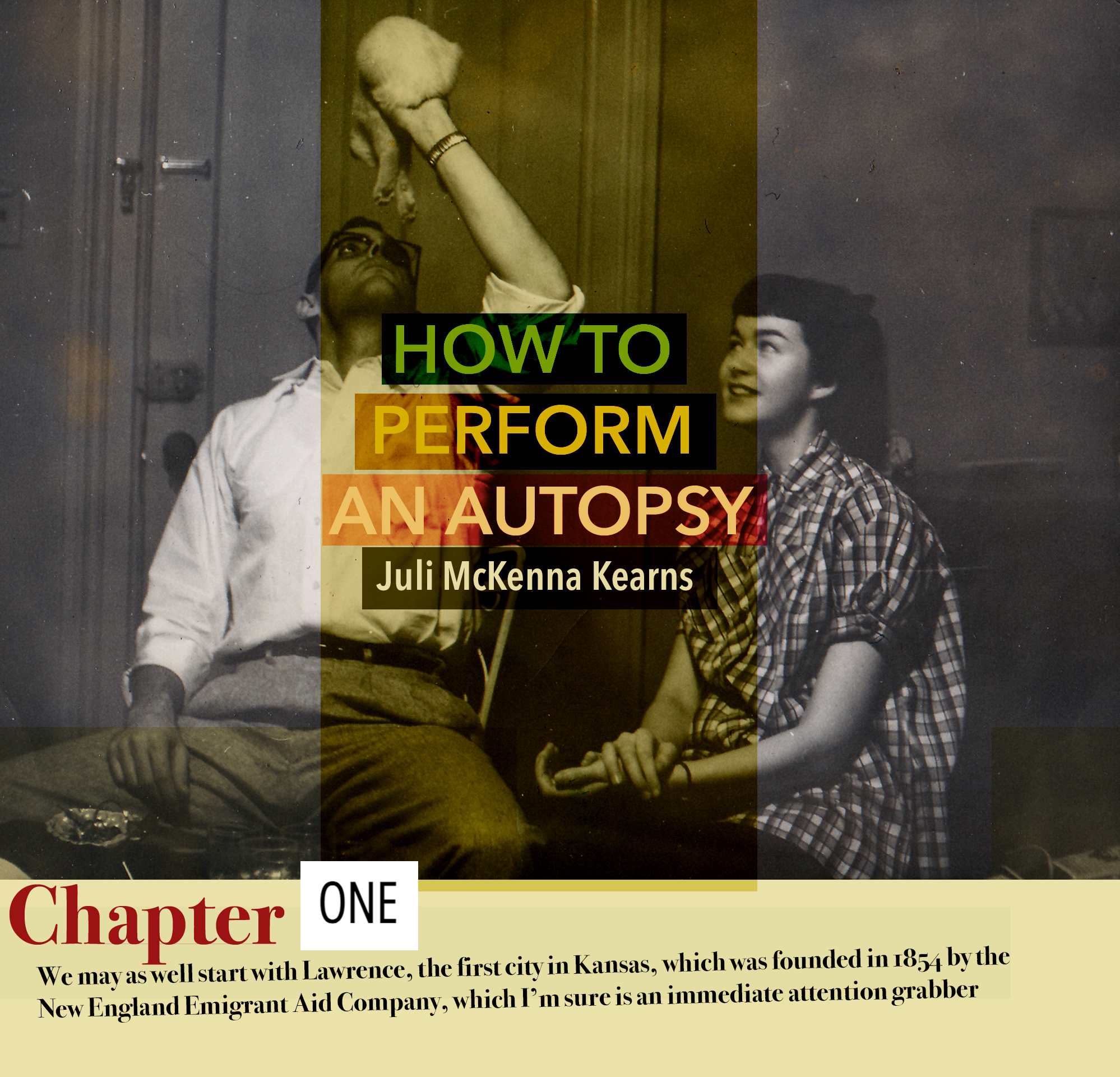
ONE
We may as well start with Lawrence, the first city in Kansas, which was founded in 1854 by the New England Emigrant Aid Company, which I’m sure is an immediate attention grabber
1
This will take some explaining. You may not be up to it, and that’s fine.
2
For several years I have wondered how to begin and eventually the cat volunteered itself. I’d prefer to not begin with the cat as that immediately risks sentimentalism, but I’m often moving in the realm of minor details rather than grand sweeping existential vistas, anchoring to minutiae with the building of a world, and, besides, many people like cats. Natsume Soseki wrote a comic short story from the perspective of a cat as a means to examine Japanese society, titled it, I Am a Cat, and it was so popular it became a novel by way of serialization of additional chapters, but I understand it is often required reading for Japanese school children which suggests to me the cat has led to infantilization of the work.
Don't ask me how I remember the cat. I was about a year old so I shouldn't remember the cat. Perhaps I don’t, perhaps I only believe that I do. But we had a cat in Lawrence, Kansas, and when we left Kansas and moved across country to the plutonium breeding reactors of the Hanford Nuclear Reservation, the cat was left behind. It was a large, light-colored ginger tabby, more yellow than orange, probably more cream than yellow. Several approximately 2 and 1/4 by 4 and 1/4 inch photos of the then popular Kodak variety exist of the cat courtesy of the 1888 trademark that documented twentieth century American life by means of a click of a camera’s shutter, the light of the moment exposed to silver halides that initiated their conversion to metallic silver and the formation of a latent image, the ephemerality of days that would “never come again” preserved. A great ad campaign, the power now in the hands of the general public to preserve the present for posterity, to guard against loss, and a nudge to believe that every moment was special and unique. The film developed and printed, we can see my mother is dressed for winter in a hooded duffle coat with toggle buttons, a wool jacket that became, at least for the child-me, my foundational idea of what a coat-jacket should be like, in particular the detail of the oblong wood buttons that were sculpted to terrace-taper down at each blunt end. A traditional duffle has buffalo horn toggles, but I remember from when I was a little older (which is how I know the coat was red) the visual and textural interest of the wood grain of those buttons, which I guess means her duffle wasn’t traditional. The
One - 2
hood up over her fashionably short black hair (refer to the mid-1950s style of pixie cut popularized by film stars Audrey Hepburn and Shirley MacLaine), wearing dark denim jeans with rolled cuffs and two-toned saddle shoes, in three of the black-and-white images she holds an about six-month-old me also bundled for winter in a pillowy hooded white onesie with attached feet and mittens. She appears to struggle with the winterized bulk of her child, and I look uncertain, upper body and arms leaning away from her rather than, as a primate Homo sapiens sapiens, instinctively seeking to cling to my mother. In three other photos I am no longer on display and she is instead with the cat that is collared and appears to even have a short leash attached, a slender cord with a handle loop, which means the cat was treated as a house cat, unusual for a time when cats were usually thought of as needing freedom to roam outdoors. Several inches of uneven snow mottle the ground before the dry sidewalk on which she stands in front of the apartment building in which we live. In one image she holds the cat as she had held me, in her left arm, though securely, so by comparison it's easy to see the cat was nearly as large as me but not so cumbersome and unwieldy a fit.
Give or take about nine months before this, in another photo from when my mother was pregnant with me, her black, coarse hair long and in a high ponytail with a bow, short fringe of bangs over her forehead (she always wore bangs), dressed in a plaid maternity blouse, short puffy sleeves, buttoned up to the collar, she sits beside my father who holds the cat in one hand raised up above his head, expressionless gazing up into its face, the cat then much smaller, a large kitten. The 4 inch by 3 inch night scene, in the room of an unknown older apartment, has been caught by a professional grade camera, and would have been hand printed, likely by novice, it shows the unmistakable splotches that may occur with time when a print’s not been properly fixed and washed. The light from an unseen ceiling lamp sets the moment in a way forgotten by color photography and never quite captured by lo-fi black-and-white Instamatics, the grays unsettled as in noir dim early Alfred Hitchcock while the white of my father's casual dress shirt is sharply highlighted. As he leans back in a metal garden chair to stare with vacant but cool intensity up at the cat, his eyes held upon the cat’s in what seems a challenge and an imprinting of his dominance over it, my mother too gazes up at the cat but she passively smiles, her cheeks brightened by the illumination of the unseen ceiling lamp directly above them, a light that quickly drops off so the room beyond fades away in shadows. The light catches the brass of an ashtray on the low table before which they sit, but so feebly brushes the rims of the seven glasses resting also on the table that they are only vaguely glimpsed at the very bottom of the photo. I can now smell the beer and realize, finally noticing the glasses, that more people were there than my parents, my fetus self, and the photographer, that this is instead the scene of a party. In the background is the apartment’s front door, which has a deadbolt and a chain that is off the hook. A small alarm clock on a bureau next the front door reads 7:26. It is early evening and they're at a gathering in this apartment because there is no drinking at the Rock Chalk Cafe or any other establishment in Lawrence because the “open saloon” is still prohibited in Kansas, a state that was dry until 1949. In the photos the cat appears so light as to be almost white rather than ginger, but it’s not from these photos that I recollect the cat.
One - 3
And when I remember the cat I don't so much as remember it as how it died.
My father is twenty-three, my mother is twenty-four, they are not quite youths but they are young in these photos, these people with whom I lived for seventeen years. Their public face was always so guarded, posed, not poised, any hint of the impetuousness of youth is already absent. Their interior lives actively recede from the camera.
My mother said they lived in two apartments in Lawrence after they were married, and perhaps this older place is their first apartment and not that of another individual. Of the few furnishings and knick-knacks captured in the photo, there is nothing familiar in the room, but there is the cat. My impression has always been that this is not their apartment as their aspects seem to be those of visiting partiers rather than the ones giving a party, but then if this wasn’t their apartment then their cat wouldn’t be there. Though, for all I know, it wasn’t yet their cat, it could have been their prospective cat, perhaps this picture was taken because it was their very new cat that had been in the care of the person to whom the apartment belonged. I don’t know. My father's face upraised in the image in which he gazes up at the cat, he appears to have a hint of a mustache, which has only been captured in one other photo, what seems an impromptu experiment at a portrait, also hand printed, from the same time period, perhaps also taken by the forever anonymous photographer who captured the image of him with the cat, but his hair is slightly disheveled in the solo portrait and he wears a jacket or heavy shirt so it was likely shot on another day. In the solo portrait photo his glasses are removed, and he has the same cool stare, looking beyond and to the screen-right of the camera. Dramatically lit from above, the screen-left half of his face is almost entirely obscured by shadow while a half-circle of glare cuts across the portrait forcing his screen-left right eye out of the dark with an effect of near pseudo solarization. The focus is only on him, the background blurred so there is no hint at the environment, but the way the light falls from above it could be the same room, the same ceiling lamp as in the beer party scene. The negative had been poorly processed and dried so that white splotch marks horizontally streak part of the print. When a young teen and I first noticed the photo in the family photo box, I asked my mother who it was. Though I thought it resembled my father, the same dark hair and complexion, the same full lips and dimple in his chin, I was thrown by the mustache and the chiaroscuro lighting, how cinematographic it was. My father seemed to be wearing the personality of a different person, one who hadn’t completely settled into being the scientist with black-rimmed glasses and wife and family. Almost bohemian. A trial identity adopted when one is contemplating shedding the person in one’s driver’s license. My mother glanced at the photo and said she didn't know who it was, then corrected and said it was perhaps someone she'd dated but she'd forgotten their name, it may have been John, but she couldn't really place the face and she wasn’t certain about the name. As she didn't associate the portrait with my father, I noted it as "John" with a question mark. It was only a few years ago that, examining the photo again, I realized it was unmistakably my father.
I never knew the story of how they came by the cat. I once asked my mother about
One - 4
the cat when I was a preteen, to confirm what I remembered having been told about the cat’s death as a child. If we’d ever looked at the photos together I might have thought to ask its name. Do other families look at old photos together? I don’t know. She only spoke of the cat as “the cat” and never said its name. She may not have remembered it.
Neither of my parents had any interest in photos, so images were rarely added to the family photo box. Their disinterest went beyond not having the easy access of at-one's-fingertips digital photography until late in life. My mother protested the few times I wanted to look at the photos, resistant to taking down the box from the upper shelf in their bedroom clothes closet, and when she did relent she would leave me alone with them behind the closed door of their bedroom, never remaining to discuss them, the places, the times, or who were the people in the images from her youth. My father never handled the dark gray box—about nineteen inches long by fourteen inches wide, about five inches deep, about the size of a bakery box for a half-sheet cake, with an attached folded lid—or looked at any of the photos contained, reminiscing. I never asked him to get down the box because it wouldn't have occurred to me to ask him. I would say there was probably no reason for my mother to be reluctant to pull out the box other than not wanting to be bothered, but that would be the lazy way out. In families that are troubled, all photos, no matter how banal, are potential silent witnesses of one lie or another that great pains have been taken to hide. In our family, not a single photo was ever framed and put on a shelf or hung on a wall, not even carried in a wallet. Indeed, when I was small, I chanced to see in my father’s billfold a lone photo portrait of a woman and wondered who it was, if it was an old girlfriend why would he still carry her photo, then when I was a little older discovered it was of the type that came with a billfold when purchased. The only portraits placed on display were of an elder white-bearded Brahms, the nineteenth-century German composer with whom my mother believed she had a beyond-the-confines-of-time spiritual relationship, and the occasional television father figure actor my mother would become too intently fixated upon in what I, even as a child, understood as her quest for a replacement father.
My father’s parents didn’t display photos. My mother’s parents didn’t display photos.
I don't display family photos either, and for various reasons I tend not to shoot photos of family. As an individual who has taken and discarded tens of thousands of photos, I deliberate for too long on this subject at this point, on what to say, considering how I should approach what is complex not only emotionally and personally, but also artistically, philosophically. The adage that a picture is worth a thousand words is not necessarily untrue but forgets the problem of viewer misinterpretation even when photos aren’t removed from historical or intimate context, and whether or not the picture itself can be relied upon, the intention of the photographer, whose story or perspective is being framed within the camera. As Homo sapiens sapiens are one large family, in the same way that photos of troubled families are potential silent witnesses of one lie or another that great pains have been taken to hide, so too is any photo a potential record of uncomfortable truths and disfigured realities. On the other hand, art can magically transcend, transform, reveal. But words are still often needed to inform and abet comprehension.
One - 5
Returning to the photos of the cat in the snow, they would have been likely courtesy of 616 film, 6.5 x 11 cm format, which was perhaps used in a Kodak Target Six-16, an amateur’s box camera dedicated to panoramic shots, viewfinders on top and side for portrait or landscape view. The type of film was probably Verichrome Pan, which was especially good for box and medium-range cameras, a general purpose film that the amateur could rely upon with its wide-exposure latitude. Or the camera may have been used in the Kodak Vigilant or Kodak Monitor, which were also 616 but had a fold-out bellows and were better-crafted and far more costly. This information may not seem of any significance, but it is to me else I’d not have researched it. These are people I don’t really know and whose history is all question marks. I’m considering the personality of the user and their pocket book, though neither may come into play if the camera was perhaps a gift or passed along when the former user acquired another camera they preferred. The clunkier, more finicky, and not-so-svelte box was sold originally for four dollars while the Kodak Vigilant sold for about forty-two dollars and the Monitor for about forty-eight dollars, the last of the Kodak 616 models, discontinued between 1948 and 1951. That’s a big price bump, and that the camera was being used in 1958 by a newly married couple who weren’t photo bugs means they didn’t purchase it, instead it may have been a hand-me-down or a pricey high school graduation gift to my father, though the lowly box camera could have been acquired as a hand-me-down, or was a personal purchase or gift when a teen.
If, in the photo of my mother holding me, I appeared to be pulling away from her as though I'd prefer to fall back into the void rather than be embraced by her, that's not speculation, that's how things were. I had trust issues with my parents. But I also remember the fear of falling back, of being carried with an arm braced under one's bottom but no support around the back, being swung around roughly (my chest reflexively tightens with an unvoiced gasp, it’s uncomfortable to imagine), the surprise and alarm of one's head snapping back and the wild reaching to attempt to grab hold of the cloth of a sleeve and hang on. When I was a child and I first saw those photos of the three of us—my mother, me, the cat—I experienced the surprise of an ancient jealousy unearthed as I looked at my mother cradling the cat in her arm. As if I could easily be replaced. The associated pain startled me and I only now realize that emotion was the mind of the infant-me. My father doesn't appear in these photos and I assume, perhaps erroneously, he was the one who took them. As I’m closely examining the photos, the question then occurs to me, where was I when he was photographing my mother with the cat? Who would have been holding me? As a child, looking at the photos, I'd the feeling of not just being out of sight when replaced by the cat but disappearing. The photos weren't processed for months, not until the following summer when we'd already relocated from Kansas to Washington State. When photos are conveniently printed with a date, I find my parents would often wait half a year to process a roll of photos, which can make narrowing the time frame to an exact month sometimes impossible, and if the photos haven’t been printed with a date there’s a ninety-nine point nine percent chance that no one has noted date or description on the rear. If the contents of that box ever turn up in a flea market, there is little chance the people represented therein will ever be identifiable. Hundreds of thousands of such anonymous photos have landed in thrift shops or in flea markets by way of estate sales because they ceased to have a context that made them matter.
One - 6
They are now curiosities. Who was this person pictured and what made that moment significant enough to be captured. What was the image intended to represent for either the photographer or the individual in the photo? When a photo of anonymous individuals is scrutinized, whole lives are reconstructed based on a hairstyle, an article of clothing, a facial expression. “Look at that scowl, they obviously don’t like standing next to that person.” “The halcyon days of youth, how happy and carefree they are.” Conjectures made with too much confidence. One of several apparently happy college girls seated on a grass lawn before their sorority house may miserably be covering up traumatic secrets she feels she dare not speak about. A person who appears angry may be discomfited by a headache or upset stomach or an article of clothing that is uncomfortable. The identification of a woman as one’s great-grandmother in the family photo record doesn’t make her so if the claim is erroneous.
To check myself, the sense of my pulling back into the void, I examine the photos again to make sure I'm getting this right, and realize the story I've just told isn't apparent, if another person were to glance through them they would only see a woman struggling a little to handle the awkward bulk of an infant snugly attired to stave off the midwestern cold and that the child’s ability to cling to the parent is hampered by the bulk of their onesie and mittens. When I revisit the photos with the intention of being as objective as possible, even I don't see anything more than that. Yet my initial immediate physical sensation upon seeing them is the fear of an unreliable embrace and the avoidance impulse that comes of learned distrust.
Almost always, there are at least two stories.
What to make of my mother not recognizing her husband in a photo? I don't believe she did recognize him, though it's possible she did. Her world was an odd one, not connected with reality, most often by choice. Or I should say that she and my father fabricated numerous false worlds they called reality. They lied as a matter of habit, with almost every breath, and also practiced gaslighting, which the American Psychological Association defines as “to manipulate another person into doubting their perceptions, experiences or understanding of events. The term once referred to manipulation so extreme as to induce mental illness or to justify commitment of the gaslighted person to a psychiatric institution but is now used more generally.” The term has its origin in George Cukor's 1944 film Gaslight, in which Charles Boyer attempted to convince Ingrid Bergman she was insane by having her believe she imagined the sound of footsteps in the attic at night, they were all in her mind, and he had her believe she was responsible for objects disappearing, such as a painting that repeatedly absented the wall, she was the one compulsively, insensibly removing and hiding it and was bewildered by its absence because she was unstable and forgetting her actions. Charles Boyer was at least after something sensible in his gaslighting of Ingrid, he was spending his nights up in the attic searching for precious jewels that had belonged to her dead aunt, who he’d murdered. His goal was theft. For a long time, not having seen the film since I was in my teens or early twenties, I misremembered it as being directed by Alfred Hitchcock, and for good reason, Gaslight was based on a 1938 play by Patrick Hamilton who in 1929 also wrote the play Rope, which served as a base for Hitchcock’s 1948 film of the same name. Ingrid
One - 7
Bergman’s turn in Gaslight was immediately followed in 1945 by her starring in her first Hitchcock film, Spellbound, in which a man struggles with phobias and dreams that with some detective-psychoanalysis turn out to be symbolically-expressed traumas he has experienced and forgotten. In Gaslight, Ingrid Bergman’s character has been convinced she is mentally unbalanced, but is proven not to be by Joseph Cotten, while in Spellbound Ingrid Bergman plays the psychoanalyst who helps Gregory Peck recover lost memories, proving he is not insane.
My parents’ lives were so much lying and gaslighting that it's often impossible to recover the truth from the false histories they created. When I was a young child, they lied. The gaslighting began in earnest when I was a preteen, but the groundwork of lies was also destabilizing.
Google Maps. 1316 Massachusetts Street, Lawrence, Kansas. Other than the biology of human reproduction that eventually evolved in consequence of the ever mysterious conception of the universe in which we precariously reside, I don’t know what I’m doing here, but worlds of a lot happened before I was born in a Kansas that already liked to think of itself as “It’s always been this god-ordained way” though it had only been a star on the flag of the United States of America for ninety-six years, which may sound like a lot of time, and it may be for a gnat, but there were then some still alive who had been born in the year of its transition from far west territory to statehood. The place where we lived my first year still stands and is easily recognizable though much has changed about it. I know we lived at this address through the agreement of a census and Google Maps with photos. A six-unit rectangle of an apartment building of two floors, oriented so the width-narrow side of the box is the facade that addresses the street, it’s configured like a motel with exterior front and rear entrances/exits to every apartment on the long sides. I have always imagined the wood siding and shingles of the original facade stained a redwood color to coordinate with a low-slung style of quasi-Frank Lloyd Wrightian architecture, intended to blend with the landscape, downgraded and redefined to communicate the unimposing aesthetic of a sleek urban cabin. The then new building likely having replaced a home such as the standard early twentieth century two- and three-story single family residences neighboring, or maybe a lingering Victorian structure, stood out as at least novel to the area pictured, as if it perhaps would prefer to be a state over in the Rocky Mountains of Colorado, but no doubt it was fashioned to appeal to young student couples graduating from the dorm to a one bedroom apartment. At some point between then and now that low-profile design must have made for problems because the roof was raised, a vented attic was constructed above the second floor, and the addition of an obtrusive enclosed gable swept away the modernist cabin-like sensibility of the facade facing the street. The minimalist windows, longer horizontally than vertically, each composed of two glass panels set side-by-side, are a contemporary rather than traditional profile for the 1950s. The original wood balcony of the second floor, the baluster of which angled out away from the building and invited one to lean against it, forearms resting on the wide cap rail, a rather romantic yet rugged detail, probably rotted and was thus replaced with the current wrought iron that seems pedestrian in comparison. The landscaping and concrete walks, once
One - 8
crisp and defined, are now uncertain as to where what begins and ends. The demarcation line announcing a street is exhausted and no longer cares.
In 1957 Dwight D. Eisenhower is president and his vice president is Richard Milhous Nixon, whose own presidency will end with the Watergate scandal and his resignation in 1974. In June of 1957, sandwiched between twenty-two-year-old Elvis Presley's "All Shook Up", "(Let Me Be Your) Teddy Bear”, and "Loving You" hits in July, the most popular song crooned over the radio was a twenty-three-year-old Pat Boone’s lamentation about writing love letters in the sand and how his girl laughed when he cried each time he saw the tide erase their love letters, the vows they made meaning nothing to her. Bitter comfort for the heartbroken. Not the best jukebox selection for a first date.
Their parents were of what is called the Greatest Generation, if you believe in generational labeling, which is simplistic and creates assumptions that categorize with too broad a brush and give a false read on cause and effect, such as much that is credited to the Boomer Generation was actually the brain child of individuals born during the years of the Greatest Generation, or even the Lost Generation that fought in WWI. The Greatest Generation, born from 1901 to 1924, was originally the G.I. Generation, Government Issue or General Issue, a moniker suggested in the 1991 book Generations, but then news anchor and journalist, Tom Brokaw, called them the Greatest Generation and it stuck, because heroes were wanted and thus forever America would know its heroes by their birth year and that they were the generation who fought the Nazis in WWII. My parents were of the Silent Generation, which means they grew up with conservative, anti-communist, blacklisting McCarthyism, which was created in part by the Greatest Generation, to which Senator Joseph McCarthy belonged. The Silent Generation was guided and fed by the Lost and Greatest Generations. My mother’s conception of the world at large, history and current events, was near non-existent. Before going to college, she had a piano teacher who she would occasionally mention to me, who she had liked, the smartest woman she'd ever met, she said, knew all about politics and was well-versed on everything. For instance, if one was trying to converse on domestic and world affairs, no matter the topic, my mother would say, "Mrs. So-and-So-My-Piano-Teacher was the most intelligent woman I ever met, she knew everything," which was the cue that the conversation on that subject would now end, that my mother would commandeer the conversation over to a self-interest because my mother had to be the center of the world. Only because of her doing this repeatedly forever, I eventually made an effort to try to dig down and learn something about the piano teacher and her opinions, a spontaneous move on my part when it one day dawned on me that despite all these mentions I knew nothing about the teacher's beliefs and opinions that made her the smartest woman in the world forever. I asked about them. What did she believe in? My mother was caught off guard, then after some mind-searching and wavering on her part, and prying insistence on mine, she said, "McCarthy". The piano teacher had loved and worshiped McCarthy and spoke often about him. Taken aback, I asked, "Joseph McCarthy?" Yes, that was it, Joseph McCarthy, my mother was pleased I recognized the name, a great man. I asked, "Do you know who Senator
One - 9
Joseph McCarthy was?" No, my mother replied, becoming defensive. I told her a little about McCarthyism and the witch hunts of the anti-communist Red Scare, and as I spoke she hardened into a posture of not hearing, though to her credit she was not herself a hater of socialists or communists, when I was ten she told me two of her uncles on her mother’s side had been communists in their youth and how her mother was ashamed of this, and she probably had been ashamed, yet she unexpectedly, very briefly, no details offered, brought it up herself a couple of years later, treating the subject as one that gave a veneer of subversive excitement to those brothers. “I don't know anything about that," my mother said about McCarthy, and shut down the conversation. The Silent Generation is described by some as being so conformist they were silent about McCarthyism, but the eldest of them was twenty-two as McCarthyism peaked, during a time when one couldn’t vote until they were twenty-one, and the youngest was five years of age. My mother’s piano teacher would have been of the Lost Generation.
They are very young marrieds in Universityville, my father less than a year from graduating with his master’s in biophysics and having his photo taken in cap and gown in procession past KU’s towering World War II Memorial Campanile & Carillon that was dedicated in 1951. My mother, a year older, was a latecomer to school after several years working to help support her family. A freshman at twenty-one years of age in 1954, older than the others in her class, she felt out of sync. Everything I know, it's all disorganized bits, their lives a blank, especially my father's. With the exception of a couple of stories related in a clipped few sentences, my father shared no personal history. We look for the who of people in what they say, what they do, how they relate to others and the world, their interests, and when these usual avenues leave us with puzzles and questions we might look to their origins. Perhaps others had stories from him, about him, but with me, his eldest child and daughter, my father had little to say about work, he didn't talk about university, he didn't talk about high school or elementary school or any of his teachers, he didn't talk about his childhood, he didn't talk about experiences had before or after I was born, such as places he'd visited or memorable foods he'd eaten, hometowns, homes, he didn't talk about one single friend he might have had in his life, he didn't talk about his parents or other members of his family, he didn't talk about my siblings, he didn't even talk about my mother, and my mother had no stories about him to relate because my mother was only interested in her own stories, which focused primarily on hates, such as her hatred for her parents, but dry on facts except for a few that served as launching pads into her grievances, not that many of them weren’t legitimate. My father did an exceptionally good job at not talking which was perhaps a reason my mother was attracted to him, he gave her the floor unconditionally, forever and ever, without question, rarely challenging her, not so much conversing as going along with her up to the point where he sometimes wouldn't, and perhaps a reason he was attracted to her was because she wouldn't be one to pry into the who of him very much. Because of the bizarreness of their relationship, as a teenager I used to look at them and wonder what brought them together, and at the same time I was a little afraid to know, as they so ostracized their children that the idea of family was absurd window dressing, they'd no room for us in any part of what bonded them, yet they'd kept
One - 10
having us. When I was about eleven, my father and mother on their side of the breakfast bar, we children on our side, having been purposefully convened for a meeting of import to us, my mother and father holding hands, she announced that they had made the decision they would never again fly apart from one another so in the case of a plane crash they would both die together, never mind leaving behind young children, they couldn't imagine life without one another. Which I believed, because our household was sick with their weird, bizarre bonding.
How did they meet? They met because they were born. He was born and grew up in Ponca City, Oklahoma, and southwestern Missouri. She grew up circulating around Chicago but with time spent in Glen Ridge, New Jersey, Wheaton, Illinois, and Cleveland, Ohio. The prestigious Glen Ridge (high median income, long list of notable people, check Wikipedia) never was mentioned, nor was Wheaton ("One of the best places to live in Illinois..."), Cleveland Heights only once or twice and so confused issues, and the story about Chicago was they had lived in Oak Park, Frank Lloyd Wright was the architect of a number of homes in Oak Park, and she had known a couple of people who lived in Frank Lloyd Wright homes. My grandmother spoke about Oak Park as well, mainly to note that it wasn't what it used to be, i.e. she would have been referring to white flight and integration, racism hinted if not spoken outright. My mother wasn't an appreciator of architecture in any form and would have never taken an opportunity to visit any Frank Lloyd Wright home as a tourist as only my mother should ever be the center of attention. I never learned whose homes these were that had been a part of her youth, it was just a rare tidbit of information to grab onto and, already an appreciator of architecture, made me feel like I had a quasi-connection to Frank Lloyd Wright history. She was born in Chicago and her family was in Chicago when her father was released from his job as comptroller and treasurer for a large retail company, something something to do with embezzlement he supposedly didn't commit, someone else did but it was pinned on him and he was forced to take the fall or something and quit or was fired something something and that's how he ended up unemployed for something years. From census records and other documents I know her father was on the low end of the upper ten percentile of earners in 1940 when in Glen Ridge, and looking up addresses I've gathered from census records and other documents, I’ve learned just how nice were the houses in which they they lived in the kind of nice upper-middle-class neighborhoods that have always made me wonder as I passed through them, on my way from not that neighborhood to another not that neighborhood, "Where and how do all these people get their money?" After the loss of his job, my mother's father unable to find another one for I don’t know how many years, my mother put off going to college and entered the workforce, the only time she ever would do so in her life, something something in a large retail store situation. When I was a youth, during one of my afternoons babysitting her in the kitchen while she drank, she told me she had been an artist in the ad department and had quickly and capably doodled a couple illustration type line drawings of children that had a very defined, well-rehearsed style (when I look for something similar they recall the drawings of Eloise Wilkin, called “the soul of Little Golden Books”), then during our last period of contact when I asked her about this she defensively objected, no, she didn’t know where I’d gotten that idea, she had
One - 11
worked in the mail department. She was expected to hand over her paycheck to help support her parents and she complied without question, but if she was ever very curious about the facts of the matter of her father's tumble from a highly desirable position she didn't display it, perhaps because she had no interest in the lives or histories of her parents (or most anyone else for that matter). As the lives of her parents directly affected her, this void of curiosity seems insensible, but this is the way she was, perhaps because she had been raised to not question her authoritarian parents, but her resolute disinterest also enabled her in the near constant construction of fictions she handed over as facts. I do know it is true that there was something something concerning embezzlement, it was once or twice even briefly mentioned around me by my grandmother in a "Don't even think of asking a single question, besides which he was innocent" way. And maybe he was innocent. I don't know. Because they always pled hardship though they were comfortably middle class in their old age, because he was the kind of asshole grandfather who would play chess with an eager first-time ten-year-old, glory in winning and thus prove to you why you should never ask to play chess with him again as you weren't up to his level (he refused to teach me the game as I was a girl, but did teach my brother, B), and because our grandmother was a frustrated social climber who, after their fall from grace, had taken labels from their older, classier Marshall Field’s coats to sew into their cheaper coats, I was inclined to be suspect because I knew that, on the competitive level, social position and money had meant everything to them. Would our grandfather be capable of embezzlement, this man who could scarcely sputter two sentences without frothing as he was such a lethal pot of barely suppressed burning rage and spite-filled resentment over the fact the brilliance of his accountant intelligence hadn't been appropriately recognized by all, the self-professed smartest person we would ever know, corroborated by my grandmother who also held he was the most moral man in the world. Was his natural acquisitiveness capable of persuading his conservative Methodist or Presbyterian ethics (news mentions show he participated in both denominations) that he should have been making more money so why not purloin it and imagine others would be too dull-minded to ever figure it out? Or was he, a Freemason, staunchly trustworthy in all dealings and as bitter as he was because he'd been wronged, wronged, wronged, not to mention he was terminally infuriated because he was so much smarter than the rest of us and we were so beneath him that we hadn't the intelligence to recognize his genius.
My siblings and I, our worlds far apart even when young, were at least in agreement on the embezzlement story as such a foundational part of the family lore, though never discussed, though nothing was known about it, that some of us would joke the reason the mahogany Mason and Hamlin parlor grand piano occupied a hallowed central role in the family was because it must have a hollowed pirate's leg in which the embezzled monies were hidden and they were still waiting the day they felt free to spend it. Almost always there are at least two stories.
We are all part fact and part fiction.
How much room is there in the world for concert pianists? When my mother lands at the University of Kansas, studying music because she's going to be a concert pianist,
One - 12
I know from a lone postcard that her parents are then living in Oak Park where their downsized lodgings would have been overwhelmed by the Mason and Hamlin on which my mother has practiced her Bach and Beethoven and Brahms for a good part of her life. This address, in the shape of an “Oh woe is me look what I’m reduced to” apartment building on North Austin Boulevard, on the very border of Oak Park, literally a couple of footsteps west of the Austin neighborhood, however nice, might be the best evidence that my mother's father had not been an embezzler. Or maybe he hadn't embezzled enough. Grandpappa (my mother's mother dictated we should call them grandmamma and grandpappa), I'm sorry if you're innocent, and I'm slandering you, however long after your death, but maybe you shouldn't have exploded on me and gone so red in the face I thought you were going to stroke out when I casually remarked that the American railway system was dying, and if memory serves I qualified that as per passenger travel. It doesn't help matters that the conversation in question was one of the few I recollect, for I only met you perhaps eight times total, and you made it more than abundantly clear that as I was female I was unworthy of ever participating in any discussion with you. Or maybe you just didn’t like me.
Home Owners’ Loan Corporation maps made about 1940 rated the borderline Oak Park area in which they were living in 1954 a downwardly trending "C", largely inhabited by white collar clerks and in decline due to "Jewish infiltration", while across the street from them the area was considered no longer lucrative due to "Italian infiltration". They had moved from a Cleveland Heights address that in 1940 had been rated as a good investment "B", populated by professional executives, junior executives, and business owners, with "some families of German, Italian, Jewish descent", also having lived in a “B” neighborhood in 1940 Glen Ridge, right across the street from the “A” class executive homes that looked exactly the same as the across the street “B” league homes but weren’t. Even with their downward mobility in status, they managed to send all three daughters to university. I could be wrong, but I trust this was because of my mother’s mother, who had been to college, as had most of her relations. She came from a family of higher education. My grandfather didn't.
My mother had attended Cleveland Heights High School. Beside her senior year photo are the clubs in which she was a member: Red Cross, Hermes (a Latin club), the Music Appreciation Club (listened to music), the Science Club, the Friendship Club. She does not appear in any photos of the members of these clubs, nor is she listed as a member who doesn’t appear in the photo. The science and latin surprise me as she had no interest in either. She never spoke of any of these clubs but then her experiences may not have been memorable or she may not have participated. Cleveland Heights had a strong, nationally recognized music department, yet she didn’t participate in the renowned choir.
The way my mother compressed her KU story I always thought she'd been there for a year when she met my father and married but I find her in a 1954 KU yearbook in a group of twenty-nine young women designated as North College I. She is third row up, third from the right. About half are dressed in light-colored sweaters, the other half in light-colored blouses, and with the exception of two who have slightly longer
One - 13
hair, it is obvious that gently curled short hair that ends a little below ear length is what they were doing in Kansas. My mother stands out because her hair is jet black and is unfailingly always the darkest, and her face shape is round. She has so unique an appearance it would be near impossible to confuse her ever with another, even standing out in her own family though she and her two siblings bear a marked resemblance to one another and their parents. She is attired in a dark short-sleeved jumper dress with a fitted waist over a blouse with a high frilled neck. To her immediate left is one of the two lone girls in the photo who have hair all the way down to their shoulders. That girl merits a mention for, though she is dressed in the conventional short-sleeved white blouse, she has differentiated herself with a beaded necklace from which hangs an unusual and dramatic palm-sized large pendant that stirs one's curiosity to want to view it more closely so one might see what it depicts, which is impossible to do with her forever in miniature. My mother's attire rouses my curiosity as well for she wears this jumper or another in a couple of other photos from earlier years, paired with different blouses, always a slim dark bow of likely velvet ribbon knotted at her neck, but in this sitting she appears to have left the usual dark neck bow untied, which is surprising as she is typically fastidious in these early presentations of self. The jumper dress is similar to one worn in the 1959 film The Wasp Woman by the female owner of a cosmetics company who takes a rejuvenating wasp royal jelly that turns her into a half-wasp, half-human killer. The dress in the film has a boat neck rather than rounded and is a sheath in shape while it may be my mother’s has a full skirt, I can’t say for certain as it’s hidden in the photo of her with her dorm mates. If the one she wears in 1954 is the same as in a 1951 photo then it would have a full skirt, but she wasn’t inclined to wear clothing for more than a year or two so the jumper dress she wears in 1954 may be a different one. In the poster for the film the woman is a giant wasp with a beautiful human face and is clasping the body of a man who is the size of a child in comparison, and as he is in white pants but shirtless the impression given is similar to an infant in a white swaddling blanket. In the movie, when she transforms she instead has the body of a human and the fuzzy face and antennae of what we are to believe is a wasp. She morphs back and forth in a Doctor Jekyll and Mr. Hyde manner, and rather than stinging her victims she drinks their blood, vampire-like.
As for North College, the name is a reminder of a building that no longer existed. North College was the first construction of KU, established in 1866, a lone structure perched atop the hill of Mount Oread, past which the wagons of the Oregon Trail had heavily trundled west, and upon which was a free state fort during the Bleeding Kansas days. Only fifteen years later, the North College building became an asylum for "feeble-minded" children throughout the 1880s, then with renovations was transformed into KU's law school for three years, but the law school must have decided the old building wasn't up to par as it then became the fine arts school, in which the music department was folded, finally to be condemned in 1917 and dismantled. So in the 1950s what is termed North College seems to refer to fine arts students who study at Strong Hall, the main administration building, where the fine arts school was then housed, the music department in the basement and first floor. KU's School of Music gained a dedicated home in the brand new Fine Arts Murphy
One - 14
Hall that was built in 1957, but by then my mother had dropped out. There are four groups of North College freshmen women pictured in the 1954 yearbook, and if I search out the page on that part of KU trusted to prepare them for a future in the arts I find, "Every day 490 students laden with music books, paint brushes, portfolios, and similar paraphernalia enter Strong Hall for classes in the School of Fine Arts. This school of the University, one of the finest in the Midwest, offers unlimited opportunities for art and music enthusiasts. Dean Thomas Gorton leads a staff of 56 instructors." Nine new teachers had been added that year. When I look up Thomas Gorton I find that he refused to allow jazz to even be played in the practice rooms at KU.
What was my mother, who lived in Chicago, doing at the University of Kansas? Was it as fine a school for the Fine Arts as stated? An attractive school for an individual supposedly preparing for a career as a concert pianist? The hometowns of the freshman students are listed next to them in the yearbook, and the vast majority are from Kansas, with a few from Missouri, often Kansas City, Missouri, which makes sense, Lawrence being so close to Kansas City, and many who live in Missouri will be connected with Kansas through relations who live there. Another yearbook reveals that the girls identified as North College I live on the first floor of their dorm building, North College II on the second floor, etcetera. Only one other student in the four North College groups is from Illinois, also in North College I. In the mid-1950s, the University of Kansas seems more a home state school rather than one that has a national appeal.
Individuals who are estranged from their families may be left without childhood photos. I was first estranged from my family when I was seventeen and experienced this. I'd the memory of childhood photos, and especially with the photos in which one appears they can feel like dislocated pieces of ourselves if one is deprived of them. When my family and I reconnected for a time, I went through the family photo box and, without telling anyone, took the few photos of which there existed copies, which weren't many but I at least had these when we were later estranged for two decades. Why would I not ask for the copies? Because to ask would have resulted in being given an excuse for why I couldn't have them, and to even be viewed with suspicion for having asked for them. If you expressed an interest in anything, you were viewed with suspicion, like they were wondering what you were looking for, what bad thing were you hunting. Then during our last period of connection, I volunteered to scan and digitally archive the family photos that a sibling had been given by our parents, which comprised the majority of what I had known to exist. Among them were several I reasoned were likely 1950s views of buildings at KU. I find one of the unidentified photos is of Strong Hall. A sister of my mother's is in the 1954 yearbook, the one closest to my mother’s age, and is identified as living at Locksley Hall. This sister never once entered my mother's few and spare stories of KU, but I discovered another one of the unidentified photos is of the long-since demolished Locksley Hall. Some other photos, obviously from the same camera and taken by the same hand, were of the visit of Queen Elizabeth II to Chicago, in July of 1959, on the Royal Yacht "HMY Britannia". My mother never took photos, and if she had she would never have thought to make notes on the back identifying any of them. The photos are different
One - 15
from those taken by a typical family photographer as they don't show any people, only buildings considered memorable and events on Lake Michigan connected with the formal opening of the New Saint Lawrence Seaway by Queen Elizabeth II and President Dwight D. Eisenhower, held in conjunction with the 1959 Chicago International Fair and Exposition. Whoever took them had a surprising, fledgling eye for photography, giving attention to framing, and would have either been my mother's mother or the sister who had been at Locksley Hall. A photo of my Locksley Hall aunt shows her with a twin reflex camera hung on a strap around her neck, which I assume means she was interested in photography. She would marry an individual who graduated from Northwestern University but he was born in Lawrence and after marrying in Seattle, Washington they would make their home in Lawrence for most of their married lives.
An uncle of theirs, brother of their mother, had a "farm" on Route 2 somewhere around Lawrence and the Palmyra-Baldwin area to the south of it, farm placed in quotes because I don't know what that means as he spent his time traveling the world as a coordinator for the Department of Interior Office of Petroleum, when he wasn't an employee of Standard Oil, also a research engineer at KU according to his obituary. I've wondered if a reason my mother and her sister landed at KU was because they had an uncle located there, though their eldest sister had gone to school in Arizona, probably to escape the reach of her parents for a year or two. My mother never discussed why she'd gone to KU or if she'd applied to any other schools, and as a child I didn't think to question her having been at KU as it seemed to me the kind of "fact" that was mandated by fate.
My mother appears in the 1956 yearbook living in Grace Pearson Hall, one of forty-seven women pictured, she's in the second row, fifth from the left. Nearly everyone wears a short-sleeved sweater with a very short necklace of beads, some in pearls, most of the women in light-colored sweaters and dark skirts. My mother's sweater is darker, appearing gray in the photo, her skirt full and a slightly darker gray. She distinguishes herself by being the only one to wear a fashionable belt, likely black, cinched around her waist, the belt cut so that it is dramatically narrower in the front than on the sides. She is stylish.
The hall is stated in the yearbook to have "spacious rooms, luxurious beds, personal services". At 1335 Louisiana Street in 1956 it was located across the street from the residence for the Phi Kappa Tau fraternity at 1332 Louisiana. My father was Phi Kappa Tau and lived in the Phi Kappa Tau residence that, as it turns out, was across the street from my mother. This was never mentioned and I only know it from learning the addresses in the yearbooks in which I've located them. According to the story that I have, this is not where they met.
Her story was that she had been living in a dorm and she was certain there were lesbians on her floor so she reported them to the house mother who told her to mind her own business and then all the bad people were against her for which reason she moved into a student boarding house that had one or two other male boarders and the landlady and her son. One morning she smelled smoke and on her way out to
One - 16
class she told the young son of the house he might want to tell someone about it but he forgot or didn't and when she returned the place was burned down and so she married my father.
"How old was the boy?" I one day thought to ask.
"I don't know. Maybe five."
Okay. That's just the person you want to tell, "I smell smoke, you better check that out." I've no reason to doubt this happened, my father always sat in silent agreement when she told the story, but the Lawrence, Kansas, census has her living in March of 1956 in a house that, according to Google Maps, is still standing, I'm looking at it right now in my browser, an old, three-story house that is one block down Louisiana Street from the Grace Pearson dorm in which she’d formerly resided. What was once a boarding house has since been converted into dark, depressing apartments, some rooms clad in pine paneling that's at least old enough to be the real deal rather than fake, the linoleum flooring so ancient it's the color of oven crud. A Hello Kitty doll (Hi, kitty!) set on the bed's pillows in apartment B is an exquisitely poignant touch, six dreamcatchers hung above to protect from the nightmares that might draft in through the window that's covered in blue plastic and sealed with gray duct tape all around. If one finds pine paneling too dark, the first floor is a little less daunting, however rundown, the flavor of pre-renovations observed in rooms that have plain plaster walls, original wood flooring, old window casements and baseboards. An enthusiastic welcome is given to university students with the dining room’s walls entirely papered in Busch Light, Corona, Bud Light Seltzer, Mojito, Magic Hat, and Coors Light cartons. At least I reason it’s the dining room because of the hutch built into the wall next a fireplace with a surround of old green ceramic tiles that extend onto the floor as part of the hearth. Built in 1925, now hosting ten bedrooms and four baths, it can be yours for between half a million and a million too much considering the fixing up it requires, plus the installation of functioning heat as portable space heaters are so frequently observed as to be a prominent feature. What can I say but that someone needs to move the space heater that's set on the stool next the bed in apartment B so that it's not touching the shirts hung on wall hooks above it or else they might end up with a fire as well.
In 1956, my mother, according to the March census, is the sole boarder and the only other residents are the landlady and her thirty-year-old son. In 1957, that household consists of the same landlady and son and three boarders, two of college age. I've no doubt the fire happened but my mother always gave me the impression the fire had burned the place down, which means it couldn’t have happened at the boarding house she was living at in March where the woman had a thirty-year-old son? My mother described the fire as happening, in July of 1956, so if it didn’t happen here this means she would have had to move between March of 1956 and July to the house where she is boarding when she will meet my father and where the fire occurred just prior their marriage. However, she never mentioned an interim boarding house. But she never mentioned a lot of things. I don't know how she meets him, that story was shaky so it never put down roots in my memory, but it was something something to do with an
One - 17
acquaintance on a sidewalk out front of somewhere and then they were forever together. As they met in July it would have been when my mother was living in the boarding house that burned. I’ve always trusted my mother’s story that the house burned, but I also know it’s unlikely that my mother would have made a move from one boarding house to another between March of 1956 and the beginning of July. Perhaps instead of the boarding house having burned down there had instead been some fire and smoke damage and it may be she’d had to move out but in March of 1957 the house was of a condition to be inhabited by the landlady and her thirty-year-old son who was not five and the three boarders. There are always two stories and I struggle to rectify believing both my mother’s story and the census’ stories. A search of the Lawrence Daily Journal-World gives no results for either a boarding house fire or a fire at that address in July of 1956, but the results may not be reliable, or it may not have been reported in the news. I wonder to where she might have moved after the fire in question as I carry out a cursory hand-combing of the paper in unindexed archives. My father never gave his version of their having met, not even to remark that when he first saw her he believed her the most ravishing creature in the world, and my mother always leaped to the end, after relating she had dated a rich boy with red hair and a red Cadillac convertible who was eager for her to marry him, she’d relate how he was devastated when she met and married my father instead after knowing him for just three weeks. Then, seated, she'd do her little supposed to be sexy jiggety jig wiggle, chickety-chick sound out the side of her mouth that meant they'd been hot to trot.
Which is why I was born less than a year later. My mother said that she had wanted to rub it in her parents’ faces that she was old enough to have sex and having it. This was why I was conceived. I was proof of sex had.
They married at the end of July 1956 so that means my parents met in early July. The long story is that her father, she said, was being a tight-wad on the amount of insurance money she was going to get for her burned belongings that she no longer possessed, he depreciated all items rather than making a claim for what they cost at time of purchase. While this was going on she either went to Chicago with my father to introduce him to her parents, or her parents went down to KU, I never got that straight, but now that I think about it the latter must have been the case, and during that visit my mother told her parents she'd decided she wasn't going to be a concert pianist, she was going to be a nurse instead, her mother's hysterical response being to threaten to throw herself down the staircase and kill herself. Indeed, I think my mother did eventually tell me her parents had come down to visit which forced me to change the mental movie I’d had for years of her mother threatening to pitch herself down the stairs in their residence, but as her parents were living in an apartment they wouldn’t have had stairs. Unless they’d moved by then. I don’t know. Anyway, it happened somewhere in Lawrence, my grandmother at the height of a staircase and her husband holding onto her to keep her from catapulting down them to her death. After the meeting with my mother’s parents, my mother only had peanut butter and crackers to eat over a weekend as her father held off a week on sending her allowance as punishment for her decision to become a nurse instead of a concert pianist, and
One - 18
my father came to the rescue and fed her and proposed and my parents eloped. I don't know where my mother was living after the fire, when she only had peanut butter and crackers for that weekend, which wasn’t the way things were as my father was buying her meals. That part was as confused in the telling as everything else. But there had never been anyone more impoverished than my mother who'd had to live on peanut butter and crackers for two days. One could be starving in front of her and she would have begged your pity with how her father's cruelty was such that she'd gone perilously hungry on a forever diet of peanut butter and crackers that lasted one weekend. No one else’s hunger mattered because of that weekend. She was the most destitute and starved person in the history of the world.
My mother was the youngest of three girls. Her eldest sister, five years older, was believed too plain, banal and graceless to possibly "catch" a husband, for which reason her parents taught her to smoke, hoping this would grant her sophistication, and still flush with money had purchased her a luxurious mink coat at twenty-two to dress up a dowdy demeanor (the census shows their next door neighbor on Scarborough in Cleveland Heights was the Hungarian proprietor of a retail furrier, ads in the paper show a nice place with merch as cheap as $268 squirrel capes and as expensive as $4000 natural wild mink, maybe they got a good deal as neighbors). It took six years after the purchase of the fur but she married in June of 1956 to a man considered beneath her station, and I'm not convinced that my mother marrying soon thereafter was entirely coincidental. The middle sister had married her first husband a little more than a year before in 1955, I believe she was the only one to have the full church bridal treatment, long white gown, no train (maybe it wasn’t fashionable, maybe it was viewed as too showy, House Beautiful’s guide for the 1955 bride shows a wedding dress with a short train), my mother and the eldest sister acting as bridesmaids in long gowns of an identical white brocade fabric but with bows that tied at a high jewel neck whereas the bride had a u-neck with an awkward lace flounce so the impression is one of demure conventionality. None of the weddings of any of the sisters were announced in the Chicago papers during an era when it was customary. The middle sister's husband soon proved to be problematic and they divorced, so we were supposed to pretend that disastrous wedding hadn't happened even though photos of it still hung around.
Three weeks after they met, my mother and father were married in gray, he in a nice neutral gray suit, she in a two piece dress, straight skirt and peplum-blouse in cool gray fabric with a pearl sheen, the blouse buttoned up the back with a white Peter Pan collar dressing up the jewel neck, white cuffs on the short sleeves, slim belt in the same fabric tightening the rather loose fit at her waist. A white headband hat adorned her hair. They had a maid of honor and a best man, and I don’t know who they were but no one else was told of the nuptials until after the fact and the choice of the best man and maid or matron of honor was last minute. The best man took two color photos of my parents, one inside the First Methodist Church of Lawrence (they didn’t regularly attend as far as I know) and one outside next to the sign so this is how I know where they were married. They were wed in days of torrid summer heat before air conditioning became the norm. They aren’t flushed or obviously sweaty in the photo, and my father’s suit is holding up beautifully, but their faces appear wan,
One - 19
wilted, and I realize it may be from the heat and look up the temperature. The high that day was 92 degrees Fahrenheit, cool in comparison to the three days preceding during which the temperatures exceeded 100 degrees, reaching 103 on July twenty-sixth. I was told they were married on July twenty-ninth but the wedding announcement sent out by my mother’s parents reads the twenty-eighth of July and that they were living at 526 California Avenue. If there was a California Avenue in Lawrence it no longer exists. Instead there is the short stretch of South California Street devoted entirely to a new development of apartments. This must be what was stated as California Avenue in the wedding announcement. Google maps shows a makeshift concrete barricade stands where there used to be more to California Street but was excised.
A spontaneous elopement—how did they have the time to find a place to live before the day of their unplanned wedding? I’m assuming my father was still living in his dorm when they decided to get married. As stated, considering the storied fire, I don’t know where my mother was then living. My mother had an engagement ring. Had my father purchased it before the wedding and taken it from his pocket and asked if she would marry him? Had he proposed spontaneously or with forethought or was it instead a mutual proposal and they purchased the engagement and wedding rings at the same time after the agreement or proposal, perhaps the day they got their license. Again, it was a quick elopement, they married immediately after agreeing they would spend the rest of their lives together, which was not long after the fire at the boarding house. If they’d managed to rent an apartment in the meanwhile, there wouldn’t have been time to furnish it. Where did they spend their first wedding night? Did they honeymoon at a motel? I never heard the story as it was never told. The story of their marriage was always the fire, the fight with her parents, that they’d eloped and there the story ended.
To a child, a week can seem an eternity, so I'd no idea how short a time were the three weeks between when my parents first met and they married. I knew, however, they'd flaunted convention, and the fact they'd eloped sweetened the lore of their rebellious romance even further. My mother’s parents didn’t want her to marry my father as he didn’t look all White, and my father had been seeing another girl who his parents preferred and thought he would marry. I don’t know who this girl was, my father never spoke of her because he never spoke of anyone. When I was eight and nine and a valiant defender of my parents, I applauded their defiance of the norm, imagining them as disrupters of the constraints of staid society because of their short romance and elopement, because my mother scorned the Leave it to Beaver (1957 to 1963 television show on how to be a good suburban) neighbors for not drinking during their morning coffee klatches, for which reason she opted out, and because my mother portrayed themselves as rebels I believed then that they were and that the elopement, the drinking, and her contempt for the world at large were all on a counterculture continuum of which I also knew they weren’t really a part. They weren’t 1950s Beatniks.
This woman I call my mother, this man I call my father, as a child I called them mom and dad. After the age of seventeen, after what they did to me, those times when we
One - 20
were in contact I never called them mom or dad, because to do so was too psychically abhorrent, the words would have stuck in my throat, I would have strangled on them. Around others, because my parents had to be called something if I had to speak of them, which I rarely did, behaving with the world as if I had no family, as if I’d simply formed out of the air we breathed, having no history, I called them mother and father as in-general, dictionary, impersonal identifiers. To even call them by their names would have been too personal. From the time I was seventeen on, the words “mom” and “dad” no longer even formed in my brain except as memories of what I’d called them. However, when later briefly in connection with my siblings, as they would have used the words mom and dad I would have as a matter of convenience in conversation.
My marriage story isn’t one to speak about. It was a low-key, an unadorned taking of vows in a church, and would have been more low-key and unadorned if my in-laws had not been religious. Without adornment, casual, it was normal if one didn’t take into account I lived with never knowing when a car would pull up and steal me away from the world, never to be seen again, as my parents promised me would one day happen, so that I was always stressed and looking over my shoulder. I didn’t speak about this with others, preferring to be a person formed from the air, with no history, but my in-laws had experience with my parents and without my knowledge had friends of theirs stand as guards outside the church in case my parents made an appearance. I didn’t elope but sometimes a part of me feels like I did as no member of my family was there.
As for my growing up believing my mother was almost a concert pianist, it took me a while to consider the plausibility of this. Doubts had surfaced before her eventual one-time confession of the injury done her when a famous something musician maybe conductor something at KU, instructor of hers of some sort, told her she would never be a concert pianist as she hadn't the strength and something something, for which reason the brief consideration of nursing, which would never have happened. The lore of her as dedicated like a vestal virgin to the divine altar of the concert stage was too strong to dead end on a few nursing classes, plus she wasn’t a caregiver by nature. When she was happy confessional drunk, she one day told me she had never wanted to be a concert pianist at all and that it was a relief to be able to let it go after the something something instructor torched that future, but the concert pianist was also the identity she kept polished and on display via her stories of this and her pianos—for we always had a piano. When we at first lived in places too small for the Mason and Hamlin that her parents kept as a maid-in-waiting wherever they were then living in Chicago, we had an ebony black upright Steinway we carried place to place to place to place to place to place, which I only later realized wasn’t a cheap toy piano, though wherever I got that notion I don’t know, perhaps from a remark she’d made when I was too young to later remember it ever having been said but had from then on defined the piano. We were daily reminded by our mother that she had been trained to be a concert pianist, the implication being that motherhood had diverted her from her genius and left her empty-handed, unable to use her fingers for their destined career. But what does it take to be a concert pianist? Performances and prizes. She had always spoken about the couple of people under
One - 21
whom she'd studied who had themselves studied under famous so-and-so names I didn't know, and it eventually occurred to me it was rather odd that none of these stories included her appearing even in a student recital, nor had she ever spoken of winning any competitions. I had been trained myself in music and one thing of which I was aware was that teachers traditionally liked to give recitals if for no other reason than parents yearly expected them as a return on their investment. I checked the Chicago and Cleveland newspapers for recitals in which she might have played, also hoping to thus dig up names of her teachers, and found reports of many recitals given by private teachers and in schools but none in which she appeared. The name of my mother, the fledgling concert pianist, didn't come up a single time. How could she be, at twenty-three years of age, seriously studying to be a concert pianist without benefit of performances or competing and placing in competitions. But I'd the image engraved in my mind of my grandmother at the height of some stairs, held back by her husband, the maybe embezzler, as she wrestles to throw herself down them crying-screaming over the prospect of my mother throwing away the brilliant destiny that had given them all meaning. Is it possible my mother might have won prizes but never mentioned them to me? No. Is it possible she performed in recital and her name never made it into the newspapers with all the other many piano students who performed in recitals? Perhaps, but I doubt this. Could she have been studying to be a concert pianist at the age of twenty-three without ever having had the benefit of any recognition or performance history whatsoever? Again, I doubt it. Could she have studied at Lawrence with the goal of eventually teaching piano or becoming a music educator? Yes, but it wasn't in her constitution to ever teach and she never considered it as an option. She held she was groomed to be a performer, not a teacher, to teach was beneath her, and she had us believe she continued to practice daily while we were at school, driven by her dedication to what had been denied her yet survived in her soul, but I would only ever hear fragments, she would never play a piece through. She never once performed for us, she never played for us.
My mother, the almost concert pianist, who always had an expensive piano, never once performed a piece of beloved music on the expensive piano for us.
We each have dreams of ourselves, conceptions of our best selves, of what we fundamentally are, and I'm not going to deny my mother her definition of self as a musician. How much this depended on her or her parents I don't know. They undeniably believed enough that they sank a not inconsiderable sum of money into the Mason and Hamlin and lessons, though I understand her sisters had lessons as well. My mother, I trust, practiced assiduously until the goal of the concert pianist evaporated, but I don't know whether all her practice was from passion or duty, whether the dream of being a concert pianist had belonged to her or if it had belonged to her parents and been absorbed by her. Even if she never had what was required to be a performing or professional musician, she was still a musician, though she had no interest in any genre of music other than the standard Bach, Beethoven, and Brahms, with a touch of Chopin and Handel. I was trained musically, and I married a musician, and she never spoke about music in the way that I’m used to musicians speaking about music. She never spoke about theory, never discussed the whole of a piece then broke it down to examine how it worked as a whole and in
One - 22
parts. She didn’t speak about differences between performers and performances and conductors except to rarely name a favored recording. She didn’t like the famed pianist Glenn Gould but never said who she did like. She never reveled in discoveries of new recordings and never shared any musical recordings for sake of their magic. She never said, “Come, listen! Listen! Isn’t this beautiful!” Rather than discussing music she would talk about how she used to have perfect pitch but a record player of ours ran a little slow and that ruined it. Her relationship to music was entirely personal and introverted, centered around her rather than her in relationship to the universe of musicianship and music.
I have a photo of her sitting at the Mason and Hamlin as a youth. It’s Christmas. She’s about fifteen or sixteen, her hair not styled yet in the bangs that she would begin to wear when she was seventeen and would keep the rest of her life. Instead, her hair is all one length, parted on her left, swept over and held back by a ribbon on the right, full-bodied and gently curled, shoulder-length. The clothing she wears resembles a school uniform but must have been the fashion of the day, a dark jacket with white piping, brass buttons, white blouse with a dark string bow tied at the neck, pleated plaid skirt, white ankle socks and what would have been teen-stylish saddle oxfords the white leather smudged with scuffs. The photo is landscape, horizontal, and takes in a fair portion of that end of the living room. On the screen right is the Mason and Hamlin, the top propped open, music books open on the music rack, a lit floor lamp beyond the piano bench upon which she sits facing three-quarter profile to screen left. Her left hand rests lightly on the corner of the piano bench, her right hand in her lap. To the screen-left in the corner of the room stands a full Christmas tree, lights aglow, regally decorated with assorted balls and shiny tinsel. Beneath it are presents, medium and large boxes wrapped and tied up with ribbons and bows. Perhaps an album of music rests among them against the base of the tree. Before the tree, against the screen-left wall of the room, is a large armchair single-piece wingback upholstered in floral tapestry with Queen Anne-style legs, before that a side table with perhaps a marble top upon which rests a small box and a glass ashtray, then before that in the very left corner of the photo a glimpse of an upholstered skirted sofa. A massive oriental rug occupies the open space of the floor between the photographer and the piano, a smaller oriental rug beneath the piano bench. The living room is quite large with four large windows spanning the wall opposite the photographer, behind the piano, plus two windows in the screen left corner, all dressed with wooden venetian blinds that are open and open floral drapes. As it is night, the effect of the open venetian blinds on these four windows, behind my mother, spanning three-quarters the length of the entire photo, is of a black field with narrow horizontal stripes, and the broad horizontal stripes of the window casement adds an interesting visual texture. I wonder if they first staged the scene for the photo with the drapes closed then opened, the blinds closed then opened and decided this would be the shot. It’s a very nicely composed image that could pass for a professional sitting. My mother neither smiles nor frowns, her face expressionless but not vacant, she gazing into the distance away from and beyond the photographer.
Perhaps because of the piano, when I was a youth this is the interior in which I imagined my mother growing up, and when I was a child it represented for me
One - 23
Chicago and the perfect apartment because my mother said they’d lived in an apartment in Chicago and I was always confused on all points of her history. At that time they would have been living in a house but I don’t know what house that might have been except that in the mid- to latter 1940s, maybe 1948 or 1949, it could have been in either Chicago or Cleveland, as they were in Chicago perhaps in 1947, but were in Cleveland by 1949.
Another photo taken from the area of the piano bench, looking back to where the photographer would have been positioned in the previous photo, shows yet another upholstered armchair on the left wall (now screen right, the piano on the screen left) covered in a fabric with broad stripes. The room is large enough that no furnishings rest on the large oriental rug that stretches across the room to before the fireplace on the opposite wall, a fire ablaze, its heat filling the room. Upon the mantle rest on either end white vases filled with pine boughs. To the screen left of the fireplace I see beyond the piano a chair twin to the one with the Queen Anne legs, sitting near the entrance to another room, in which can be viewed yet another Christmas tree that’s even larger than the one in the living room, also fully decorated.
No, I discover that second photo is instead of their living room in Cleveland Heights, for I’ve found interior photos of the house there on a realty site and the living room matches that second photo while it doesn’t match the first.
Returning to the fireplace mantle, it’s adorned with several antique porcelain cups and saucers and plates, two wax candle figures of choir boys facing one another, and between them, at the center of the mantle is a pair of hand-cut profile silhouettes of bride and groom ancestors down my grandmother’s father’s line, these silhouettes made on the wedding day of those ancestors in 1808. He was forty-one, a Scots-Irish sea captain from County Donegal, Ireland. She was his second wife, twenty-two years of age, her father a captain in the Revolutionary War (DAR Patriot #A027261, my maternal grandmother was of course a member of the Daughters of the American Revolution though not through this individual), one grandfather on her father’s side from Scotland, another from Ulster, Ireland, and she was suddenly a stepmother to four children, the eldest of which was a ten-year-old girl, the youngest of which was a four-year-old girl who had been two when her mother died. The eldest girl would marry at fifteen, perhaps anxious to get out of the home and away from her new mother, or was quickly ushered out of the home. My ancestor, this second wife, birthed seven more children and her daughters were not quickly disposed of as wives, all waited until at least twenty-two to marry.
My mother had identical choir boy wax candles that were never lit but set out at Christmas for a few years when I was very young. Or could they have been the same ones on this mantle?
As I’ve noted, if my mother is fifteen or sixteen this photo of her seated at the piano is in 1948 or 1949, but the windows don’t match their Cleveland Heights address of 1950, nor do they match their Wheaton address of 1942. This must be 1948 and another house. I recognize the wingback armchair. It was in my grandparents’ home when I was a teenager, but had been reupholstered in a tapestry of large and small red floral patterns on a white background. There is an unknown home next to which my mother
One - 24
and her sisters are pictured in several undated photos possibly from about this time, one with a first floor of old brick covered with vines, the second floor Tudor-styled, the elegant arched front door in a frame of stonework. Maybe this photo took place there. It must have been a beautiful house. And while my mother practiced in this beautiful house, at the Mason and Hamlin, her parents, or at least her mother, had concert pianist fantasies, which means my mother’s mother envisioned herself in the front row at Carnegie Hall dressed in a gown adorned with a grand corsage, my mother rising from the piano bench after her performance, in her own flowing gown, receiving a bouquet of flowers, bowing, gesturing in thanks for her mother to rise and bow as well. What fueled this lustrous illustrious dream?
3
Because the photos of my mother, the cat, and me show us on a ground floor, concrete sidewalk before one of the building’s apartments, I have always pictured our living on the first floor, but we instead would have lived on the second floor.
My mother once, when she was drunk, talked about going up and down the stairs to the apartment when she was pregnant with me. Google Maps reveals that parking for the building is a small plot off an alley that runs behind the building, and that the front and rear entrances to the second-floor apartments are accessed by stairs while the first-floor entrances are ground level. The reason she described going up and down the stairs is because she was talking about my premature birth. By the time I was a teenager, her habit had been to begin drinking beer in the morning, on the excuse she needed it for her blood sugar, ramping up to wine in the afternoon, then mixed drinks by four or five o’clock, it depended, sometimes she’d wait on the mixed drinks until my father came home from work. I knew I’d been a premie and had to stay in the hospital after I was born, but this day my mother, at the stage of being very laughing-drunk (the desired state to try to keep her in, laughing, so she wouldn’t escalate into raging, mean drunk, which she inevitably did), surprised me when she said that she had gotten tired of being pregnant with me and so had decided to bring on labor by carrying bags of groceries up and down the stairs, and that it had worked. I read conflicting reports on whether this could possibly have brought on labor, but she’d had mononucleosis when pregnant with me and, though a slender woman, she had scarcely put on any weight with the pregnancy, and she was quite proud of hardly putting on weight as she’d almost immediately been able to fit into her pre-pregnancy clothes after my birth. I laughed along with her, careful to keep her in her joking mood, but was appalled that she was laughing while she described how she’d brought on my premature labor, or at least believed she had. Then she described how she had done the same with the twins, born when I was sixteen months old. She had gotten tired of being pregnant with them as well so had gone out, in October, and mowed the lawn, which she laughingly said also worked and brought on labor. All her other conversations about the twins were trauma ones, because they were premature enough that they’d died. But this day there was no grief, just her laughter over being done with being pregnant and mowing the lawn, the twins born while we were living in another place a thousand miles from the apartment building where I was born and
One - 25
there were no steps to climb. I didn’t laugh about the twins because I was stupefied, however I had also to mask my shock so she wouldn’t realize I wasn’t in sync with her and have that catapult her into the ugly drunk phase. I knew which mower she was talking about as we still had it, a push mower that could be a crying struggle to push just a couple of feet. Maybe after the deaths of the twins the mower decided it no longer wanted to mow lawns.
There are always two stories. And more. I don’t know if my mother’s carrying the groceries brought on my labor, if her mowing the lawn brought on the twins’ labor, or if she just believed these actions were responsible. Would she have gone into labor anyway? I don’t know. So I don’t know if she’s actually culpable. What I can say is this feels like the kind of dirty secret one doesn’t tell, which one is supposed to carry to their grave, and that I’m committing a deep and sordid betrayal by divulging it, especially if my mother was wrong and these activities hadn’t brought on these early labors.
I’m sometimes not sure about the rest of my mother’s story about my birth. She said I’d just been very small and so had to be kept in the hospital for a couple of weeks in what she sometimes described as a light box, and sometimes as a heat box. She said it wasn’t an incubator, that I just needed to be kept in a box to keep my body temperature up. I read online, “Infant warmers provide easy access to newborns who require critical medical attention while ensuring the thermal environment is undisturbed.” The March of Dimes website reads, “Providers may use a warmer instead of an incubator if your baby needs to be handled a lot.” I’m going to go with my mother’s story that I was a healthy baby who only needed body temperature regulation. However, the doctor wanted me to gain weight before I was sent home, then when nearly two weeks passed and I hadn’t gained any weight, I was described as a “failure to thrive” infant, so my mother said, and they went ahead and discharged me on the chance I might gain weight outside the hospital setting. One medical website describes a “failure to thrive” newborn as one who hasn’t regained their birth weight by two weeks of age. I have the pink-checked doll dress, the smallest they could find, in which I was taken home, and photos show that it swam on me, my arms and legs protruding from it like thin little sticks, no fat on them. Once when I asked my mother about the time of day I was born, not yet knowing anything about how birth certificates are acquired and not having one yet, I wondered if I could send to the hospital for a record that showed my time of birth, and my mother said no, that the hospital had burned down and my birth records were destroyed. I always accepted that story as true, of course, why not, but one doesn’t get one’s birth certificate from the hospital (and mine, which I acquired decades ago, doesn’t have the time of birth). When I check the history of Lawrence Memorial Hospital I don’t find any record of it having burned. However, a new hospital was built in 1977, which was six or seven years after my mother gave me “the hospital burned so your records were burned” story. My mother also once said I’d been born in the University of Kansas hospital, but that was in Kansas City not Lawrence. So she just messed up the name of the hospital, that’s understandable. What I don’t understand is the why of her telling me my birth hospital had burned and with it my birth records. I was a young teen when she told me this and I had imagined the building I’d never seen, probably old, burning down to its structural husk, and I was so used to stories of this type in
One - 26
my family, what should be normal thoroughfares instead leading to dead ends, that I thought, well, that’s what I should have expected, that’s normal for us.
The hospital burned and it did not burn. There are always two stories.
A news article relates Lawrence’s ten most notable fires, and there is no mention of a hospital fire or a courthouse fire.
I stand and realize I’ve sat too long with thinking about these birth stories, trying to wrestle them into shape in my brain. The air has been sucked out of the room and I feel light-headed, emotionally disoriented.
4
The sky is overcast, a uniform light gray. The top of the MARTA (Metropolitan Atlanta Rapid Transit Authority) bus, with its logo, or signature, of three abbreviated, upper left-leaning diagonal stripes of royal blue, amber yellow or marigold, and tangerine orange at a forty-five degree angle, can be seen out our apartment’s kitchen window as it rests at the traffic light. A MARTA page devoted to how designers should use the elements of the logo, also called a device, relates the slanted color field and logotype are part of the “personality of Atlanta”, and informs how the logotype creates the feeling of rail and bus paths letter to letter. While the colors are not named, their Pantone, CMYK (cyan, magenta, yellow, and key, which is black) and RGB (red, green, blue) equivalents are given and through these I find the marigold is Sunglow, slightly lighter than Traffic Yellow, the orange is Flush Orange, and the blue is Lochmara, “Lake of the Sea” in Scottish Gaelic, the name of a bay on Queen Charlotte Sound in New Zealand, which until the 1860s was known by its Maori name, Pehautangia, meaning “Place of Roaring Winds”. According to the website, Lochmara Blue “shows creativity and intelligence”, is calming, the color of wisdom and trust, and is popular with large corporations, hospitals, and airlines. I prefer Place of Roaring Winds.
For some, place of birth is hometown is identity, perhaps especially for those who grow up where they were born and more so if they remained through their teen years. Others move and find a place they want to adopt as their home identity. Then there are people who appear to lightly carry with them the places where they’ve lived, who could make their home almost anywhere, they never attach themselves, and are from nowhere. Both my mother and father were like this. Though Chicago is rich with history and personality and many who are from there remain bonded to the city if they move away, even when they wholly adopt another place as their new home, my mother didn’t speak of the cities of her youth, not even Chicago. She never spoke of its museums or parks, of deep-dish pizza or Chicago-style hot dogs made with chopped white onions, sweet pickle relish, dill pickle, tomatoes, sport peppers, mustard and celery salt on a poppy seed hot dog bun. She never spoke the name “Lake Michigan” or described the freezing chill of the winds coming in off the water that have made Chicago famous as the Windy City. But her father never spoke of his history, his family. He wasn’t from Chicago, and neither was her mother, they were
One - 27
always those who came from Elsewhere and claimed Nowhere as a home. Her father grew up in the Pacific Northwest, and his father was from New York. I am one of those people from Elsewhere, knowledgeable that no hometowners of any of the places in which I’ve lived would feel I could claim belonging, yet I’ve been profoundly impacted and influenced by each, and when I was young I came to feel that everywhere that had been home to my antecedents was a part of me as well because I too was affected by where they had lived, their experiences, as with how a bioarchaeologist can find clues to origins in fossils, and linguists can discern origins through speech. In the effort to learn about my parents and grandparents and so on by exploring the environments through which they passed, the traces of culture left behind, engrained or reacted against, examining them as an etymologist digs for the address of a word and its occupation, I have ended in feeling myself a citizen of everywhere they’ve been. Which is, I suppose, a way of giving me a home.
When I was three years of age, both my mother’s parents became ill with pneumonia subsequent influenza. We’d all had influenza but we had mended or were on the mend, and so, from Richland, Washington, where we were then living, my mother took the train to Chicago to care for them, carrying me along with her, and my infant brother, sleeping in our seats in the passenger car rather than getting seat-to-sleeper berths or riding in a private cabin as did my mother’s mother when she came from Chicago to visit us when I was eight years of age. When I was eight and we dropped my mother’s mother off at the small train station in Pasco, Washington, I was briefly allowed onboard to see her compartment, which she apologetically dismissed as being rundown, she said she didn’t want me to get the wrong idea that this was how things had always been, that trains used to be nicer and had once been a lovely way to travel. Her compartment on the train, near to or at the car’s rear, was entirely self-contained with its own toilet and wash area that I wasn’t permitted to look at, as if it would be unseemly to observe the toilet she would be using, and I remember a narrow closet being opened, and a small table and a seat beside the window. It was dark when we dropped her off, the light onboard was dim, I was still getting my bearings in a situation where I had been welcomed on the train to be shown her compartment, yet even as I briefly glanced about at everything I was told I wouldn’t be shown I realized she didn’t want me there, and as I questioned how the sleeping arrangement worked my presence became so untenable she rebuffed my inquiry, waving her hands for me to be gone as she quickly ushered me out, smiling while she complained it was too small a space for us both and she had things she must do in preparation for her departure.
The cabin, admittedly, didn’t elicit the excitement of Eva St. Marie’s private train accommodation in North by Northwest, a film that had impressed me greatly when I was little, because of the train ride from New York to Chicago with Eva St. Marie and Carry Grant, because of the intrigue, because of Cary Grant being chased through the cornfield by an invisible killer in a crop duster, because of the faux Frank Lloyd Wright not-a-cantilever home, audaciously perched on Mount Rushmore, intended to not only wow the audience but confuse reality and make them believe the home existed. The train in the film was movie screen palatial and bright in comparison, because it was aglow with the presence of Eva St. Marie and Cary Grant, and because Eva St.
One - 28
Marie’s private compartment was on a set that duplicated the 20th Century Limited, a luxury train for the rich, famous and executive class, it ran between New York and Chicago into the 1960s.
The movie had impressed me not only for its story and how that story was filmed, but also because it imparted an aura-like knowledge that drifted into the real world and invited one to view everything as having a mysterious alter-ego. Cary Grant kept trying to convince people that he was not this person with whom he'd been confused, but nearly everyone else had multiple identities, they were pretending to be something they weren’t, and didn’t believe him.
My grandmother viewed her compartment as rundown, and it may have been that it was, but this was a woman who had her home painted regularly to maintain a fresh appearance, and when they had settled eventually in Sarasota, Florida, she had her new Sarasota painters do a job over three times until she felt they’d properly enameled her kitchen cabinets. It may be they hadn’t properly enameled them, maybe she was right when she complained they didn’t know what they were doing, but she was a woman for whom proper might not even be adequate. She may have been right about the cabinets, but if a person has always behaved in a certain way then it may cease to matter when they are right. She was a woman for whom proper might not even be adequate and whose burden to bear throughout her life was having to make do in a world of declining standards, for which reason when I was a pre-teen and teen and we rarely visited them for holidays in Huntsville, Alabama, I was disappointed when we dined on paper plates. They lived in Huntsville before their move to Florida, my grandfather then employed at the Redstone Arsenal after having been, according to his obituary (newspaper archive sourced), a “Federal Civil Service price analyst and negotiator in Chicago”, no mention of his having been a comptroller and treasurer for a large retail company that had ruined his reputation for a time with everyone suspecting he was an embezzler. When we visited them in Huntsville I expected the old school holiday meal my mother never cared to prepare because she scorned the ways of her mother, and was disappointed that we ate take-out food off paper plates even as my grandmother excused how we weren’t being proper but she couldn’t risk the good china around children who wouldn’t even appreciate it, and it was less clean up besides. She was a woman for whom proper might not even be adequate, but was also like my mother as she would also say that she scorned tradition and saw no reason to cling to rituals that had passed their expiration date (my paraphrasing). Her dining room, at least to my eye, was a museum of the traditional with its mahogany table and chairs, china cabinet filled with china, silver tableware and serving pieces, and I had looked forward to having, for my first time, a “traditional” holiday dinner, but she said she never used the china or silver in her china cabinet because it just wasn’t the same, holidays had changed, and it wasn’t worth bringing out the china and silver any longer. During one visit the silver cleaner was brought out and I was sat at the dining table, the only time I would ever sit at it, to polish the larger pieces on display, a task that was treated as a privilege but made me feel maybe it wasn’t worth having silver as no matter how much I polished the pieces I didn’t get them polished enough for my grandmother, she did say I had done a good job but it wasn’t quite good enough. Not long before her death she wrote to me and, though I’d not inquired,
One - 29
though she was the one who had contacted me after decades, volunteered that all she had was silver plate and worthless pieces of old furniture, no valuable antiques, so she had nothing to pass along to me. She wanted me to know this in case the idea of an inheritance of any kind might have anything to do with the troubles between me and my family, because that inheritance wasn’t going to happen there was nothing to inherit. My mother must have given her this idea.
Though my grandmother viewed the train as rundown, a video on a YouTube channel dedicated to trains asserts that even when the Great Northern was in decline, it ran high class service to the end, “one of the best run passenger trains in the country”.
A uniformed black attendant escorted my grandmother to her compartment, assisting with her luggage, and was the one who opened the closet for me to see inside it. He would have been a member of the Brotherhood of Sleeping Car Porters, the first Black labor union, founded in 1925 by labor organizer and civil rights activist, Philip Randolph, who in 1963 initiated the March on Washington for Jobs and Freedom where Martin Luther King Jr. would deliver his “I have a Dream” speech.
My mother’s mother would have felt a special connection with the train that she didn’t remark on, for my mother’s father had once worked for the Great Northern Railway. His father had been a Great Northern Railway Station Agent, whose job placed him for a time in (obituary as source) Casselton, North Dakota, and carried him westward from (census by census) Winona, Minnesota, to Bonner, Idaho, to Leavenworth, Washington. A Leavenworth news article from 1920 records his organizing a Christmas party on the dining car of a Great Northern train that was carrying Polish-Russian orphans from Seattle to Chicago where they were to be provided homes by Polish-Russian immigrants who had established themselves. “This opportunity to do something for the little sufferers was immediately realized by Agent J. C. McClure and he set about it at once. Merchants and others were phoned…A dining car had been set out here Tuesday afternoon in which meals were to be served the refugees en route, and a Christmas tree was secured and decorations provided, and the conductor and the colored porters, besides going out and making purchases on their own accounts, tore loose and decorated the car in true Christmas fashion, and the hundreds of pounds of nuts, candies, cookies and cakes provided by the Leavenworth people were placed in readiness to be distributed to their charges when the time arrived. The diner was picked up Wednesday morning by No. 28 when it came through with the refugees in sleeping coaches, and they no doubt will be having Christmas festivities all the way on their journey to Chicago, which they will probably reach tomorrow. There were 164 orphans on the train, all of whom had lost both parents.” At the time of the Christmas party, my mother’s father was Manifest Clerk for the Great Northern, his elder brother was Assistant Agent for the railroad depot and a member of the Brotherhood of Railway Clerks (organized in 1899), and his sister, Gertrude, was Express Clerk for the railroad. By 1922 my mother’s father worked for the Great Northern Lumber Company and by 1927 he was married and in Chicago with the first of three children. Grand-uncles to my mother, a brother of my mother’s father’s father had also been with the railroad, (newspaper archive obituary) Superintendent of the Coudersport & Port Allegany Railroad in Pennsylvania. Another had been Assistant Superintendent with (newspaper archive obituary) the Buffalo, New York & Philadelphia Railway (BNY&P) in Clermont, Pennsylvania.
One - 30
The one time my maternal grandmother spoke about her father-in-law, she said he was an abusive alcoholic, which she would not go into further, and he was not to be remembered, nothing about the family warranted preservation, and that she resented having had to help support his widow who lived four years after his death, that no young family should be tasked with aiding an elder family member.
My mother’s paternal grandfather died when she was two years of age, and her paternal grandmother when she was six, and based on what she once wrote me it’s doubtful she would have ever ridden the train out to visit them, but her father’s sister, Ruth, lived until 1975 in Leavenworth, Washington, and it seems they must have met at some point as my mother mentioned her a couple of times and spoke warmly about her, that she was a nice woman. Leavenworth was on the Great Northern Railway route into the 1950s and my mother’s father would have certainly ridden the Great Northern regularly as a youth, and likely later used the train for business. Because my family didn’t speak of family, I didn’t know about any of this as a child, and my mother only spoke of her father’s sisters when a few years ago she wrote to ask me about his sister Gertrude, to inquire what I might have discovered about her. She wrote that her father not only never spoke about his family, he told her he’d “left there” and refused to ever tell her anything about them. So she wanted to know what I might have learned, specifically about Gertrude who had died in the asylum in Spokane. All that she knew was her father had said that when he went to her funeral she had burns on her hands, and when my mother asked him about it he said that he hadn’t wanted to get involved. Then she added that she didn’t believe he had actually gone to Gertrude’s funeral—she wouldn’t have believed he'd gone because my family was always all suspicion and never believing what anyone said or struggling with whether to believe them or not or how much to believe them. My mother’s father having told her he’d seen “burns” on Gertrude’s hands in her casket, she somehow accepted this as true, but not that he’d traveled to Washington State for the funeral, which is a confusing state in which to live and have that be always how one had lived. My mother wondered what was wrong with Gertrude and stated that once, as a youth, when she was sad and tried to talk to her mother about it, her mother had threatened that she would “end up like Aunt Gertrude”. I could tell my mother nothing about Gertrude’s illness as I didn’t have Gertrude’s death certificate at the time, but I now have it and it reports she died at the age of fifty of coronary thrombosis and “exhaustion from psychosis due chronic mental disease, more than seven years”. Gertrude never married. Ruth married a wood and trail foreman with the forestry service but only after her father was committed to the same asylum to which Gertrude would later be committed. Gertrude died at the Medical Lake asylum in 1947, he in 1935 from cardiovascular-renal degeneration with a complement of senile psychosis.
When I was twenty-three and hospitalized for “alcohol abuse” and a suicide attempt, my mother’s mother made a surprise call to me at the hospital to say she and my grandfather had determined it might be helpful for me to know that I’d had a grand-aunt Gertrude who had been committed to an insane asylum. It was the only time she ever called me, and the next communication I’d have with her was when, many years later, she had written to tell me she wouldn’t be leaving me anything. In that note she also remarked she’d heard I’d had a child and she hoped I’d write back with news
One - 31
about this. Though I wasn’t in contact with my family, news still traveled to Chicago where she returned to live after the death of her husband in Sarasota. As for the call about Gertrude, I wondered what made them think this would be helpful to me and didn’t ask any questions about Gertrude or her illness as I reasoned the bulk of her problems would have been caused by family, but thanked them for thinking of me.
Horror stories are written and movies made about individuals who die in early to mid-twentieth century insane asylums. Open with a long shot of the front facade of the Eastern State Hospital in Medical Lake, Washington. Night. The hospital’s sign is observed. Cut to an interior shot down a long hall. Begin to dolly down the hall. A distant scream is heard. Cut to close-up of Gertrude’s face in a dark room. But I have no idea what she looked like so she is out of focus. Begin fade of Gertrude until she disappears. Cut to a medium shot of a man in his late forties standing beside an open casket. Close-up of Gertrude’s burned hand. Cut to the man and begin a fade of him from the scene as he may not even be there.
A 1960 pamphlet schedule for the Great Northern Railway trains, the Empire Builder and Western Star, has on its front an illustrated scene that is a flat white landscape ending in snow-white mountains dressed with varying tints of sea-foam green that give the impression of being both shadows on their northeastern faces and suggestive of rocks. The sky above this is a deep navy blue on which are the white outlines of the states through which runs the bright red line of the railway from Portland in Oregon, Tacoma, Seattle, and Everett, Washington, and Vancouver, British Columbia, through Spokane, Washington, Glacier National Park, Shelby and Havre in Montana, Williston and Minot and Grand Forks and Fargo in North Dakota, Willmar and St. Cloud, Minneapolis, and St. Paul in Minnesota, to Chicago’s Union Station on South Canal Street. On the snowy landscape run two trains, a Great Northern that speeds east, pulled by engine 365-A, passing the Empire Builder racing west. The trains are painted a fiery orange through which passes down the horizontal center a bronze stripe outlined in mustard yellow, the tops and bottoms of the trains bronze as well. These colors are officially known as Omaha Orange and Great Northern Green. An edge of 365-A glints as if reflecting a southern-oriented sun. Toward the top of the brochure is a logo that displays the white silhouette of a mountain goat, perched on a cliff, backed by a bright circle of red. The goat, named Rocky, is intended to represent the goats of Glacier National Park, the creation of which was spearheaded by the founder of the Great Northern Railway, James Hill, who counted on the park becoming the Playground of the West for the wealthy, he enjoining them to “See America First” and drop a chunk of their money while they were at it, to ride his railroad to his Glacier National Park resorts before gallivanting around Europe. The brochure has not only schedules but thumb-nail black-and-white illustrations of accommodations: there are berths, sofa seats that convert into beds shielded by curtains at night (during the day a boy stands looking out the window while a seated man has his hand on the child’s shoulder, the night drawing shows a woman in her nightgown in the lower berth while another woman in a robe talks with her before climbing the ladder to the upper berth); duplex roomettes (by day, a shirtless man stands in his compartment shaving before a mirror, while a woman sits looking out the window on her side, by night a man sits on his unfolded bunk and begins to remove his tie while the woman in her dress sits on her bed); roomettes with
One - 33
complete toilet facilities within the cabin (by day a man watches out the window with binoculars, while the night image instead shows a woman in pajamas seated on the prepared bed, doing her hair); double bedrooms with an enclosed toilet (during the day a seated woman waves out the window while a man stands facing away from it, at night the woman is dressed and seated on the prepared bed while the woman with whom she shares the compartment prepares to enter the toilet with her purse); compartments with an enclosed toilet and washing facility (by day a woman sits at a small table, a man on another seat holding a child in his lap, by night the boy sleeps in a lower berth, the woman seated on the edge of it, the man reading in the chair); and there’s a compartment bedroom suite that can sleep four and has two toilets (by day a boy and girl each look out their own window, a woman seated next the girl and a man reading beside the boy, at night the boy occupies an upper bunk, the girl the lower, the woman in her nightgown sits on her bed and brushes her hair, the man exiting the toilet in his pajama bottoms and t-shirt). If there was a closet in the compartments, I don’t see from the diagrams where it might have been, nor do I see in any arrangement but the largest option a table. Is my memory faulty? Was there no closet or table in my maternal grandmother’s compartment though I remember them well? How can I trust anything else I recollect? Then researching further I find a video that shows the closet exactly as I recollect it and states that tables were provided upon request.
The schedule suggests the train I rode on with my mother and infant brother was perhaps the Great Northern’s Empire Builder. I remember nothing about Glacier National Park and haven’t returned since so I feel a little cheated as I have no memory of its grand scenery. What I well remember is an old suitcase we carried on the train with us, a hard case covered with a tan-colored tweed cloth gone darker in spots with years of use, edged in leather trim, the handle covered in leather. The mauve satin lining of the case’s interior was discolored as well, spotted with liquid stains, and had a musty smell. That suitcase didn’t carry clothes, but items we would need while traveling, including our food, a jar of peanut butter, a jar of jam, and a loaf of white bread, which comprised the whole of my meals on the train, peanut butter and sticky jam sandwiches that didn’t hold up well, as if the environment of the train and travel made the jam and peanut butter stickier than usual, and the bread more fragile, so the sandwich would begin to fall apart almost as soon as it was in my hand. My mother was soon frustrated with the problem of changing an infant’s diapers on the train, which was also my job as well as I assisted her with the mess, and keeping my brother quiet. I remember the boredom of living in the train’s seats for nearly two days and how difficult it was to sleep in them, but otherwise I was excited by the novelty of the train. The only landscapes I remember are flashes of farm land. From a picture book I had come to associate farms with gray-haired grandparents and was certain that all grandparents had farms. The picture book had portrayed for me the domain of the elders of America as farms that were the real heart of the nebulous thing of whatever America was, and these elders were the self-reliant individuals who were the foundation and stayed on the farm while their children had moved away. All the grandparents of America were Old McDonald and his wife. All the grandparents in America had patchwork fields that rolled over hills into the distance where green trees bound the limits of their land. In the foreground, before the requisite red barn,
One - 34
was the grandmother in her work apron over her house dress and grandfather in dungaree overalls and boots, both in country sun hats, near them the farm implements of a hoe and shovel and a tractor, and the incredible prospect of a chicken, a rooster, a pig, a cow, a dog and a cat becoming real life, because all farms had animals as well and I was on my way to see one. For hours, having been told we were nearing the end of the trip, I sat excitedly staring out the window alert for the red barn that would signal we had arrived at my mother’s parents, and was surprised by how much countryside still kept passing by and how it seemed almost all the barns I saw were white. A man who was sitting in front of me suggested that perhaps some of the white buildings I thought were barns were instead farmhouses, but I felt I knew the difference between a barn and a house. When I did spy a red barn I’d call out, and I must have asked over and over which red barn was theirs because my mother grew exasperated with telling me that wasn’t the one, and scolded she wished she’d not told me we were nearing the end of the trip and that I was going to be surprised because my grandparents didn’t live anything like that. Though I would soon discover my grandparents didn’t live on a farm and they didn’t have a barn or farm animals, that they instead lived in the city, my memory was so strong of sitting quietly by the window watching for their red barn, that I somehow never quite grasped how I’d been searching for hours for a thing that didn’t exist, by which I mean my mother didn’t tell me my grandparents didn’t live on a farm with a barn. Perhaps it had begun with a game, my mother hoping to occupy me by having me watch for barns, such as on road trips when children were once kept involved with looking for words in signs beginning with the letters of the alphabet, going from A to Z.
Two days on the train, sleeping in its seats, living on peanut butter sandwiches, is not a great hardship in the grand scheme of things, but I was anxious as I was aware we were the exception in the way we were traveling, and it bothered me that we might be viewed as difficult. I feared we’d be viewed as difficult as my mother became more and more agitated and angry, complaining the attendant wasn’t helpful. I thought my mother was being too demanding because she wanted things he couldn’t supply. Except for a couple of times, my mother never mentioned the trip later, so it was as if it had scarcely made any impression on her, yet another part of the anxiety I felt came from her contending with an infant, dirty diapers, and all for the reward of caretaking parents she deplored, with whom she couldn’t get along because they weren’t people to be gotten along with, and she became a person not to be gotten along with. She’d lost the twins when I was sixteen months old and the remainder of her life she would angrily tell and retell the story of how her parents didn’t come to visit and help her when she needed them, that they’d instead behaved as if the loss of the twins was negligible as they’d only drawn a few breaths, names not written with pen but with pencil and erased, they would soon be forgotten, some lived and some didn’t and life went on, she would have more children and the pain would be forgotten. They sent a sympathy card. And there we were, with no sleep and our peanut butter and jam sandwiches and a crying infant, riding to Chicago so that my mother could nurse them, undoubtedly hoping to win their love and appreciation, likely wanting to show them how a person in need should be cared for by those closest to them and that if they hadn’t done as much for her then she would exemplify caring and do it for them. And I have to question whether her parents would have wanted a three-year-old and
One - 35
a crying infant underfoot when they were ill and had no tolerance for children, and why my mother would put us all in that position when she knew they didn’t like children, they’d had their own who were now out of the house and they had said they were done with all that, it wasn’t their job to contend with grandchildren. I remember nothing about the trip after searching for hours for their red barn that didn’t exist. Our few physical interactions with my mother’s parents later in Huntsville would almost invariably end in screaming matches, my mother’s mother threatening that my mother was going to give her a heart attack, she would go to the stairs to climb them to her bedroom, and would yell how her heart, her heart, she couldn’t make it up the stairs and would lie prostrate on them, her skirt hiked up and showing her slip, crying out for her husband to help her, my mother’s father red in the face yelling at my mother for being the person she was, my mother yelling back at him for his being the person he was. Our visit with them in 1960 is so much a blank I don’t recall what their home in Chicago was like, if they were then in an apartment or a house (or I may remember it a little, that they were in an apartment, which was a problem as they weren’t equipped and didn’t have the room to handle my mother and two children), how long we stayed, I don’t remember the return trip home, which would have given me a second opportunity to take in the peaks and valleys of Glacier National Park. I recall eating the peanut butter and jam on the way there, my mother making the sandwiches out of the suitcase, the kitchen knife with which she spread the peanut butter and jam on the bread, taking the sandwich in hand and the repellent discomfort of it falling apart as I ate it, the stickiness, because I was a child who was careful to keep clean. The peanut butter and jam sandwiches of the return trip didn’t leave any impression, nor my struggles to take care of my brother and keep him quiet. If there were tirades between my mother and her parents I don’t recall them. Maybe her parents were sick enough that they stayed in the confines of their bedroom and didn’t have the lung power or stamina to rage. Maybe she had counted on this. Without remembering, I do know that my role there would have been to babysit my baby brother and keep him quiet. I was typically a quiet child who always surprised others with how I didn’t behave like a child, I behaved like a little adult taking care of my siblings. I behaved this way because for as long as I can remember I was trying to keep little things from happening that they didn’t know yet would bring on a crisis, as any minor irritation could, without warning, ignite a terrifying, bewildering, inescapable rage, and I would be responsible as I’d failed to keep us invisible.
Part of me wonders if I don’t recall the return trip on the train, no part of it, was because there had been a crisis almost immediately at her parents. As I write about it, I feel the apartment like shadows, blasts of rage going back and forth are as winds, it’s supposed to be quiet but my brother, B, isn’t quiet enough, my grandparents would be complaining they are ill and can’t take the noise and that she shouldn’t have brought two children, my mother yelling back that they never appreciate anything. Either my mother or one of my grandparents had phoned my father and he had come to get us. The few times when my father was deeply displeased with her, my mother would reverse her trajectory rather than pressing forward with the drama, reset, wipe that day from the map, make for a while as if she was content and flood him with the attention she usually reserved for herself. If my father came to retrieve us, that return trip may have been a trip to forget.
One - 36
5
The Lawrence Daily Journal-World makes note of my birth. While the newspaper archive service to which I subscribe doesn’t have the Lawrence paper, Google does, but its archive of the paper is difficult to access and the search function is useless, which necessitates a tedious hand search. A city with a university in which 8864 people are enrolled in 1957 (source University of Kansas, Office of Institutional Research and Planning, Table 4-164 Net Registration Head Count Enrollment, Fall 1910-2014), the Lawrence newspaper hasn’t the character of an old small town newspaper but on the second page of every edition are listed funerals, as well as births, deaths, admissions and dismissals from the Lawrence Memorial Hospital. My mother is shown as having been dismissed on the twenty-seventh of June, the fourth or fifth day after I was born depending on whether or not one counts the day of my birth (I do know I was born early morning), and I would wonder if she was instead released on the twenty-sixth but this was an evening newspaper, its name revealing it was once two papers that were combined (the Library of Congress shows they were combined in 1911) and as it was the news of the day then there may have been time to get in the daily stats from the hospital before the paper went to print. If that’s not the case then the real date of the hospital reports needs to be adjusted to the day before.
Three other births were reported alongside mine—all girls identified by their father’s full name, the Mrs. an appendage with no given name, wife and mother distinguishment enough: Bruggeman, Wing, and Walker. “Mrs. Bruggeman and baby girl” and “Mrs. Wing and baby girl” went home the day after my mother was dismissed, and “Mrs. Walker and baby girl” went home the day following the dismissal of the other two. One might picture each woman in a wheelchair rolled to the hospital’s front door, in their arms the bundle of their brand new human still swaddled in a hospital blanket, and the gift or gifts of flowers received may have gone home with them if still viable, ported behind, the customary acknowledgment of the significant events of a life with fragrant blooms of the earth that are temporary, the beauty of them enjoyed for the few days between their cutting and wilting, which is perhaps a part of what makes them precious, that they don’t add to one’s material wealth and quickly become only memories. Taking for granted the other three births were into relatively normal situations, the mothers might have felt excitement and joy and thankful their situations were the desired outcomes in which mother and infant went home together. My mother would also have been wheeled in a wheelchair to the hospital’s entrance, but she went home with empty arms and said that rather than saddened or depressed by this she was relieved. She was glad to have me remain in the hospital as she enjoyed having that extra time to rest, and said she believed every woman ought to have a period of time to just take care of themselves after giving birth and not worry about the baby. This period of rest and relaxation at home sans infant lasted a little over a week for I’m shown as being dismissed on the fifth of July. I was in the hospital thirteen days. I had been in it for thirteen days and gained no weight, for which reason I was sent home as a "failure to thrive" baby, the hope being I would gain weight outside the hospital.
The headline news story in the Lawrence Daily Journal-World on the day my birth was recorded was “Scientists Tell Ike H-Bomb Fallout Small. Experts Claim Weapon
One - 37
Now Nearly Clean.” The story was that obviously pleased University of California physicists were able to report to President Eisenhower that radioactive fallout had “been reduced by nine-tenths from that of earliest H-bombs” so they were ninety-five percent free of scary residuals that were busy transforming the ordinary into monsters in horror sci-fi films. As for concerns over the harm of radioactive dust and particles from testing that had occurred to date, the three scientists were “emphatic” that all H-bomb tests were harmless and that weapons testing could continue, which would have to do with the then proposed testing moratorium due health concerns over radioactive fallout, which would result in the first testing ban, informal, that would last from November 1958 to September 1961. There are always two stories and science now states that “no measurable success was ever achieved” in the efforts made between 1952 and 1992 to produce a pure, clean, fusion weapon. Next to the article on the “clean” H-bomb having been already produced was one titled “Brightest Bomb Yet Fired at Test Site.” This was Priscilla, exploded in Nevada over Frenchman Flat, one of twenty-nine tests codenamed Operation Plumbbob that took place between May twenty-eighth and October seventh of 1957. The strength of Priscilla was equal to 37,000 tons of TNT. In entertainment news, crooner Bing Crosby was upset by musical trash taking over the radio and TV. In local news, a soft drink machine had been broken into at 745 New Hampshire Street and change taken by the burglar who had entered the establishment by breaking a skylight. The Summer Institute on Asia at KU was showing the 1955 Japanese film, The Phantom Horse, which had been entered at the 1956 Cannes Film Festival. Geneva Shaw’s letter to the editor was on how she was privileged to be able to go to the public pool for a swim but, with the exception of the university campus, hypocritical Lawrence was as Jim Crow racist as South Carolina, black individuals not allowed into the public swimming pool, into restaurants, and the nice areas of town. The film, Island in the Sun, about interracial relationships on a fictitious Caribbean island, featuring James Mason, Harry Belafonte, Joan Fontaine, and Joan Collins was playing at two theaters. Calypso cotton dresses, a trend from Trinidad which had the “country goin’ mad”, were on sale for $2.98 at Penny’s. The ad was illustrated with three white models attired in the full-skirted, sleeveless dresses.
If my parents ever mentioned this, I don’t recollect it, but KU went to great lengths to attract Wilt Chamberlain, the legendary basketball player, who attended the school from 1956 to 1958, playing for the Jayhawks. As Geneva Shaw’s letter attests, racism was a problem in Lawrence, which Chamberlain was disappointed to discover and when he left his hope was that he had been an agent of change.
My mother liked to tell the story that, while in college, she went to a movie with a white male friend and his black friend, and was cautioned beforehand that they would have to sit in the balcony, the black section of the theater. I wish I’d thought to ask what movie this was.
Island in the Sun, because of its content, had difficulty being booked into theaters in the South. It was banned in Memphis, Tennessee, and a temporary restraining order was issued in Atlanta, Georgia, where it would only be shown at the drive-in. A 21 October 1957 report in The Atlanta Constitution is on the Twin Starlight Drive-In
One - 38
Theater, where the movie was playing, being picketed by 500 people, ten police cars keeping watch over what was described as an orderly protest. Most of the individuals questioned admitted to not having seen the film. On October twenty-first Dekalb Superior Court Judge Frank Guess “granted an injunction…ordering the manager of the theater to show cause why the film should not be ‘permanently’ enjoined from showing”. On November eighth the hearing was put off until November twenty-first. It was stated the temporary injunction could be absolved “on agreement of the Twin Starlight Drive-inTheater not to show the film”. This is likely what transpired as there follows no news on a November twenty-first hearing and the film is not again advertised.
If it’s curious that Island in the Sun was playing at two theaters in Lawrence, one of the movie houses was an establishment that showed sexual exploitation films.
I skim watch Island in the Sun, in which Joan Fontaine, who is said to “always pick the wrong man”, looks with fierce longing upon Harry Belafonte but they never kiss. Joan Collins, daughter of a wealthy plantation owner, sibling to James Mason, falls in love with Stephen Boyd, heir to an English title and a place in the House of Lords, but plans to break their engagement when she learns her father’s mother, who died in childbirth, was Jamaican with African ancestry. She and Stephen do kiss onscreen, then when she learns she’s pregnant her mother reveals she’s instead the child of an adulterous affair with a white man, which Joan now decides leaves her and Stephen free to marry despite the fact they won’t make public her real ancestry and the reason Joan wouldn’t marry Stephen in the first place was because of her uncertainty of whether it would be acceptable for him to have an interracial wife though Stephen had no problem with her being interracial. John Justin, an aspiring novelist who is white, marries Dorothy Dandridge, a black woman who is mixed race, and without ever an onscreen kiss they fly away to England to start a new life, but Harry Belafonte puts the kibosh on a relationship with Joan Fontaine, for he has work to do on the island as a union leader and his people would never understand their being together.
Island in the Sun has the distinction of being touted as the first film in which an interracial kiss occurs. As far as I can tell, Island in the Sun is a film in which the first interracial kiss purportedly occurs on screen but also doesn’t take place. Both actors are white, and Joan’s character turns out to be white rather than biracial.
On June twenty-seventh, the day my mother went home from the hospital with empty arms, happy for the rest, the headline news was “Audrey Smashes into Texas and Louisiana”, a hurricane that would prove to be one of the deadliest in U.S. history, killing at least 416 people. An image at the bottom of the page shows a white man, Joseph Schwartz, eighteen, member of the notorious street gang The Cornell Square Rebels, of the Back of the Yards neighborhood of southwest Chicago, weeping after having been sentenced to fifty years in prison for slaying, with a #397 ball peen hammer, seventeen-year-old Alvin Palmer, a black youth. Palmer, sixteen when killed, had been selected at random by the then seventeen-year-old Schwartz who had gone riding with a few gang members with the intention of finding and assaulting a black individual in a white neighborhood. The initial plan, one of the gang members asserted, was to only prank the individual they targeted by stealing his shoes, but
One - 39
Schwartz had instead felled Palmer with a single tragic blow to his head, and he had died the following day. Many of the gang’s members were Polish-Americans, the children of immigrants. Upton Sinclair had memorialized the Back of the Yards area, the horror of the slaughterhouses of the Union Stock Yards, the impoverishment of its lower-class workers, often immigrants, in his 1906 novel, The Jungle.
On July fifth, the day I was released from the hospital, the front page news headline was “Atom Blast Called Most Spectacular”. Which it was. Footage of the Hood blast shows a demon mushroom sun consuming all the light in the sky. The strength of the Hood explosion was that of 75,000 tons of TNT. In local news, Lawrence had enjoyed a Fourth of July fireworks display of forty-five minutes over Mt. Oread, an extravaganza of fountain-like lights that was preceded by a concert. In Tonganoxie, a town located between Lawrence and Kansas City, an old two-story native stone building had collapsed killing three persons, and the wreckage was being nightly "ravaged" by out-of-town looters. Two of the three births that had been reported alongside mine were to couples from Tonganoxie.
Fifty-seven years later, in 2014, it was reported that recently released declassified documents revealed Operation Plumbbob had been responsible for the loading of 58,300 kilocuries of radioiodine (I-131) into the atmosphere over four months, and comprised thirty-two percent of civilian exposure due to continental nuclear tests. A Downwinders map of fallout exposure shows the highest concentrations occurred in western portions of Utah, and the midstate area of Idaho moving into Montana. The Midwestern states of Kansas, Nebraska, the Dakotas and Missouri were profoundly affected, though not as much as Idaho. The event was international but the map doesn’t show Canada, though the area above Montana and North Dakota would have impacted in the same manner as the Midwest.
A plumb bob is a pointed weight, much like a ballpoint pen tip, hung at the end of a line. By means of the instrument, gravity does the work of drawing a vertical reference line. What is “plumb” stands upright. I’ve yet to locate any publication that divulges how the operation came by its name.
My father, with his degrees in biophysics, spent my childhood performing radiation experiments on miniature livestock. I never asked him, “How did you get into this line of work?” Like the marriage of my parents, and my mother’s concert pianist aspiration, when I was young it all seemed a priori destined by fate. He never mentioned any compelling childhood desire to go into the sciences or medicine. In the Lawrence Daily Journal-World, 6 August 1956, a large ad taken out by a firm of investment bankers shows an illustration of what appears to be a city skyline within the three spirals of a standard illustration of an atomic nucleus structure and reads, “Invest in atomic science through a mutual fund. Atomic Development Mutual Fund, Inc. is designed to provide a managed investment in a variety of companies participating in activities resulting from atomic sciences. Get the facts and free prospectus.” Fields associated with the atomic sciences would have presented themselves as a sure bet for gainful future employment.
The Lawrence Daily Journal-World is, in a way, as close as I will ever get to knowing
One - 40
my Lawrence, Kansas, edition parents. Everyone, back then, daily purchased the newspaper for more in-depth domestic and world coverage than could be communicated in thirty minutes of the nightly news consumed only by those able to nightly settle themselves before a television during the designated programming schedule. My father would read the paper for news, just as it was later his habit to each evening cover his face with the paper then switch to silent consumption of vapid sitcoms that were good at not compelling discussion. My mother never read the newspaper for its stories or comics, eschewing all forms of news, eventually trying to ban me from watching television news when I was a teen as she didn't want to hear the nightly news from the table in the kitchen where she drank. But as a newlywed she would have likely dipped into the Lawrence Daily Journal-World to peruse ads for clothing and the grocery specials. They perhaps had the newspaper delivered. Every time my father saw the newspaper delivery boy, or man, unlikely to be a female as it was then a job typically held by male youth, he perhaps thought of when he had delivered newspapers. He mentioned this once, when I was a teen, a subject covered by two sentences, a surprising degree of bitterness coloring his voice, convinced that carrying the heavy bag of papers had forever harmed his back and seeming to blame the parents of whom he rarely spoke but with whom I later would realize he was in frequent contact even during the times he supposedly was not, when my mother insisted on no communication with them, just as she would often break with her own parents.
The population of Lawrence grew from 23,351 in 1950 to 32,858 in 1960, and for a city of that size the newspaper seems to have fewer ads for grocery stores than one would expect, perhaps because nearly a third of the population was students, and students in dorms, boarding houses, or still living in the homes of their parents don’t purchase groceries, furniture or appliances. If one doesn’t know the “who” of a person, at least it’s known they are subject to the physiological demands that rule us all. Several days after their marriage, my mother may have glanced through the paper for grocery specials and perhaps her eye was caught by a Safeway ad for the Greatest Values on Earth, a Summer Circus of Savings ad, the rare one that is illustrated to be an eye-catcher for not only adults but children who are only interested in the comics but who will, because of the ad, associate the circus with the grocery store and plead to be taken shopping at the magical Safeway. It occupies a full page, considerable real estate for the few specials hawked by a smiling, long and skinny circus ringmaster with long, skinny mustache curled at the ends, a brass band riding atop a wagon, a clown with a smiling donkey, a joyful lion displaying four sharp but non-threatening canines, smiling tiger, smiling elephant in a ballet tutu, and smiling giraffe. Kleenex tissues, four boxes for a dollar. Philadelphia cream cheese for thirty-five cents. Hamburger at thirty-nine cents a pound. Ten cans of standard cut green beans for a dollar. A two-pound package of fig bars for forty-nine cents (when she once made the rare purchase of Fig Newtons, my mother mentioned enjoying fig bars while they lived in Lawrence). Two quart jars of Western Pride dill pickles for forty-nine cents. But my mother isn’t one to be attracted to Crushed Royalty pineapple, or Large Size Thick Golden Meated cantaloupes, Curtsy Angel Food cakes and “TV popcorn”. We never had canned pineapple, and I never tasted a fresh, prickly pineapple with palm-like frond top or an Angel Food cake until I was out of the house, and popcorn was too
One - 41
much trouble for them to ever fix. The full page 10 August 1956 ad for the Cole’s Rusty IGA (Independent Grocers Alliance, founded in 1926) on Louisiana Street is a closer fit for my mother with two pounds of cottage cheese for thirty-nine cents (she ate calorie-conscious cottage cheese for lunch every day), one pound of crisp carrots for ten cents, three cans of Chicken of the Sea tuna for seventy-nine cents (they always ate Chicken of the Sea, which I liked because of the golden-haired mermaid on the can), a large box of Tide for twenty-five cents (to which I’m allergic but they always used Tide), three pounds of ground beef for a dollar, an eleven ounce jar of hot dog relish for thirty-one cents, five six-ounce cans of Snow Crop orange juice for nine-five cents (but they only ever purchased Minute Maid frozen concentrate, a type of food processing developed in the 1940s for delivering vitamin C to soldiers). There’s a deal on Colgate toothpaste but my father refused to have anything other than Crest in the household, a habit that may have already been established as Crest with Floristan was rolled out nationally in 1956, then “the only toothpaste recognized effective against cavities by the American Dental Association”, and was by 1962 the leading toothpaste in the nation perhaps due in part to an advertising campaign featuring smiling children painted by Norman Rockwell. However, the Cole’s Rusty IGA store, way down at Twenty-Ninth Street, next the Haskell Indian Nations University where some of my father’s extended family would attend, seems distant their apartment in comparison to the Reeves at Ninth and Mississippi, which also has three pounds of ground beef for a dollar, a quart of Miracle Whip for fifty-five cents (Miracle Whip was always used rather than mayonnaise which I wouldn’t taste until I was out of the household), four rolls of Charmin tissue for thirty-three cents, and a large size Welch’s grape juice for thirty-nine cents. My mother loved Welch’s grape juice in the bottle and they would frequently buy it but it was for her exclusively. I loved it but “pure Concord” Welch’s in the bottle was considered too costly for children’s consumption.
As I go through the grocery store ads I realize I’m looking for any early married hints at the formation of their habitual go-to foods and meals, which were limited, and I’m surprised at the variety of fresh and canned fruits and vegetables, offered in even the 1950s store ads, which never found their way into our home. When they cooked the vegetable offerings were always frozen peas (I do like frozen peas) and mashed potatoes made out of dried flakes. We never had regular potatoes. Sometimes we had canned green beans. Always with macaroni and cheese we had canned spinach which I loved for the apple cider vinegar that was poured over it. Rarely canned corn. Corn on the cob was something we did have but it was a once-a-year treat in the summer, dressed with salt and pepper and margarine, we never had butter in the house which was perhaps a holdover from the dairy rationing they experienced as World War II children. As with corn on the cob, the sweetness of watermelon was a once-a-year event that I would spend the next 364 days anticipating like it was Christmas in summer. The meat offering with the green peas and dried mashed potatoes was typically thin pork chops, occasionally an electric skillet fried chicken for which my mother did have a knack though it was nothing like what one thinks of as fried chicken, not even my mother thought it was successful fried chicken, but I really liked it. On Sunday we would have either a canned ham or a beef roast. If it was a canned ham my mother would stud it with whole cloves. If a beef roast, it was prepared and
One - 42
served by my father, it seeming to be a traditional hard fact that if it was a chunk of beef it was handled by the head male of the household. And it was only ever a beef roast as we never once had a pork roast. Tuna fish casserole made with cream of mushroom soup and crushed saltine crackers on top was frequent. Tuna fish salad made with relish in the summer. A can of pork and beans with hot dogs. Chef Boyardee spaghetti in a box until I was a teenager and my mother started putting spaghetti in a bowl with canned tomatoes and mushroom soup and baking it as a casserole. For fruit we never had anything but bags of the cheapest mealy, bruised, tasteless apples that only my father would eat and sometimes a bag of oranges. We didn’t ever have fresh or canned peaches, apricots, pears, plums, or pineapple, only rarely green grapes (but those were often reserved only for my mother), and even more rarely strawberries and bing cherries. We never once had blueberries, raspberries or blackberries. We certainly would never have had avocado, papaya, figs, kiwi, mango, or kumquats. We sometimes had bananas. We never had limes and if my mother needed lemon it came out of a bottle of ReaLemon, just as we infrequently had frozen orange juice and instead had powdered Tang drink. My mother liked canned Mandarin oranges so we would have those on the shelf but they were reserved only for her. Maybe once a year we had the treat of frozen pink lemonade. Rather than fruit we would occasionally have jello, which was rare enough to be celebrated for its breaking the monotony. They did buy pink grapefruit, a calorie-conscious food my mother would sprinkle with a little sugar and dip into with her serrated grapefruit spoon with its bamboo handle, one half for my father and one half for her, and sometimes I’d get a half if my father was having instant Carnation chocolate-flavored powdered breakfast drink, which was often his breakfast of choice. We weren’t allowed to drink his instant breakfast but were permitted Nestle’s Nesquik dried chocolate milk powder and drank it once a day at most so it wouldn’t disappear too quickly and thus be banned from the household. Breakfast for the children was always Cheerios and Wheaties, and maybe once every couple of months we would have the treat of a box of Cocoa Krispies which between the four of us would be devoured in one sitting. My father often ate the Wheaties and I’d the impression they were a hold-over from his childhood. My mother didn’t like Wheaties or Cheerios so she had Kellogg’s Concentrate or Grape Nuts, both of which I liked but were considered special so again they were reserved only for her consumption and kept on a shelf above the Wheaties and Cheerios so to reinforce how they were reserved for her. My mother also liked to have Thomas English muffins for breakfast, a calorie-conscious nibble nibble little mouse half of one for her and a half for my father. When I was a young teen Ruffles with ridges potato chips were introduced to the household as our Saturday evening dinner with a dip made of green olives mixed with Philadelphia cream cheese and milk. This was our special, communal once-a-week descent into veritable food hedonism, sometimes spiked with a blender of chocolate milkshake split between four children and two adults. Once in a blue moon, Saturday dinner would instead be a root beer float made with vanilla ice milk. My mother usually only ever had the treat of ice milk, which had fewer calories than ice cream and was why we never ever had ice cream. As we weren’t allowed to eat the ice milk, only my mother, it would sit in the freezer until it had freezer burn. We never had candy except at Halloween. There was always a Mounds bar in the refrigerator but it was reserved for my mother, eaten in her calorie-conscious way of having one
One - 43
half of it one day and the other half saved for another, and we were so well trained that no one ever touched that candy bar or any of the other foods reserved for our parents. We children never had sodas. Coca-colas were in the house, but these were also reserved only for my mother, which she would place in the freezer to get ice cold then would sometimes forget them and they would explode glass and frozen cola slush over her carton of ice milk and the big bag of frozen peas. We children ate dill pickles as our treats. For a snack or side dish my mother would often make calorie-conscious fresh cucumber slices in vinegar, which seemed like a big fancy deal as the cucumbers had to be peeled. For snack treats we had Saltines and peanut butter on Saltines. Ritz crackers were a cut above our grade as children so though we loved them they were never purchased, Honey Graham crackers were also rare and seemed like dessert, again often reserved for my mother’s consumption, she’d put Philly cream cheese on them, so the Philly cream cheese and graham crackers were hers. As far as a standard menu that ran weekly for years, at least the months when my mother wasn't in the hospital, which she began to regularly enter when I was seven, for breakfast it was Cheerios and Wheaties, for sandwiches we had bologna or sliced processed cheese, and peanut butter and jelly. We always had a block of sharp cheddar cheese but this was again largely reserved for my mother to snack on, though it made its way eventually into our sandwich meals. The standard evening menu that ran weekly for years was tuna fish casserole one night, Chef Boyaredee spaghetti on Wednesday nights, macaroni and cheese with canned spinach often had on Thursdays, and the pork chop somewhere in there, or egg noodles with cream of mushroom soup mixed with hamburger, or meatloaf with peas and dried flakes mashed potatoes. When my father was cooking he liked to fry Spam and occasionally we had TV dinners which seemed a great and novel treat even if they tasted like cardboard. Before the Saturday night potato chips and olive dip dinner was introduced, Saturday was the night for pork and beans and hot dogs. And on Sunday the peas, fake mashed potatoes and canned ham or roast. The monotony at our family table was actually preferred for otherwise the introduction of a new food was something we children found unpleasant. Such as when liver was introduced, and broccoli another time, both when I was not yet ten years of age, and as we children wouldn’t eat either we were forced to stay at the table for several hours, an ordeal of infuriated yelling chastisement, tears on our parts, gagging or vomiting when we struggled to eat the liver or broccoli, and beatings with our father’s leather belt, the point being we must do as we are told even if it makes us physically ill, and beaten again at the end of the night when we were finally allowed to leave the table and sent to bed exhausted by a trial that had nothing to do with respecting waste not want not, our parents hadn’t been left hungry and traumatized by the depression as in some families, we didn’t hear stories of deprivation, their parents were employed and we were never told we should be thankful as children in China were starving to death.
Mid-twentieth century America ran on pre-prepared foods so in this respect our household wasn’t unusual in its reliance on what was canned and frozen. The selling of canned as a modern convenience largely meant you didn’t have to do the canning yourself, and no one in the city had gardens that supplied produce for home preservation anyway. While Tang was on board the 1962 Mercury fight and the Gemini missions and provided Space Age thrills in a glass, the aesthetic is ultimately
One - 44
survivalist. Take something pleasing and transform it so you have food that will last the long ocean voyage from the Old World to the Americas, from Earth to Mars. Farming forebears had canned and dried the produce of summer for sustenance the remainder of the year, so the idea that everything must be garden fresh the year round would have been more novel than preserved foods. The Baby Boomers consumed what the Silent Generation and the Greatest Generation put on the table.
Our family was, however, extreme in food not being a source of pleasure, though my parents had their special treats which were denied us, which is a give-away that the parental attitude was children were not full-fledged human beings as they were dependents, and to be dependent was to expect to have only one’s basic needs met.
When I was an older teenager and others expressed astonishment with my revelations that I’d not had such-and-such foods, I became aware that this degree of monotony in dining and exclusion from restaurants was not the norm, which became a source of embarrassment and another thing to hide, just as everything about our family was best hidden, it was a deeply inculcated necessity to protect my parents from the eyes of the outside world which meant never disclosing to others any aspect of our home life. The ignorance of my parents in respect of food as something in which one might take pleasure wasn’t criminal, nor is not being a good cook a criminal offense, nor was not taking us out to eat, every family is different in its relationship to food, but I believe there was negligence with an intentional deprivation of pleasure, and negligence in that the parental disinterest was in part from the bulk of their calories coming from the primary food group that was alcohol, which meant that for us children anything that wasn’t Wheaties or Cheerios or peanut butter on white bread or mealy bruised apples was considered a food luxury. My parents experienced less food monotony as they went out to eat, but without us. Before I was ten, once in a while we would have dinner at the International House of Pancakes, or hamburgers at the A&W Drive-In. After the age of ten, for Easter dinner we might go to the cafeteria, which was exciting and special as we got to choose our own food and have a dessert, whereas at home we only had cake at birthdays and freezer pie only at Thanksgiving and Christmas. Sometimes my father would pick up Kentucky Fried Chicken. When my mother was in the hospital during the school year, we lived on sandwiches or cereal at night as we would be given the money to eat a hot meal lunch at school, and on the weekends we had sandwiches and cereal. When she was in the hospital during the summer we lived on sandwiches and cereal, hot dogs, pot pies, and canned Chef Boyaredee ravioli. Because we, as children, weren’t taken out to eat, I was seventeen and out of the house before I had my first taste of Chinese food, albeit American-Chinese. I didn’t eat at an Italian restaurant until I was seventeen and out of the house. I never tasted Mexican food until I was seventeen and out of the house. I never tasted German or Greek food until I was seventeen and out of the house. I was seventeen when I had my first pomegranate, which was so special, mythic, and wonderful, that for me they are still prized jewels, and for this reason the couple I purchase every autumn I’ll often not eat as they are so special that though I might possess one it’s too precious to cut into and enjoy. I’m this way with fruit in general, we purchase fruits I like and then I don’t eat them as they’re too special to eat—this is a mental hangover from childhood and ends up with me feeling guilt and
One - 45
shame also with the waste of money and food when it has to be thrown out. Steak houses and restaurants that served fish were popular for families but we never went to one. There was sometimes steak at home, by which I mean it was always a T-bone, always only for my father, my mother not caring for steak, and he would give me the steak bone to gnaw on afterward as a treat, for which I was always eager. It was like a gift. Then as my next sibling, my brother, B, grew older, he too would want the gift of the bone and I was then rarely given it. If we argued over it, the bone was thrown away and no one got to enjoy it.
Dogs are given bones for treats, or used to be before veterinarians warned about the consequential bone splinters being harmful for dogs.
Remembering how grateful and eager I was for the prized bone, how I would gnaw on it forever, digging out the marrow, drawing the last iota of flavor out of it, and thinking of how bones used to be conceived of as routinely reserved for dogs, I stop writing for a little while.
6
Outfitting a new household is expensive. It’s a rite of passage, whether straight out of the parental nest or via college, for both individuals and couples. When I was seventeen, my first foray, after couch surfing for a while, was a single mattress on the floor of a rented room in the apartment of a brass player who I could always tell was preparing for a hopeful, romantic evening at home when his crock pot was full of spaghetti sauce. When my husband and I started out we had slightly more, a mattress (we eventually moved on to futons), an old upright chest of drawers and metal utility shelving from his boyhood bedroom, and desperate optimism, occupying two rooms in the first floor of one of a slumlord’s inherited properties, the second floor of which was uninhabitable except by rats and pigeons. We added to that a card table and circa WWII vinyl sofa that was destined for landfill by the move of a church across town, these articles deemed too shabby to be preserved for their youth group which merited better in their new building. The apartment had been previously occupied by another musician, a jazz pianist, and because it had been formerly occupied it felt occupiable. I did, however, demand the landlord replace the broken glass of the windows in the second floor to slow the incursions of pests and the elements, an embellishment for which we had to pay extra each month, sign on the dotted line. My husband and I were penniless, I was eighteen, he was twenty, working college students (the apartment was within easy walking distance of the college), and the landlord surveyed us with disdainful contempt, acting as if we should feel he was doing us a favor to be thus housed, which is not atypical behavior for landlords. The jazz pianist left in the back yard an old school bus he’d been working on to outfit as a traveling home a la Ken Kesey’s bus Further, and though we were paying for three rooms, one of them was packed with parts for the bus that he never retrieved, just as the bus was now abandoned. The kitchen involved a working refrigerator, the stove/oven proving to be broken. We cooked in an electric wok and heated things in a
One - 46
small toaster oven. Our diet was a lot of stir fry, which didn't feel like much of a sacrifice. What was important was a roof over our heads, water, electricity, a working bathroom, working heat, and easy access to the college. When the gas heater malfunctioned we moved downtown to a better rundown old apartment that had a working burner on the stove and no bus parts everywhere.
Everyone has their own history of starting out and accruing and some have it tougher than others, and then there are some who no matter how fortunate their circumstances may remember their initial steps as ones of deprivation due a few missing pieces or because they are not yet occupants of the ideal. I don’t know how it was for my paternal or maternal grandparents starting out but I know they would have had the essentials and decent starting-out housing because my paternal grandfather, who had been to business college, was then an accountant for a railroad in Kansas (all these railroads), that was his launch pad to other ventures in the game of life, and my maternal grandfather was then (census info) an “investment” accountant in Chicago who had gotten his start accounting for the Great Northern Lumber Company, formerly with the Great Northern Railway. My grandmothers each married men who worked with numbers and money because they were comfortable with this for pillow talk, which isn’t to denigrate the accounting trade, but they weren’t women who were looking for any kind of sacrifice to be made on their parts. They had reliability right out the gate, decent income and a promised climb to far better—unless, of course, someone might get in trouble for maybe embezzling. In 1956 my paternal grandparents were in radio and my mother’s father was back in the employment game after the something something embezzlement trouble, he was probably still in accounting though I don’t know where as he had yet to make the move from the private sector to being an employee of the Federal Civil Service, which had stability but not the excitement and promise of the 1940s and early 1950s when he was making two to four times a year more than three of his wife’s four brothers, all of them college graduates while he wasn’t, but I don’t know what was the income of my maternal grandmother’s brother who worked for the federal government in petroleum, also for a petroleum company, as he traveled internationally and escaped the 1930 census as well the 1940 census that shows income. I find my maternal grandfather was making over twice as much as his brother-in-law who was employed by Eastman Kodak in Rochester, New York as a mechanical engineer and who would receive a certificate in 1943 for his work with several others on simplifying the construction of telescopes which increased their production by fifty percent. Learning that an uncle of my mother’s was employed by Kodak for years, I consider the attention I’ve paid to the potential different makes of cameras represented in the few old family photos I have and wonder if he made gifts of Kodak equipment to some of his relatives. Looking up news articles on him I find that not only was a sister of my mother’s at the University of Kansas, and my maternal grandmother’s brother who was in petroleum, but in 1952 a daughter of the engineer at Kodak was a senior at KU, and her brother went to KU as well, though their family was in Rochester, New York. For whatever reason, as it turns out, the University of Kansas was a popular destination for my mother’s family.
Along the way, while looking to see who else might have gone to KU, I find one of my maternal grandmother’s brothers turns up in the Chicago papers in 1937, arrested on
One - 47
suspicion of shooting a former prohibition agent. In the first news report leading up to this event, on 10 May 1937 it’s related how the man who was shot, who was living at the Belvedere Hotel, a nice residential and tourist hotel that had opened in 1923, was reading when he realized a man was looking in through his window. He went outside to confront him and when he asked the man to come into the hotel for questioning, the prowler drew a revolver and shot him in the chest. The second story, from June of 1937, relates how the individual who was shot identified the shooter who was arrested and charged with assault with intent to kill. My grand-uncle, that person, denied the charge, saying he was a chemist. I personally don’t see how his being a “chemist” is an appropriate denial for being a shooter. “I wasn’t in the area,” seems to be more appropriate. Then the story disappears. Nothing else is written up about whether or not my mother’s uncle was cleared, and nothing else is written up about any further investigation of the shooting of the former prohibition officer, who I find made the newspapers semi-frequently when he was doing prohibition work in Aberdeen and Deadwood, South Dakota, and was for a time in the early 1930s chief of police in Chamberlain, South Dakota. Several months after his arrest, my mother’s uncle was married in Chicago so I know he wasn’t in jail, the reception stated in the paper to have been held by my grandmother. I keep wondering how the man who was shot was able to identify my grand-uncle unless they knew one another, and yet it took a month before the arrest of my grand-uncle was made. Questions with no answers. I’m going to assume he must have been innocent, but that doesn’t satisfy my curiosity as to how my grand-uncle became the only suspect in the city of Chicago. Seven years earlier, in 1930, before he became chief of police in Chamberlain, South Dakota, this same former special prohibition investigator was determined to have attempted suicide by shooting himself above the heart, an act credited to shattered nerves, this action taken while he was in custody for something something being over-zealous in his pursuit of the law, this having something to do with his impersonating an officer. He confused the newspapers for years, article after article wondering whether the special prohibition investigator had also been a police officer as he’d claimed. He could get rough when pursuing an arrest and was sued for it in 1934. In 1930 he was booked for assault with a dangerous weapon while performing his prohibition duties. Following this 1930 assault, a deputy prohibition administrator said the investigator was not connected directly with the federal prohibition department and was instead “for some time past” an undercover man, employed by state attorneys of various counties to obtain evidence on prohibition law violators and that federal agents had cooperated with him for the evidence he obtained. What’s weird is in 1927 he was reported in a New York paper to have been arrested for burglary and larceny, having stolen “a quantity of liquor, known as pre-Volstead goods”, the National Prohibition Act also known as the Volstead Act, named after the individual who had managed the legislation. He pled guilty and was sentenced to a reformatory for an unspecified time, then suspended sentence during good behavior, ordered to report every month for two years. His obituary gave him as a retired employee of the Bureau of Indian Affairs in Kansas. I’ve no idea what he was doing at the Bureau of Indian Affairs but if this person was as sketchy as he seems then it also seems just right he would eventually end up employed by the Bureau of Indian Affairs.
I’ve a photo of this grand-uncle who pled, “But I’m a chemist”, that would be from about the time of his marriage. He’s with his bride and my mother’s family visiting the
One - 48
brother who lived outside of Lawrence, Kansas. The chemist’s wife, whose parents were born in Finland, is blond and stylishly dressed in a very slim transparent black dress over a black slip, the transparent overdress having a wide white collar and a row of closely-set white buttons down the bodice, bound with a wide white belt at the waist, the slender skirt of the dress flaring out a little at the knees. Wearing also a dark hat perched at a tilt on the side of her head, she can be easily pictured gliding across a movie screen as not just an extra but a starlet. My maternal grandmother, seven years older, is looking comparatively dreary and a little self-conscious at being upstaged by the stylish blond in transparent black. Or maybe it’s transparent navy blue. After all, the photo is black-and-white. She could be wearing green for all I know, even red, but that underslip looks black and my grandmother looks like she may be solacing her ego with her confidence that childbirth will soon enough undo her sister-in-law’s svelte figure. Or maybe my grandmother was still unsettled by her brother having been arrested and charged with assault with intent to kill. Maybe she held the wedding reception for him and it was published in the papers to show that he was in good standing with society.
Enough for that scenic detour, now to try to reconstruct my parents furnishing their apartment, which is a reasonable way to get to know them during an era when product placement prizes, from cars to coffee pots, seized the attention of much of America’s daytime viewing television audience.
Three weddings of daughters in a row is a lot when the bride’s parents are traditionally expected to pay for the nuptials. First my mother’s middle sister in April 1955, then she and her husband were for good reason divorced a little over a year later, a full church wedding down the drain and he became such a taboo subject that he ceased to exist but the wedding photos were kept because I guess that kind of money couldn’t be entirely wasted, there had to be something to show for it. Then my mother’s eldest sister married in June of 1956 and I don’t know what kind of wedding she had as there were no photos in our family’s photo box. Then my mother in July of 1956. But she eloped so there was no money spent on dresses for bride and bridesmaids and church and flowers and the reception and wedding cake.
My parents immediately had more than the necessary furnishings for their apartment on Massachusetts Street, nothing second-hand, all new, a wedding gift that may have been courtesy the bride’s parents as they didn’t have to spring for a wedding, or maybe my father’s parents sprang for it all, or maybe them both, my guess would be the bulk of the money for setting up their household was from my father’s parents. The expandable dining table and chairs were simple, blond wood, perhaps birch, and though their appearance was utilitarian they were as fashionably Mid-Century Modern as their other choices, all of which would have been purchased in Lawrence. The August 1st issue of the paper entices one to visit the big furniture sale at Miller Furniture Company at 741 Massachusetts Street as it’s frosty cool inside, the ad’s illustrated lettering coated with ice, “air conditioned for your shopping comfort”, but autumn is just around the corner and heavy coats and jackets are already on sale in clothing stores that tempt potential purchasers with layaway plans. At Miller, a sofa bed could be had for $199 and a Simmons Ambassador Innerspring Mattress for $39.95, which would be about $2204 for the sofa bed today and $442 for the mattress according to a CPI calculator. Pendry Furniture at 729 Massachusetts Street offers the
One - 49
same deal on its Sealy mattresses, but it’s closing down and having a complete liquidation. I scour the paper for the month of August and find few furniture sales and nothing advertised like what my parents would have purchased in Lawrence that month so they may not have been bargain hunting.
Their gray-black-and-white tweed sofa appeared streamlined contemporary despite being a sleeper sofa, a staid box shape avoided with its sides being slightly at an angle, subtly narrowing in a couple or three inches from the arm rests down to the exposed blond wood and brass feet, no pillowy overstuffing, no skirt, and the arm rests took a cue from pedestal columns styled so the top part upon which the arm rested was separate from the end pieces of the frame and extended out on the sides by perhaps an inch, details that set it on a higher level design-wise in the way that a 1956 car would move up from its 1955 predecessor with a slightly sleeker profile, new grill and tail lights. My mother always called the end tables ebony, and maybe they were, I don’t know, they were two-tier, shaped much like some Mid-Century Modern blond laminate Lane end tables that were a hot item, the very hard, dense wood a deep saturated black, tops finished with an inset of white laminate as near as indestructible as the wood. Upon them sat black and brass lamps with fiberglass double-tiered lamp-shades in black and white. The living room furnishings were likely selected to complement the Steinway fifty-four inch upright piano that was Ebony Satin. A low-pile green and black tweedy area rug added a touch of color while tying in with the sofa through its tweediness. My mother, during the 1950s, knew how to pull a room together, and when I was young I was proud of her for that. What their bedroom furnishings were I don’t recollect but they always had a nice name-brand mattress with a mattress pad and box springs and frame and matching chests of drawers. The name-brand towels matched, bath and hand towels and washcloths. Their name-brand sheets matched, pillow cases and top and bottom sheets. The plates, dinner and salad/dessert, bowls, coffee cups and saucers matched. The name-brand drinking glasses matched. The name-brand stainless steel “silverware” matched. Set of serrated steak knives. Set of kitchen knives. Set of Anchor Hocking Fire-King oven ware peach luster Beehive 1-cup handled soup bowls. They had a full matching set of stainless steel, copper-bottom Paul Revere cookware, bakelite handles, saucepans, double boiler, French chef skillet, dutch oven and tea kettle. Large baking sheets, cake pans, muffin pan. Large black-and-white speckled enamel on steel roasting pans. Set of Pyrex nesting primary color mixing bowls, four quart, two and one-quarter quart, one and one-quarter quart, one-half quart. Official Pyrex measuring cup, transparent with bright red lettering that has always looked more medical to me than food-oriented, officially sanitary. Stainless steel measuring spoons gathered together on a ring. General Electric shiny chrome coffee pot that wasn’t used as they drank powdered instant coffee. General Electric shiny chrome toaster. Electric waffle iron, maybe used once. Flour sifter. Whisks. Egg separator. Spatulas. Rolling pin. Ladles. Wood spoons and metal long-handled stirring spoons. Grater. Paring knife. Vegetable peeler. Tongs. Bottle sterilizer. Countertop flour, sugar, coffee and tea canisters. Electric hand mixer. Blue and gray Hoover upright vacuum with expandable dust bag. Chrome and mint green molded plastic General Electric swivel top canister vacuum on wheels with long no-kink hose, extension wands, floor and wall brush, upholstery and fabric nozzle, and crevice tool.
No matter how my mother might have complained about hardships, they had more than the basics for setting up housekeeping.
One - 50
A full four-piece set of 1952 Kentley “The Romance of Pepe & Fifi” in Gay Paree, decorative faux wood, paper mache trays, given to them as a wedding gift, still in the box, were never used. Seated at a small round cafe table before the Cafe Michele, Pepe the poodle is attracted to Fifi the poodle when she walks past in a scene titled “Admiration”. In the scene titled “Fascination” the two dogs sit together in a park, rubbing snouts and holding hands as a French artist works on a painting on his easel beyond them. On the third tray, titled “Inspiration”, Pepe purchases flowers, a token of his love, for Fifi, from a flower cart. On the fourth tray, “Celebration”, having seemingly wed, Pepe raises his cane to hail a taxi that will return them to the Cafe Michele where they first met, but they also look like they could simply be on their way to the opera, Pepe in a gray top hat and gray cape lined in red, Fifi with a red flower in her poodle hair and pink ribbon at her neck. I came across the trays, rather minimalist color illustrations printed on a black field, in a cabinet when I was five, and then again when I was a teenager, and was sad that apparently any occasion for which the fun trays might have been used had seemingly long since passed them by. It didn’t occur to me to say can we use these because one didn’t question reasons or why things were any particular way. When I was a teen I did ask my mother how they had come into possession of them, which is how I know they were a wedding gift, and because of the poodles my mother reminisced she had a wool felt poodle skirt when they were in fashion. When I some years later inquired about the trays, having decided to ask if I could have them, no matter my descriptions of Pepe and Fifi, my mother said she didn’t recollect their ever having had the trays and switched the subject. By then, she may have had no memory of the trays she had never used, or she didn't want to tell me she had given them to someone else, though there was no reason not to tell me, or that they were likely thrown out during one of their moves, which happens, it's a natural part of paring down.
A full set of the four in excellent condition is on sale on the internet for $48, and I am tempted to buy them as after all these decades I remain enchanted by Pepe and Fifi’s romance in Paris. I have even searched online for these trays more than once over the years but have always opted not to purchase them as the money could better be used elsewhere. I also wonder if I did bring them into the home if they would import an element of disorientation, an attempt to redeem an illogical portion of an irredeemable past. My brother, B, became attached to finding a set of the Fire-King oven ware peach luster Beehive handled soup bowls out of which we daily ate our cereal as children, and sometimes had Campbell’s tomato soup in them. He even gave me a set as a gift on the promise that I wanted them and would use them. I wanted them but I have never used them, partly afraid they may break, but also because I am discomfited by any hint of a return to my childhood table by using a style of bowl that I ate out of every day, however much I did and do like them, their golden-peach sheen was a touch of special and we had little enough of magic. It’s not out of nostalgia that I keep the bowls, which are tucked on a shelf behind our plates and bowls, out of sight and thus out of mind until I am reminded they exist and go take a glance to make sure they’re still there. I keep the bowls for a reason other than sentiment, but I would be hard pressed to identify what that reason is.
If other fresh-out-of-the-marital-gate belongings of theirs were also wedding gifts, then the gifters were people with wallets ready to pay for the good stuff.
One - 51
Other than a Japanese painting I’ll later describe, in another chapter, about the only thing I have that once belonged to my parents is a set of six small Russian Lleha black Toleware trays my mother purchased in Russia in 1987 that have no connection to my youth other than the fact she became interested in Toleware when I was young, we had driven up from Richland to Vancouver, British Columbia and she saw in an antique shop a tall, Khokhloma, lacquered, Russian vase, hand painted gold and red green flowers and leaves on a black background. She vacillated on whether or not it was too much of an extravagance to purchase, what did I think, should she get it or not, what did I think. When she wanted something and was worried about spending too much money and wanted a supportive second opinion she would often ask me to tell her what I thought she should do. I was eight and my sister, A, was a newborn, I remember the difficulty of negotiating the baby carriage around in the few shops we visited as I helped manage my brothers, don’t touch, don’t play, don’t break anything, I was a little offended by the hovering shopkeeper who seemed to not buy that I could manage my brothers who had never broken anything in a store under my watch, what my mother most wanted to do was settle down in a bar with my father but my father was mostly absent, he must have been at a convention because we were alone with my mother in a strange city and that wasn’t a good thing. It was the time we had the police called on us. We’d stayed at a motel on a busy highway, it was probably outside the city proper. My father had gone off for too long in the car that Sunday morning, where was he, it was past time for us to leave the room, my brothers were hungry as we hadn’t eaten, the owner showed up at the door to turn us out as we’d not left at check-out time and maybe it was the second time or was there a third time that they showed up but things escalated with my mother frantic and enlisting my help to barricade the door against them, and I didn’t know whose side to be on. Of course I should have been on the side of the woman with three children and an infant, that we should not be put out on the side of the road, but I was eight and didn’t want to be in trouble with the police in Canada, I was scared of the police in America as well, I didn’t know if they would put my mother in jail for fighting with these people, my mother had already been hospitalized for mental health issues and I didn’t know if this might result in our being taken from her, my mother’s drama was an embarrassment and my father’s negligence was typical though usually only in respect of his children. I’ve always believed I remembered the story pretty clearly, that we were being thrown out, but I’ve also always cut off the end of the story, the part to do with the police showing up, perhaps because the several times my mother later called it to mind it was only to rage over how horrible was the innkeeper throwing out a woman with her children and an infant. I realize now I don’t remember if a policeman showed up before or after we were being physically turned out, our suitcases already outside the room or were they still inside, it’s just flashes of motel room then the front of the motel, a policeman walking up, I remember herding the boys, making sure we stayed together, sitting us on the suitcases. I remember first the suitcases outside the door of the room on the concrete walkway, but then I remember them sitting out on the grass between the motel’s parking lot and the highway and I know we were on the grass with the suitcases because I also keep the boys close because of the highway and I feel very exposed out there on the grass with the suitcases, like everyone who
One - 51
drives by sees the police and knows exactly what has happened and will think we’re criminals or homeless. It’s uncomfortable to be unsheltered out in the bright sun and we’re hungry, the boys keep talking about how hungry they are, even crying, and they cry too because of the stress and uncertainty of the situation, upset for our mother. Even as I write about this, my stomach goes empty with remembering the hunger and tightens and I wonder at how hungry we were and why that was. But I am older than my brothers, one being five, the other being three, and can control how I respond to feeling hungry whereas they can’t. Then my father drives up. Had he been looking for a place to exchange US for Canadian currency? That’s what I was told. I recollect the in-general standard motel arrangement of furnishings in the room, and I try walking around it in my memory in the hope that will clarify things but it doesn’t. Out on the grass, my father had made a rare condescension to tell my brothers and me we had been good about sticking together and not causing any extra problems. I felt good that I’d done a good job keeping the boys together. I was always eager for any spare dollop of praise my father would infrequently grant, always in connection with my helping hold things together. I don’t remember anything about the subsequent seven-hour drive home. I doubt we would have gone to a restaurant. Usually on trips we children never went in a restaurant, my parents would instead go in and eat a meal to get a break from us while we sat out in the car, then when they were done they’d come out and ask if any of us needed to use the bathroom. Most likely a stop was made at a grocery store for peanut butter and bread for sandwiches and Cheerios to snack on. On trips we used to eat sandwiches we brought from home or made on the road, which in itself wasn’t an odd practice, others did this as well. My mother ended up with the Russian vase and I didn’t think about the motel adventure whenever I looked at the vase because nothing bad really happened, because it was just more disorientation, and the most important part of the trip was my mother had fallen in love with this object. We have few pictures from Richland but there are two devoted to this vase displayed on top of our one bookshelf, a small one fashioned of dark-stained boards and glass bricks. On the shelf below the vase is a worn hardback copy of Heloise’s Housekeeping Hints, published in 1962, still sporting its book cover. During a visit when we were last in contact, when I said I liked the little Lleha black Toleware trays that they’d picked up during a trip to Russia, she told me to take them, which was a surprise. I accepted the offer because they were plastic and seemed an inexpensive souvenir, and she’d a couple of times asked me if there was anything I especially wanted in the event of their passing, she’d make a note of it, and I’d always turned down claiming anything, but I accepted these as they would be utilitarian, and because they reminded me of the Russian vase without being the Russian vase. I took them home and put them to immediate use around the apartment. Then a couple of months later she called and said she had reconsidered and wanted them back, then she reconsidered again and said maybe not all of them, she would take half of them back. I could hear in her voice how she would have bitterly talked about the trays during those two months, and I said sure but intentionally neglected to return them though she’d only asked for half of the set. An internet search shows they are about $15.00 each now.
How my parents had but didn’t have was always a mystery to me.
One - 52
My parents didn’t have fine dinner china and silverware or crystal, my mother didn’t want these things, at least not when I was young, as fine china and silverware and crystal had mattered to her mother so she didn’t want it, and my father wouldn’t have cared whether they had it or not. My parents were quintessential all new 1950s, all fresh, all contemporary, nothing borrowed or formerly used, nothing from before the 1950s, nothing from his parents or her parents. Good set decoration for a movie will consider that most homes have a mix of different styles of furnishings and objects because of acquiring from several generations of design, but my parents were all 50s. They weren’t wealthy, they weren’t poor, they were middle class newlyweds fortunate to be well-stocked with durable name brands intended to last forever, took what they had for granted, and being open for homemaking business they now had a baby-me and bassinet and crib and baby carriage. They took for granted that the infant-me who arrived home from the hospital had survived, no big deal, children were durable creatures, a stork could drop them off in a field and infants would drink dew and eat air and sunlight and grow, grow, grow because they were veritable weeds.
A few photos exist showing me not long after I arrived home from the hospital, some with my parents, and several with my mother’s parents, and my father’s parents, on separate days. They wouldn’t have visited together.
Or would they?
I have many disjointed, unstuck memories, as likely everyone. I am standing on a sidewalk before a house where my mother used to live and someone is talking about how the grassy area between the sidewalk and street used to be filled, block after block, with elm trees but then came Dutch elm disease and all the trees were killed and had to be removed. The reason I remember this is because I am so shocked when told this story. I hadn’t known trees could be diseased and with a thing so virulent it would wipe them all out. I’m left with the erroneous idea that no elms survived.
I only visited Chicago once as a child, in 1960 when I was three years of age, the trip made by train. I look up information on the spread of Dutch elm disease, native to Asia—called “Dutch” elm because it was identified in 1921 in the Netherlands—how it first appeared in America in 1928 and, progressing westward from New England, was in different areas of Chicago before and by 1960.
A very disjointed memory. I am standing in the living room of my father’s parents in Missouri and for some reason my mother’s parents are there, but only briefly, I don’t even recall them being there long enough to sit down. They are friendly with one another and talking about friends who were mutuals before my parents married, who they both still know, which startles me, and is also disorienting because it seems both sets of my grandparents have previously gotten together. My family is so fractured I don’t know how this is possible but at some point they had mutual friends in the past. I’ve always been confident in this memory but it is another disjointed one, I don’t know when this happened, and when I now attempt to reason out what my mother’s parents were doing passing through Carthage I am unable to do so. Yet I can still see how relaxed they were with one another, convivial, and my grandmothers smiling as they exchanged news. Because there was so much hate in my family, I had assumed
One - 53
they would be enemies, but both my grandmothers had grown up in Missouri, though four hours apart, and it’s entirely sensible they had mutual friends, perhaps through college, I don’t know.
The photo of my mother and her mother and the new me. At the apartment on Massachusetts Street, they sit on the tweed sofa. My mother wears shorts and a light green, sleeveless, loose, Chinese-inspired silk top with a Mandarin collar. On her feet are white sling-back summer sandals, flats. Her black hair, bangs cut micro short, is pulled back in a ponytail and dressed with a white ribbon, a tendril of curl dangling before each ear. She sits screen right of her mother who wears a full-skirted black sundress with a print of small alternating white and red dots. The dress is sleeveless and the heart-shaped neckline has modest yet two rather bold peek-a-boo marquise shape cut-outs below the neckline and above the breasts. There’s no risk of even exposing her bra, it’s just the very idea of the cut-outs that feels daring and is indicative she did enjoy fashion. She wears a choker of white costume pearl-beads. Embraced by her right arm, I lay on her lap on a diaper that is being used as a blanket for me. Her left hand holds back a side of the diaper so I can be pictured by the camera. I wear only a diaper, which is still huge on my small body, but I look like I’ve put on a little weight so they would have visited at a later time than my father’s parents but when it was still hot according to their clothing. Draped over the back of the sofa next my grandmother is a short jacket, likely waist-length, in the same fabric as her dress. Her shoes are white heels. Her hair, which extends no longer than just beneath her ears, is parted down the middle and gently curled back away from her forehead and face. In the photo where my mother’s father takes her place to sit beside his wife, cross-legged, a little bared calf showing between his dark dress socks and his light-colored pants, wearing a white shirt that is light enough in weight that the dark eyeglass case he keeps in a shirt breast pocket shows through the cloth, he preserves distance as he looks down at me, aloof. My grandmother smiles. There is no hint of a smile on his face. The part of the photo to the screen left of my grandmother has been cut off and the edge folded over and taped down over the photo’s front thus creating the illusion of the natural border of a photo. I see this done to another photo and I’m going to assume that this was an end roll shot and that the folding and taping back was perhaps done by the outfit that did the developing.
The earlier photo that shows me with my father’s parents has a few steps more distance between the sofa and photographer so the majority of the sofa can be seen as well as the black-and-white end table on its screen right. A magazine and two glasses rest on the bottom tier of the table, the glass on the screen right completely emptied while an inch of dark liquid remains in the other. Had they been drinking tea? I don’t recollect my mother ever making tea or my father’s parents drinking it, but they wouldn’t have had Coca-cola as my grandmother was diabetic. Maybe they were having mixed drinks. My father’s mother sits in the middle of the couch, as had my mother’s mother, which means the side arm and end table belong to the men. I am perhaps wearing, still overlarge, the pink-checked dress I’d worn home from the hospital and the color has completely disappeared in the photo. My father’s mother, dressed in a dark, sleeveless sundress with shoulder straps, a decorative, thin light stripe crossing at her bodice and her waist, wears light-colored open-toed heels that are edged in a darker color. A slender strand of necklace glints gold. As with my
One - 54
mother’s mother, her hair is cut to be no longer than just below her ears and curled back away from her face. She holds me with stiff flat open hands rather than embracing me, appearing uncertain. Whereas my mother’s mother sat immediately next her husband, resting against his shoulder, my father’s father sits further removed from his wife, pressed into the far corner of the sofa, though his right arm is draped over the back behind her. He’s dressed in a short-sleeved summer sport shirt of a light-colored fabric with horizontal stripes. His trousers are probably gray, less casual and fuller than my mother’s father’s. He sits cross-legged but his left leg is crossed over his right whereas my mother’s father sat with his right leg over his left. My father’s father cranes away as he looks down at me, unsmiling, even grim. I am awake in this photo and my little arms extend stiffly out with my hands wide open.
The photos were originally color but have faded, being almost entirely pink due to the deterioration of the cyan and yellow color layers leaving the magenta. The collection of them seems random at best. The camera used is different than the one that used 616 film, these are square 2 and 1/4 by 2 and 1/4 shots. Their habit of photo-taking, at least what survives of it, suggests they may have taken one or two of any event, if I don’t factor in the probable culling, but they also will spend a roll on a subject, such as the photos of me, my mother and the cat.
Most people who are interested in shooting people memories, a person the reason for the image that is often the record of their relationship to an event or place, are probably adverse to “wasting” film so will likely shoot posed individuals, even if casually arranged, and won’t take too many photos of inanimate objects or landscapes. My parents took photos in that way. So we have a 616 black-and-white photo of my father out on the campus of the university sitting before the Chi Omega fountain, in a button-down shirt and shorts wearing calf-high socks, but we aren’t shown the references to the Eleusinian mysteries depicted in the limestone of the interior basin of the fountain—an owl, pomegranate, Hades in his chariot, Persephone and Hermes, wheat, Demeter and Persephone as Queen of the Dead. However not even a Smithsonian record of the fountain shows these bas-reliefs, I’ve seen no photos that do, not even from the day the fountain was dedicated in 1955, only cursory descriptions. On that same day my father is recorded at the fountain, wearing the same clothing he is pictured outside the apartment building. Another time, from the same 616 camera are five shots of my parents outside the apartment building holding a fairly new me, my mother in a striped dark dress with a Peter Pan collar, the dress already slimly belted at the waist, and my father in a festive summer-print shirt and light slacks, smoking a cigarette in these photos of him as a new father. Likely taken the same day is one devoted to an elderly man holding me who I’ve always assumed was the owner of the apartment building and would be the person who took the previous shots of my parents. In the same photo format is another photo of a small, square Valentine’s cake with a heart shape on it and the lettering “I love you Joey”, processed in July of 1958. I never heard anyone call my father Joey, but it seems my mother did for a little while. There are a few more shots but not many and they tend to the out-of-focus. My parents weren’t inclined to the preservation of memories, but there are people who would consider this a more than decent haul from one’s first year of life.
One - 55
Before the advent of photography, when not making murals of the dramas of ancient gods and legendary figures that were condoned food for thought, Bathsheba in her bath and the rape of the Sabine women a good excuse to opportunistically display the female form, the obligation of a portrait painter was to create an idealized semblance of what was usually a member of the elite or upper class, one that illustrated their wealth and position with jewels and fabulous fabrics ornamenting. In different periods and places, the fashionable depiction of status shifted so instead it might be communicated by a person or family not wearing their treasure chests but featured in a landscape of their estate with a favored hunting dog and or horse on display. The Dutch, perhaps becoming bored with the fantasies of Biblical and Greek and Roman mythological scenes, looked to their immediate world and began to realize the art inherent in the moment, painstakingly but with a certain casual intimacy depicting everyday scenes of middle class life that appeared to have been captured on the fly, much as in a photograph, Johannes Vermeer’s gently precise articulations aided by a camera obscura-like optical aid. Then photography happened and the painter was set free to interpret, became obligated to represent life in a way the realism of photography did not do because photography was then tied to the possession of appearances and overnight democratized portraiture that required the sitter to rest still for the length of the exposure that was at first so long they needed headrests and other aids to support a frozen aspect for twenty seconds, but soon enough it was but a moment’s pause. Nearly everyone, though not all, could afford to stand or sit before a painted backdrop for what would be called their wedding photo even if taken six months later. Many, but not all, could afford the Kodak Brownie that made possible leaving professionals behind, the Brownie a camera that nearly any person could operate out in the wild and record what they could only previously write about or quick sketch but didn’t because they hadn’t the time or skill or interest, events such as visiting family, picnicking, standing beside the car that was also a member of the family. Few people could take a good photo but quality wasn’t the point. For quality, the professional photographer kept themselves in demand with high school and college yearbook photos, wedding photos, baby photos, and maybe a yearly family photo, which might be elevated to art by a photographer with individual style. For most, the personal camera, often the family camera, was the realm of the memory nudge, a haphazard visual diary. Often enough, the deployment of the camera was an afterthought, as in maybe we should get a picture while we’re all together because Aunt Edna might not be around next year. The amateur camera was the means to share with others how much fun was had on Highway 66, here we are standing in front of a sign showing the border of Arizona and New Mexico. Bonnie, wouldn’t it be fun if we got a picture of you holding that cut-down, semi-automatic, Remington Model 11 shotgun on Clyde, plus everyone needs to know what a good looking couple you make before you’re made hash in a hail of bullets.
The casual amateur photo was usually not art, nor was it journalism. If Florence Leona Christie’s husband took a photo of her as social commentary on their dark depression days as migrant workers drawn from Oklahoma to California then no one knows about it. Instead, Dorothea Lange’s famous 1936 “Destitute Pea Pickers” immortalized her, the portrait of a weary, young woman Lange didn’t know, her face creased with worry, one child in her arms and the other two clustered around her, their faces
One - 56
turned from Lange’s prying camera as they rest their heads on their mother’s shoulders. Their clothes are in tatters and the backdrop is the fabric of the small tent in which we assume they live. They were among the many for whom a personal photo record of their experience was beyond their means. They were among the few who misery would make famous. And as there are always at least two stories, it turns out they weren’t pea pickers. Lange found them in a pea pickers camp, and while she usually had notes accompanying photos this time there were none on the Florence and her family, instead Lange would recount in an interview how Florence had told her of living off vegetables in the frozen field and birds killed by the children and that they’d sold the tires from their car to buy food. In a 1960 article, Lange states she was the only woman with whom she spoke at the camp, not pursuing other interviews as she felt she had captured the essence of her assignment. Instead, they were migrant workers who were on their way from the Imperial Valley, where they’d been picking beets, to the Pajaro Valley, where they expected to find work picking lettuce, when their car broke down and while Florence’s husband went into town for parts to repair it, Florence and her children remained behind in a temporary camp they’d set up. The car, which would still have its tires, must have been near at hand. When her identity was discovered in 1978, Florence said she wished Lange hadn’t taken the photo, more famously titled, “Migrant Mother”, she’d not made any money off it, Lange hadn’t asked her name and had promised she wouldn’t publish the pictures, yet, she also said Lange had promised to send her a copy and never had. Certainly, in order to send her a copy, Lange would have had to ask Florence’s name, but Lange hadn’t recorded it, and there's the problem of Florence saying Lange hadn't asked her name. In 1936, the original news story on the pea pickers , related by a United Press reporter, attributed the story of tires being sold off cars to a Mrs. Carpenter, wife of the “camp boss”, J. W. Carpenter. Mrs. Carpenter also related that those in the camp had been living off vegetables from the neighboring fields. The fact that Florence was mixed-Cherokee through her father is sometimes written about as if it had been known all the while and was a fact ignored, perhaps because an American Indian would have been a less sympathetic character. But the fact she was mixed-Cherokee was unknown until decades later. While her father always gave himself as Cherokee in the census, Florence, raised by her mother and stepfather, both white, always gave herself as white. Even if she had given Lange more information on herself, it’s doubtful she would have identified herself as Cherokee.
Despite the misstatement of facts and the later controversy, the fact remains that Florence was living a hard life as a migrant worker, though not recently from Oklahoma as she'd been in California about nine years. In 1930, Florence and her first husband, who would die in 1931, were in Oroville, Butte, California, and not alone, they were part of a family system, her husband's parents and siblings had moved there as well. When I see that they were in Oroville, I shudder. That's where my great-great grandmother's niece (McK side of the family) was living, daughter of her sister, Martha, when in 1914 she made it into the news as having gone violently insane, "badly run down", terrified that someone was out to kill her, she was institutionalized, her five children were put in a Detention Home and were so raggedly deprived the Detention Home was asking for clothes to be donated for them. If the father wasn't an alcoholic I'm taking it for granted he was abusive as his second wife had him arrested
One - 57
eventually for beating her. When she got out of the asylum she made news again for threatening a police officer with a gun when he was sent to check on one of their girls who had not been in school for a while, and when the father was located at work he could offer no explanation for anything, the mother was institutionalized again, the children were taken and this time placed in the Home for the Feeble-Minded. When released, with her children she then returned to Oklahoma, where her family was, where it seems she was permanently institutionalized. The family of the husband was mostly rooted in Butte and Yolo counties, California, as was another family, distantly related by marriage, the mother in that family institutionalized in 1900 and then in 1912, under horrifying circumstances of abuse, her children abused as well, they experienced terrible deprivation. Yolo and Butte counties were and are heavily reliant on low pay and migrant farm laborers, and while I don't know if these families were migrant laborers, they were highly mobile at times and were farm laborers.
My parents weren’t photojournalists or artists. They wouldn’t have typically thought of themselves as taking photos, instead the camera took photos and they had no control over how the camera saw, they snapped the shutter. They would never have thought about how the magic of the photo happened, because it wasn’t magic to them. What the camera did was taken for granted, and many of the pictures weren’t really for themselves as they didn’t look at them. Instead, the photos had more to do with an obligation periodically fulfilled. People took photos so they should also take photos sometimes. Exempting the rare picture of a vase or the cake for Joey, they were disinterested in memories. My mother even mocked a sister’s husband who was an avid chronicler of his family, and because my mother mocked so did my father, but he likely felt the same way as he too was disinterested in memories. The one photo of my father in which he appears wholly present, interested in the photo, not challenging it, is a record of his standing on the Great Wall of China in 1986, he having been invited to the International Symposium on Biological Effects of Low-Level Radiation to present his paper, “The Psychosocial Impact of Nuclear Developments.” There’s something about it that makes my heart weep, perhaps because his smile looks honest. He looks free. He wanted this occasion to be remembered. With all that he did to me, I shouldn’t care, and yet I do.
Another photo from the color batch taken in the Lawrence apartment after my birth shows my mother holding me on the sofa seated next its screen left arm. On the end table next that arm is a white shoulder bag with a thin leather strap. Beside her on the sofa is a medium-size tote bag and it’s impossible to discern what it holds other than the fact the contents seem to be papers. My mother is dressed in a white blouse of a very light fabric, buttoned to the neck, with short puffy sleeves. She favored jumpers and over this is a light-colored jumper with a semi-full skirt, the straps are slender, not thin, attached to a partial bodice that begins below her breasts and fits tightly through the waist so it’s unlikely this is worn immediately post-pregnancy, but highlights her slenderness soon after. She wears a choker of white costume beads not too unlike the strand her mother had worn in the photo in which she’d held me. Her black hair is pulled back into a ponytail wrapped up with a white bow and a decorative fabric flower with little green leaves, her bangs microshort. On her feet are her favored black patent leather flats. Dressed in the pink-and-white check doll’s dress, I
One - 58
rest in her lap. Her left hand is unseen, propping the upper portion of my body up a little from behind. Her right hand holds one of my small feet. Though I’m still in the doll’s dress and my arms and legs are stick thin, jutting out of the huge diaper and dress, I am holding up my head as I gaze forward, it would be with the assistance of her left hand behind me, not of an age yet to focus on the camera but alert, and my arms folded across my chest I hold my own hands with my fingers open, so I’m a little older in these photos than I imagined I was when I first saw them as a child. As it can be with premature infants, I have the strange appearance of being both new to the world and old due my having no fat, due how small and thin I am, yet alert. Looking at myself in the photos, I know I am small, but I have a difficult time registering how small I am. For physical evidence, I have the doll’s dress, my mother saved it, she gave it to me during the last years we were in contact, and the armholes of the sleeves are about the circumference of two adult fingers. Though the dress appears short on me in the photo, as it’s hiked up about my large diaper, one can tell it was beyond knee length. None of this matters except to me, the doll dress is a means for me to connect with myself as an infant, to comprehend how small I was, and the time limit for its significance ends when I do. The doll’s dress meant something to my mother, but I don’t think that the doll’s dress meant the same thing to her as to me. To my mother, the doll’s dress meant that I was smaller than a doll, and that was enough. That I was smaller than a doll was something unique, a little like a circus sideshow, a child that when born was smaller than the smallest doll dress they could find. That I was small made me stand out, for a little while, as different. I locate a newspaper announcement of my birth in the paper serving the town of my paternal grandmother’s mother, that states I weighed four pounds and fourteen ounces. In the 1950s and 1960s an infant that weighed less than five pounds and five ounces (2500 kg) was seventeen times more likely to die in the first year according to a report published in 1970, and had excess morbidity, particularly of the central nervous system, with a higher incidence of cerebral palsy, epilepsy, mental retardation, congenital anomalies, deafness, blindness, and strabismus. In 1957 6.8 percent of white children were born weighing less than five pounds and five ounces, and 12.4 percent of nonwhite children, the average being in 1957 that 7.6 percent of children had a birth weight under 2500 kg. A contemporary article states that modern care for premature infants didn’t begin until 1970. While I weighed four pounds and fourteen ounces at birth, I would have lost weight after I was born and not regained it if the doctors sent me home as a “failure to thrive” infant after nearly two weeks in the hospital. I don’t know how much I weighed when I was released from the hospital.
Then I grew and put on weight, as infants should do, my mother said I became a “fat” baby. I’ve photos from that time as well, and rather than being a “fat” baby as far as I can tell I was normal size. I wasn’t a “fat” baby at the age of three months or less, in pictures developed in October of 1957. In one I am seated straight up on my mother’s knee, she lightly bracing my side so that I almost look like I’m sitting independently. My head is straight up and unsupported, and I am now of an age to be conscious of the camera and look toward whomever is taking the photo of me, my mother, and my father on the tweed sofa. I have somewhat the appearance of a little toy, albeit one that is aware. Perhaps when my mother called me a fat baby she was thinking of me when I was older and had collected in my face what some call baby fat, and my legs
One - 59
and arms were no longer thin. I’ve heard I began to walk, holding onto furniture, when I was about nine months of age, just as my son would do, and there are several photos that I think are from the camera of my mother’s eldest sister’s husband, one of which shows me standing. He was the photo bug and a couple of photos are taken, by way of a mirror, of my mother holding me and her eldest sister holding her child who is five months younger than me but I’m only a little larger than him. The photographer has made the attempt at a unique even artistic image, capturing us not directly but reflected in a lovely old mirror at the home of my maternal grandparents, wherever they were then living in Chicago. He frames a little outside the mirror so that the mirror can be observed, the sheen of its wood, how it has a Roman triangular pediment atop it. In a shot of only my mother and me, it is lit so that our reflections stand out in the mirror while the area behind us quickly fades into a deep saturated black, barely a glimpse had of a table setting on the dining table in the next room, fine silver, china, and crystal goblet. They were preparing to have dinner. My mother, her hair cut pixie short, but not quite as short as in the photos of October 1957, wears a smart short-sleeved mock turtleneck sweater matched with a slender skirt in the same material, perhaps a lightweight cashmere, certainly wool. A brooch of small sparkling costume rhinestones adorns the neck of the sweater, pinned slightly off-center to her right, the jewelry not so heavy that it drags on the sweater’s material. In the photo my mother gazes down at me while I look out of frame at something to screen left, likely my aunt with her child. In another photo from that evening I stand by myself, holding onto the wood frame of a dining chair, my feet in spotless white ankle-high shoes. I look at the photographer, smiling.
When my son started walking I got him navy blue ankle-high walking shoes because I believed they were necessary for support, but then as I recorded a video of the momentous occasion of his first time wearing and walking in them, I saw how the joy of walking became a chore due the weight of the shoes, I saw he expected to smile over the happiness walking gave him, but that smile became confusion, and I felt horrible, ashamed, I’d destroyed his joy, and I took the shoes off immediately, freeing his feet. I will never forget that and it still pains me.
This uncle-in-law died when his sons were young, the eldest having just become a teenager, and I have no deep personal knowledge of him. My mother did object to her parents viewing him as not good enough, but my parents also said things that revealed they looked down on him for not being white collar, and for the fact he was a large man, not only in bulk, he was taller by far than his father-in-law and his two brother-in-laws. During a brief holiday when my family and their family convened at my mother’s parents when I was eleven, I looked at photo albums he brought along to acquaint us with their lives and considered what the pictures had captured, how he took his family on road trip vacations to parks around the United States, and was involved in activities with his sons. They did things, while my parents didn’t do anything with us. The albums being pressed upon us by my uncle-in-law, they were in a corner of the living room in case we wanted to look at them, and I felt a little sad for them being untouched by my grandparents and my parents who later mocked the photography and photo albums, as if documentation and memories were vulgar. They also mocked the few Christmas letters in which acquaintances gave a glimpse of what
One - 60
they’d done during the year, counting anything like that as vulgar preening, they said no one wanted to know how anyone else lived. Certainly, one is circumspect and uncomfortable when lives are sold as enviably perfect, or when there is no reciprocal interest in the lives of others, but in our case, in the long view, I think the blanket scorn had to do with my parents’ complete rejection of others, of people who did things as families, people who simply did and thought things.
The first night after this uncle-in-law’s death, though I was thirteen years of age and knew it was ridiculous, when I was taking a bath I covered myself with washcloths because of the idea his spirit was now disembodied and he might possibly be able to see me in my bath. He was a man who had never abused me. This anxiety quickly lessened over the following couple of weeks.
After my father died, though I was in my sixties, absurd as this may sound, I became terrified by the fact that I was no longer protected from him by physical space, by miles of distance, his spirit having slipped his body. Now that he was free of his body, I felt that he could attack me at any time. It took me a while to get over this.
7
My mother once told me that while waiting for me to come home from the hospital, she had all these ideas of how close we would be but instead I had rejected her, I was an infant who didn't want to be held. She said I was a cold baby. This story, which she related during the last years we had contact, contradicted the story they'd begun to sell, when I was twelve, that I had become alienated from them when I was sixteen months old with the deaths of my twin brothers and subsequently no longer trusted them. Toward the end of our last period of contact, on one of the occasional long, meandering phone calls during which I sat and listened and often never said anything at all and wondered at how she didn't seem to notice, how she was satisfied with our conversations always being one-sided, she impromptu confessed she wasn't a mother who showed affection, who touched and held and hugged, and she wondered if that had an effect on any of us. She said her parents hadn't shown affection, so she didn't know how. She said she'd asked my brother, B, if he remembered and he'd said he didn't. This surprised me that she would mention him, that she would raise this question to him, and I had reason to doubt that she had. She asked if I remembered, but I didn't trust questions, I'd learned when I was small not to hand over to them any scrap of information about me and my life lest it be somehow twisted and used against me. Besides which, during these calls she would at least once self-congratulate on her parenting and how I was lucky to have such a wonderful, kind father when her father had been a horror. According to her, we were never physically disciplined. "We never spanked you," she'd say. And yet, "Do you remember our ever spanking you," she demanded once or twice in that weird duplicitous voice she could have, which would make me freeze, which would make me hyper-alert, because it was like a double-edged razor blade sneaking between my cells, secretly seeking something other than what she was asking about and I didn’t know what she wanted,
One - 61
what were her ulterior motives. I would stop scrolling on whatever news article on the computer I was perusing because, though this happened in some fashion on every phone call, it could still be a surprise, a little stunner that forced me to think about how I was going to lie and how I wanted to tell the truth but I couldn’t because there was no trusting her.
After a long pause of some struggling indecision I vacantly replied, "No."
The balance is an awkward one. On the one hand, we are told who we are and what our experiences have been, a personal, familial, and social form of self that is built upon the foundation of our early reliance on parental figures. On the other hand, we have also the self that is built on our initial awarenesses, interior private emotions and perceptions, and these may run counter to the parental and social construct. Some have no reason to not believe what they have been told, they have trust in what they believe are reliable witnesses. Some don't have that trust, they know their witnesses lie, though they may not know how much they lie. All of us greatly depend upon the trust that the other is telling the truth, or at least what the other believes to be the truth. We are raised to trust without question that the world around us is exactly as we are told, and we too are exactly as we have been told we are.
I was the eldest of seven children. The twins, both boys, were born and died when I was sixteen months old. The next son, B, was born in Richland the summer I turned three years of age. After this came another son, W, born in Seattle in the spring when I was four. My sister, A, was born in Richland when I was almost eight. I initially left home when I was seventeen, and my youngest sister, D, was born in Augusta about eighteen months later during the period of my first estrangement from the family. I only reconnected because my parents contacted me when I was nineteen to tell me I had a new sibling who was ill and might die. They sent a letter, and I wondered how they knew my address as my husband and I lived under the radar in order to avoid having my parents show up on our doorstep. After all, they’d threatened to make me disappear, I was terrified of them. But I agreed to meet, in order to see my new sister who they said might die. “Are you sure you want to do this?” my spouse asked. I said yes and he supported me in that decision. As it turned out, what my parents had written, that she was sick, was a lie, but I didn’t address it. D was perfectly healthy and they acted as if I’d not been told she was ill, as did I, because I was there meeting my baby sister and that should be special, and because one isn’t so surprised to realize one was lied to and you don’t call them out on it because it feels too dangerous, no matter how calm things may seem to be there’s always the underlying current of threat that ensured the success of the theatrical my parents were presenting, they said their lines and up to certain levels of derangement one went along with the script in order to avoid hell, one self-protected by not revealing what one was thinking, and because one is used to there somehow being two stories, she was sick and yet she was not, one didn’t argue the point as all points were unstable and never in one’s favor. I didn’t immediately disconnect again because I’d the idea I would stick around and keep an eye on things, to make sure my youngest sister was safe.
If I remember correctly, my mother had cheerfully volunteered they knew my address
One - 62
because one of my siblings had a friend who had an older sibling who knew and had told them.
That initial meeting after about two years estrangement is an episode I’ve never revisited, I have always avoided thinking about it, a part of the big past I scraped off the table and into the trash can, and I feel nauseous as I experience it again. My first time in my parents’ new home, which they’d moved into not long after I left. A new suburban brick home so architecturally devoid of style it made the most modest neighboring ranch rectangle stand out as an example of iconic design. Viewed from the street, there was a two-car garage on the right, in the middle a gated and narrow courtyard entrance to a front door hidden from the street, and on the left, the only rooms of the house facing the street, were the two foremost bedrooms, each represented with one narrow window covered with Spanish wrought iron grills that were purely decorative in this neighborhood but also a no trespassing declaration of separation from the world. To the house’s rear, the main room and combined dining and study area faced an oddly expansive, uninviting, barren back yard that didn’t have a single tree or shrub, backed by a wall of woods that served as so effective a barrier one wouldn’t even guess Highway 28 was beyond, and became home to the chickens and roosters my mother, before we reunited, had elected to keep on their patio, the myth being she’d always wanted to raise chickens, but there were soon no chickens in the yard as they had opted to fly over the fence to enjoy the freedom of the woods or be eaten by dogs in neighboring yards. Coyotes had yet to move into the area. For some reason my parents had moved from a popular, established subdivision to a new, somewhat lower income one on the edge of nowhere, which I didn’t realize then neighbored a new and very exclusive subdivision to which some other families from the old subdivision had begun to migrate, West Lake, a gated community with country club and golf course that I now read had been established by Governor Carl Sanders and partners. And maybe West Lake answers why my parents had moved out there. Maybe they couldn’t afford West Lake but could neighbor it. Or maybe they didn’t want to risk the social attention of peers in West Lake, but they could neighbor it. The only exterior, natural light in the faux-wood-paneled main room was had via a double-paned glass patio door that was ugly in the way most patio double-paned glass sliding doors are ugly, as was the patio ugly so one didn’t care to pull back the heavy drapes to view it, the impression had was of a cave, which felt visually cramped but had far more footage than it seemed, chaotically filled with blue and orange flower print sofas that were so overstuffed they approached being Jeff Koons levels of kitsch baroque excess, dark wood end tables, credenzas and cabinets, television, every surface covered with multi-colored crochet doilies made by my mother, even the shades of the table lamps draped in brown, red, orange, green, yellow and beige crochet. The former house on Edinburgh was a nightmare, but this one felt as sick, though everything in it was as new as the house as if to defy old ghosts. It didn’t occur to me to wonder at the expenditures of the brand new life. I don’t remember my other siblings being there when we first arrived, instead they each came drifting in and out during our brief visit, breezing through, barely a nod given to me, “Oh, hello”, then back out to see friends.
Members of a family can have various perspectives due true differences in experience
One - 63
and the information granted them by parents and other family members. For instance, our mother was frequently hospitalized between the time I was seven and thirteen years of age. I discovered, in my late twenties, that my sister, A, had no knowledge of her hospitalizations. The last time our mother had been hospitalized she was six years of age and not only had she no memory of the hospitalizations, she was unaware that era of our lives had been erased from the family history. While I imagine our youngest sister, D, eventually learned our mother had been hospitalized, she might have considered it to have little relevance to her life as the hospitalizations were before her birth. My siblings and I will have different perspectives, different stories, which I take into account with all biographies I read. Just because a sibling reports on things being a particular way doesn’t mean that this was the experience of the other siblings. There are many biographies in which it’s explored whether a person may have been physically or sexually abused, but a sibling or other relative says absolutely not and it’s taken as the definitive word. It may be they are covering up, protecting the perpetrator because they have a lifetime of being taught to protect them or the family’s honor, maybe they are protecting themselves because they have to maintain the veil of normalcy that they’ve draped over the family in order to prevent a crisis of confronting things as they actually were. But siblings may also have a different perspective and different stories because the way they were raised was like living in different countries.
It's true that my two younger sisters were never spanked. And my youngest brother was rarely spanked. But I had been, not infrequently on a daily basis, spanked, whipped and beaten just for existing, for having the badness to breathe.
Spanked. When I was a child, whatever the physical abuse, it was described as being spanked, and if one was being spanked one wasn’t being beaten, for spankings were only disciplinary, and if one was disciplined one had done something bad to cause this. I don’t like the word “spanked”. An etymology website notes its appearance in 1727 with “spank” defined as “to forcefully strike with the open hand, or something flat and hard, especially on the buttocks”. As a noun in connection with the punishment of children, it seems to date from 1854. It can refer to paddling, caning, and slippering, defined as a punishment usually administered with a sports shoe with a rubber sole rather than a softer, more flexible bedroom slipper. Some sources state spanking is to be hit on the bottom as a punishment. Beating a person is defined as to strike with repeated blows so as to injure or damage, or to hit someone hard and repeatedly. Spanking seems a word born to legitimize corporal punishment in respect of children, with a line drawn to separate the action from a beating that instead infers an outlaw aspect of rage rather than justice on the part of the perpetrator. With the use of the hand as the instrument, spanking often takes for granted the use of the open hand and palm, the closed fist instead belonging to the realm of a beating and abuse, a fight. But a spanking has a broad range of interpretation if it involves use of objects for inflicting physical punishment, and the definitions give no boundary in respect of force used or duration where a “spanking” becomes abusive. I become bogged down, looking on the internet for how people now respond to the issue of “spanking”, though research has found that it negatively impacts brain development and biology, that the brains of children who have been spanked respond differently, with a heightened
One - 64
activity response for threat detection as they skry even non-threatening facial expressions for meaning. They are more likely to be depressed and anxious. I become bogged down looking for a variety of personal opinions on the internet because there are so many voices who believe spanking is an essential form of discipline, that it did them good, those voices mixed in with individuals who are suspect, who relate spanking stories that after two or three sentences begin to hint that this is for them sex porn. I become bogged down because it is so deeply inculcated in others, the biblical spare the rod and spoil the child, passed along generation to generation. Individuals who experienced the most innocuous forms of physical discipline are perhaps the most dangerous in their cavalier and thoughtless upholding of a practice they say is righteous and always hurts the parent more than the child.
My mother actually rarely “spanked”, that was left to my father. My mother would suddenly lash out grabbing any object at hand to strike me with over and over so I would cower then run holding my hands over my head as she struck me wherever my hands weren’t, my hands weren’t able to protect myself all over at once and I was concerned most with my head. And, no, I know that is wrong about her not “spanking” me because I remember my mother many times becoming furious when she spanked me because she said my bottom was too hard, she said I didn’t feel anything, she’d complain she couldn’t hit me hard enough with her hand because I felt nothing so she would have to hit me harder and harder with whatever object she weaponized. I would start laughing hysterically as I tried to escape her and she’d scream about how I felt nothing, how I was laughing at her, how I was mocking her, how I felt no pain at all. Sometimes, she was right, I would stop feeling anything, I would start laughing for no reason. A few websites say a child who laughs when spanked is feeling embarrassed that they have done something wrong, so they become silly, but this wasn’t the case. I was desperate, but the pain was gone and I’d just uncontrollably laugh, I couldn’t help it, then another bout of sudden hell would be over and I’d lie on the floor scarcely able to breathe.
Why my parents were resolved, from her birth when I was seven, not to physically abuse my sister, A, but continued their abuse of me for years, I don't know. I began to think of myself as perceived as damaged goods. When I was seventeen and A was nine, I was left to babysit her one night and she wasn’t supposed to go out after a particular time. We argued over this. I had been babysitting her since she was born but it had now been about four years since our mother had last been hospitalized and during that time our parents had rigorously pushed for me to be seen as the bad one who was in conflict with everyone else. My nine-year-old sister was insisting on going out after hours, in the dark, to wander the streets with a friend and wouldn’t listen to me that it was too late for her to go out. Obviously firmly resolved she would go out, she finally retorted, “I’m going to do what I want. You can’t tell me what to do, you’re not my mother”, and I snapped and slapped her face, which I’d never done before. For years the responsibility had been put on me to act as her guardian and now I couldn’t protect her, she wouldn’t listen to me, because I had been so undermined by my parents, I felt trapped because I was supposed to take care of her, I’d been told she wasn’t supposed to be out after dark, but I could wield no authority because my parents had poisoned my siblings against me. I didn’t smack her hard but it doesn’t
One - 65
matter. She exclaimed she was going to tell on me. Fine. I didn’t argue. When our parents got home, she told our father, we were standing in the exact spot where she and I had argued, he turned to me in front of her and everyone, and as he said, “Don’t you ever touch her again!” he drew back his arm and struck my face and nose with such force that blood flew all over me. I reasoned from this that I was right, I was considered damaged goods, but I had known that for years. I didn’t wash the blood off my face and didn’t change my clothes, wanting to see if by any chance I would get an apology, hoping the blood would eventually coerce an apology out of him. He didn’t apologize. I went to school on the bus with the blood on my face and on my clothes, wondering if anyone would ask me what had happened. No one did. I felt as if I was invisible. But the blood had turned brown so perhaps people thought I was just dirty.
As I’ve noted, there was a lot A didn't know, such as her having no knowledge until in her twenties that our mother was hospitalized due mental illness, off and on, from not long before she was born to when she was about six years of age, during which time I was given the position of daily caring for my siblings regardless whether our mother was in the hospital or not, which was difficult but I had already long been responsible for their care. Despite these responsibilities, I was also, however, the designated black sheep of the family, the problem, and my siblings were ever more deliberately alienated from me after our mother decided she would never be hospitalized or see a psychiatrist again, which is when my father left behind the physiology world and returned to medical school to become a psychiatrist, I suspected because he intended to take over prescribing medications for her. When I was as young as nine years of age, because our mother could not, I would put together birthday parties for my siblings, inviting neighborhood children and planning games and decorating, but I was told to have everyone believe our mother had arranged the celebrations. Our mother home from the hospital for a day, my role was to stand back and make sure all went smoothly while she enjoyed the love and excitement and gratitude of my siblings—which I understood, the children needed to have confidence in her, and she needed to feel involved. She would return to the hospital and my role was to then clean up, and I tried to not be pained that my devotion went unrecognized, that my function was to do the work but be invisible.
A photo of weak Kodak Instamatic color. I’m twelve years of age, in our home on Edinburgh Drive in Augusta, in the family room that for a couple of years had only had the color Magnavox television in the corner and the blond wood table, the extension leaf long lost, that my parents had for their dining table when they first married, but now the room also has a green Colonial style sofa that is very suburban Southern style and is supposed to complement the pine paneling that is in nearly every family room in the neighborhood. The floor is a beige linoleum that when we’d moved in was already discolored with numerous applications of wax and is perhaps the reason shag carpet came into style, to cover ugly linoleum floors that were ankle deep in old wax all over America. My mother hasn’t made an attempt to decorate the home and the few items in the room are a combination of suburban kitsch and whatever. Over the table hangs on the wall a single small, purchased image of something, probably flowers, in a round wood frame, an insensible decoration. On the table below is a globe and a tall table lamp with an ugly fluted, green glass globe base, the shade
One - 66
askew atop a brass-toned column. On the television is an ugly and forlorn potted plant in a white ceramic vase. Next to the fireplace is pressed a toy chest entirely padded in red vinyl flecked gold, which I still resented for the Christmas when I was nine and the boys got a toy chest, and I got one, topped with bows, which were our presents, and I didn’t know what they were supposed to hold, what toys of mine they were supposed to keep off the floor as I had so few, it seemed like a prank that would never be amusing. In the center of the room hangs an ugly brass ceiling lamp from which dangle balloons that I spent a long while blowing up by myself, and from the lamp I’ve hung pink streamers twisting into the four corners of the room. I’ve taped balloons up on the far wall as well, dark blue and light blue balloons, red balloons and yellow. This is the fruit of my attempt to make the room festive for A’s birthday party, and I was proud of what I’d done, which looks pathetic in the photo, I stand at room’s center with my hair pulled back, forehead covered with bangs bent and frizzy that my mother insisted I have since I was a small child because she said my forehead was too high and had to be covered up. I was by then buying my clothes with money I make babysitting, my parents that year having sat me down for the announcement that I would have to buy my own clothes from then on with my babysitting money as they couldn’t afford to buy clothes for me. This wouldn’t have saved them much money as they did a good job of not buying me clothes beforehand, which made for such embarrassments as the November day my mother was again in the hospital and my father looked at me outside in the cold, I was standing next to the car as we were preparing to go somewhere, and he tersely ordered me to go dress appropriately, meaning to put on something other than the pair of shorts and shirt I’d outgrown, no coat, and I had to tell him that was all I now had. That was when I was eleven and no new clothing was being purchased for us our mother was in the hospital and my father paid no attention to such matters. Now I’m twelve, and because no clothes are being purchased for me, and it’s more than expensive enough for me to have purchased a couple of skirts and tops for school, in this photo I’m wearing a white sleeveless button-down shirt with a collar that is my mother’s because I dig in her Goodwill pile and make do as well with clothing she never wanted or wore, and a faded pair of what used to be floral print jeans that I’ve cut off for shorts as I’ve grown too tall for them. I stand slouched, staring off into the corner, not smiling, my arms behind my back, and I don’t know who took the photo or how I felt as they took it but I do know that I was struggling to make peace with my excitement over pulling together A’s birthday party and the disappointment with pretending I didn’t do it. My mother would come home for a couple of hours and return to the hospital and I understood and didn’t understand why I had to make myself invisible, but wished my sister knew I was the one who cared enough to pull together this party for which my mother receives the credit and thanks. I was torn because I knew it was better to be selfless and not take credit, that it would be selfish of me to do otherwise. I still felt it was unfair that my father would tell me everyone needed to believe my mother arranged the party, but I accepted it was spiritually best to be without the vanity to want praise and got used to not taking credit, to being invisible, to looking for good projects that seem to need someone invisible to accomplish them or else they’d not be done.
When I say that I was, from the age of twelve, paying for all my clothes out of what I
One - 67
made babysitting for others on days when I wasn’t babysitting my siblings, this means that I was paying for everything I wanted or needed, school supplies as well, and if I wanted books or art supplies or paper for writing. My parents hadn’t been much for buying me anything anyway. I will perhaps to some sound critical and resentful, when instead it’s a matter that I didn’t have things because my parents never imagined that I should have anything. One would think they’d at least invest in books, but other than some purchased in early childhood, they only bought a few for me, meaning I can tell you which two those books were. Cherry Ames, Student Nurse, and Bobbsey Twins: The Goldfish Mystery, were both given to me when I was ten because it was my reading material for a road trip and my father made the selection of the Bobbsey Twins book because he had gone on a trip to Japan for a conference when I was seven. I loved reading about the Bobbsey Twins but it was the only book in the series I ever got, and I never had any of the other series books that my friends had that were popular then, like Nancy Drew, or any of the many books popular for young and older children that people reminisce about reading. I looked forward to visiting others who had the Dr. Seuss books and Charlie Brown, and I’d frustrate and irritate friends by ignoring them and consuming their books. They didn’t understand that unlike them I didn’t have books and I was hungry to read what others had in their homes. Even the Highlights magazines, if anyone had those I would be immersed in them for as long as I was visiting.
Another photo from that party shows I’ve set the kitchen breakfast bar for seven guests, the kitchen breakfast bar being what we used for our dining table always while I was with them on Edinburgh. I’ve placed a party favor above each plate, the type that you pull on each end and it pops open to reveal a surprise. There are paper party napkins folded beside each plate and upon each a fork for the cake and a spoon for the ice cream. I can’t get rid of the straw basket piled high with extraneous clutter that sits always at the end of the table where it joins the wall under a rotary dial phone, the long cord of which drapes down over the table, the basket is kept there by my parents so I don’t consider moving it. For seating there are two colonial-styled captain’s chairs my mother had purchased for her and my father, a black metal folding chair with a cushion, one of the chairs that went with the newlywed blond dining table and is still in its natural color, one of the chairs that went with the newlywed blond dining table but it has been painted a light olive green and the paint is chipped and worn. A small Colonial-style lamp sits atop the dishwasher next the table. A curtain my mother had sewn, decorated with yellow, green, and brown rickrack, is over the window next the table, which is open. The photo is splotched red and tries for the error of a double exposure with another photo in which there is a hint of the folding venetian doors between the kitchen and the family room. Another photo shows more guests may have shown up than I’d anticipated, seven children, plus one of my brothers, circulate around A who is blindfolded and being spun about for a game on the back concrete patio that is strewn with a long spiraling green garden hose that my father didn’t bother to put away and will trip up the guests. I obviously didn’t know what to do with it either and had to work around it. My brother, B, flings a red balloon about with the same arm upon which is a sling reminding it is sprained. Or perhaps this is from when he jumped off the roof, playing Batman. My other younger brother is not pictured but was there. I am realizing the bulk of these guests would have belonged to a Roman Catholic family that lived two doors up the street. It
One - 68
had been two years since we’d been to Roman Catholic mass or confession, but we were still Roman Catholic enough.
Again, I may sound hypercritical. What does it matter if the chairs didn’t match and if my parents didn’t decorate? My preference is for an eclectic mix of mismatched furniture, some pieces of which are street-curb finds that I decorate. But that’s not my parents, and I knew something was wrong with neither one of them caring how we lived, not paying any attention to their children, not paying any attention to their home so that it was near empty of furnishings and showed few hints of functioning as a home, displaying things one enjoyed. As a present to my parents and my family during my teen years I purchased furnishings for the family room in a style I thought that they’d like. They acquired a Colonial style sofa and as a present for my mother, who briefly displayed an interest in antique tea cups, I got her a Colonial style wood curio display case (four shelves) that would be hung over the sofa, and I periodically purchased tea cups I thought she’d like. I purchased also a Colonial bucket-style side table and newspaper holder to sit next to my father’s recliner, and a maple Colonial coffee table, all with my babysitting money. The furnishings were purchased from the Sears catalog but they were real maple and oak, no particle board, no plastic. I wasn’t the only one who tried to buy love in this way. My brother, B, with the proceeds from his first job at a jewelry store, would buy our mother an even larger, magnificent console curio display cabinet, fifty inches long with glass shelves, interior lighting, and two Lalique glass doves to display inside it. He was happy to make our mother happy with him for a moment, but I remember his standing there expectant, waiting for her to fully realize how much he’d spent, so she would appreciate his sacrifice, and knowing he would wait forever, just as I had waited forever for my parents to comprehend my sacrifices, and sometimes they didn’t even appreciate them at all, for my father had told me he didn’t like the bucket side table I got him. I asked him why he didn’t use it and he had brusquely replied, “I don’t want it.” When I had made him a cardboard briefcase when I was eight, and he threw it out, I had realized, ah, it’s worthless because it’s homemade, I thought I had worked hard and given him something wonderful, but instead I woke to the fact I had given him something childish and stupid and handmade and for that reason he didn’t want to be seen with it, I must give him better gifts. When I was older, about thirteen, I thought the bucket side table alongside his recliner would be in the league of better, but he coldly told me, so as to wither and crush me, told me in secret so no one else would hear, not even my mother, that he would prefer nothing over the bucket side table to hold his newspapers and ashtray and drink, in a surprisingly curt and hostile tone he said he didn’t want anything from me, which is when I realized he would never accept a gift from me. The existence of the bucket side table was then a daily reminder it was a gift that had been turned down but too late for it to be returned. I understood I was attempting to purchase the love of my parents, their favor, while also sacrificing my money to try to make a home for my siblings and myself, and while I was a little proud of making the home look nicer, I also hated myself for it, finding myself pathetic because I knew one couldn’t purchase love and I thought it grotesquely obvious that this was what I was trying to do. I felt the same way about my brother. I had sympathy for him because I knew the reason he purchased the expensive display case and the Lalique glass satin doves, yet I also found it all pathetic and sad, just as I thought I was pathetic as a teen.
One - 69
When my parents didn’t buy bed linens or coverlets for the room I shared with my sister, A, I used my babysitting money to buy bed linens and coverlets and wall art for the room. My mother asked in that prying odd voice she had why I purchased the linens and coverlets in a fanciful Noah’s Ark theme, wasn’t it more suited for a child, and I explained it was because I wanted my little sister, who was almost eight years younger, to be excited with the redecorating, it needed to be also for her as we then shared the room, so I had chosen from the Sears catalog something she’d really liked.
I’m not going to get into yet how I was “disciplined”. But, as I was saying, my mother had asked me if I remembered them ever spanking me, and I lied and said no, one could take my acquiescence as cowardly, and point out that I too was lying, when instead it was self-protection, there was no point objecting as I knew she'd never admit to anything they'd done, she'd done, which made me wonder why she asked in the first place, what was up her proverbial sleeve if I instead replied yes, I couldn't guess. Was she testing me, her self-perceived control over me, or did she possibly believe I wouldn’t remember. With her gaslighting assertions of no abuse I was always put in the position of wondering if she actually had no recollection or if she only wanted to seem she had no recollection. But I believed she remembered as she was prying and was satisfied to find I’d say no. As to the confession of her not having been an affectionate parent and if that had affected me, I decided to noncommittally reply, "It's fine." On these calls, I paid as little attention as possible, distancing myself by roaming the internet. iPhone in my left hand or resting on my desk, paying just enough attention to her voice so that I would know when and whether to punctuate with a yea, nay or uh-huh, with my other hand I scrolled and tapped through domestic, political, international news, focused on my computer's monitor. My voice was so cool and blank, I would almost feel guilty, thinking of how she'd accused me of being the rejecting infant. Anyone listening in, I knew, must imagine me to be the cold and unfeeling one, even cruel in my disengagement as she told me for the one hundred thousandth time how cruel her parents had been. Sacrificing a few hours to do not much more than sit and listen, which had been my job throughout my childhood, to babysit my mother, I thought I had matters well enough in hand. But I didn't. I'd even imagined this was, in its own way, a connection, that I was in the only way possible between us showing my love, taking the opportunity when I could to try to move into a subject not emotionally charged, that wasn't a fantasy or lying fabrication, to try to move her out of her monologues and into a real conversation, which was difficult as she never read, she never watched movies, she had no use for anything involving history, she didn't care about the world except for the chem trails she believed had taken over the skies, and GMOs she had to avoid and for which reason they ate special foods purchased over the internet. We couldn't talk about any of my interests as she didn't care about them. She didn't have interests other than herself and her dog, a Shih Tzu she spent more money on in a year than she had on me in my entire childhood, for which reason I felt a minimal, childish resentment that I ignored because it wasn't the dog's fault. When I brought facts into a conversation that contradicted false assertions she made about history or the world, she'd say, "How do you know? You don't know everything." When I offered to send her articles, she’d say, “I have my own sources,” or, “I don’t care. I don’t have to study history to
One - 70
have my own beliefs.” But if I said something with which she agreed I was "smart". The curious thing is she spoke like a child when she wasn't dissecting a person with biting criticism, and because she spoke like a child it was impossible to deal with her or even conceive of her as a mature adult. Grasping, peevish, she had to be the center of attention, and if the topic of interest strayed from her for even a few seconds she would become petulant, pout and refuse to participate, disinterested, then would reoccupy the stage by childish force. If I could take it, it's because she wasn't screaming at me, as she used to do when I child, and in my twenties after we’d reconnected. When I was twenty-eight, my husband had asked, coming in from the other end of the apartment, "How can you take it?" From the bedroom, the door closed, he’d been able to hear her yelling at me over the phone, how ungrateful I was to not take a white pair of shoes she was offering me, which I didn't want. Several years before I had accepted a pair of black patent heels from her that she suddenly didn’t want, only to have the shoes stick on each other while I was walking and pitch me down some stairs the first time I wore them. When I mentioned this, she said, “They made me almost fall too, that’s why I didn’t want them,” and when we got home my husband angrily took the shoes and threw them in the trash. The day I refused the white shoes was the day before I broke contact the second time. It was the day I realized that something was wrong because my husband felt sick to his stomach listening to my mother scream at me, and I felt nothing. It was the night I dreamed my father laughed at me for being in contact with them because it kept me in their control and not recognizing how I’d been abused. That second time I cut contact lasted for nearly twenty years. And of course it wasn’t just over a pair of shoes, it was over a lot of things that had happened that I kept excusing in order to keep the peace. And I cut them off because my control over my sleep was breaking down so that I was screaming in my sleep. Before, I’d been able to stave off the night terrors by telling my brain not to dream, not to dream, don’t dream, but that no longer worked, a dam had broken and the nightmares and night terrors were unrelenting, every night, all night long. I cut contact because I knew if I didn’t I couldn’t permit myself to examine why I was waking up screaming at night, and everything about the past that I’d shut down and out of my life in order to survive. If I later let them back into my life after nearly twenty years it was because my father wrote that my mother was ill, which I believed, just like I’d believed when they wrote the first time and drew me back into their lives by saying my youngest sister might not live. And I reasoned too that maybe, with all my family consequently then accepting me back into the fold, my siblings having cut contact with me when I cut off my parents, that my son would have cousins, which might be nice for him, and my parents wouldn’t hurt him because I wouldn’t ever let them around him without me being in the room protecting him, which would be a rare event as they were a continent away and maybe they’d be long–distance nice to him, and I’d let him make up his own mind about them, I’d already resolved I wasn’t going to tell him anything about what had happened to me until he was sixteen or seventeen because I didn’t want him to know, I wanted him to have a normal life, I didn’t want him to grow up with my burden of family drama.
I was wrong to imagine I wasn’t being used as long as I was hundreds of miles away. The eventual crushing realization of how I'd been manipulated and used during those last few years in which I had consented to contact (my father had been the one to
One - 71
reach out to me which I later realized would have been only at my mother's urging), would be beyond devastating. Those last few years I thought I was adroitly dodging land mines, only to be hit with a veritable atomic blast when I imagined we were most connected, after which we would never speak again. Shattered, I stopped answering her calls, and my mother didn't try to pull me back in as she'd used me up. And while I'm ready to come clean with my childhood that laid the basis for that final brutal blow, I'm not sure...well...I've a while to think about whether if I can write about it or not. And how.
8
The cat. About the yellow tabby cat that I shouldn’t be able to remember from Lawrence and I’m not sure that I do.
We are moving to Richland, Washington. I’m only a year old and I don’t know what it means to move, which makes it sound like I was conscious of the fact we were moving. I’m not and yet I am. I knew enough about what was happening that I was anxious about the cat, which was being left behind, I knew that it wasn’t coming with us, and, as I feared, it had a bad end, though I was told cats can take care of themselves. I don't know how in the world I remember my father telling me cats can take care of themselves. I have a brief seeming memory of the interior of the apartment which is empty after the chaos of everything having been moved out and into the moving van, not that I recollect the moving van for I don’t, not that I remember furniture being moved for I don’t. Just this brief view of the apartment that isn’t in the few photos I have that were always depicting a person or people on the sofa, and there are several of me in my crib that are varying muddied shades of gray so it’s difficult to make anything out in them other than the bars of a crib and a human form behind them. The lights aren’t on, the apartment is empty, and I’m nervous about the cat which I’m aware is being left behind, it can’t go with us. I remember running those words in my head numerous times, that cats can naturally take care of themselves, and I doubted this. I must have been able to express my concern over the cat, for me to be told that cats can naturally take care of themselves, and because I remember not long after we moved I was told the cat had been locked in the apartment and starved to death. My mother said the owner of the building must have accidentally locked it in, that the cat must have gotten back inside the apartment when he went in to check the apartment after we’d left, he hadn't realized the cat had followed him in, he’d locked the apartment up, then when he returned some time later he found the cat inside, dead. They had a friend in Lawrence who my mother said had let them know the cat had been found dead. I already didn't trust my parents because instead of believing that story I believed my parents had carelessly left the cat inside and it died of starvation. That's the way things were between us, they would tell me something and I would be suspicious because I knew they didn't tell the truth, it wasn't in their nature to ever tell the truth. So from the time soon after our move, when I was a little less than a year old, because I remember hearing
One - 72
about the cat’s death during the brief time we were in an apartment in Pasco, Washington, waiting on a house in Richland, from then on I had the image always of the empty apartment in Lawrence and the dead cat, because I knew they were careless with lives and I believed it was still in the apartment when we left.
When I had just turned twelve, the summer before I entered seventh grade, I spent a couple of weeks at a Girl Scout Camp, which I’d expected would be like the Haley Mills film, The Parent Trap, but it wasn’t, there were five girls in the cabin and it was such a wretched experience that the black girl in our cabin, the only black girl in the camp as far as I remember, whose bunk was next mine, fled after two or three days, both homesick and terrorized into constant silent tears by the actions and language of two hard-core bullies in our cabin who were best friends with one another from home, they mocked the three others in the cabin for not being tough like them, but I wasn’t homesick, my life at home was hell, and while this too was hell, home wasn’t a refuge to which I longed to return. The black girl was the only person in the cabin with whom I could talk, as far as I remember or knew I was the only one she was on speaking terms with, and when she left that was it, I had no one. I consider whether or not I should leave out that the first few nights the two girls spoke about how they had been sexually abused at home by boyfriends of their mothers, and uncles, I was surprised at how open they were about it, talking in the dark cabin about who had done what to them, not as in sharing with us what had happened, they were aggressive, they spoke of it in a way meant to intimidate, and while speaking of it they engaged in sexual activity with one another while making threats of sexual assault if anyone told on them being lovers, they said they did this at home and camp wasn’t going to stop them, they would spend the night at each other’s homes to keep the uncles and boyfriends out of their beds, and they were used to sex, they liked having sex with one another, it was how they got to sleep. To be clear, these threats they made were only verbal, not physical. I couldn’t fathom that they could so bluntly talk and laugh about being abused, as if it was only their initiation to sex, and as they had been abused I was bewildered at how they’d threaten to abuse us. After they’d run out the black girl the bullying chilled a little, they at least stopped with the sexual threats, which leads me to now wonder if the threats were partly racially motivated though I didn’t think of this at the time, at least in front of me they didn’t call the black girl any racist names or overtly attack her for being Black but they were displeased with sharing a cabin with her, this was a year before school integration by busing, they taunted the black girl and me for being friends (the kind of brief but immediate friendships one forms in a group environment where you don’t know anyone and yet soon pair up with the person who resonates best) which was one hundred percent racist but no racial epithets were used, I can see how if they’d been warned racial bullying wouldn’t be tolerated this sexual bullying may have been intended to dramatically alienate and traumatize her, I don’t know, that may not have factored at all, but she was terrified by the dynamic of the cabin from the moment we all found ourselves cabin mates. I was so much in my own head at the time, trying to deal with the bullying, we recipients of the bullying were three little separate islands in the dark and we didn’t communicate with one another about it, we were silent except for the black girl who quietly cried and was taunted for crying, we didn’t talk about it during the day, we acted with one another like it hadn’t happened, except the black girl kept
One - 73
crying and told me she hated it there and wanted to leave, she was going to call her mother to come get her, I hoped that was just talk because I didn’t want to be left alone but she was soon gone. I was a little astonished with how we didn’t say a word about the bullying to one another, I was waiting to see who might raise the subject of how we were being terrorized and as no one else did I didn’t either because I also thought well perhaps this is just the way it is, maybe if I’m alarmed that’s my problem, I should be able to take care of myself. I don’t remember with confidence what happened with the fifth girl in the cabin who was as good as invisible. I remember her as leaving within a day of the black girl but she hadn’t talked to me about leaving as had the black girl, I think her leaving was framed as due a family emergency, and I didn’t know if that was true or an excuse, she was there then she no longer was, her bed was empty. The nighttime bullying completely stopped, but the daytime bullying continued, no physical threats, just brusque, needling contempt. After the first week I got the idea the girls in the other cabins seemed like they were having honestly good Parent Trap times, so I tried to transfer to another cabin that had a vacancy, that seemed friendly, they’d said sure move in, which was great, which I immediately did on a Sunday morning when everyone was doing something else, maybe the campers were at some kind of Sunday service, maybe it was just that I moved while everyone had gone to breakfast, then I went to breakfast and returned to find the two bully girls had trashed my belongings, made an in-general mess of the new cabin, had stolen something of mine and something that belonged to another girl, I don’t even recollect what only that they were a couple of items left out and which were now gone, maybe a watch of mine. It hadn’t occurred to me the two girls would extend their bullying of me to the other cabin, it made no sense to me, I had thought they’d be happy I was out and they’d have the cabin to themselves. The others in the new cabin were alarmed I’d brought violence into their midst, complained, and a head counselor stepped in and said I couldn’t change my cabin assignment without approval and that it was too late to change my assignment now so I had to move back into the old cabin. My belongings were searched by the counselors for the item that the other girl was missing, and they seemed satisfied I’d not stolen it. They scolded the girl who was upset over her missing item and said it was each our responsibility to securely put away our belongings if we didn’t want to lose them, that the camp was no place for precious belongings. Who had messed up the cabin was a matter that the counselor said didn’t concern them, if there was strife between any campers they needed to settle it themselves. No, I didn’t tell anyone how bad the bullying was, it was too complex, the way these two girls were messed up, I knew they’d been sexually abused and were acting out and because of that I didn’t want to tattle, plus they came from Harrisburg, the cotton mill area of Augusta, which was steeped in poverty and was a significant part of their identity, that they were from Harrisburg, I understood that the bullying was a part of a class and culture clash (also racial with the black girl), they were from the cotton mill neighborhood and I wasn’t nor had been the other two girls. What I knew of Harrisburg was from our sometimes driving through it on the way downtown, the old brick two-story tenements for workers that lined the road, looking like they were from a prior century, during the warm months women and men would hang out on the porches smoking drinking careworn women in curlers and slippers bone-thin gaunt-cheeked men in ragged undershirts for all the world to see which was alarming to me even when they were vital and laughing and having a good
One - 74
time in my world this was taken as self-esteem so degraded that a person didn’t care how they were perceived, like hanging out one’s dirty laundry, from the street one could feel the Dickensionian ghosts of transgenerational mill families, souls born in a place that dedicated them to working at the mill they would never be able to get away from it and some wouldn’t want to get away as it was a family legacy it was home. I knew, as well, many of these mill workers were Irish immigrants, just as my family was Irish, but these families had settled into a mill identity, planted their roots there, and if given the opportunity some families would be living there twenty generations in the future because it was their ancestral home. Whereas my family kept its roots shorn short. I’d always felt a deep unease driving through these tenements and these two girls were the first people I’d met from them. That they were from Harrisburg meant to me that I couldn’t judge them, we were aliens to one another and they’d no interest in bridging that gap. I did plead with the head counselor we didn’t get along, and was told it was up to me to learn to get along. I had gotten in trouble for switching cabins without permission, the other two girls didn’t get in trouble, they’d won, I moved back into the old cabin and from then on, except for occasional taunting, they pretty much left me alone the rest of the week. They said they were disappointed in me for trying to move out because they thought we were getting along, and I didn’t know what to think about that. I thought they were being ironic but they also seemed meanly sincere. I wasn’t happy but they settled down so that we co-existed, which was peculiar to me, how they bullied me out of the cabin then bullied me back in and then not only left me alone but were even occasionally pleasant, not friends-pleasant, but agreeable. I didn’t get the psychology of it.
Looking it up, I find this would have been Camp Tanglewood, located in Martinez, Georgia, only about ten miles from our Augusta suburb but it seemed far out in the woods to me. I’m shocked to see from current pictures that decades later the camp appears to have the same old dining hall and the same cabins, though new, sounder ones have been added. Maybe it’s a good place now but when I was there it felt aimless, with little supervision, the two teenage camp counselors for our unit, who stayed in their own cabin, were so disinterested and inexperienced that for our one overnight excursion in the woods they asked for volunteers who weren’t allergic to poison ivy to clear the area for where we’d lay down our blankets for the night (one other girl, an ever pleasant little blond girl, and I raised our hands, because I’d believed myself to have accidentally come into contact with poison ivy once before and had not had a reaction, at least my father had told me I was standing in poison ivy then when I didn’t have a reaction he’d said I must not be allergic to it, but I also didn’t know what it looked like and I don’t know if any of the plants I pulled out were poison ivy or poison oak), then the counselors so undercooked our meal, a potato and hamburger wrapped in aluminum foil for each camper, buried in hot coals, that only a couple of girls who were desperately hungry tried to eat their lump of soggy hamburger with the center still raw pink and cold. In fact, looking at promotional material for Tanglewood today it’s described as, “When you think of camp (or the parent trap!), this is the kind of camp you think of. Tall pines, hilly hikes and a lake called Frog Hollow.”
Late Sunday afternoon, 20 July 1969, as many as could packed into a room in the main
One - 75
lodge of the camp to watch on the camp’s lone television the moon landing at 4:17 in the afternoon. Those of us who gathered (not all cared or cared to watch) were entirely immersed in the experience, and cheered. That we were afforded this luxury was a little surprising as a fair number of the girls had expressed interest in watching but the camp leader waited until Sunday afternoon to let us know if we’d be permitted access to the television to view it. That’s how I am confident I was there in 1969 rather than a year earlier or later as the only good memory I have of the experience was our being gathered to watch on the television in the community hall adjacent the dining hall the moon landing, and I believe they had air conditioning in the community hall which was a nice relief from the July muggy heat.
How I was there I don’t really know as I wasn’t a Girl Scout, my parents didn’t pay it, no one in my family paid for it, someone else had paid for me to go, for all I know I may have been somehow a charity case through the church, it’s unclear to me, I think a someone paid for it rather than an institution, it didn’t occur to me at the time to consider how it was I was I got to go to the camp, I was told I was going and I thought wow Parent Trap and I went, not until afterward when it was mentioned to me that someone else had paid for it did it occur to me to think about the how of my going to camp and at that point I really didn’t care, I don’t know why but I had preferred to not think about it. Instead, what I had wondered all along was how I was even allowed to go because I was always used for babysitting. If I was somehow there on charity, it may be that every girl in my cabin was a charity case, that they’d lumped us into the same cabin, but I instead think it was a an individual who had paid for it, which mystified me. As I was a child curious to know all that was going on around me, I’m baffled that I had so little interest in who had been responsible for my having gone to the camp. The Harrisburg girls were aware they were there as charity cases, and were acting out against this, they were angry about being charity cases, the feeling of owing someone for being charity cases and rebelling against this, defensive, scornful of do-gooders, they talked about how they had to behave as goody two-shoes innocents for adults who gave them charity and how they didn’t like those adults and fooled them, but they also seemed to enjoy much of their camp experience, not that I paid any attention, I avoided them as best I could during the day, but they liked swimming and all the sports, activities for which I didn’t care, not long after I’d arrived I checked out the bookcase in the main lodge for reading material and I don’t remember if I found any books to borrow but I must have because I remember always having a book in hand and reading.
When we were in college, desperate for a job during a recession, my spouse briefly worked at one of the cotton mills, in the area where they dyed fabric. He’d come home covered with blue from the free-floating cotton fibers, and cough up blue mucous. I saw in that blue mucous how mill workers must come down with lung disease, though at the time all I’d heard about was black lung from mining, and demanded he quit after only two or three weeks (looking it up I find “brown lung”, or byssinosis, is a hazard for mill workers). Later, in my mid-twenties we rented a small house in Harrisburg, a house probably from about 1911 with no built-in closets, it was fine in the summer and fall but then in winter we had a record-breaking hard freeze, the house would have had not a particle of insulation, the heat bill from the single gas
One - 76
heater in the main hall shot up to cost far more than our monthly rent (the landlord had said the gas utility was minimal) and during that hard freeze though we left the faucets dripping the pipes froze the dripping water froze we were so frozen we fled to a friend’s apartment where it was welcoming warm, we broke our lease and moved out with the landlord screaming at us about it despite the fact they’d not fixed the broken pipes, of course we lost our deposit. When I was about twenty-one we lived for several weeks in the mill area in Covington, Georgia, at least the house was painted inside and out but the surrounding houses the insides were papered with decades of newspaper soaked in grease and grime, and it was sickening when the church van came around once a week to minister to the youth with a few candies and bible verses the body language of the youth minister and the teenage girls was at the very least suspicious and the preteen girls watched and imitated, at least to my eyes these visits were saturated with sexual opportunism, and some of these girls would comprehend sex was their only way to move up a notch with a few favors gained if not out.
Why am I writing about this experience with these girls at Tanglewood rather than giving a tourist postcard paragraph then moving on. For one thing, I only spoke about this once ever, and that was about fifteen years ago, I wrote a few paragraphs to accompany a couple of analogue photographs I’d taken and printed of one of the old mills when I was about nineteen. But I felt guilty at what I’d written, a kind of shame, I shouldn’t talk about it, and felt such a glowering pressure from above in my mind that the next day I removed the piece from my website. I had done nothing wrong, unless you count my not taking up for myself against the girls as a wrong (but they were physically tough and I’d the feeling they’d easily have wiped the floor with me as they wouldn’t check themselves). Still, I felt shame, sharing about these girls, I felt I was telling on them, it felt like exploitation. This time around writing about them, I realize what was needed was that I put them into context, the little I knew of their history, because it’s their history of having been abused that makes the style of bullying sensible and becomes more than about only my encounter with them which was a distant secondary in their lives, for after camp I can tell you I was poof vanished and gone, they never thought of me again. I was the one who held them in memory all these years, the first individuals I ever heard speak about sexual abuse. I had never previously heard an adult talk about child sexual abuse. Never previously had I heard a child speak about sexual abuse. Not to educate. Not to reveal they had been abused. One may now wonder how this was so, but this was 1969. Experiences I’d had were deposited in a deep dark underworld cavern of the psyche sometimes closer to the realm of fairy tale than reality because there were almost no words for what wasn’t permitted to be conscious, much less talked about, and when you have no words for a thing it’s difficult to define and relate it, the thing will have emotional and physical shape, it occupies territory, but it has been left speechless, voiceless. I knew all about sex, and of course I knew adults took advantage of children sexually, yet still there were no words for the experience and it being spoken about. In my youth, the words “childhood sexual abuse” were never said around me, I don’t think those three words were ever lined up that way publicly. Is it any wonder that just turned twelve I felt I couldn’t divulge anything about these two girls, who I absolutely believed, they said they had been raped and fucked and I knew it was so. But I had also just turned twelve, and during the coming year, among my peers was when the questioning of the possible sexual experience of a person our age began, the person in question becoming adultified. For instance there was a well-developed blond girl in our elementary school and in the bathroom other girls spoke about her, in seventh grade rumors hinted she was experienced, which we conceived of in adult terms, and I also
One - 77
knew that these rumors might only exist because she was well-developed, and if the rumors were true I wondered if she had any choice in the matter, if she had been abused. American middle-class culture blamed sexually active twelve-year-old girls, they were conceived of as precocious, fast, and responsible, and many of my peers assumed the same, but I could see a number of scenarios in which she was instead being abused. She was thirteen, a little older than us, but in our grade. I knew she wasn’t mature enough yet to have real choice. These two girls at the camp, they were people I thought of as on the edge between children and teenagers, and for this reason I didn’t think of them as children who had been abused sexually so much as girls who had been sexually abused. I also knew they weren’t responsible and that they were coping with what had happened to them and this was how they coped. Bullying others was a bad way of coping, but I understood them as coping. Of course it never occurred to me to tell an adult about them with the idea their situation could be improved because I didn’t see adults as saviors. Plus, this was secret. Which was why I had been so astonished by the girls talking about it at all. This was secret, underworld material that didn’t dare meet daylight lest your life explode.
The reason I’m relating this Camp Tanglewood story at all has to do with cats. In the autumn beforehand, I’d gotten a black cat from a friend, which I cared for, because I was the one who had to be responsible for it, and it was an outdoor cat. It was before Thanksgiving when I was eleven that I got her for she appears as a kitten in a Thanksgiving photo and also in a couple of spring photos from that year. Of course the cat wasn’t fixed and had kittens when it was about seven months old old, my father had felt her stomach and said, yep, she was going to have babies, and after that I haunted the cat, worried about making sure she was alright when she gave birth. The cat and I had a close relationship despite it living outside and I somehow intuitively found her in a window well at the back of the house immediately after she’d given birth. I was worried the kittens would drown in the window well if there was rain, and to protect the cat and her kittens from the elements I was granted permission to move them into a storage closet that was part of the house but separate in that it had no interior door to the house but had an exterior door I left open so the cat could come and go. I’d put a towel in a cardboard box for them. There were two kittens, one that was gray with a couple of white spots, and one that was black with a couple of white spots identically placed. I named the black-and-white one Steinway, because of the black Steinway we used to have and its white keys, and I named the gray-and-white one Rebel, which was insensible because I was an out-of-place northerner who was called a Yankee and treated as the enemy in a still isolationist South, and I was fine with being the enemy, I didn’t like the South, but I knew southern soldiers had worn gray uniforms in the Civil War thus Rebel. Even my mother, knowing how I felt about the South, had asked me if I was certain about the name, and I’d said yes, because gray, and also because I’d thought about it and decided that Rebel didn’t have to be connected only with a Confederate soldier, that a rebel could simply be a rebel. I understand the thought process I went through with this being an intentional reclaiming of the word, but the fact remains that if the kitten had been blue and white I wouldn’t have thought to name it Rebel, and so I’m not sure I can have it both ways, but I was eleven when I named the kittens so I’m going to cut myself some slack. The kittens were about four weeks of age when I went off to camp and entrusted them to my family to take care of them. My mother was having gum
One - 78
surgery and despite that I was sent off to camp, which surprised me as I would usually have been expected to take care of my siblings while she was recuperating, and she wrote me a couple of amusing letters and I appreciated how funny she could be on paper. Then after five days I got the letter that the kittens were dead, my mother wrote they must have been hiding in a wheel well of the car and one morning when my father started the car to go to work they were both run over. I was perplexed as when I’d left the kittens had not yet explored the carport or car, at four weeks of age they didn’t explore outside the fenced back yard, they didn’t go far at all yet and had been safe in the back yard. I returned home to their mother, my black cat, having turned wild. She could no longer be touched or held and I set about trying to win back her trust. If you tried to pick her up she’d tear your hands and arms apart. I was the only one who could begin to manage her and only did so because I was determined to return my cat’s trust to me. Throughout, I wondered if the story my parents told me about her kittens was true, how they were run over, and it didn't matter if it was, because I believed that they had been careless, had I not gone to camp the two kittens would still be alive and Smokey wouldn’t have gone crazy and eventually disappeared, because my parents had been careless with their lives, careless because they were careless with the lives of others. They didn't care about the lives of others.
Dissociated memory with no home. My next cat after Smokey was a gray tabby, I’m not sure I named it Thomas, my little sister, A, may have done so, but I think I did for “Tom Cat”. I kept Thomas from about the time I was thirteen until I fled home at seventeen, after which I was later told it disappeared as well though I’d thought it would stay around for my siblings. Somehow I have a distinct memory of our driving to a rural area outside Augusta, away from the suburbs, near the interstate, and burying a cat there. It wasn’t the kittens, which had been disposed of while I was at camp, I wasn’t told how, and it wasn’t Smokey who disappeared a couple of months or so after the deaths of the kittens, I assumed she had run off and I went house to house for blocks knocking on doors to ask if anyone had seen her. This was another cat, and I remember nothing about it. This dissociated memory might not have been preserved except that as we drove away I saw a couple of individuals approaching the burial and realized they must have been watching from a nearby house, that where my father had elected for us to bury the cat was probably on their property and they were curious as to what we’d buried. Of course they were curious. I had been opposed to and unsettled by our driving out into a rural area to bury the cat, uncomfortable with burying it on someone else’s property, but I was still a little offended over the probability they would open the grave and disturb the sanctity of the resting dead, yet laughed about the prospect as we drove away, how surprised they would be to find a cat. We all laughed about how they’d find a dead cat. I have no idea why my father hadn’t chosen to simply bury the cat in our back yard, perhaps way back by the rear fence in the right rear corner where no one ever went.
My browser window open to the page on which are the photos I’ve been looking at of A’s birthday party from the month I would turn thirteen, it startles me to realize that I have always overlooked a scan I made of a photo of a young yellow tabby cat on Edinburgh, it lying playfully curled up on the rug in the family room. There it is, grouped in with the other photos from when I’m twelve, and I have always
One - 79
remembered Thomas as being a gray tabby, but I now become doubtful. What about this yellow cat? I find a photo in which I know a friend of mine, at thirteen, is holding Thomas as a kitten and examine it. Things have gotten confused. Have they gotten so confused I no longer remember what color Thomas was? I examine the photo of my friend holding the cat I know to be Thomas, and yes the photo is in black and white but he looks like he’d be a gray tabby. His stripes are dark. I note the last couple inches of his tail is solid black in the photo so it looks like he’d tipped it in an ink pot. I look at the yellow tabby on the red rug before the fireplace, and its striping is not as bold, and the end of its tail is white with a little bit of very light orange at the tip. I realize this yellow tabby must be the cat that we buried outside the city limits. I’ve known there was a cat missing from my memory, the one that had been buried, and it must be this one. I’m not suggesting anything amiss happened with this cat when I say I am mystified I’ve no memory of it except for the burial.
Or was Thomas a yellow tabby and somehow along the way I came to believe he was a gray tabby? Maybe Thomas, who ran off after I left home that first time, can have a tail that is tipped in white in one photo of him as a kitten but is tipped solid black in another. Maybe it’s somehow both ways, maybe it can be a white and yellow-orange-tipped tail in the color photo but be an ink pot tipped tail in the other, because I don’t want to be wrong and erroneously claim Thomas was a gray tabby when he was instead this yellow tabby cat. I take both photos into Photoshop and I blow them up and play around with turning the color photo into a black-and-white photo with as similar tones and saturation as I can get to the other one. The yellow tabby from Edinburgh has a white neck and white that goes up higher on its face while Thomas does not. And there’s the tail. I outline the yellow tabby’s tail in red and stare at it, contemplating how it is tipped in white and yellow-orange that becomes a very light gray when converted to black and white. I see that there’s the red toy box in the photo with the yellow tabby, just as it was next to the fireplace in the photos from the birthday party, and the markings on these photos show they are on the same roll as some from Christmas, almost six months before my sister’s birthday party, and that my father’s mother is there during Christmas, I had forgotten they ever visited us in Augusta after carrying my brother, B, and me down there when I was ten. The cat is mixed up in there somewhere, we had this yellow tabby during the time this roll of photos was taken, when I was twelve and in seventh grade.
These can’t be the same cat, Thomas came later, but in the world I grew up in they could effectively be made into the same cat, or one could erase the existence of the other.
Being lied to and gaslit by your family the entire time you’re growing up can fuck you up, and even after, when you’re an adult and think they can’t fuck you up any longer because you’re estranged and they’re not in the same time zone. Even after they’re dead.