Kubrick's Lolita and Fassbinder's 1966 films, The City Tramp, and A Little Chaos / The Little Chaos
Go to TOC for this film ( (which has also a statement on purpose and manner of analysis and a disclaimer as to caveat emptor and my knowing anything authoritatively, which I do not, but I do try to not know earnestly, with some discretion, and considerable thought).
Beginner Fassbinder. I hadn't previously seen his 1966 shorts, A City Tramp (Der Stadtstreicher) and A Little Chaos (Das Kleine Chaos), filmed when he was twenty-one years-of-age, and felt very fortunate to find Internet Archive has them up with English subtitles.
Fassbinder had said that A Little Chaos was influenced by Godard, and my initial response was, "Yes, it certainly was", which I didn't care for because Godard was uncomfortably being injected where Fassbinder should instead be. But I watched it a second time, and there's a good bit of sub-context that merits attention, which I'll be discussing here.
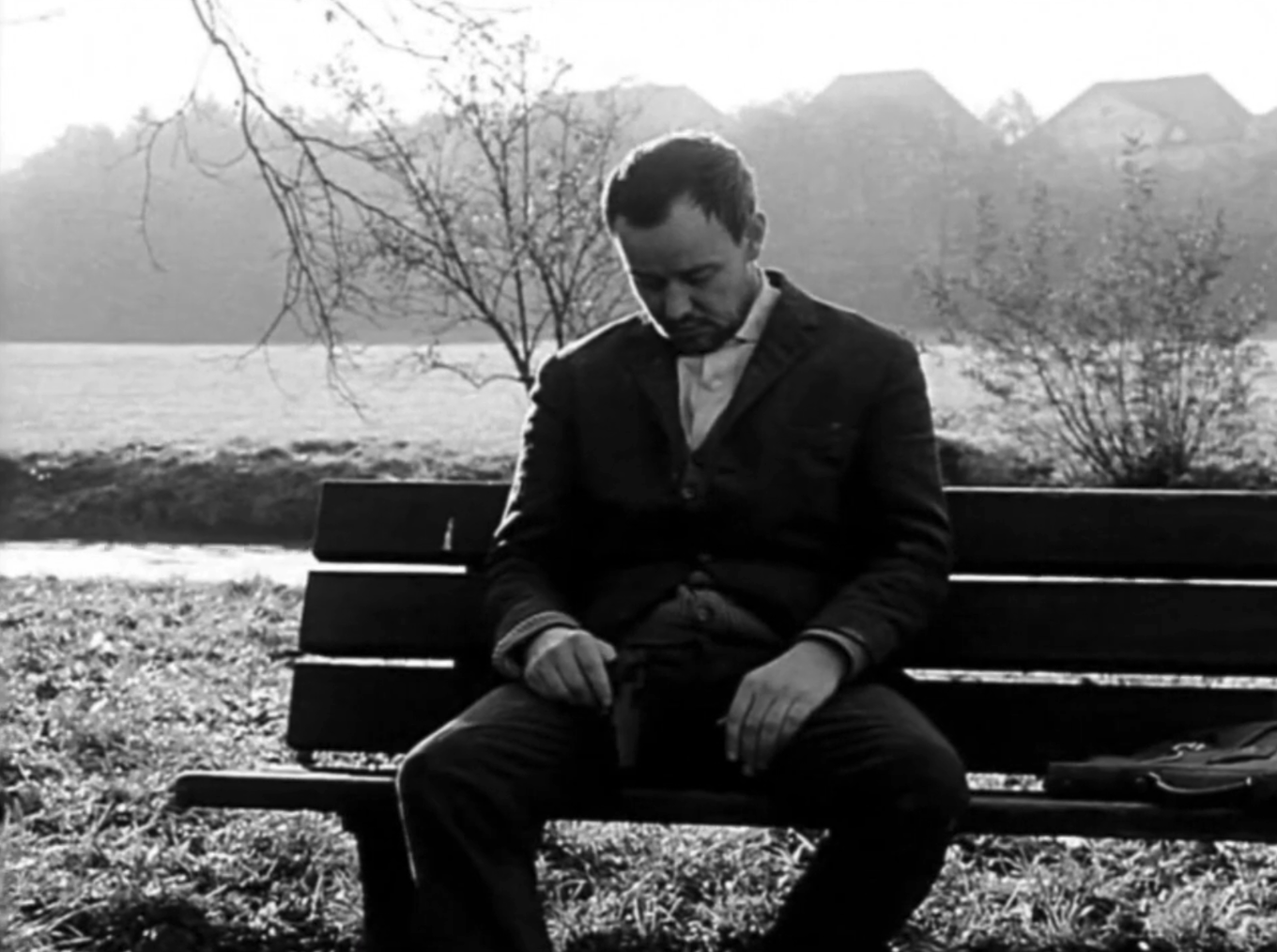
The first film, A City Tramp, I initially found a little more interesting because of its question marks. A man finds a gun at the Schinderbrucke (Tailor's Bridge). While he eats at an outside table in a large park, a server passes by and, however at a distance, appears to notice the gun that the tramp has placed on the table, which he then thinks to cover. She nods to two men who stand waiting and appear to be already aware of the tramp. After he's done eating, the tramp tosses away the gun but the server retrieves it and chases him down to return it to him, during which he briefly believes he's being held up. In possession of the gun again, he envisions himself a suicide, he also envisions himself as a crucified Christ with the gun in his hand. He goes to the apartment of a woman (Irm Hermann's debut) he doesn't appear to know and asks to commit suicide in her bathroom. She says, "Sweet", leaves him at the door a moment, during which time he is very Brecht and sings a song to the camera about how things in Japan are small and in Europe they are big, then when she returns she hands him an object I can't identify and he leaves. When he appears to want to attempt suicide in a public loo, he is interrupted by Rainer and others and rushes out. He is seated on a park bench, dozing, the gun in his hand, when the two men to whom the server had complicitly nodded (one of whom had interrupted him in the loo) grab the gun from him, toss it back and forth over his head, then run off. The gun he had picked up, then tried to throw away but had been returned to him, he is now desperate to keep, but it has been taken by the men. The tramp lies on the ground and trains his finger on the men who took the gun from him and fires his pretend finger gun at them. The gun, which he'd intended to use for suicide, having been taken from him, becomes in its absence a weapon he imagines using against others.
I ponder on how with a twenty-one-year-old I shouldn't pay too much attention to certain question marks—such as who are these men and this woman—as a twenty-one-year-old with big ideas is likely not to have yet realized what risks becoming unintentional chaos, how to fine-tune by expanding upon what is essential so it has more body, or omitting what can't be clarified as it actually remains ambiguous in the director's brain and thus gets in the way. Fassbinder obviously wants us to think about who these people are, but ultimately I'm not sure it's important as we already have the end message. As twenty-one-year-old Fassbinder put the question mark there it merits consideration, but it doesn't feel like they'll be that rewarding a return on investment.
I read that Fassbinder said he was influenced by Rohmer's Le Signe du Lion with the above film, and I've watched a fair amount of Rohmer but don't know that film and can't find it online, so I can't comment on this. It may be that had I watched that film I'd have essential information that helps out with the question marks, I don't know.
It could be Fassbinder didn't care if the question marks had an answer, he just liked the feel of the question marks.
The James Cagney as punk impact on Fassbinder slides on screen with both films through Fassbinder's posturing swagger, which comes with commentary in A Little Chaos.
In A Little Chaos, Fassbinder, another man (Chris Roser), and a woman (Marite Greiselis) attempt to get money by selling magazine subscriptions, which appears to have been as much a scam in the 1960s as in later decades. Unable to sell anything, they retreat to an apartment, where Fassbinder reads from a book, Die Junge Madchen, by Henry de Montherlant. The passage is a woman's remarks on how with love comes pain, and that everything that hurts her is for her own good.
Motherlant is a writer with whom I'm unfamiliar. Wikipedia states, "He wrote in admiring tones of the victorious Germans, seeing in them members of a manly, stronger race", which seems problematic, especially when one considers that subsequent WWII, though he escaped the severe punishments of other French pro-German writers, he was prohibited from publishing anything for a year. This merits the question, how much of a Nazi was he? Well, he was enough pro-Nazi to right for the pro-Nazi Paris weekly La Gerbe.
Die Junge Madchen was anti-feminist and misogynistic.
Simone de Beauvoir wrote of him in The Second Sex, "It was a harsh symbol that a man could not walk straight because the woman he loved was on his arm," which attracts my attention as in Fassbinder's 1969 Katzelmacher, when Elizabeth (Irm Hermann) walks down the street with her boarder-lover, Peter, her arm in his, she asks him, "Can't you hold your arm straight?" He says he's shorter than her, to which she replies, "That has nothing to do with it", and he takes his hand out of his jacket pocket and folds his arm into a corner into which her hand is clasped. To my eye, his arm is straighter when his hand is in his pocket, so either there's a problem in the translation getting the point across, or we need only to look at the vertical portion of the lower arm, when horizontal, as being straight. But women friends walk down the same street in the same manner, with one woman's hand in the crook of the other's arm.
The New York Times obituary of Motherlant states of Les Jeunes Filles", that the tetralogy was "a savage indictment of women, to whom he ascribed all grave ills of the modern Occident: irrealism, the cult of pain, wanting to please, gregariousness, sentimentality..."
And, "Under German occupation, in a book comparing the two world wars, he welcomed the advent of the swastika as her alding a new era of grandeur". He extoled the manly virtues of war.
This tells us a good bit about Motherlant, and society's perceptions of women as his The Young Girls series sold millions and was translated into thirteen languages.
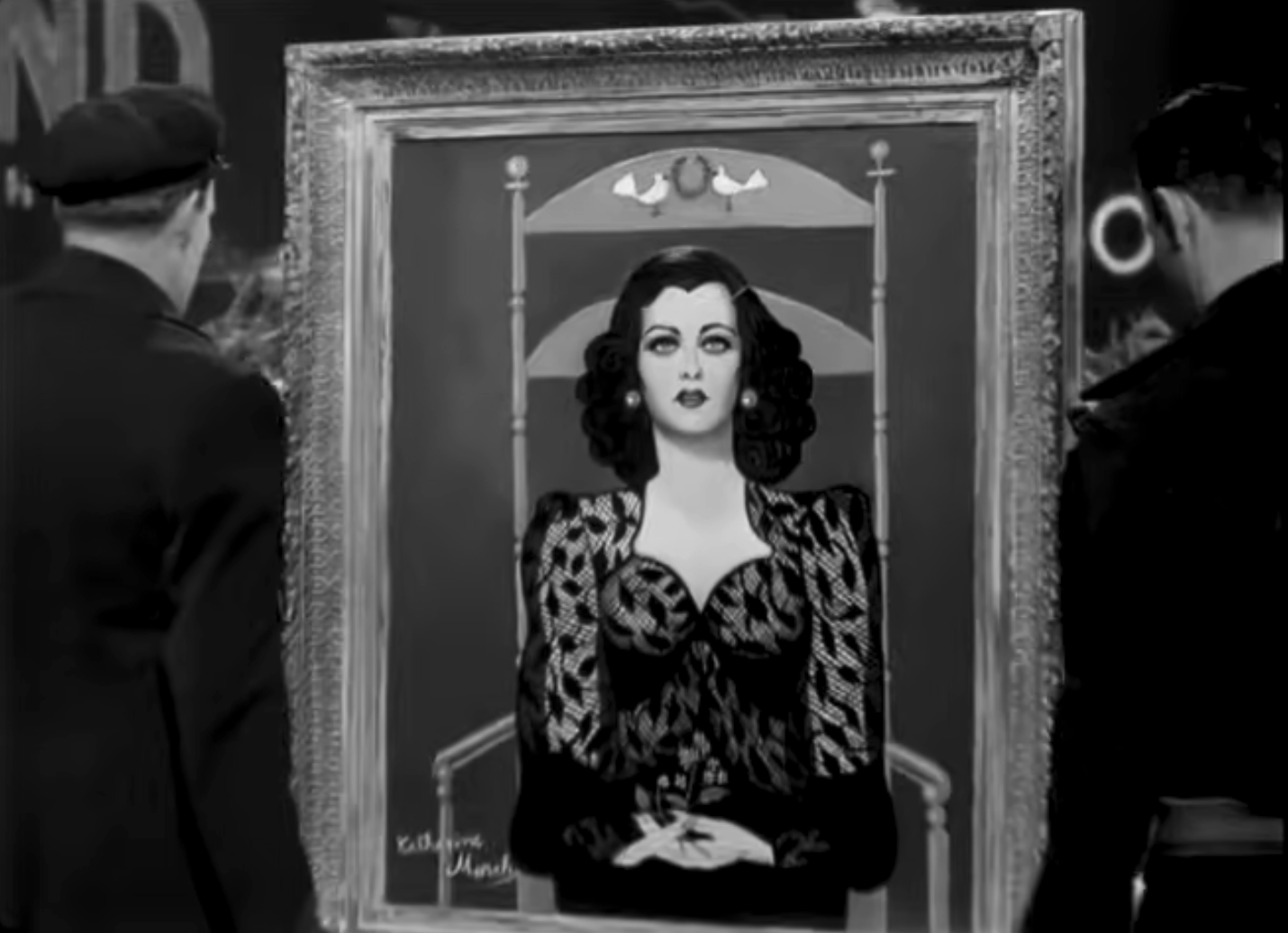
Speaking of Rohmer's Le Signe du Lion, Roser sits before a German poster for the film (Im Zeichen des Lowen), and on it is pinned a still from Fassbinder's immediately previous film, The City Tramp, of Roser sitting on a bench with the gun, immediately before the gun is taken from him by the two men.
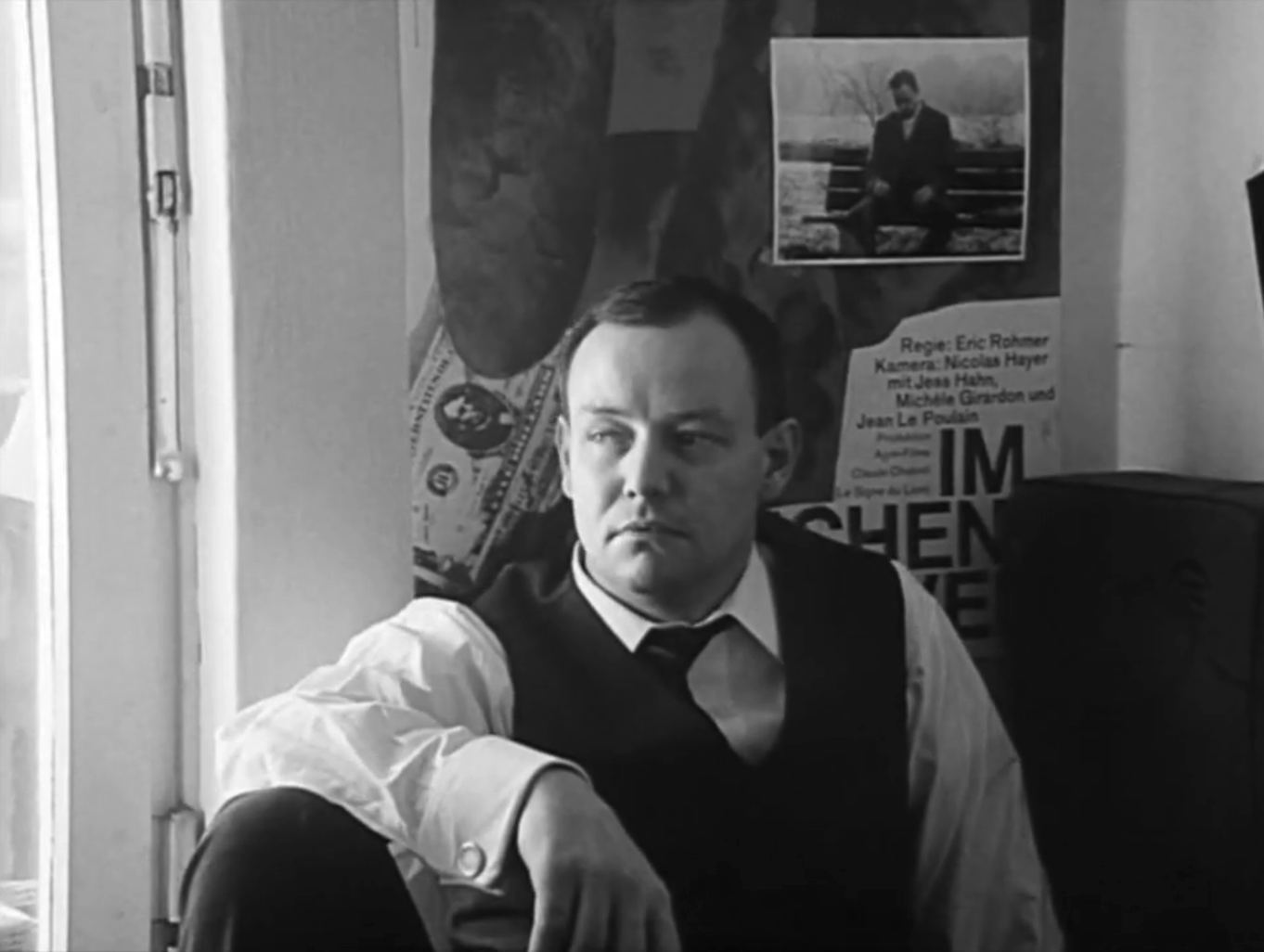
All right, we already know that Fassbinder was a tyrant to some, while others said he was only tender with them (those with whom he wasn't sexually involved in some way seem to have enjoyed a less complex relationship). We know he was emotionally abusive with Irm, and at least once physically abusive of her. Not excusing those abuses, we know from the interviews of people with whom he worked that even those who described him as tyrannical felt that their most creative years were with him, that he launched careers giving actors great roles, and his actors would eventually leave him, too, as they became tired of his demands that a role be played a certain way. We know he had a mostly-bourgeoise emotionally-distant upbringing in which his divorced parents left him at times to vulnerably fend for himself, and eventually he was sent to boarding school. His films frequently shine a light on the drama (melodrama) of toxic relationships.
Of interest to me is he does this reading from Motherlant under a photo of a man carrying an American Flag behind a man standing at a lectern upon which is a swastika, below which is taped "von Raoul Walsh".
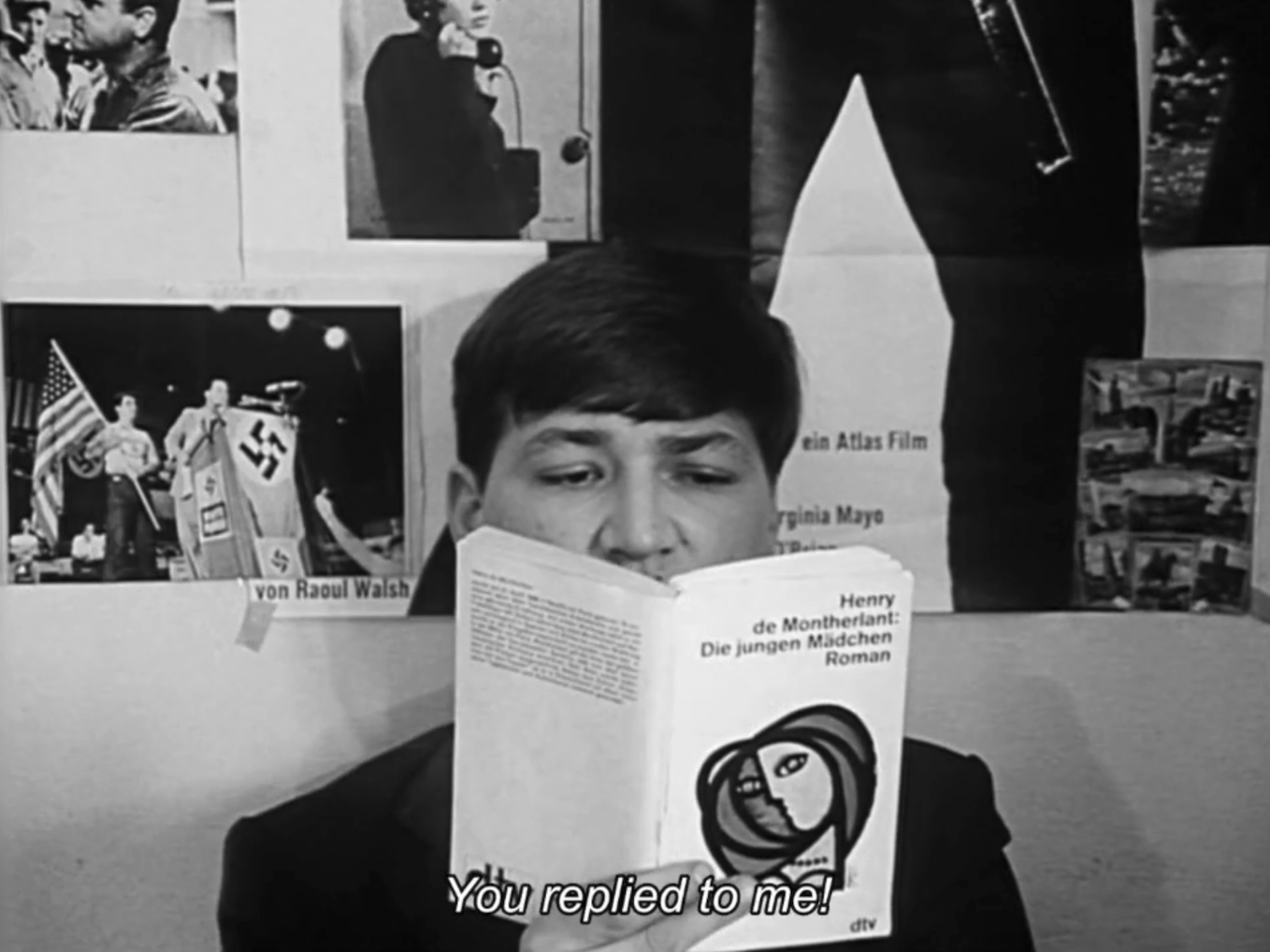
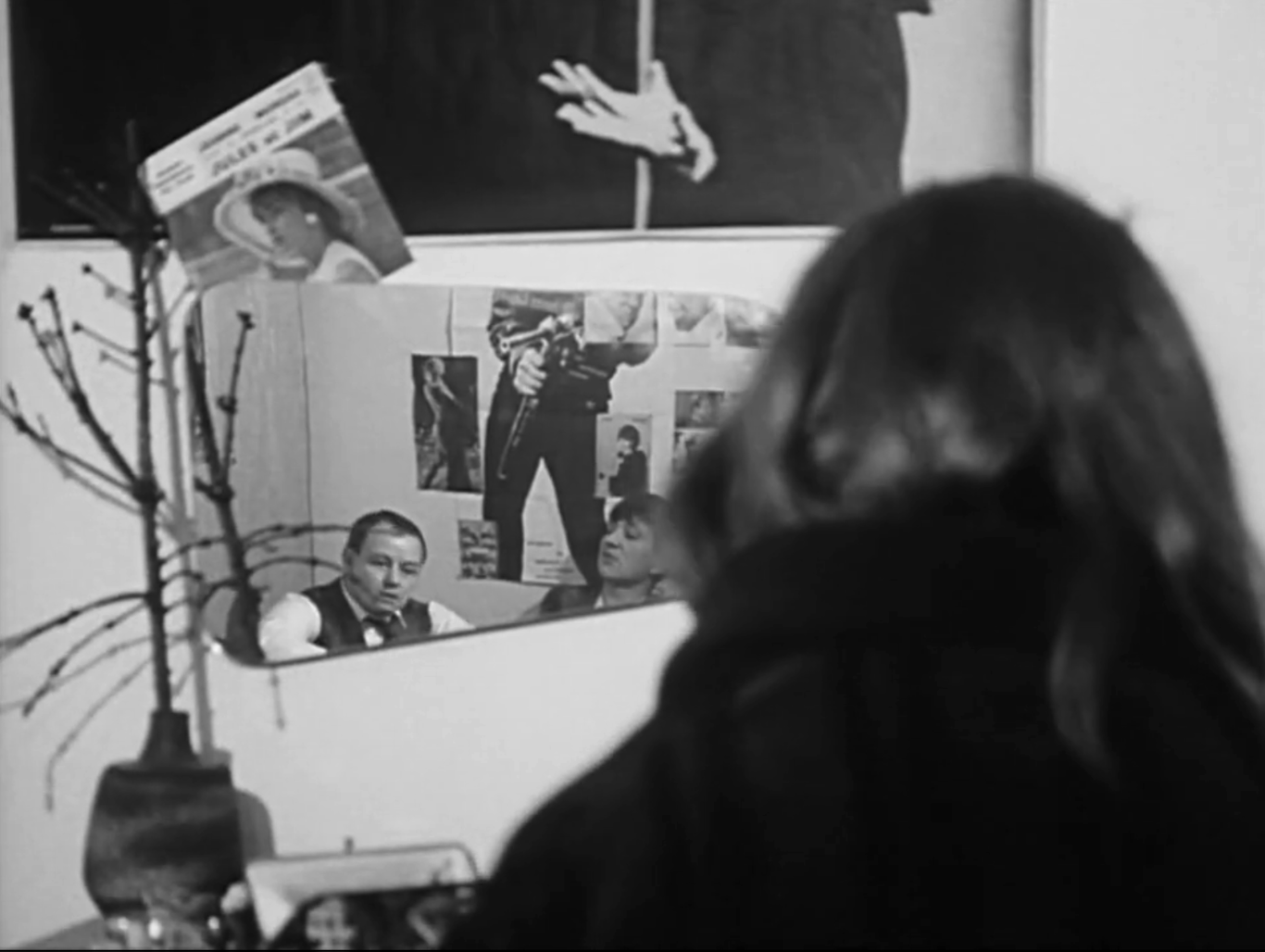
Raoul Walsh directed several Cagney films. The image to which his name is attached is from a 1966 rally of the American Nazi Party in Chicago, the founder George Lincoln Rockwell at the lectern. Though "von Raoul Walsh" is taped under the American Nazi Party image, alongside it is a German poster for Walsh's White Heat. The pairing of the two images here needs to be considered in respect of not only the reading of Motherlant, but the plot of White Heat, in which a psychotic criminal, played by Cagney, pushed by his mother to attain "the top of the world", at film's end, entirely alone, having killed the last member of his gang, cornered by the police, climbs to the top of a Horton sphere, and when shot he commits suicide by firing into the Horton sphere, exclaiming, "Made it, ma! Top of the world!" The tank explodes. I must seem negligent, but I'd never seen White Heat before, and immediately watched it because of this reference. The end must have been stunning on the big screen, one explosion after another consuming it.
Fassbinder's character in A Little Chaos is cinema obsessed, just as Fassbinder was enraptured by cinema as a youth. When the woman of his gang of three is kissed by Roser, Fassbinder grabs her away and aggressively demonstrates a proper kiss, saying, "That's how it's done," to which Roser dismissively objects, "In Hollywood," and Fassbinder says, "So what!" He pretends to pull out a gun, adding he'd like to see one Hollywood gangster film that ends well, which has all to do with the Hays Code, that morality had to always have the upper hand which meant the bad guys could never win.
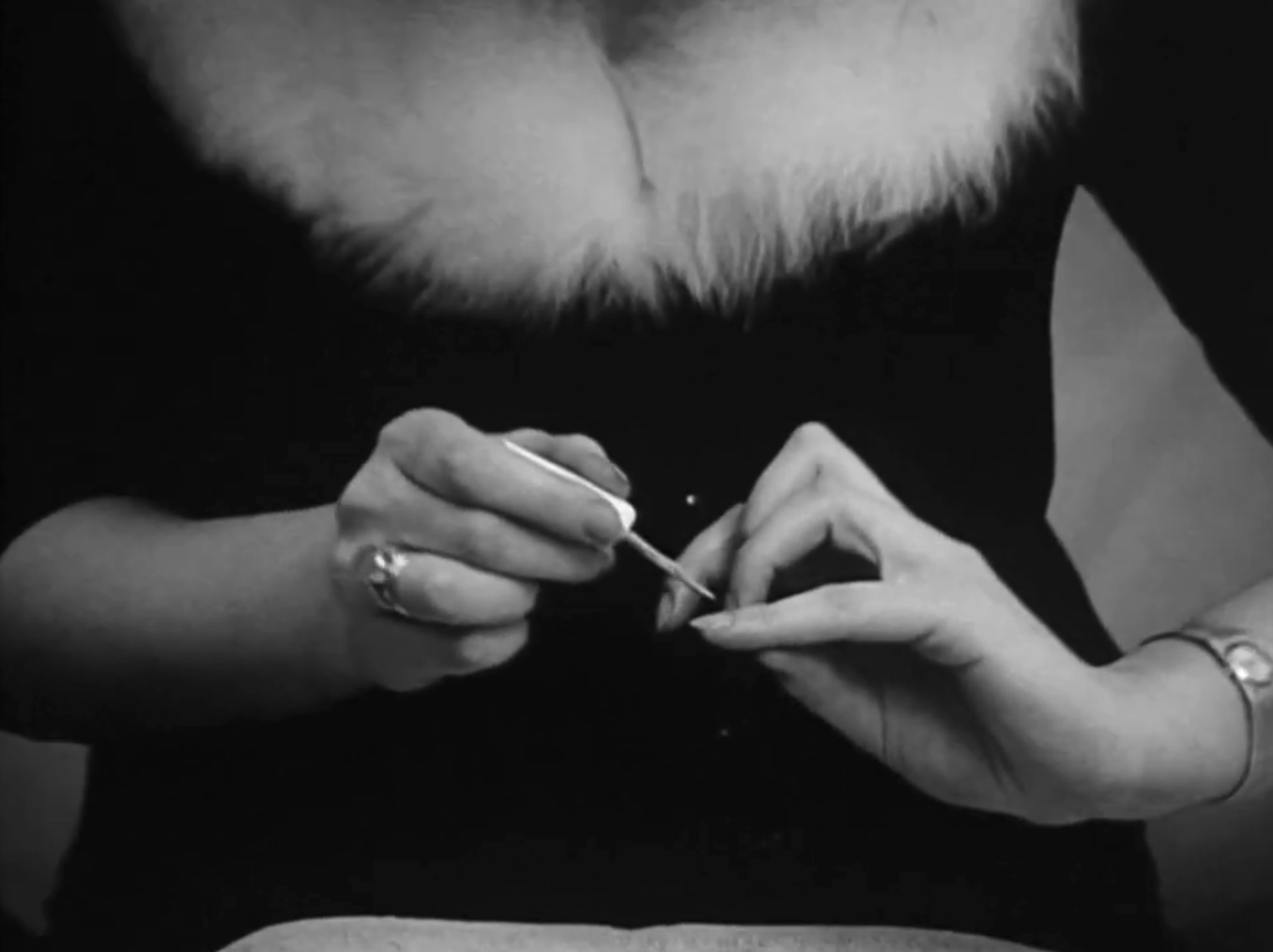
Cut from Fassbinder wishing he could see one Hollywood gangster film that ends well to a close-up of a woman painting her fingernails, and zoom out. She wears a houserobe with a white ruff.
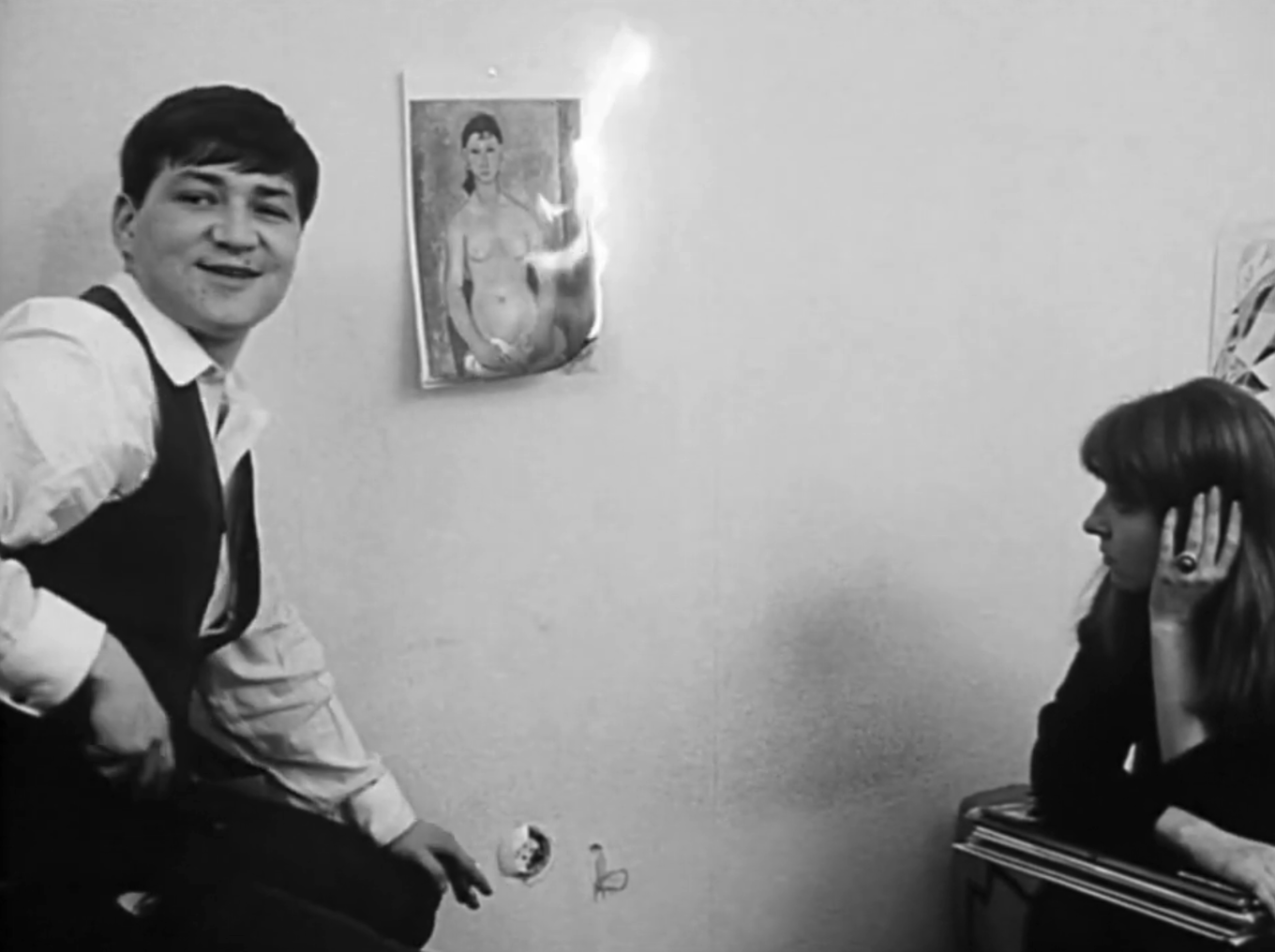
During the ensuing robbery of the middle-aged woman, Rainer insists that Wagner be played, and orders the victim to stand up and down, up and down, there being no point but to further exert power over her. He then sets fire to a print of Modgliani's "Elvira, Standing Nude" that is taped to the wall.
Kubrick featured this painting twice in his films, both in Lolita and Eyes Wide Shut.
Let's take a look at these dates. When was Lolita released? 1962. And I wonder if Fassbinder, in 1966, lifted the use of the image from Lolita. I don't just wonder, I know for certain that he does as in Lolita the image appears on a bedroom wall during the scene in which Humbert paints Lolita's toenails, and Fassbinder has opened this scene with the woman-to-be-robbed seated painting her fingernails in close-up. There's a knock on the door, she leaves painting her fingernails to answer it, Fassbinder pulls out a gun and the three invade her apartment. Fassbinder demands that music be played and decides it should be Wagner. Thiis is when we first glimp the "Elvira" painting in the room. We only see the lower portion.
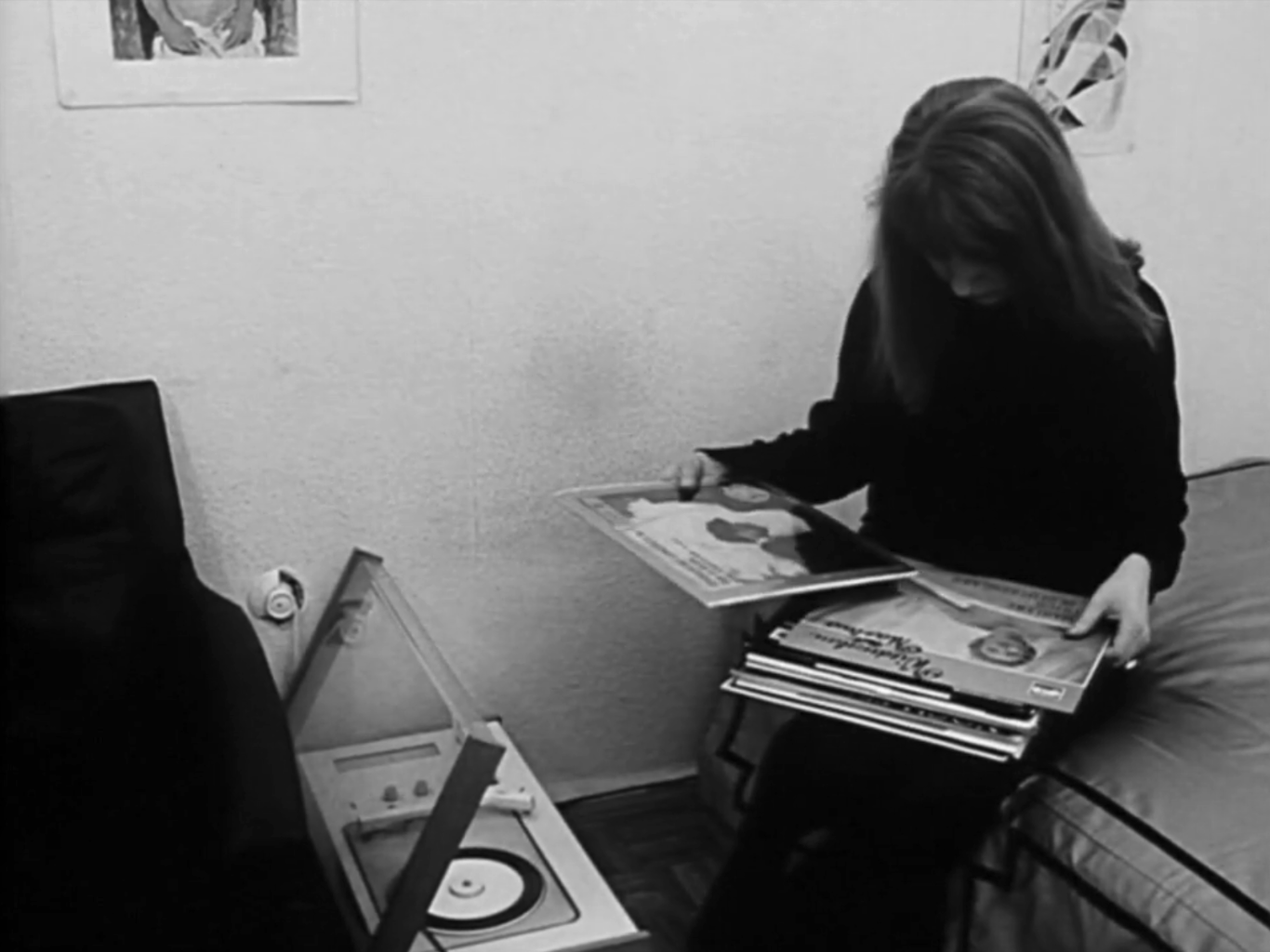
Compare with the only glimpse of the Elvira painting we have in Kubrick's Lolita.
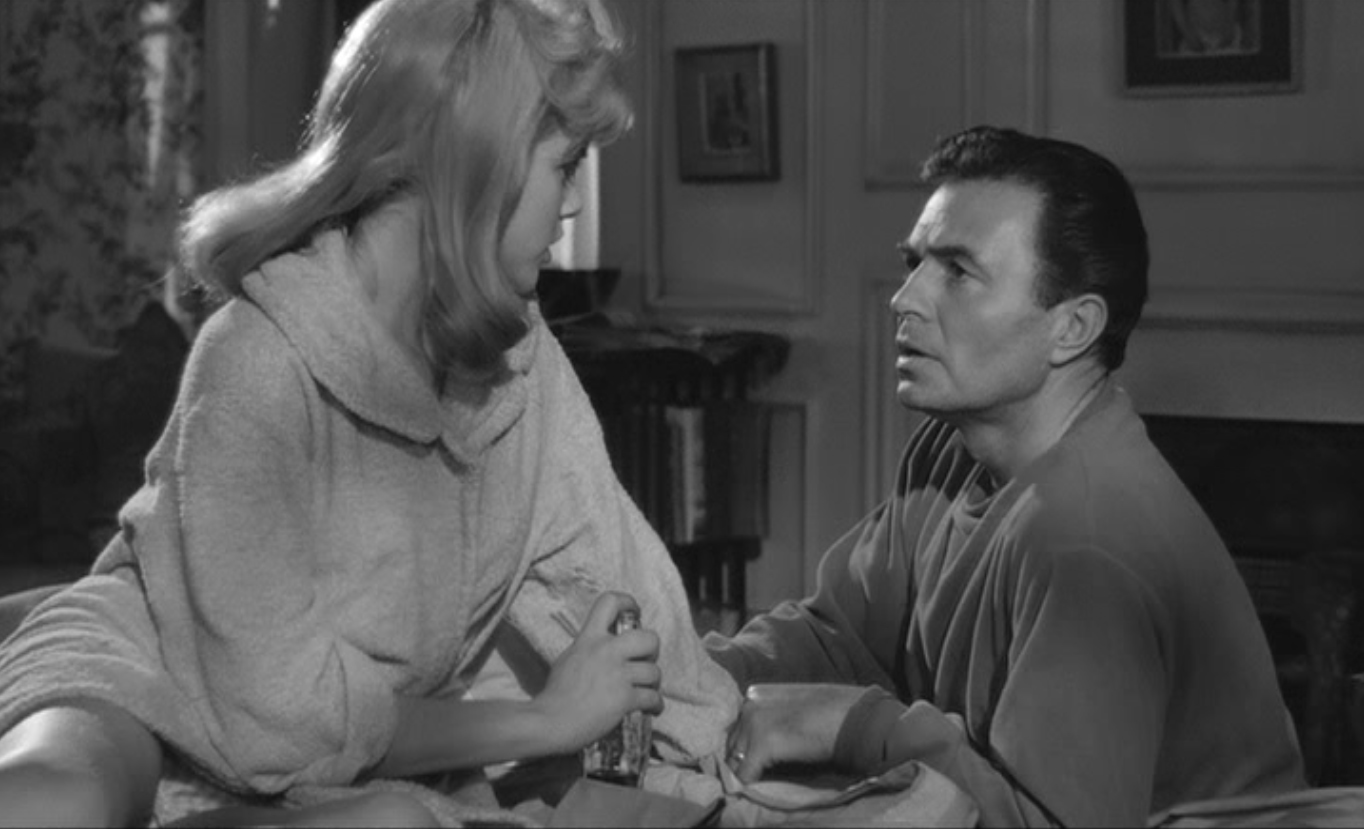
She's there, but you can barely see her. If you know "Elvira" then you'll immediately recognize her, though we only see the lower half of her, her hands on her lap. Yes, I know she's supposed to be standing but I've always viewed her as sitting with the way her hands are positioned holding the white drape over her pelvic area with no hint of tension, as if it's settled on her lap, and behind her is a dark object that gives the impression of a chair. Yes, she's standing, but I think even Kubrick read her as sitting, which I'll show later.
You know where I'm going with this. How did this scene in Lolita begin, in which we see "Elvira"? With Humbert painting Lo's toenails.
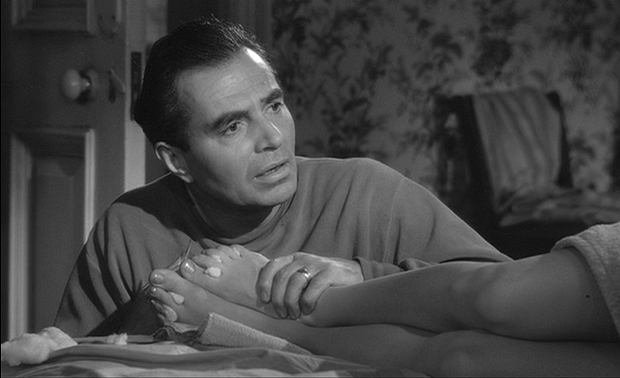
And how did this scene with "Elvira" begin in Fassbinder's film?
With the woman-to-be-robbed painting her fingernails.
Throughout the scene, a piano concerto with orchestra plays, and I knew, "Hey, what's this about, that's not Wagner!" No, it's not. Instead, it's Beethoven's Piano Concerto Number 5 in E Flat Major, opus 73, as performed by Rubenstein. It came to be called the "The Emperor Concerto", though it wasn't written for an emperor, it was composed for Beethoven's student and benefactor, the Archduke Rudolf. Beethoven had dedicated his third symphony to Napoleon, but then Napoleon declared himself emperor in 1804 and Beethoven removed the dedication. He composed this concerto while Napoleon was assailing Vienna. Beethoven wrote to his publisher that "nothing but drums, cannons, men, misery of all sorts" surrounded him.
"Do you love the fuhrer?" Fassbinder asks the woman with the fresh nail polish after the not-Wagner has been put on to play. Roser apologizes for him, saying he sometimes gets carried away.
I believe Kubrick's fingernail-painting scene was referencing Fritz Lang's Scarlet Street, which I've already written about in my analysis on the film. In Scarlet Street, a man (Edward G. Robinson) paints pictures at the apartment of his lover (Joan Bennett), his wife not permitting it in their home. His lover, who has another lover, secretly sells the paintings to make some money. When they are critiqued as the work of a great genius, she takes credit. The artist doesn't mind this, though the woman is getting recognition he deserves. He wants to paint a portrait of her and the woman finally agrees to this, saying, "Paint me," and hands him the nail polish so he may paint her toenails.
Fassbinder's fingernail-painting woman wears a robe with a white ruff. The woman in Scarlett Street wears, during her toenail painting scene, a negligee robe with a white fur or feathered ruff at the neck, which also decorates the hem of the negligee and the sleeves.
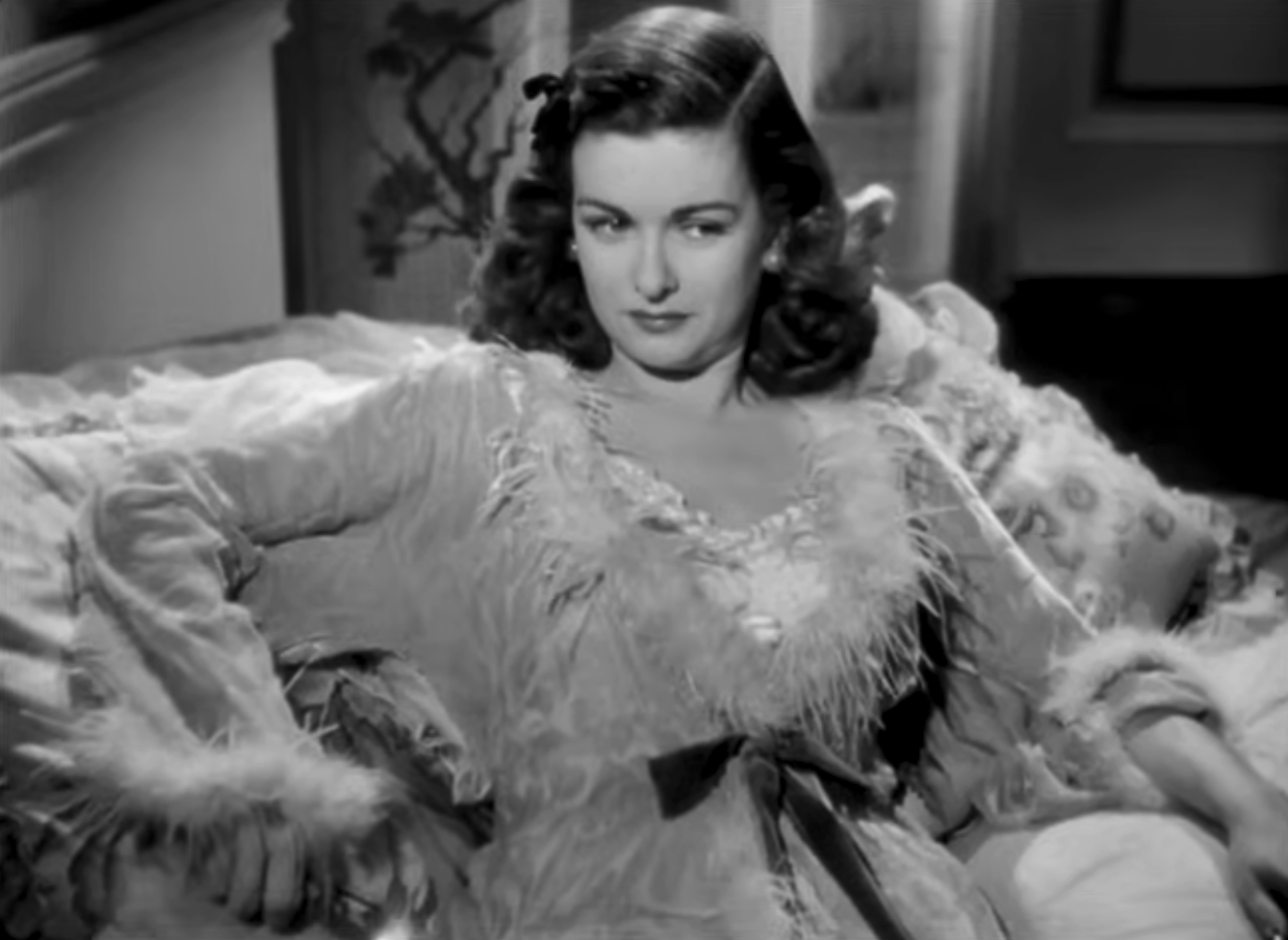
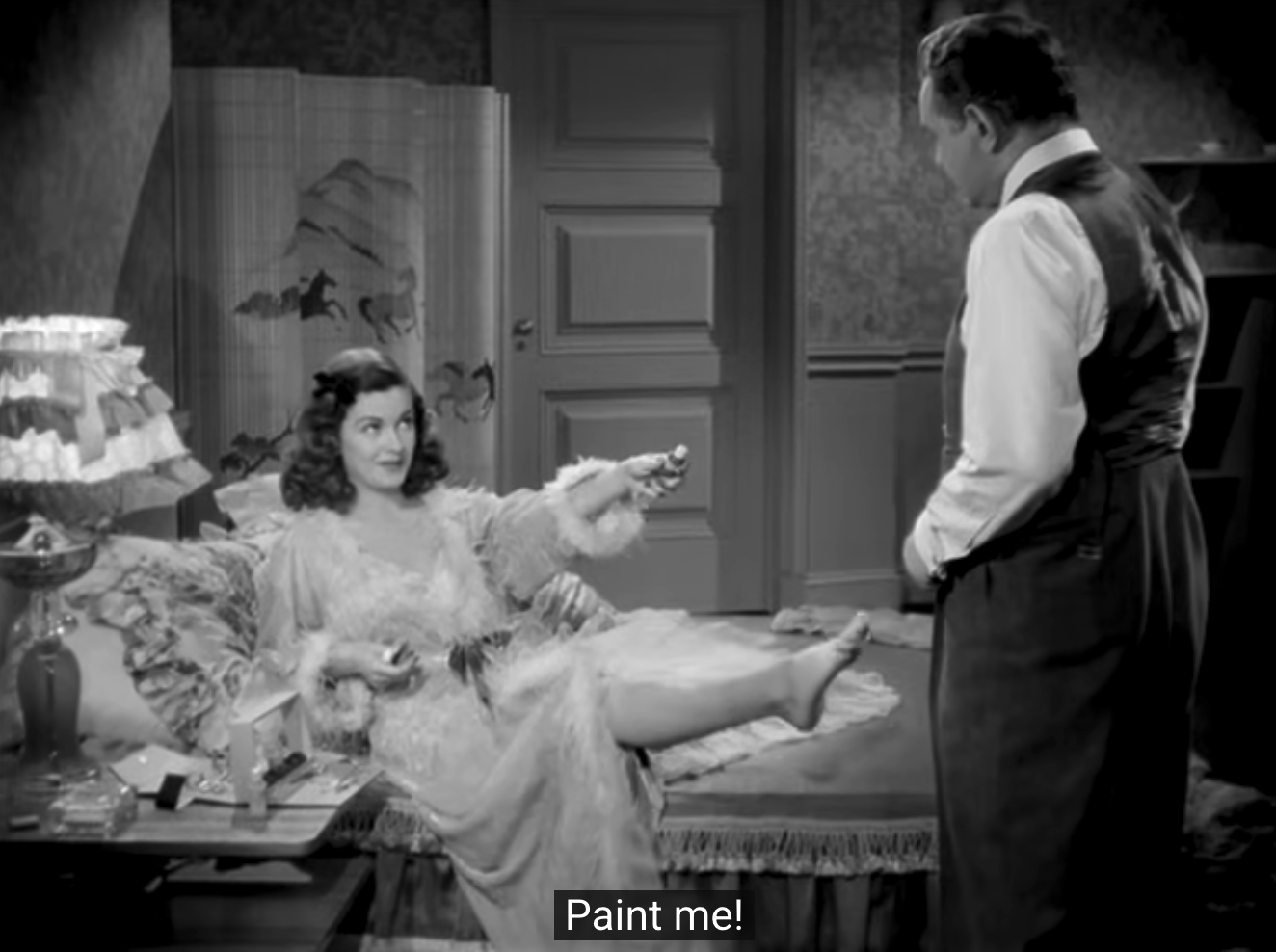
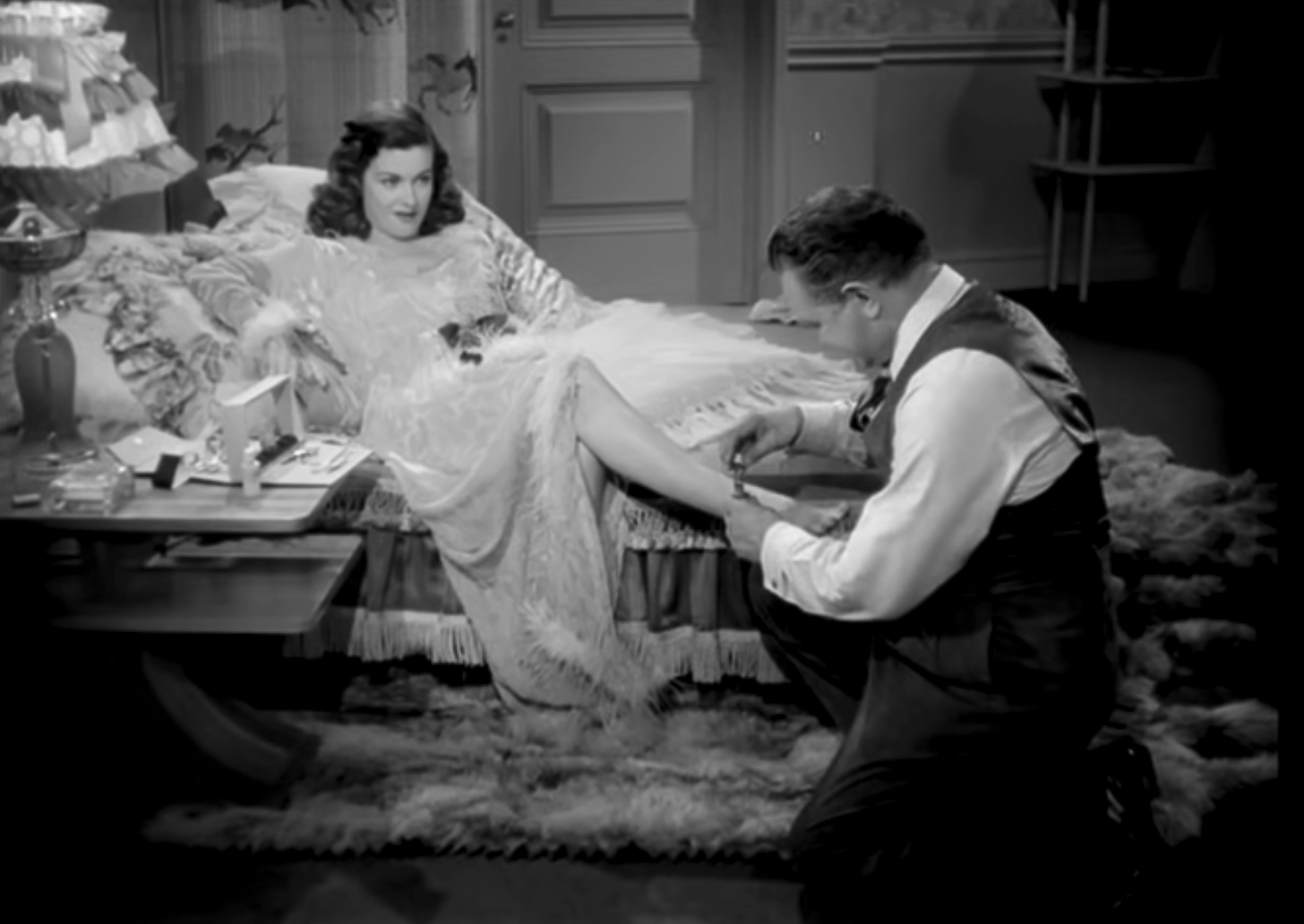
The artist, who has painted her toenails with great tenderness, when he learns she doesn't love him, that she has a lover, murders her and frames the boyfriend, who is executed. And as the Hays Code wouldn't have it any other way, the artist, unable to tolerate the guilt of it all, commits suicide.
Oh, wait, the artist commits suicide, but it doesn't take. He hangs himself but is saved before dying. What has happened to honoring the Hays code? At the film's end, he is found living a life of penury, haunted by the accusatory voices of the woman he killed, the man who was executed in his place, who flaunt also that his murders have placed them together forever in the afterlife. He passes by a gallery from which is brought out for delivery a painting of his lover, a "self-portrait" of the supposed genius artist, that has been sold for a fabulous price. And he can never reveal he was the true artist.
Never mind all that about Scarlet Street? What is significant is that Fassbinder, at twenty-one, borrowed from and was remarking on Kubrick's "Lolita" in this film, his punk character setting the Modigliani print on fire (with some anxiety I watched it quickly turn to cinders, apparently not harming the wall, but I hope someone was standing nearby with a fire extinguisher).
Top of the world, ma! Top of the world.
After the burning of the painting of Elvira, Fassbinder looks for what's good for loot, checking the desk which the woman had initially hovered over protectively. In it he finds a lockbox. How to open it?
First, the victim had signed to us where her loot was hiding by protectively hovering over her desk immediately after her home was invaded and repeatedly looking at it in a panic. Of course this was where her loot would be. Now, how to open the lock box that was found in a bottom drawer? With the key. Which the woman wears around her neck. To which her hand goes. All signage.
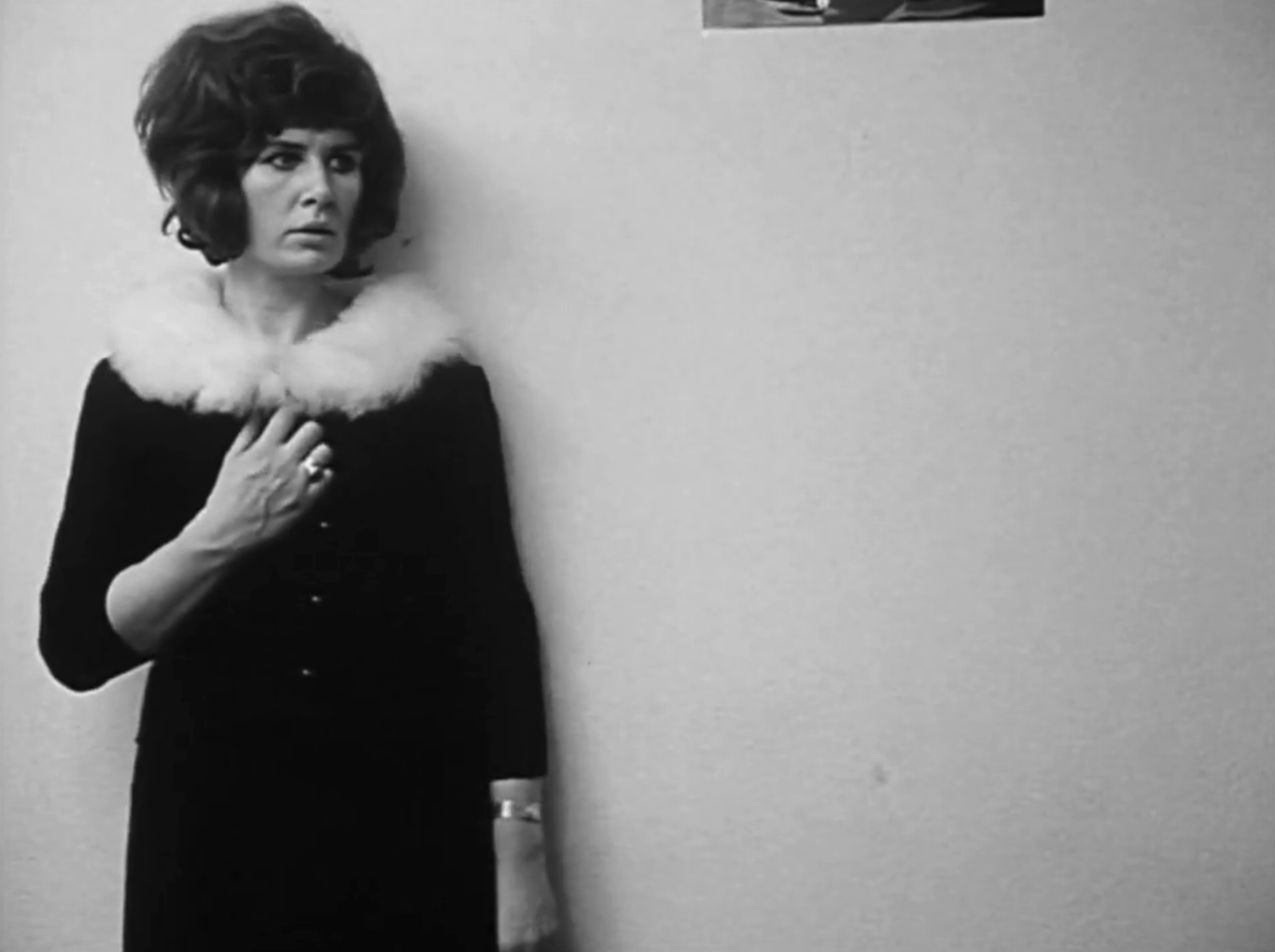
Fassbinder takes the key from her and empties the lockbox. He asks his female accomplice what she'll do with her share, she says she'll get a dress, make-up. Roser says he'll get a teddy bear for his boy. Fassbinder says he's going to the movies.Great joy. The three frolic as they run from the building to their Volkswagen. As Fassbinder had wished, a gangster film has a not unhappy ending, except for the woman who has been robbed.
In the toenail painting scene, Lolita had complained that Humbert kept her locked up in the house when he wouldn't let her take a role in a play. Who unlocked her?
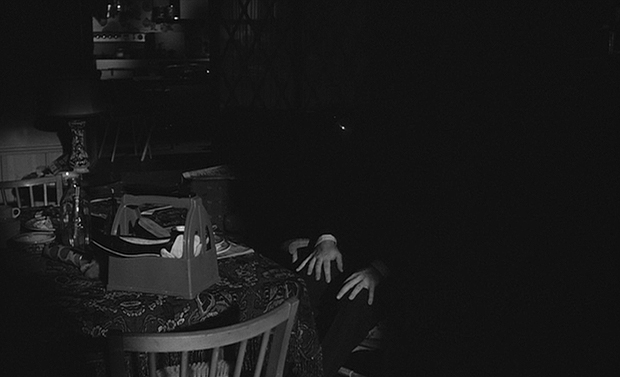
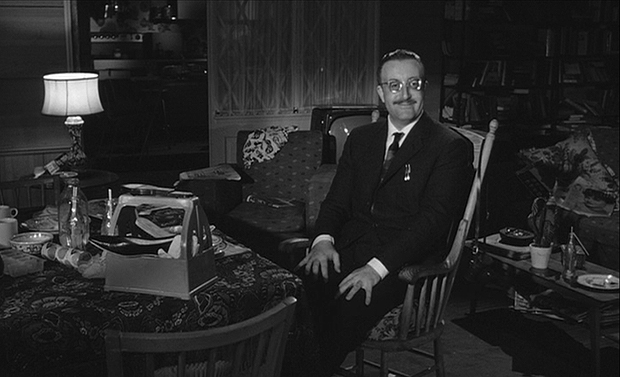
Look at those hands. The next scene begins with Humbert going home to find Dr. Zemph waiting for him in his study, who makes allusions to Humbert's relationship with Lolita not being healthy, and so they come to an agreement that Lolita will participate in the play in order to keep others from snooping into their lives.
Quilty performing as Dr. Zemph.
From there we get into gender-bending, the individual as male and female, which Fassbinder pursued for himself and his friends by giving them all names typically thought of as for females. As I note in my commentary, The Painting of the Toenails, Scarlet Street, The Woman in the Window, La Chienne, Modigliani's Elvira, Vivian Darkbloom, and the Confusion Between the Muse and the Artist:
Vivian Darkbloom is mentioned by Lolita in the toe-nail painting scene, and though we see her several times in the film I believe this is the only time her name is revealed. She is given as an author of the play being presented, along with Quilty. Her name is an anagram for Vladamir Nabokov, so we have the author's feminization of himself, which fits with the young muse, in "Scarlet Street" and "La Chienne"", taking on the artist's identity, becoming his public face...Kubrick, with Humbert painting Lolita's toenails, makes him the painter of her portrait, of her, but Humbert is also doing his own self-portrait in how he paints and represents the girl. We know this in the book, but it was another thing to communicate it in the movie. Lolita can't even properly see herself.
Lolita begins with presumably Humbert's hands painting Lo's toenails while a dramatic piano concerto plays in the background. The first scene ends with him shooting Quilty through the portait of a young woman who represents both Lolita and Humbert. And here we have Humbert painting Lo's toenails, the viewing of half the portrait of Elvira, her hands, then moving to the light shining on Quilty's hands. A continual morphing, just as Quilty morphed in his assuming of many different characters, but it all boils down to Humbert, through his writing of Lolita, painting his own self-portrait.
Imagine, these are the two films, , A City Tramp (Der Stadtstreicher) and A Little Chaos (Das Kleine Chaos), Fassbinder made after his rejection by the German Film and Television Academy in Berlin, both financed by a lover who aspired to be an actor and appeared in them. Chris Roser.
I was not expecting a Kubrick reference in a film made by Fassbinder when he was twenty-one. As far as I'm aware, only a part of the painting of "Elvira" is ever observed in that scene in Lolita, the lower half, of the woman's hands settled in her lap, but if you know that painting you immediately recognize it is Modigliani's. Fassbinder, using this painting, only half shown, in the background, attention never called to it but for the camera observing it, was, at twenty-one, demonstrating to Kubrick how he paid attention, how he caught "Elvira" in the background. He paid attention to detail and he understand these details as vital to the film, as being commentary. Just as he also supplies commentary on A Little Chaos and The City Tramp through background details.
Posted May 2026.
Go to Table of Contents of the analysis (with supplemental posts)
Link to the main TOC page for all the analyses