The Art - Photography
Quitting Photography
When I stopped doing analogue photography completely at twenty-one. I had hit three walls. One was economic. The price of silver had gone up so dramatically that it made photography too expensive for me. The second one was health. The darkroom chemicals had always aggravated my asthma but now became impossible, and I wasn't going to send out my film for others to process and print, that took away the artistic point of doing black-and-white photography.
The third wall was the below neighborhood and this little girl and the incident I photographed involving the two older girls.
We briefly moved into a low-income neighborhood in Covington while transitioning to Atlanta. It felt like a mill neighborhood and was located in proximity of a Mill Street but there was no mill close by, which was confusing, and I wasn't there long enough to figure out the perplexities that made this an area where historically-low class, industrially-employed whites had settled, which the prosperity of post-WWII had completely bypassed, not far removed from a better class of housing in some directions and a pocket of what seemed historically-black housing just down the street, and the boundaries so cemented that souls didn't traverse from their small neighborhood into the other climates not even if it meant an easier way from point A to point B, which it didn't, as we were also weirdly located next to a weed-eaten veritable green area, which I reasoned was where had been perhaps some industrial operation that had been removed, but I didn't know this for certain and it seemed if this had been the case it would be more obvious than not (I now find the expansive grounds were the site of a nineteenth-century boys academy that in the late 1800s had joined with a woman's academy and then left to ruin). The feeling was this was a dead-end neighborhood though located not far from downtown. The house we'd rented with another band member and his partner had no heat but we were still in the realm of summer-moving-into-fall so that was all right, we reasoned another option would soon present itself, this was a temporary measure before the temperatures dropped.
We had lived in shit places before, but they were a different kind of shit place. The photos below make the houses not look that bad from the outside, but when you went inside the walls weren't painted, they were papered with newsprint made greasy with a couple of post-war generations of people and grease. The poverty was baked in so no one could escape. These several blocks as a functional prison was visceral. I was so put off by the hard crystallization of no-exit lower-class whites and their black neighbors from what was even lower-class wealth that I never bothered to check out the supposed picturesque town square that was less than a mile's walk away.
I go searching for the house on Google. Revitalized as a "historic district", the house and surrounding ones, built around 1910, are now sold as renovated craftsman bungalows, though while they were ancient there was nothing that compared them to what people typically think of as craftsman bungalows. The grip of the same owners that had them when we were there can be felt in those who renovated them to sell now for near half-a-million dollars but other than new sheet rock walls little has been done to gentrify the two-beds with single bath interiors, which have shitty cheap-as-can-be-had plastic bath furnishings, nothing matching, kitchens that look like they were, however recently, updated with a few pieces of cabinetry to keep pace with the 1970s, a stainless sink, ugly marbleized counters in brown, and linoleum flooring that is as low-rent as the other updates. This area is still all about how much the old-town family landholders can grift.
We were two couples forming a "band house", with musicians coming and going, and we had no money but to these people we looked like we did. Dogs and cats roamed the neighborhood that you knew hadn't likely had their shots. The adults were chronically drunk. The children were dirty and looked as if they were left to fend for themselves in the way that batches of kids fend for one another. The adults we could do without, but we loved the kids. They were all over us, especially this little blond girl and her older sister who was about nine. And the slightly pre-pubescent boys. We were a bit of excitement and they did their best to impress. They told us the story about how the house we'd moved into had stood empty for a while because of the murder that had taken place there and they pointed out the blood stains one could still make out on the hall wall through the bad paint job. They let us know it was a rough neighborhood (as if we didn't already know that) but they'd keep an eye out for us--and the neighborhood didn't give us a minute's trouble while we were there, though I was spooked by a rat skeleton that was hammered to a utility post out front of us. We had seen Santeria practices in Augusta but I didn't have a clue about a rat nailed to a telephone pole and whether it was just for decoration.
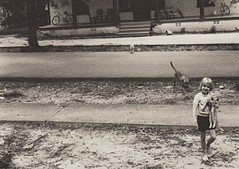
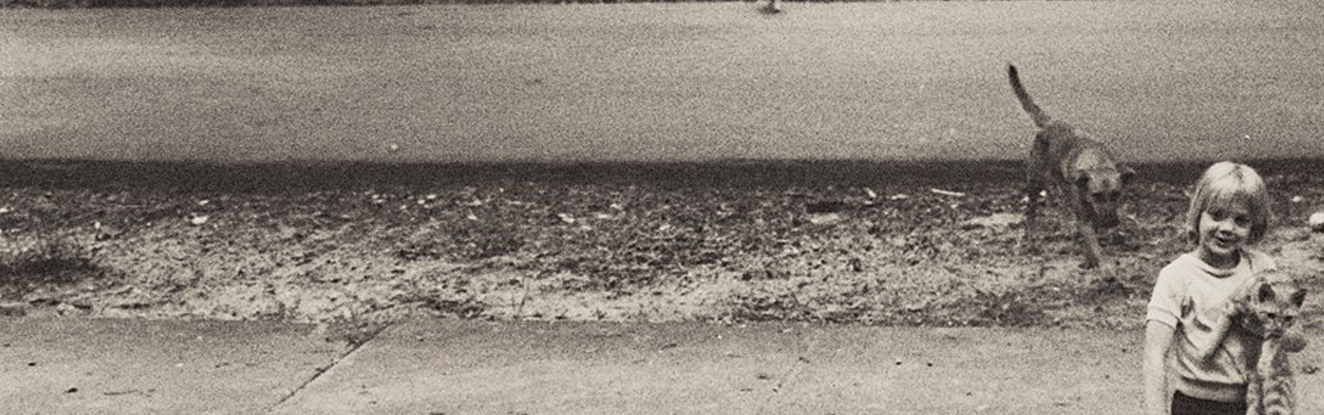
Aside from this photo of the girl with the cat, I did a close-up portrait of her with a filthy, beloved doll that was near as big as she was. Except for the occasional off-the-cuff portrait, I'd previously stayed away from taking photos of people. I didn't like intruding on people's lives. In a way, I didn't like stealing their souls to "use" as a subject. If I was doing journalism with a focused purpose, that would have been different, and I wasn't doing journalism. But here, in this neighborhood, there really was nothing to photograph except the people amidst their situation.
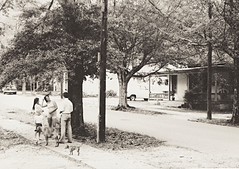
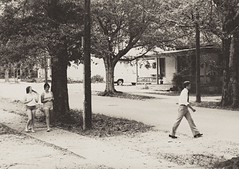
We lived there just long enough for me to have become familiar with the practice of a church in the area, its evangelizing, trying to attract people from the neighborhood, they'd send out a van with this young guy who I guess was one of the ministers, I believe he was a youth minister, I no longer remember. Real food in this neighborhood was too expensive to be regularly consumed. The adults lived on smokes and alcohol. The kids lived on candy. The youth minister would come out with candy and talk a bit to them, using candy to draw them in as a reward. Even with the young teens. In one of the photos he's seen talking with the girls.
I had decided I wanted to document this, how the church was building a dialogue with the girls in the neighborhood using sex. He flirted with them. They were ready and eager to flirt with him. In the photo, the girl with the short hair is grooming her hair in response to the attention he's giving them, and how he would speak with them, which I felt was too intimate. And he'd give them candy. The next photo shows the short-haired girl with the candy he'd given her, the other girl continuing to preen as he walks away. This youth minister had bad boundaries. It wasn't even so much that he had the power of the church behind him, though that was part of it, his being a youth minister gave him easy access. It was an economic imbalance. They had nothing. He was dressed up in his crisp pants and shirt and that tie. And he wore the stereotypical evangelical preacher "I'm cool" sunshades that he would play with while he spoke with them. I could see how this was prime territory to get messy.
When I took these, I was still used to looking around with an eye for taking photos, I was struggling against asthma and my allergies taking away photography. I don't remember if I didn't develop these prints on my own because there was no good situation in the house to set up my darkroom equipment, or if it was because of my reaction to the chemicals, but I sent them out to be printed. What you see here are photoshopped versions of bad commercial prints. But I also was still doing some printing because I used to have the large print I'd done of the little girl with her doll, which was just too depressing. With film as in moving pictures her inner spirit, which was bold and bright and still indomitable, would have been communicated. But a static print just caught the poverty it made her a subject who was impoverished and unkept, rather than a lively little girl. A static print was exploitative because it couldn't show all that I liked about her, how she was clever and talkative and funny and loved to hear stories.
That little blond girl and that situation of the church youth minister flirting with these adolescents and giving them candy was my wall. The cost of silver was practical, only emotional as far as disappointment. The asthma was physical and practical, and only emotional as far as disappointment. When I looked at the photos I'd taken of the little blond girl and the adolescent girls with the youth minister, I felt revulsion at what communicated as exploitative because of all that wasn't captured and couldn't be captured in a still photograph. I was disappointed in myself, even angry at myself for having made these photos that replaced the complexity of the human with the window dressing into which they'd been born. I've had non-artists fire at me, "A picture's worth a hundred words", and not only is it not that simple, the statement is often quite false. Photos showed the dirt and poverty, but they didn't capture whole people, photos separated them from their souls, or rather photography made their environment, their predicament so loud that their souls couldn't compete. This is a problem that I have with people judging others based purely on how they dress. For instance, if you'd let this little girl loose in a fancy store or a costume shop, and said, "Express yourself," then there would be a picture. She'd have a choice, and wouldn't it have been wonderful to see what her dream was. That was my aim with the photos I would eventually make with Aaron when he was little, as collaborative art, in which he dreamed up costumes and situations he wanted photographed and fine-tuned to complement the fantasy.
After this little blond girl, I didn't take up photography again until Aaron was five, twenty-four years later, and I had just gotten a fair-not-great digital camera (that with Photoshop meant not worrying about dark room chemicals any longer) and Aaron wanted me to take photos of him costuming himself, becoming a bird, a dragon, a robot.
So, you see, there's a reason I went from talking about how I stopped photography with this girl--because she wasn't able to express in a photo her spirit, we would always instead see the environment competing against her, which felt too close to exploitation to me, which made me soul-sick--to how it would have been different if she'd been instead given the means to express her inner dreams for the camera.
We were at the house a short period of time, mostly not living there. Then I was there for a week and the bats happened. But that's another story--how the house was suddenly filled with bats, how I barricaded myself and my cats in a front room. The landlord kept telling me they were chimney sweeps, and I told him to come look at the bats I'd killed and kept for the health department. He declined, still insisting they were chimney sweeps and I was upset over nothing. I realized the attic had been suddenly filled with them. As twilight fell, the bats flew out of the attic's vents, swooping away into the night to chase bugs. They were entering the house in part through an old stove pipe hole in the kitchen ceiling that went into the attic. I called the health department because I had collected about twelve bats I'd killed flying around me, that the neighborhood was filled with dogs and cats that were likely not inoculated, and I wanted the bats tested for rabies. They said they weren't interested in doing this. They insisted there was no reason to be concerned about bats carrying rabies. It was in the mid- to late'1970s and they didn't give a damn. Autumn was priming to descend, the house had no heat, the landlord wasn't going to supply heat, and we'd been planning to move anyway. So, we moved, but under duress I found another location in Atlanta immediately. The landlord said as we were breaking the lease we wouldn't get our deposit back. One of my cats went into hiding when we moved so I had to go back out at night and, the power already shut off, transferred, I had to enter that dark bat-infested house, the eerie sweep of batwings around my ears in the heavy blackness. It was a weird reverberation of air, all those wings. I only had to call "Paloma" once and she thankfully answered and came trotting out of the black to me, ready to leave.