
When I read that William A. Wellman's 1948 Yellow Sky was a western (very) loosely adapted from Shakespeare's The Tempest via a then-not-published novel by W. R. Burnett, of course that meant I was going to locate and watch this film of which I'd not previously heard. Though Wellman directed what I consider one of the best westerns I've ever seen, Westward, the Women, I'm largely unfamiliar with his work. It wasn't until after I'd viewed Yellow Sky that I would watch his well-known The Ox-Bow Incident, considered one of the first psychological westerns. As one of the earliest, Wikipedia puts it in the same breath as Howard Hughes' The Outlaw, and I sit here wondering at the behind-the-Wikipedia-scenes discussion that may have occurred due this pairing. "But AllMovies says they're both psychological westerns. It has them both on a list!" The only source I can find for these two movies being coupled together is literally AllMovies, and not even an article, I find it's just that they're both on AllMovies as psychological westerns. This has turned into, it seems, "historians agree that the earliest psychological westerns were...", and if I'm doubling down on this as a complaint then it's because of my inability to locate other things about Wellman that are considered major factoids but the sources given don't pan out.
In a way, Yellow Sky is so consistently anti the traditional western, in all its particulars--cinematography, editing, acting, plot--that after the initial surprise of, "Oh, this is really excellent on atmosphere so far", one can forget how different it is, for which reason I had to watch it several times in order to step back and better examine all those particulars, soak them in and resettle them as a whole. Which I did despite the fact I had some problems with pacing in the middle, as soon as we get into the boy-romances-girl-by-attacking-and-forcing-her-into-a-kiss part of the story. When that started, my first time through I promptly unplugged as I've a low threshold for this. "Oh, damn, it's that kind of a film." On my successive watches I talked myself into making an allowance for the forced kiss due the fact this was from 1948 and the stupid awkwardness of the fight choreography, the manner in which Gregory Peck (his body double) leaps upon Anne Baxter seeming to reveal that they had to think hard about how to go about this introduction to a romance and not quite succeeding. The fact that Anne loudly head butts him (thank you foley artists) forehead to forehead is a nice surprise (oops, spoiler), even humorous, less so that he head butts her back, though it kind of works because that second loud head crack is a surprise as well and one thinks, "Wow, that hurts", then after they kiss she tells him he smells, shoots a new part in his hair with a well-aimed bullet, tells grandpa she shot him because he makes her feel she doesn't know what but...and, unable to articulate her feelings, running off in confusion, she goes to her room and angrily rips up an illustration of a dress she's had taped up to the wall, which looks like it is a page extracted from Godey's Lady's Book, an example of a dress fashionable from the early to mid 1860s, while the film takes place in 1867, so the character of "Mike" is just a little behind the times, but one wonders how she even came upon any issue of Godey's Lady's Book in the first place, which I'll get into later. In 1867, when the action is supposed to take place, just post the Civil War, "Mike" (how we first are introduced to her), who later becomes Constance Mae, is intended to be perceived as a "tomboy" as she was raised in the outback and dresses in trousers. I was born in the mid-nineteenth-century and automatically view "Mike" as dressed sensibly for Death Valley and handling chores and the labor of prospecting. However, she's intended to be half-a-Caliban (see The Tempest) for the purposes of this story, having grown up in the outback with indigenous non-colonized Apaches, just as Gregory Peck, who is Stretch, who is James Dawson, is intended to be half-a-Caliban due the rigors of the war. The script even eventually has Mike's grandfather supposing that the war has taken good boys and set them off on the wrong foot.
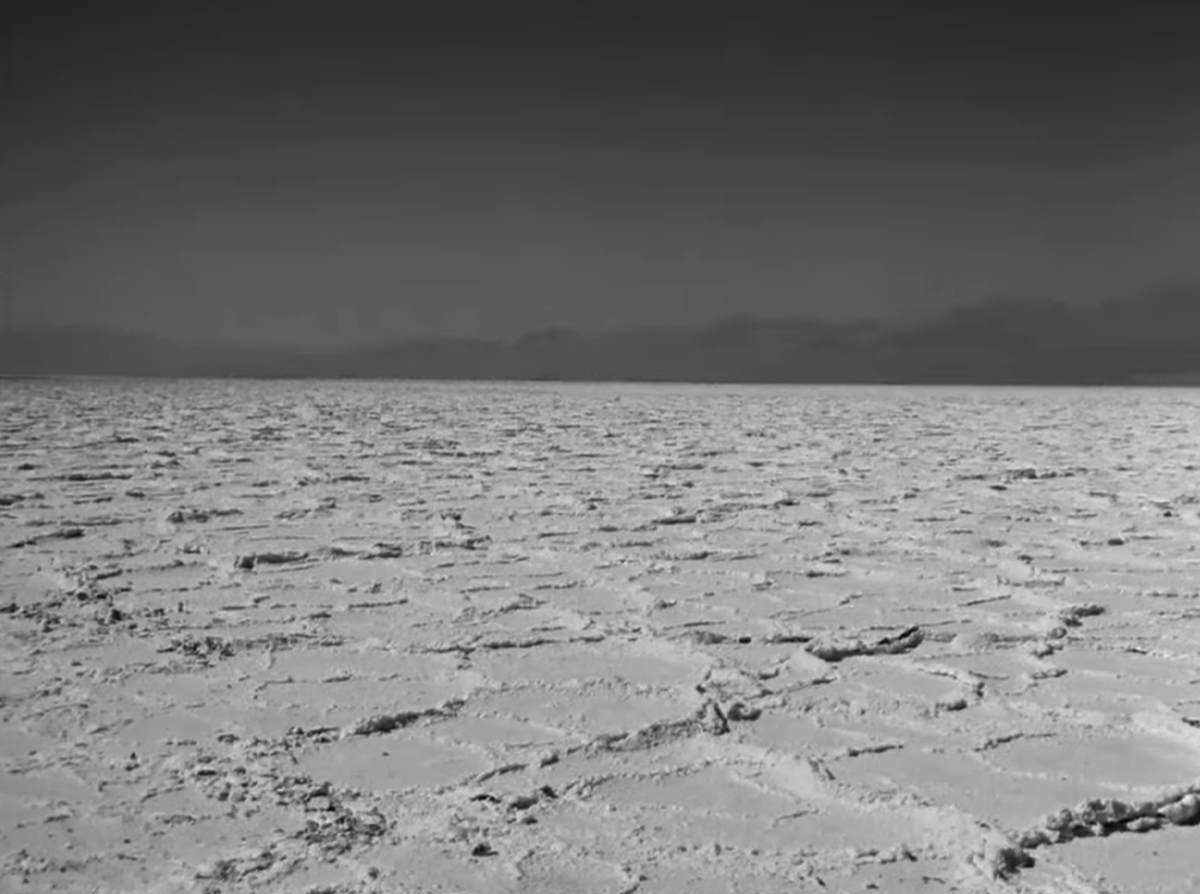
So, I'm at first watching Yellow Sky, not having seen The Ox-Bow Incident and with an eye for things Tempest. It starts off with thunder (psychically tempesty, no physical rain) as Stretch's gang rides into view and takes in the lay of the land, including the desolate salt flats (cue more thunder) to the south, where are Apaches, which is an expanse that not even rattlesnakes dare to intrude upon. Stretch's gang is composed of Richard Widmark as the well-dressed gambler "Dude", John Russell as "Lengthy" who is as tall as "Stretch", Harry Morgan as "Half Pint" because he's short, Charles Kemper as the husky "Walrus", Robert Arthur as "Bull Run", an innocent kid, and Robert Adler as Jed, who is quickly dispensed with and immediately forgotten. At first, I define these men as a group, not a gang, partly because Stretch is so laid back, however grizzled (grizzled looks good on Gregory Peck). When the group rides into town and ventures into the saloon, it doesn't occur to me they might be bandits. At that point, to me, they are just men on horses riding together. Why not. At that point there are all kinds of reasons they could be riding together.
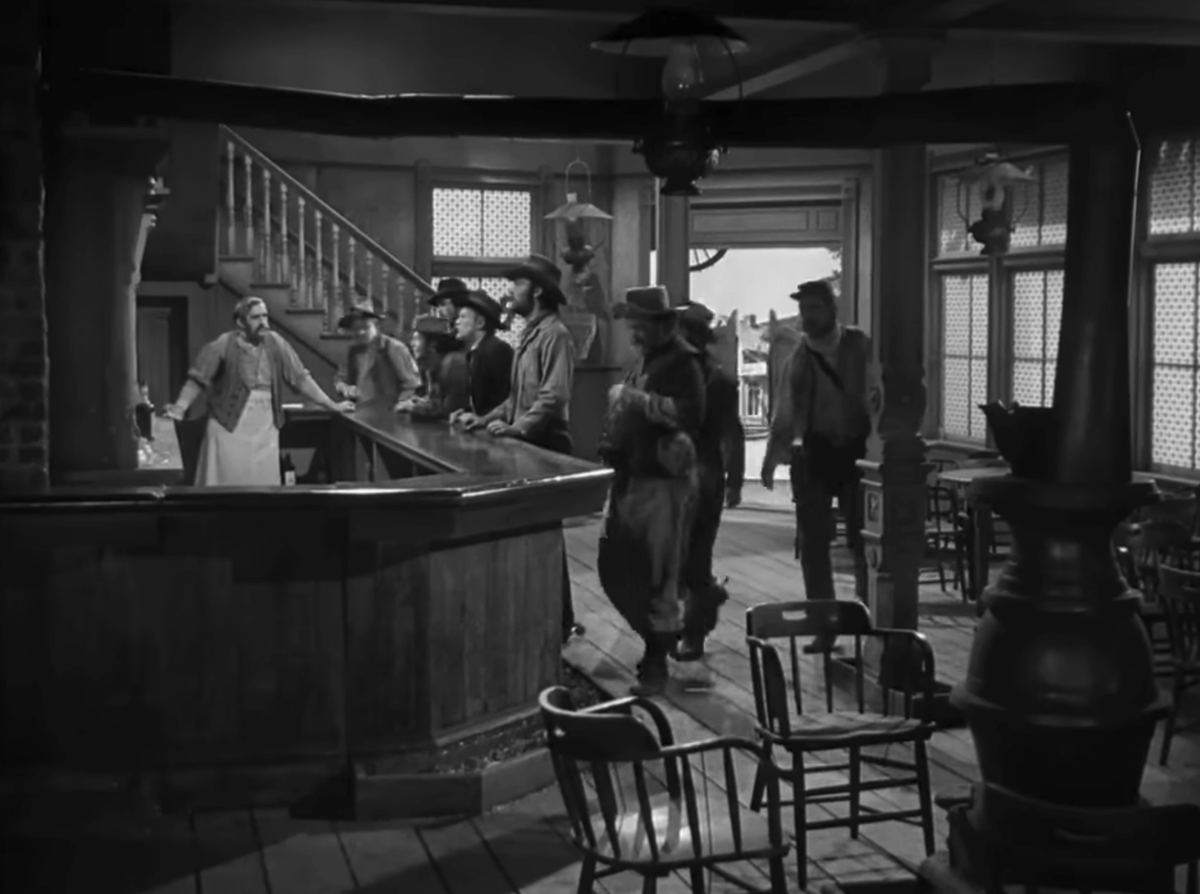
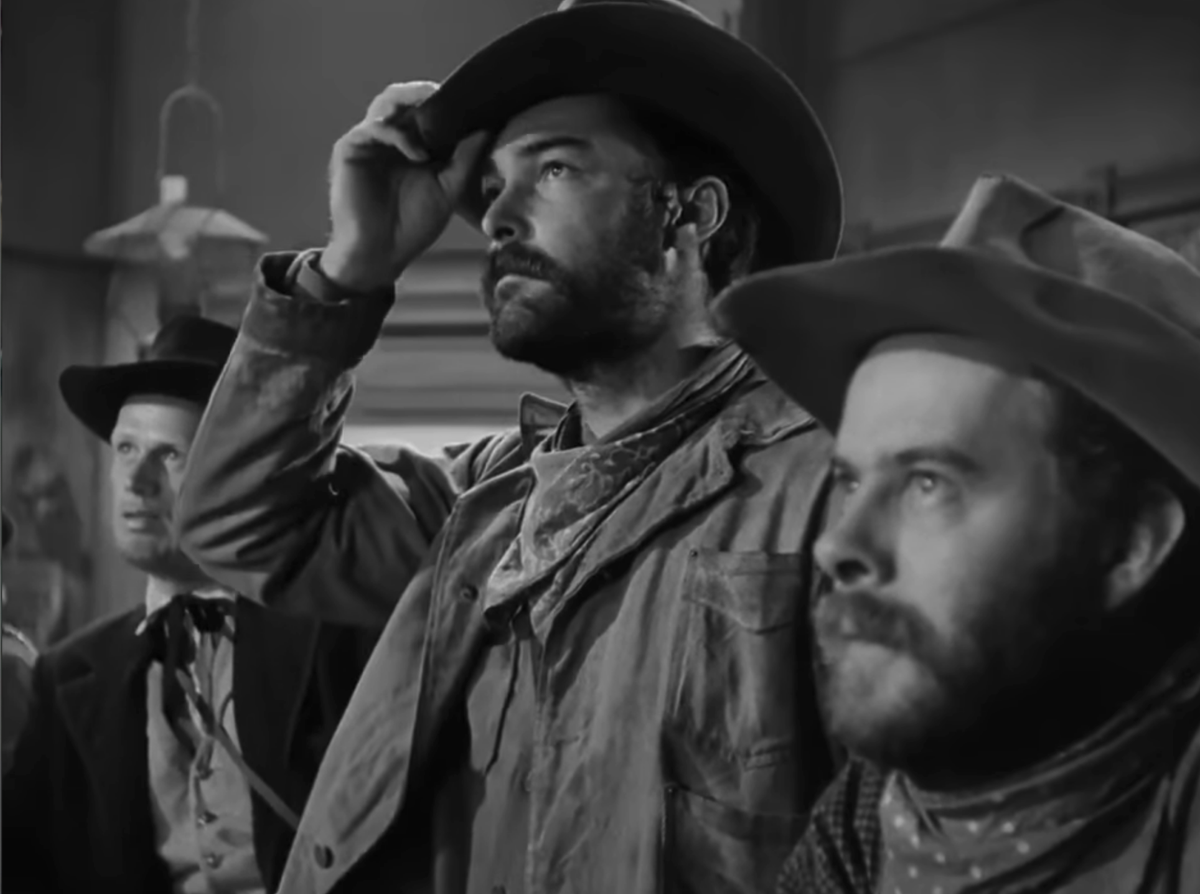
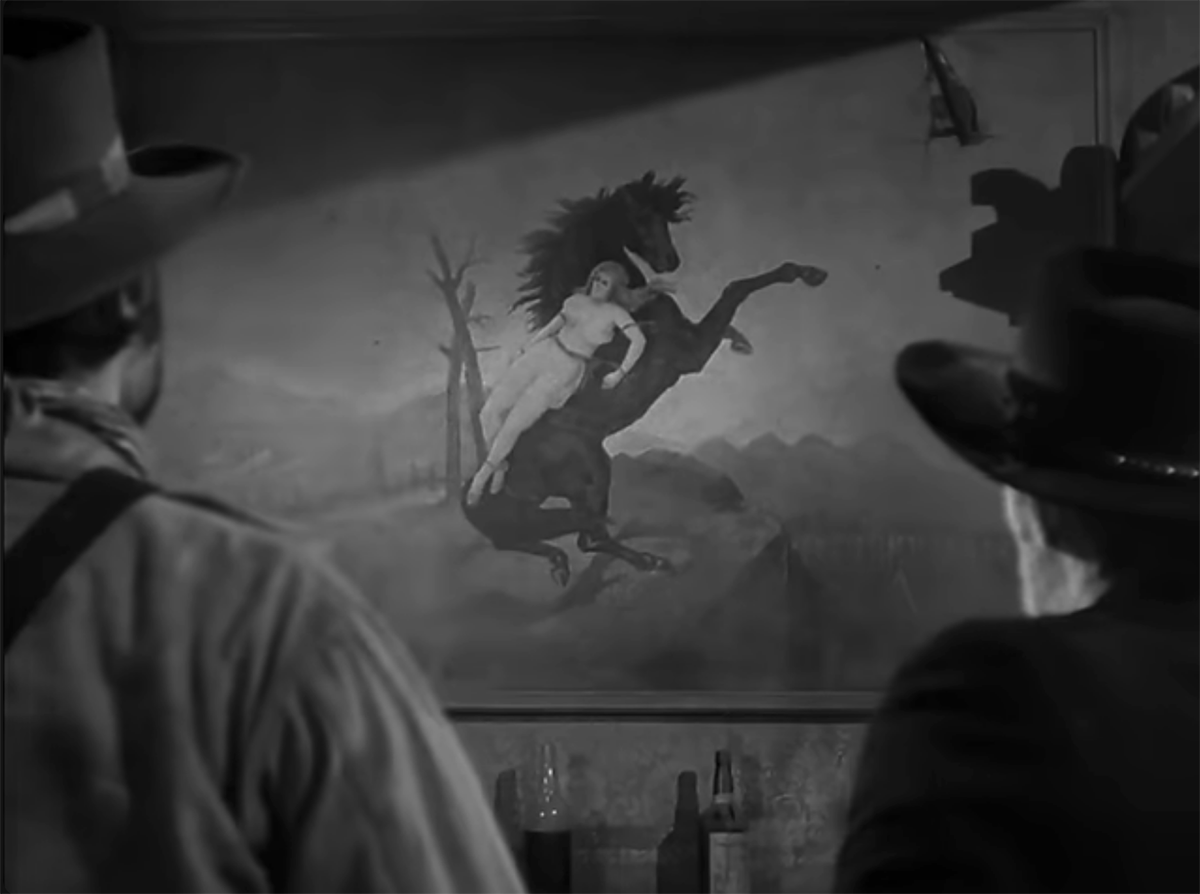
At the saloon, Lengthy is riveted by an illustration/painting behind the bar of a woman in circus leotard lying on her back on a wildly rearing horse, apparently bound to it. Lengthy asks, "I wonder if she's got any plans after she gets through riding that horse." In fact, he says this twice, just so we know this is important and don't forget it. In the meanwhile, Stretch buys a drink for the local drunk who followed them inside from the outer porch, inquires where the sheriff is and if he was a union soldier, then goes and very nonchalantly robs Raveyville's bank with Dude while the others water the horses.
 From Yellow Sky
 From Yellow Sky
 From Yellow Sky
 From Yellow Sky
 From Yellow Sky
The painting refers to a historical person, Adah Isaacs Menken, who created a fictitious persona for herself and became a dancer, actress and burlesque performer, though she wanted to be known as a writer. The role for which she gained renown was that of Mazeppa. The original Mazeppa was said to be a seventeenth-century nobleman, Ivan Mazepa (he existed in real life but this is his legendary form), in early romances given as Polish, who seems to have been a serial womanizer, and when caught with a certain noblewoman, was bound naked to a horse by her husband, and the horse set free to run until it dropped, which was only after it carried poor naked Mazepa across the steppes from Poland to Ukraine. The horse having died, Mazepa is himself near death, still bound to it, with no hope of being released, but then he wakes to the lovely face of a Cossack maiden who rescued him, and becomes their military leader. One gets in the tale a whiff of ancient initiation rite, horse and rider as one, the journey into the supernatural and rebirth. It was also pure romance. Lord Byron wrote a poem on it, which was published in 1819. In the mid-nineteenth century, "Mazeppa" was brought alive in the circus and in theater, Byron's poem accompanied by wild panoramas rolling past Mazeppa as he underwent the ordeal of his stormy ride. Then Adah Isaacs Menken put on a nude-colored body-stocking and took the stage as the male Mazeppa, scandalizing and thrilling audiences throughout the 1860s, then she became ill and died in poverty in 1868 at the age of thirty-three. Idah, acting as Mazeppa, was not yet dead in the year of the action of this movie, and the male Mazepa has successfully transformed into the female Mazeppa of whom pictures were painted. There was even music for Mazeppa. In 1862, Michael William Balfe wrote a cantata, "Mazeppa", which J. P. Clarke arranged into the "Mazeppa Waltzes." Tchaikovsky did an opera. Liszt did a "Transcendental Etude". The wild ride of the inconstant Mazeppa was a much beloved legend. Everyone wanted a measure of the passion of Mazeppa. File under "whatever helps get you through the day".
The Tempest. In case you don't know the Shakespeare play, the basics are that Prospero, a sorcerer, with his young daughter, is set adrift on the ocean, expected to not survive, but becomes moored on an island upon which the only other souls are Caliban, the monster son of a similarly exiled, deceased "witch", and Ariel, a spirit who had been imprisoned in a tree by the same "witch". Prospero released the spirit but bound it in servitude to him for a time, and while he initially treated Caliban as a son he instead came to treat him as a hated slave. Now that his daughter has come of age to marry, concerned for her future, Prospero magically causes a ship to wreck on the island, knowledgable that on the ship is Prince Ferdinand. Miranda and he immediately fall in love, Prospero rather pretends to stand in their way, treating Ferdinand rudely, but all is well (I'm leaving out the part where Prospero tortures Ferdinand's father, king Alonzo, who was also on the ship, with hallucinations, in revenge for Alonzo having a part in exiling him), Miranda and Ferdinand will be married and a secure future for Miranda is secured. Magic flavors the proceedings and in the end we are called upon to wonder at what is real and what is not.
In my analysis of Kubrick's Fear and Desire, which was also based on The Tempest, I approach the "why" of the image of a horse appearing in the opening credits when there is no horse in the film and not in the play either, except that it's believed that Caliban, as a hybrid creature, is partly inspired by the indigenous of the "New World" having been said to believe the Spanish horse and rider were as a centaur. This didn't happen, but never mind, it's another legend. A scene occurs in The Tempest in which Caliban and Trinculo are confused with being a monster composed of four legs and two voices. Trinculo is a jester who was also moored by the crashed ship. Caliban, who has never met any humans other than Miranda and Prospero and his mother, knowing there are no other humans on the island, when he sees Trinculo believes him to be a spirit and n a panic throws himself on the ground and covers himself with a cloak. A storm threatening, Trinculo takes refuge under the same cloak. Stephano, the moored drunken butler of king Alonzo, comes upon Caliban and Trinculo and believes them to be a monster. One can't think about this too linearly, in proprietary terms, that the hybrid is one thing alone. Caliban is the hybrid of a human and what's esteemed by Prospero to be a monster, a savage ruled by instinct, but Caliban instead sees Prospero as the monster who has stolen from him his birthright, which is the island. Miranda, who doesn't remember having seen any other human, except Prospero, before Ferdinand appears, is a sort of Caliban in that she has grown up with Caliban and has been influenced by him.
To my eye, when I see the painting of the woman bound to the back of the horse, knowing Yellow Sky was influenced by The Tempest, I see the hybrid. In the case of the film it will be animal instinct versus the enlightened human. It will be the girl, "Mike", who grew up without the influence of women, and amongst Apaches, so she is the tomboy savage who wears moccasins and trousers and can take care of herself. In the case of Stretch, he is a hybrid by way of violence, as a man who comes of a good home but who has been confused by war. Stretch tells Mike if she prettied herself up a bit she might almost look female, and Mike tells Stretch he smells. So Stretch takes a bath and puts on a fresh shirt, he becomes protective of her, she decides she likes kissing him, and at film's end he buys her a woman's hat decorated with flowers.
However, I then read that William Wellman said in the 1975 book, The Men Who Made the Movies that he didn't know there was a connection to The Tempest. And I believe this, it seems so confidently written about, but I feel I need to check this out and when I locate a copy of the book on the internet Archive, I find it has nothing in it about The Tempest or even Yellow Sky. Yet there are various people on the internet who report that William Wellman, in that book, said he had no idea there was a connection between The Tempest and Yellow Sky until long after its filming. Rather than in the book, was this instead in the TV documentary form of The Men Who Made the Movies, in an interview with Wellman? If so, then perhaps The Tempest was so well-enough communicated in Lamar Trotti's script that Wellman needn't have had knowledge of The Tempest. I don't know. I'm skeptical at this point.
Another problem presents itself. Wellman's The Ox-Bow Incident has an almost identical opening to The Tempest. Let's compare them.
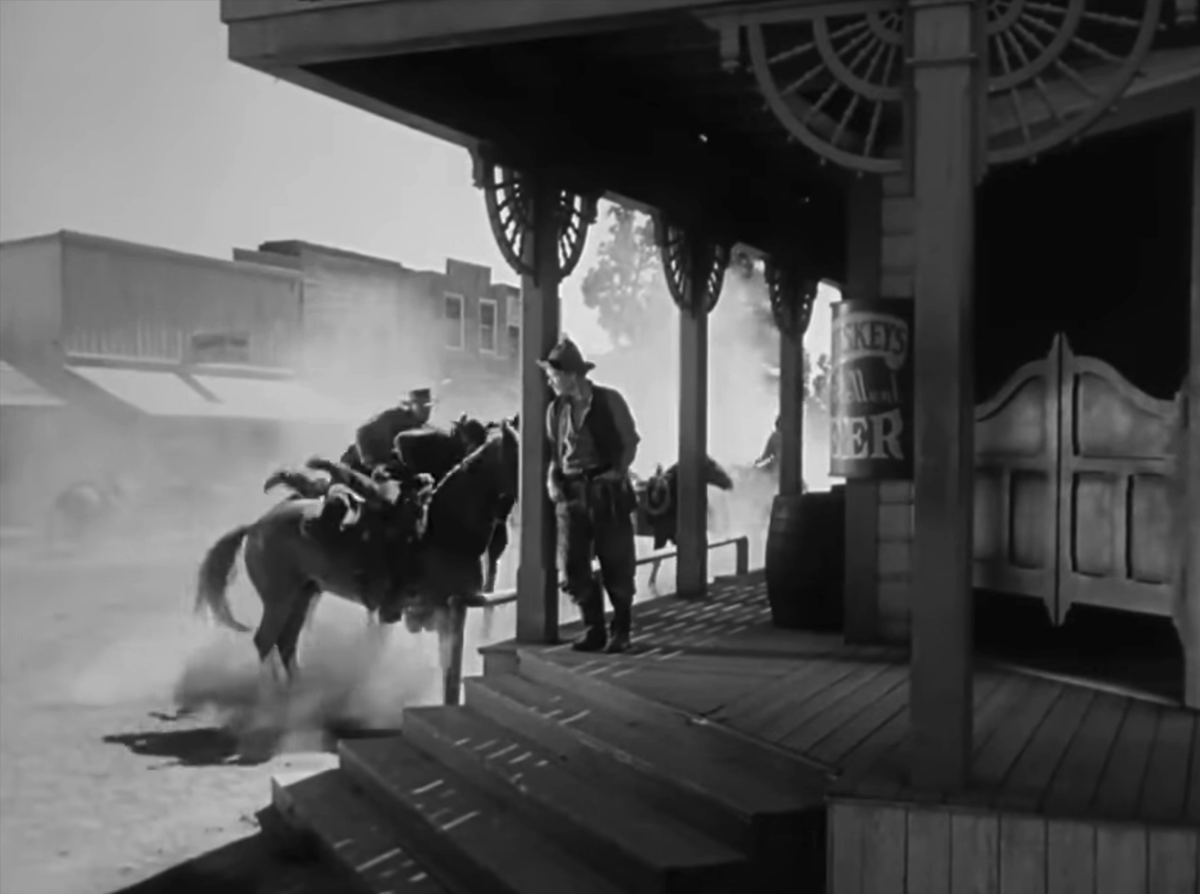
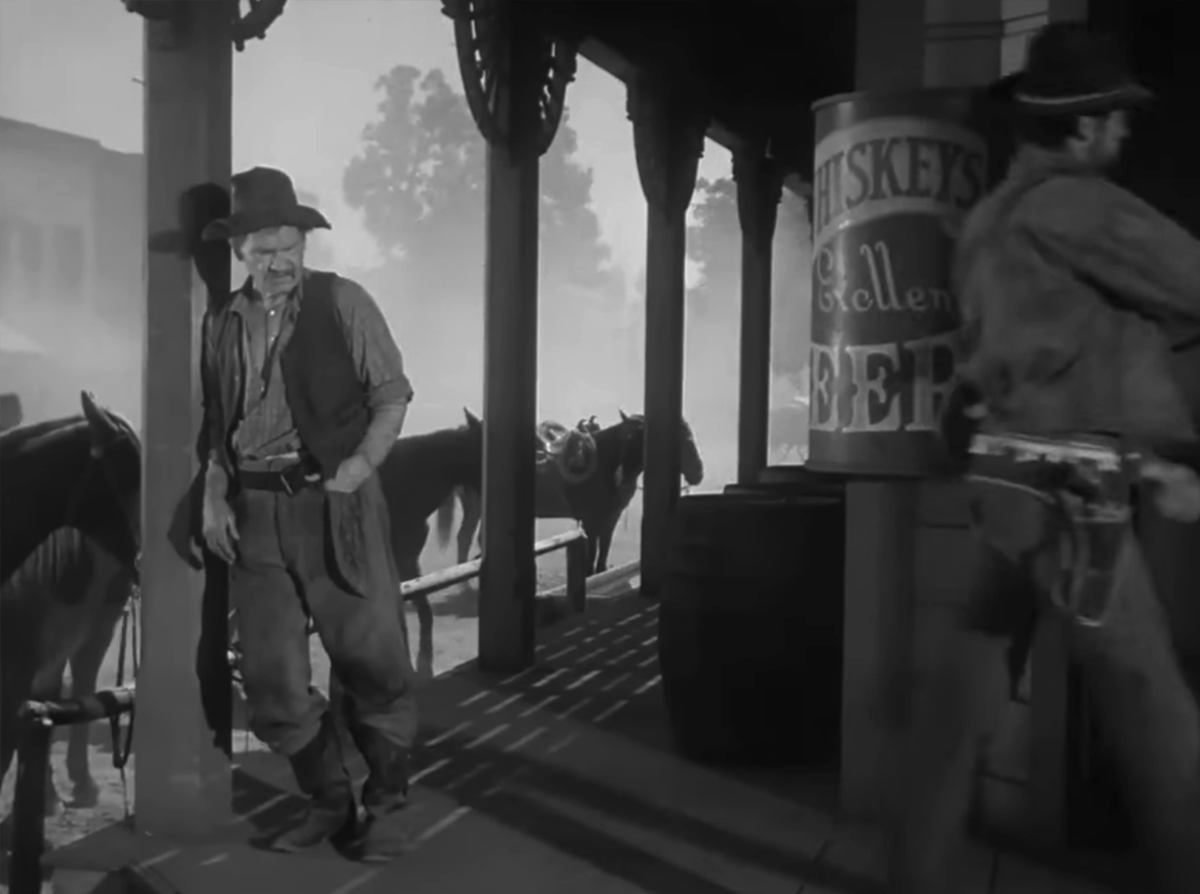
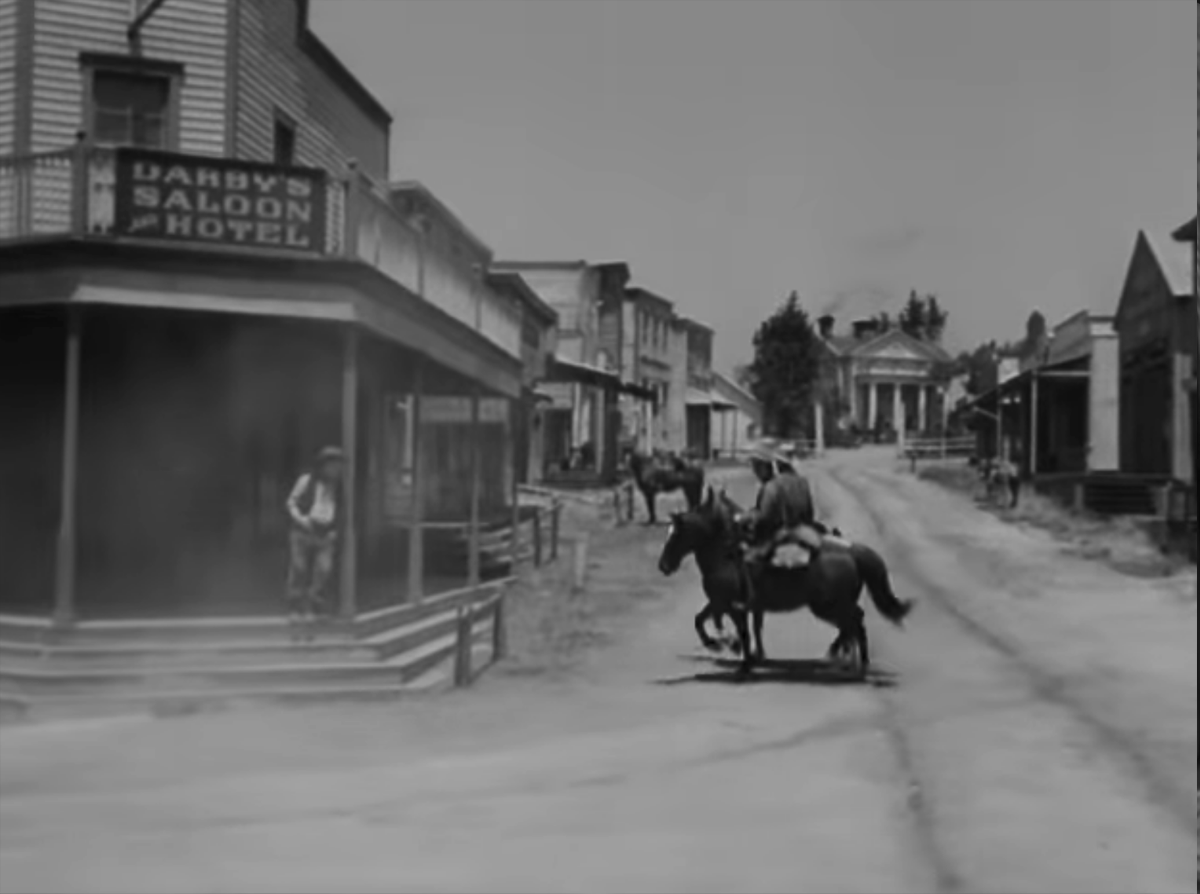
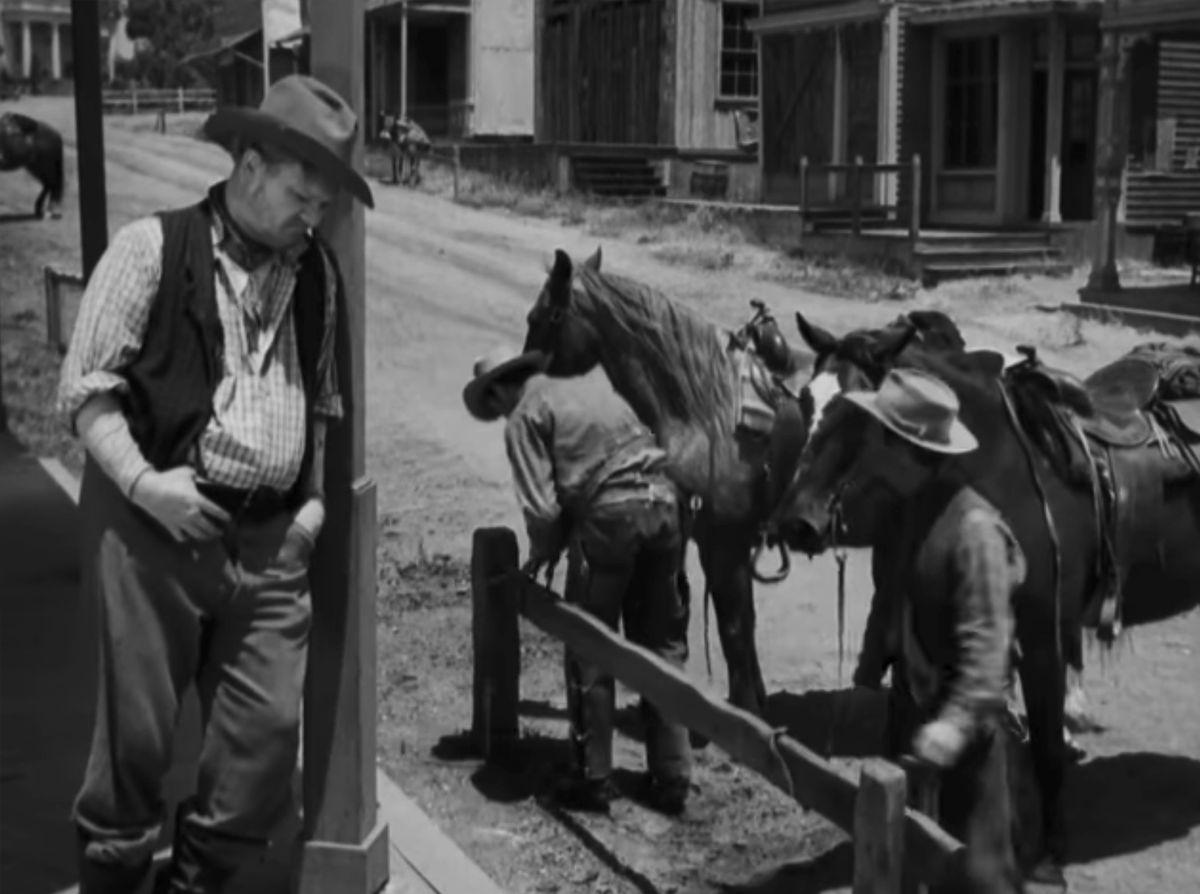
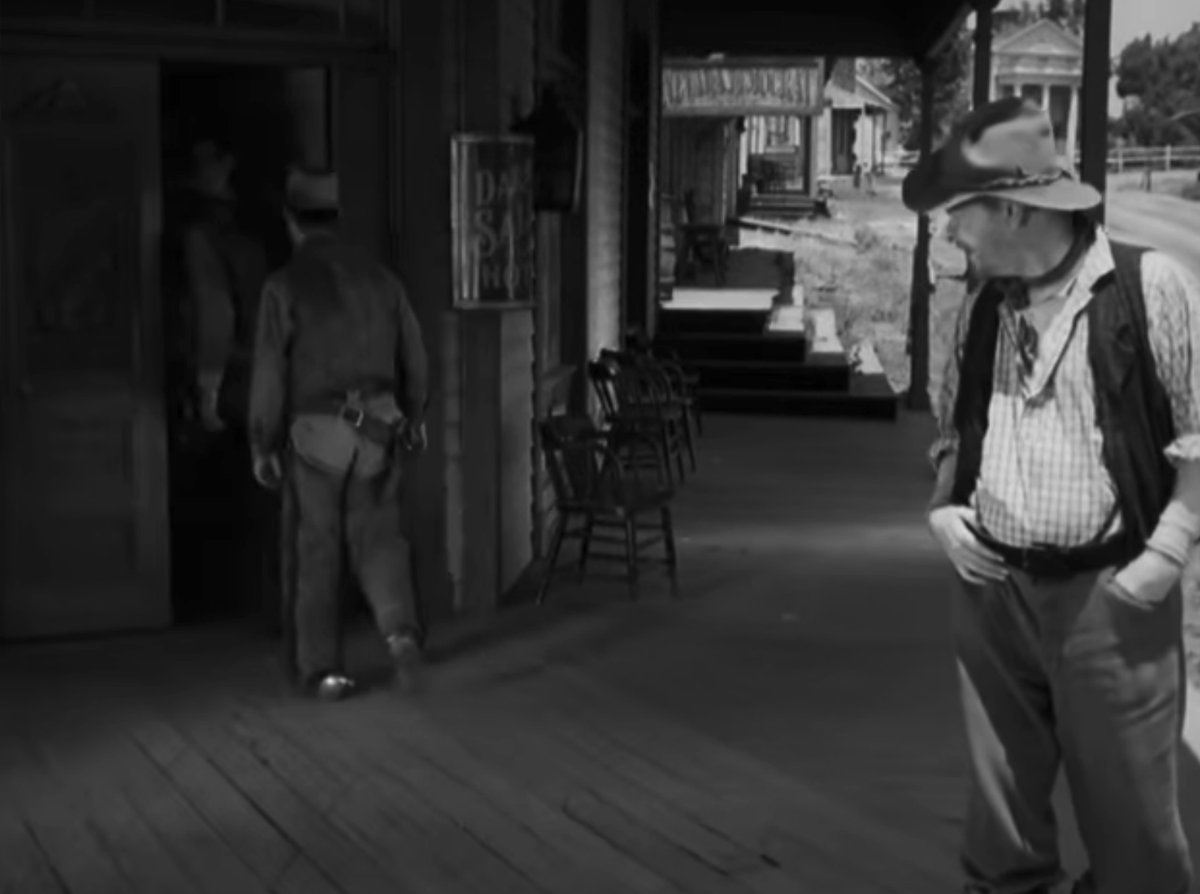
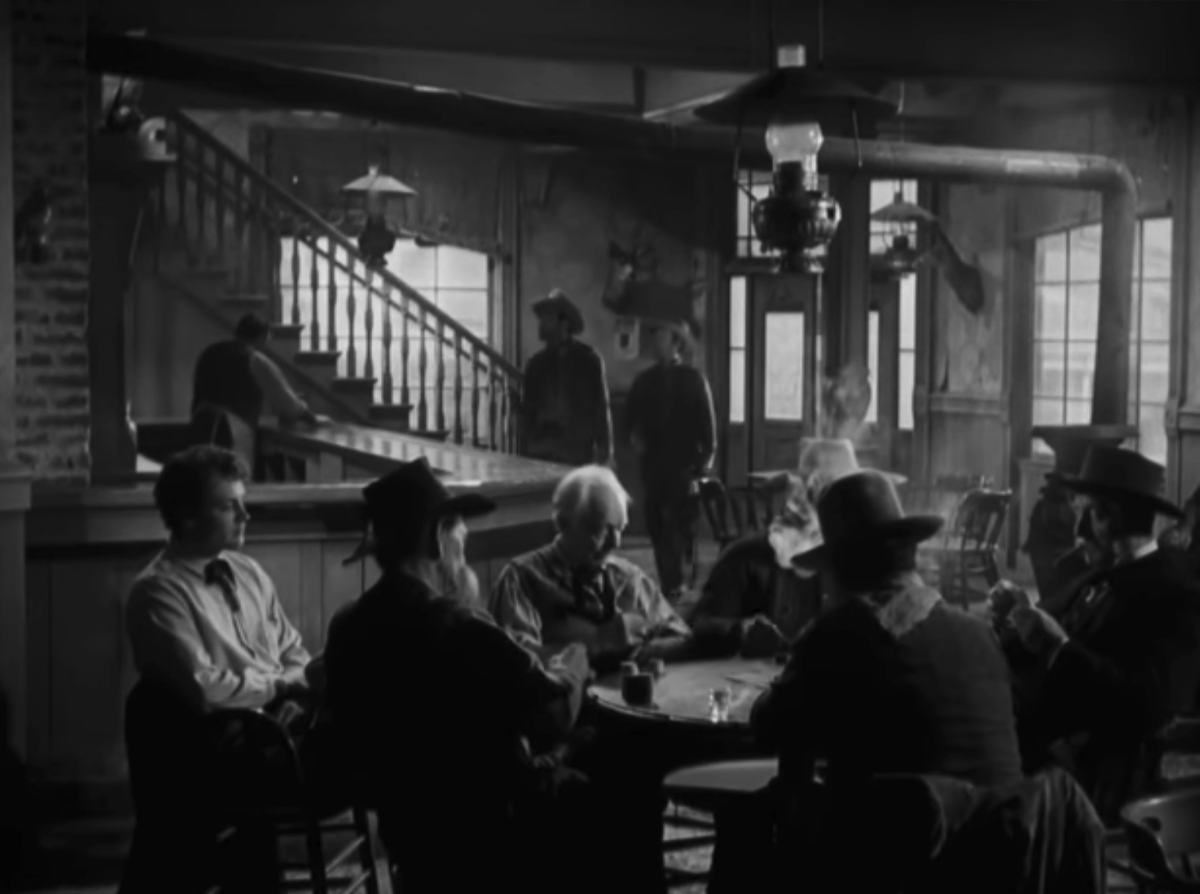
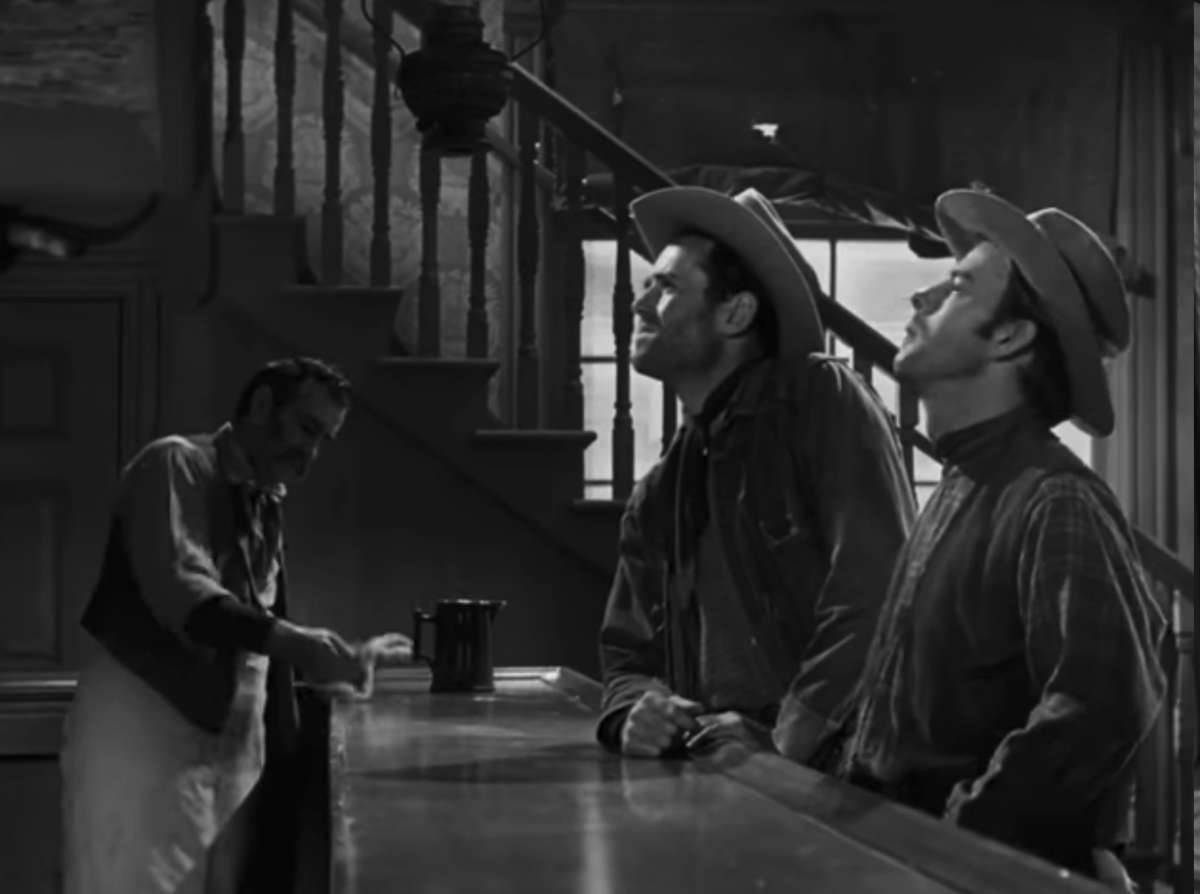
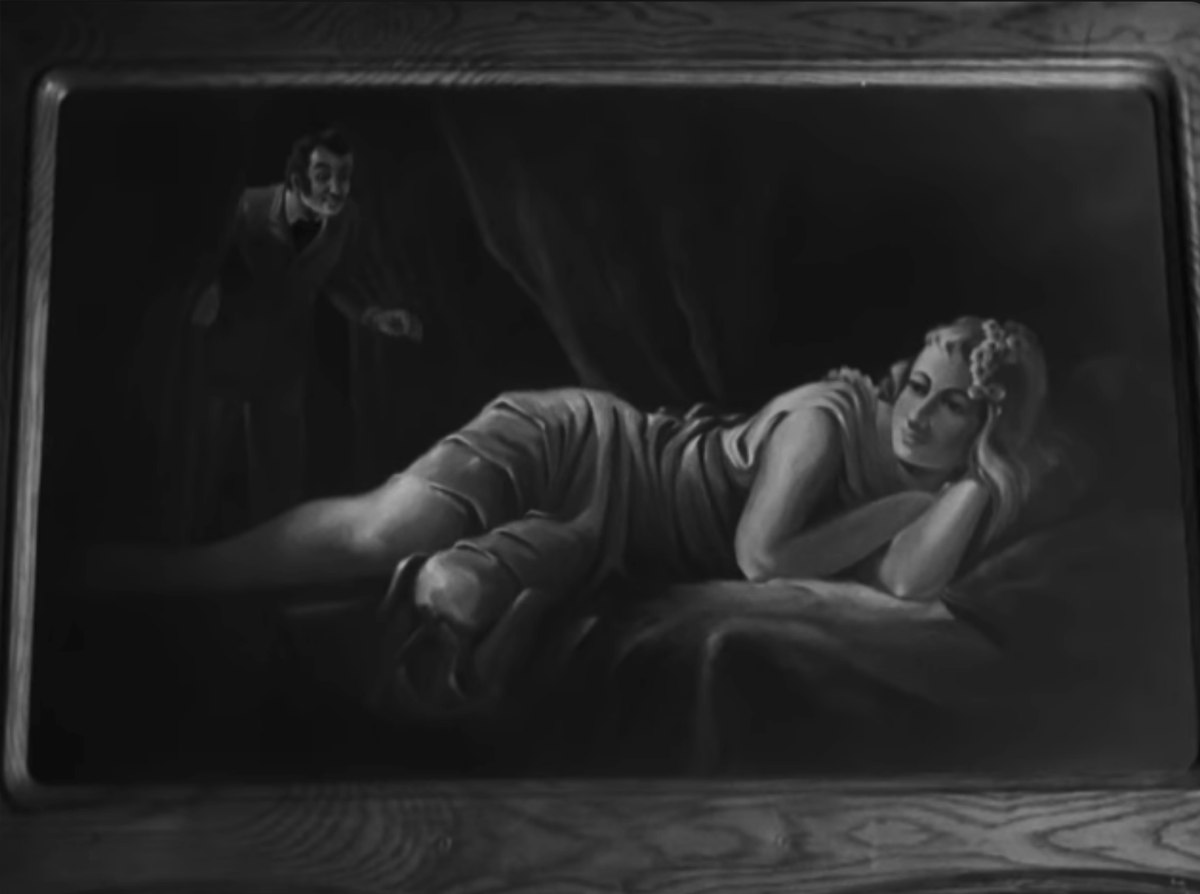
The below images show Gil Carter (Henry Fonda) and Art Croft (Harry Morgan) riding into town after months out on the winter range. Whereas in The Ox-Bow Incident they ride up from screen right, they do so from screen left in Yellow Sky. A drunk stands outside the saloon, and follows them inside, just as the drunk follows them inside in Yellow Sky. He's given a drink and leaves. Carter and Croft both gaze up at a painting above the bar, but in The Ox-Bow Incident it is of a woman in a filmy nightgown, resting seductively on a bed, and a man with a mustache peering in on her through the room-divider of a curtain. Carter says, "That man sure is slow getting there," to which the bartender responds that he feels sorry for the man, always within reach but never able to do anything about it. Carter says he has the feeling the woman could do better. Then he learns that his supposed girl, who had promised to wait for him, had taken off in the spring. Later we will discover she looks much like the blonde in the painting, has married a rich man who has a mustache, and that they will be living in San Francisco. Her husband warns Carter to not come visiting until she becomes used to her new situation. For the life of me, i don't know why this subplot is in the film except for the fact it's in the book, but I don't understand why it's in the book as it adds nothing, at least as far as I can tell.
 From Ox-Bow Incident
 From Ox-Bow Incident
 From Ox-Bow Incident
 From Ox-Bow Incident
 From Ox-Bow Incident
 From Ox-Bow Incident
What's astonishing is that Harry Morgan as Croft, who is the narrator in the book, the rational man, whereas Carter is half-mad at times, should reappear in Yellow Sky, to stand at another bar and this time gaze up at the painting of Mazeppa strapped to the horse. If you compare the saloon in Yellow Sky with the one in The Ox-Bow Incident, an obvious connection is being drawn by Wellman, which is reinforced by the presence of Harry Morgan.
In The Ox-Bow Incident, it's learned that a rancher has been killed, his cattle rustled, and a posse is formed to go after those responsible. The posse, given what they believe is a good lead, head out to catch the three men, determined to exact their own justice with an on-the-spot lynching, no bothersome trial intervening. Individuals also ride along, including Croft and Carter, who hope to convince the posse to hand over the suspects for a trial. That won't happen. The men are hung by the posse, and it's immediately thereafter learned they were innocent.
In Yellow Sky, we are shown that Stretch's gang robbed a bank, or at least Stretch and Dude did so, aided by the other members of the gang. There is no doubt as to their guilt. They are pursued by the army who shoot Jeb dead, but when the gang rides onto the salt flats, the army stops and opts to let them go, the leader says the salt flats will save them the trouble of a hanging. Again, we have a link from Yellow Sky to The Ox-Bow Incident. The flats are expected to exact the same justice as a hanging however by natural, environmental means. However, despite our being shown that Stretch and Dude robbed the bank, correct and due process would involve a trial with witnesses. At film's end, Stretch is even granted redemption for he and Walrus return the money to the bank. I suppose one could call this an anti-death penalty film, not just anti-vigilante justice, as the situation of the guilty is provided context, and they are given the opportunity to reform.
What are those salt flats? They are the remains of a once great ocean. The salt flats, on which the men and their horses stand to die of thirst, are like the ocean upon which an individual, set adrift, could die of thirst. They are as the ocean upon which Prospero and his daughter were set to drift. They are as the ocean upon which Ferdinand and Alonzo's ship was crossing when shipwrecked by a storm called up by Prospero.
After having spent a night on the salt flats, the situation of the gang is looking hopeless. Walrus complains that he will die of thirst, to which Stretch says it looks like he may, even while alleviating the thirst of first his own horse, then Walrus' horse, by damping a bandana with water and pressing it to the mouths of the horses. "Kind of noble, aren't you?" Dude says to Stretch (a reference to his being as Prince Ferdinand) to which Stretch responds that a horse is a useful animal and there's no use letting it suffer.
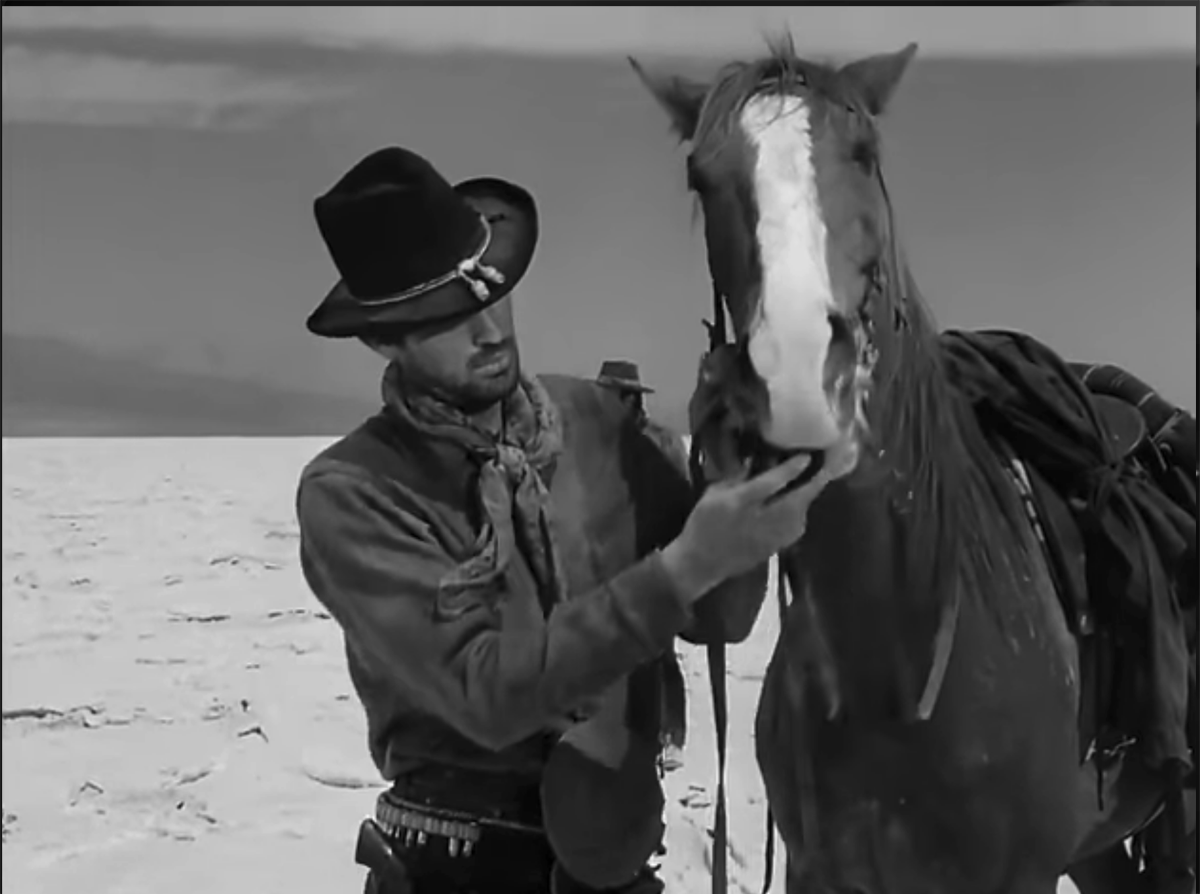 From Yellow Sky
Lengthy's response is to point out a lizard that he says is in better shape than Walrus, which he says doesn't seem right. He shoots the lizard, which upsets Half Pint, that Lengthy would kill something for no reason at all, which hadn't done anything to him.
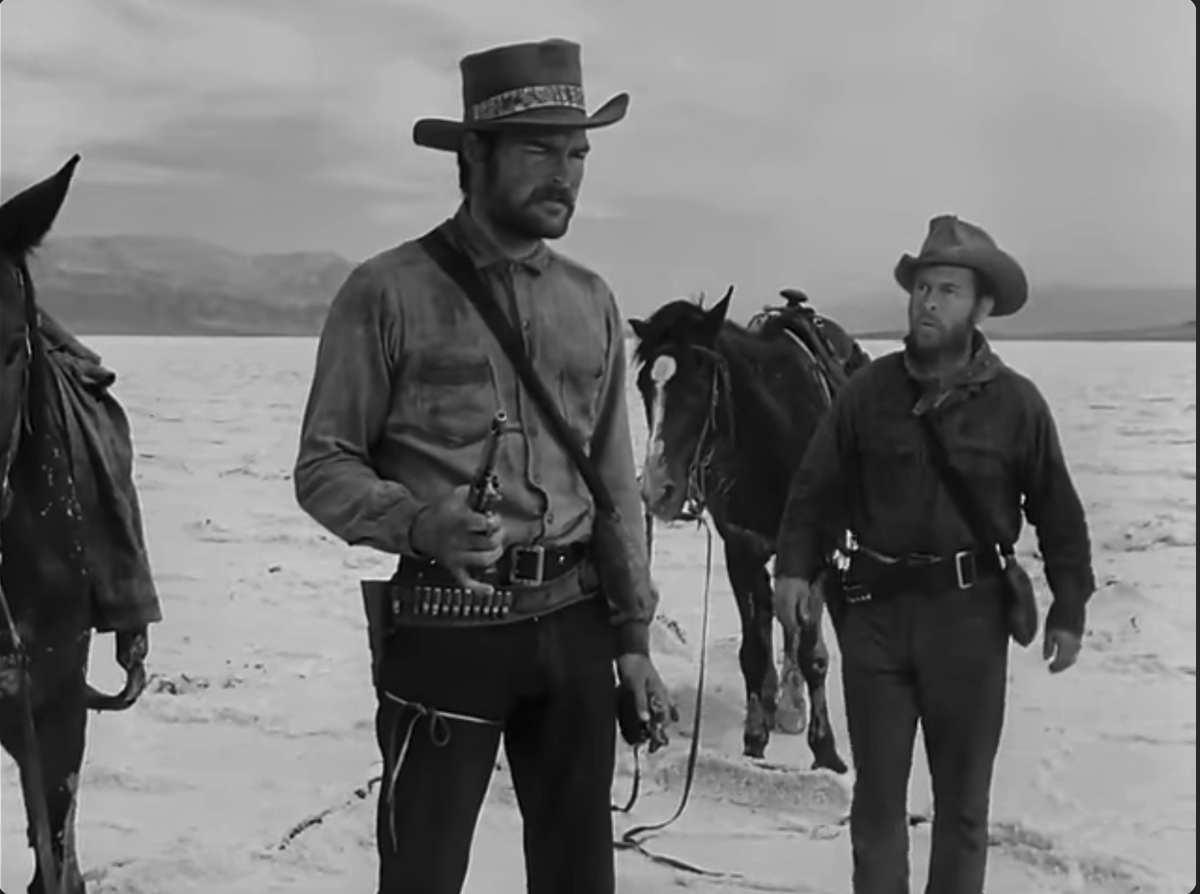 From Yellow Sky
Soon enough, Half Pint's horse is down, and won't be getting back up. Stretch sticks near as Half Pint, knowing what must be done, to save the animal from pointless suffering, shoots his horse.
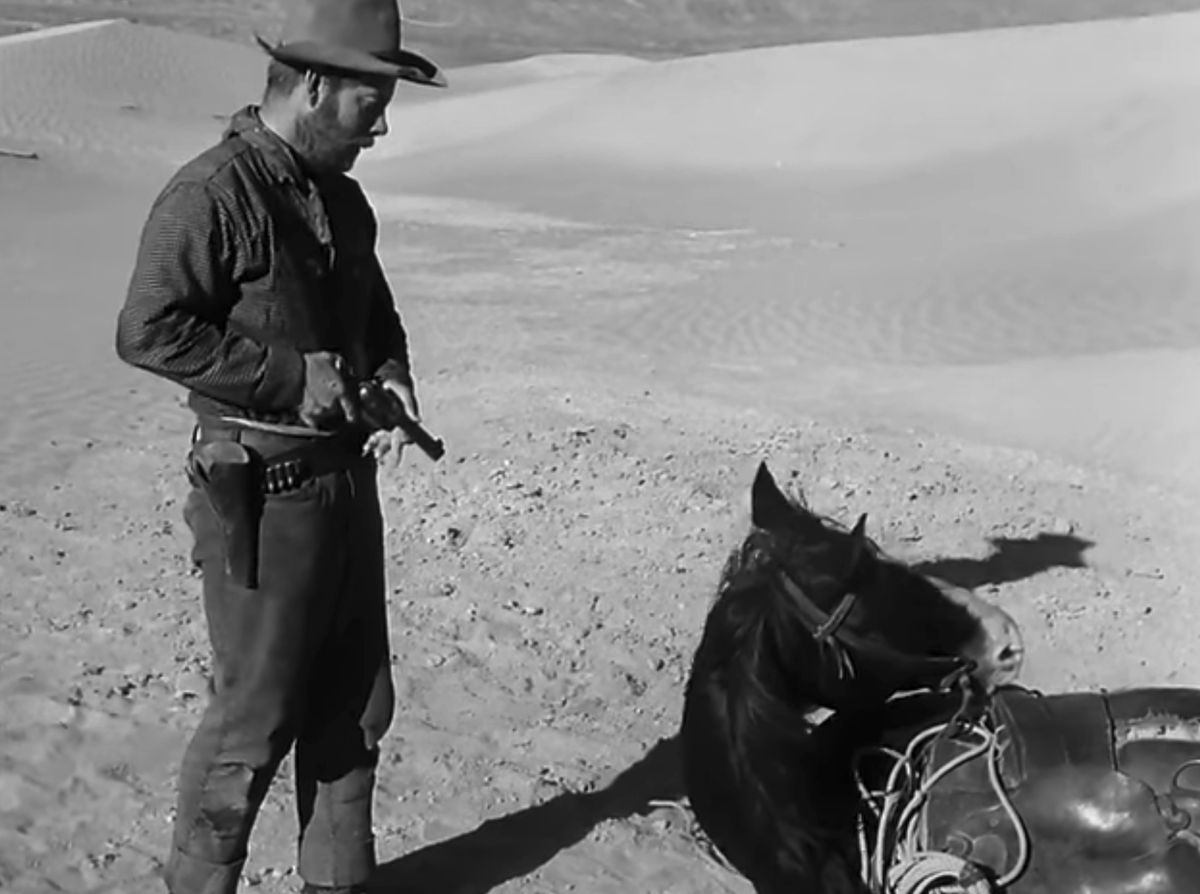 From Yellow Sky
The death of Half Pint's horse is the equivalent of magic. Remember the painting of Mazeppa bound to the horse and Lengthy wondering what were her plans when she was done riding the horse? It's no coincidence that immediately after the death of the horse, Stretch looks across the wasteland to see a town come into focus.
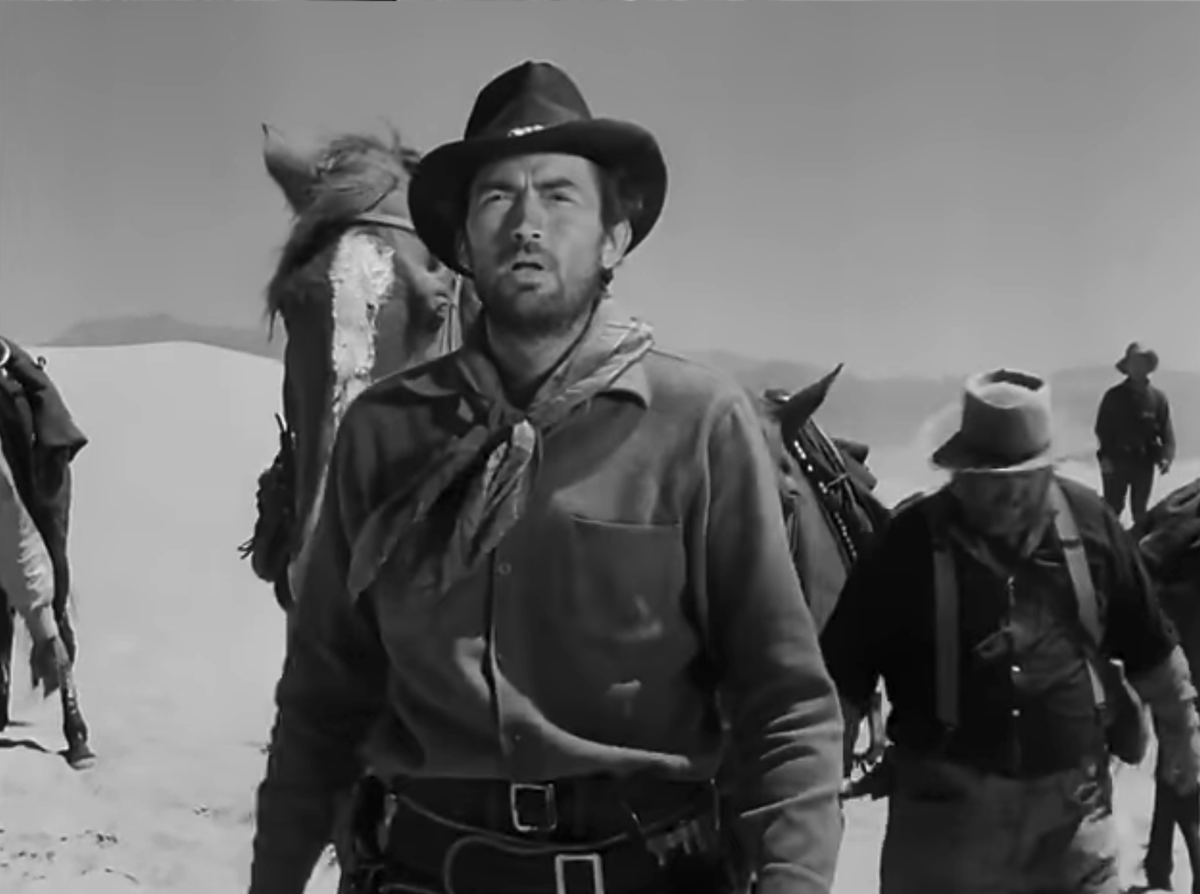 From Yellow Sky
A town that looks like it's just beyond a great beach on an island.
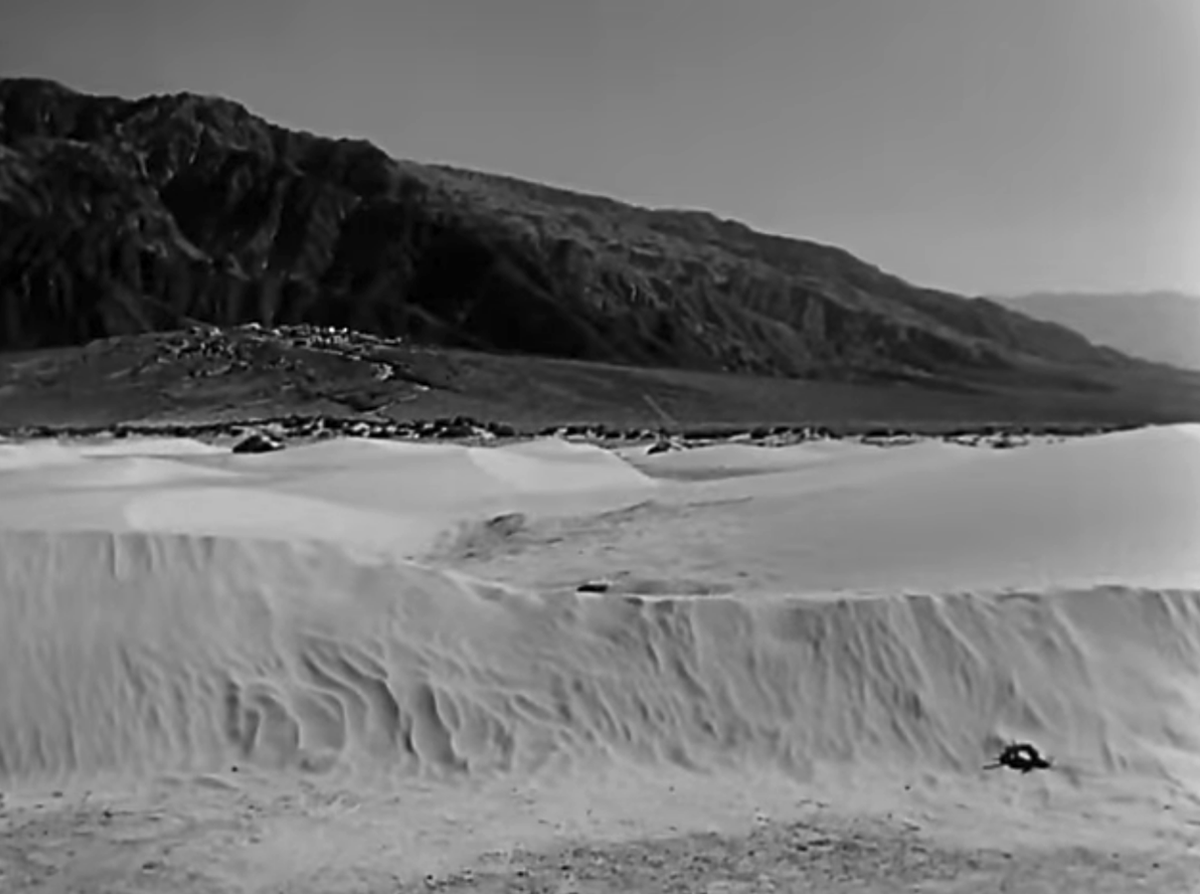 From Yellow Sky
It is however a ghost town.
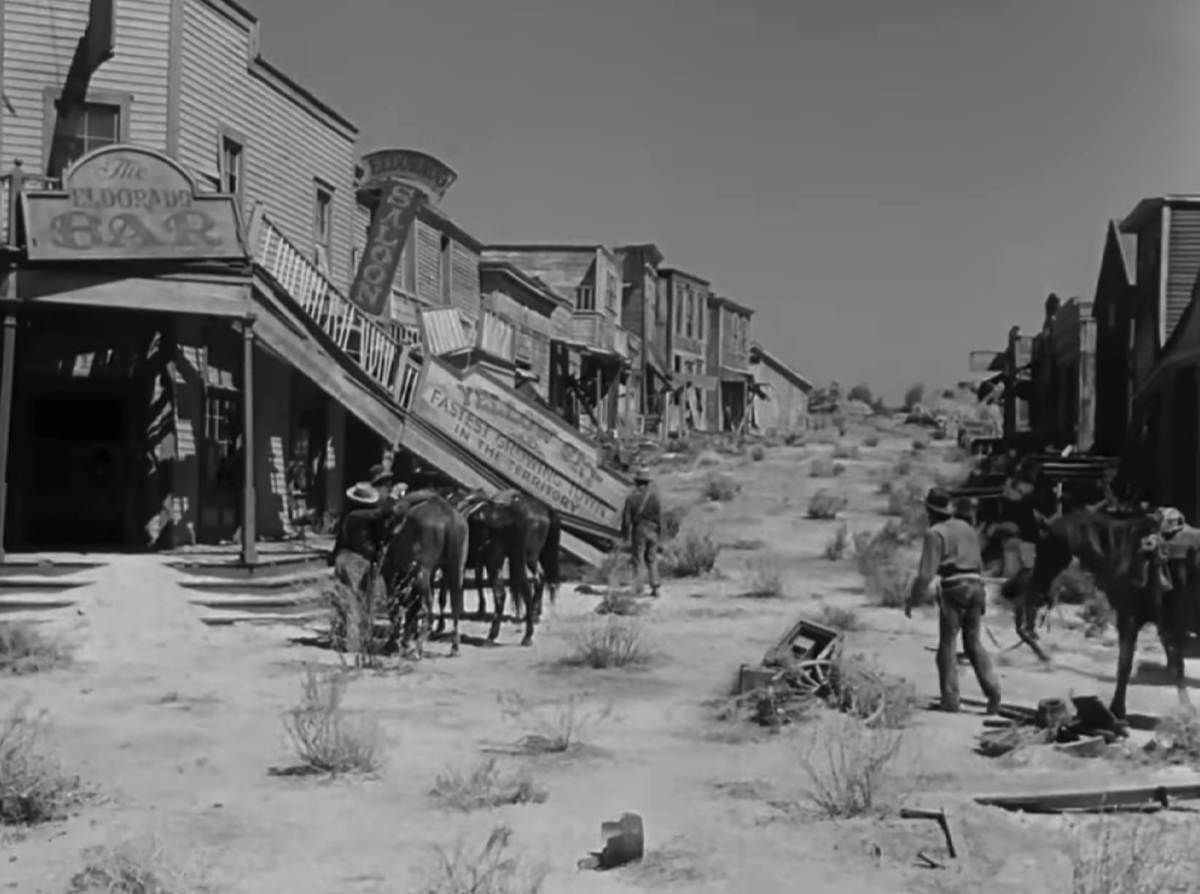 From Yellow Sky
A ghost town with the name of Yellow Sky, yellow skies a common portend of a storm, And the saloon is named El Dorado, for the mythical city of gold.
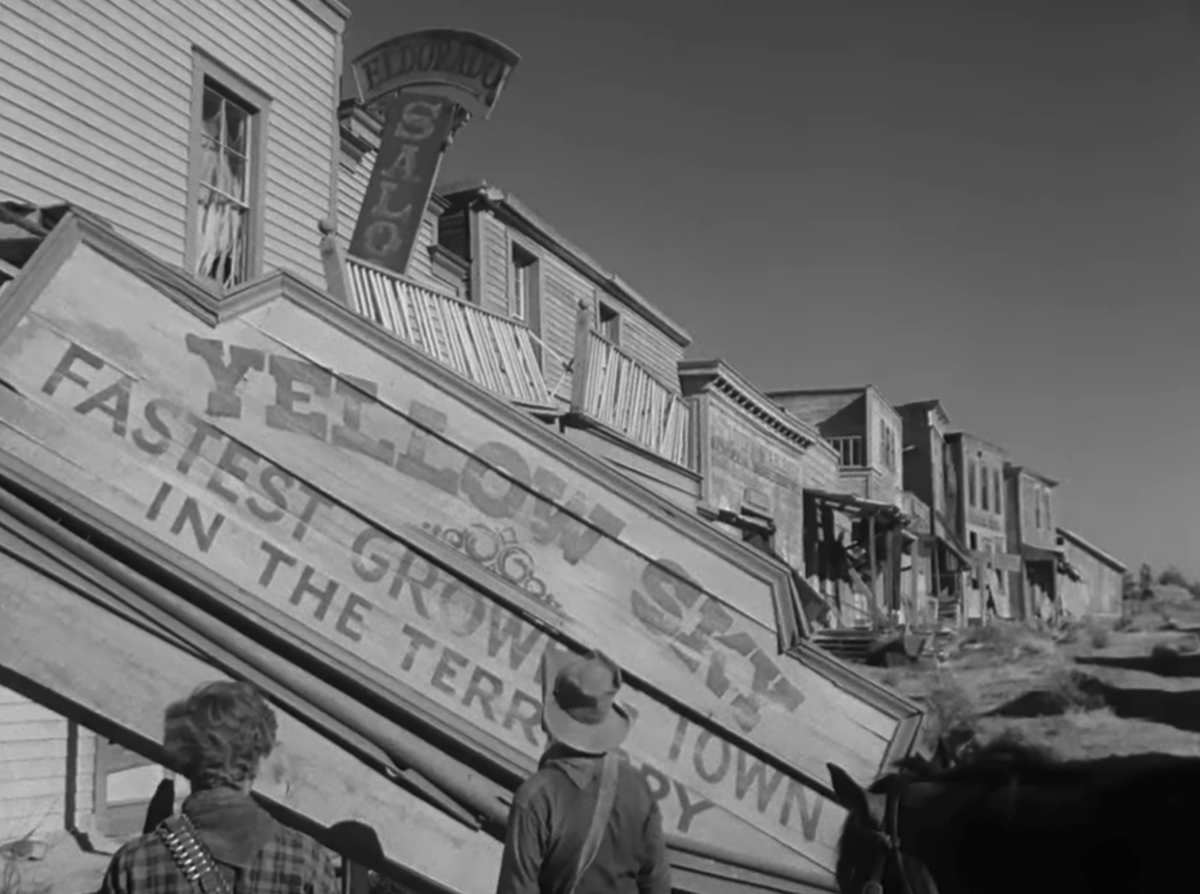 From Yellow Sky
There are no signs of life here, not even around the barn.
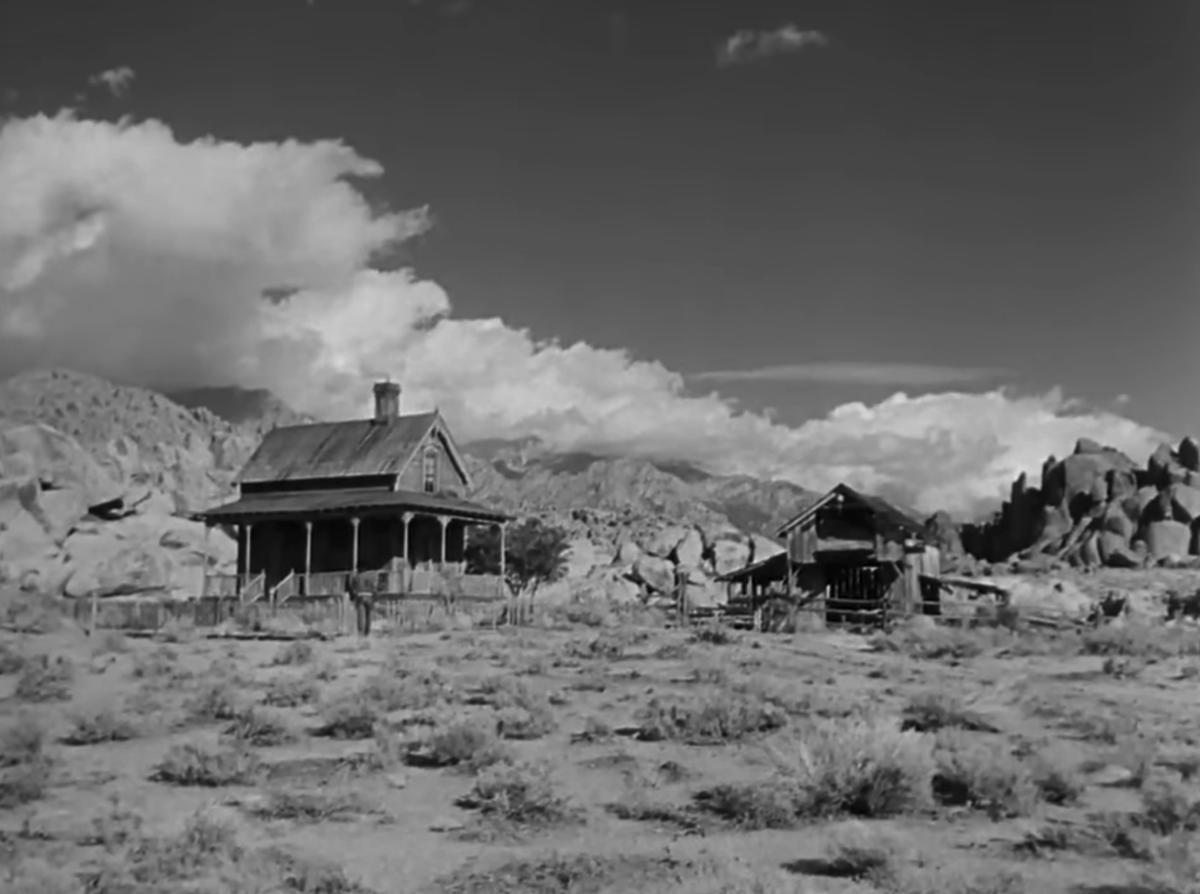 From Yellow Sky
The only inhabitants are Mike and her grandfather, who we learn is a prospecter.
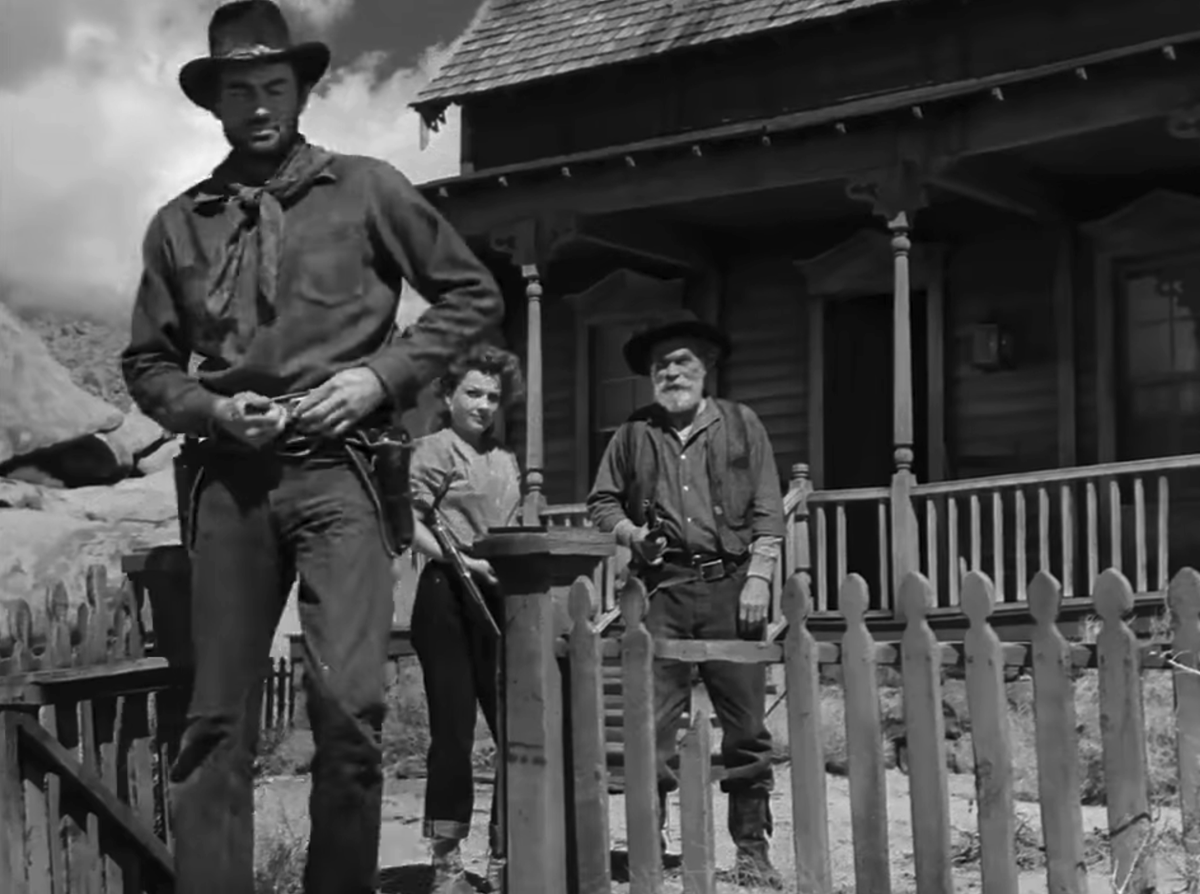 From Yellow Sky
The location of the town is never given. We are to infer it is at Death Valley, due the salt flats--filming took place at Death Valley and at Alabama Hills in Lone Pine, a little footage occuring for The Ox-Bow Incident took palce at Lone Pine as well--but from the movie's beginning Apache Indians are stated as being in the area, and Apaches were not around Death Valley, they hundreds of miles to the east in Arizona, New Mexico, Southern Colorado and West Texas. Incidentally, the action taking place in 1867, this is the year of the October signing of the Medicine Lodge treaties with the Kiowa, Comanche, Arapaho, and the Plains Apache, in which the Plains Apache agreed to move onto a reservation in Oklahoma, while other bands of Apache would eventually take up residence on reservations in Arizona and New Mexico.
The situation of Mike and her grandfather isn't normal. They have no horses. Not even for food do they have any chickens for eggs or meat, cattle or dairy cows. The barn is empty. At one point in the film we are eventually shown a brief glimpse of two mules, but that is it. They have the watering hole, but no garden. And they've been there for fifteen years, arriving as the town died. Their situation in this respect is much like that of Prospero and Miranda. How have they survived? We will learn that they have been prospecting, employing Apaches to help them, and one might guess that they have perhaps traded with them, and have likely ridden into the town of Alkali that Mike says is not too distant. We can guess that they've kept their profile as low as possible so that their gold vein isn't discovered by others (the Apache appear to have no use for it) but there remains an air of mystery about them appropriate for Prospero and Miranda. For all appearances, they seem to have existed on water and air.
Having guessed that the grandfather has likely struck gold, the band sets about trying to discover where it's at. Hoping to scare them off, Mike shoots at them from where she and her grandfather have taken refuge in the rocks after burying their gold. Stretch, who is at the point of redemption that he's taken a bath and changed clothes, waves a white flag of truce, wanting to talk, which Mike views through the barrel of her gun. He's sent the others to look for Mike and the grandfather's ammunition, but tells them that they've found it and they'll soon run out of bullets. During an ensuing brief skirmish, the grandfather is shot, now it's Mike's turn to wave a white flag. Everyone goes to the house where Mike will doctor her grandfather, a tale will be told, and a prospective deal struck.
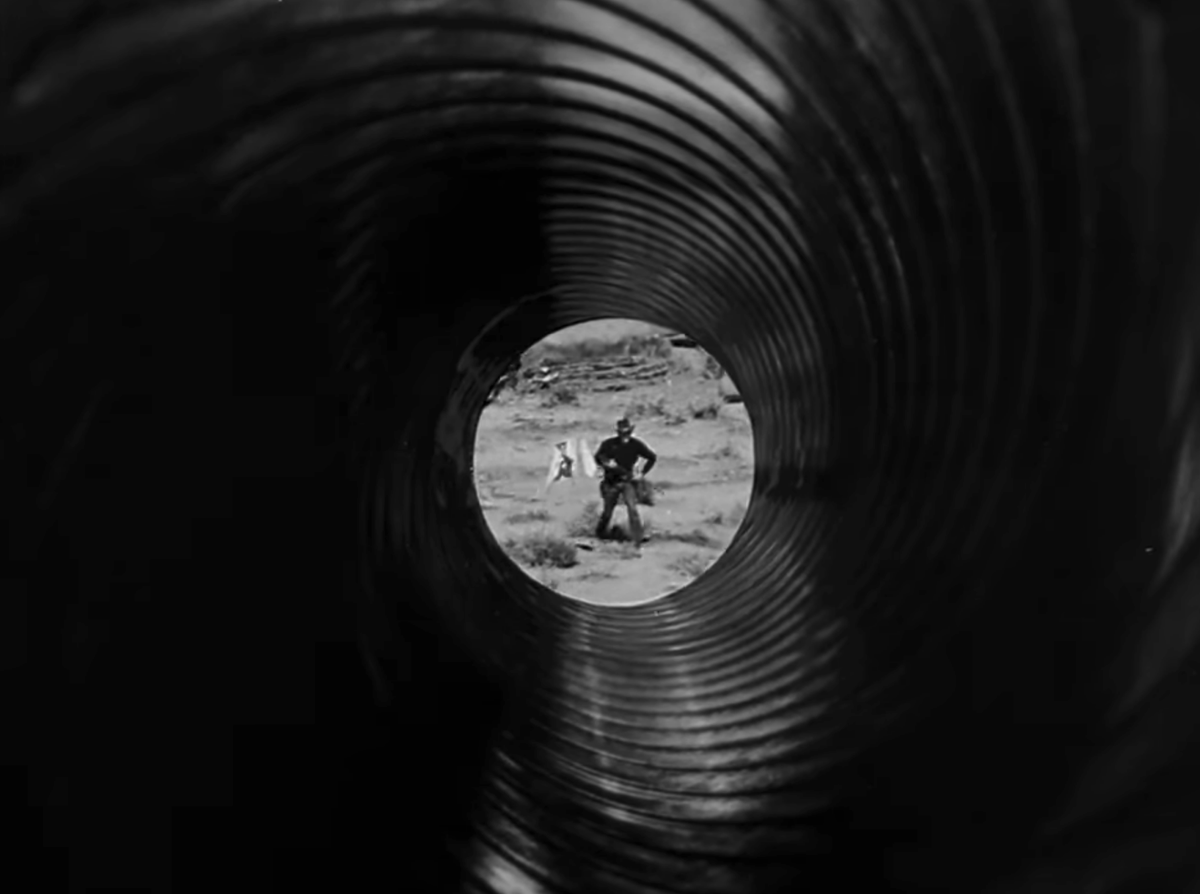 From Yellow Sky
Just look at that gun barrel shot, fourteen years before James Bond would be eyed through a gun barrel in Dr. No.
At the film's beginning, while the gang is surveying the land, Bull Run points out some bones, including a skull that shows the manner of death, an Apache arrow that has driven through the side of the skull and its right eye socket. Stretch observes, from nearby paraphernalia, it belongs to a prospecter. Walrus notes how little the individual was.I think we're intended to consider the victim may have been a female, and I can't help but draw an association between the skull with the arrow through its eye socket and the shot of Stretch viewed through the gun barrel.
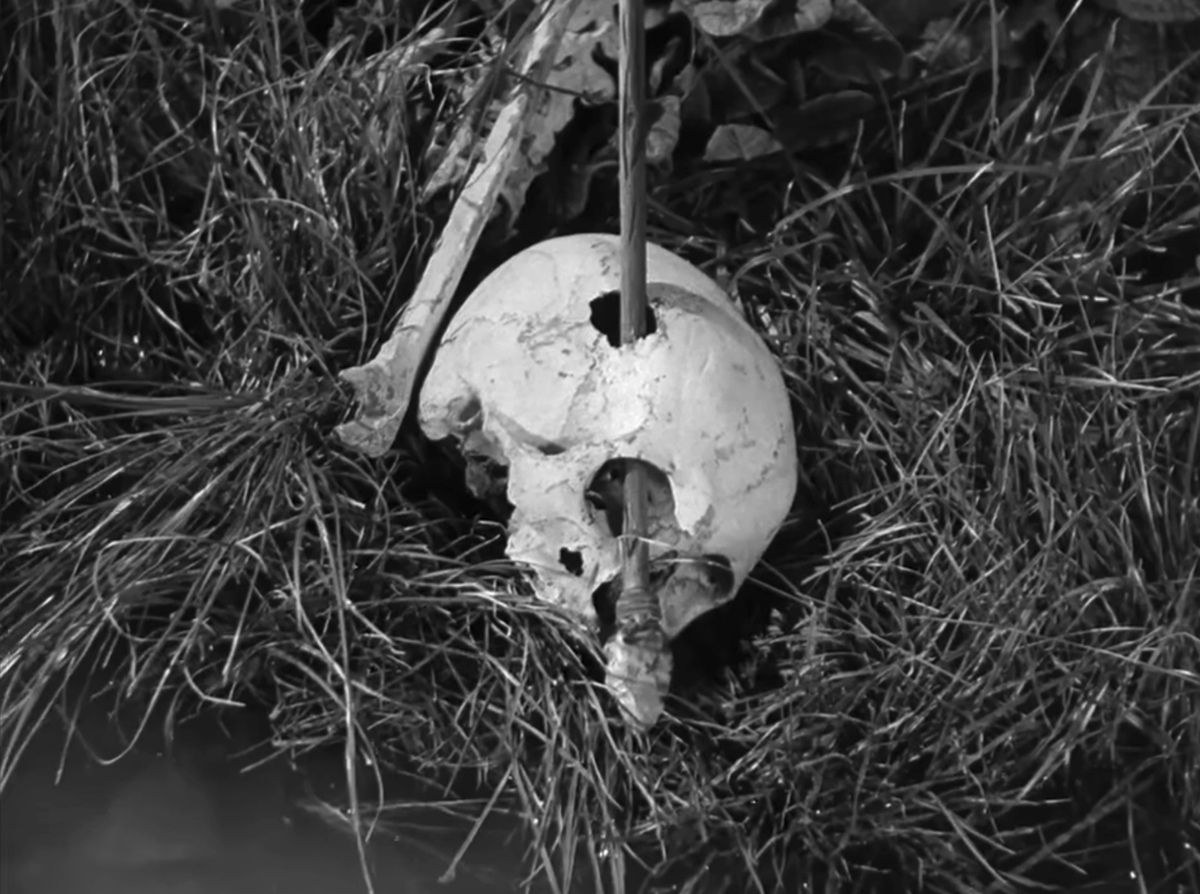 From Yellow Sky
To aid in the telling of his tale, the grandfather first asks the rebellious Mike for his pipe, she adamant against any cooperation with thieves.
He relates how they came to the failed town and eventually found what they were looking for, hiring two or three Apaches to help them. At which point the grandfather stops and says, "You know, I've been smokin' a pipe for 60 years. I'm still havin' trouble with my puffer." Then he goes into how gold is a dangerous thing if one wants it out of greediness, that he's seen many men ruined by it.
The grandfather reveals he has mined $50,000 in gold, which would be over a million dollars today. For 1867, that was exceptional. So what are the grandfather and Mike still doing there, out in Death Valley? Mike speaks of how her grandfather has dreamed of the town being resurrected, but we're not given a clue on why or how, except for revealing the gold vein and causing a gold rush.
Okay, that puffer. It's such an awkward insertion. I think it has to do with a "puffer" having been a quack alchemist, the type only concerned with discovering the secret of transmuting base metals into gold, the "puffer" moniker derived from the bellows used. With what is an alchemist such as Prospero concerned? The production of gold as a metaphor for the purification of the soul (as well as some personal revenge) and that really is what the movie's concerned with from now on, wrapped up in a plot of Dude and Lengthy not being satisfied with the 59/59 split of the gold agreed upon by the grandfather and Stretch, Stretch taking the side of Mike and her grandfather against his gang, bullets flying. When the largely peaceable Bull Run is shot, who had earlier stepped in and defended Mike when Lengthy proceeded to assault her, Dude and Lengthy abandon Walrus and Half Pint to fight between themselves, down in the ghost town, who will leave with the full portion of gold.
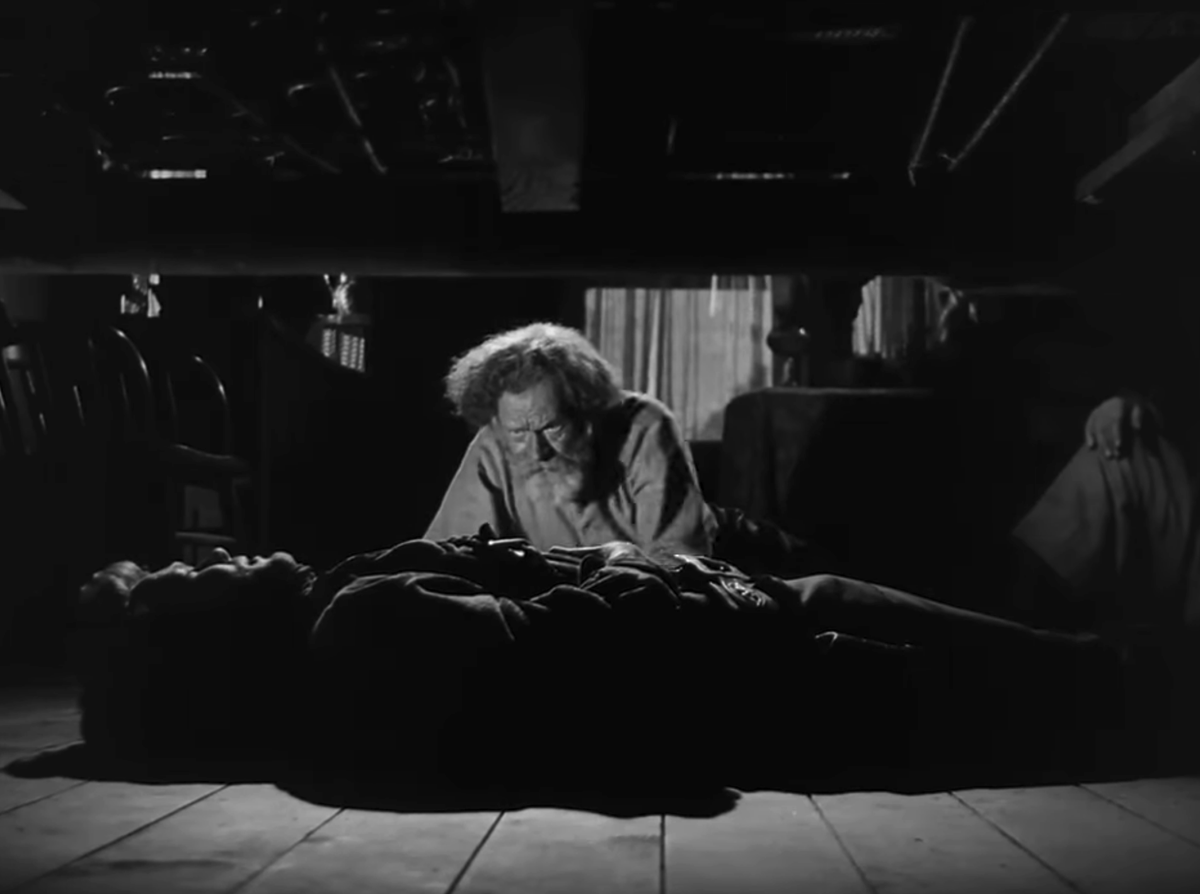 From Yellow Sky
The shot of Bull Run reminds me of Kubrick's Fear and Desire and those of the "enemy" soldiers killed at the cabin where the "friendly" soldiers find a meal, so that they dine amongst the dead.
Stretch pursues Dude and Lengthy to the saloon in which they hide from one another. We are shown him bursting in through the saloon doors but we don't see the shoot out. Instead we hear shots, see flashes of light within the saloon, the shadows of the two horses left outside the saloon shown reacting to the gun shots and bolting. It's a wonderful scene.
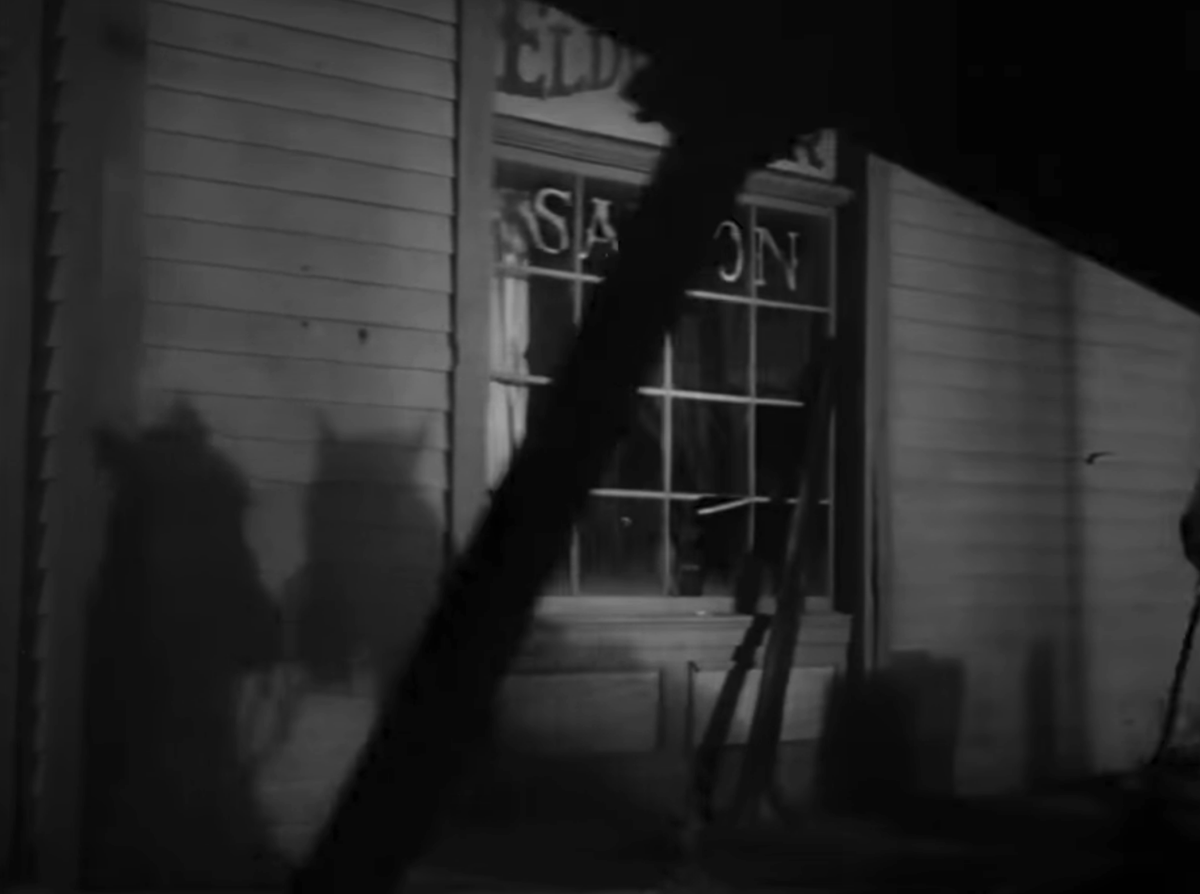 From Yellow Sky
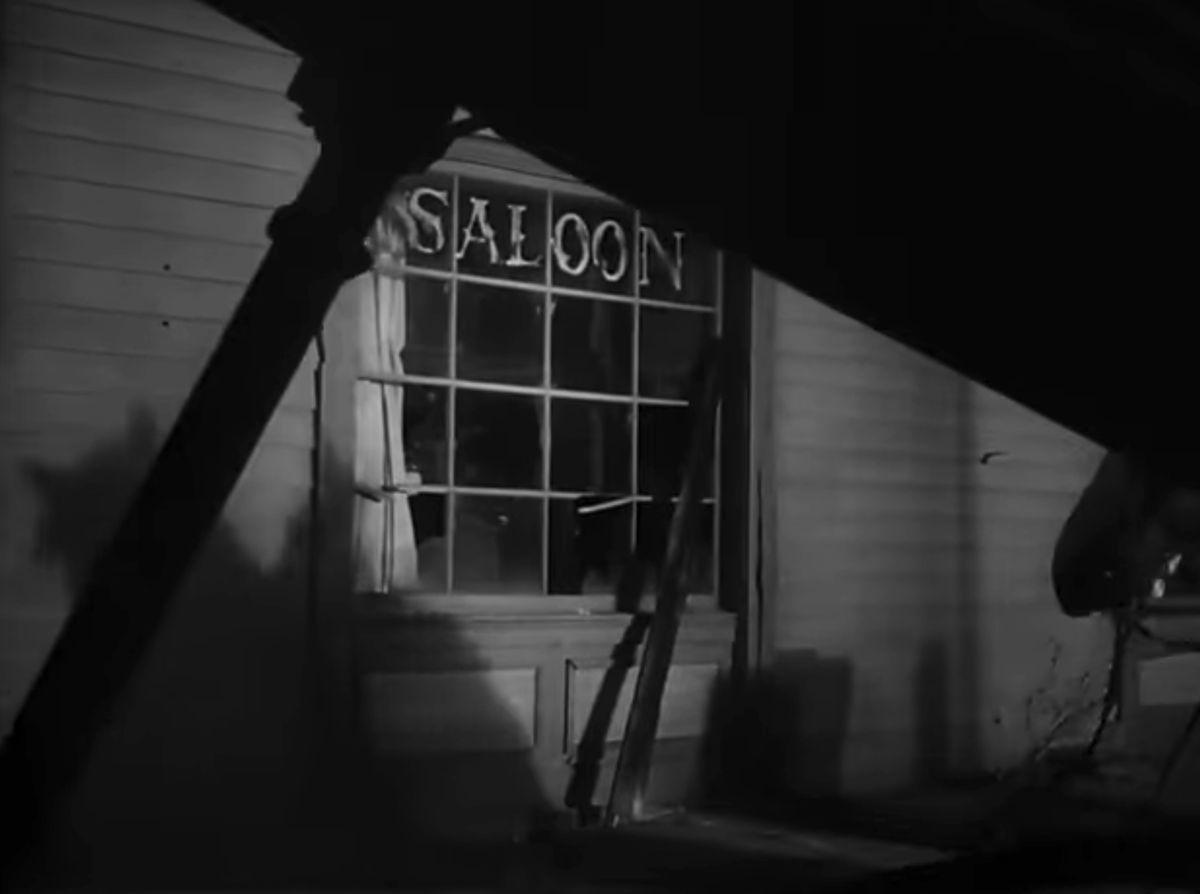 From Yellow Sky
The gun fight having concluded, a curtain in a saloon window is torn off the rings that hold it to its rod. What would cause the curtain to be torn down but someone having grabbed it. It's unlikely to be Dude, who was hidden behind the bar, or Lengthy, who was behind the casino table.
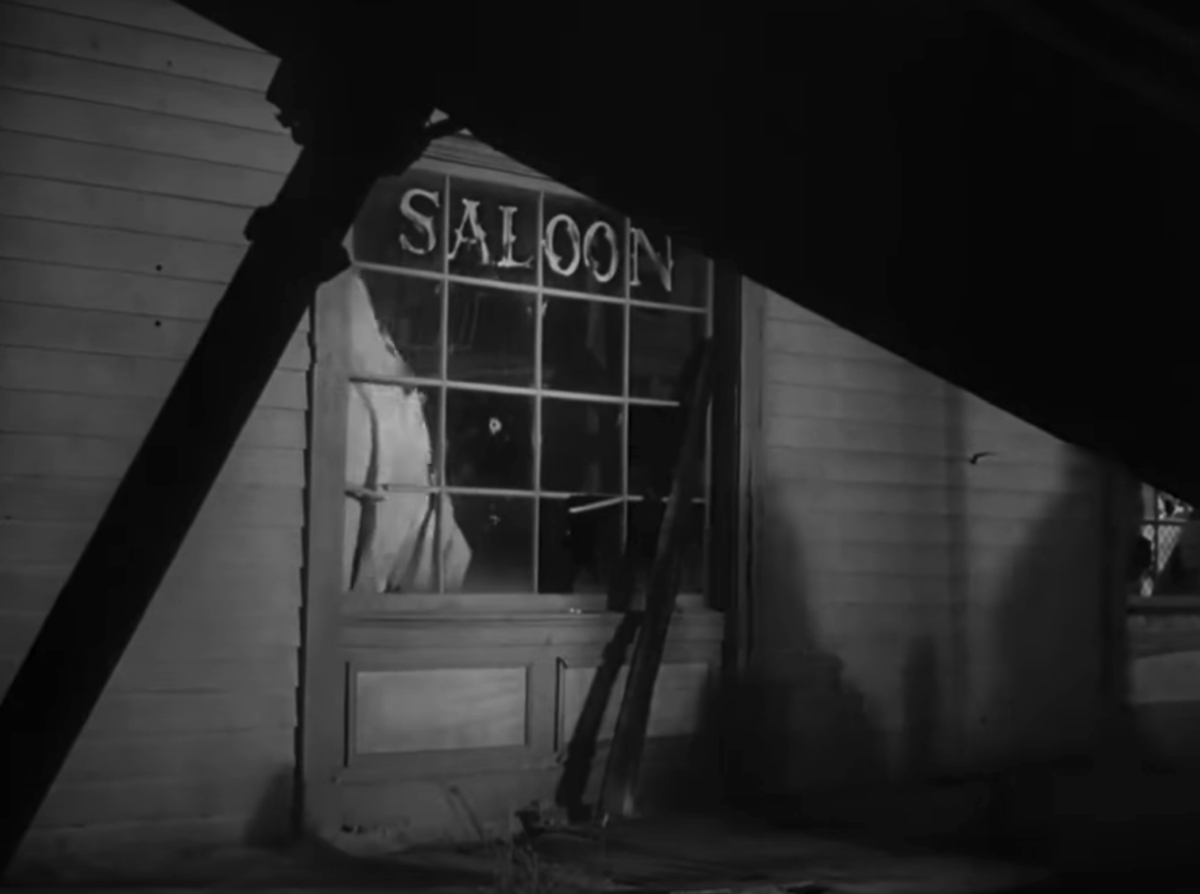 From Yellow Sky
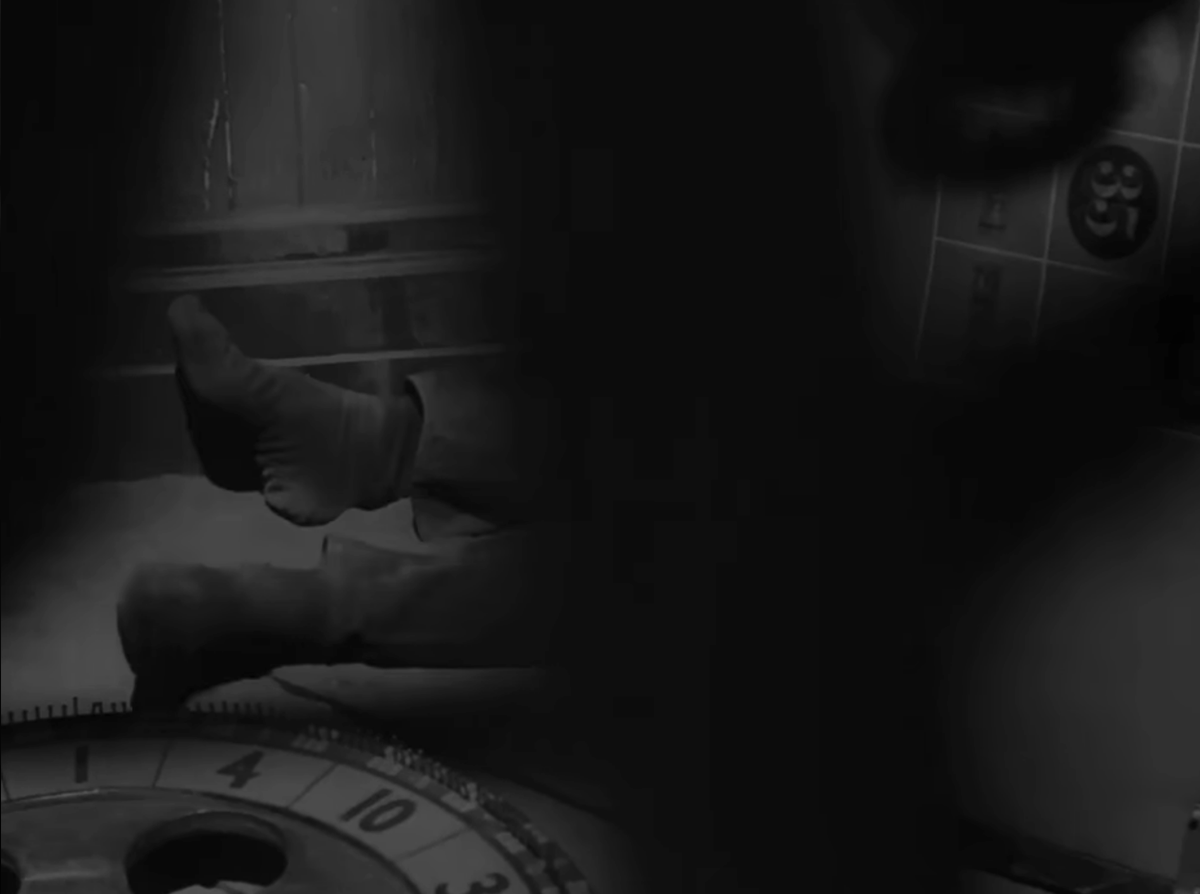
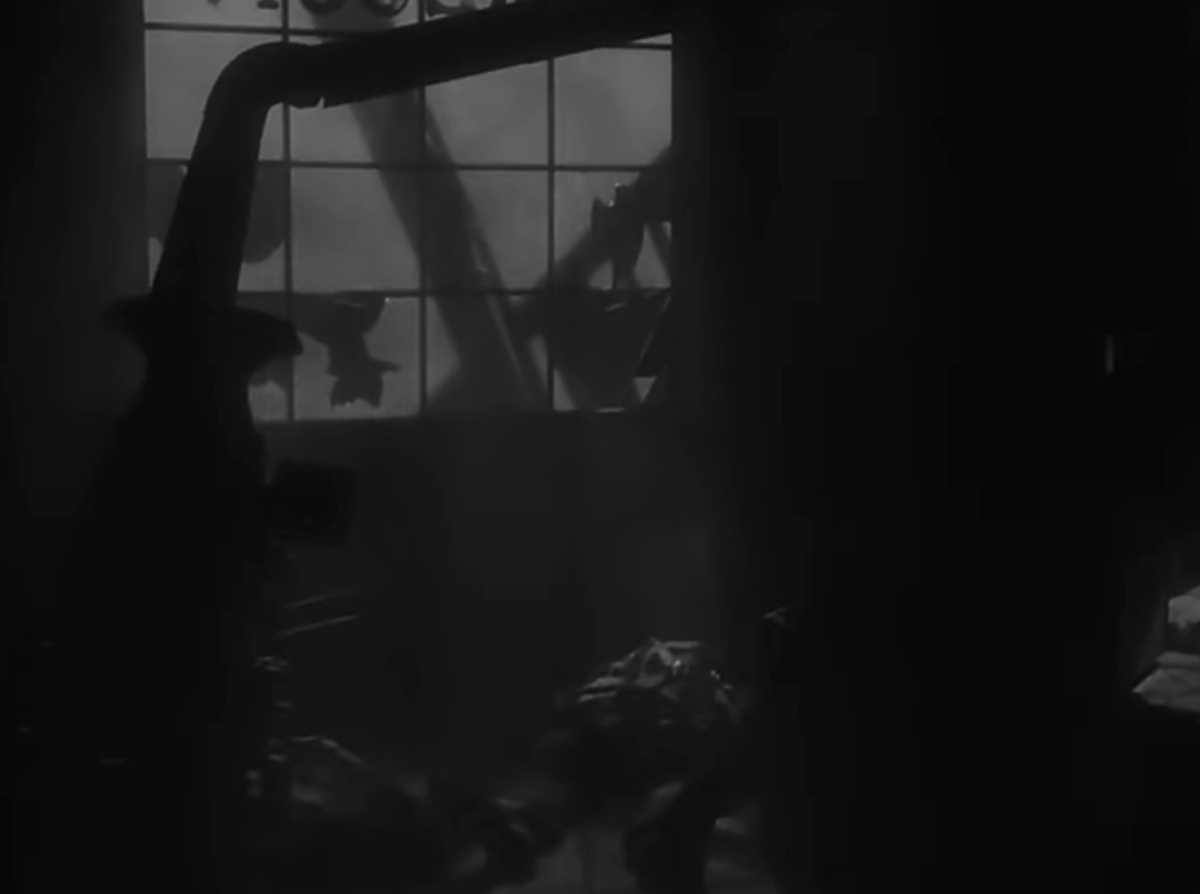
Mike rushes down the street, into the saloon, where she searches for Stretch. She comes first upon Dude, and then Lengthy. The first we see of Dude is his hand, and the first we see of Lengthy are his feet. Again, I'm reminded of Fear and Desire and the shots of the dead during the dinner, which included dissociated hands and feet, but in Yellow Sky each shot inside the saloon is chaotic, near abstract, jigsaw sliced with a tumble of silhouettes and shadows.
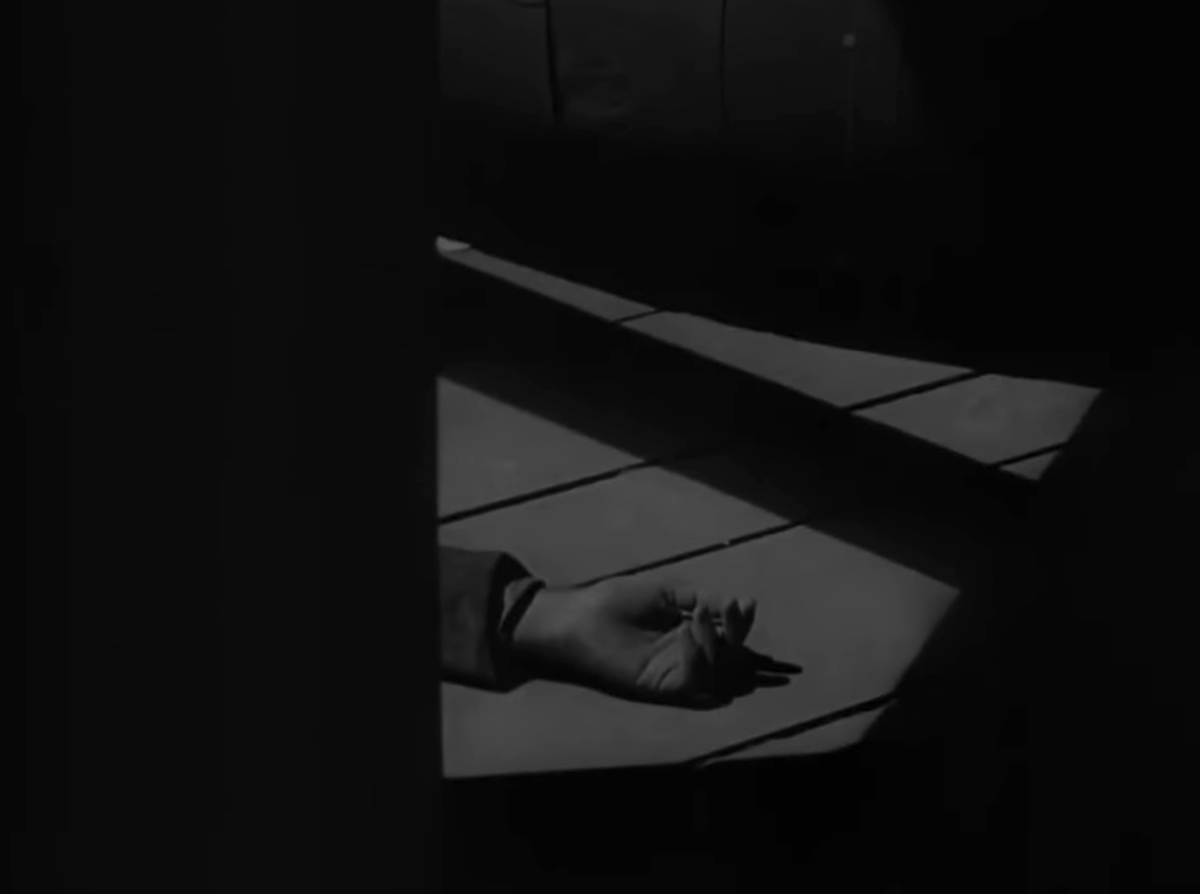 From Yellow Sky
 From Yellow Sky
 From Yellow Sky
Finally, Mike finds Stretch under the window. He's unconscious but alive. Though we can hazard best guesses, we will never have certain knowledge of whose bullet it was that killed Lengthy or Dude, whose bullet it was that wounded Mike's grandpa, or felled Stretch at the saloon. I'm not certain if I've ever seen another non-war film in which bullets are so near anonymously delivered. The bullet that injures Stretch's arm during the gunfight that ensues after he sides with Mike and her grandfather is one whose source we know, which was Dude's gun. The bullet that strikes Bull Run, if we carefully watch, we can assume comes from Stretch's gun, though we only deduce this from seeing what we assume is the shadow of Stretch's gun firing and then we see a pair of eyes fall between the boards of a stall in the barn, which we realize would belong to Bull Run. And the psychology of it, the uncertainty, does have impact. With the final battle, the viewer seeing the flashes of gunfire from outside the saloon, is prepared not to know, the outcome allotted to fate alone. It's true, however, if we go back and carefully examine the scene, after Stretch enters the saloon the first gun shot/light flash likely comes from his own gun, and the second, which is to the left and higher, likely is from Lengthy's gun. The third may come from either Stretch's gun or Dude's. Then, the camera having moved over to he side window, we can make out beside the curtain a hand just extending from it, holding a gun, which would be Stretch's. He appears to fire twice. The third shot would come from Dude, however that bullet doesn't strike Stretch as it goes through the window. Stretch would have had to have been already injured before that sixth wild shot.
Climactic gun battles usually have a winner and a loser identified by whose gun shot the killing bullet, and because Stretch is the one left alive one may even assume he was the one who delivered the killing shots to both Dude and Lengthy, but for all we know Dude and Lengthy may have shot one another as well as Stretch. We've no idea and because of that Stretch is less interpreted as the winner than the one who survived.
At some point in the future, Walrus, Stretch and Half Pint visit again the town of Rameyville where they'd committed the robbery, Walrus and Stretch returning the money to the bank, and Stretch purchasing from a woman her flowered hat. They then ride out to meet Mike and her grandfather who had waited for them outside the town. Stretch gives Mike the hat, which she puts on, and grants her first smile of the film. All ride off into an uncertain future, but one in which we're confident Stretch and Mike are together.
Is Yellow Sky tightly bound to The Tempest? Not so much that individuals who don't know of the connection might guess at it, but I've the impression it was important to the script writers, Lamar Trotti and W. R. Bennett. And I imagine the connection granted permission for the inexplicable and mysterious that would have beeen left out of a more standard western. For The Tempest is irreligiously supernatural, which Yellow Sky is also. That Stretch chooses to enter into the salt flats is an illogical act on par with Prospero's brewing up the storm to which the ship carrying Ferdinand will appear to be lost, causing him to be moored upon the island. I've already noted how it's when Half Pint kills his horse as an act of compassion that the town materializes, first appearing as a wavering mirage then taking on full substance, however as a ghost town. Miranda and Ferdinand are unaware of Prospero's manipulations, and though Mike's grandfather is treated less obviously, his actions repeatedly run counter Mike's judgement, giving Stretch the time and opportunity to reform as James Dawson. Prospero isn't without fault by any means and is forced to face consequences of his own intemperance, which I believe can be sensed in how the grandfather gazes, as one stricken, upon the dying Bull Run. When Mike pleads, "We can't just let him lie there and die," a bullet immediately pierces the room, supposedly fired from outside by Half Pint's gun, after which Walrus announces Bull Run's death. We see the bullet strike a vase nowhere near Bull Run, but we should think back to when Half Pint shoots his horse, putting it out of its suffering, after which the town appears first to Stretch and then to the others.
With Bull Run's death, Walrus says of him, "Funny thing, he was the only one against coming here in the first place." Which doesn't match up with earlier scenes. When the gang rides into the salt flats and the army turns back, it's Bull Run who mocks them, saying, "Them garrison soldiers just can't take country like this." When they stop to divide the loot from the bank, Dude, Walrus and Lengthy are all against continuing into the salt flats, while Bull Run says nothing about it.
So how has this change occurred that would cause Walrus to say that Bull Run was the single person who hadn't wanted to come there.
Walrus is aware that Bull Run has been made nostalgic by Mike, that her home reminds him of his in Ohio, and of his parents calling him, Luke, to dinner. At about 59:05, during the quiet of an earlier night, Walrus begins singing and observes Bull Run staring at the house as he sings. The song is this:
I"m sad and I'm lonely, my heart it will break
My sweetheart loves another, Oh, I wish I were dead!
My cheeks once were red as the bud on the rose
But now they are whiter than the lily that grows
Young woman, take warning, take a warning from me
Don't waste your affections on a young man so free
He'll hug you, he'll kiss you, he'll tell you more lies
Than the cross-ties on the railroad or the stars in the sky
I'll build me a cabin, on a mountain so high
Where the blackbirds can't see me or hear my sad cry
I'm troubled, I'm troubled, I'm troubled in mind
If trouble don't kill me, I'll live a long time
It's an old folk song first recorded by Carl Sandberg in 1937 then by Susan Reed in 1947, Carol Sandberg having been a family friend, her parents involved in the theater and films. She had her big break singing at the Cafe Society club in Greenwich Village, progressed to singing with Burl Ives, had a national tour, and by 1947, when she was only twenty, Alam Lomax, an authority on American folk music, included her among those who were leading a rebirth of the genre. I'm including the history here, how Susan Reed was a well-known singer at the time of the film, as when I set out to find the origin of the song I was only coming up with DJ Shadow, I had to dig down to find Susan Reed then Sandberg.
It's while Walrus is singing this song that he stops and asks a thoughtful Bull Run if he's ruminating on what transpired earlier in the afternoon, likely referring to when Bull Run stepped in to rescue Mike from the clutches of Lengthy, whose advances were egged on by Walrus and Half Pint. In response to Bull Run punching him, Lengthy nearly drowned Bull Run in the water hole. Stretch had rescued him and then held Lengthy so long under water that we believe we may see his last breath of air bubbling to the surface while he drowns.
Bull Run tells Walrus he is instead thinking about home, to which Walrus says he's in love. No, Bull Run objects, "I got a right to remember, haven't I?"
Walrus returns to singing his song which touches all. It draws Mike out into the night to stand and listen. It attracts Stretch to find her, and then go in to to relate his history to her father, promising he can be trusted.
We should, at this point, connect the singing Walrus with the ethereal Ariel of The Tempest whose songs enchant Ferdinand and the others who have been moored on the island.
Full fathom five thy father lies.
Of his bones are coral made.
Those are pearls that were his eyes.
Nothing of him that doth fade
But doth suffer a sea change
Into something rich and strange.
Sea nymphs hourly ring his knell.
Hark, now I hear them: ding dong bell
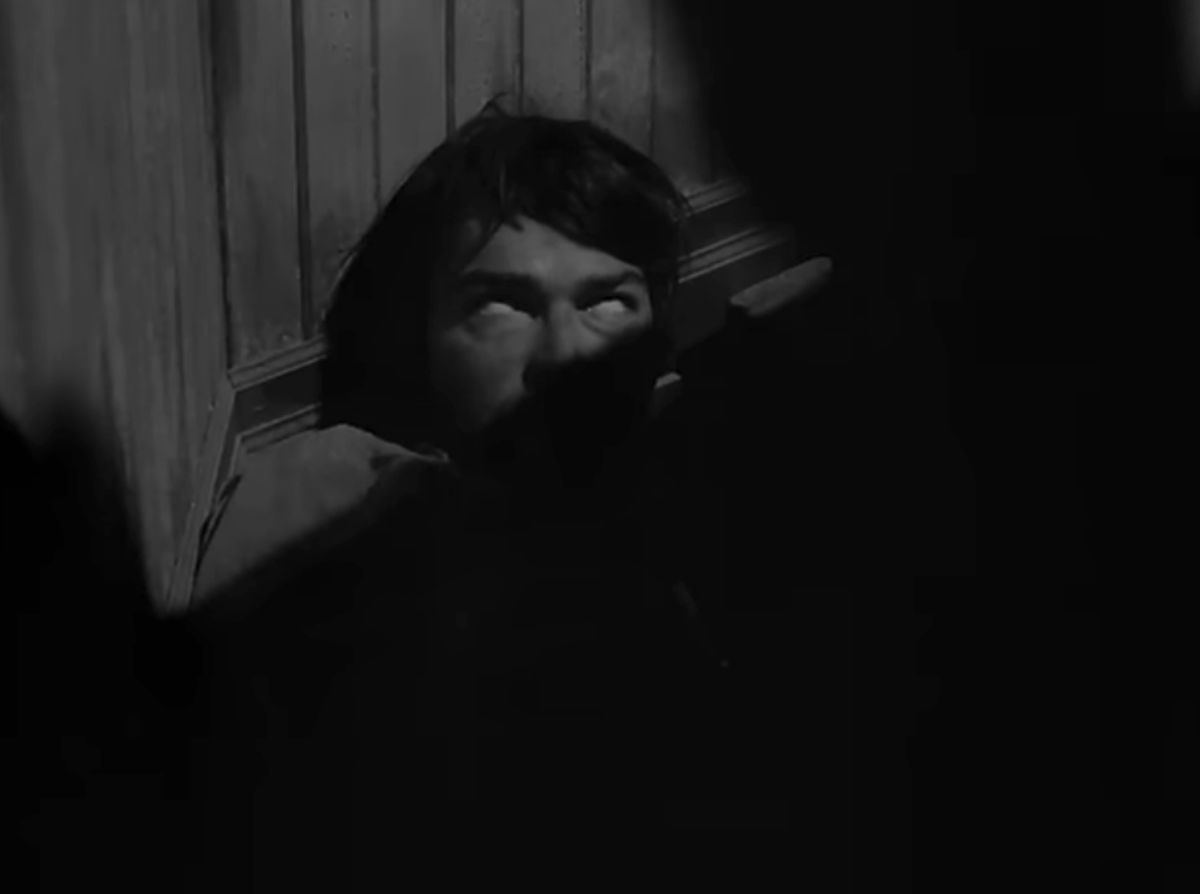
Though the above song causes Ferdinand to remember his father, who he believes has drowned, Ariel's voice has also guided him across the island to Miranda. Just as with Walrus' song, Stretch is drawn to Mike, and Bull Run to remember his home in Ohio and being called to dinner. We should instead of Ariel's song when Mike searches for Stretch in the dark saloon after the gunfight and sees the body of Lengthy whose eyes are rolled back in his head, shining white as pearls.
 From Yellow Sky
If one knows The Tempest one is invited to consider that there is more to the film than what one first takes at face value. What strange sea changes have been suffered to produce the rich and strange.
Now, am I saying Yellow Sky is a successful western interpretation of The Tempest? No, it isn't quite. The mystery lends much to the atmosphere, but the film becomes awkwardly bogged down in Lengthy's determination to rape Mike, which takes away air that could have been more imaginatively put to use. As the film was based on Bennett's manuscript that was published as Stretch Dawson a couple of years after the movie, I would love to get my hands on the book to see how it differs from the film, but from the little I find written about it online the movie is better, and the book's ending sounds like a free-for-all mess in which the ghost town is set fire by another gang who wants the gold, whereupon Stretch's gang and Mike and the grandfather are rescued by a passing wagon train. The principal characters all become leaders of the rejuvenated town, and I don't know what that means in respect to Stretch's gang, if none of them perhaps die in the book and are all reformed, which fits more with the end of The Tempest in which all are found to be safe and the ship as well by which they'll be carried back to civilization. But we don't know if that was the original ending and what changes were made to the book subsequent the film. I will have to be content with not knowing, and deliberating on the end that Wellman has given us, which is very different from the book but indeed lends more mystery to the film and is more atmospherically true to it.
July 2026
Return to top of page
Link to the index page for all the analyses
 |