
I've been unable to find Rosa von Praunheim's (1971) Die Bettwurst or (1975) Berliner Bettwurst with English subtitles (at least online) and I'm not sure it matters? The design is so good, the acting so (fumbling for a word and not quite succeeding) emotive, that it's more than good enough just watching and not understanding a word while wishing one did.
Die Bettwurst presents for us the characters Dietmar and Luzi as camp commentary on the cultural, even ritualized aesthetics of a mid-twentieth century, working class couple--she's a secretary, he's a former crook attempting to escape the sorry life of crookdom in which he became engaged as a youth after the death of his mother and which led to a stint in prison--while communicating them in a rather innocent manner as two unique individuals who love-need one another and are creating their shared lives as a dedicated study of the "norm" to which they want to belong, not in a futile, hopeless manner but trusting that their companioned aspiration to fit in assures that they are desired consumers and thus fit in. At least that's my visual read of the film, and what I have been able to gather about the plot which ends in Dietmar rescuing Luzi when she is kidnapped by the bad guys, by which we know that he truly cares about her. While the couple is portrayed as heterosexual, it's obviously an LGBTQ commentary in a Germany where it was only in 1968 and 1969 that same-sex acts between men were decriminalized.1971, the year of Die Bettwurst, was still a vulnerable time.
While I was thoroughly enjoying Praunheim's Dietmar and Luzi, a painting caught my eye, and I wasn't sure I wanted to write about it but decided, well, why not, though it presents a non-solvable problem which is probably a non-problem.
First, Die Bettwurst had its television release 2 Feb of 1971.
In Die Bettworst , there's an exchange of Christmas gifts.
Image 1 shows Dietmar holding a photo of herself that Luzi has gifted him, while Dietmar has given her a kitsch painting of a woman. The painting, "Tina", is by Joseph Henry Lynch, and I read was done in 1961.
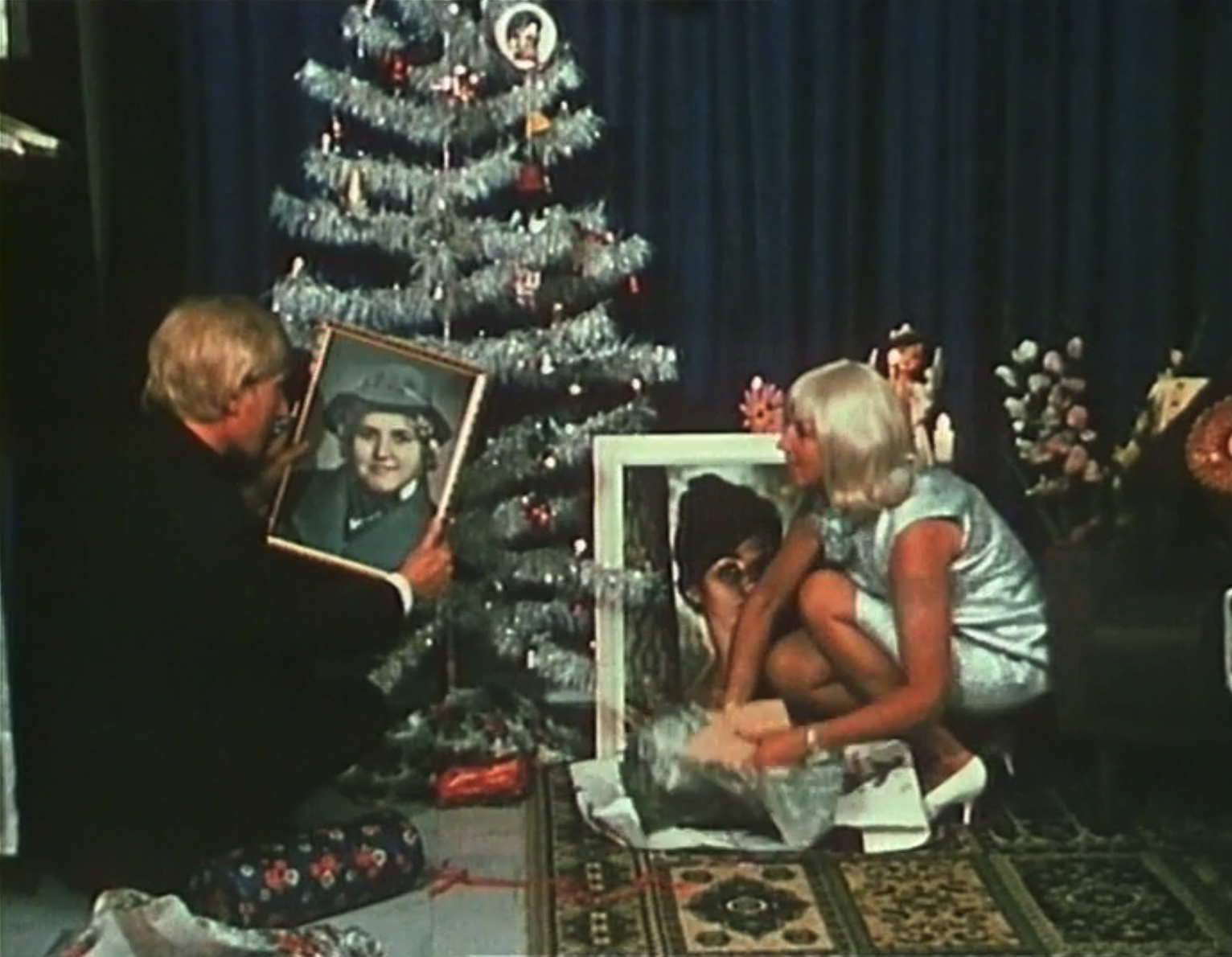 Image 1
In image 2, Dietmar and Luzi carry the "Tina" painting over to hang it on the living room wall above the sofa.
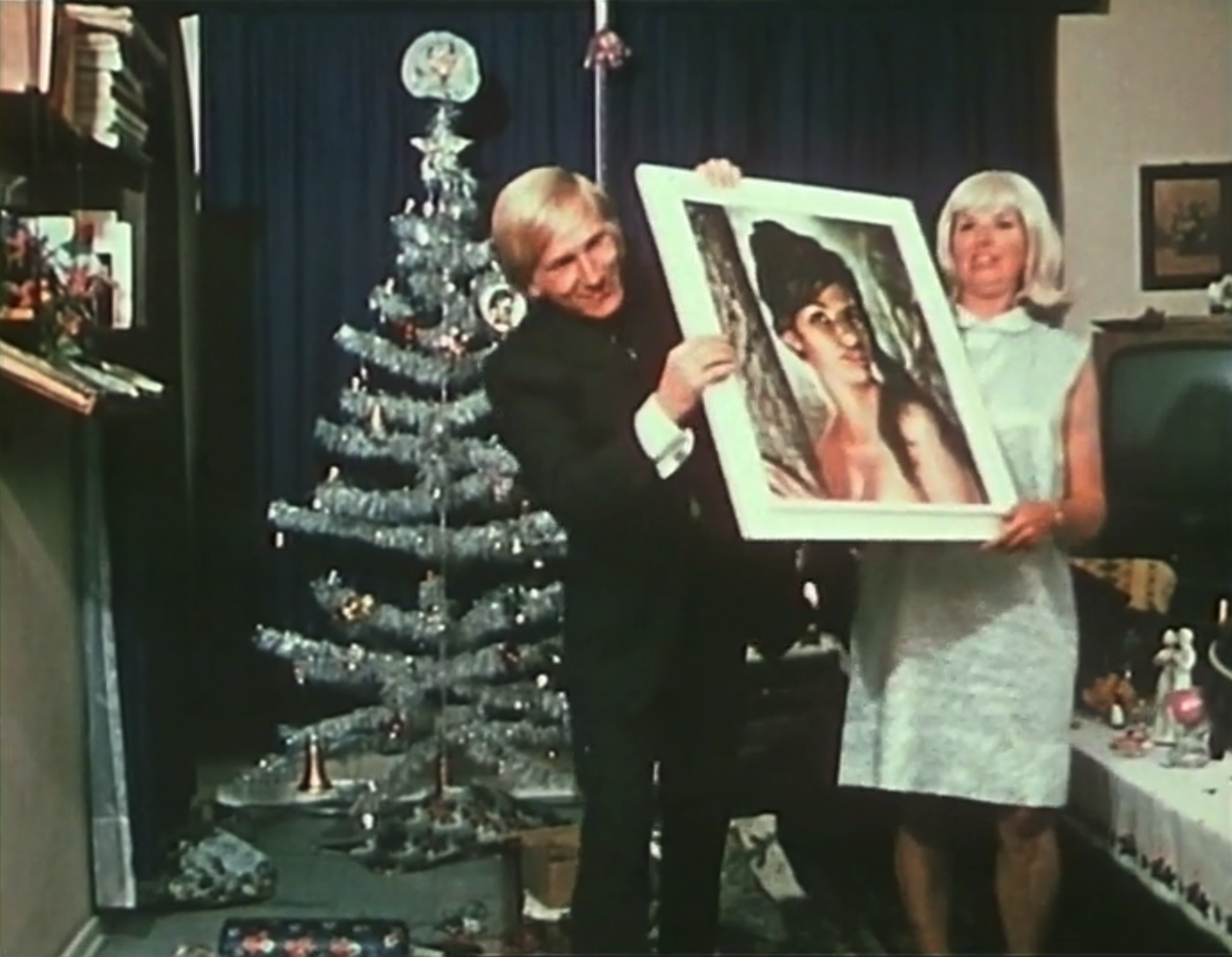 Image2
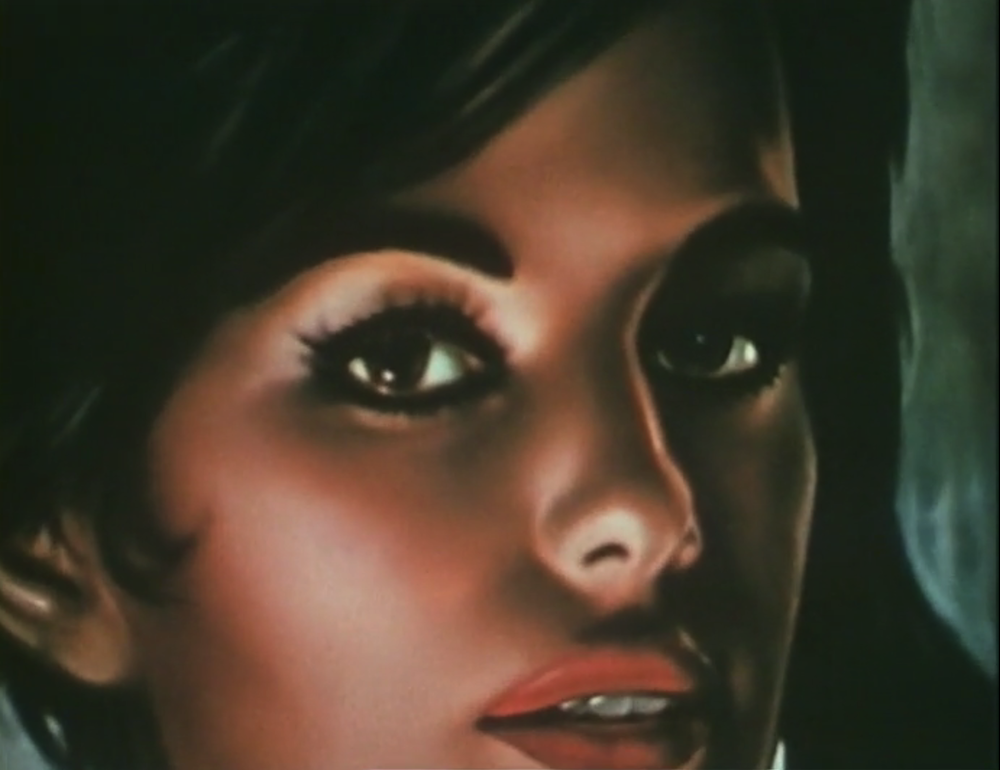
Image 3 is taken from a close-up of the painting in which the camera really gets personal with it, holding on the painting for a long while. Tina breaks the fourth wall looking directly at us and we look at Tina. Von Praunheim exaggerates the sense of encounter, after which we are shown Luzi and Dietmar standing before the opposite wall discussing the painting. I took a year-and-a-half of German in high school, decades ago, which means I know no German. They talk about the painting at some length. Using Google to translate the Youtube-generated German subtitles suggests that the woman in the painting reminds Dietmar of a stripper he once knew, a childhood love. But Luzi, he leaps to say, is like an angel. Does he say that the woman in the painting is snake-like? The word "snake" appears, at least in the translation, which means nothing.
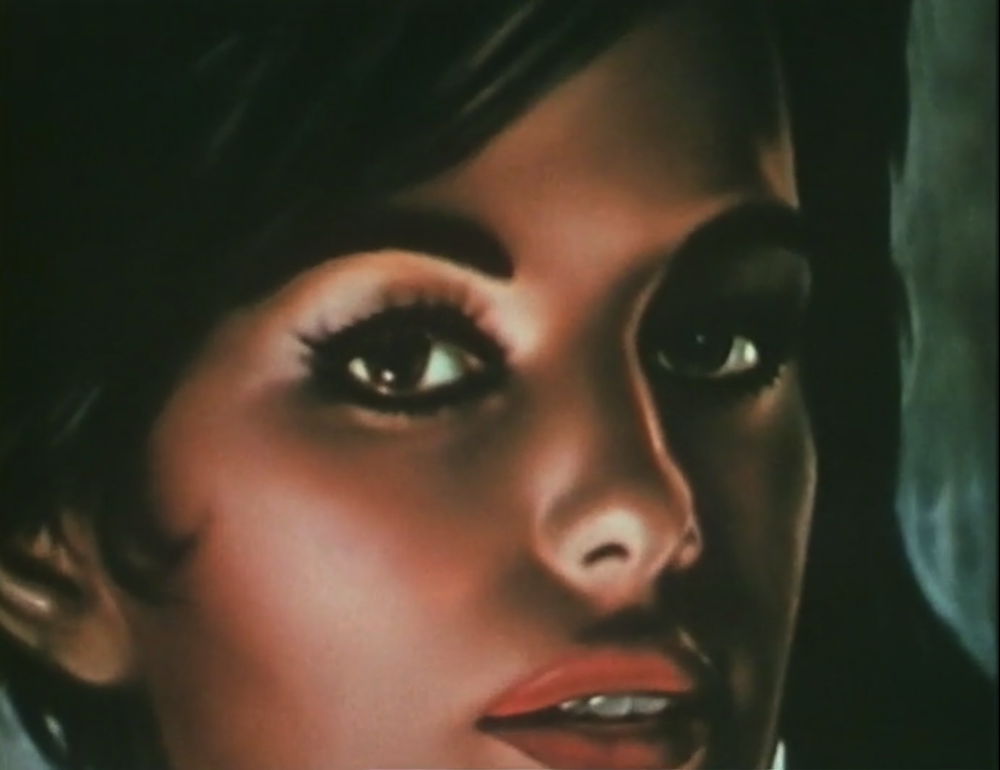 Image 3
There's some history behind this in the film, as prior this Dietmar had one day brought home a velvet painting (image 4) of a nude woman looking at herself in a hand mirror, a little nod to Narcissus perhaps. But the velvet painting also refers to an earlier scene in which, the morning after the first night they'd slept together, Dietmar had watched Luzi sitting before a large vanity-table mirror while also making herself up in a hand mirror by which means she could see her rear reflection. During that scene, Dietmar had told Luzi of his history, Luzi primping throughout, scarcely taking her eyes from the mirror, after which--again, relying on Google translation of Youtube-generated German subtitles--she had agreed that he should stay with her.
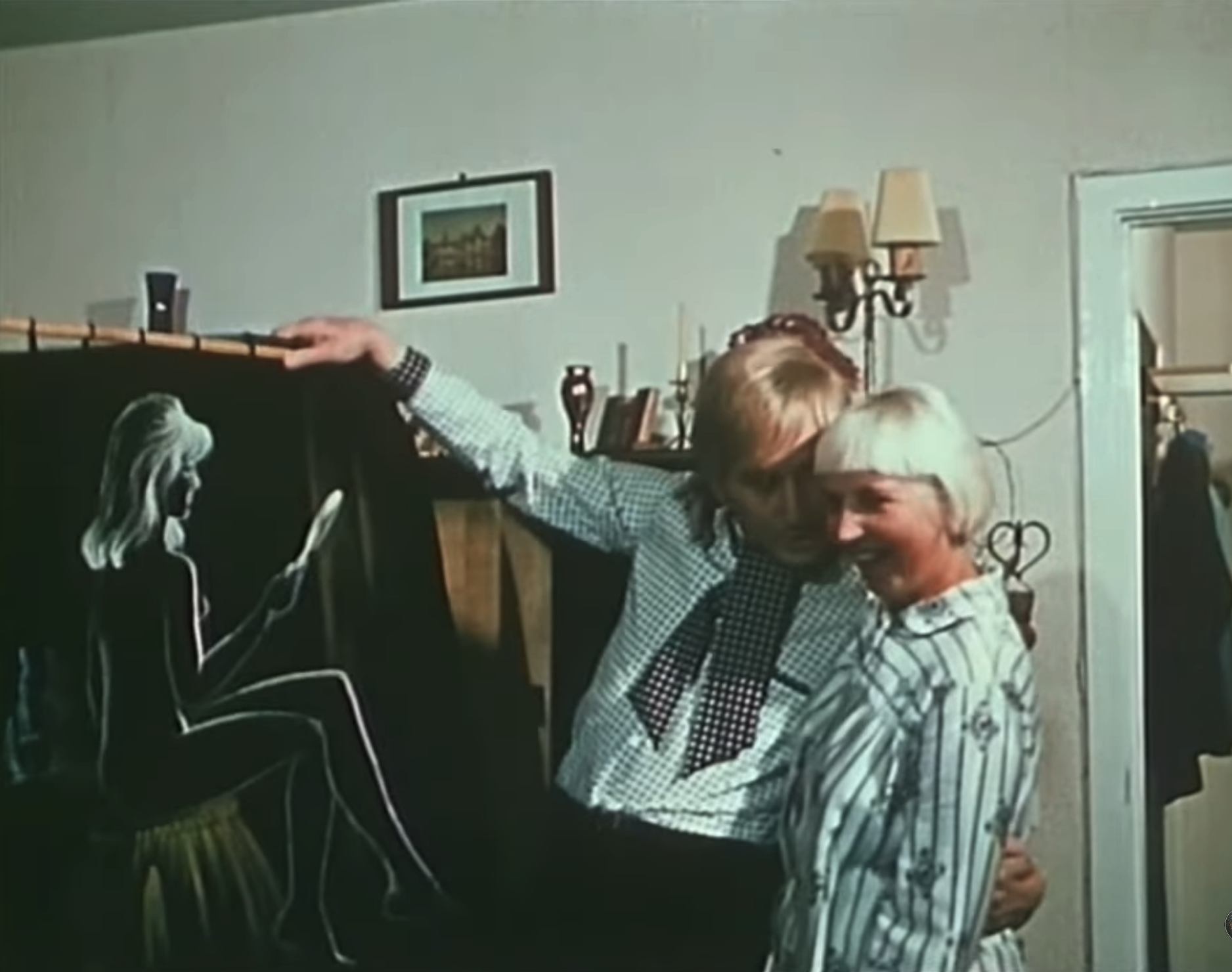 Image 4
A landscape had been hanging on Luzi's wall and in image 5 we see how they replace the landscape with the velvet panting of the woman looking in the mirror. At Christmas, this painting of "Tina" goes on the same wall and may have replaced the nude looking in the mirror.
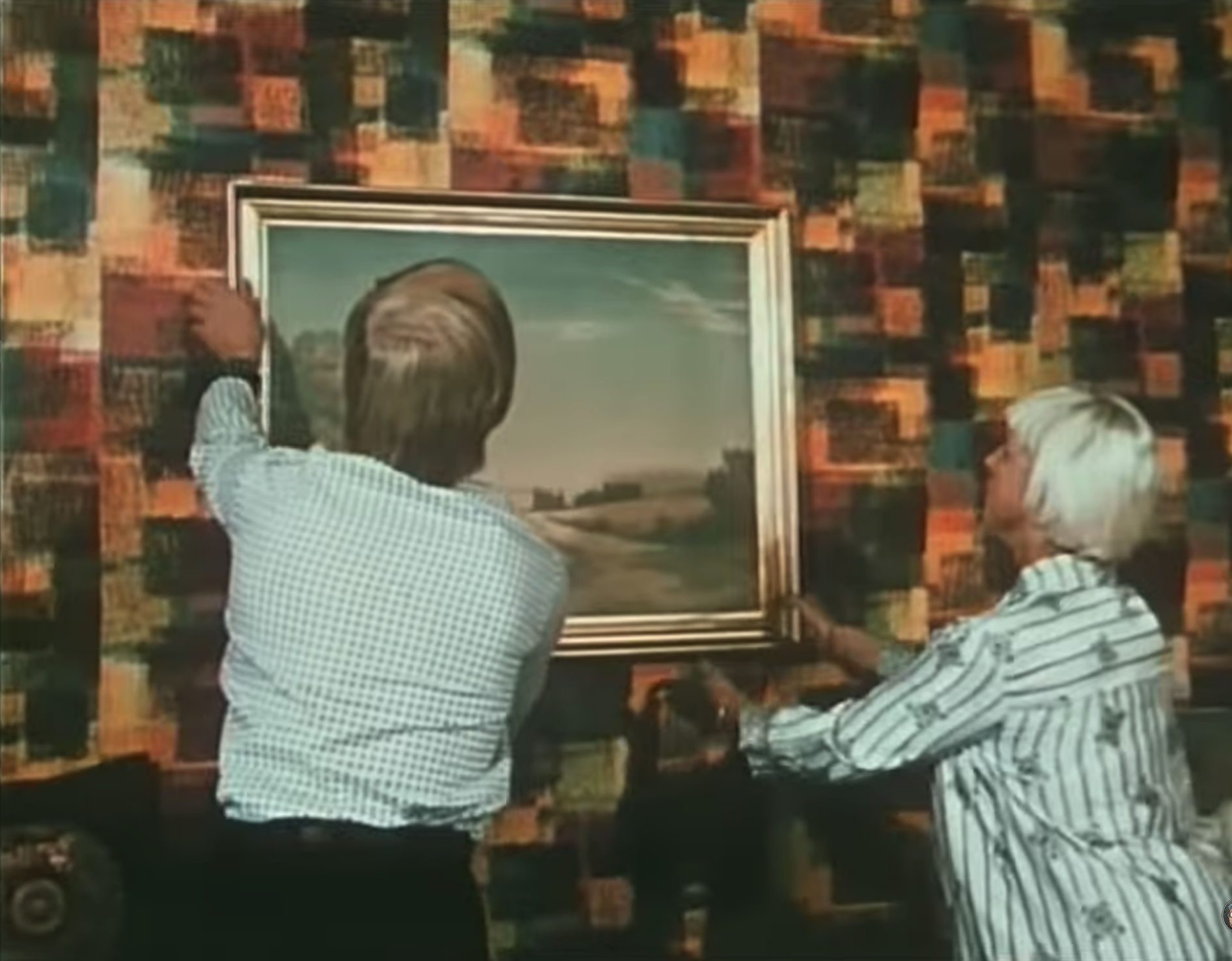 Image 5
Why would "Tina" catch my eye? Because the same painting appears (image 6) in Kubrick's A Clockwork Orange. We get a close look at it when Alex arrives home from prison, the interior of Alex's parental home.
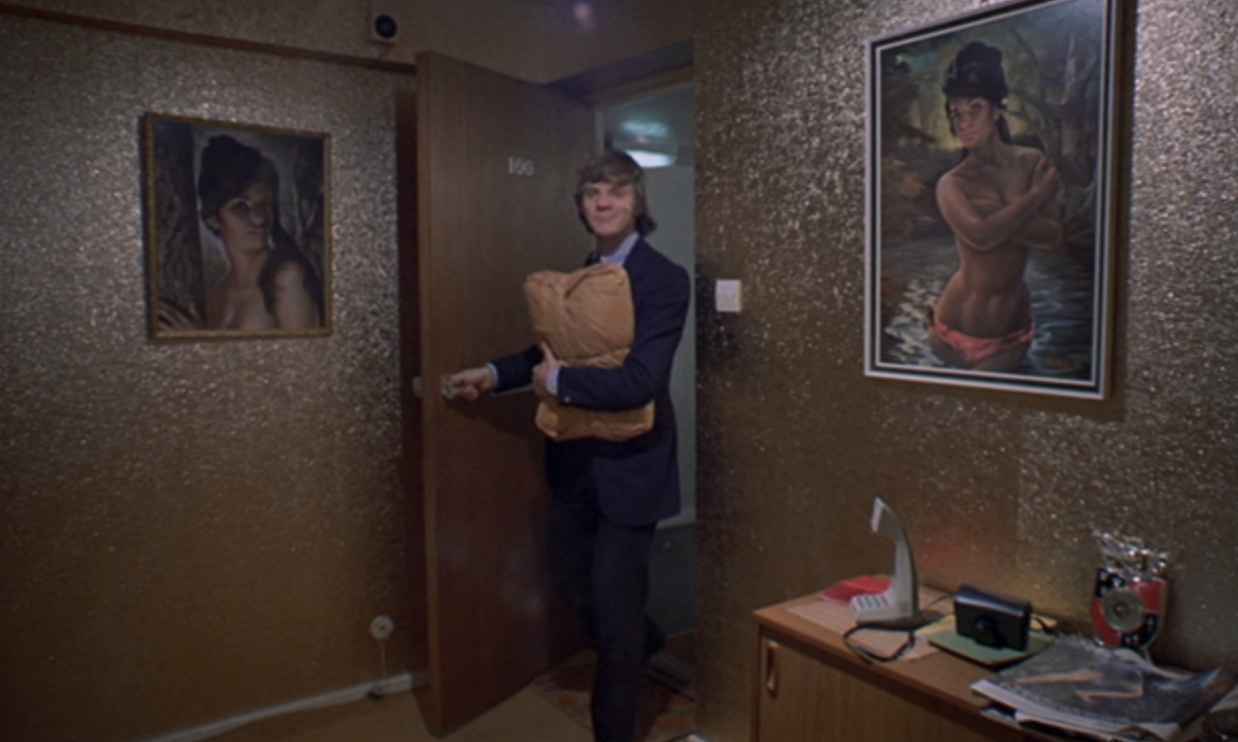 Image 6
In image 7 we see the painting behind Alex as he looks into his bedroom, he realizing all of his things are gone, that while he was in prison he has been displaced. The thing about Alex is that the pre-prison scenes made clear he obviously deplored the gaudy petit-bourgeois, working class tastes of his parents and had decorated his room with modern art designs more in aesthetic alignment with the home of Alexander, which Alex and his gang invade, Alex raping Alex's wife. It's as if Alex was born to the wrong family, that the writer, Alexander, should instead be his father. However, when Alex is imprisoned, it's for his accidental murder of another woman during an invasion of her home and his gang betraying him to the police. The Ludovico Treatment of violence aversion has led to his being declared "cured" and released again into the general population, but Alex now finds he has no home to which to return. His room has been cleared of any vestige of his affection for high-end modern art design, also his love for Beethoven, his beloved snake is gone, all replaced with decorative elements courtesy of his mother and those of a new tenant who has plastered the walls with images of men playing sports along with a few pictures of pin-up girls.
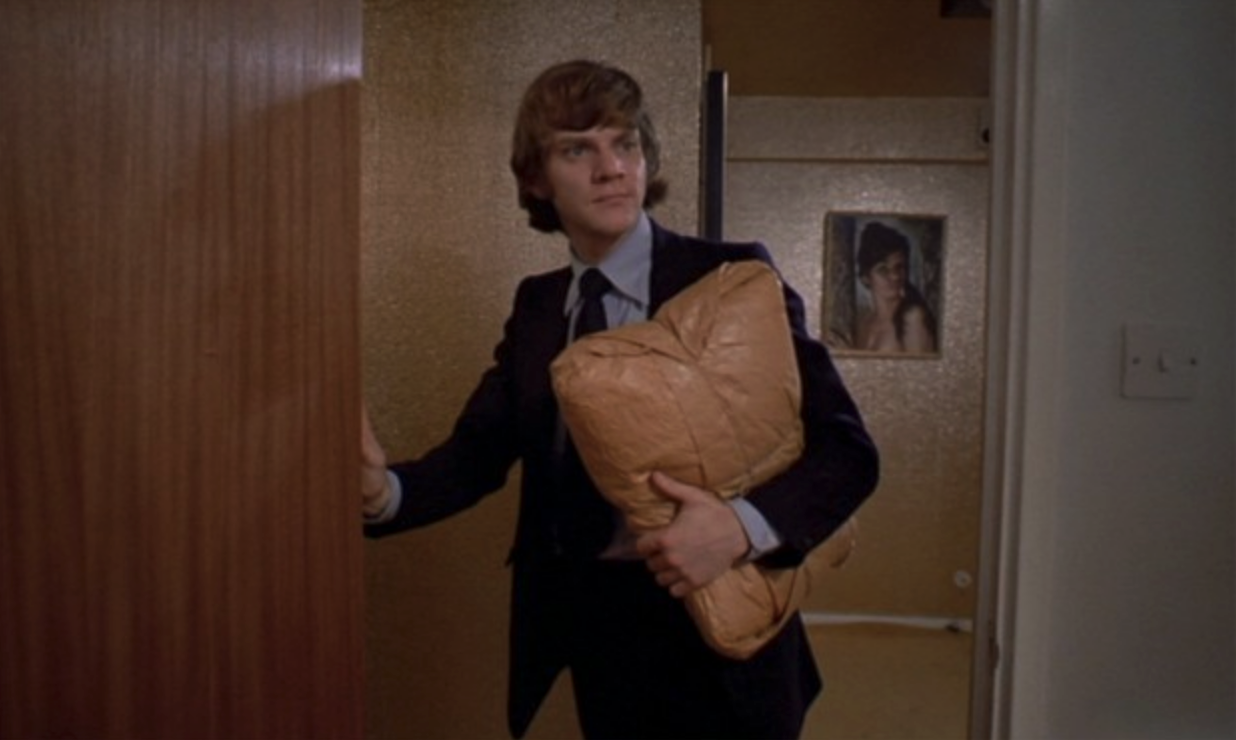 Image 7
The entire home of Alex's parents (image 8) is actually decorated with Joseph Henry Lynch mass-market paintings in the same style of "Tina".
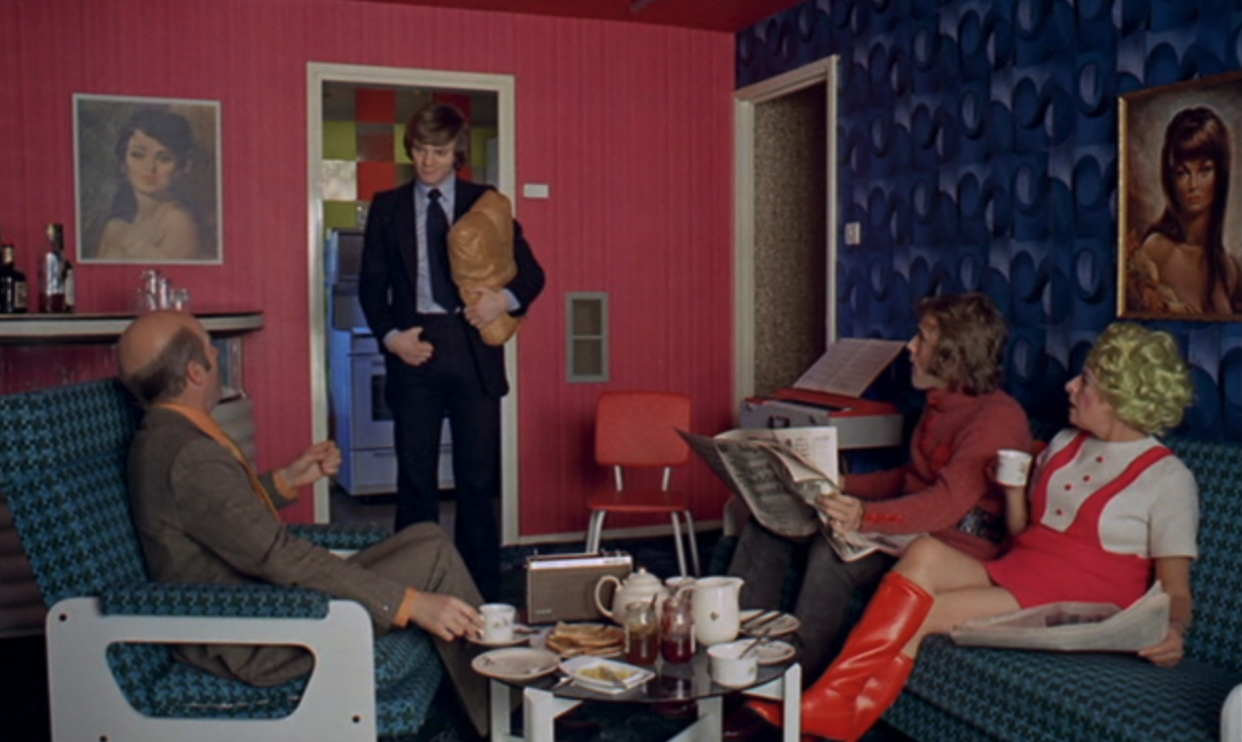 Image 8
A thing I've explored in my analyses of Kubrick's films is how he slides in commentary with the references he makes to other films and of course to his own films as well. Some films we know he referenced while in the space of Alex's parents apartment were Cat Ballou, One Million Years B.C. and Christopher Lee as Dracula. There are other films referenced in A Clockwork Orange, I'm just mentioning the very obvious ones connected with the home of Alex's parents, all the above references occurring when Alex was resting in his room after the rape of Alexander's wife.
A Clockwork Orange was released in December of 1971, ten months following the television release of Die Bettwurst 2 February 1971. In some instances I read cinematography for A Clockwork Orange ended in April 1971 and in others I read principle photography ended February of 1971. A Warner Brothers fandom page states shooting continued through February 24, the last scene shot being the fight scene in the casino. The interiors of Alex's parental home were filmed at Canterbury House. When did this filming at Canterbury House take place? I don't know. I've searched around and don't see an exact time frame given. But it seems highly unlikely, doesn't it, given the dates, that Kubrick would have been influenced by Die Bettwurst in his choice of "Tina" and her siblings to decorate the apartment of Alex's parents.
The images of "Tina" and her mass-market siblings, in A Clockwork Orange, have a peculiar effect established by "Tina" appearing to gaze over Alex's shoulder when he realizes he's displaced. More than that, if you examine Alex's stance before the open door of his room, it is much the same as Tina's, so one could even imagine that Tina's action anticipates Alex's.
Kitsch images of Indigenous children are used in much the same way in The Shining, so they are rather like spirits from another realm peering in on what's happening in the lodge. One gets a bit of the same feeling here in A Clockwork Orange. "Tina" is not simple background decor, she is as good as a character, making eye contact with the viewer, which is how von Praunheim used her, reinforced by the extended close-up in which Tina locks her gaze with that of the viewer, the fourth wall broken.
With both directors, "Tina" was not merely a momentarily glimpsed element. She was a main character in homes that are conspicuously outfitted to satirize those naive as to higher culture, however in the case of Die Bettwurst this is accomplished in a manner sympathetic with these two individuals living their artificially best lives as sold to their level of income and presumed tastes.
Also to be considered is that Alex has been replaced, in the lives of his parents, by not only a person who takes on the role of the doting son, but gives a hyper-masculine, queer read, while in Die Bettwurst, the couple is obviously fond of and dependent on one another, but Dietmar is a gay man who is in a relationship with an older woman. If it had been at all possible that filming at Canterbury House was after the release of >Die Bettwurst, I would have wondered if Kubrick very intentionally plucked her from the home of DIetmar and Luzi, that no coincidence was involved in his likewise using "Tina" in eye-to-eye engagement with the audience in a film that comments so much on the relationship of the audience to both theater and film. But it does appear to be only a coincidence, which means "Tina" was so popular in certain settings that she would be a natural occurrence in Alex's British home and Dietmar and Luzi's German home.
July 2026
Return to top of page
Return to Table of Contents for A Clockwork Orange analysis
Link to the index page for all the analyses
 |