The premise is simple. A man (Michael Johnston as Bear) wants the woman he loves (Inde Navarrette as Nikki) to love him in return. He's afraid to voice his feelings for her because what if she protests she only cares for him as a friend. He fears rejection and the relationship he does share with her being destroyed by his admission. Though I liked Barker's "Milk and Serial", I wasn't on fire to watch "Obsession", but when I learned of its plot, because I knew of a 1995 film, "The Chemistry Lesson", in which Alan Cummings captures the love of his life by also casting a spell on her, which destroys the lives of all concerned, I was curious to see how they compared. Not that I enjoyed "The Chemistry Lesson", because I didn't. I thought it a thin film with feeble story-telling and artless cinematography that befit the ghost or supernatural television genre for which it was made. The concept was the high point, but when filled out it became a clumsy morality tale. Had there not been a good amount of nudity, it could have been an after-school special, an education on boundaries, less because of learning respect for than fear that you, too, being uneducated, might fuck up a good time by not weighing the ingredients in the proper proportion to avert catastrophe. "Don't do this at home!"
Love spells are probably as old as the ability to conjure and tell a story, as depictions of prey animals on the walls of caves, and undoubtedly are as old as spells to destroy another. To my recollection, I never cast a love spell as a child but I had one or two friends in elementary school who did. At that time, boys would give girls chain bracelets with their names engraved on them to show that they were a couple. One of the girls I knew, who cast a love spell, gave herself a chain bracelet with the name of her love interest on it, because he went to another school and she reasoned the deception wasn't likely to be discovered. In "The Chemistry Lesson" a bracelet that belongs to the love interest is the main ingredient of the spell, but the chain bracelet wasn't part of this girl's love spell, it just demonstrated her willingness to construct, by deception, the alternate reality she desired. She would have happily had the boy enslaved by a spell. I know because we discussed this. "What if he doesn't love you? What if he doesn't want to love you?" I didn't believe in love spells, and while I wasn't horrified by her willingness to try one out, because I'd no belief in them, I was worried to learn of her willingness to make a person her puppet if she could. She was fine with this. Preteen love spells weren't hard to come across, I think they were even printed in some preteen magazines, because people like to make money and every word and image was calculated for the preteen to gladly hand over their allowance so that they may feel some intimacy with their heart-throb idols who were scarcely recognized as persons, they were instead fantasy fodder. Not many preteens have the maturity to care about the concept of free will. She had been raised in a very traditionally Christian home, but it's not as if traditional Christian family values prepare preteens for the consideration of the supposed inviolability of god-given free will. Telling children they're going to hell if they don't believe in (love) a God whose main message is, "I gave you free will, but if you don't love and obey me in all things, your soul is lost toast", doesn't exactly lay the groundwork for comprehending free will relationships. The one with the power is the one with free will. This may seem irrelevant, but it's not.
Though I was struck by the callousness with how my friend didn't care if the function of a love spell was to enslave the target of her affection (by the way, her beliefs about love were such that when she was a little older and raped by another so-called boyfriend, though she was miserable with the abuse she thought this was love as well, because she was wanted), an example of the love spell as unquestionably appropriate and forgivable by the audience is had in the film, "Bell, Book, and Candle". Kim Novak is a witch, and because she's a supernatural witch it's supposed she can neither love nor cry. Attracted to Jimmy Stewart, she casts a love spell on him which causes them to be so entwined that he breaks his engagement to Janice Rule, and the audience is fine with this because Janice is a bitch and Kim is delightful and everyone in the audience knows that Jimmy Stewart ought to be with Kim Novak anyway, plus it will make up for what they were denied in Hitchcock's "Vertigo". When Kim eventually, guiltily tells Stewart how she ensnared him, Jimmy hires another witch to break the spell, and all go about living miserably, Kim in tears because she does love Jimmy, and by that love is now chastened and dedicated to penance for her deception. In the end, of course, Jimmy and Kim reunite, and while witchery as a reality in the film isn't left up to doubt, the question remains open as to whether Jimmy had been enchanted by Kim or if they'd simply loved one another all along, which was was what was responsible for their initial, rapturous and happy captivation with one another. The conceit of the spell was, for Kim, the excuse for her to deploy her charms on a Stewart who was already intrigued by a woman who was attracted to content rather than the societal benefits of the shell.
Then there's Gottfried von Strassburg's twelfth-century story of "Tristan and Iseult" in which love is literally a poison, and while it slays you it does so for the benefit of you metaphysically and historically, for the entranced have exposed to them the dread mysteries of the universe disclosed only to a few and become the stuff of legend. The love that is poison is so singularly focused that all social conventions are abandoned for sake of forbidden, universal rapture. The love spell operates as an excuse and method for the abandoning of all rules, of all others, of the world itself, for the a passion which is death. By reason of its captivating force, love as eros is a spell, and no one in their right mind should give themselves up to it, which is why it's the property of the possessed. The love that is agape, that is philia, honors the fact of eros, but for sake of the good of all and the individual has attempted for millenia to manufacture guardrails. It's a complex history built on generations of negotiation with eros, certainly not always successfully and fairly, and under some systems not successfully at all, because eros is a shapeshifter and can consume a society in masked forms, such as dark eros' operation in the fascistic.
"The Chemistry Lesson" communicates much the same message as "Obsession", that a love spell takes the target hostage and violates free will, thus becoming rape. With "The Chemistry Lesson", a twist enters when reversal of the spell is sought and it's learned that the witch who cast the spell turns out to have had her own agenda. The behavior of the character who Cummings portrays isn't excused, but he becomes a victim as well, and things go from very bad to disastrously worse. While both films leave no doubt that the spell is real, the spell caster in "Obsession" initially carries the same disbelief as the audience would have when they make the traditional wish when blowing out the candles of a birthday cake. Such a wish is simply an exercise in hope. In real life, if a person came to one and said, "I made a wish on a $6.99 toy and now my crush loves me!" you'd think they were simple-minded and resolve never to trust them with such a complex decision as, "Where do you want to eat?" The film places the audience and spell caster in the same position of disbelief for a while, which is essential for the preservation of any empathy and a good thing to keep in mind.
The story. Four friends work in a music store owned by the father of one of them (Sarah, played by Megan Lawless). Bear was originally an outsider, when he moved to town he felt Nikki was the sole person who befriended him, then after the death of his grandmother she was there for him, to talk to him. All he can do now is think about her. He doesn't feel he can live without her. We know this back story because the film opens with him in a restaurant seemingly confessing his feelings, but instead it's a practice run on a waitress, who is sold, it works for her. But not for Ian (Cooper Tomlinson), Bear's friend, who protests the vulnerability of the confession is cringe, and also vetos the suggestion of the waitress that Bear get Nikki flowers or the candy she's said she likes. Ian's right, the confession is kind of cringe, not because it is vulnerable and honest but because it doesn't build up Nikki as having been anything other than available for him as a sympathetic individual. The "who" of Nikki, what makes Nikki as desirable in and of herself, as a unique individual, isn't voiced. Though the story is concerned with respecting boundaries, Ian suggests Bear instead flirtatiously bully Nikki with an old, hated nickname, Freaky Nikki. What we don't presently know is is that Ian and Nikki have been having a secret sexual relationship, though not romantically intimate. Ian's motives may not be questionable. Even without having this information, we must wonder if Bear makes these suggestions because this kind of tease-bullying is a usual tactic for him. The suggestion is so oddly, adamantly specific, one may even wonder if Ian wants Bear to fail. Ultimately, he advises Bear to wait for the right time, "All you have is time."
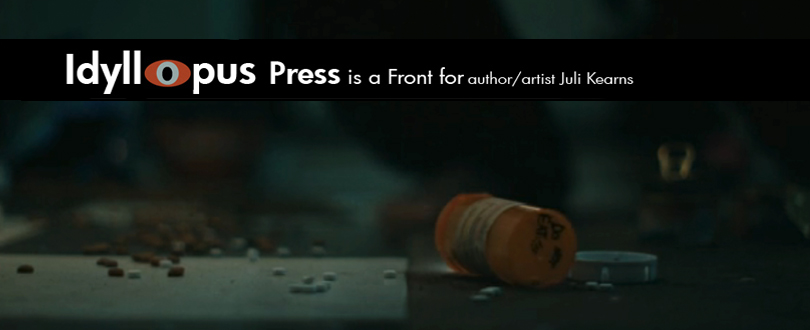
Enter the film's big mystery. Bear returns home to find his tabby cat, Sandy, is dead. The kitchen floor is littered with kibble from an overturned bag of cat food, opened tins of cat food, and an open bottle of Oxycodone, blue pills spread about, mixed in with the kibble. "How did you get into these?" Bear wonders. Good question, and one which will never be answered. But as for the bottle of Oxycodone? The camera focuses in several stages on the mess, and we see finally on the bottom of the Oxycodone bottle, written in black sharpie...
Right there. Written futilely on the bottom of the bottle where Alice in Wonderland will certainly not see it. Do not eat. On the bottom of the bottle where only you, the audience, are privy to its warning.
When Bear replaces the bottle in the bathroom medicine chest, which is filled with prescription bottles, we see it is for Barbara Bailey, and realize this was his grandmother's medication. Is Bear taking them? No. When Bear returns to this medicine chest at the film's end, the appearance of the cabinet is much the same. He is not addicted to Oxycodone. A symbolic comparison is instead being drawn between the Oxycodone and love. Oxycodone triggers a surge of dopamine which means pain relief but also rewards the system with pleasure and euphoria. A difference between it and morphine is that this dopamine surge is long-lasting, one adapts, and thus develops a new normal of dopamine response. One becomes addicted. The same process can be naturally observed in the early stages of love in which dopamine floods the system, in a sense one becomes addicted to to one's partner, hyper-focused on them, thinking always of them. Eventually this surge calms and bonding takes over, the dopamine high replaced with other hormones that have been activated.
Bear sobs in his bedroom as we see a photo booth series of photos that shows he and his friends have been together since at least 8 July 2020, during the initial trauma of the COVID pandemic and its lockdowns, calling themselves the Bass Clef Bandits, or the B-Squad. They're a team. We also see that Bear's home is as his grandmother left it. He is surrounded by her things. Bear has done little to imprint the home with his personality, whether out of inertia or not being ready yet to release his grandmother we don't know.
Bear's cat is not the only thing he's losing. Nikki calls and lets him know that she's going to give her two-week notice at the store. In contradiction of Ian, she says, "We're running out of time." Bear stares at a bright orange ticking Kit-Kat clock on the wall that reads 8:45. One might be reminded of the Cheshire Cat from Alice's Wonderland.
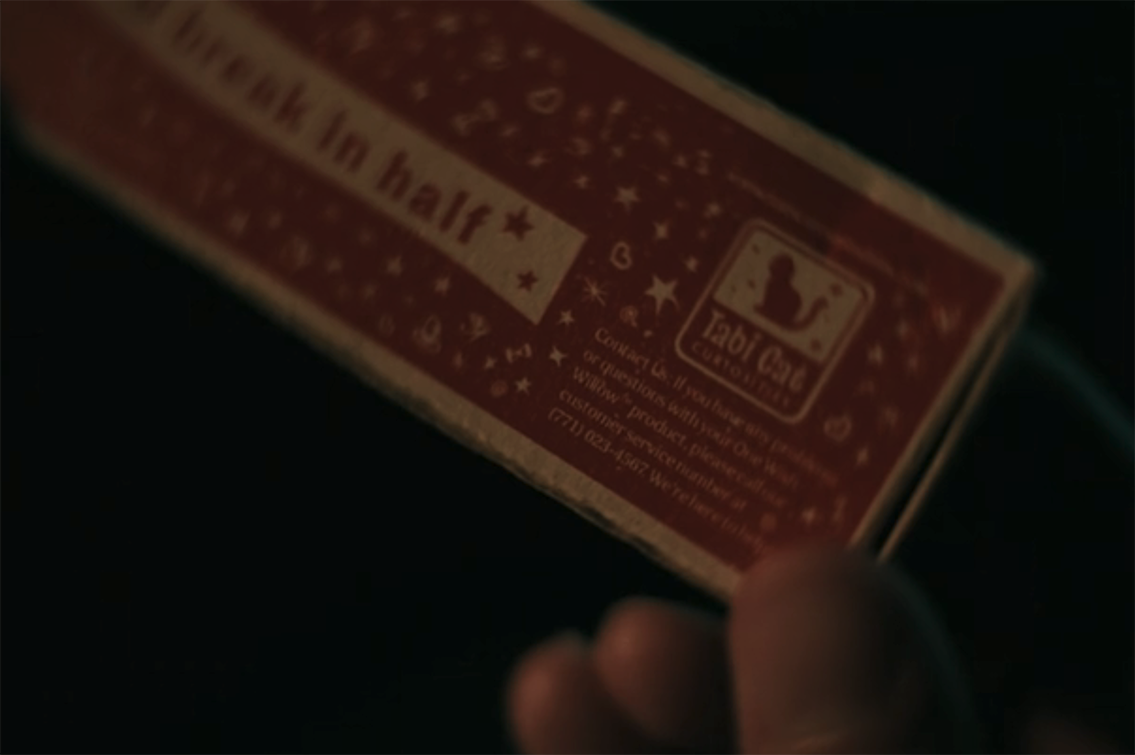
Bear had spent the day mourning the loss of his cat. On his reluctant way to that night's trivia meeting in which he and his fellow employees compete against others, because Nikki had dropped her crystal necklace down the drain while they were on the phone, Bear stops at The Green Man magic store. Unable to decide upon which crystal necklace would be an appropriate gift, the citrine "sunshine in a rock" being something Nikki would hate, which tells us a little about Nikki, and opting not to go for the love-energy of the rose quartz, he finds himself attracted to the One Wish Willow displayed next to Voodoo Dolls.Though the willow is valued for its ability to bend, the promise of the One Wish Willow is that you snap it in half to obtain one wish. The shopkeeper says they're popular, but advises him they're collectibles that people often don't open them, and those that do are likely to complain. Why do they complain? Is it because the One Wish Willow doesn't work or ruins their lives? "Or they die or wish they were dead," is the shopkeeper's response.
At the bar for the trivia meet, Sarah is trying to convince Nikki to stay on at the store, but we also learn that Sarah is potentially leaving, waiting to hear if she's gotten into art school, her hope being for Luther. When Nikki and Bear go to the bar to order drinks, she mocks him for ordering a Pina Colada as it is feminine, which he insists it isn't. She insists on paying for the drinks. When she asks about his day and Bear tries to speak to her about it, Ian comes up to interrupt and let them know he's just learned Sarah's dad keeps a gun in the break-room safe. As they toast with their drinks, Bear suggests they toast to Sandy. "Why to Sandy?" Sarah asks as Nikki and Ian walk off, and Bear tells her Sandy has died. She expresses her dismay and hugs him as the trivia game starts, the first question being a two parter to do with early film trivia.
The animated movie, I assume, from early film trivia, would be the 1992 "Aladdin".
Step back to the blue 30 mg. Oxycodone pills (high dosage) strewn about Bear's kitchen floor, on which Sandy apparently overdosed though it's impossible to say how that blue djinn escaped the medicine bottle.
By the end of the film, three wishes will have been granted.
Rather than go with everyone to another bar after the trivia contest, Nikki insists she wants to go home, and Bear says he'll drive her. She borrows some money from Sarah and runs over to a guy hanging out by the door of the bar. We later learn the drug she was purchasing from him was MDMA. On the way to her home, Bear tells her about his cat having died. When he hopes to convince her to keep working at the store she says she wants to write and needs a big life change, "I'm not feeling love and I want to feel love if I want to bring the story to life." Bear assumes the story must be about love, thus romance, but she says no, it's a love story--which may be her distinguishing the book she wants to write from a light romance genre. She confesses Bear is the only person she can talk to about this stuff, that he's not a complete brick wall, which returns us to his practice confession at the restaurant the previous morning. Now would be the time for him to reciprocate and confess how he feels. Instead, he tells her he's gotten her a gift. She tells him that Sarah was asking him, and wants to know how he feels about that. He says he likes her as a friend. Nikki says when she has a crush on a guy no one knows, so they are both highly secretive individuals. As Nikki gets out of the car, Bear exercises Ian's suggestion by calling her Freaky Nikki, to which she objects, wondering why he would do that when he knows how much she hates that, but it does inspire her to ask him if he likes her, "Cause if you do, now is the time to tell me." Bear says he thinks they're good friends, then when she goes into her home he pulls out the One Wish Willow he'd forgotten to give her, opens it, and says, "I wish Nikki Freeman loved me more than anyone in the fucking world."
Nikki's last name of Freeman obviously relates to the film's focus on love, its boundaries, and free will.
Bear is surprised to realize Nikki is outside her house rather than inside, seeing her dark silhouette on the porch. Returning to the car, Nikki asks for the gift he'd gotten her and he says he left it at home. She asks Bear to come inside, saying she'd just lost her cat, which of course we notice, that she is speaking now as if identified with him. He corrects her, that he'd lost his cat. Then she pleads she doesn't want to be alone because her dad is dying, which connects with the death of Bear's grandmother. However oddly she is behaving, how can Bear turn down Nikki in duress.
At her suggestion they go to his home. We realize that despite their friendship, she's never been inside it, when Nikki says it is "bigger than his last place", and he explains it's his grandmother's and that he got to keep it. If we've had any previous allusions to Alice's Wonderland, are we intended to recall how when Alice ate a cake she grew larger, when she drank she grew smaller, and when she imbibed of the mushroom it was a matter of which side she ate that would make her larger or smaller, but as a mushroom is round she can only make a guess. A right-hand bit made her shrink, while the left telescoped her neck so that her head was "free at last."
Nikki appears momentarily shaken by Bear's home, perhaps by how much it remains the realm of his grandmother. Then she zeroes in on the kitchen, where Sandy died, and says, "It smells like you," which says is nice. Because her father is dying, Nikki asks Bear to sleep with her (I'm going to ignore how the bedside clock changes time from 12:08 to something like 6:59 or 16: 59, my screen is too small to read it). Bear, confused, not sure what is going on, assumes this is for companionship not sex. Nikki then vacillates between passion for him and confused feelings of being lost, then at one point appears so startled by something about Bear that she leaps away, then excuses her reaction saying she thought she'd seen something. So he sleeps on the floor. Nikki had said if he didn't sleep with her she would spend the night staring at the ceiling. Instead, while Nikki sleeps, it's Bear who stares up at the ceiling, then rises to search on the computer (the search interface is PROBE, stereotypical alien face, also a skull face, in the O) if One Wish Willow actually works. Results bring up assorted paranormal subjects. The Mandela Effect, which is a shared, false memory. "Did One Wish Willow Really Exist in the 80s?" Related searches are bigfoot, skin-walkers, fruit of the loom (for its Mandela effect) and Jif peanut butter (again the Mandela effect as it is Jif, whereas many remember it as having been Jiffy). On a forum, some say adamantly yes that the One Wish Willow, which may have been sold as a toy in the 1980s, works. Some say adamantly no. Bear is wondering if the spell had worked or else he wouldn't have looked it up, which means he also doubts it, and the results don't help. Common sense would say no, a $6.99 toy wouldn't grant anyone's wish, however wild it may be.
In the morning Bear gets up to find on the dining table breakfast awaits him, made by Nikki. That's good. But in the kitchen she has also dragged the cat out of its bag (we had observed him putting it in a garbage bag) and set it up as a "memorial" on the kitchen floor with a candle. Oh, no, this is bad. And it's really bad that Nikki is surprised that Bear would find this weird. She'd hoped to please him.
At work, Ian is excited to see them enter together, seeming honestly pleased that Bear may have slept with Nikki. Bear tells Ian that things were weird, and convinces him that Nikki only wanted him to cuddle in bed with her, that was all that happened, to which Ian reacts with some revulsion, and they both agree that this was weird. Ian attributes her strange behavior to her being on Molly again, which suggests a troubled history with the drug, the way it is spoken about. That evening, Nikki goes to Bear's to let him know she had been on MDMA and shouldn't have been. She insists he didn't take advantage of her, then professes that she knows he likes her and that she has feelings for him that have happened over time, she first becoming aware of her feelings back around Christmas. Is this a fiction or is it true? The audience doesn't know but if we are to accept it as true then this makes Nikki's attraction possibly legitimate, she does really love him. That is the frame wrapped around the pair, for the audience, for Bear, and we are to think of Bear's wish as having had no effect or being inconsequential. Also, there's the prospect that as Nikki had taken Ecstacy before his driving her home, she may have been preparing herself to spend the night with him.
Yea! Nikki loves Bear. So they get together and we've a montage of scenes of the stereotypically freshly in-love movie couple delighting in the honeymoon phase. They enjoy eating breakfast together like it's their first time ever having a great breakfast. They kiss at work, they shut all others out, huddling together at work, joyfully focused on one another. At home they intimately play together. She wears his sweater while they cook together. Either she brings flowers to him or he brings flowers to her. They watch TV together. Then comes the time when they're playful and he's on his laptop on the bed and she attempts to shut it and he opens it back up rather then refocusing entirely on her. Again, when they're cuddled together on the couch watching TV, she attempts to draw his attention and he physically but gently redirects her attention to the television screen.
Out to eat, Nikki asks what he wants to do with his life, which is a subject that has never come up. It would seem that had they been as close as Bear had given them as being, they would have shared their future hopes, but apparently not. He suggests he could be a food critic, but whether he's serious we don't know. During the meal, Ian calls and tells Bear that Nikki's dad is quite well, not dying, and he has a bad feeling about this, not knowing if Nikki has some sort of ill intentions or if she's mentally unwell. When Bear returns to the table, having left it to take Ian's call, Nikki gives him a gift in a long rectangular box that may vaguely bring to mind the One Wish Willow box. The box makes him nervous, because Nikki makes him nervous. As it turns out, her gift is a Tiger's Eye, for confidence. He can now be a food critic. Nikki reveals its history, that it used to be her mother's, and so Bear asks why she would give this to him, to which she responds that she loves him so much she couldn't live without him. "More than anyone in the world?" Yes. He asks her if her dad really has cancer, and she explodes, they were supposed to be having a nice date. That night he wakes to find she's not in bed, instead he can vaguely make her out standing in the misty shadow of the corner of the darkened room beyond his grandmother's pile of hat boxes. She behaves bizarrely, even moving briefly like a predator. She says, "I feel like you don't love me as much as I do. Like it's not mutual." She entreats him to go back to sleep then she yells, "Why don't you love me?" and comes scooting in from the opposite side of the room with a vase of flowers before her face, positioned to hide it. "For Sandy," she says, and suddenly returns to normal, climbing into bed with him. Then when he warily attempts to slide out of bed she yells at him to stay.
And it's hilarious. For every unsettling move there's a dark comedy reflex that balances just enough.
In the morning, as he leaves for work and glimpses himself in a mirror, he realizes she's cut a lock of his hair. She pleads that she behaved the terrifying way she did the prior night because of a bad dream. "How's this?" she asks affecting a normal smile, which he tells her isn't right. He tells her not to watch him in his sleep again or move weird, and she promises not to, sending him off to work with a lunch box she'd packed for him. As he approaches the door he realizes she'd duct-taped it over in an effort to keep him from leaving. After he leaves, she freezes where she stands with an odd grin on her face, so we know this is how she will wait for him all day. As if out of fear, grinning all the while, she uncontrollably urinates. Shades of "The Exorcist", but that duct-taped door is funny enough that it ably balances out the surrounding horror. This is a very tight black comedy about horrible things. It's not a tragedy. It's not "Saving Private Ryan".
At work, Bear opens the lunch box to find an apple and a sandwich in a plastic container. There are two Polaroid photos on the lunch box. One of "You", which is Bear circled by a gray heart, taken somehow from an elevated position looking down on him, and one she had shot of them both while he was sleeping, she smiling at the camera. That photo is titled, "Not Me". On the container is a note that reads, "My little food critic." Sarah asks if he's going to a party Ian is holding that night, which he says he didn't know about. Bear tells Sarah Ian had told him she'd said that Nikki had originally told her she only saw him as a friend. Sarah's response is she assumes that Nikki is playing some weird game with Bear, she doesn't know why (which, again, says something about Nikki's history, if both Sarah and Ian believe Nikki could be gaming Bear), and is about to inform him that Nikki and Ian used to hook up when she learns that she has been rejected by one of the art schools to which she'd applied. For solace, she nonchalantly leans her head on Bear's shoulder, and he leans his head on hers and says that he'll let her tattoo him in a small, hidden location. She remarks his lunch smells weird, and asks what another lunch note Nikki packed could mean: "What's the verdict - cat?" Having taken a bite of the sandwich, unnerved enough by Nikki's behavior he's ready to believe the odd meat in the sandwich was likely his cat, Bear vomits.
Ian warns Bear that if Nikki is having mental health problems, as he says she is, then it could look like he's taking advantage of her. If Bear wants to come to his party, okay, but he can't bring Nikki. If it's a healthy relationship, not co-dependent, she should be fine with him having a boys' night out.
Back at home, as Bear sits in the car, preparing to go in and confront Nikki about how she can't cook the cat, he hears music from the One Wish Willow box in his bag. Removing it, he sees there's a number to call for service under a Tabi Cat logo. He calls and is told he can't alter or cancel his request, that Nikki is stuck with this for as long as he lives. As long as he lives he has a moral obligation to be with Nikki. When he's asked if he wants to speak to Nikki, we hear what seems to be Nikki screaming in the background.
Bear enters the house to find Nikki where he had left her, but inexplicably disheveled and covered with body fluids such as vomit, perhaps blood. She explains that she may have eaten a bug or maybe she has a stomach bug, which suggests that while Bear was vomiting over the prospect of having perhaps eaten his cat, back at his house Nikki might have experienced his distress.
We keep being returned to the death of Sandy, the tabby cat, on a presumable and inexplicable overdose of Oxycodone. However dead, the cat is as persistent as "The Cat Came Back", enduring while all falls apart around it. And now it's been disclosed to us that the One Wish Willow logo is a Tabi Cat. The word for "tabby", as in the Tabi Cat, Sandy, derives from a type of striped, watered silk cloth called atabis (14th century French), from the Arabic attabiyya, the cloth so-named for it having been produced in the Attabiya district of Baghdad, named for Attab who was a companion of the prophet (Muhammad), and appointed as the first governor of Mecca, Attab's descendants having settled in that area. Because "Aladdin" was a Middle-Eastern folk tale, associated with "The Arabian Nights" though not part of the original text, whether Barker intends this or not, I'm going to associate with this Tabi Cat the earlier mention of the Arabian blue djinn. Which may feel like a stretch to some but the film seems to be guiding us there.
Arriving at the party, with Nikki, as he has really no other choice but to take her in the hope of averting more disaster, we see that other women are indeed present, it's not just a boys' night out. They play either Truth or Dare Jenga, or a game like it, in which each pulls a block on which is something they must do. When one receives the instruction for him to change seats, he chooses to take Bear's place beside Nikki, who bemoans being away from Bear for a moment. She's asked what kind of a spell did Bear put on her, to which she laughs too loudly, and says, "It's true!" She does not read aloud the instruction that was on the block she pulled, but opens her iPhone and recites from it a story. In it she is Gretel, whose brother she believes she can sense gazing at her maturing chest. She asks him to come lie with her, to which he replies that she's not his wife. She says she's more than his wife, she's his sister. Shifting her voice from that of Gretel's to her own, she says she knows he wouldn't leave, that he would relent and rest inside her as he had many nights before. If not, she would filet his forearm, roll it like a stick of licorice, and insert it between her legs. "Hansel is my soul. A love only the branch of a willow tree could conjure. Brother, you will be inside me tonight." She announces to the stunned room it's a new book she's working on and that she doesn't have to drink.
If Bear or the audience had any doubts at all, Nikki has just admitted her knowledge of the One Wish Willow and that it is what made her love him.
The game continuing uncomfortably, Baron's turn reveals he's to kiss whoever is on his left, which is Sarah. Nikki slides Sarah, in her chair, away from Bear, settle's herself beside him, and purses her lips for Baron to kiss them. She then proclaims no one on the earth will know what it's like for her to love someone as much as she loves Bear, and that everyone in the room will die never having felt the strength of connection she has with him. When she reaches to touch Bear, she abruptly pulls away, apparently shocked by something she sees in his place, or by her own actions, and screams, "It's not me! It's not me!" Before anyone has a chance to respond, she bashes her face a couple of times with a bottle, and while she streams blood people yell at Bear, who is frozen, to take care of her, to get her to the hospital. He takes her but Nikki seemingly refuses to be seen. The dark comedy balance is Nikki dancing, as if out of her skull on drugs, next the car. And it works. It's funny as hell.
It's also funny as hell because shit happens that is really truly bad and out of control and it's drugs or alcohol or a brain falling to pieces and the person to whom it happened will likely later laugh about it, as well as anyone who knows just how it is, because people can find something funny in terrible things up to the point someone else gets really hurt or the person in crisis kills themself and thus are removed from being able to find humor in what's horrible. That's how it is. There are lives and times when it's going to be a perfectly normal scene for an out-of-control Nikki to be dancing outside the hospital, while blood streams down their face, and there's nothing to be done about it if there isn't authorization for the individual to be involuntarily admitted for observation. You think an out-of-her-skull Nikki would admit herself? Highly unlikely. That's real life. But this is a movie, not real life, it is instead confronting real life situations indirectly, by means of a wish that shouldn't have been made on a One Wish Willow, which wasn't taken seriously, which becomes a situation of manipulative control, even rape, which is a strong message about boundaries, while also being a picture of just brains fried on love gone wrong and or oxycodone and or whatever that causes a personality to morph from Jeckyll into Hyde or to fall to pieces completely and in the thick of things no one really knows how to deal with a person who is completely gone one moment and half-themselves the next, everyone goes to bed and the next day maybe things will be better or worse, you don't know which, and if they're better people tend to operate in denial until they can't any longer. Also, this is a movie where a person might go, "Oh, yeah, I know what that feels like", because things can feel like but not physically be like.The movie has made room for all of this, it's created space for Bear to be the guilty asshole, it's created space for him to be the ordinary person who didn't take seriously the wish made blowing out the birthday cake candles, it's created space for Nikki to to be really just plain scary on love and or drugs, or the woman who's possessed by a psychotic djinn or just play psychotic while preserving the central message of, "Respect boundaries." This is why it's a well-done black comedy. Also, it's filmed well with just the right aesthetics to not get in the way of audience involvement, a style that keeps the movie within reach, and it's tight, very tightly written. I've got a couple of problems with it but they're nothing in respect of how tightly honed and well-acted this black comedy is.
After the disaster of the party, at home, Bear bemoans how everything used to be good and how he wants her to just be Nikki, she's not acting like Nikki. He asks if she even likes him at all, if Nikki is happy. She says yes, and says, she's his Freaky Nikki. He pulls away even while telling her this is all he's ever wanted and when she says it's the same for her, he says it's not, that it's not working. When she insists it can work he demands they behave normally, that they give each other some space, which she can't tolerate. She insists she can be Nikki, anything he wants her to be. They talk about Nikki in the third person because it's undeniable, this is not Nikki, this is a supernatural wilderness. When Bear asks would it be so bad to be with him, Nikki even says she's never been with him. Yet whatever is in there with Nikki insists she loves him in every reality, and when he says he loves her, too, reality breaks and she briefly moves in reverse, because it looks great as it's done just in the right amount, and the audience enjoys the version in which this is supernatural and not just plain life. She describes how if she is left by herself, without his attention, lying in bed she will go from feeling warm to freezing cold, her hands will feel filled with sand, like she's lain on them wrong, a feeling that will spread across her entire body, he will be still in her heart but slipping, and any thought of pain or regret will slip away like a chemical switch, the quiet becomes quieter, it's not painful, one just lets go of everything you once were and there's nothing.
Sand. Sandy. The cat. Again.
Who or what is in there with Nikki? All that we know about this spirit that is supposed to love Bear more than anyone else in the world is that it is not Nikki but promises she can be Nikki, she can be anything Bear wants her to be, and loves him in every reality.
In the book, Requiem, by Graham Joyce, which is about a man who deals with djinn after his wife has died in an accident, he's told that djinn "inhabit an infinite number of personalities, each a different facet of you. You must search through your dreams for the good djinn, and ask the good jinn to make intercession for you." Subsequent this revelation, in a confrontation with a djinn, switching perspectives with it, he sees on the djinn his own face and collides with it.
In the Robbe-Grillet novel, "Djinn" (which I've not read in forever ao must consult Wikipedia on its plot, but I remember it was clever), the protagonist becomes involved with a woman named Jean, pronounced "Djinn". Jean is a form of John, and while the protagonist is named Simon, an alias of his is Yann, which in French is John.
There's a lot of lore about djinn out there, because it involves so many cultures and so much history, but the basics are they're not all-powerful, that they're shapeshifters. Like the djinn of Aladdin's lamp, unless brought out for some reason, they kind of keep to themselves. Shadow people. The lurkers in the sand (all those dunes). There are also lines of thought in which they're a little like doppelgangers, which has perhaps to do with when the word djinn is related to the Latin genius in a syncretic merger, and what is the genius but the inbetween, the divine nature that bridges heaven and earth, the physical and etherial. The genius was like a guardian angel that accompanied one through life. But it wasn't just people who possessed a genius, places did as well. Leave it to the philosophers to argue what made the difference between a genius and soul.
Returning to the cat, I've wondered if, for Lewis Carroll, the Caterpillar in "Alice in Wonderland" is a form of the cat.
“Who are you?” said the Caterpillar.
This was not an encouraging opening for a conversation. Alice replied, rather shyly, “I—I hardly know, sir, just at present—at least I know who I was when I got up this morning, but I think I must have been changed several times since then.”
“What do you mean by that?” said the Caterpillar sternly. “Explain yourself!”
“I can’t explain myself, I’m afraid, sir,” said Alice, “because I’m not myself, you see.”
“I don’t see,” said the Caterpillar.
“I’m afraid I can’t put it more clearly,” Alice replied very politely, “for I can’t understand it myself to begin with; and being so many different sizes in a day is very confusing.”
“It isn’t,” said the Caterpillar.
“Well, perhaps you haven’t found it so yet,” said Alice; “but when you have to turn into a chrysalis—you will some day, you know—and then after that into a butterfly, I should think you’ll feel it a little queer, won’t you?”
“Not a bit,” said the Caterpillar.
“Well, perhaps your feelings may be different,” said Alice; “all I know is, it would feel very queer to me.”
“You!” said the Caterpillar contemptuously. “Who are you?”
Which brought them back again to the beginning of the conversation. Alice felt a little irritated at the Caterpillar’s making such very short remarks, and she drew herself up and said, very gravely, “I think, you ought to tell me who you are, first.”
“Why?” said the Caterpillar.
Here was another puzzling question; and as Alice could not think of any good reason, and as the Caterpillar seemed to be in a very unpleasant state of mind, she turned away.
“Come back!” the Caterpillar called after her. “I’ve something important to say!”
This sounded promising, certainly: Alice turned and came back again.
“Keep your temper,” said the Caterpillar.
“Is that all?” said Alice, swallowing down her anger as well as she could.
“No,” said the Caterpillar.
Alice thought she might as well wait, as she had nothing else to do, and perhaps after all it might tell her something worth hearing. For some minutes it puffed away without speaking, but at last it unfolded its arms, took the hookah out of its mouth again, and said, “So you think you’re changed, do you?”
I get a little irritated when I have to refer to "Alice in Wonderland", especially after a particular date, like for movies there was a "best to use by" such-and-such date, and that date has passed. But thirty years ago, despite not liking Lewis Carroll, and never having liked Lewis Carroll, I found his work a little useful, perhaps only because it was just so present in so many things. And it still is. Which shows that the "best to use by" date for me isn't the same as for another. And, in respect of this movie, I don't know how much Wonderland there is, but the Cheshire Cat is center stage.
"You. Not Me." As far as I'm concerned, the movie allows for the "other" inhabiting Nikki to be "you" as in Bear, if only by a wish that takes her hostage to his desire. The movie allows for the other being the djinn, whatever that is. It allows for the other to be the spirit of Oxycodone or the spirit of eros in its most toxic out-of-control, addicted form. It can be a variety of things and I don't have to make a decision about it. Which is nice..
After the disastrous party, Hansel and Gretel having tucked into bed for the night, Bear stares at the ceiling as Nikki sleeps. Sarah calls and demands he meets her at the park. As he leaves the bed, naively thinking he might do so unobserved, Nikki, appearing to be asleep, says, "She's sleeping", and begs him to kill her while the other sleeps. His response is to ask what would be so bad about being with him. Now is when she responds she's never been with him.
One thing we don't have to worry about with "Obsession" is whether or not the bad that's unleashed with the breaking of the One Wish Willow is imaginary. It's not. Barker removes that question absolutely with Nikki's acknowledgement of the willow, and that the woman who is bound to Bear with this obsessive love isn't her. Nikki speaks to him from her sleeping form and entreats him to kill her. Instead, he goes to meet Sarah, who Nikki knows has feelings for him.
Sarah's perspective is that she had thought Nikki, who had been casually sleeping with Ian off and for two years, was getting back at Ian through this relationship with Bear, but that Nikki obviously needs help. She tells Bear he's with the wrong person, and he acknowledges that he should perhaps instead be with her, which the audience has known from the beginning because that's how it is. She's brought along the letter she's received from Luther, that will tell her whether she's been accepted into the school nor not. She's brought it along to share the moment with him, because the audience has known from the beginning if these two had gotten together at the very beginning then there would have been no movie. Just when she's about to open with him the letter from Luther to see if she's been accepted into school there Nikki appears on the scene and ruthlessly kills Sarah so she will never know she had been accepted and would be moving to Decorah (I had never heard of Luther College, but it ranks high in generous financial aid, and good outcomes for the success of its graduates). Nikki tells Bear this was all his fault, that he'd wished for this (that fine print part of being careful about what you wish for), but that she can fix everything and is not going anywhere. Nikki tells him to go home, that she'll take care of it Sarah.
Covered with blood, in a state of shock, Bear returns to The Green Man to get some more One Wish Willows. He demands, how could they sell this to people, and is told that the box is full of warnings.
There were only several One Wish Willows left. In the car, Bear attempts to wish Nikki back into only loving him as a friend but the willow won't break. He goes to see Ian, tells him about the One Wish Willow, and asks him to wish that Bear never made a wish. Which is a much better wish than wishing Nikki back into only loving him as a friend, which wouldn't have erased all that blood. Instead,Ian wishes for a billion dollars, which immediately falls from the sky around their ears.
It's funny. One is a little inclined to say Ian is an asshole for ruining Bear's wish, the one that may have saved Sarah and Nikki had it worked as hoped, except that Ian had no reason to believe the silly One Wish Willow would work.
Bear goes to his home with his last One Wish Willow, hopeful he can convince Nikki to make the wish that Ian blew. Now, I may have missed out on something here, but I'm a little confused that when he gets home Nikki is there and poor Sarah is propped up dead and naked in an armchair in a side room. I don't call that taking care of things. Enraged by Bear's not loving her, Nikki threatens to kill herself, producing the gun that Ian way back earlier at the bar, on trivia night, had said was locked away in the safe in the break room at the music store, so that it must end up being used as per Chekhov's Rule. When Ian appears, exultant that his billion dollars his real, as he bursts through the front door, Nikki instead shoots him.
Bear goes to the bathroom with the gun, determined to shoot himself. Unable to convince himself to do so,let's rewind now to the day he came home, after practicing his confession speech with the waitress, the one Ian had vetoed as too cringe, and there was Sandy lying on the kitchen floor in a mess of spilled kibble mixed with Oxycodone and several opened cat tins of food. How, how, how did the cat open those cans with the pull-top lids? How, how, how die the cat open the Oxycodone bottle? We can't excuse the mess as having been dragged out of the trash by the cat. Certainly not the Oxycodone bottle. Bear is bewildered, he has no answers. There's no one to call and inquire of them, "My cat did the impossible and opened cat tins of food and a medicine bottle and overdosed, can you tell me how this happened?" I don't know if this service is still available, but you used to be able to call the library and ask a staffer for a fact or two, and they'd check up on it and get back to you. OK, I just checked, and you can still do this. But no librarian can answer a question such as this. And, true, while the pills are blue on the floor, tucked back in their bottle they appear to be white, round tablets. Maybe that's continuity. Could be. Or blame a djinn. Maybe they were only supposed to be blue outside the bottle. What do I know? It's okay, here, to not know.
In all seriousness, who or what killed Sandy, or did Sandy snuff Sandy, and if Sandy snuffed Sandy then how? I can't answer what happened to Sandy, and that's fine.
Bear takes the Oxycodone from the medicine chest, which is there just as he left it when he replaced it while cleaning up after Sandy. He consumes the rest of the bottle. Then he appears to have a change of heart, and begins to attempt to throw up, even as we hear the last One Wish Willow breaking in the living room, and his aspect immediately changes. Nikki has apparently wished for him to love her. He goes to her and they kiss in a moment of perfect meeting of hearts, Nikki batting a shy eye, ecstatic with his love, and Bear finally happy as well. Then, as they kiss, Bear collapses, because Nikki's wish interrupted his throwing up all that Oxycodone. With his death, bewildered and horrified, Nikki wakes with a start from her brief grieving over him, shoves Bear's lifeless body off her lap onto the floor, and gazes in horrified bewilderment at the chaos that surrounds her. One can tell, just as Bear was clueless over the how of Sandy's death, Nikki will be just as empty of answers, the djinn having fled, the wish undone, she will have no memory of Sarah's murder (who last spoke with Bear, asking to meet with him), or Ian's death (Bear had taken the gun with him to the bathroom, so his prints are all over it). As for Bear, the evidence is clear that he died by suicide.
August 2026
 |