
Go to Table of Contents of the analysis (which has also a statement on purpose and manner of analysis and a disclaimer as to caveat emptor and my knowing anything authoritatively, which I do not, but I do try to not know earnestly, with some discretion, and considerable thought).
On the communal entry wall of the building in which Alex's family lives, at 18-A Linear North, is a mural that is obviously state propaganda designed to extol the virtues of the working class, but rather than it being a mural that has its roots in unifying the working class in order to rise out of class oppression, the painting glorifies the labor of the worker with the antique glow of a golden age, just as we find the wall in Alex's apartment claustrophobically coated with gold paint, and solidifies a social order of class subjugation. Those who recognize the truth of their oppression have defaced the mural, in which we observe dock workers backed by an industrial landscape. "Suck it and see" reads one word balloon.

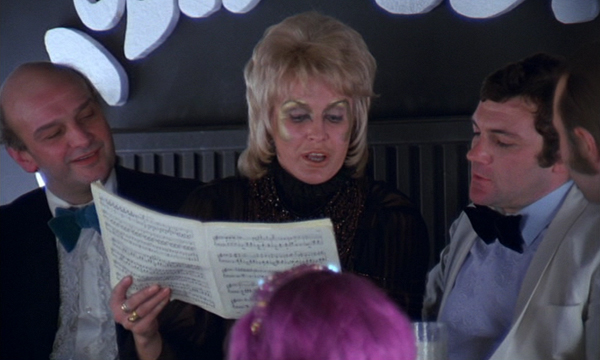
Just prior this scene, after a night of rape and pillage, Alex and his droogs had stopped by a bar for their favorite mind-altering milk beverage, wherein they hear a woman singing the "Ode to Joy" portion of Beethoven's Ninth Symphony. Alex describes the woman singing as being like a great bird having flown into the milk bar, the music having a profound effect on him that doesn't exalt peace but inspires violence.
After Alex's Ludovico treatment, unable to act upon his violent urges, Alex returns home to find he has been replaced. Now houseless, ejected by his parents, he goes to the riverfront, where we see a view of factories and smokestacks that reminds of the mural earlier viewed at the apartment building. We hear seagulls, just as we had observed seagulls in the mural. The Dawn section from The William Tell Overture plays. The manner in which Alex gazes at the water, it's to be wondered if he is contemplating suicide. We learn that, unable to behave violently, means that Alex is also rendered helpless to protect himself from any violence committed upon him by others. Ironically, we will later find that Alex is, however, able to commit violence against himself when he pitches himself out a window in an attempt at suicide.

Burgess is sometimes given as a socialist, but he was in fact a monarchist and believed socialism ridiculous, even leaving Britain in order to avoid paying high taxes on his wealth. He believed in wealth as good for its awakening of and satisfying of the senses. As for socialism and communism, he believed they were based on the "heresy" that man is good, can become better, and ultimately build a just society. Burgess instead believed that man was born in original sin and is more likely to choose the bad. In one interview, conversation on his denunciation of humanism directly follows his statement that wealth is good and that he didn't begrudge the wealthy for their material comforts (a common argument against socialism is that it arises out of jealousy or envy of the lower class for material goods that meritocracy has benefited the upper class). In A Clockwork Orange, the political picture he presents appears to have Alex living in a society that offers certain fundamental socialist supports, but if it is then it is a society that remains highly classist and divided.
Unhoused, when Alex stumbles upon a place of refuge, it happens also to be the home of Alexander, who is part of a group that is against the Ludovico technique, considering it to be state violence. It is also the home which Alex and his droogs had invaded, raping Alexander's wife, and Alexander realizes to whom he has given refuge. He and others confine Alex to a room in which they blast the Ninth Symphony at him, which is what provokes Alex to attempt suicide, he flinging himself from a window, rather like a bird that can't fly. The supposed aim, however, is to vividly turn the public eye to the inhumanity of Alex's treatment in sympathy, how the Ludovico technique has caused Alex to turn against himself.
The mural in the apartment building backs a scene in which Alex's droogs rebel against how Alex, a petty tyrant, had physically assaulted Dim for disrespecting the woman who had sung "Ode to Joy" at the milk bar. They insist that the power in the group be split between its members, rather than Alex always telling them what to do. They also believe that Alex has been keeping the bulk of the spoils of their robberies to himself. Alex appears to submit to this redistribution of power but soon brutally takes that power back with an attack on the others. In retaliation, the droogs arrange for him to be seized by the police during a robbery that turns into a murder.
Now to skip over to Dustan Makavege's 1965 film Man is Not a Bird. In it, an engineer, spurred by the government, drives his fellow workers to finish ahead of schedule the installation of equipment at a factory for sake of an export deal. One can tell he knows this is wrong, but there is a certain amount of pride involved. Though he receives a medal for his service at a big affair that celebrates both the work and the worker, the engineer finds himself separated from his fellow workers by what he's done, they have their own celebration, and not even a young woman with whom he has become involved makes an appearance to celebrate with him his being presented the medal.
The film opens with a hypnotist describing how parents had called him about a girl who had fallen in love with a boy who they believed was unsuitable, but she insisted she couldn't live without him. Hypnotizing her, he learned the boy had knotted together a hair from each, and had placed them under where she was seated. The hypnotist freed her of the obsession with indirect suggestion. After this he talks about the power superstition and magic continue to hold in modern society. Cut to a journalist calling in a report to his paper. From what's revealed, we know the report has to do with Beethoven's "Ode to Joy" having been played, and we hear how he first says the exalted words fell on the somber faces of the workers, and then he changes this to radiant faces.
"And then, in complete silence...resounded the chords of that powerful music, the crown of Beethoven's work, and a masterpiece of world symphonic literature...the exalted words of Schiller's 'Ode to Joy' fell on the somber faces of the workers, no, sorry, fell on the radiant faces of the workers..."
We have no idea what this report is chronicling until near the film's end, that it is on the celebration of the work and the worker, for it is the "Ode to Joy" that is performed live at the event where the engineer receives his medal, while his fellow workers are elsewhere partying. During that celebration, cuts are made back and forth between the Ninth Symphony being performed, and the engineer's girlfriend making love with another man. At the end, the engineer is left wandering an overwhelming landscape, an alienated soul.
Below is a clip from that opening scene. In the background, through a window, we see the smokestacks of the new factory. As he speaks, the journalist moves to screen right and we see the exact same scene again but it is instead a giant photograph.
“Beethoven's Ninth Symphony is considered a great work of art. To verify its claim to be such, I must first ask myself whether this work transmits the highest religious feeling? I reply in the negative, for music in itself cannot transmit those feelings; and therefore I ask myself next, Since this work does not belong to the highest kind of religious art, has it the other characteristic of the good art of our time,--the quality of uniting all men in one common feeling: does it rank as Christian universal art? And again I have no option but to reply in the negative; for not only do I not see how the feelings transmitted by this work could unite people not specially trained to submit themselves to its complex hypnotism, but I am unable to imagine to myself a crowd of normal people who could understand anything of this long, confused, and artificial production, except short snatches which are lost in a sea of what is incomprehensible. And therefore, whether I like it or not, I am compelled to conclude that this work belongs to the rank of bad art. It is curious to note in this connection, that attached to the end of this very symphony is a poem of Schiller's which (though somewhat obscurley) expresses this very thought, namely, that feeling (Schiller speaks only of the feeling of gladness) unites people and evokes love in them. But though this poem is sung at the end of the symphony, the music does not accord with the thought expressed in the verses; for the music is exclusive and does not unite all men, but unites only a few, dividing them off from the rest of mankind.”
"The Kingdom of God is Within You - What is Art:" by Leo Tolstoy
Return to the top of the page.
Go to Table of Contents of the analysis
Link to the main Kubrick page for all the analyses
 |